
Colossae
Summary
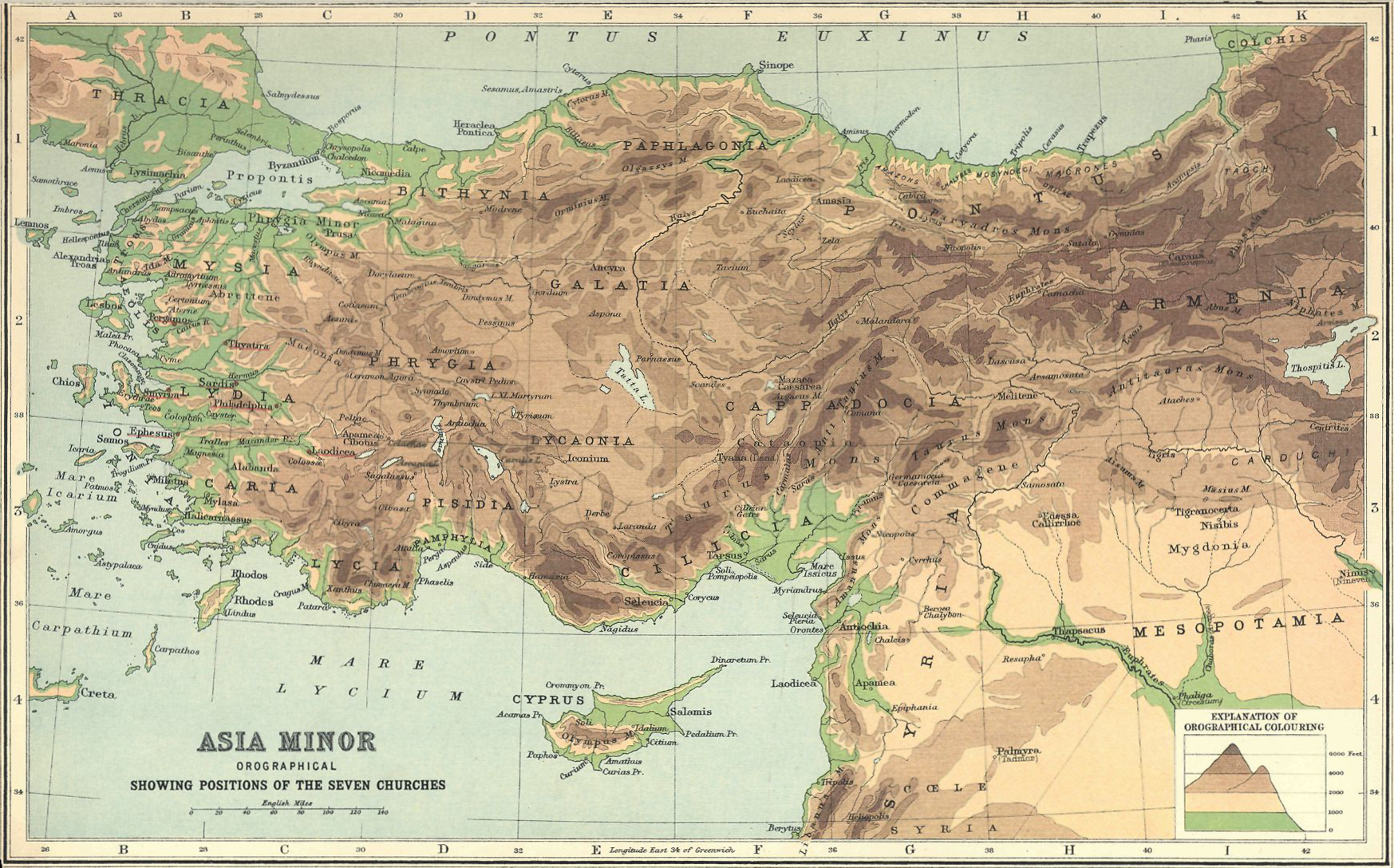
A small city of the Lycus Valley in Phrygia whose church Epaphras founded and Paul never visited, and which received one of his letters.
- A small city in the Lycus Valley of Phrygia whose church Paul never visited in person.
- Epaphras founded the church there and told Paul about it, and Paul wrote back.
- The letter's center is Christ: the image of the invisible God, before all things, holding all things together.
- Paul warns the church against philosophy and empty deceit, and against rules imposed by human tradition.
- The letter closes among the same household named in Philemon, and points to Laodicea and Hierapolis nearby.
On this page
In Scripture
- Verses
- 1
- Books
- 1
Near Colossae
Straight-line distances, computed from the gazetteer coordinates.
Where it is
the country around it
- Coordinates
- 37.7833° N, 29.2500° Efind it on the Atlas →
- Region
- Lycus Valley, Phrygia
- Kind of place
- City
2 places the record names with Colossae, the farthest 19 km away
- 1Paul struggles for those he has not metColossians 2:1 · 16 kmFor I want you to know how much I am struggling for you and for those at Laodicea, and for all who have not met me face to face,
- 2Epaphras also labors for Laodicea and HierapolisColossians 4:13 · 19 kmFor I testify about him that he goes to great pains for you and for those at Laodicea and Hierapolis.
- Located: the gazetteer fixes one site
- A dashed line ends at a place the gazetteer does not fix
Why Colossae matters
What has been found
the evidence, and where it is disputed
Paul's letter to a church he never saw
Colossians 1 to 4, and the household it shares with Philemon
Read Colossians 1 to 4, and the household it shares with Philemon
- Paul writes to a church he has never seenColossians 1:2To the saints and faithful brothers in Christ at Colossae: Grace and peace to you from God our Father.
- They learned the gospel from EpaphrasColossians 1:7You learned it from Epaphras, our beloved fellow servant, who is a faithful minister of Christ on our behalf,
- Christ, the image of the invisible GodColossians 1:15The Son is the image of the invisible God, the firstborn over all creation.
- In Him all things hold togetherColossians 1:17He is before all things, and in Him all things hold together.
- Paul has not met them face to faceColossians 2:1For I want you to know how much I am struggling for you and for those at Laodicea, and for all who have not met me face to face,
- Do not be taken captive through philosophy and empty deceitColossians 2:8See to it that no one takes you captive through philosophy and empty deception, which are based on human tradition and the spiritual forces of the world rather than on Christ.
- Do not let anyone disqualify you by the worship of angelsColossians 2:18Do not let anyone who delights in false humility and the worship of angels disqualify you with speculation about what he has seen. Such a person is puffed up without basis by his unspiritual mind.
- Onesimus, a beloved brother, sent home with the letterColossians 4:9With him I am sending Onesimus, our faithful and beloved brother, who is one of you. They will tell you about everything here.
- Read this letter, and the letter from LaodiceaColossians 4:16After this letter has been read among you, make sure that it is also read in the church of the Laodiceans, and that you in turn read the letter from Laodicea.
Colossians 4:9 names Onesimus as one of the Colossians. Philemon 1:10 names the same Onesimus as the runaway slave Paul sends home. The two letters travel together.
Colossians: the full studyWhat happened here, in order
in the order the canon tells it
- Grace and peace to the saints at ColossaeColossians 1:2To the saints and faithful brothers in Christ at Colossae: Grace and peace to you from God our Father.
- Epaphras brought them the gospelColossians 1:7You learned it from Epaphras, our beloved fellow servant, who is a faithful minister of Christ on our behalf,
- The Son, image of the invisible GodColossians 1:15The Son is the image of the invisible God, the firstborn over all creation.
- Christ, head of the churchColossians 1:18And He is the head of the body, the church; He is the beginning and firstborn from among the dead, so that in all things He may have preeminence.
- Paul struggles for those he has not metColossians 2:1For I want you to know how much I am struggling for you and for those at Laodicea, and for all who have not met me face to face,
- The warning against philosophy and empty deceitColossians 2:8See to it that no one takes you captive through philosophy and empty deception, which are based on human tradition and the spiritual forces of the world rather than on Christ.
- Let no one judge you over food, feasts, or a SabbathColossians 2:16Therefore let no one judge you by what you eat or drink, or with regard to a feast, a New Moon, or a Sabbath.
- The warning against the worship of angelsColossians 2:18Do not let anyone who delights in false humility and the worship of angels disqualify you with speculation about what he has seen. Such a person is puffed up without basis by his unspiritual mind.
- Do not handle, do not taste, do not touchColossians 2:21“Do not handle, do not taste, do not touch!”?
- Onesimus, one of the ColossiansColossians 4:9With him I am sending Onesimus, our faithful and beloved brother, who is one of you. They will tell you about everything here.
- Epaphras also labors for Laodicea and HierapolisColossians 4:13For I testify about him that he goes to great pains for you and for those at Laodicea and Hierapolis.
- Read also the letter from LaodiceaColossians 4:16After this letter has been read among you, make sure that it is also read in the church of the Laodiceans, and that you in turn read the letter from Laodicea.
- Archippus told to complete his ministryColossians 4:17Tell Archippus: “See to it that you complete the ministry you have received in the Lord.”
- The same household: Philemon, Apphia, ArchippusPhilemon 1:2to Apphia our sister, to Archippus our fellow soldier, and to the church that meets at your house:
- Paul appeals for OnesimusPhilemon 1:10I appeal to you for my child Onesimus, whose father I became while I was in chains.
- No longer a slave, but a beloved brotherPhilemon 1:16no longer as a slave, but better than a slave, as a beloved brother. He is especially beloved to me, but even more so to you, both in person and in the Lord.
The voices
each quoted from the work named
The Apostle sets forth here the glory of nature and the greatness of the dignity of the Only-Begotten. "Who," he says, "is the image of God"; consequently, exactly alike, differing in nothing.
There is a thief; he creeps up secretly, he digs under the walls from below unnoticed, intending to rob your mind. Therefore, beware. He also shows the way by which the thief comes: it is philosophy.
Why does he not write to him? It is likely that he did not need a lengthy epistle; for him, one brief reminder was sufficient.
Colossae in Scripture
1 verse names it, in 1 book
Open a book to read its mentions here. Text: Berean Standard Bible.
New Testament1 book · 1 mention
Common questions
Who founded the church at Colossae?
Colossians 1:7 says the Colossians learned the gospel from Epaphras, called a beloved fellow servant and faithful minister of Christ. Colossians 2:1 has Paul say plainly that he himself had not met the Colossians face to face, and Colossians 4:12-13 shows Epaphras still laboring in prayer for Colossae, Laodicea, and Hierapolis. The church came from Epaphras, not from a visit by Paul.
What is the center of the letter to the Colossians?
Colossians 1:15-20 names Christ as the image of the invisible God, the firstborn over all creation, the one through whom and for whom all things were made, before all things, holding all things together, and the head of the church. God was pleased to have all His fullness dwell in Him and to reconcile all things through the blood of His cross. Every warning later in the letter is measured against this picture of Christ.
What did Paul warn the Colossian church against?
Readers differ; the positions are named
The letter itself names philosophy and empty deceit resting on human tradition rather than Christ, judgment over food, drink, festivals, and a Sabbath, the worship of angels paired with claims about visions, and rules like do not handle, do not taste, do not touch. The letter does not give this teaching a single name. Interpreters differ over what exact system lies behind it, and this page states only what Colossians 2:8-23 itself says it opposes.
Who was Onesimus, and how does Philemon connect to Colossians?
Colossians 4:9 names Onesimus as a faithful and beloved brother who is one of the Colossians, sent along with the letter. Philemon 1:10-16 names the same Onesimus as the one Paul appeals for, once useless to his master Philemon and now useful, sent back no longer as a slave but as a beloved brother. Philemon's household shares the same names as Colossians, Archippus among them, which is why the two letters are read as one story.
What is the letter from Laodicea?
Colossians 4:16 tells the church to read the letter to the Colossians, and then to read in turn the letter from Laodicea, instructing the same exchange in the other direction. Scripture never gives the text of that letter, and no source confirms which of Paul's surviving letters it might be. This page names it only as Colossians 4:16 names it: a letter to Laodicea that has not come down to us.
Sources cited
- OpenBible.info Bible Geocoding: Colossaeread 2026-08-20The coordinates on this page. Used under CC-BY with attribution to OpenBible.info.
- Berean Standard BibleAll Scripture text on this page, from the site's own verse store. Public domain since 2023.
- Theophylact of Ohrid, Commentary on Colossians (late 11th century)Public domain.
- Tacitus, Annals, Book 14, Chapter 27Records the AD 60 earthquake at Laodicea, near Colossae; Colossae itself is not named in the passage.
Keep studying
On this page
Keep this page