
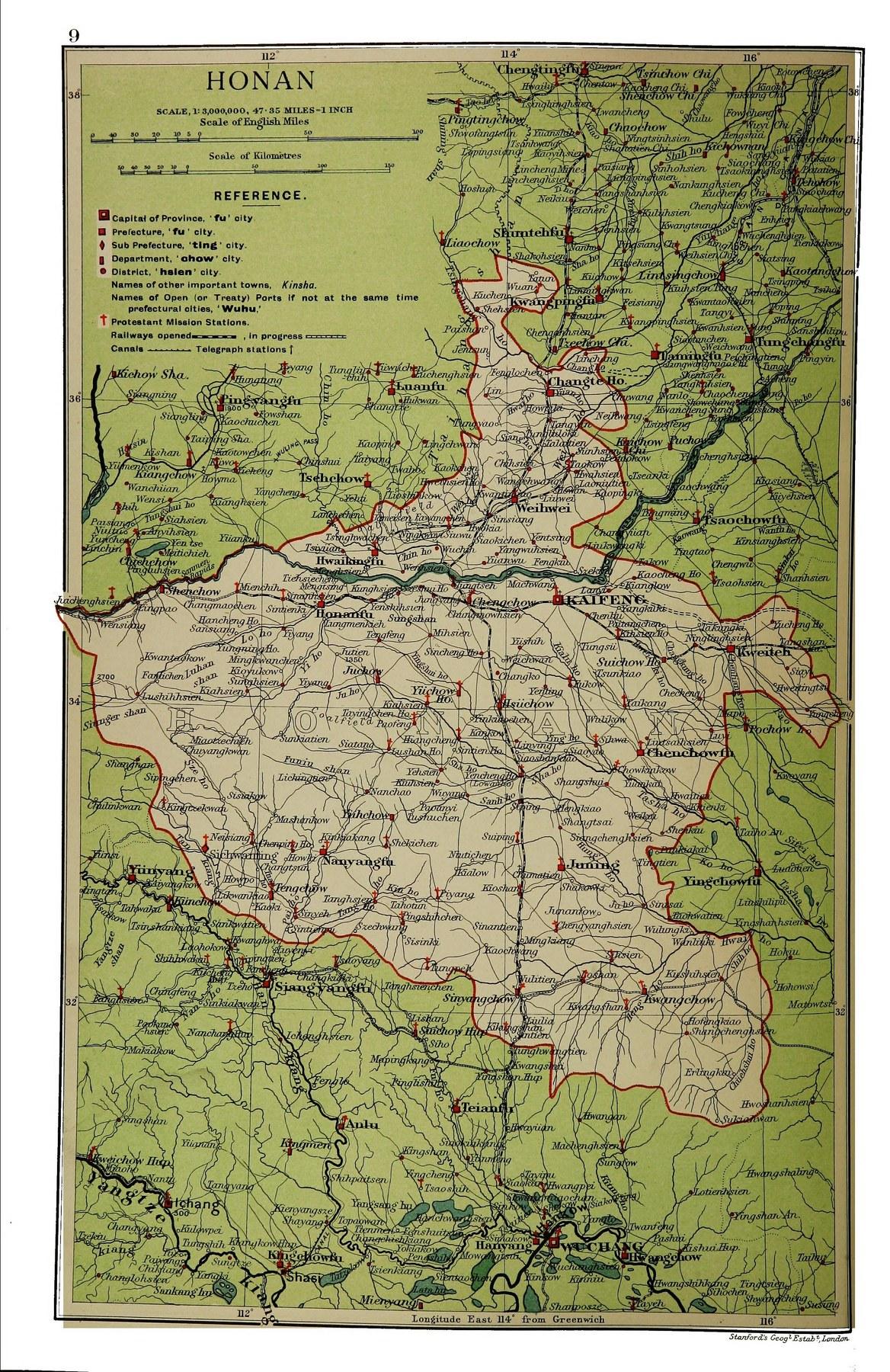
Honan, Complete Atlas of China, 1917. Public domain.
Henan to the house churches · Subject · Featured Study
Songs of the House Churches
A woman of Henan without musical training has written more than sixteen hundred songs for China's house churches.
Lü Xiaomin had no theological or musical education, and in 2016 a printing of the Canaan Hymns held 1,682 of her songs.
About midnight Paul and Silas were praying and singing hymns to God, and the other prisoners were listening to them.
About midnight Paul and Silas were praying and singing hymns to God, and the other prisoners were listening to them.
- Books
- Acts, Colossians
- Hold in memory
- Acts 16:25, Colossians 3:16
Summary
The songs of Lü Xiaomin, a peasant woman of Henan, are sung in China's house churches and among Chinese Christians abroad. They stand in a line of songs carried by China's churches through the years of persecution.
- Lü Xiaomin was born in Fangcheng County, Henan, in 1970.
- Irene Ai-Ling Sun dates her coming to faith and her first songs to the same year.
- Her first song was Come With Your Joy.
- She wrote at least one of her songs in prison.
The Verses the House Churches Sing
Paul writes of psalms, hymns and spiritual songs, and the church of Jerusalem met from house to house.
The house churches meet in homes, as the first church did, and sing as Paul told the churches to sing. Paul and Silas sang in prison, and the Canaan Hymns include a song written in a cell.
Singing in the church
Let the word of Christ richly dwell within you as you teach and admonish one another with all wisdom, and as you sing psalms, hymns, and spiritual songs with gratitude in your hearts to God.
Paul joins the church's singing to its teaching of one another.
Speak to one another with psalms, hymns, and spiritual songs. Sing and make music in your hearts to the Lord,
Paul names the same three kinds of song, sung and made in the heart to the Lord.
The church in the house
With one accord they continued to meet daily in the temple courts and to break bread from house to house, sharing their meals with gladness and sincerity of heart,
The first believers broke bread in their homes, as the house churches of China meet in homes.
Acts 2:46BSB
Acts 2:46
Four Dates from 1970 to 2016
The dated steps run from her birth to the printed edition of her songs.
Lü Xiaomin was about twenty when she began to write, and about forty-six when the printed edition appeared.
- The writer of the Canaan Hymns born1970Aikman, Jesus in Beijing, 2003
- She comes to faith and begins to write1990Sun, in Worship and Mission for the Global Church, 2013
- The songs counted from this monthMarch 1991Balcombe, 2014
- The edition of 20162016A chapter of 2022
A timeline of dated steps, each row naming the record that fixes its date.
How the Sources Count the Songs
Each source counts the songs at its own date, so the figures differ.
Sun counted over 1,500 songs in 2013, Balcombe more than sixteen hundred and fifty in 2014, and Kang 1,682 in the printed edition of 2016. The counts agree once each is read at its own date, and the printed edition gives the firmest figure.
Singing Before 1990
Watchman Nee's churches sang from their own hymnal, and believers hid their hymnbooks in the Cultural Revolution.
Hollington K. Tong, writing in 1961, records that Watchman Nee made a hymnbook of songs of his own composition, the Little Flock Hymnal. Its name came to be used of the churches that sang from it.
Christian History magazine, in its issue of 2008 on the church in China, tells of miners in the Cultural Revolution. They met deep in the coal mines of the north, their hymnbooks and copied Bible verses disguised as Mao's Little Red Book.
The site's page on the Chinese house churches tells the history of those churches at length.
Lü Xiaomin and the Canaan Hymns
Four writers between 2003 and 2022 tell of her life and her songs.
David Aikman, in Jesus in Beijing of 2003, records that she was born in Fangcheng County in 1970 and is known to Christians as Sister Ruth.
Irene Ai-Ling Sun calls their writer a peasant woman from Henan who became a Christian in 1990 and began composing songs for the house churches.
Dennis Balcombe writes that her first song was Come With Your Joy and that the songs were collected into a book called the Canaan Hymns.
Jie Kang writes that she composed them without theological or musical education, and that they are widely known on the mainland, in Taiwan and among Chinese abroad. Sun lists Five O'clock at Dawn in China as hymn number 268 of the collection.
Balcombe records a brief detention.
In Their Own Words
Irene Ai-Ling Sun
The Canaan Hymns: Songs of the House-church Christians in China, in Worship and Mission for the Global Church: An Ethnodoxology Handbook, the chapter on the Canaan Hymns, the passage on prison songs (the full-text passage; the page number not seen)
Sun records a song written in prison.
“Xiao Min composed a song while she was in prison, proclaiming the gospel to other prisoners”
Chinese Christian hymnology
About this saying1 paragraph
This passage, printed in 2013, tells of a song from prison.
Dennis Balcombe
China's Opening Door, page 130 (the full-text passage)
Balcombe counts her songs from March 1991.
“From March 1991 till now more than sixteen hundred fifty songs have been credited to Xiaomin”
Other
About this saying1 paragraph
This count, printed in 2014, runs from her first song.
Jie Kang
Nationalism and Chinese Protestant Christianity: From Anti-imperialism to Islamophobia, in The Nation Form in the Global Age, pages 198 to 199, the notes
Kang notes that she had no training for the work.
“Without any theological or musical education, Lü Xiaomin has composed many Christian songs ‘through the work of the holy spirit’.”
Other
About this saying1 paragraph
This note of 2022 says how she came to write.
What the Record Leaves Open
The published sources differ on details of her story, and her own published words were not reached.
Sun gives 1990 as the year she became a Christian. Balcombe counts her songs from March 1991, and the two dates may mark her conversion and her first song.
The sources give no date or place for her detention, and none is given here.
Every account here is written about her by others, and her own account was not among the sources read.
Books to Read Next
Worship and Mission for the Global Church
Irene Ai-Ling Sun, a chapter · 2013
Sun's chapter gives the songs' place in the house churches.
In print: find it wherever books are sold.
Jesus in Beijing
David Aikman · 2003
Aikman records Lü Xiaomin's birth and her Christian name.
In print: find it wherever books are sold.
The Nation Form in the Global Age
Edited by Irfan Ahmad and Jie Kang · 2022
Kang's chapter on Chinese Protestant Christianity reads her songs and counts them.
Free open-access textWhat the Songs Carry
Believers who once hid their hymnbooks now sing songs written among them by one of their own.
Sources
Scripture is the Berean Standard Bible.
- The Holy Bible, Berean Standard Bible (read 2026)
- David Aikman, Jesus in Beijing (Regnery, 2003), the chapter on the Fangcheng fellowship and Sister Ruth.
- Irene Ai-Ling Sun, The Canaan Hymns: Songs of the House-church Christians in China, in Worship and Mission for the Global Church: An Ethnodoxology Handbook (Pasadena: William Carey Library, 2013)
- Dennis Balcombe, China's Opening Door (Lake Mary, Florida: Charisma House, 2014), page 130.
- Jie Kang, Nationalism and Chinese Protestant Christianity: From Anti-imperialism to Islamophobia, in The Nation Form in the Global Age, ed. Irfan Ahmad and Jie Kang (Palgrave Macmillan, Springer Nature Switzerland, 2022, open access, CC BY 4.0), pages 198 to 199, the notes.
- Christian History 98 (2008), How the Church in China Survived and Thrived in the 20th Century.
- Hollington K. Tong, Christianity in Taiwan: A History (1961), the section on the Church Assembly Hall.
Keep Studying
People and groups2
Trials of life1
Doctrines1
Church history1