
Skip to content
mannafest.faith
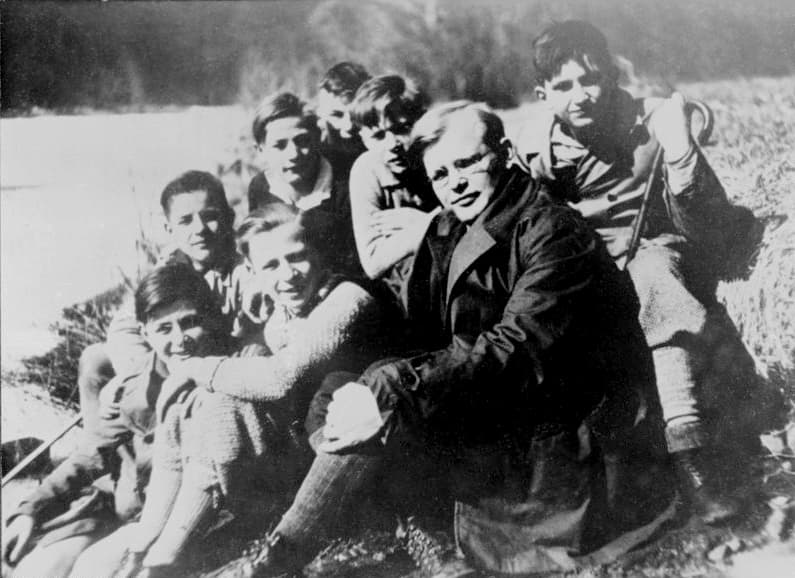
Dietrich Bonhoeffer with his students

Dietrich Bonhoeffer with his students, 1932. CC BY-SA 3.0.

The Great Cloud of Witnesses, era 10 of 10 · Church history · Featured Study

The Church Under Fire & Into All the World

Two counts of the twentieth century's Christian dead are in circulation and they are built differently, so the page gives both. David Barrett and Todd Johnson put the figure near forty-five million in the World Christian Encyclopedia, first edition 1982 and second edition 2001. They counted every believer whose life was cut short by human hostility. That takes in whole populations killed in wars and famines where faith was one cause among several. Thomas Schirrmacher, working for the International Institute for Religious Freedom, puts the yearly figure near seven to eight thousand, counting only deaths documented case by case as killings for confessing Christ. Barrett and Johnson's own Center for the Study of Global Christianity revised the annual rate down in the third edition of 2019. The wide number and the narrow number measure two different things, and even the narrow one is large. The same century saw the church grow faster than it ever had. Both are true of the same hundred years.

Span
1930–today
Boundary
The span opens in 1930, with the German church struggle already forming.

More Christians died for the faith in the twentieth century than in any before it.

Summary

The same hundred years saw the church grow faster than ever. Both are true of the same years.

  • The Barmen Declaration of May 1934 named one Lord and no other.
  • Bonhoeffer was hanged at Flossenburg on 9 April 1945.
  • Wurmbrand was held in Romanian prisons from 1948 to 1964.
  • Five men were killed in Ecuador on 8 January 1956. Two of the widows went back.
  • Most Christians now live outside Europe and North America.

The era's own voice

Why he wrote it: Bonhoeffer wrote Nachfolge in 1937 while running an illegal seminary at Finkenwalde for a church that had refused to fall in behind the state. The sentence about coming and dying was written by a man who had already chosen what it would cost him.

What else says so: Eberhard Bethge, his friend, student and editor, describes the writing at Finkenwalde in his biography of 1967, and the seminary's circular letters of the period survive.

“When Christ calls a man, he bids him come and die.”

Dietrich Bonhoeffer · The Cost of Discipleship (German Nachfolge, 1937), chapter 1, quoted in brief; the book is still in copyright, so go read it wholeEvangelical

The turning points

The era hangs on these moments, each with a document a reader can open.

  1. May 1934The Barmen DeclarationIt is a church saying no to a state at the moment of most danger, and it states the ground on which any church refuses: Jesus Christ is the one Word of God we have to hear.The Theological Declaration of Barmen, May 1934
  2. April 9, 1945Bonhoeffer is hanged at FlossenburgThe letters are the century's most read Christian writing from a cell, and the man who wrote them paid the price the Barmen Declaration implied.Dietrich Bonhoeffer, Letters and Papers from Prison, written 1943 to 1945, published 1951
  3. January 8, 1956Five men die on a sandbar in EcuadorIt sent a generation of American students into missions, and the widows going back in 1958 is the part of the story that made the difference.Elisabeth Elliot, Through Gates of Splendor, 1957
  4. July 1974The Lausanne CongressIt put evangelism and social responsibility together in one document that churches worldwide signed, and it is where the centre of gravity visibly moved south.The Lausanne Covenant, 1974
  5. Autumn 1989Candles in LeipzigA weekly prayer meeting grew into a crowd carrying candles through the city, the state did not fire, and the wall came down five weeks later.The Nikolaikirche's own record of the Monday peace prayers, kept from 1982

The 5 turning points of The Church Under Fire & Into All the World, 1930–today, in order, each with the document that records it and why it earned its place.

The story

A pastor in Leipzig held a prayer meeting for peace every Monday evening for seven years while the secret police photographed everyone who went in. The meetings were not illegal, and attending one could still cost a man his job and his child's place at university.

Two things are true about the last hundred years, and you have to hold both or you will misread the century. More Christians were killed for their faith than in any era before it, and the church grew faster and spread wider than in any era before it. The blood and the growth are the same story. You will often hear the first half stated as a hard fact, more martyrs in the twentieth century than in all previous centuries combined, and that line deserves a careful reading rather than a repeat. The figure behind it, around forty-five million, comes from the missions researchers David Barrett and Todd Johnson in the World Christian Encyclopedia, first edition 1982 and second edition 2001, and they counted broadly, including believers who died in wars, famines, and mass killings where faith was one factor among several. At the other end, Thomas Schirrmacher of the International Institute for Religious Freedom counts only deaths documented one by one as killings for confessing Christ, and reaches roughly seven to eight thousand a year. Barrett and Johnson’s own Center for the Study of Global Christianity revised the annual rate down in the third edition of 2019. The two numbers measure two different things; even the narrow one is enormous.

And I tell you that you are Peter, and on this rock I will build My church, and the gates of Hades will not prevail against it.
Matthew 16:18BSB

The promise that the gates of hell will not prevail was tested in this century as hard as it has ever been tested, and China, Romania, and the Soviet bloc all failed to close the church down.

It started with a church that got the test wrong. When the Nazi government came to power in 1933 it moved to absorb the German Protestant church, one national church, one bishop, party emblems in the sanctuary, and a rule barring anyone of Jewish descent from the ministry. Most churchmen went along. A minority would not, and in May 1934 about 139 of them met at Barmen and put their refusal on paper. Their first thesis is the whole of it: the church listens to one Word, Jesus Christ as Holy Scripture presents Him, and it cannot take a second word from anyone, not from a movement, not from a moment in history, not from a leader. Say that out loud in 1934 Germany and you have said everything.

Now the honest part. Barmen defended the church's freedom and said almost nothing about the Jews being driven out of Germany. Bonhoeffer had already written in April 1933 that the church owes its neighbors more than bandaging the victims of the wheel, sometimes it must jam a spoke in the wheel itself, and few followed him there. Members of the Confessing Church resisted bravely and also stayed silent, sometimes in the same week. In October 1945, standing in the ruins, its surviving leaders signed the Stuttgart Declaration and said before the world that they had not resisted, prayed, or believed as they should have. Both the courage and the failure belong in the record.

And this gospel of the kingdom will be preached in all the world as a testimony to all nations, and then the end will come.
Matthew 24:14BSB

The verse behind the whole missionary engine of this era: the gospel preached to every nation, which is why Lausanne in 1974 started counting peoples rather than countries.

Bonhoeffer's own road bends in a direction that still troubles people. He began as a pacifist theologian who loved the Sermon on the Mount, taught it, and lived in a house of prayer with his students at an illegal seminary at Finkenwalde. He had a safe teaching post in New York in the summer of 1939 and left it after a few weeks, writing to Reinhold Niebuhr that he would have no right to help rebuild Germany if he had not shared its trial. Back home he joined a conspiracy to kill Hitler. He never argued that this was clean; he thought it was guilt he had to take on and answer for. Arrested in April 1943, he was hanged at Flossenbürg on April 9, 1945, two weeks before the Americans arrived.

Then the map went dark from the Elbe to the Pacific. Richard Wurmbrand was picked up in Bucharest in 1948 and spent fourteen years inside, three of them alone thirty feet underground, keeping himself sane by preaching a sermon every night into the dark and tapping the Morse alphabet through the wall. Released in 1964 and out of the country in 1965, he showed the scars to the United States Senate Internal Security Subcommittee on 6 May 1966 and then spent the rest of his life speaking for people who could not. Meanwhile a Dutchman named Anne van der Bijl was driving Scripture across those same borders in a small car, and Corrie ten Boom, who had survived Ravensbrück after hiding Jews in her family's watch shop, was crossing the world telling audiences that no pit is so deep that God is not deeper still.

For to me, to live is Christ, and to die is gain.
Philippians 1:21BSB

Paul's arithmetic, to live is Christ and to die is gain, is exactly the trade Jim Elliot wrote about in his journal and Bonhoeffer walked out to the gallows holding.

China's fifty-year answer is the sharpest thing in the century. Missionaries were expelled in the early 1950s and the remaining churches were folded into one government-supervised body. Wang Mingdao would not join it and went to prison for roughly twenty-two years. Watchman Nee was arrested in 1952 and died in 1972, on the way to the prison hospital in G. Wright Doyle's account. During the Cultural Revolution the last open doors closed and Bibles burned in the street. Everyone assumed the church was finished. It had gone into houses. The state's own figures, as the Pew Research Center reports them, put Chinese Protestants at about 700,000 in 1949 and 38 million in 2018, and those counts leave out the house churches. The surveys read differently: about 20 million adults called themselves Christian in the 2018 Chinese General Social Survey, and Pew finds little evidence in the surveys that the growth went on after 2010. Nobody has a reliable census of a church that spent decades avoiding being counted.

Some of the century's costliest deaths came with no state behind them at all. On January 8, 1956, five Americans in their twenties and thirties were speared on a sandbar in the Ecuadorian rainforest by Waorani men they had been trying for months to reach, dropping gifts from a small yellow plane. They carried pistols and had agreed in advance not to use them, because they were ready to die and the Waorani were not. Jim Elliot had written in his journal seven years earlier that a man is no fool who gives what he cannot keep to gain what he cannot lose.

They have conquered him by the blood of the Lamb and by the word of their testimony. And they did not love their lives so as to shy away from death.
Revelation 12:11BSB

They overcame by the blood of the Lamb and the word of their testimony, and did not love their lives to the death; this is the century's own verse, and its martyrs are past counting.

But the killing is only half the story, and it is the half people remember wrongly. Elisabeth Elliot took her small daughter and went to live in the Waorani settlement, and Rachel Saint, whose brother Nate had died there, went with her. They learned a language nobody outside had written down. Many of the men who had held the spears became believers, and years later two of them baptized Nate Saint's son and daughter in the same river where they had killed their father.

In July 1974 some 2,700 Christians from 150 nations met at Lausanne and took stock of the map. Ralph Winter pointed out that most people still without a church were not in unreached countries but inside reached ones, separated by language and culture rather than borders. And the voices from Latin America and Africa were no longer guests at a Western meeting. The biggest change on that map was Africa, where researchers commonly count fewer than ten million Christians around 1900 and several hundred million today; the figures vary by method, but nobody disputes the shape of the curve. It was not safe growth. Idi Amin's Uganda killed Archbishop Janani Luwum in February 1977 after he protested the disappearances, and the official car-crash story convinced no one; he is carved above the west door of Westminster Abbey now, among ten martyrs of the century.

The era's writings, 1 to 3 of 9: each with its date and one line on what it holds.

WritingDateWhat it holds
The Theological Declaration of BarmenMay 1934Six theses by the Confessing Church saying the church has one Word to hear and obey, Jesus Christ, and cannot take a second word from any ruler or ideology.
The Cost of Discipleship (Nachfolge)1937Bonhoeffer's attack on what he called cheap grace, forgiveness sold without repentance, communion without confession, grace without the cross, and his case that following Jesus costs a life.
Life Together1939A short, practical book on Christian community written out of the illegal seminary at Finkenwalde: how believers actually live with one another, pray, confess, and bear each other's burdens.

Then in the autumn of 1989 the thing nobody planned for happened. For years a Monday evening prayer meeting had gathered at the Nikolaikirche in Leipzig, small, watched, unimpressive. By that October it spilled into the streets, and on the ninth about seventy thousand people, by the estimates reported at the time, walked past armed police carrying candles and nothing else. No shots. A Communist official reportedly said afterward that they had been ready for everything except candles and prayers. Within a month the Berlin Wall was open, and much of it came down without a battle.

So where is the church growing fastest now? Not where the cathedrals are. Philip Jenkins wrote in 2002 that the typical Christian of this century is a poor woman in the Southern Hemisphere, and the two decades since have proved him right. Congregations in Nigeria, Brazil, Korea, and China now send missionaries to Europe and North America. And persecution did not close as a chapter: Open Doors counts hundreds of millions of Christians living under high pressure for their faith, with North Korea at the head of its list for more than twenty years running.

The era's writings, 4 to 6 of 9: each with its date and one line on what it holds.

WritingDateWhat it holds
Letters and Papers from Prisonwritten 1943–1945; published 1951Bonhoeffer's letters from Tegel prison to his family and to his friend Eberhard Bethge, who later gathered and published them, theology, poems, and ordinary requests for socks and books, written by a man who knew how it would end.
Through Gates of Splendor1957Elisabeth Elliot's account of the five men killed in Ecuador, written from their journals and letters the year after it happened; it sent a generation of young Americans into missions.
The Hiding Place1971Corrie ten Boom's memoir of hiding Jews behind a false wall in her family's Haarlem watch shop, of Ravensbrück, of her sister Betsie's death there, and of learning to forgive a guard she later met face to face.

Hebrews 12:1 says we are surrounded by so great a cloud of witnesses. Notice the tense. The cloud is not a closed roll of the honored dead; it is still gathering, and most of the names added in the last hundred years were never written down anywhere but heaven, a farmer in Hunan, a girl in Sekhukhuneland, a pastor in Pyongyang. They are not spectators in a gallery. They ran the part of the course you are standing on, and they are watching you run yours.

The era's writings, 7 to 9 of 9: each with its date and one line on what it holds.

WritingDateWhat it holds
Tortured for Christ1967Richard Wurmbrand's report on the underground church behind the Iron Curtain, written weeks after he reached the West; it launched the ministry now called The Voice of the Martyrs.
God's Smuggler1967The story of the Dutchman Anne van der Bijl, Brother Andrew, who drove Bibles across communist borders in a Volkswagen for years, praying that eyes which could see would not notice what was in the car.
The Lausanne Covenant1974A fifteen-point statement of what the worldwide evangelical church believes about the gospel and its mission, still the reference document for cooperation across denominations and continents.

Philippians 1:21, Revelation 12:11

Why these years

The span opens in 1930, with the German church struggle already forming. It has no closing date, because it is the era the reader stands in. It overlaps the Revival Streams by twenty years on purpose: the two were happening at once, and a witness hangs in the era that formed him.

What did not change

The underground church did not change its method. From Romania to China to Uganda it met in houses in small numbers, memorised Scripture because copies were scarce, and kept no records, exactly as the first century did.

Where the numbers come from

The persecution figures on this page are Open Doors' own, gathered under conditions that make clean counting impossible: a house church in Hunan keeps no membership roll, and a believer in North Korea cannot be surveyed. They are the best public accounting there is, and they are an estimate.

Philip Jenkins's Southern-Hemisphere figures are projections built on birth rates and census religion, which is why they read as trends rather than tallies. The direction has held for two decades; the decimal places never mattered.

What this page leaves out

This page follows the churches under pressure and the growth in the global South. It leaves out the decline in numbers of the Western churches, the Second Vatican Council, and the Orthodox churches under Soviet rule, each of which belongs to its own page.

What it handed the church

Barmen gave the church a permanent test question: when a government, a movement, or a cause asks for a second word alongside Christ, the answer is no.

The twentieth century proved that persecution does not reliably kill a church. China, Romania, and the Soviet bloc all tried to close it down, and it multiplied out of sight.

Missions stopped being something the West does to everyone else. The sending countries now include Korea, Nigeria, and Brazil, and the churches of the Global South have a voice in how the gospel goes out.

The Ecuador story set the standard for what forgiveness costs and what it can do, not a sentiment but two women moving into the village of the men who killed their families.

Bonhoeffer, ten Boom, Wurmbrand, and Luwum left a body of writing and testimony that gives ordinary believers language for suffering, resistance, and forgiveness under real pressure.

It also left an unfinished task: thousands of people groups still have no church in their own language, and the translators are still working.

The dated line14 dated moments of the era in order, the turning points included

Every dated moment of The Church Under Fire & Into All the World in order, 14 in all, the turning points included.

YearMomentWhat happened
May 1934The Barmen DeclarationOne hundred thirty-nine delegates met in a church hall in Barmen, a district of Wuppertal, while the German government was busy fusing the Protestant church to the Nazi state. Their six short theses, drafted mainly by the Swiss theologian Karl Barth, said the church listens to one Word, Jesus Christ as Scripture presents Him, and to no other lord, event, or leader.
July 1, 1937Martin Niemöller is arrestedThe most famous preacher in Berlin, a decorated U-boat commander in the First World War who had at first welcomed the new government and then turned hard against it, was taken from his home. Hitler kept him as a personal prisoner in Sachsenhausen and Dachau until 1945.
April 5, 1943Bonhoeffer is arrestedBy then the pastor and scholar was working inside German military intelligence, using the cover to help Jews escape to Switzerland and to carry word of the conspiracy against Hitler to contacts abroad. The Gestapo took him and his brother-in-law Hans von Dohnanyi on currency and conspiracy charges.
April 9, 1945Bonhoeffer is hanged at FlossenbürgTwo weeks before American troops reached the camp, he was executed at dawn along with Admiral Wilhelm Canaris and others of the resistance. The camp doctor who watched later wrote that he had never seen a man die so submissive to the will of God. He was thirty-nine.
October 1945The Stuttgart Declaration of GuiltGerman church leaders, Niemöller among them, admitted before the world that they had not resisted enough, not prayed enough, not believed enough. It is one of the rare times a national church has said plainly that it failed.
1948–1964Richard Wurmbrand's fourteen yearsA Romanian Lutheran pastor of Jewish descent, converted at thirty, was seized off the street in February 1948 and spent fourteen years in communist prisons, about three of them alone in an underground cell where he kept his mind by preaching a sermon every night to no one. He was released in 1964 under Romania's general amnesty for political prisoners and left the country in 1965, after Western Christians paid for his exit.
1949–1955China's long night beginsAfter the communist victory, foreign missionaries were pushed out within a few years and churches were pressed into a single state-supervised body. Wang Mingdao, a Beijing pastor who had refused Japanese pressure a decade earlier, refused this too, and was arrested in August 1955. He signed a confession under interrogation, could not live with it, took it back, and served roughly twenty-two more years.
January 8, 1956Five men die on a sandbar in EcuadorJim Elliot, Nate Saint, Ed McCully, Pete Fleming, and Roger Youderian were speared on the Curaray River by Waorani men they had spent months trying to befriend. They carried pistols and did not use them, having agreed beforehand that they were ready for heaven and the Waorani were not.
1958The widows go backElisabeth Elliot, with her toddler daughter Valerie, and Rachel Saint, Nate's sister, went to live in the Waorani settlement, among the men who had done the killing. Years later two of those men baptized Nate Saint's son and daughter in the same river.
1966–1976The Cultural RevolutionRed Guards closed the last open churches, burned Bibles, and sent pastors to labor camps. Watchman Nee, imprisoned since 1952, died in 1972, on the way to the prison hospital in G. Wright Doyle's account. Public Christianity in China effectively ceased, and the faith moved into kitchens and back rooms, where it was never counted.
July 1974The Lausanne CongressAbout 2,700 Christians from 150 nations met in Switzerland at Billy Graham's invitation. The Anglican John Stott drafted the resulting covenant; the missiologist Ralph Winter's address put "unreached peoples" on the map; and Latin Americans like René Padilla and Samuel Escobar pressed the point that preaching and mercy are not rivals.
February 16, 1977Archbishop Janani Luwum is murderedThe head of the Church of Uganda had delivered a protest to Idi Amin against the killings and disappearances. The government announced he had died in a car crash; the evidence and the eyewitness accounts point to his being shot. His statue now stands above the west door of Westminster Abbey among ten martyrs of the twentieth century.
Autumn 1989Candles in Leipzig, and the wall comes downMonday peace prayers had gathered for years at the Nikolaikirche under pastor Christian Führer. On October 9 about seventy thousand people, the figure the city's own contemporary reports give, walked out of that neighborhood carrying candles past armed police, and not a shot was fired. The Berlin Wall opened a month later, on November 9.
TodayThe center of gravity has movedResearchers who track global Christianity now place most of the world's Christians in Africa, Asia, and Latin America rather than Europe and North America, a reversal from 1900, though the counting methods behind such figures vary and the numbers should be read as careful estimates, not a census.

1949–1955, January 8, 1956, 1958, 1966–1976, July 1974, February 16, 1977, Autumn 1989, Today

Books to Read Next

The Cost of Discipleship
Dietrich Bonhoeffer

Start here. His distinction between cheap grace and costly grace is the most quoted idea of the century, and it lands harder when you know he was hanged for living it.

Dietrich Bonhoeffer: A Biography
Eberhard Bethge

The standard life of Bonhoeffer, by his friend, student and editor, who later gathered and published the letters from Tegel prison; read the revised edition of 2000.

Through Gates of Splendor
Elisabeth Elliot

Written the year after her husband was killed in Ecuador, from the five men's own journals, and then read what she did next, in Shadow of the Almighty.

Tortured for Christ
Richard Wurmbrand

Short, plain, and hard to put down: fourteen years in communist prisons told without self-pity. The Voice of the Martyrs, which he founded, has long given the book away free.

God's Smuggler
Brother Andrew, with John and Elizabeth Sherrill

The best introduction to what ordinary obedience looked like behind the Iron Curtain, one Dutchman, a Volkswagen full of Bibles, and a prayer at every border.

The Next Christendom: The Coming of Global Christianity
Philip Jenkins

The book that made Western readers notice the church's center of gravity had moved south and east; read his numbers as projections, which is how he presents them.

Sources

Scripture is the Berean Standard Bible.

  1. The Theological Declaration of Barmen (1934), primary text.
  2. Dietrich Bonhoeffer, The Cost of Discipleship (Nachfolge, 1937), Life Together (1939) and Letters and Papers from Prison (1951), cited.
  3. Eberhard Bethge, Dietrich Bonhoeffer: A Biography (1967; revised edition, Fortress, 2000), the standard life, by his friend and editor.
  4. Elisabeth Elliot, Through Gates of Splendor (1957) and Shadow of the Almighty (cited)
  5. Richard Wurmbrand, Tortured for Christ (1967) (cited)
  6. Brother Andrew with John and Elizabeth Sherrill, God's Smuggler (1967) (cited)
  7. Corrie ten Boom with John and Elizabeth Sherrill, The Hiding Place (1971) (cited)
  8. The Lausanne Covenant (1974), primary text.
  9. Philip Jenkins, The Next Christendom: The Coming of Global Christianity (2002; rev. eds.) (cited)
  10. Mark A. Noll, Turning Points: Decisive Moments in the History of Christianity (1997) and The New Shape of World Christianity (2009), cited.
  11. David B. Barrett and Todd M. Johnson, eds., World Christian Encyclopedia (1st edition 1982; 2nd edition 2001; 3rd edition, Edinburgh University Press, 2019), and the Center for the Study of Global Christianity, the source of the widely repeated martyr and growth estimates, counted on the broad definition; Thomas Schirrmacher, International Institute for Religious Freedom, for the narrow count of deaths documented as killings for confessing Christ.
  12. Open Doors, World Watch List (published annually since 1993), that organisation's own persecution estimates.

Every cited work: the sources registry →