
Mark 10:35 to 45 · Passage · Servanthood
The Son of Man Came to Serve
James and John asked Jesus for the seats beside Him in His glory, and He answered that greatness among His followers is service.
The two brothers who asked for power beside Jesus were fishermen who had left their father Zebedee in the boat to follow Him.
But it shall not be this way among you. Instead, whoever wants to become great among you must be your servant,
- The passage
- Mark 10:35 to 45
- Book
- Mark
- Hold in memory
- Mark 10:45
Summary
Jesus met the brothers' request with a question about His cup and His baptism. He told them that the places beside Him belonged to those for whom they had been prepared. When the other ten grew angry, He set the rulers of the nations, who lord it over their subjects, against His own followers. He gave His own coming to serve others and to give His life for many as the reason.
- Mark gives the two roles of the teaching two Greek words, diakonos for the servant and doulos for the slave.
- The disciples argued over rank on the way to Capernaum, on the road up to Jerusalem and at the Last Supper, and each time Jesus answered with service.
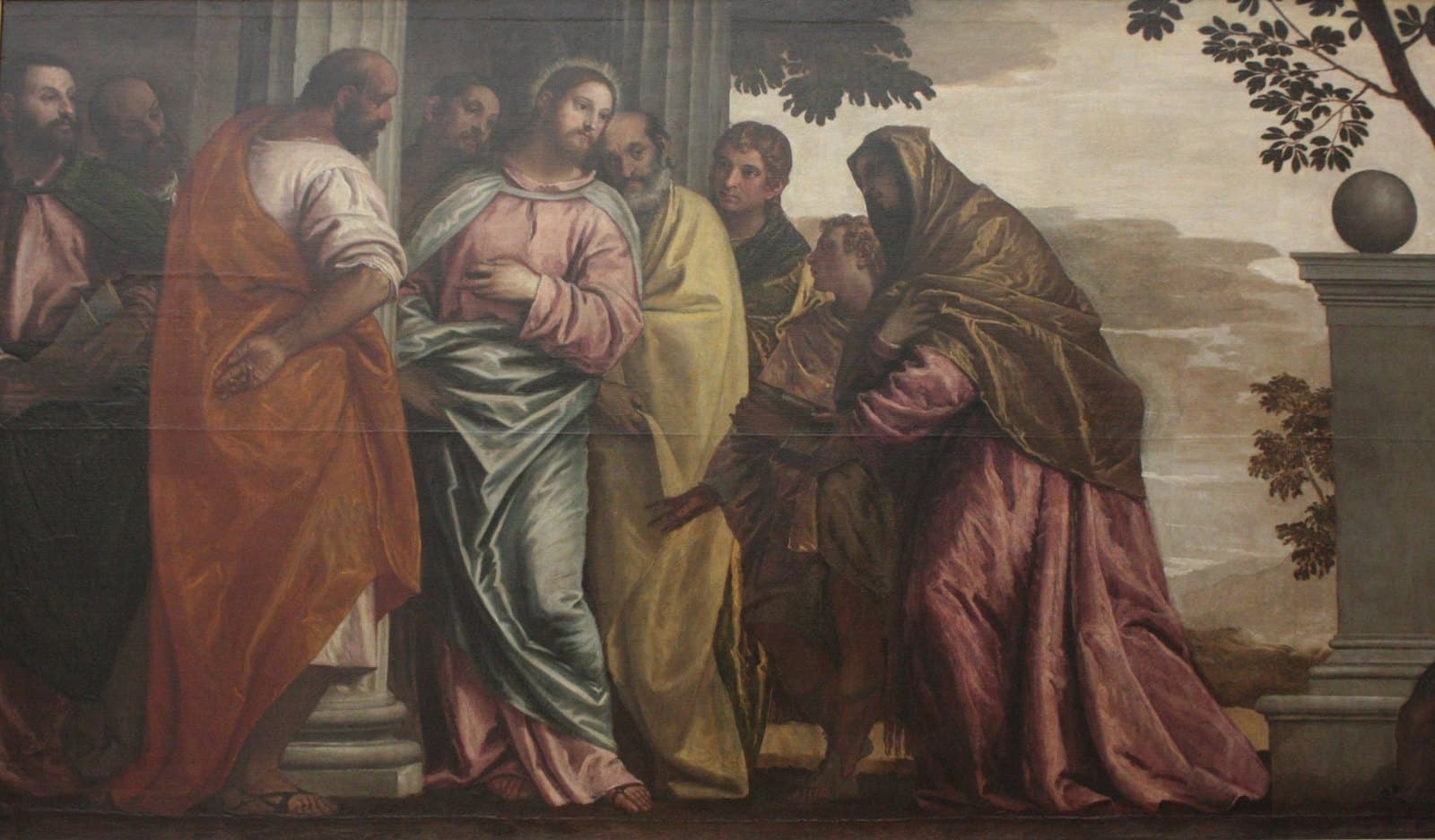
- In Matthew's account the mother of Zebedee's sons knelt before Jesus and made the request with them.
The Request of James and John
The brothers came to Jesus with a request on the road up to Jerusalem.
The Son of Man Came to Serve studies Mark 10:35 to 45, in which two brothers ask Jesus for honour and He answers the whole group with a rule for His followers. It belongs to the value of servanthood, because here Jesus ties greatness among His people to the work of a servant.
The question the study answers is what Jesus meant when He told men who wanted rank that they must become servants and slaves. It sets the passage on the road where it stands and matches the three times the disciples quarrelled over rank. It then reads the cup and the baptism and sets out two questions on which readers have divided.
Mark places the request straight after the third time Jesus told the Twelve what would happen to Him in Jerusalem. On that road “Jesus was walking ahead of them. The disciples were amazed, but those who followed were afraid” (Mark 10:32).
Read He Told Them Three Times, the study of the passion predictions
Then James and John, the sons of Zebedee, came to Jesus and declared, “Teacher, we want You to do for us whatever we ask.” “What do you want Me to do for you?” He inquired. They answered, “Grant that one of us may sit at Your right hand and the other at Your left in Your glory.”The brothers ask before they name the favour, and the favour they name is power beside the King, which sets up every answer that follows.
Three Settings of One Dispute
Mark, Matthew and Luke each record the dispute, and Luke places it at the table.
The quarrel over rank went with Jesus from Galilee to Jerusalem and was still alive at the Last Supper.
| Setting | Passage | The question at issue | Jesus' answer in the Berean words |
|---|---|---|---|
| On the way to Capernaum | Mark 9:33 to 35 | The disciples had argued on the road about which of them was the greatest, and they fell silent when He asked. | “If anyone wants to be first, he must be the last of all and the servant of all.” |
| On the road up to Jerusalem | Mark 10:35 to 45, with Matthew 20:20 to 28 | James and John wanted to sit beside Him in His glory, and Matthew adds that their mother came and asked with them. | “and whoever wants to be first must be the slave of all.” |
| At the table of the Last Supper | Luke 22:24 to 27 | A dispute arose over which of them would be considered the greatest. | “the greatest among you should be like the youngest, and the one who leads like the one who serves.” |
The Cup and the Baptism
Mark 10:38 to 40 gives two images of suffering, a cup to drink and a baptism to undergo.
“You do not know what you are asking,” Jesus replied. “Can you drink the cup I will drink, or be baptized with the baptism I will undergo?” “We can,” the brothers answered. “You will drink the cup that I drink,” Jesus said, “and you will be baptized with the baptism that I undergo. But to sit at My right or left is not Mine to grant. These seats belong to those for whom they have been prepared.”These verses stand first in the answer because Jesus speaks of suffering before He speaks of rank.
Luke records the image of a baptism in another saying: “But I have a baptism to undergo, and how distressed I am until it is accomplished!” (Luke 12:50). In Gethsemane Jesus prayed of the cup, “Take this cup from Me. Yet not what I will, but what You will” (Mark 14:36).
Acts records how the word came true for one of the two brothers. Herod “had James, the brother of John, put to death with the sword” (Acts 12:2).
The Rulers of the Gentiles and the Servant of All
Jesus set two ranks of service against the rule of the nations.
When the ten heard about this, they became indignant with James and John. So Jesus called them together and said, “You know that those regarded as rulers of the Gentiles lord it over them, and their superiors exercise authority over them.The verses show that the ten wanted rank as much as the two did, and they give the pattern of power Jesus is about to forbid among His own.
Strong's dictionary of 1890 defines diakonos, the servant of Mark 10:43, as an attendant, a waiter at table or in other menial duties. It defines doulos, the slave of Mark 10:44, as a slave whether the service is forced or freely given.
The Greek of Mark 10:43 to 45 holds the noun diakonos once, the noun doulos once and the verb diakoneo twice, in “to be served” and “to serve”.
Why the Son of Man Came
Luke and John record the same teaching on the night of the Last Supper.
For even the Son of Man did not come to be served, but to serve, and to give His life as a ransom for many.”The verse stands as the last word of the passage, and its two halves carry the teaching from the rule for disciples to the cross.
Luke records that at the meal Jesus asked who is greater, the guest who reclines or the one who waits on him. He answered, “But I am among you as one who serves” (Luke 22:27). John records that on that night Jesus washed the disciples' feet and told them, “I have set you an example so that you should do as I have done for you” (John 13:15).
The noun lutron, a ransom, stands in the New Testament only in Mark 10:45 and Matthew 20:28. Strong's defines it as a redemption price.
Voices on the Way to Glory
Two fathers of the church, Augustine and Origen, read the passage.
died 253 · Origen of Alexandria
Origen turns the rule of Matthew 20:25 to 26 on the leaders of the church.
Read the page on Origen of Alexandria
“That is, not content merely to rule over their subjects, they are severe and oppressive. But among you who are Mine these things shall not be so; for as all carnal things are done by compulsion, but spiritual things by free-will, so those rulers who are spiritual ought to rest their power in the love of their subjects, not in their fears.”
Origen of Alexandria · Catena Aurea by Aquinas · on Matthew 20:25 to 26Patristic
died 430 · Augustine of Hippo
Augustine reads the request as a question about the road the disciples would have to take.
Read the page on Augustine of Hippo
“Ponder how profound this is. They were conferring with him about glory. He intended to precede loftiness with humility and, only through humility, to ready the way for loftiness itself. For, of course, even those disciples who wanted to sit, the one on his right, the other on his left, were looking to glory. They were on the lookout, but did not see by what way. In order that they might come to their homeland in due order, the Lord called them back to the narrow way. For the homeland is on high and the way to it is lowly. The homeland is life in Christ; the way is dying with Christ. The way is suffering with Christ; the goal is abiding with him eternally. Why do you seek the homeland if you are not seeking the way to it?”
Augustine of Hippo · Tractate on John 28.5.2 · on Mark 10:37Patristic
What Is the Cup, and Does the Ransom Saying Echo Isaiah 53?
Fathers of the church and modern scholars have given two answers to each question.
The first question is whether the cup and the baptism name the suffering that every faithful disciple shares with Christ, or His own cross and death.
The cup is suffering, which the disciples would shareJohn Chrysostom; Jamieson, Fausset and Brown
John Chrysostom, in his sixty-fifth homily on Matthew, took the promise to the brothers to mean “you shall be held worthy of martyrdom, you shall suffer the things I have suffered”. Jamieson, Fausset and Brown (1871) wrote of the cup, “Here it is the cup of suffering”.
The objection: in Gethsemane Jesus asked the Father to take the cup from Him (Mark 14:36), a cup that was His alone. Bede raised a second difficulty, how John drank the cup of martyrdom when he “finished his life by a natural death”.
The cup is His cross and the baptism His deathTheophylact of Ohrid
Theophylact of Ohrid, in the words the Catena Aurea gives from him, wrote, “But by the cup and baptism, He means the cross”. The cup was a draught He took willingly, and the baptism was “the cause of the cleansing of our sins”.
The objection: Jesus told the brothers that they too would drink the cup and receive the baptism (Mark 10:39), so the words reach further than a death that no one else could die.
The second question is whether Jesus drew the ransom saying from the Servant of Isaiah 53 or from the Son of Man of Daniel 7.
Therefore I will allot Him a portion with the great, and He will divide the spoils with the strong, because He has poured out His life unto death, and He was numbered with the transgressors. Yet He bore the sin of many and made intercession for the transgressors.The verse stands here because its Servant bears the sin of many, the words readers set beside the ransom for many.
The saying alludes to the Servant of Isaiah 53R. T. France
R. T. France, in The Servant of the Lord in the Teaching of Jesus, Tyndale Bulletin 19 (1968), set the words of Mark 10:45 beside Isaiah 53 one by one. He judged that the parallels in word and thought were “sufficient to demand a deliberate allusion by Jesus to the role of the Servant as His own”.
The objection: the Berean text of Isaiah 53 has no word for a ransom, and Mark 10:45 quotes no line of the chapter.
The saying grows from the Son of Man of Daniel 7C. K. Barrett; Morna Hooker
C. K. Barrett, in The Background of Mark 10:45 (1959), and Morna Hooker, in Jesus and the Servant (1959), found the main background of the saying in the Son of Man of Daniel 7. France sets out their case and quotes Hooker's conclusion that the reference is “a general one to the necessity which is laid upon him by the divine will”.
The objection: in Daniel 7:14 the nations serve the Son of Man, and the chapter holds no death given for many.
The Servant of All
Matthew sets the same request straight after a parable about wages.
In Matthew's Gospel the request of Zebedee's sons follows the parable of the workers in the vineyard (Matthew 20:1 to 16). There the men hired last are paid first, and the first grumble at being made equal. Both passages answer disciples who were counting their rank against one another.
Sources
Scripture is the Berean Standard Bible.
- STEP Bible, Translators Amalgamated Greek New Testament, the tagged Greek text (Tyndale House, Cambridge), CC BY 4.0.
- James Strong, A Concise Dictionary of the Words in the Greek Testament (1890), entries 1247, 1249, 1401 and 3083.
- Augustine of Hippo, Tractates on the Gospel of John 28.5.2, on Mark 10:37.
- Thomas Aquinas, Catena Aurea on Matthew 20:25 to 26, quoting Origen of Alexandria.
- John Chrysostom, Homilies on the Gospel of Matthew, Homily 65, on Mark 10:38 to 39.
- Thomas Aquinas, Catena Aurea on Mark 10:38, quoting Theophylact of Ohrid.
- Robert Jamieson, A. R. Fausset and David Brown, Commentary Critical and Explanatory on the Whole Bible (1871), on Mark 10:38.
- Bede on Mark 10:39, from the same Catena on Mark.
- R. T. France, The Servant of the Lord in the Teaching of Jesus, Tyndale Bulletin 19 (1968), pages 26 to 52.
- C. K. Barrett, The Background of Mark 10:45, in A. J. B. Higgins, editor, New Testament Essays: Studies in Memory of T. W. Manson (Manchester University Press, 1959), pages 1 to 18, as France reports it.
- Morna D. Hooker, Jesus and the Servant (London: SPCK, 1959), as France reports and quotes it.
Keep Studying
Read it1
Studies1
In this value1
People and groups11
Doctrines6
Values1