

Galatians 5 · Value 12 of 41 · Featured Study
Self-control
Proverbs praises and the apostles command the rule of the self under God.
Paul wrote, "I will not be mastered by anything" (1 Corinthians 6:12).
No temptation has seized you except what is common to man. And God is faithful; He will not let you be tempted beyond what you can bear. But when you are tempted, He will also provide an escape, so that you can stand up under it.
- Anchor text
- Galatians 5:22 to 23 “But the fruit of the Spirit is…”
- Its opposite
- The want of self-control, drunkenness and slavery to desire
- Hold in memory
- 1 Corinthians 10:13, Galatians 5:16
Summary
Scripture teaches self-control in lives as well as in commands. Daniel refused the king's food and wine, and David twice spared the king who was hunting him. Esau gave up his birthright for a bowl of stew, Samson told Delilah the secret of his strength, and the same David later took another man's wife. The same Scriptures show where the strength to rule oneself comes from and what it guards against.
- Scripture asks self-control over the appetite for food and wine, over sexual desire, over anger and over the mind.
- Its opposite is to be ruled by desire, for "a man is a slave to whatever has mastered him" (2 Peter 2:19).
- God promises that no believer will be tempted beyond what he can bear, and that with the temptation He "will also provide an escape" (1 Corinthians 10:13).
- Jesus "was tempted in every way that we are, yet was without sin" (Hebrews 4:15).
What Self-Control Is
Paul, Peter and the Proverbs use four words for what the English calls self-control.
What does Scripture mean by self-control, where does it come from, and how is a believer to rule his own desires under God? It gives the Greek and Hebrew words behind the English, the key texts from Proverbs to Peter, the commands and their ground in the Spirit and in grace, and the self-control of Jesus. It names the people who kept it and lost it, the practice Scripture names and its opposite. It then gives the stories of Scripture and of the church, the voices of the church, the science and three questions on which readers disagree, and the studies of the family take each part further.
Enkrateia, self-control
4 uses in the canon
The Greek noun enkrateia (G1466), which the STEP tagging spells egkrateia, is the word the King James Version renders temperance.
Sophron, sound in mind
4 uses in the canon
In Titus 1:8 an elder must be "self-controlled, upright, holy, and disciplined", and there "self-controlled" renders sophron (G4998) and "disciplined" renders enkrates.
Nepho, to be sober
6 uses in the canon
Peter uses the verb nepho (G3525) three times in his first letter, as in "Be sober-minded".
Ma'tsar, restraint
1 use in the canon
In Proverbs 25:28 the noun ma'tsar (H4623) stands beside ruach, the spirit, which the Berean text renders temper.
Enkrateia, self-control, Sophron, sound in mind, Nepho, to be sober, Ma'tsar, restraint, The Words Enkrateia and the City Without Walls, the study in brief
The Key Texts of Self-Control
Each card gives a text's Berean words and the place where it stands.
Wisdom
He who is slow to anger is better than a warrior, and he who controls his temper is greater than one who captures a city.
The proverb ranks the man who rules his own temper above the soldier who takes a city.
Wisdom
Do not join those who drink too much wine or gorge themselves on meat. For the drunkard and the glutton will come to poverty, and drowsiness will clothe them in rags.
The proverb warns against the company of drunkards and gluttons and names the poverty that follows.
Acts and Epistles
As Paul expounded on righteousness, self-control, and the coming judgment, Felix became frightened and said, “You may go for now. When I find the time, I will call for you.”
Paul set self-control between righteousness and the judgment when he spoke to the governor, and Felix sent him away.
Acts 24:25BSB
Acts and Epistles
So then, let us not sleep as the others do, but let us remain awake and sober.
Paul joins staying sober to staying awake for the day of the Lord.
Acts and Epistles
Be sober-minded and alert. Your adversary the devil prowls around like a roaring lion, seeking someone to devour.
Peter gives the reason for a clear mind, an adversary looking for someone to devour.
1 Peter 5:8BSB
Proverbs 23:20 to 21, Acts 24:25, 1 Thessalonians 5:6, 1 Peter 5:8
Where Scripture Commands Self-Control
Paul asks self-control of overseers and elders, of old and young, and of men and women.
Paul asks self-control first of those who lead. An overseer must be "temperate, self-controlled, respectable, hospitable, able to teach" (1 Timothy 3:2).
In his letter to Titus he names every rank of the church. Older men are to be "temperate, dignified, self-controlled", and the young women are to be taught "to be self-controlled, pure" (Titus 2:2 and 5).
For it is God’s will that you should be holy: You must abstain from sexual immorality; each of you must know how to control his own body in holiness and honor,Paul makes control of one's own body part of the holiness that is God's will for every believer.
In the same way, urge the younger men to be self-controlled.Paul gives Titus a charge for the young men, the age the letter names last.
1 Thessalonians 4:3 to 4, Titus 2:6
Self-Control Rests on God's Work
Self-control rests on what God has done and given, in Paul's letters and in Peter's.
Paul grounds self-control in the price paid for the body: "You are not your own; you were bought at a price. Therefore glorify God with your body" (1 Corinthians 6:19 to 20).
Peter grounds it in God's power: "His divine power has given us everything we need for life and godliness" (2 Peter 1:3).
For God has not given us a spirit of fear, but of power, love, and self-control.Paul reminds Timothy that God's gift includes self-control, beside power and love.
2 Timothy 1:7, The Fruit of Self-control, the study in brief
Jesus and Self-Control
Jesus refused bread in the wilderness, taught His disciples to watch and pray, and kept silent under abuse at the cross.
Hungry in the wildernessMatthew 4
The Spirit led Jesus into the wilderness, and after fasting forty days and forty nights He was hungry. The tempter told Him to turn the stones into bread if He was the Son of God.
But Jesus answered, “It is written: ‘Man shall not live on bread alone, but on every word that comes from the mouth of God.’”
Matthew 4:4BSB Jesus answers forty days of hunger with the word of God and leaves the stones as they are.
Watching in GethsemaneMatthew 26
On the night of His arrest Jesus prayed in Gethsemane and came back to find His disciples asleep. Matthew 26:40 records that He asked Peter, "Were you not able to keep watch with Me for one hour?"
“Watch and pray so that you will not enter into temptation. For the spirit is willing, but the body is weak.”
Matthew 26:41BSB Jesus names the weakness of the body and gives watching and prayer as the guard against temptation.
When one of His disciples drew a sword at the arrest, Jesus told him to put it back. He said that He could call on His Father for "more than twelve legions of angels" (Matthew 26:53), and He let Himself be taken.
Silent under abuse1 Peter 2
Peter wrote that Christ suffered and left His people an example, "that you should follow in His footsteps" (1 Peter 2:21). Isaiah had written of the Servant, "He was oppressed and afflicted, yet He did not open His mouth" (Isaiah 53:7).
When they heaped abuse on Him, He did not retaliate; when He suffered, He made no threats, but entrusted Himself to Him who judges justly.
1 Peter 2:23BSB Peter sets Christ's restraint at His trial and cross before believers who suffer unjustly.
Read the story of the Crucifixion 12 sections, 12 verses set out
Watching in Gethsemane (Matthew 26), Silent under abuse (1 Peter 2)
The Greek words of the enkrateia family stand in six verses of the New Testament, and each speaks of people, never of God. The Old Testament does speak of God's restraint. A psalm says that "He often restrained His anger" (Psalm 78:38), and in Isaiah God says, "I have remained quiet and restrained" (Isaiah 42:14).
Who Kept Self-Control
Two people of the Bible are remembered for ruling their eyes and their appetite.
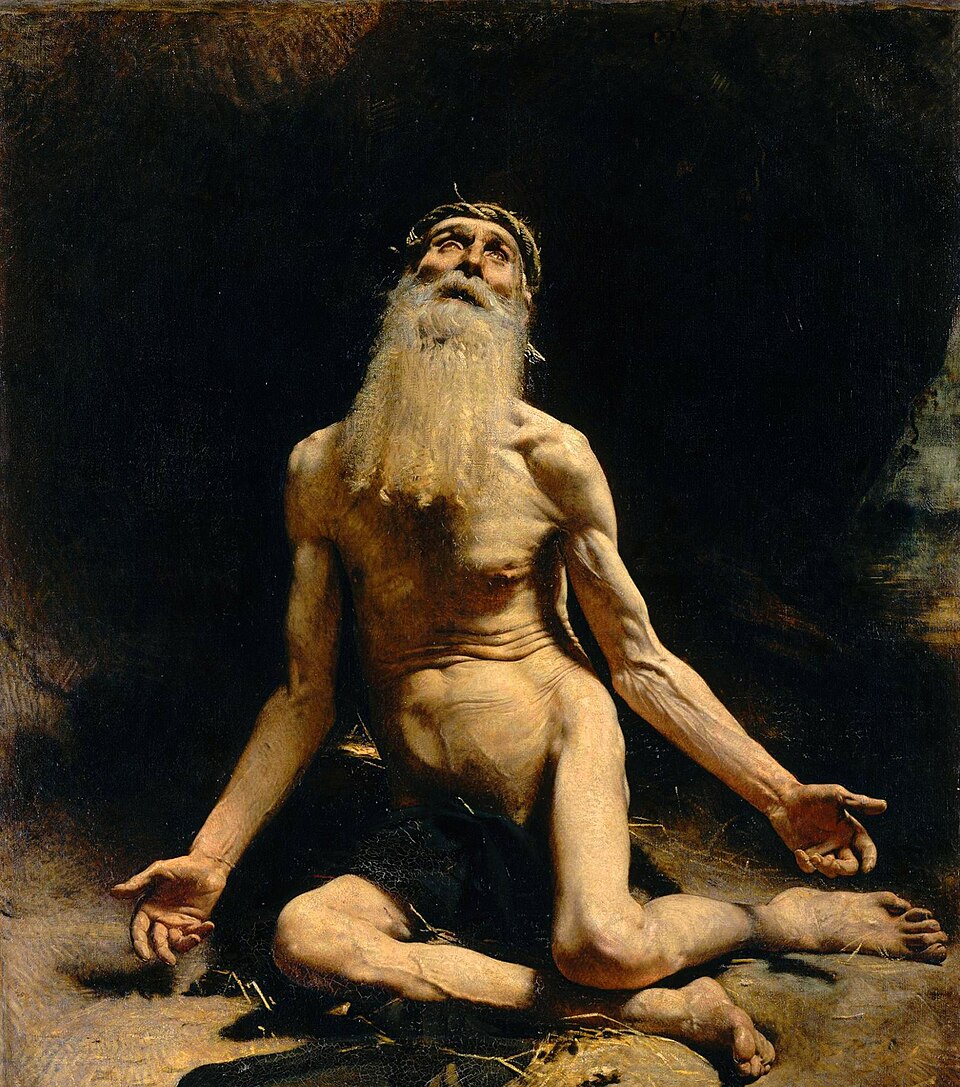
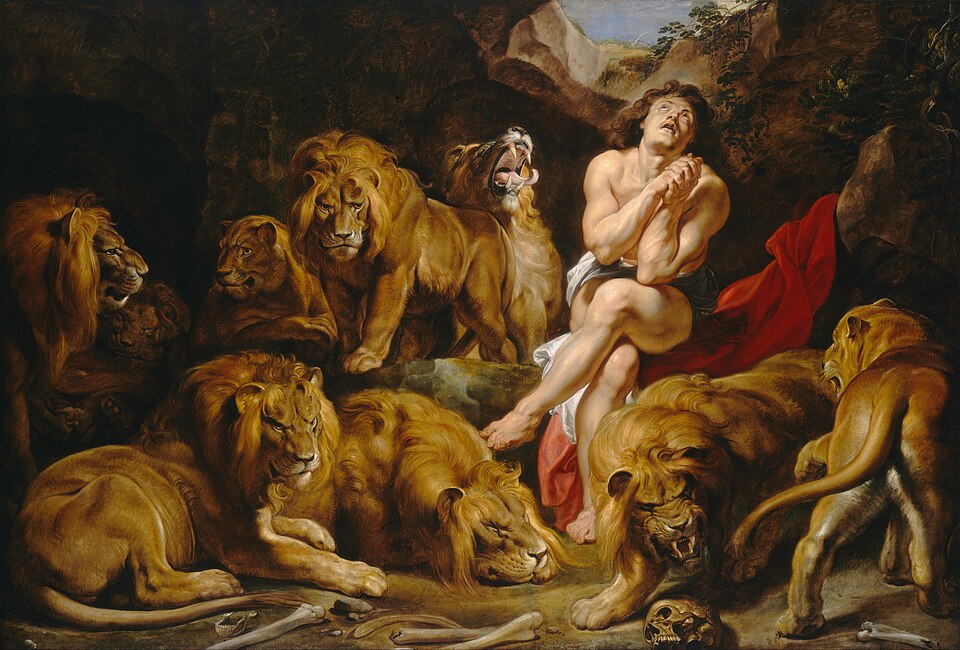
A captive in training for the king's court, he "made up his mind that he would not defile himself with the king's food or wine".
Daniel 1:8
The Practice of Self-Control
Scripture names eight practices of self-control, each with the verse that gives it.
- 1Fast in secretJesus told those who fast to anoint their heads and wash their faces, so that only the Father who sees in secret knows.Matthew 6:17 to 18
- 2Keep measure at the table"If you find honey, eat just what you need, lest you have too much and vomit it up."Proverbs 25:16
- 3Guard the appetite before a ruler"When you sit down to dine with a ruler, consider carefully what is set before you."Proverbs 23:1
- 4Flee"Flee from youthful passions and pursue righteousness, faith, love, and peace."2 Timothy 2:22
- 5Put the deeds of the body to death by the SpiritPaul writes, "if by the Spirit you put to death the deeds of the body, you will live."Romans 8:13
- 6Put earthly desires to deathPaul names the desires to be put to death: sexual immorality, impurity, lust, evil desires and greed.Colossians 3:5
- 7Train for godlinessPaul writes, "train yourself for godliness. For physical exercise is of limited value, but godliness is valuable in every way."1 Timothy 4:7 to 8
- 8Be filled with the Spirit"Do not get drunk on wine, which leads to reckless indiscretion. Instead, be filled with the Spirit."Ephesians 5:18
Keep measure at the table, Guard the appetite before a ruler, Flee, Put the deeds of the body to death by the Spirit, Put earthly desires to death, Train for godliness, Be filled with the Spirit
What Stands Against Self-Control
Scripture names the want of self-control, drunkenness, an unguarded tongue and slavery to desire as its opposite.
The Greek word for the want of self-control is akrasia. Jesus said the scribes and Pharisees cleaned the outside of the cup and dish, while "inside they are full of greed and self-indulgence" (Matthew 23:25). Paul lists people "without self-control" among the marks of the last days (2 Timothy 3:3).
The Proverbs warn against drink: "Wine is a mocker, strong drink is a brawler, and whoever is led astray by them is not wise" (Proverbs 20:1).
James makes speech the test of the whole person: "If anyone is never at fault in what he says, he is a perfect man, able to control his whole body" (James 3:2).
But each one is tempted when by his own evil desires he is lured away and enticed. Then after desire has conceived, it gives birth to sin; and sin, when it is full-grown, gives birth to death.
James traces sin to desire left to grow, and death to sin full-grown.
The sons of Eli
The priest's sons had no regard for the LORD and slept with the women who served at the entrance to the Tent of Meeting.
1 Samuel 2:22Amnon
Sick with desire for his sister Tamar, he violated her, and then his hatred for her was greater than the love he had had before.
2 Samuel 13:14 to 15
James 1:14 to 15, The sons of Eli, Amnon
Self-Control in the Stories of the Bible
Four stories tell of Joseph's flight, David's mercy and his fall, Esau's hunger and Samson's secret.
Joseph and Potiphar's wifeGenesis 39
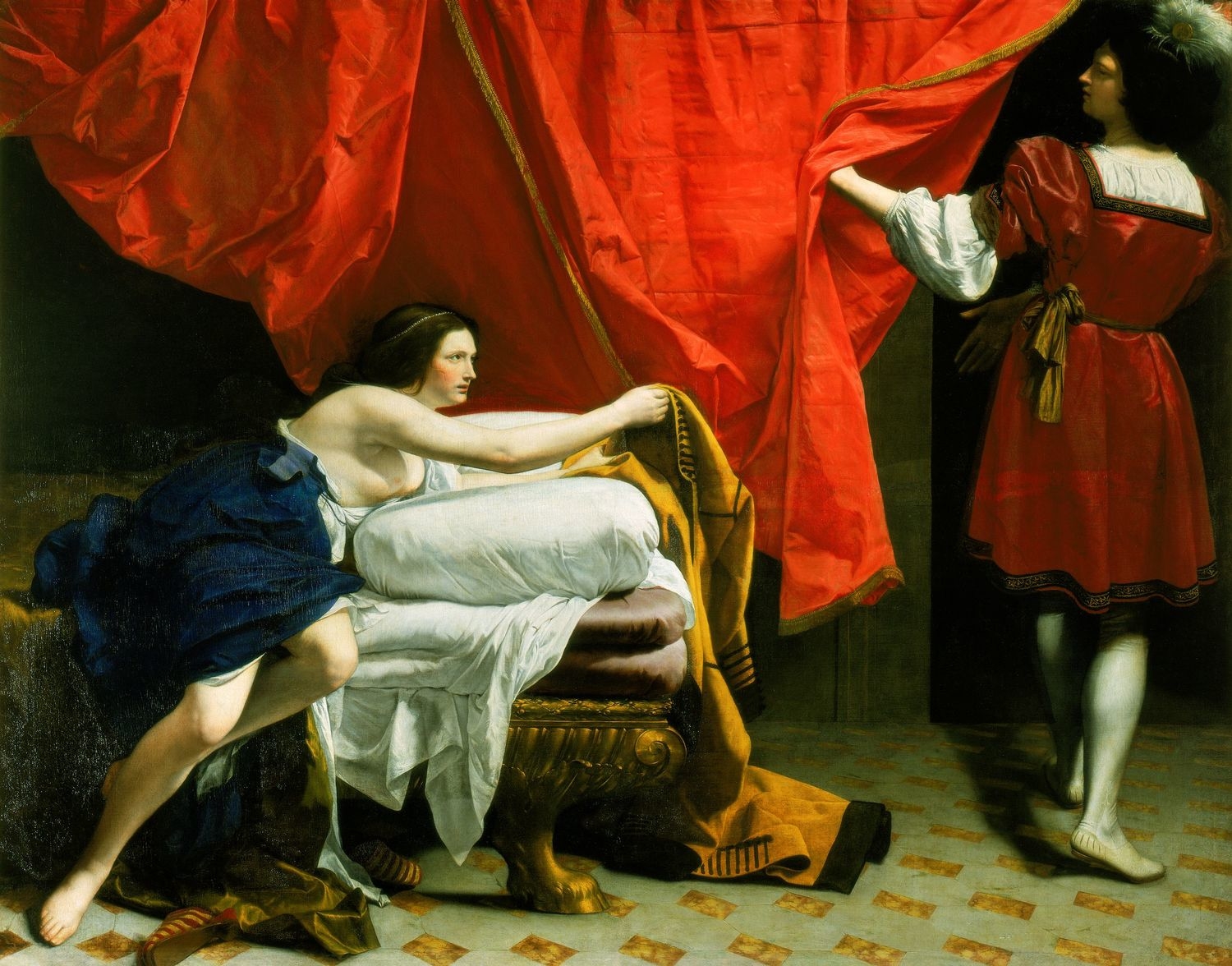
Joseph, sold by his brothers, was put in charge of everything his Egyptian master owned. His master's wife spoke to him "day after day" (Genesis 39:10). In Genesis 39:9 he gave his reason in his own words: "So how could I do such a great evil and sin against God?" When she grabbed him by his cloak, he escaped and ran outside without it.
Read the story of Joseph and Potiphar's Wife 11 sections, 7 verses set out
David spares Saul, and falls1 Samuel 24 to 2 Samuel 11
In a cave where Saul was hunting him, David cut off a corner of the king's robe, his conscience was stricken, and he "restrained his men" (1 Samuel 24:7). He spared Saul again in the camp. Between the two, Abigail turned him back from avenging himself on Nabal (1 Samuel 25:33). Years later, from the palace roof, the same man saw Bathsheba bathing and sent messengers to get her (2 Samuel 11:2 to 4).
Read the page on David 14 sections, 34 verses set out
Esau sells his birthrightGenesis 25
Esau came in famished from the field while Jacob was cooking stew. He asked, "what good is a birthright to me?", swore it away for bread and lentil stew, and "ate and drank and then got up and went away" (Genesis 25:32 to 34). Hebrews warns believers not to be "godless like Esau, who for a single meal sold his birthright" (Hebrews 12:16).
Read the page on Esau 12 sections, 11 verses set out
Samson and DelilahJudges 16
Samson was a Nazirite to God from his mother's womb. At Gaza he went in to a prostitute (Judges 16:1). Delilah pressed him daily until he "told her all that was in his heart", the secret of his uncut hair (Judges 16:17). She had his head shaved while he slept, his strength left him, and "he did not know that the LORD had departed from him" (Judges 16:20).
Read the page on Samson 13 sections, 18 verses set out
David spares Saul, and falls (1 Samuel 24 to 2 Samuel 11), Esau sells his birthright (Genesis 25), Samson and Delilah (Judges 16)
Self-Control in the Church's History
Five accounts tell of a garden prayer, a monk's first conflict, a rule for the table, resolutions and a rule against drink.
Augustine of HippoConfessions, book 8
Augustine recalled that as a young man he had prayed, "Grant me chastity and continency, but not yet." Years later, weeping in a garden at Milan, he heard a child's voice chanting, "Take up and read; take up and read." He opened Paul at Romans 13:13 to 14 and wrote, "No further would I read, nor did I need." The account is his own confession.
John CassianInstitutes, book 5
John Cassian brought the teaching of the Egyptian monks to Gaul. He wrote that "the first conflict we must enter upon is that against gluttony", and he reported the Fathers' saying "that the right method of fasting and abstinence lies in the measure of moderation and bodily chastening" (Institutes, book 5, chapters 3 and 8). The account is his report of what those monks taught.
Benedict of NursiaRule, chapters 39 and 40
Benedict's Rule gives each monk two cooked dishes and "a good pound weight of bread" a day and warns against over-indulgence. It allows a measure of wine with misgiving, since the monks of his day "cannot be persuaded" to give it up, and so Benedict wrote, "let us at least agree to drink sparingly" (chapter 40, translated by Leonard J. Doyle).
Jonathan Edwards1723
Jonathan Edwards began preaching in New York in 1722 and opened his written resolutions with a plea, "Being sensible that I am unable to do any thing without God's help, I do humbly entreat him, by his grace, to enable me to keep these Resolutions". The twentieth reads, "Resolved, To maintain the strictest temperance in eating and drinking." The fortieth, dated 7 January 1723, sets a nightly review of his eating and drinking.
John Wesley and Lyman Beecher1743 and 1827
The General Rules of John Wesley's societies, dated 1743, bar "Drunkenness: buying or selling spirituous liquors, or drinking them, unless in cases of extreme necessity", as the United Methodist Church prints the clause today. In 1827 Lyman Beecher went further in his Six Sermons on Intemperance, published in Boston, and called the drunkard and the sober alike to "immediate and entire abstinence".
John Cassian (Institutes, book 5), Benedict of Nursia (Rule, chapters 39 and 40), Jonathan Edwards (1723), John Wesley and Lyman Beecher (1743 and 1827)
Voices on Self-Control, by Century
Seven voices from the third century to the nineteenth, each under the line it teaches.
died 220 · Tertullian
Ad Martyras
Third century. The athlete's hard training shows that virtue is built up by hardship and overthrown by indulgence.
The quotation1 quotation
“They are kept from luxury, from daintier meats, from more pleasant drinks; they are pressed, racked, worn out; the harder their labours in the preparatory training, the stronger is the hope of victory. ‘And they,’ says the apostle, ‘that they may obtain a corruptible crown.’ We, with the crown eternal in our eye, look upon the prison as our training-ground, that at the goal of final judgment we may be brought forth well disciplined by many a trial; since virtue is built up by hardships, as by voluptuous indulgence it is overthrown.”
Tertullian · Ad Martyras · on 1 Corinthians 9:25Patristic
died 397 · Ambrose of Milan
On the Duties of the Clergy 1.21.96
Fourth century. Anger turned on oneself for being roused so easily stops burning against another.
The quotation1 quotation
“If you are angry, be angry with yourselves, because you are roused, and you will not sin. For he who is angry with himself, because he has been so easily roused, ceases to be angry with another. But he who wishes to prove his anger is righteous only gets the more inflamed and quickly falls into sin. ‘Better is he,’ as Solomon says, ‘that restrains his anger than he that takes a city,’ for anger leads astray even brave men.”
Ambrose of Milan · On the Duties of the Clergy 1.21.96 · on Proverbs 16:32Patristic
died 407 · John Chrysostom
Homily on Galatians 5
Fourth and fifth centuries. The mastery of the passions belongs to the soul, and good works need God's kindness as well as our diligence.
The quotation1 quotation
“He says not, ‘the work of the Spirit,’ but, ‘the fruit of the Spirit.’ Is the soul, however, superfluous? the flesh and the Spirit are mentioned, but where is the soul? is he discoursing of beings without a soul? for if the things of the flesh be evil, and those of the Spirit good, the soul must be superfluous. By no means, for the mastery of the passions belongs to her, and concerns her; and being placed amid vice and virtue, if she has used the body fitly, she has wrought it to be spiritual, but if she separate from the Spirit and give herself up to evil desires, she makes herself more earthly. You observe throughout that his discourse does not relate to the substance of the flesh, but to the moral choice, which is or is not vicious. And why does he say, ‘the fruit of the Spirit?’ it is because evil works originate in ourselves alone, and therefore he calls them ‘works,’ but good works require not only our diligence but God's loving kindness. He places first the root of these good things, and then proceeds to recount them, in these words, ‘Love, joy, peace, long-suffering, kindness, goodness, faithfulness, meekness, temperance; against such there is no law.’ For who would lay any command on him who hath all things within himself, and who hath love for the finished mistress of philosophy? As horses, who are docile and do every thing of their own accord, need not the lash, so neither does the soul, which by the Spirit hath attained to excellence, need the admonitions of the Law. Here too he completely and strikingly casts out the Law, not as bad, but as inferior to the philosophy given by the Spirit.”
John Chrysostom · Homily on Galatians 5 · on Galatians 5:22 to 23Patristic
died 604 · Gregory the Dialogist
The Book of Pastoral Rule, Part 3, Chapter 9
Sixth and seventh centuries. The mind that brings itself under its own rule wins a greater victory than the taking of a city.
The quotation1 quotation
“Better is the patient than the mighty, and he that ruleth his spirit than he that taketh cities. For victory over cities is a less thing, because that which is subdued is without; but a far greater thing is that which is conquered by patience, since the mind itself is by itself overcome, and subjects itself to itself, when patience compels it to bridle itself within.”
Gregory the Dialogist · The Book of Pastoral Rule, Part 3, Chapter 9 · on Proverbs 16:32Patristic
died 735 · Bede
Commentary on Proverbs
Eighth century. A mind without the wall of silence lies open to the enemy's darts.
The quotation1 quotation
“‘As a city broken down and without walls,’ etc. For if it does not have the wall of silence, the city of the mind lies open to the darts of the enemy. And as it casts itself outside through words, it exposes itself openly to …”
Bede · Commentary on Proverbs · on Proverbs 25:28Patristic
died 1107 · Theophylact of Ohrid
Commentary on 1 Thessalonians
Twelfth century. Sobriety is watchfulness made more intense, so that good works are done with attention.
The quotation1 quotation
“That is, let us not be negligent in good works. The intensification of watchfulness is sobriety. For it is possible to be watchful, but not be sober; therefore the apostle says, as it were: let us do good works soberly and attentively.”
Theophylact of Ohrid · Commentary on 1 Thessalonians · on 1 Thessalonians 5:6Patristic
1802 to 1910 · Jamieson, Fausset & Brown
Commentary Critical and Explanatory on the Whole Bible
Nineteenth century. Knowledge of God's will must show itself in practice as self-control over lusts and passions.
The quotation1 quotation
“Greek, ‘And in your knowledge self-control.’ In the exercise of Christian knowledge or discernment of God's will, let there be the practical fruit of self-control as to one's lusts and passions.”
Jamieson, Fausset & Brown · Commentary Critical and Explanatory on the Whole Bible · on 2 Peter 1:6Reformed
John Chrysostom, Gregory the Dialogist, Bede, Theophylact of Ohrid, Jamieson, Fausset & Brown
How Self-Control Has Been Taught
Clement of Alexandria, Thomas Aquinas, Jeremy Taylor and Charles Spurgeon taught self-control from about 200 to the nineteenth century.
Clement of Alexandria taught temperance at the table and in the contest1 paragraph
Clement of Alexandria wrote of drink in The Instructor (book 2, chapter 2, translated by William Wilson, 1885). He said, "I therefore admire those who have adopted an austere life, and who are fond of water, the medicine of temperance". On Paul's athlete he wrote in the Stromata that the one who competes, "though he does not abstain from everything, yet he is self-controlled on such things as he thinks fit".
Aquinas counted temperance a virtue of reason and defined continence beside it1 paragraph
Thomas Aquinas held that temperance is a virtue, since "its very name implies moderation or temperateness, which reason causes" (Summa Theologiae, second part of the second part, question 141, article 1). He defined continence beside it: "Continence denotes, by its very name, a certain curbing, in so far as a man contains himself from following his passions" (question 155, article 1).
Jeremy Taylor called sobriety the bridle and temperance the bit1 paragraph
Jeremy Taylor wrote in Holy Living (chapter 2, section 2), "Sobriety is the bridle of the passions of desire, and temperance is the bit and curb of that bridle".
Spurgeon named the flesh the worst enemy and the Holy Spirit the one who contends with it1 paragraph
Charles Spurgeon preached in 1884 on the fruit of the Spirit that the "worst enemy we have is the flesh" (sermon 1782, The First Fruit of the Spirit). In the same sermon he said that "the Holy Spirit must contend for the mastery within us".
Where the Science Speaks
Studies of self-control as a trait and as a habit stand beside Scripture as later witnesses.
Do not be conformed to this world, but be transformed by the renewing of your mind. Then you will be able to test and approve what is the good, pleasing, and perfect will of God.Paul names the renewing of the mind as the way a believer is changed, and the studies of habit stand beside it as corroboration.
A study that followed 1,000 children from birth to age 32 found that self-control in childhood predicted adult health, finances and criminal offending, apart from intelligence and social class (Moffitt and others, 2011).
Self-control and the Brain, the study in brief
The Studies of Self-Control
Galatians 5, Paul's athlete, Joseph in Egypt, the broken wall and the research on habit each have a study.
The texts
2 studies
- Doctrines · 3 verses set outThe Fruit of Self-control
Galatians 5:16 to 26 sets self-control among the fruit of the Spirit inside Paul's teaching on the war between the flesh and the Spirit.
- Passages and psalms · 7 verses set outI Discipline My Body
In 1 Corinthians 9:24 to 27 Paul compares his own life to a runner's race and a boxer's fight, writing to the church at Corinth.
- Doctrines · 3 verses set outThe Fruit of Self-control
The stories
1 study
- Stories · 7 verses set outJoseph and Potiphar's Wife
Genesis 39 tells in twenty-three verses how a slave in Egypt refused his master's wife and went to prison on her charge.
- Stories · 7 verses set outJoseph and Potiphar's Wife
The words
1 study
- Symbols and words · 11 verses set outThe Words Enkrateia and the City Without Walls
Three families of Greek words and one Hebrew noun stand behind the English words self-control, sensible, sober and temperate in Proverbs and the New Testament.
- Symbols and words · 11 verses set outThe Words Enkrateia and the City Without Walls
The practice
1 study
- Subjects · 12 versesTemptation
The pull toward sin, and the way of escape promised with it.
- Subjects · 12 versesTemptation
The science
1 study
- Doctrines · 4 verses set outSelf-control and the Brain
Nine studies published from 1998 to 2021 measured self-control as a trait, in daily life, as a limited resource and in the brain.
- Doctrines · 4 verses set outSelf-control and the Brain
I Discipline My Body, Joseph and Potiphar's Wife, The Words Enkrateia and the City Without Walls, Temptation, Self-control and the Brain
Where Readers Disagree
Seven readings answer three questions, each with its holders, the work that argues it and the objection raised against it.
Gift or training
Read the study of the Fruit of Self-control 8 sections, 3 verses set out
| Reading | Held by | Work | Objection |
|---|---|---|---|
| Self-control is grace's gift, asked of God | Augustine of Hippo (Patristic) | Confessions, book 10, chapter 29 (translated by J. G. Pilkington, 1887) | Paul tells believers to "work out your salvation with fear and trembling" (Philippians 2:12). |
| A virtue formed by repeated acts, with a higher temperance that grace gives | Thomas Aquinas (Roman Catholic (Thomist)) | Summa Theologiae, I-II question 63, article 4 | Paul says that "it is God who works in you to will and to act on behalf of His good purpose" (Philippians 2:13). |
| The believer puts sin to death by the Spirit who lives in him | John Owen (Reformed (Puritan)) | Of the Mortification of Sin in Believers (1656), chapter 2 | A stress on the believer's own fight can slide into effort that no longer rests on Christ. |
A virtue formed by repeated acts, with a higher temperance that grace gives, The believer puts sin to death by the Spirit who lives in him
Wine
Read the page on the Nazirite Vow 11 sections, 17 verses set out
| Reading | Held by | Work | Objection |
|---|---|---|---|
| Moderate use is lawful, and wine is God's gift | John Calvin (Reformed) | Institutes of the Christian Religion, book 3, chapter 10, sections 1 and 2 | Paul says it is better not to drink wine where it would cause a brother to stumble (Romans 14:21). |
| Abstinence is the wiser course | Clement of Alexandria (Patristic) | The Instructor, book 2, chapter 2 (translated by William Wilson, 1885) | Paul rebukes teachers who require abstinence from foods that God created to be received with thanksgiving (1 Timothy 4:3 to 4). |
How far bodily discipline goes
Read the study of I Discipline My Body 8 sections, 7 verses set out
| Reading | Held by | Work | Objection |
|---|---|---|---|
| The body is brought low by fasting | Ambrosiaster (Patristic (Latin)) | Commentary on Paul's Epistles, on 1 Corinthians 9:27 | Paul says that harsh treatment of the body has an appearance of wisdom but is of no value against the indulgence of the flesh (Colossians 2:23). |
| As far as the desire it restrains, and no further | Martin Luther; John Calvin (Lutheran; Reformed) | Luther, A Treatise on Good Works (1520), sections 19 and 20; Calvin, Institutes, book 3, chapter 10 | Jesus expects His disciples to fast (Matthew 6:16), and a measure set by the self can excuse the self. |
Sources
Scripture is the Berean Standard Bible.
- STEP Bible, Translators Brief lexicon of Extended Strongs for Hebrew and for Greek (Tyndale House, Cambridge), CC BY 4.0, with the Greek brief lexicon based on Abbott-Smith (1922)
- Augustine of Hippo, Confessions, book 8, chapters 7 and 12, and book 10, chapter 29, translated by J. G. Pilkington, Nicene and Post-Nicene Fathers, first series, volume 1 (Buffalo, 1887)
- John Cassian, Institutes, book 5, chapters 3 and 8, translated by C. S. Gibson, Nicene and Post-Nicene Fathers, second series, volume 11 (Buffalo, 1894)
- The Rule of Saint Benedict, chapters 39 and 40, translated by Leonard J. Doyle (Collegeville: Liturgical Press)
- Jonathan Edwards, Resolutions, in The Works of Jonathan Edwards, volume 1, edited by Edward Hickman (London, 1834), with the memoir by Sereno Dwight.
- The Nature, Design, and General Rules of Our United Societies (1743), as printed by the United Methodist Church.
- Lyman Beecher, Six Sermons on the Nature, Occasions, Signs, Evils, and Remedy of Intemperance (Boston, 1827), page 97.
- Clement of Alexandria, The Instructor (Paedagogus), book 2, chapter 2, translated by William Wilson, Ante-Nicene Fathers, volume 2 (Buffalo, 1885)
- Clement of Alexandria, Stromata, book 3, on 1 Corinthians 9:25 to 27.
- Thomas Aquinas, Summa Theologiae, I-II question 63, article 4, and II-II questions 141 and 155, English Dominican translation, second edition (1920)
- Jeremy Taylor, The Rule and Exercises of Holy Living, chapter 2, section 2.
- C. H. Spurgeon, The First Fruit of the Spirit, Metropolitan Tabernacle Pulpit, sermon 1782 (1884)
- John Owen, Of the Mortification of Sin in Believers (1656), chapter 2.
- Martin Luther, A Treatise on Good Works (1520), sections 19 and 20, translated by J. M. Reu.
- John Calvin, Institutes of the Christian Religion, book 3, chapter 10, sections 1 and 2, translated by Henry Beveridge (1845)
- Ambrosiaster, Commentary on Paul's Epistles, on 1 Corinthians 9:27.
- T. E. Moffitt and others, A gradient of childhood self-control predicts health, wealth, and public safety, Proceedings of the National Academy of Sciences 108(7): 2693 to 2698 (2011)
- D. T. D. de Ridder and others, Taking stock of self-control: a meta-analysis of how trait self-control relates to a wide range of behaviors, Personality and Social Psychology Review 16(1): 76 to 99 (2012)
- B. M. Galla and A. L. Duckworth, More than resisting temptation: beneficial habits mediate the relationship between self-control and positive life outcomes, Journal of Personality and Social Psychology 109(3): 508 to 525 (2015)
- M. S. Hagger and others, A Multilab Preregistered Replication of the Ego-Depletion Effect, Perspectives on Psychological Science 11(4): 546 to 573 (2016)
- K. D. Vohs and others, A Multisite Preregistered Paradigmatic Test of the Ego-Depletion Effect, Psychological Science 32(10): 1566 to 1581 (2021)
Keep Studying
Studies9
In this value5
People and groups29
Show the next 6 titles
Show the next 6 titles
Show the next 6 titles
Doctrines10