
Genesis 46:1
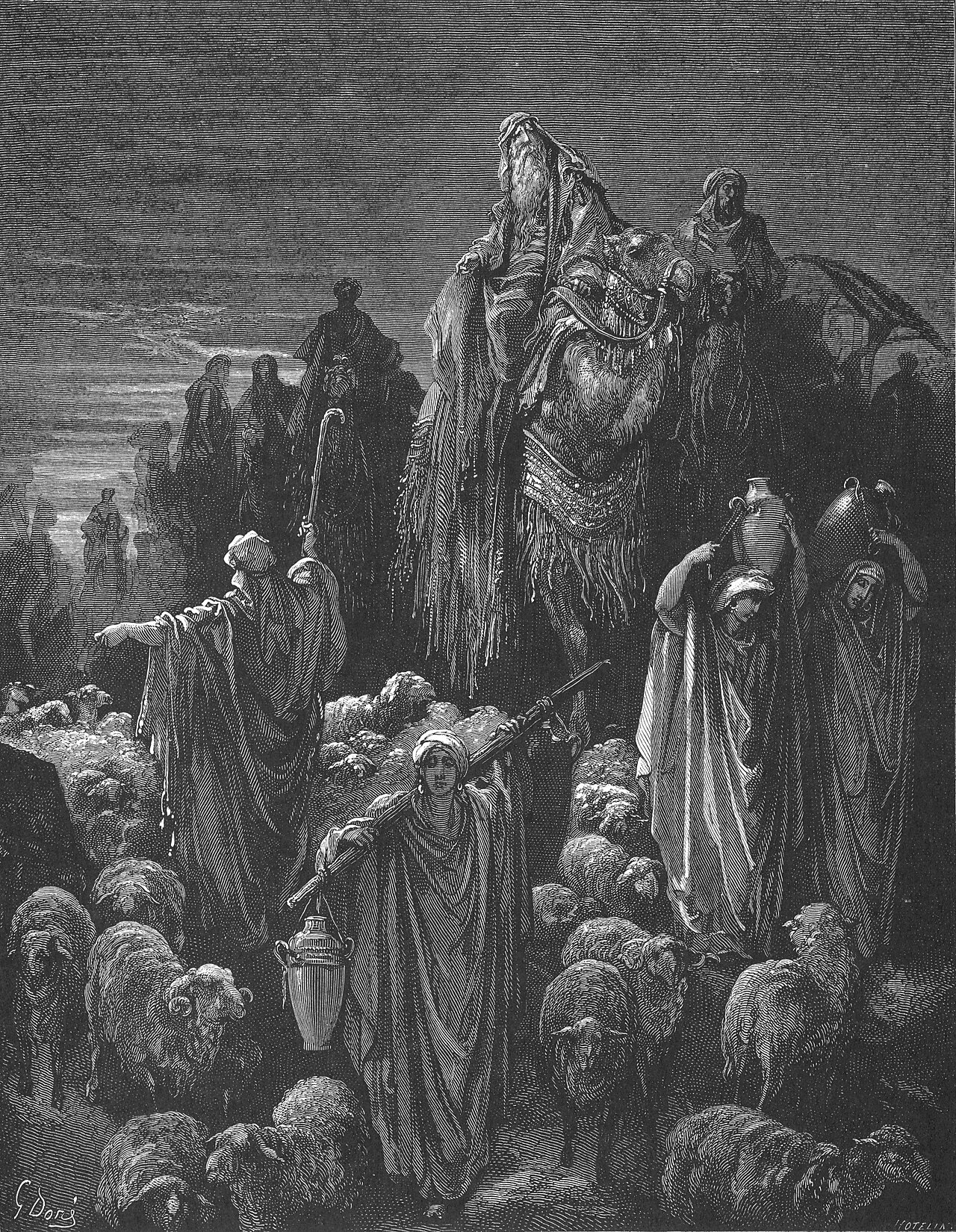
in Genesis 46So Israel set out with all that he had, and when he came to Beersheba, he offered sacrifices to the God of his father Isaac.
BSB
The same verse in ASV and KJV ▾
ASV
And Israel took his journey with all that he had, and came to Beer-sheba, and offered sacrifices unto the God of his father Isaac.
KJV
And Israel took his journey with all that he had, and came to Beer–sheba, and offered sacrifices unto the God of his father Isaac.
⋯
This verse in Genesis 46
Commentary
11 notes on this verseNOTICE in this passage the two names which are mentioned. "Israel took his journey and God spoke unto Israel in the visions of the night and said, Jacob, Jacob." "Jacob" was the name of his weakness—"Israel" was the title of his strength. "Jacob" was the name of his birth-nature—"Israel" was the name of his new and spiritual nature. When Israel set out to go down into Egypt and see his son Joseph, he started in great vigor and strength for an old man—faith made him full of force. Therefore we read, "Israel took his journey."
This site's exposition
he offered sacrifices to the God of his father Isaac
on Genesis 46:1-2
Beersheba is the last town in the land on the road to Egypt, and Israel stops to sacrifice before he crosses out of it. The ground is his father's, where the LORD appeared to Isaac at 26:24 and named himself the God of Abraham. God speaks that night in a vision and calls the old name twice, Jacob, Jacob. He answers, Here I am.
The record, by era
The Church Fathers2 voices
On hearing this, let us learn in whatever we do, whether embarking on some project or beginning a journey, first of all to offer a sacrifice to the Lord in prayer and, by calling on his help to address the matter in hand, thus also imitate these good people's godliness. "He offered a sacrifice to the God of his father, Isaac," the text says, for you to learn that Jacob followed in his father's footsteps and thus demonstrated the reverence for divine things that Isaac had. Because he took the initiative in showing his own right attitude in thanksgiving, at once he felt the influence of grace from on high. I mean, because he had in view the length of the journey and kept in mind his advanced age, Jacob was afraid that death might come upon him before the meeting and rob him of the sight of his son; so he offered prayers to God to grant him life enough to enable him to enjoy this final satisfaction.
It is appropriate, for that person rises up who is hastening to Christ. Faith precedes devotion. First Jacob rose up; later he sacrificed. The man who has searched out the knowledge of God offers a good sacrifice. Now "at night in a vision God spoke to Israel, saying, 'Jacob, Jacob.' He said, 'What is it?' God said, 'I am the God of your fathers, do not fear, go down into Egypt; for there I will make you into a great people, and I will lead you forever.'
The Puritans and the Awakening3 voices
In his devotion he had an eye to God as the God of his father Isaac, that is, a God in covenant with him, for by Isaac the covenant was entailed upon him. He offered sacrifices, extraordinary sacrifices, besides those at his stated times.
And Israel took his journey with all that he had,....
(2.) By way of petition for the presence of God with him in his intended journey; he desired by these sacrifices to make his peace with God, to obtain the forgiveness of sin, that he might take no guilt along with him in this journey, for that is a bad companion. By Christ, the great sacrifice, we must reconcile ourselves to God, and offer up our requests to him.
4 more voices on this verse
The Nineteenth Century4 voices
A commentator
Jamieson, Fausset & Brown1802–1910
Commentary Critical and Explanatory on the Whole Bible (1871)
Israel took his journey with all that he had--that is, his household; for in compliance with Pharaoh's recommendation, he left his heavy furniture behind.
NOTICE in this passage the two names which are mentioned. "Israel took his journey and God spoke unto Israel in the visions of the night and said, Jacob, Jacob." "Jacob" was the name of his weakness—"Israel" was the title of his strength. "Jacob" was the name of his birth-nature—"Israel" was the name of his new and spiritual nature. When Israel set out to go down into Egypt and see his son Joseph, he started in great vigor and strength for an old man—faith made him full of force. Therefore we read, "Israel took his journey." I see the old man revived and stirred up to a high degree of hopeful energy. He traveled some few miles on the first day and reached the well of Beersheba. It was the border town, where stood the well of the oak—after passing Beersheba he would be out of the land of promise and on his way to Egypt. And at the remembrance of this fact, the old trembling came over him and he became Jacob, as at some prior time. When he was to take the decisive step to leave Canaan and make his journey into Egypt, then he suddenly felt himself a Jacob and began to halt upon his thigh. And the Lord in the visions of the night addressed him by the name which was most suitable to his condition, saying to him, "Jacob, Jacob." He did not call him "Israel." He came to him in his infirmity and trial and suited His speech to his condition. The Lord met the weakness of His servant's faith, and sent him consolations fitted rather for Jacob than for Israel. Dear Friends, I am afraid that the lives of many of the Lord's chosen people alternate between "Israel" and "Jacob." Sometimes we are "strong in the Lord and in the power of His might," and at another time we cry, "Who is sufficient for these things?" Like princes we prevail with God and are true Israels. But perhaps before the sun has gone down we limp with Jacob and though the spirit is willing, the flesh is weak.
And came to Beer-sheba - This place appears to be mentioned, not only because it was the way from Hebron, where Jacob resided, to Egypt, whither he was going, but because it was a consecrated place, a place where God had appeared to Abraham, Gen 21:33, and to Isaac, Gen 26:23, and where Jacob is encouraged to expect a manifestation of the same goodness: he chooses therefore to begin his journey with a visit to God’s house; and as he was going into a strange land, he feels it right to renew his covenant with God by sacrifice. There is an old proverb which applies strongly to this case: “Prayers and provender never hinder any man’s journey. He who would travel safely must take God with him.
A commentator
Albert Barnes1798–1870
Notes, Explanatory and Practical, on the Old and New Testaments (1832-1869)
proposed
- Jacob Goes Down to Egypt 9. פלוּא pallû', Pallu, “distinguished.” חצרן chetsrôn, Chetsron, of the “court,” or “village.” כרמי karmı̂y, Karmi, “vine-dresser.” 10. ימוּאל yemû'êl, Jemuel, “day of El.” ימין yâmı̂yn, Jamin, “right hand.” אהד 'ôhad, Ohad, “joining together.” יכין yâkı̂yn, Jakin, “he shall establish.” צחר tsôchar, Tsochar, “whiteness.” 11. גרשׁון gêreshôn, Gereshon, “expelling.” קהת qehâth, Qehath, “assembly.” מררי merârı̂y, Merari, “flowing, bitter.” 12. חמוּל châmûl, Chamul, “pitied, treated with mercy.” 13. תולע tôlâ‛, Tola‘, “worm, scarlet.” פוּה pû'âh, Puvvah, “mouth?” יוב yôb, Job, “enemy?” שׂמרן śı̂mrôn, Shimron, “watch.” 14. סרד sered, Sered, “fear.” אלון 'êlôn, Elon, “oak.” יחלאל yachle'êl, Jachleel, “El shall sicken or inspire with hope.” 16. צפיון tsı̂phyôn, Tsiphjon, “watcher.” חגי chaggı̂y, Chaggi, “festive.” שׁוּני shûnı̂y, Shuni, “quiet.” אצבון 'etsbôn, Etsbon, “toiling?” ערי ‛êrı̂y, ‘Eri, “watcher.” ארודי 'ǎrôdı̂y, Arodi, rover? אראלי 'ar'êlı̂y, Areli, “lion of El?” 17. ימנה yı̂mnâh, Jimnah, “prosperity.” ישׁוה yı̂shvâh, Jishvah, ישׁוי yı̂shvı̂y, Jishvi, “even, level.” בריעה berı̂y‛âh, Beri‘ah, “in evil.” שׂרח śerach, Serach, “overflow.” חבר cheber, Cheber, “fellowship.” מלכיאל malkı̂y'êl Malkiel, “king of EL” 21. בלע bela‛, Bela‘, “devouring.” בכר beker, Beker, “a young camel.” אשׁבל 'ashbêl Ashbel, “short?” גרא gêrâ', Gerah, “a grain.” <נעמן na‛ămân, Na‘aman, “pleasant.” אחי 'êchı̂y Echi, “brotherly?” ראשׁ rô'sh, Rosh, “head.” מפים mûppı̂ym, Muppim, חפים chûppı̂ym, Chuppim, “covering.” ארד 'ard, Ard, “fugitive, rover.” 23. צשׁים chûshı̂ym, Chushim, “haste.” 24. יחצאל yachtse'êl, Jachtseel, “El will divide.” גוּני gûnı̂y, Guni, “dyed.” יצר yêtser, Jetser, “form.” שׂלם śı̂llêm, Shillem, “retribution.” The second dream of Joseph is now to receive its fulfillment. […]
How the passage was read
What the Jewish commentators add
The duty of honoring one’s father is more imperative than that of honoring one’s grandfather. Therefore the sacrifices are associated with the name of Isaac, and not with that of Abraham. Thus the language of Rashi.
1 more on this passage, in their own words ▾
After G-d had told him, Thy name shall not be called any more Jacob, but Israel shall be thy name, 172 Above,:10. it would be proper that He call him by this glorious name, and so he is indeed mentioned three times in this section.
This section is reception history: how the passage was read and kept in the Jewish tradition. Where a reading parts from an essential of the Christian faith, the section says so at that point.
Texts and citation data: Sefaria; each excerpt follows its version’s licence. 3 further sources are cited on this chapter that carry no English text this site may quote or only restate the verse.
The words behind it
13 Hebrew wordsEvery Hebrew word of this verse in the order it stands, with what it means and the door to its own study. The last column counts the times a word stands in the whole Bible: the rarer the word, the more the places it appears belong together.
| Hebrew | Sound | Meaning | Word study | In the Bible |
|---|---|---|---|---|
| וַיִּסַּ֤ע | vaiyisa' | and he set out | H5265 → | 146 times |
| יִשְׂרָאֵל֙ | yisrael | Israel | H3478 → | 2507 times |
| וְכָל־ | vekhol | and all | H3605 → | 5413 times |
| אֲשֶׁר־ | ʾasher- | that | H834 → | 5497 times |
| ל֔וֹ | lo | [belonged] to him | ||
| וַיָּבֹ֖א | vaiyavo' | and he came | H935 → | 2568 times |
| בְּאֵ֣רָה | beerah | Beer towards | H884 → | 68 times |
| שָּׁ֑בַע | shava' | Sheba | H884 → | 68 times |
| וַיִּזְבַּ֣ח | vaiyizbach | and he sacrificed | H2076 → | |
| זְבָחִ֔ים | zevachim | sacrifices | H2077 → | |
| לֵאלֹהֵ֖י | lelohei | to [the] God of | H430 → | 2601 times |
| אָבִ֥יו | ʾaviv | father his | H1 → | 1212 times |
| יִצְחָֽק׃ | yitzchak | Isaac | H3327 → | 108 times |
וַיִּסַּ֤עand he set out
vaiyisa'H5265 →146 times
יִשְׂרָאֵל֙Israel
yisraelH3478 →2507 times
וְכָל־and all
vekholH3605 →5413 times
אֲשֶׁר־that
ʾasher-H834 →5497 times
ל֔וֹ[belonged] to him
lo
וַיָּבֹ֖אand he came
vaiyavo'H935 →2568 times
בְּאֵ֣רָהBeer towards
beerahH884 →68 times
שָּׁ֑בַעSheba
shava'H884 →68 times
וַיִּזְבַּ֣חand he sacrificed
vaiyizbachH2076 →
זְבָחִ֔יםsacrifices
zevachimH2077 →
לֵאלֹהֵ֖יto [the] God of
leloheiH430 →2601 times
אָבִ֥יוfather his
ʾavivH1 →1212 times
יִצְחָֽק׃Isaac
yitzchakH3327 →108 times
A shaded row is a word that stands 400 times or fewer in the Bible.
The walk
8 stopsEach card is a verse this one points to, and under it the verses that one points to in turn. Where several paths arrive at the same place, that place is listed first: the text keeps returning to it.
Through
Genesis 31:42If the God of my father, the God of Abraham and the Fear of Isaac, had not been with me, surely by now you would have sent me away empty-handed. But God has seen…
it leads to
- Psalms 31:7
I will be glad and rejoice in Your loving devotion, for You have seen my affliction; You have known the anguish of my soul.
- Psalms 31:7
Through
Genesis 28:13And there at the top the LORD was standing and saying, “I am the LORD, the God of your father Abraham and the God of Isaac. I will give you and your descendants the…
it leads to
- Genesis 13:15
for all the land that you see, I will give to you and your offspring forever.
- Genesis 35:12
The land that I gave to Abraham and Isaac I will give to you, and I will give this land to your descendants after you.”
- Genesis 48:3
Jacob said to Joseph, “God Almighty appeared to me at Luz in the land of Canaan, and there He blessed me
- Genesis 26:24
and that night the LORD appeared to him and said, “I am the God of your father Abraham. Do not be afraid, for I am with you. I will bless you and multiply your…
- Genesis 35:1
Then God said to Jacob, “Arise, go up to Bethel, and settle there. Build an altar there to the God who appeared to you when you fled from your brother Esau.”
- Genesis 13:15
Through
Genesis 21:33And Abraham planted a tamarisk tree in Beersheba, and there he called upon the name of the LORD, the Eternal God.
it leads to
- 1 Timothy 1:17
Now to the King eternal, immortal, and invisible, the only God, be honor and glory forever and ever. Amen.
- Isaiah 40:28
Do you not know? Have you not heard? The LORD is the everlasting God, the Creator of the ends of the earth. He will not grow tired or weary; His understanding is beyond searching…
- 1 Timothy 1:17
About Genesis
Who and where
2 names in this verse with a page on the site.
This page draws on 10 works. Open the list of works
This page draws on Adam Clarke, Commentary on the Bible; Albert Barnes, Notes, Explanatory and Practical, on the Old and New Testaments (1832-1869); Ambrose of Milan, ON JOSEPH 14.81-82; Charles Spurgeon, The Metropolitan Tabernacle Pulpit, Sermon No. 2116: “The Unchanging God Cheering Jacob in His Change of Dwelling Place” (lightly modernized text, CCEL edition); Jamieson, Fausset & Brown, Commentary Critical and Explanatory on the Whole Bible; John Calvin, Commentary on Genesis; John Chrysostom, HOMILIES ON GENESIS 65.5; John Gill, Exposition of the Old Testament (1748-1763); John Wesley, Explanatory Notes upon the Old Testament and Matthew Henry, Commentary on the Whole Bible.