
2 Samuel 18:9
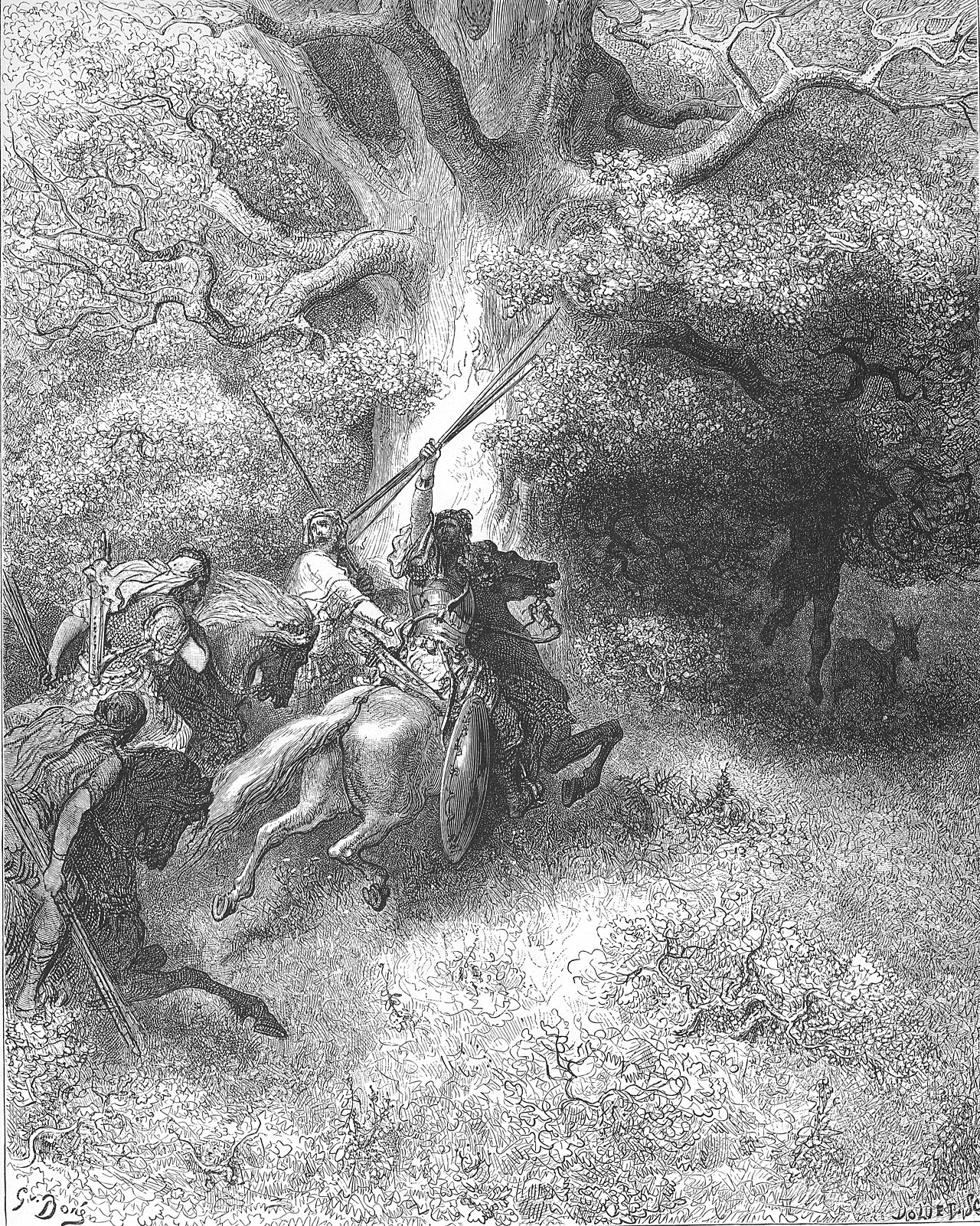
in 2 Samuel 18Now Absalom was riding on his mule when he met the servants of David, and as the mule went under the thick branches of a large oak, Absalom’s head was caught fast in the tree. The mule under him kept going, so that he was suspended in midair.
BSB
The same verse in ASV and KJV ▾
ASV
And Absalom chanced to meet the servants of David. And Absalom was riding upon his mule, and the mule went under the thick boughs of a great oak, and his head caught hold of the oak, and he was taken up between heaven and earth; and the mule that was under him went on.
KJV
And Absalom met the servants of David. And Absalom rode upon a mule, and the mule went under the thick boughs of a great oak, and his head caught hold of the oak, and he was taken up between the heaven and the earth; and the mule that was under him went away.
⋯
This verse in 2 Samuel 18
Commentary
4 notes on this verseA commentator
Albert Barnes1798–1870
Notes, Explanatory and Practical, on the Old and New Testaments (1832-1869)
would seem that the two things which his vain-glory boasted in, the royal mule, and the magnificent head of hair by which he was caught in the “oak” (rather, terebinth or turpentine tree), both contributed to his untimely death.
This site's exposition
taken up between the heaven and the earth
Absalom rides his mule under a great oak and his head catches in the boughs, so that he hangs suspended between heaven and earth while the mule runs on without him. Older writers, reading against 14:26, where his hair was cut once a year and weighed two hundred shekels, take the boughs as catching that same hair rather than his head plainly; Wesley calls it the very pride that made him admired turned into the instrument of his ruin. The verse itself says only that his head caught hold and he was left hanging alive, and the hair reading, old and widely held as it is, goes beyond what the text states outright.
The record, by era
The Puritans and the Awakening1 voice
Thus he that fleeth from the fear shall fall into the pit, and he that getteth up out of the pit shall be taken in the snare, Jer. xlviii. David is inclined to spare him, but divine justice passes sentence upon him as a traitor, and sees it executed--that he hang by the neck, be caught alive, be embowelled, and his body dispose of disgracefully. He is hanged by the neck.
The Nineteenth Century1 voice
A commentator
Jamieson, Fausset & Brown1802–1910
Commentary Critical and Explanatory on the Whole Bible (1871)
"It is necessary to be continually on one's guard against the branches of trees; and when the hair is worn in large locks floating down the back, as was the case with a young man of the party to which I belonged, any thick boughs interposing in the path might easily dislodge a rider from his seat, and catch hold of his flowing hair" [HARTLEY].
The words behind it
27 Hebrew wordsEvery Hebrew word of this verse in the order it stands, with what it means and the door to its own study. The last column counts the times a word stands in the whole Bible: the rarer the word, the more the places it appears belong together.
| Hebrew | Sound | Meaning | Word study | In the Bible |
|---|---|---|---|---|
| וַיִּקָּרֵא֙ | vaiyikare' | and he was met | H7122 → | 139 times |
| אַבְשָׁל֔וֹם | ʾavshalom | Absalom | H53 → | 110 times |
| לִפְנֵ֖י | lifnei | <to> before | H6440 → | 2123 times |
| עַבְדֵ֣י | ʾavdei | [the] servants of | H5650 → | 799 times |
| דָוִ֑ד | david | David | H1732 → | 999 times |
| וְאַבְשָׁל֞וֹם | veavshalom | and Absalom | H53 → | 110 times |
| רֹכֵ֣ב | rokhev | [was] riding | H7392 → | 78 times |
| עַל־ | ʾal- | on | H5921 → | 5755 times |
| הַפֶּ֗רֶד | hapered | the mule | H6505 → | 15 times |
| וַיָּבֹ֣א | vaiyavo' | and it went | H935 → | 2568 times |
| הַפֶּ֡רֶד | hapered | the mule | H6505 → | 15 times |
| תַּ֣חַת | tachat | under | H8478 → | 505 times |
| שׂוֹבֶךְ֩ | soekh | [the] branche[s] of | H7730 → | |
| הָאֵלָ֨ה | haelah | the oak | H424 → | 13 times |
| הַגְּדוֹלָ֜ה | hagedolah | <the> great | H1419 → | 526 times |
| וַיֶּחֱזַ֧ק | vaiyechezak | and it was firm | H2388 → | 291 times |
| רֹאשׁ֣וֹ | rosho | head his | H7218 → | 599 times |
| בָאֵלָ֗ה | vaelah | in the oak | H424 → | 13 times |
| וַיֻּתַּן֙ | vaiyutan | and he was put | H5414 → | 2011 times |
| בֵּ֤ין | bein | between | H996 → | 407 times |
| הַשָּׁמַ֙יִם֙ | hashamayim | the heavens | H8064 → | 421 times |
| וּבֵ֣ין | uvein | and between | H996 → | 407 times |
| הָאָ֔רֶץ | haaretz | the earth | H776 → | 2504 times |
| וְהַפֶּ֥רֶד | vehapered | and the mule | H6505 → | 15 times |
| אֲשֶׁר־ | ʾasher- | which | H834 → | 5497 times |
| תַּחְתָּ֖יו | tachtav | [was] under him | H8478 → | 505 times |
| עָבָֽר׃ | ʾavar | it passed on | H5674 → | 556 times |
וַיִּקָּרֵא֙and he was met
vaiyikare'H7122 →139 times
אַבְשָׁל֔וֹםAbsalom
ʾavshalomH53 →110 times
לִפְנֵ֖י<to> before
lifneiH6440 →2123 times
עַבְדֵ֣י[the] servants of
ʾavdeiH5650 →799 times
דָוִ֑דDavid
davidH1732 →999 times
וְאַבְשָׁל֞וֹםand Absalom
veavshalomH53 →110 times
רֹכֵ֣ב[was] riding
rokhevH7392 →78 times
עַל־on
ʾal-H5921 →5755 times
הַפֶּ֗רֶדthe mule
haperedH6505 →15 times
וַיָּבֹ֣אand it went
vaiyavo'H935 →2568 times
הַפֶּ֡רֶדthe mule
haperedH6505 →15 times
תַּ֣חַתunder
tachatH8478 →505 times
שׂוֹבֶךְ֩[the] branche[s] of
soekhH7730 →
הָאֵלָ֨הthe oak
haelahH424 →13 times
הַגְּדוֹלָ֜ה<the> great
hagedolahH1419 →526 times
וַיֶּחֱזַ֧קand it was firm
vaiyechezakH2388 →291 times
רֹאשׁ֣וֹhead his
roshoH7218 →599 times
בָאֵלָ֗הin the oak
vaelahH424 →13 times
וַיֻּתַּן֙and he was put
vaiyutanH5414 →2011 times
בֵּ֤יןbetween
beinH996 →407 times
הַשָּׁמַ֙יִם֙the heavens
hashamayimH8064 →421 times
וּבֵ֣יןand between
uveinH996 →407 times
הָאָ֔רֶץthe earth
haaretzH776 →2504 times
וְהַפֶּ֥רֶדand the mule
vehaperedH6505 →15 times
אֲשֶׁר־which
ʾasher-H834 →5497 times
תַּחְתָּ֖יו[was] under him
tachtavH8478 →505 times
עָבָֽר׃it passed on
ʾavarH5674 →556 times
A shaded row is a word that stands 400 times or fewer in the Bible.
The walk
8 stopsEach card is a verse this one points to, and under it the verses that one points to in turn. Where several paths arrive at the same place, that place is listed first: the text keeps returning to it.
Through
Proverbs 30:17As for the eye that mocks a father and scorns obedience to a mother, may the ravens of the valley pluck it out and young vultures devour it.
it leads to
- Deuteronomy 21:18–21
If a man has a stubborn and rebellious son who does not obey his father and mother and does not listen to them when disciplined,
Reached by 2 separate paths from here.
- Proverbs 30:11
There is a generation of those who curse their fathers and do not bless their mothers.
- Proverbs 23:22
Listen to your father who gave you life, and do not despise your mother when she is old.
- 2 Samuel 18:14–17
But Joab declared, “I am not going to wait like this with you!” And he took three spears in his hand and thrust them through the heart of Absalom while he was still alive…
- Leviticus 20:9
If anyone curses his father or mother, he must be put to death. He has cursed his father or mother; his blood shall be upon him.
- Deuteronomy 21:18–21
Through
Deuteronomy 27:16‘Cursed is he who dishonors his father or mother.’ And let all the people say, ‘Amen!’
it leads to
- Leviticus 19:3
Each of you must respect his mother and father, and you must keep My Sabbaths. I am the LORD your God.
- Exodus 21:17
Anyone who curses his father or mother must surely be put to death.
- Leviticus 19:3
Through
Job 31:3Does not disaster come to the unjust and calamity to the workers of iniquity?
it leads to
- Job 21:30
Indeed, the evil man is spared from the day of calamity, delivered from the day of wrath.
- Job 21:30
Where this verse is studied
On this page
Studies1
About 2 Samuel
Who and where
1 name in this verse with a page on the site.
This page draws on Albert Barnes, Notes, Explanatory and Practical, on the Old and New Testaments (1832-1869); Albert Barnes, Notes on the Old Testament; Jamieson, Fausset & Brown, Commentary Critical and Explanatory on the Whole Bible; John Wesley, Explanatory Notes upon the Old Testament and Matthew Henry, Commentary on the Whole Bible.