
Mark 4:39
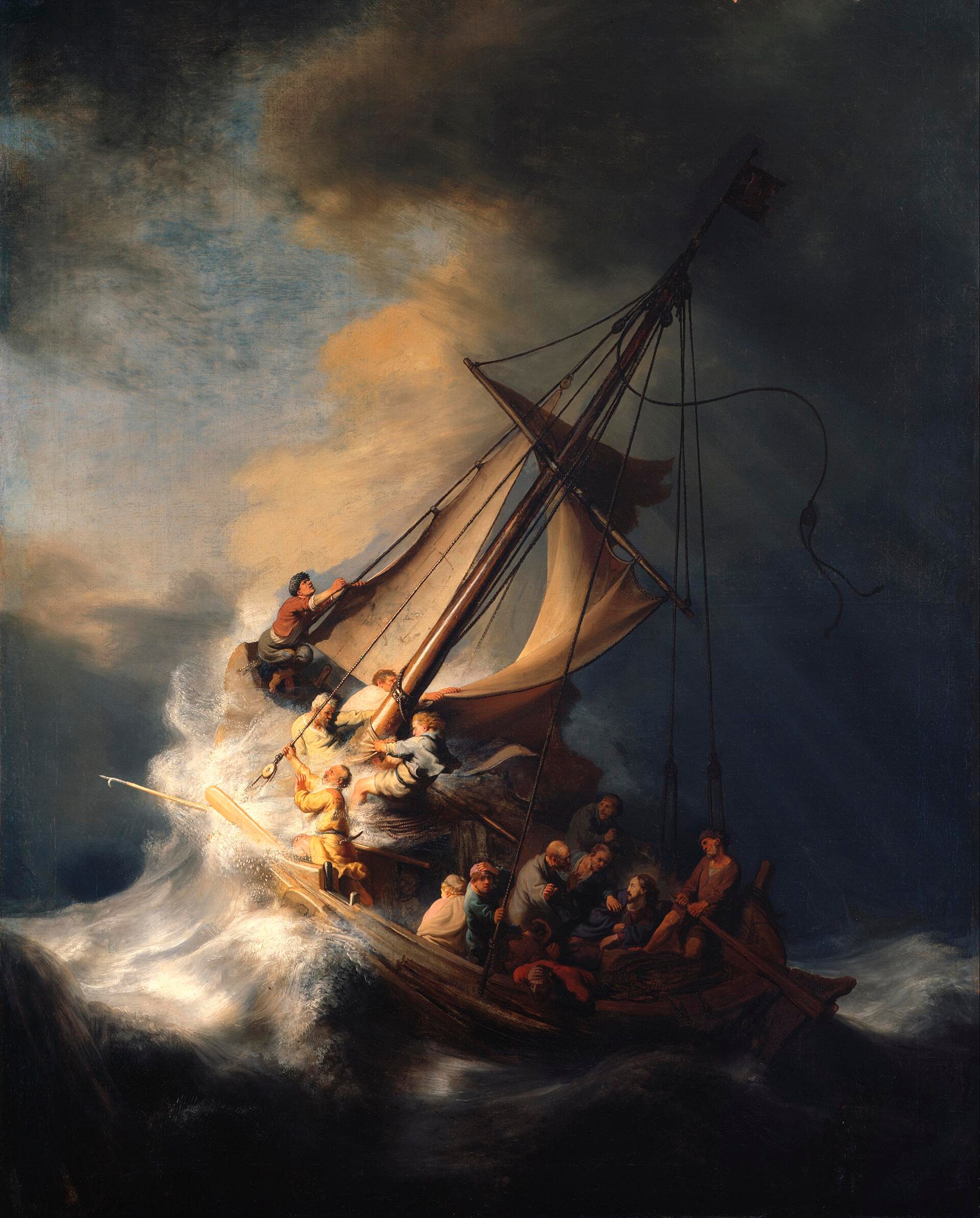
in Mark 4Then Jesus got up and rebuked the wind and the sea. “Silence!” He commanded. “Be still!” And the wind died down, and it was perfectly calm.
BSB
The same verse in ASV and KJV ▾
ASV
And he awoke, and rebuked the wind, and said unto the sea, Peace, be still. And the wind ceased, and there was a great calm.
KJV
And he arose, and rebuked the wind, and said unto the sea, Peace, be still. And the wind ceased, and there was a great calm.
⋯
This verse in Mark 4
Commentary
16 notes on this versePay close attention to the Lord's words; whenever he instructs us about the Father, he knows that by using terms of personal authority, such as "I will; be clean"; and "Peace! Be still!" and "But I say to you"; and "You deaf and dumb spirit, I command you";18 and other similar expressions, we will be led to recognize his authority as master and creator. By these encounters we are meeting the Father of the Son, the Father who creates through the Son.
This site's exposition
rebuked the wind and the sea
Then Jesus got up and rebuked the wind and the sea, and He commands the sea to be silent and still. Mark uses the same verb rebuked when Jesus silences the unclean spirit at 1:25, so the storm is handled as a hostile power. Then the wind died down, and it was perfectly calm, a calm that is total and immediate.
The record, by era
The Church Fathers1 voice
When he disperses its waves, Habakkuk's words are fulfilled, where he speaks of the Lord "scattering the waters in his passage." When at his rebuke the sea is calmed, Nahum's prophesy is fulfilled: "He rebukes the sea and makes it dry."
The Medieval Church4 voices
(ubi sup.) Or else the ship into which He embarked, is taken to mean the tree of His passion, by which the faithful attain to the security of the safe shore. The other ships which are said to have been with the Lord, signify those, who are imbued with faith in the cross of Christ, and are not beaten about by the whirlwind of tribulation; or who, after the storms of temptation, are enjoying the serenity of peace.
And rising, he rebuked the wind, and said to the sea: Peace, be still. And the wind ceased, and there was a great calm. Indeed, rising, he rebuked the wind, because he subdued the pride of the devil, who had the power of death, while …
(non occ.) For from the troubling of the sea there arises a certain sound, which appears to be its voice threatening danger, and therefore, by a sort of metaphor, He fitly commands tranquillity by a word signifying silence: just as in the restraining of the winds, which trouble the sea with their violence, He uses a rebuke. For men who are in power are accustomed to curb those, who rudely disturb the peace of mankind, by threatening to punish them; by this, therefore, we are given to understand, that, as a king can repress violent men by threats, and by his edicts sooth the murmurs of his people, so Christ, the King of all creatures, by His threats restrained the violence of the winds, and compelled the sea to be silent. And immediately the effect followed, for it continues, And the wind ceased, which He had threatened, and there arose a great calm, that is, in the sea, to which He had commanded silence.
After His teaching, they come from that place to the sea, and are tossed by the waves. Wherefore it is said, And the same day, when the even was come, &c. Mystically, however, the hinder part of the ship is the beginning of the Church, in which the Lord sleeps in the body only, for He never sleepeth who keepeth Israel; for the ship with its skins of dead animals keeps in the living, and keeps out the waves, and is bound together by wood, that is, by the cross and the death of the Lord the Church is saved. The pillow is the body of the Lord, on which His Divinity, which is as His head, has come down. But the wind and the sea are devils and persecutors, to whom He says Peace, when He restrains the edicts of impious kings, as He will. The great calm is the peace of the Church after oppression, or a contemplative after an active life.
9 more voices on this verse
The Medieval Church2 voices
Having awakened, Christ rebukes first the wind, since it is the cause of the agitation of the sea, and then calms the sea as well.
But He arising, rebukes first the wind, which was raising the tempest of the sea, and causing the waves to swell, and this is expressed in what follows, And he arose, and rebuked the wind; then He commands the sea; wherefore it goes on, And he said to the sea, Peace, be still.
The Puritans and the Awakening3 voices
11 And he said unto them, Unto you it is given to know the mystery of the kingdom of God: but unto them that are without, all these things are done in parables: 12 That seeing they may see, and not perceive; and hearing they may hear, and not understand; lest at any time they should be converted, and their sins should be forgiven them.
quarantine:scripture (2026-07-29) — verbatim-scripture
And he arose and rebuked the wind,....
It was out of the way, when they had occasion for it, and so it was as if they had not had it. " How is it, that in this matter ye have no faith, that ye think I would not come in with seasonable and effectual relief?" Those may suspect their faith, who can entertain such a thought as that Christ careth not though his people perish, and Christ justly takes it ill.
The Nineteenth Century4 voices
Peace, be still - Be silent! Be still! There is uncommon majesty and authority in these words. Who but God could act thus? Perhaps this salvation of his disciples in the boat might be designed to show forth that protection and deliverance which Christ will give to his followers, however violently they may be persecuted by earth or hell. At least, this is a legitimate use which may be made of this transaction.
A commentator
J.C. Ryle1816–1900
Expository Thoughts on the Gospels: Mark (lightly modernized text, Grace Gems edition) (1857)
These verses describe a storm on the sea of Galilee, when our Lord and His disciples were crossing it, and a miracle performed by our Lord in calming the storm in a moment. Few miracles recorded in the Gospel were so likely to strike the minds of the apostles as this. Four of them at least were fishermen. Peter, Andrew, James, and John, had probably known the sea of Galilee, and its storms, from their youth. Few events in our Lord's journeyings to and fro upon earth, contain more rich instruction than the one related in this passage.
A commentator
Jamieson, Fausset & Brown1802–1910
Commentary Critical and Explanatory on the Whole Bible (1871)
And the wind ceased, and there was a great calm--The sudden hushing of the wind would not at once have calmed the sea, whose commotion would have settled only after a considerable time. But the word of command was given to both elements at once.
A commentator
J.C. Ryle1816–1900
Expository Thoughts on the Gospels: Mark (lightly modernized text, Grace Gems edition) (1857)
proposed
These verses describe a storm on the sea of Galilee, when our Lord and His disciples were crossing it, and a miracle performed by our Lord in calming the storm in a moment. Few miracles recorded in the Gospel were so likely to strike the minds of the apostles as this. Four of them at least were fishermen. Peter, Andrew, James, and John, had probably known the sea of Galilee, and its storms, from their youth. Few events in our Lord's journeyings to and fro upon earth, contain more rich instruction than the one related in this passage. Let us learn, in the first place, that Christ's service does not exempt His servants from storms . Here were the twelve disciples in the path of duty. They were obediently following Jesus, wherever He went. They were daily attending on His ministry, and hearkening to His word. They were daily testifying to the world, that, whatever Scribes and Pharisees might think, they believed on Jesus, loved Jesus, and were not ashamed to give up all for His sake. Yet here we see these men in trouble, tossed up and down by a tempest, and in danger of being drowned. Let us mark well this lesson. If we are true Christians, we must not expect everything smooth in our journey to heaven. We must count it no strange thing, if we have to endure sicknesses, losses, bereavements, and disappointments, just like other men. Free pardon and full forgiveness, grace along the way, and glory at the end — all this our Savior has promised to give. But He has never promised that we shall have no affliction. He loves us too well to promise that. By affliction He teaches us many precious lessons, which without it we should never learn. By affliction He shows us our emptiness and weakness, draws us to the throne of grace, purifies our affections, weans us from the world, makes us long for heaven.
The words behind it
19 Greek wordsEvery Greek word of this verse in the order it stands, with what it means and the door to its own study. The last column counts the times a word stands in the whole Bible: the rarer the word, the more the places it appears belong together.
| Greek | Sound | Meaning | Word study | In the Bible |
|---|---|---|---|---|
| καὶ | kai | And | G2532 → | 9120 times |
| διεγερθεὶς | diegertheis | having been awoken | G1326 → | |
| ἐπετίμησεν | epetimesen | He rebuked | G2008 → | 29 times |
| τῷ | to | the | G3588 → | 19766 times |
| ἀνέμῳ | anemo | wind | G417 → | 31 times |
| καὶ | kai | and | G2532 → | 9120 times |
| εἶπεν | eipen | said | G2036 → | 925 times |
| τῇ | tea | to the | G3588 → | 19766 times |
| θαλάσσῃ· | thalasse | sea; | G2281 → | 90 times |
| σιώπα, | siopa | Silence! | G4623 → | 10 times |
| πεφίμωσο. | pephimoso | you must be still! | G5392 → | |
| καὶ | kai | And | G2532 → | 9120 times |
| ἐκόπασεν | ekopasen | abated | G2869 → | |
| ὁ | ho | the | G3588 → | 19766 times |
| ἄνεμος, | anemos | wind, | G417 → | 31 times |
| καὶ | kai | and | G2532 → | 9120 times |
| ἐγένετο | egeneto | there was | G1096 → | 667 times |
| γαλήνη | galene | a calm | G1055 → | |
| μεγάλη.¶ | megale | great. | G3173 → | 243 times |
καὶAnd
kaiG2532 →9120 times
διεγερθεὶςhaving been awoken
diegertheisG1326 →
ἐπετίμησενHe rebuked
epetimesenG2008 →29 times
τῷthe
toG3588 →19766 times
ἀνέμῳwind
anemoG417 →31 times
καὶand
kaiG2532 →9120 times
εἶπενsaid
eipenG2036 →925 times
τῇto the
teaG3588 →19766 times
θαλάσσῃ·sea;
thalasseG2281 →90 times
σιώπα,Silence!
siopaG4623 →10 times
πεφίμωσο.you must be still!
pephimosoG5392 →
καὶAnd
kaiG2532 →9120 times
ἐκόπασενabated
ekopasenG2869 →
ὁthe
hoG3588 →19766 times
ἄνεμος,wind,
anemosG417 →31 times
καὶand
kaiG2532 →9120 times
ἐγένετοthere was
egenetoG1096 →667 times
γαλήνηa calm
galeneG1055 →
μεγάλη.¶great.
megaleG3173 →243 times
A shaded row is a word that stands 400 times or fewer in the Bible.
The walk
8 stopsEach card is a verse this one points to, and under it the verses that one points to in turn. Where several paths arrive at the same place, that place is listed first: the text keeps returning to it.
Through
Psalms 89:9You rule the raging sea; when its waves mount up, You still them.
it leads to
- Psalms 65:7
You stilled the roaring of the seas, the pounding of their waves, and the tumult of the nations.
Reached by 2 separate paths from here.
- Mark 4:41
Overwhelmed with fear, they asked one another, “Who is this, that even the wind and the sea obey Him?”
Reached by 2 separate paths from here.
- Psalms 93:3–4
The floodwaters have risen, O LORD; the rivers have raised their voice; the seas lift up their pounding waves.
Reached by 2 separate paths from here.
- Psalms 107:25–29
For He spoke and raised a tempest that lifted the waves of the sea.
- Matthew 8:24–27
Suddenly a violent storm came up on the sea, so that the boat was engulfed by the waves; but Jesus was sleeping.
- Psalms 65:7
Through
Psalms 107:29He calmed the storm to a whisper, and the waves of the sea were hushed.
it leads to
- Psalms 89:9
You rule the raging sea; when its waves mount up, You still them.
Reached by 2 separate paths from here.
- Matthew 8:26
“You of little faith,” Jesus replied, “why are you so afraid?” Then He got up and rebuked the winds and the sea, and it was perfectly calm.
- Psalms 89:9
Through
Jeremiah 5:22Do you not fear Me?” declares the LORD. “Do you not tremble before Me, the One who set the sand as the boundary for the sea, an enduring barrier it cannot cross? The waves…
it leads to
- Job 38:10–11
when I fixed its boundaries and set in place its bars and doors,
- Job 38:10–11
Where this verse is studied
On this page
Studies5
About Mark
This page draws on 14 works. Open the list of works
This page draws on Adam Clarke, Commentary on the Bible; Basil of Caesarea, ON THE HOLY SPIRIT 8.21; Bede, Catena Aurea by Aquinas; Bede, On the Gospel of Mark; Glossa Ordinaria, Catena Aurea by Aquinas; J.C. Ryle, Expository Thoughts on the Gospels: Mark (lightly modernized text, Grace Gems edition); Jamieson, Fausset & Brown, Commentary Critical and Explanatory on the Whole Bible; John Gill, Exposition of the New Testament; John Gill, Exposition of the New Testament (1746-1748); Matthew Henry, Commentary on the Whole Bible; Pseudo-Jerome, Catena Aurea by Aquinas; Tertullian, AGAINST MARCION 4.20; Theophylact of Ohrid, Commentary on Mark and Theophylact of Ohrid, Catena Aurea by Aquinas.