
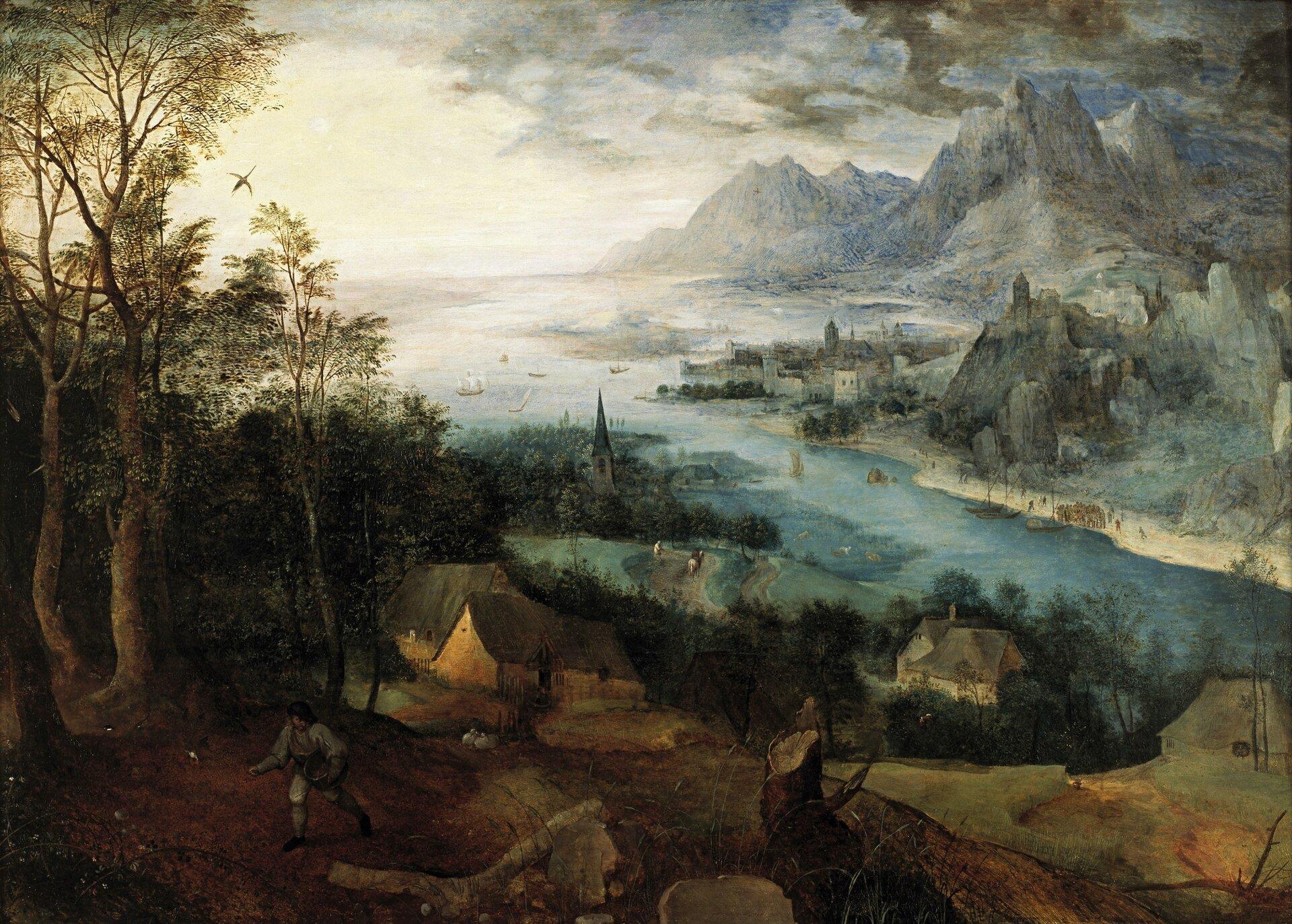
Pieter Bruegel the Elder, Landscape with the Parable of the Sower, 1557. Public domain.
Luke 8:4 to 15 · Passage · Featured Study
The Parable of the Sower
Matthew, Mark and Luke each give this parable with Jesus's own explanation of it.
Now this is the meaning of the parable: The seed is the word of God.
- The passage
- Luke 8:4 to 15, Mark 4:1 to 20, Matthew 13:1 to 23
- Books
- Luke, Mark, Matthew
- Hold in memory
- Luke 8:15, Isaiah 55:11
On the last ground the seed returns as much as a hundredfold.
Summary
The parable of the sower is a story Jesus told about a farmer whose seed fell on four kinds of ground: a path, rocky ground, ground among thorns and good soil. Jesus explained it Himself. The seed is the word of God, and the four kinds of ground are four kinds of people who hear it. Some lose the word at once, and some fall away when testing comes. Some are choked by the worries and riches of this life, and some hold on to it and bear a crop.
- Mark and Matthew give the good soil three harvests, and Luke gives it one.
- Jerome tied the three harvests to three ways of life.
- Teachers of the church differ over who the sower is and over the three harvests.
What the Parable Means
The explanation Jesus gave is the key He gave to every other parable.
Jesus gave this explanation in private, when His disciples asked Him about the parable. The seed is God's word and the ground is the heart that hears it. Three of the grounds lose the seed, each at a different time, and only the last keeps it to harvest.
In Mark, Jesus told the Twelve that this parable opens the rest. He asked how they would understand any of the parables if they did not understand this one (Mark 4:13).
Four Kinds of Ground
Each ground in the story has its meaning in Jesus's explanation.
Three grounds lose the seed at three different times, and only the good soil keeps it to harvest.
| The ground | What happened to the seed | The meaning Jesus gives |
|---|---|---|
| Along the path | It was trampled, and the birds ate it (Luke 8:5) | "the devil comes and takes away the word from their hearts" |
| On rocky ground | It came up and withered for lack of moisture (Luke 8:6) | "They believe for a season, but in the time of testing, they fall away." |
| Among thorns | The thorns grew up with it and choked it (Luke 8:7) | "choked by the worries, riches, and pleasures of this life" |
| On good soil | It sprang up and gave a crop, a hundredfold (Luke 8:8) | "cling to it, and by persevering produce a crop" |
Three Tellings of One Parable
The three Gospels agree on the story and differ in the setting and in a few words.
Each Gospel gives the same four grounds and sets the scene and the harvest in its own words.
| What the telling gives | Luke | Mark | Matthew |
|---|---|---|---|
| The setting | Crowds came to Him from town after town (Luke 8:4). | He taught from a boat beside the sea (Mark 4:1). | He sat in a boat, and the crowds stood on the shore (Matthew 13:2). |
| The good soil | Luke names a noble and good heart (Luke 8:15). | Mark says they hear the word and receive it (Mark 4:20). | Matthew says the hearer understands it (Matthew 13:23). |
| The harvest | Luke gives one yield, a hundredfold (Luke 8:8). | Mark gives thirty, sixty and a hundredfold (Mark 4:20). | Matthew gives a hundred, sixty and thirtyfold (Matthew 13:23). |
Between the parable and its explanation stands Jesus's answer on why He spoke in parables, with words from Isaiah (Matthew 13:10 to 15).
Seed, Soil and Harvest
The Old Testament had already compared God's word to rain that brings a harvest.
For just as rain and snow fall from heaven and do not return without watering the earth, making it bud and sprout, and providing seed to sow and food to eat, so My word that proceeds from My mouth will not return to Me empty, but it will accomplish what I please, and it will prosper where I send it.Isaiah gives God's word the work that rain does for a field.
Now Isaac sowed seed in the land, and that very year he reaped a hundredfold. And the LORD blessed him,Isaac's harvest is the one hundredfold crop in the Old Testament, and Genesis gives it as the LORD's blessing.
Jamieson, Fausset and Brown called a hundredfold a rare return in ordinary farming, though Isaac's harvest shows it was known.
Thomas Aquinas, on Matthew 13:8, raised the objection that a farmer who sowed on a path and on rock would be foolish. He answered that the parable is about the soil of the heart, so the objection does not hold.
How Each Ground Hears
Cyril and Gregory applied two of the grounds to the hearers of their own day.
Cyril of Alexandria (died 444)
Cyril of Alexandria saw the rocky ground in those who came gladly to church and failed under persecution.
“For when they enter the Church they gladly wait on the divine mysteries, but with infirmity of purpose. But when they leave the Church they forget the sacred discipline, and as long as Christians are undisturbed, their faith is lasting; but when persecution harasses, their heart fails them, for their faith was without root.”
Cyril of Alexandria · Catena Aurea by Aquinas · on Luke 8:13Patristic
Gregory the Dialogist (died 604)
Gregory the Dialogist, preaching on the thorns, asked who would have believed him had he called riches thorns on his own word.
“For who would ever have believed me if I had wished to interpret thorns as riches, especially since the former prick while the latter delight? And yet they are thorns, because they tear the mind with the prickings of their thoughts, and when they drag it all the way to sin, they cause it to bleed as if by an inflicted wound. These, in this passage, as another evangelist attests, the Lord calls not simply riches, but deceitful riches, and rightly so.”
Gregory the Dialogist · Forty Gospel Homilies, Homily 15 · on Luke 8:7Patristic
Two Questions Readers Ask
Gill and Jamieson, Fausset and Brown part over the sower, and Jerome parts from Cyril and Henry on the harvests.
The sower is Christ firstJohn Gill, Exposition of the New Testament, on Luke 8:5
John Gill held that Christ is chiefly meant by the sower. The words are true, he added, of every preacher Christ sends. He drew it from the words his seed, which he read as naming Christ the owner of the word (Luke 8:5).
The objection: Jamieson, Fausset and Brown give the sowing to the preachers Christ sends.
The sower is every preacher of the wordJamieson, Fausset and Brown, on Mark 4:14
“Each of these has his agents among men themselves; and Christ's agents in the sowing of the good seed are the preachers of the word. Thus, as in all the cases about to be described, the sower is the same, and the seed is the same; while the result is entirely different, the whole difference must lie in the soils, which mean the different states of the human heart.”
Jamieson, Fausset & Brown · Commentary Critical and Explanatory on the Whole Bible · on Mark 4:14Reformed
The objection: Jesus's explanation leaves the sower unnamed and speaks of the seed and the soils (Mark 4:14).
The yields are degrees of fruit among true hearersCyril of Alexandria, Commentary on Luke, Sermon 41; Matthew Henry, on Matthew 13:23
“Observe therefore, that just as Christ described three degrees of loss, so similarly the degrees of success are equal in number. For those seeds that fall upon the pathway are snatched away by the birds: and those upon the rocks, having merely shot up, within a little while wither away: and those among the thorns are choked. But that desirable land brings forth fruit in three several degrees, as I said: a hundred, sixty, and thirtyfold.”
Cyril of Alexandria · Commentary on the Gospel of Luke, Sermon 41 · on Mark 4:8Patristic
Matthew Henry drew from the three numbers that where there is true grace there are still degrees of it.
The objection: Luke gives only the hundredfold (Luke 8:8), so the three degrees rest on Mark and Matthew.
The yields are three states of lifeJerome, Letter 48, in the Catena Aurea on Matthew 13:23
Jerome, as Thomas Aquinas gathers him, read the three yields by the signs the numbers made on the fingers. He gave the sixtyfold to widows and the hundredfold to the crown of virginity. He read the sign for the remaining number, made with joined hands, as husband and wife.
The objection: in all three Gospels Jesus ties the crop to hearing and keeping the word (Luke 8:15).
Those Who Hear and Carry It Out
Luke follows the parable with two sayings on hearing.
Pay attention, therefore, to how you listen. Whoever has will be given more, but whoever does not have, even what he thinks he has will be taken away from him.”Jesus turns the parable into a charge to every hearer.
But He replied, “My mother and brothers are those who hear the word of God and carry it out.”Luke ends this part of his Gospel with Jesus's word about His own family.
Sources
Scripture is the Berean Standard Bible.
- Cyril of Alexandria, Commentary on Luke, Sermon 41 (fifth century)
- Thomas Aquinas, Catena Aurea on Luke 8, gathering Cyril of Alexandria.
- Thomas Aquinas, Catena Aurea on Matthew 13, gathering Jerome, Letter 48.
- Gregory the Dialogist, Forty Gospel Homilies, Homily 15 (Gregory died in 604)
- Thomas Aquinas, Commentary on Matthew, on Matthew 13:8.
- John Gill, Exposition of the New Testament (1746 to 1748), on Luke 8:5.
- Matthew Henry, Commentary on the Whole Bible (1710), on Matthew 13:23.
- Jamieson, Fausset and Brown, Commentary Critical and Explanatory on the Whole Bible (1871), on Mark 4:14 and 4:20.
Keep Studying
Read it4