
2 Samuel 12:8
in 2 Samuel 12I gave your master’s house to you and your master’s wives into your arms. I gave you the house of Israel and Judah, and if that was not enough, I would have given you even more.
BSB
The same verse in ASV and KJV ▾
ASV
and I gave thee thy master’s house, and thy master’s wives into thy bosom, and gave thee the house of Israel and of Judah; and if that had been too little, I would have added unto thee such and such things.
KJV
And I gave thee thy master’s house, and thy master’s wives into thy bosom, and gave thee the house of Israel and of Judah; and if that had been too little, I would moreover have given unto thee such and such things.
⋯
This verse in 2 Samuel 12
Commentary
8 notes on this verseThy master’s wives into thy bosom - Perhaps this means no more than that he had given him absolute power over every thing possessed by Saul; and as it was the custom for the new king to succeed even to the wives and concubines, the whole harem of the deceased king, so it was in this case; and the possession of the wives was a sure proof that he had got all regal rights. But could David, as the son-in-law of Saul, take the wives of his father-in-law?
This site's exposition
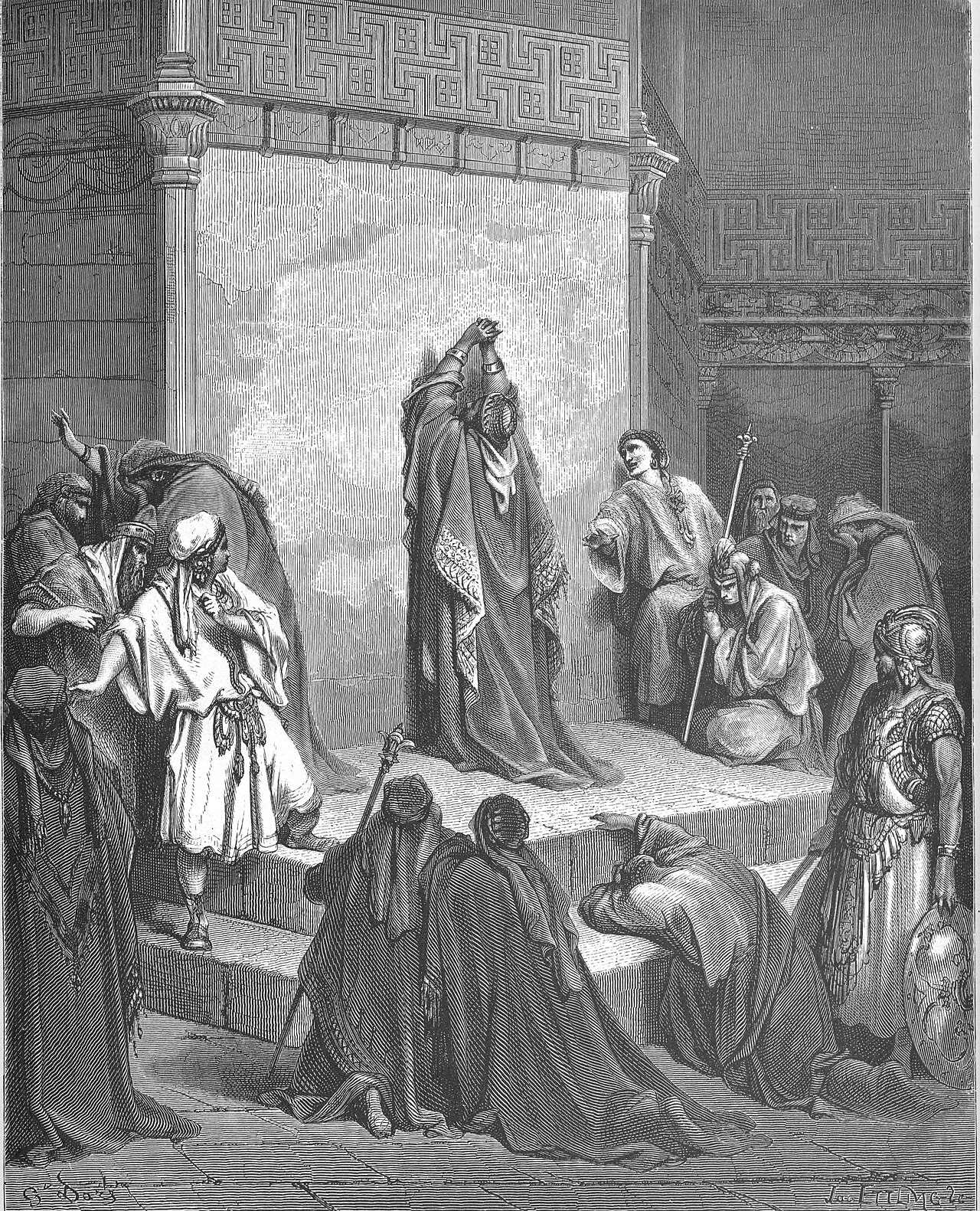
Thou art the man
on 2 Samuel 12:7-9
Thou art the man is Nathan's whole reply, and the phrase occurs nowhere else in Scripture, the parable's judge becoming the accused in three words. Nathan recites what the Lord had given David, the kingdom, the house of Israel and Judah, and more besides for the asking, before naming what David took that was never his to take. The charge is put in the sharpest terms the text allows, thou hast killed Uriah the Hittite with the sword and hast taken his wife, with the Ammonite blade named only as the instrument David chose. Jamieson Fausset and Brown read the rebuke as necessary precisely because David's public standing made a private sin into a public wound on the name of the Lord.
This site's exposition
your master’s wives into your arms
Barnes says the royal harem passed with the throne to the next king by Eastern custom. Jamieson, Fausset and Brown say God gave David all that had been Saul's. Clarke asks whether Saul's son-in-law could take Saul's wives.
The record, by era
The Church Fathers1 voice
A commentator
John ChrysostomHOMILIES ON REPENTANCE AND ALMSGIVING 2.2.9 · Written in the 5th century.
proposed
Therefore, Nathan went to David and wove a dramatic act for judgment. And what did he say? "My king, I want your judgment. There was a certain rich man and a certain poor one. The rich person possessed herds of cattle and many other flocks; and the poor one had one ewe that drank from his glass, ate from his table and slept in his embrace." Here Nathan revealed the genuine bond between a husband and wife. "When a certain stranger arrived, the rich man desired to keep his own animals, and he took the poor man's ewe and slaughtered her." Here, do you see how Nathan wove the dramatic act, mysteriously concealing the weapon in the glands of David's throat? Then what did the king say? Thinking that he had to pass judgment against someone else, he decided most severely. For such are human beings. When it concerns other people, they gladly and abruptly render decisions and publicize them. And what did David say? "As the Lord lives, the man who did this thing is worthy of death. And he shall restore the lamb fourfold." Therefore, what did Nathan reply? He did not allow the wound to be relieved for many hours; rather, he quickly stripped it naked and sharply embedded the knife deeply into it, so as not to rob it of the painful sensation. "You are the man, my king." What did the king say? "I have sinned against the Lord." He did not say, "Who are you who censures me? Who sent you to speak with such boldness? With what daring did you prevail?" He did not say anything of the sort; rather, he perceived the sin. And what did he say? "I have sinned against the Lord." Therefore, what did Nathan say to him? "And the Lord remitted your sin." You condemned yourself; I [God] remit your sentence. You confessed prudently; you annulled the sin. You appropriated a condemnatory decision against yourself; I repealed the sentence. […]
The Puritans and the Awakening2 voices
And I gave thee thy master's house,....
It is ungrateful to covet what God has prohibited, while we have liberty to pray for what God has promised, and that is enough. (2.) He charges him with a high contempt of the divine authority, in the sins he had been guilty of: Wherefore hast thou (presuming upon thy royal dignity and power) despised the commandment of the Lord?
The Nineteenth Century2 voices
A commentator
Jamieson, Fausset & Brown1802–1910
Commentary Critical and Explanatory on the Whole Bible (1871)
proposed
I gave thee thy master's house, and thy master's wives--The phraseology means nothing more than that God in His providence had given David, as king of Israel, everything that was Saul's.
quarantine:scripture (2026-07-29) — scripture-overlap:83%@v3-8
A commentator
Albert Barnes1798–1870
Notes, Explanatory and Practical, on the Old and New Testaments (1832-1869)
proposed
And thy master’s wives ... - According to Eastern custom, the royal harem was a part of the royal inheritance. The prophets spoke in such matters according to the received opinions of their day, and not always according to the abstract rule of right. (Compare Mat 19:4-9.)
The words behind it
21 Hebrew wordsEvery Hebrew word of this verse in the order it stands, with what it means and the door to its own study. The last column counts the times a word stands in the whole Bible: the rarer the word, the more the places it appears belong together.
| Hebrew | Sound | Meaning | Word study | In the Bible |
|---|---|---|---|---|
| וָאֶתְּנָ֨ה | vaetenah | and I gave ! | H5414 → | 2011 times |
| לְךָ֜ | lekha | to <the> you | ||
| אֶת־ | ʾet- | <obj.> | H853 → | 10935 times |
| בֵּ֣ית | beit | [the] house of | H1004 → | 2046 times |
| אֲדֹנֶ֗יךָ | ʾadoneikha | master<s> your | H113 → | 333 times |
| וְאֶת־ | veet | and <obj.> | H853 → | 10935 times |
| נְשֵׁ֤י | neshei | [the] wives of | H802 → | 781 times |
| אֲדֹנֶ֙יךָ֙ | ʾadoneikha | master<s> your | H113 → | 333 times |
| בְּחֵיקֶ֔ךָ | becheikecha | in bosom your | H2436 → | |
| וָאֶתְּנָ֣ה | vaetenah | and I gave ! | H5414 → | 2011 times |
| לְךָ֔ | lekha | to <the> you | ||
| אֶת־ | ʾet- | <obj.> | H853 → | 10935 times |
| בֵּ֥ית | beit | [the] house of | H1004 → | 2046 times |
| יִשְׂרָאֵ֖ל | yisrael | Israel | H3478 → | 2507 times |
| וִֽיהוּדָ֑ה | vihudah | and Judah | H3063 → | 819 times |
| וְאִ֨ם־ | veim- | and if | H518 → | 1069 times |
| מְעָ֔ט | meat | little | H4592 → | 101 times |
| וְאֹסִ֥פָה | veosifah | and I will add | H3254 → | 212 times |
| לְּךָ֖ | lekha | to <the> you | ||
| כָּהֵ֥נָּה | kahenah | like those | ||
| וְכָהֵֽנָּה׃ | vekhahenah | and like those |
וָאֶתְּנָ֨הand I gave !
vaetenahH5414 →2011 times
לְךָ֜to <the> you
lekha
אֶת־<obj.>
ʾet-H853 →10935 times
בֵּ֣ית[the] house of
beitH1004 →2046 times
אֲדֹנֶ֗יךָmaster<s> your
ʾadoneikhaH113 →333 times
וְאֶת־and <obj.>
veetH853 →10935 times
נְשֵׁ֤י[the] wives of
nesheiH802 →781 times
אֲדֹנֶ֙יךָ֙master<s> your
ʾadoneikhaH113 →333 times
בְּחֵיקֶ֔ךָin bosom your
becheikechaH2436 →
וָאֶתְּנָ֣הand I gave !
vaetenahH5414 →2011 times
לְךָ֔to <the> you
lekha
אֶת־<obj.>
ʾet-H853 →10935 times
בֵּ֥ית[the] house of
beitH1004 →2046 times
יִשְׂרָאֵ֖לIsrael
yisraelH3478 →2507 times
וִֽיהוּדָ֑הand Judah
vihudahH3063 →819 times
וְאִ֨ם־and if
veim-H518 →1069 times
מְעָ֔טlittle
meatH4592 →101 times
וְאֹסִ֥פָהand I will add
veosifahH3254 →212 times
לְּךָ֖to <the> you
lekha
כָּהֵ֥נָּהlike those
kahenah
וְכָהֵֽנָּה׃and like those
vekhahenah
A shaded row is a word that stands 400 times or fewer in the Bible.
The walk
8 stopsEach card is a verse this one points to, and under it the verses that one points to in turn. Where several paths arrive at the same place, that place is listed first: the text keeps returning to it.
Through
Psalms 84:11For the LORD God is a sun and a shield; the LORD gives grace and glory; He withholds no good thing from those who walk with integrity.
it leads to
- Psalms 34:9–10
Fear the LORD, you His saints, for those who fear Him lack nothing.
- Proverbs 2:7
He stores up sound wisdom for the upright; He is a shield to those who walk with integrity,
- Matthew 6:33
But seek first the kingdom of God and His righteousness, and all these things will be added unto you.
- Philippians 4:19
And my God will supply all your needs according to His glorious riches in Christ Jesus.
- Psalms 85:12
The LORD will indeed provide what is good, and our land will yield its increase.
- Psalms 34:9–10
Through
Romans 8:32He who did not spare His own Son but gave Him up for us all, how will He not also, along with Him, freely give us all things?
it leads to
- John 3:16
For God so loved the world that He gave His one and only Son, that everyone who believes in Him shall not perish but have eternal life.
- Romans 8:28
And we know that God works all things together for the good of those who love Him, who are called according to His purpose.
- Psalms 84:11
For the LORD God is a sun and a shield; the LORD gives grace and glory; He withholds no good thing from those who walk with integrity.
- John 3:16
Where this verse is studied
About 2 Samuel
Who and where
1 name in this verse with a page on the site.
This page draws on Adam Clarke, Commentary on the Bible; Albert Barnes, Notes, Explanatory and Practical, on the Old and New Testaments; Albert Barnes, Notes, Explanatory and Practical, on the Old and New Testaments (1832-1869); Jamieson Fausset and Brown, Commentary Critical and Explanatory on the Whole Bible; Jamieson, Fausset & Brown, Commentary Critical and Explanatory on the Whole Bible; John Chrysostom, HOMILIES ON REPENTANCE AND ALMSGIVING 2.2.9; John Gill, Exposition of the Old Testament (1748-1763) and Matthew Henry, Commentary on the Whole Bible.