
1 Samuel 2:27
in 1 Samuel 2Then a man of God came to Eli and told him, “This is what the LORD says: ‘Did I not clearly reveal Myself to your father’s house when they were in Egypt under Pharaoh’s house?
BSB
The same verse in ASV and KJV ▾
ASV
And there came a man of God unto Eli, and said unto him, Thus saith Jehovah, Did I reveal myself unto the house of thy father, when they were in Egypt in bondage to Pharaoh’s house?
KJV
And there came a man of God unto Eli, and said unto him, Thus saith the Lord, Did I plainly appear unto the house of thy father, when they were in Egypt in Pharaoh’s house?
⋯
This verse in 1 Samuel 2
Commentary
11 notes on this verseA commentator
Albert Barnes1798–1870
Notes, Explanatory and Practical, on the Old and New Testaments (1832-1869)
A man of God - See Jdg 13:6 note. The sudden appearance of the only prophet of whom mention is made since Deborah, without name, or any notice of his country, is remarkable.
This site's exposition
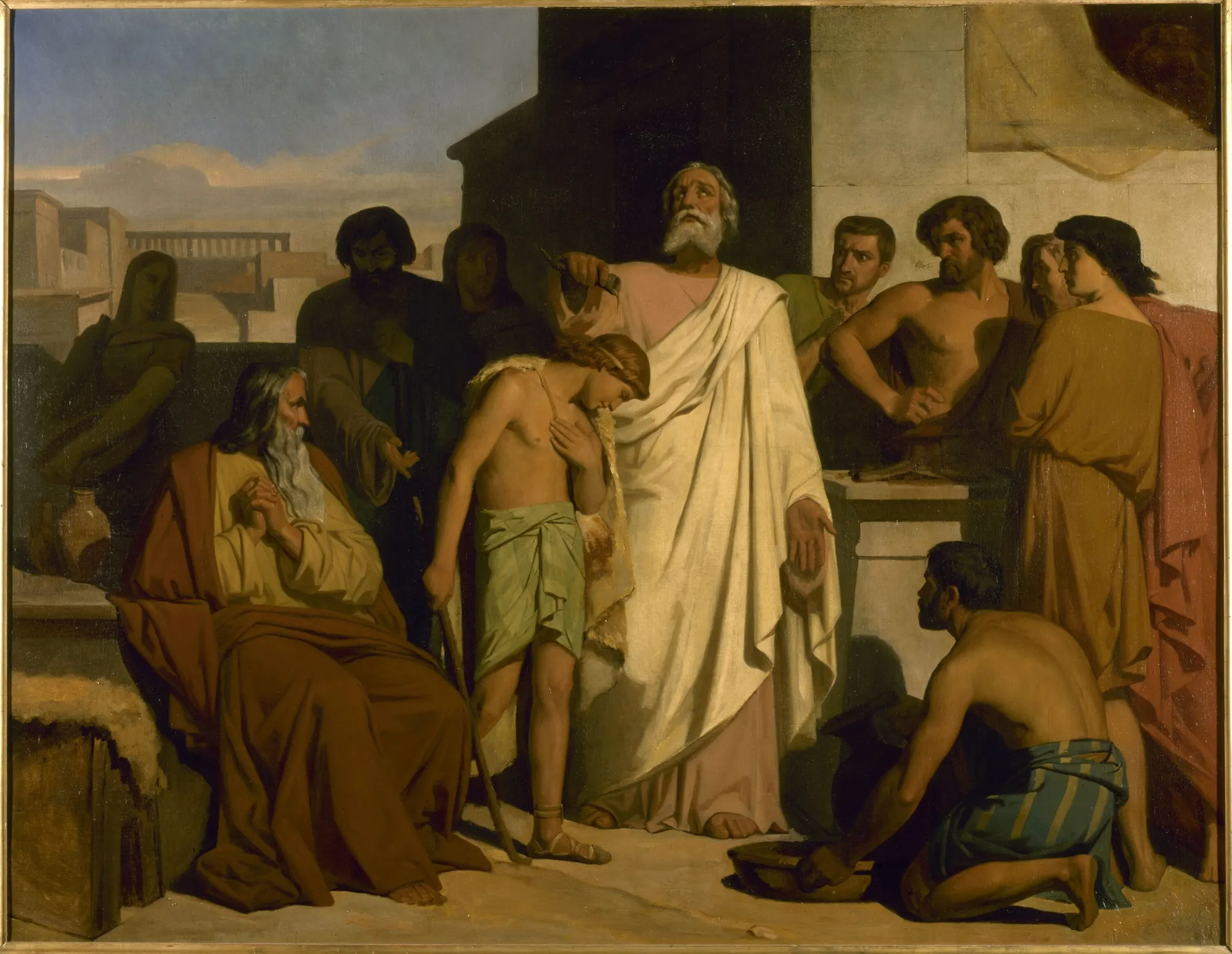
Then a man of God came to Eli
on 1 Samuel 2:27-30
An unnamed man of God reminds Eli that his father's house was chosen “to be My priest”. The charge follows, “You have honored your sons more than Me”, with the priests fattened on offerings meant for the altar. Verse 30 states the rule the book will test on king after king: “I will honor those who honor Me, but those who despise Me will be disdained”.
The record, by era
The Church Fathers1 voice
For with respect to the future, they will not be benefited by the honor done them, but receive the greater condemnation, neither will they be injured as to the future by ill treatment, but will have the more excuse. But all this I desire to be done for your own sakes. For when rulers are honored by their people, this too is reckoned against them; as in the case of Eli it is said, "Did I not choose him out of his father's house?" But when they are insulted, as in the instance of Samuel, God said, "They have not rejected thee, but they have rejected Me." Therefore insult is their gain, honor their burden. What I say, therefore, is for your sakes, not for theirs. He that honors the Priest, will honor God also; and he who has learnt to despise the Priest, will in process of time insult God. "He that receiveth you," He saith, "receiveth Me." "Hold my priests in honor," He says. The Jews learned to despise God, because they despised Moses, and would have stoned him. For when a man is piously disposed towards the Priest, he is much more so towards God.
The Medieval Church4 voices
A commentator
Gregory the DialogistCommentary on 1 Kings, Book 2, Chapter 2 · Written before 604.
proposed
24. Because Judea is rejected by divine judgment, it is shown with what wonderful disposition of equity the severity of that judgment itself was brought about. For first the gifts bestowed upon Eli are enumerated, so that while almighty God is shown to be so generous a giver, it may be known how justly He strikes the one who despises Him. He declared that He had revealed Himself to the house of his father, so that he could have no excuse of ignorance. And He teaches that He had shown him this same knowledge of His revelation in Egypt, so that Eli might by no means think that he had obtained it by his own merits. As if He were openly saying: There I offered Myself to be known by him, where he could forget Me, where he did not know how to remember Me. And lest perhaps the very gifts of divine knowledge might seem small to the reprobate, he is declared to have been raised from the other tribes of Israel to the summit of the priesthood. As if He were saying: I preferred him to those to whom he was not superior, but equal. 25. It should be noted that three things are indicated in the office of the priesthood itself. "That he should go up," it says, "to my altar, and burn incense to me, and wear the ephod before me." What is shown by this altar, if not that stone which the patriarch Jacob set up as a pillar (Gen. 28:18)? And what other stone is expressed by this, if not the one Paul proclaims in praise of the faithful, saying: "Built upon the foundation of the apostles and prophets, Christ Jesus himself being the chief cornerstone" (Eph. 2:20)? The father Eli was therefore chosen by the Lord for the priesthood so that he might go up to the altar, because the order of the ancient teachers presided over the people subject to them for this purpose: to proclaim the restoration of the human race that was to come in the advent of the Redeemer. […]
Was I not openly revealed? etc. He does not speak here of the recent father of Eli, who could not have been in that Egyptian servitude; but of Aaron himself, to whose house He was revealed in Egypt, and whom He, having been instructed from …
A commentator
Gregory the DialogistCommentary on 1 Kings, Book 2, Chapter 2 · Written before 604.
proposed
23. What is represented by this man of God, if not that venerable company of the holy apostles? He is indeed called a man of God on account of the excellence of his holiness, because he governed the summit of authority, which he had ascended in the governance of the whole world, with an equal loftiness of virtue. He came to Eli at that time when he approached the chief priests to announce the rejection of the Synagogue. There follows: (Verses 27, 28.)
A commentator
Gregory the DialogistCommentary on 1 Kings, Book 2, Chapter 3 · Written before 604.
proposed
Now a man of God is described as having come to Eli, who, being about to bring forth the severity of the divine sentence, carefully enumerated how many gifts He had bestowed upon him. And because he finally announces the punishment of the vengeance that he deserved, what does this give us to understand, except that the faults of pastors are judged more strictly? And not only do their sins increase the punishment of retribution, but also the gifts that were granted. Likewise, because he recounts those same gifts one by one, he indicates something more serious: that each individual gift comes to be a torment, when it is proved to have been poorly preserved. For he poorly guards in himself the gifts of almighty God who defiles the splendor of the pastoral summit through the stains of wicked conduct.
4 more voices on this verse
The Puritans and the Awakening2 voices
The message is sent to Eli himself, because God would bring him to repentance and save him; not to his sons, whom he had determined to destroy. And it might have been a means of awakening him to do his duty at last, and so to have prevented the judgment, but we do not find it had any great effect upon him. The message this prophet delivers from God is very close.
And there came a man of God unto Eli,....
The Nineteenth Century2 voices
A commentator
Jamieson, Fausset & Brown1802–1910
Commentary Critical and Explanatory on the Whole Bible (1871)
proposed
The prediction of this prophet was fully confirmed by the afflictions, degradation, poverty, and many untimely deaths with which the house of Eli was visited after its announcement (see 1Sa 4:11;
quarantine:debris (2026-07-29) — unbalanced-parens
There came a man of God - Who this was we know not, but the Chaldee terms him נביא דיי nebiya daya, a prophet of Jehovah. Unto the house of thy father - That is, to Aaron; he was the first high priest; the priesthood descended from him to his eldest son Eleazar, then to Phinehas. It became afterwards established in the younger branch of the family of Aaron; for Eli was a descendant of Ithamar, Aaron’s youngest son. From Eli it was transferred back again to the family of Eleazar, because of the profligacy of Eli’s sons.
The words behind it
19 Hebrew wordsEvery Hebrew word of this verse in the order it stands, with what it means and the door to its own study. The last column counts the times a word stands in the whole Bible: the rarer the word, the more the places it appears belong together.
| Hebrew | Sound | Meaning | Word study | In the Bible |
|---|---|---|---|---|
| וַיָּבֹ֥א | vaiyavo' | and he came | H935 → | 2568 times |
| אִישׁ־ | ʾish- | a man of | H376 → | 1663 times |
| אֱלֹהִ֖ים | ʾelohim | God | H430 → | 2601 times |
| אֶל־ | ʾel- | to | H413 → | 5510 times |
| עֵלִ֑י | ʾeli | Eli | H5941 → | 33 times |
| וַיֹּ֣אמֶר | vaiyomer | and he said | H559 → | 5305 times |
| אֵלָ֗יו | ʾelav | to him | H413 → | 5510 times |
| כֹּ֚ה | koh | thus | H3541 → | 577 times |
| אָמַ֣ר | ʾamar | he says | H559 → | 5305 times |
| יְהוָ֔ה | yahweh | Yahweh | H3068 → | 6520 times |
| הֲנִגְלֹ֤ה | hanigloh | ¿ really <to reveal> | H1540 → | 186 times |
| נִגְלֵ֙יתִי֙ | nigleiti | did I reveal myself | H1540 → | 186 times |
| אֶל־ | ʾel- | to | H413 → | 5510 times |
| בֵּ֣ית | beit | [the] house of | H1004 → | 2046 times |
| אָבִ֔יךָ | ʾavikha | ancestor your | H1 → | 1212 times |
| בִּֽהְיוֹתָ֥ם | bihyotam | when were they | H1961 → | 3559 times |
| בְּמִצְרַ֖יִם | bemitzrayim | in Egypt | H4714 → | 641 times |
| לְבֵ֥ית | leveit | to [the] house of | H1004 → | 2046 times |
| פַּרְעֹֽה׃ | paroh | Pharaoh | H6547 → |
וַיָּבֹ֥אand he came
vaiyavo'H935 →2568 times
אִישׁ־a man of
ʾish-H376 →1663 times
אֱלֹהִ֖יםGod
ʾelohimH430 →2601 times
אֶל־to
ʾel-H413 →5510 times
עֵלִ֑יEli
ʾeliH5941 →33 times
וַיֹּ֣אמֶרand he said
vaiyomerH559 →5305 times
אֵלָ֗יוto him
ʾelavH413 →5510 times
כֹּ֚הthus
kohH3541 →577 times
אָמַ֣רhe says
ʾamarH559 →5305 times
יְהוָ֔הYahweh
yahwehH3068 →6520 times
הֲנִגְלֹ֤ה¿ really <to reveal>
haniglohH1540 →186 times
נִגְלֵ֙יתִי֙did I reveal myself
nigleitiH1540 →186 times
אֶל־to
ʾel-H413 →5510 times
בֵּ֣ית[the] house of
beitH1004 →2046 times
אָבִ֔יךָancestor your
ʾavikhaH1 →1212 times
בִּֽהְיוֹתָ֥םwhen were they
bihyotamH1961 →3559 times
בְּמִצְרַ֖יִםin Egypt
bemitzrayimH4714 →641 times
לְבֵ֥יתto [the] house of
leveitH1004 →2046 times
פַּרְעֹֽה׃Pharaoh
parohH6547 →
A shaded row is a word that stands 400 times or fewer in the Bible.
The walk
8 stopsEach card is a verse this one points to, and under it the verses that one points to in turn. Where several paths arrive at the same place, that place is listed first: the text keeps returning to it.
Through
1 Kings 13:1Suddenly, as Jeroboam was standing beside the altar to burn incense, there came a man of God from Judah to Bethel by the word of the LORD.
it leads to
- 2 Kings 23:17
Then the king asked, “What is this monument I see?” And the men of the city replied, “It is the tomb of the man of God who came from Judah and pronounced these things…
- 1 Kings 12:32–33
And Jeroboam ordained a feast on the fifteenth day of the eighth month, like the feast that was in Judah, and he offered sacrifices on the altar; he made this offering in Bethel to…
- 1 Thessalonians 4:15
By the word of the Lord, we declare to you that we who are alive and remain until the coming of the Lord will by no means precede those who have fallen asleep.
- 2 Kings 23:17
Through
Judges 13:6So the woman went and told her husband, “A man of God came to me. His appearance was like the angel of God, exceedingly awesome. I did not ask him where he came from,…
it leads to
- Matthew 28:3–4
His appearance was like lightning, and his clothes were white as snow.
- Judges 13:17–18
Then Manoah said to the angel of the LORD, “What is your name, so that we may honor you when your word comes to pass?”
- Revelation 1:17
When I saw Him, I fell at His feet like a dead man. But He placed His right hand on me and said, “Do not be afraid. I am the First and the Last,
- 1 Samuel 9:6
“Look,” said the servant, “in this city there is a man of God who is highly respected; everything he says surely comes to pass. Let us go there now. Perhaps he will tell us…
- Daniel 10:11
He said to me, “Daniel, you are a man who is highly precious. Consider carefully the words that I am about to say to you. Stand up, for I have now been sent to…
- Matthew 28:3–4
Where this verse is studied
About 1 Samuel
Who and where
2 names in this verse with a page on the site.
This page draws on 11 works. Open the list of works
This page draws on Adam Clarke, Commentary on the Bible; Albert Barnes, Notes, Explanatory and Practical, on the Old and New Testaments (1832-1869); Bede, Commentary on Samuel; Gregory the Dialogist, Commentary on 1 Kings, Book 2, Chapter 2; Gregory the Dialogist, Commentary on 1 Kings, Book 2, Chapter 3; Jamieson, Fausset & Brown, Commentary Critical and Explanatory on the Whole Bible; John Chrysostom, HOMILIES ON 2 TIMOTHY 2; John Gill, Exposition of the Old Testament; John Gill, Exposition of the Old Testament (1748-1763); Matthew Henry, Commentary on the Whole Bible and W. G. Blaikie, The First Book of Samuel (Expositor's Bible).