
Genesis 3:15 to Revelation 12 · Symbol · Featured Study
The Seed
A symbol study of Genesis 3:15, Galatians 3:16, John 12:24 and 1 Corinthians 15, with the readings of the seed set out and their holders named.
One word does three jobs in Scripture: a family line, a single promised Person, and a grain that has to go into the ground and die.
- The word
- זֶרַע (zera), H2233
- First appears
- Genesis 1:11 “…the earth bring forth vegetation: seed-bearing plants and…”
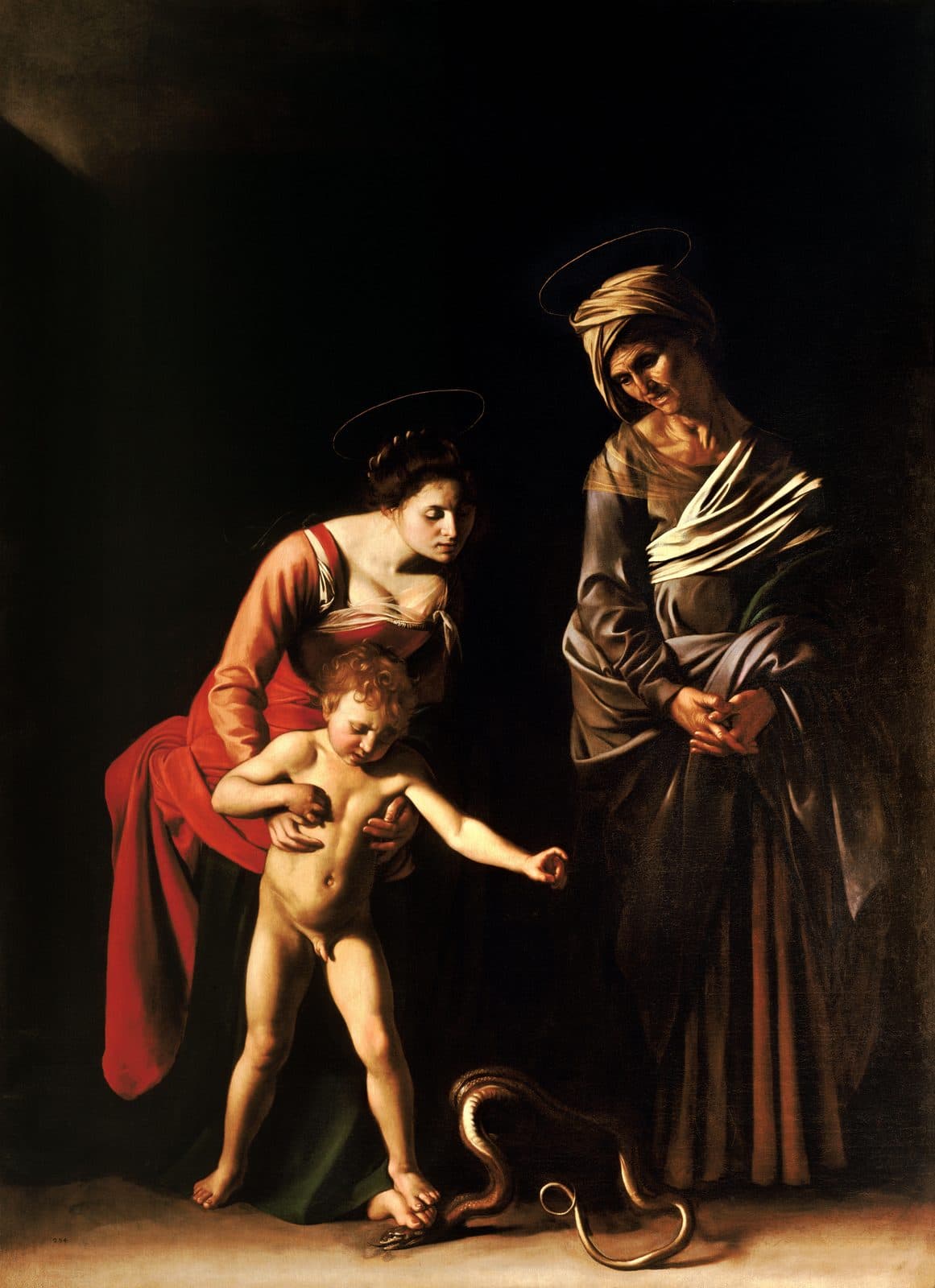
Caravaggio, Madonna and Child with Saint Anne, 1605 to 1606. Public domain.
Summary
Genesis 3:15 is the first verse where seed carries a promise, and Galatians, John and 1 Corinthians take the word up again.
- The word is first spoken over a ruin in Genesis 3:15, and that verse names nobody.
- Galatians 3:16 makes the link itself: the promise was to one seed, and that seed is Christ; Galatians 3:29 calls the church the same seed.
- Jesus decodes the picture twice: the seed is the word of God (Luke 8:11), and the good seed represents the sons of the kingdom (Matthew 13:38).
- He uses the farming sense of His own death in John 12:24: unless a kernel of wheat falls to the ground and dies, it remains only a seed.
- Paul takes the buried grain for the resurrection body and Peter for the new birth.
First Spoken Over a Ruin
Genesis 3:15, and what it does and does not say.
And I will put enmity between you and the woman, and between your seed and her seed. He will crush your head, and you will strike his heel.”God speaks it to the serpent inside a curse, and it is the first promise in the Bible.
Read it slowly and notice how little it supplies: enmity, two seeds, a head and a heel, and not one name. The readings Christians bring to it, the serpent as Satan and the seed as Christ, arrive later in the canon. The New Testament never quotes Genesis 3:15 with a citation formula; the messianic reading travels through Paul's naming of the seed in Galatians 3:16 and the echo of the crushing in Romans 16:20.
One checkable detail stands in the verse itself: the same Hebrew verb is used of both blows, so the head and the heel take the same word. What makes one wound fatal and the other not is anatomy, and the verse does not comment on it.
He, she or it: who crushes the serpent's head?Jerome, Hebrew Questions on Genesis
The Latin tradition long read she shall crush, which Bede, in his commentary on Genesis, takes of the church. The Hebrew reads he, and the best witness for the Hebrew is Jerome, the translator of the Latin, saying so himself.
“He himself will keep your head, and you will keep his heel. It is better in Hebrew: He will crush your head, and you will crush his heel; for our steps are hindered by the serpent, and the Lord will quickly crush Satan under our feet.”
Jerome · Hebrew Questions on Genesis, on Genesis 3:15Patristic
The Hebrew pronoun is masculine singular, which rules out she. It does not by itself prove one person rather than a line, because the noun is masculine whether it means one or many.
Clarke and Jamieson, Fausset and Brown on the enmityGenesis 3:15
“This has been generally supposed to apply to a certain enmity subsisting between men and serpents; but this is rather a fancy than a reality. It is yet to be discovered that the serpentine race have any peculiar enmity against mankind, nor is there any proof that men hate serpents more than they do other noxious animals.”
Adam Clarke · Commentary on the Bible (1832), on Genesis 3:15Evangelical
“Thus, fatal shall be the stroke which Satan shall receive from Christ, though it is probable he did not at first understand the nature and extent of his doom.”
Jamieson, Fausset & Brown · Commentary Critical and Explanatory on the Whole Bible · on Genesis 3:15Reformed
Offspring, the One and the Grain
Zera in Hebrew and sperma in Greek carry the first two senses, and kokkos the third.
English has two words, offspring and seed corn; Hebrew and Greek have one.
Each sense opens the verse that shows it.
When Jesus speaks of a seed that dies, He uses kokkos, a kernel, and the picture of sown grain joins the promise.
The Seed Through Scripture
Fourteen stops in the order of the canon; seven of them are links Scripture makes itself.
The fountainhead names nobody, and the naming happens later, in the open.
- GenesisThe word is spoken for the first time over a ruin, and it names nobody (Genesis 3:15).
- GenesisEve names Seth as another seed in place of Abel, so the promise word is already a family line (Genesis 4:25).
- GenesisGod tells Abraham that all nations will be blessed through his offspring (Genesis 22:18).
- 2 SamuelThe promise takes a throne: God will raise up David's descendant and establish his kingdom (2 Samuel 7:12).
- IsaiahThe Servant who is crushed will yet see His offspring (Isaiah 53:10).
- MatthewScripture's own link: the good seed represents the sons of the kingdom, and the weeds the sons of the evil one (Matthew 13:37 to 38).
- LukeScripture's own link: Jesus says the seed is the word of God (Luke 8:11).
- JohnScripture's own link: a kernel of wheat must fall to the ground and die to bear fruit (John 12:24).
- RomansThe God of peace will crush Satan under the church's feet (Romans 16:20).
- 1 CorinthiansScripture's own link: what is sown does not come to life unless it dies (1 Corinthians 15:36 to 38).
- GalatiansScripture's own link: the promise is to one seed, who is Christ (Galatians 3:16).
- GalatiansScripture's own link: those who belong to Christ are Abraham's seed (Galatians 3:29).
- 1 PeterScripture's own link: believers are born again of imperishable seed, through the word of God (1 Peter 1:23).
- RevelationThe dragon makes war on the rest of the woman's children (Revelation 12:17).
Each book opens its verse in the reader. A stop marked Scripture's own link is one where the text supplies the meaning itself.
Said Outright, and Heard by Readers
Three verses where Scripture reads its own picture, one reading with its holder, and one question left open.
What is stated, and what is inferredLuke 8, Galatians 3, 1 Peter 1, Genesis 3
Each row opens its verse in the reader.
| Verse | What it says or what readers hear | Which |
|---|---|---|
| Luke 8:11 | The seed is the word of God. | Said outright |
| Galatians 3:16 | The seed of the Abrahamic promise is Christ, argued from the number of the noun. | Said outright |
| 1 Peter 1:23 | Born again of imperishable seed, through the living and enduring word of God. | Said outright |
| Genesis 3:15 | The first gospel: the term protoevangelium is the church's, and Irenaeus reads the verse of Christ in Against Heresies 5.21. | A reading |
| Galatians 3:16 | Which verse Paul quotes: the promise to Abraham's offspring stands in Genesis 12:7, 13:15 and 24:7, and to his descendants in 17:8, and Paul does not say which. | Left open |
Two Seeds
Matthew 13:37 to 38, and the reading of Genesis 6.
He replied, “The One who sows the good seed is the Son of Man. The field is the world, and the good seed represents the sons of the kingdom. The weeds are the sons of the evil one,Two sowers, two seeds, one field, and the wording is sons of.
Genesis 3:15 puts two seeds in enmity, and Matthew 13:38 names the second: sons of the evil one, in a parable Jesus interprets. Genesis 6 and its reading are treated in the study The Watchers and the Nephilim.
The dragon and the woman's offspringRevelation 12:17 and Romans 16:20
And the dragon was enraged at the woman, and went to make war with the rest of her children, who keep the commandments of God and hold to the testimony of Jesus. And the dragon stood on the shore of the sea.The God of peace will soon crush Satan under your feet. The grace of our Lord Jesus Christ be with you.A bruise in Isaiah 53:10Commentary Critical and Explanatory
Jamieson, Fausset and Brown read Isaiah 53 as the fulfilment of Genesis 3:15 and say in the same breath that the Hebrew word for bruise is not the same word. That is how a careful reader holds a connection and its evidence at the same time.
Zera, Sperma, Kokkos and Spora
The words for seed, for a kernel and for a sowing.
zera, זֶרַע
seed; figuratively fruit, plant, sowing time, posterity
sperma, σπέρμα
something sown, seed; by implication offspring
kokkos, κόκκος
a kernel of seed
spora, σπορά
a sowing, by implication parentage
The lexicon in full1 table or figure
Each row opens a verse where the word stands.
| Word | Strong's entry | Count |
|---|---|---|
| zera, זֶרַע, H2233 | seed; figuratively fruit, plant, sowing time, posterity | 229 entries |
| sperma, σπέρμα, G4690 | something sown, seed; by implication offspring | 43 entries |
| kokkos, κόκκος, G2848 | a kernel of seed | 7 entries |
| spora, σπορά, G4701 | a sowing, by implication parentage | 1 entry, 1 Peter 1:23 |
What Scripture Does Not Say
Three places the text is silent and readers have filled the gap.
Genesis 3:15 never says the woman is a virgin or that the seed comes without a father, and it never says the serpent has physical offspring. John 12:24 does not say the grain is Christ.
A Thing That Has to Be Buried
John 12:24, and the buried grain in Paul and Peter.
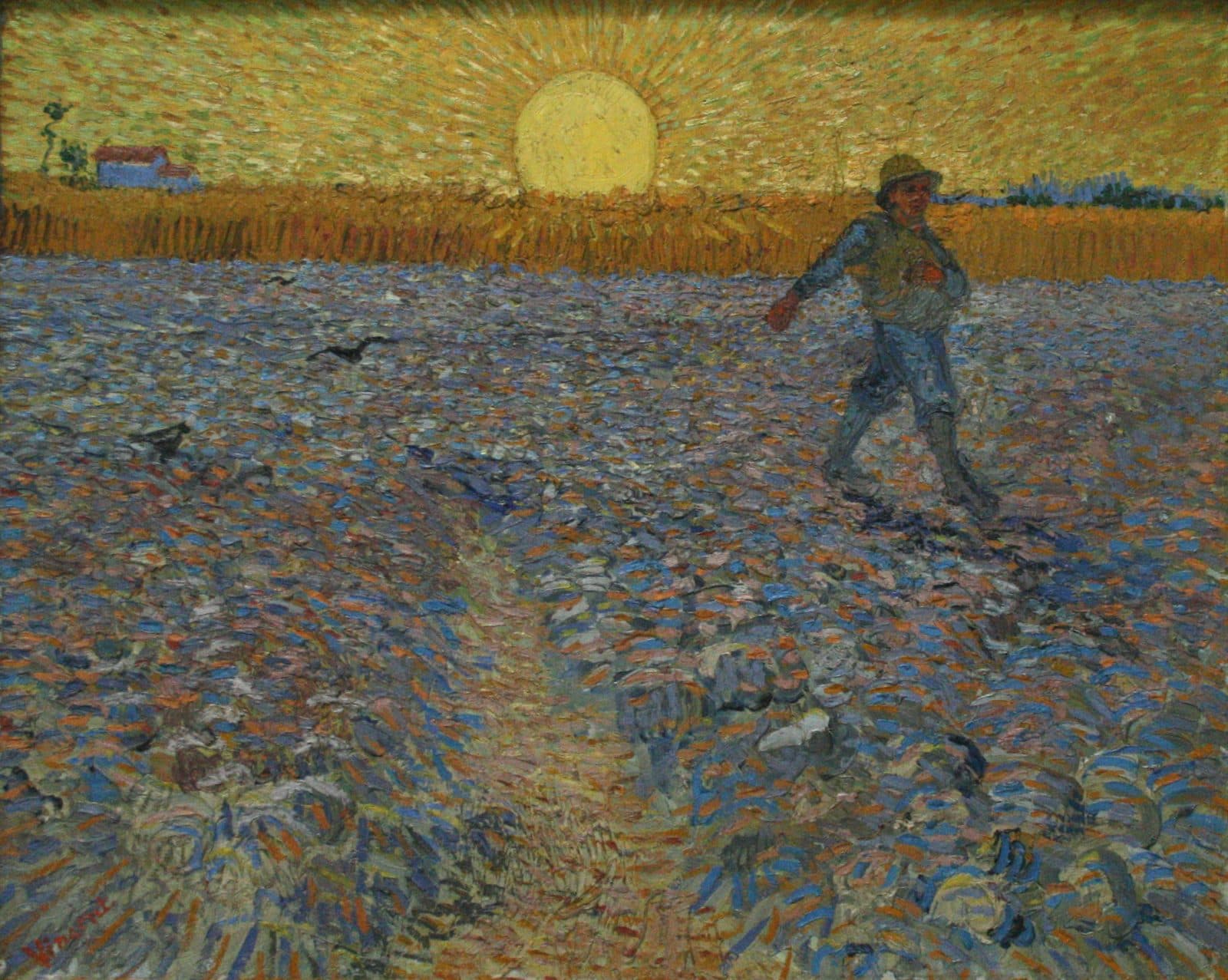
Vincent van Gogh, The Sower, 1888. Public domain, via Wikimedia Commons.
Van Gogh painted the sowing that the parable of Matthew 13 and the grain of John 12:24 both start from.
Days before the cross, with the hour named in the sentence before it, Jesus reaches for a farmer's field. A grain of wheat is useless while it is whole; it bears fruit only by being buried and coming apart.
Truly, truly, I tell you, unless a kernel of wheat falls to the ground and dies, it remains only a seed; but if it dies, it bears much fruit.He speaks in the third person about wheat and leaves the last step to the setting.
The buried seed in Paul, Peter, John and Luke1 Corinthians 15:36 to 38, 1 Peter 1:23, John 12:23 and Luke 8:11
You fool! What you sow does not come to life unless it dies. And what you sow is not the body that will be, but just a seed, perhaps of wheat or something else. But God gives it a body as He has designed, and to each kind of seed He gives its own body.For you have been born again, not of perishable seed, but of imperishable, through the living and enduring word of God.But Jesus replied, “The hour has come for the Son of Man to be glorified.Now this is the meaning of the parable: The seed is the word of God.The grain and the seed in the commentatorsJohn 12:24, 1 Corinthians 15:36 and Matthew 13:19
“He Himself, of the seed of the Patriarchs, was sown in the field of this world, that by dying, He might rise again with increase. He died alone; He rose again with many.”
Bede · Catena Aurea by Aquinas · on John 12:24Patristic
“The necessity of His death is here brightly expressed, and its proper operation and fruit--life springing forth out of death--imaged forth by a beautiful and deeply significant law of the vegetable kingdom.”
Jamieson, Fausset & Brown · Commentary Critical and Explanatory on the Whole Bible (1871), on John 12:24Reformed
“The late resurrection of Lazarus gave our Lord a natural occasion of speaking on this subject. And agreeable to his infinite knowledge, he singles out, from among so many thousands of seeds, almost the only one that dies in the earth: and which therefore was an exceeding proper similitude, peculiarly adapted to the purpose for which he uses it.”
John Wesley · Explanatory Notes upon the New Testament (1755), on John 12:24Evangelical
“Undergo a dissolution of its parts, a change analogous to death. Thus St. Paul inverts the objection; as if he had said, Death is so far from hindering life, that it necessarily goes before it.”
John Wesley · Explanatory Notes upon the New Testament (1755), on 1 Corinthians 15:36Evangelical
“Death, so far from preventing quickening, is the necessary prelude and prognostication of it, just as the seed ‘is not quickened’ into a new sprout with increased produce, ‘except it die’ (except a dissolution of its previous organization takes place).”
Jamieson, Fausset & Brown · Commentary Critical and Explanatory on the Whole Bible · on 1 Corinthians 15:36Reformed
“In these words the Lord explains what the seed is, to wit, the word of the kingdom, that is of the Gospel teaching. For there are some that receive the word of the Lord with no devotion of heart, and so that seed of God's word which is sown in their heart, is by dæmons straightway carried off, as it were the seed dropped by the way side.”
Remigius of Rheims · Catena Aurea by Aquinas · on Matthew 13:19Patristic
The Voices
Seven voices, from Jerome to the commentators of the nineteenth century, each with the work named.
1762 to 1832 · Adam Clarke
The commentators are Adam Clarke, John Wesley, Matthew Henry, and Jamieson, Fausset and Brown. The older voices are Jerome, and Bede and Remigius of Rheims as Thomas Aquinas gathers them in the Catena Aurea. Each quotation names its work.
The Promise Word Becomes an Argument
Galatians 3:16, with the objection stated and two answers beside it.
The promises were spoken to Abraham and to his seed. The Scripture does not say, “and to seeds,” meaning many, but “and to your seed,” meaning One, who is Christ.And if you belong to Christ, then you are Abraham’s seed and heirs according to the promise.Paul uses the word of the whole church in the same chapter.
The objection is stated by the commentators themselves. Zera is a collective singular, singular the way offspring is, whether one person or a nation is meant. So seed and not seeds proves nothing on its own, and Paul seems to press a point the grammar will not bear.
One kind of posterityJohn Wesley, Explanatory Notes upon the New Testament
“Several promises were made to Abraham; but the chief of all, and which was several times repeated, was that of the blessing through Christ. Saith not, And to seeds, as of many - As if the promise were made to several kinds of seed. But as of one - That is, one kind of seed, one posterity, one kind of sons.”
John Wesley · Explanatory Notes upon the New Testament (1755), on Galatians 3:16Evangelical
One Person in whom the many are includedMatthew Henry; Jamieson, Fausset and Brown
“And he gives us a very surprising exposition of this. We should have thought it had been meant only of the people of the Jews. ‘Nay,’ says the apostle, ‘it is in the singular number, and points at a single person-- that seed is Christ, ‘ So that the covenant is still in force; for Christ abideth for ever in his person, and in his spiritual seed, who are his by faith.”
Matthew Henry · Commentary on the Whole Bible · on Galatians 3:16Puritan
“This verse is parenthetical. The covenant of promise was not ‘spoken’ (so Greek for ‘made’) to Abraham alone, but ‘to Abraham and his seed’; to the latter especially; and this means Christ (and that which is inseparable from Him, the literal Israel, and the spiritual, His body, the Church).”
Jamieson, Fausset & Brown · Commentary Critical and Explanatory on the Whole Bible · on Galatians 3:16Reformed
Clarke on Galatians 3:16 and Genesis 22:18Commentary on the Bible
“The promise of salvation by faith was made to Abraham and his posterity. He saith not, And to seeds - It was one particular kind of posterity which was intended: but as of one - which is Christ; i.e. to the spiritual head, and all believers in him, who are children of Abraham, because they are believers, Gal 3:7. But why does the apostle say, not of seeds, as of many?”
Adam Clarke · Commentary on the Bible (1832), on Galatians 3:16Evangelical
“We have the authority of St. Paul, Gal 3:8, Gal 3:16, Gal 3:18, to restrain this to our blessed Lord, who was The Seed through whom alone all Gods blessings of providence, mercy, grace, and glory, should be conveyed to the nations of the earth.”
Adam Clarke · Commentary on the Bible (1832), on Genesis 22:18Evangelical
Clarke rests the restraint of Genesis 22:18 to Christ on the authority of Galatians.
Books to Read Next
Three public domain works a student reads next.
Commentary on the Whole Bible
Matthew Henry · 1708 to 1710
His note on Galatians 3:16 reads the seed as Christ in His person and in His spiritual seed.
READ AT CCEL →Against Heresies
Irenaeus · second century
Book 5, chapter 21, reads the enmity of Genesis 3:15 of Christ.
READ AT NEW ADVENT →The Seed That Was Buried
The seed promised over the ruin of Genesis 3 was buried like grain and bore much fruit, and those who belong to Christ are counted Abraham's seed.
The text asks the reader to belong to Christ by faith.
Understand, then, that those who have faith are sons of Abraham.Sources
Scripture is the Berean Standard Bible.
- James Strong, Exhaustive Concordance of the Bible, 1890, H2233, G4690, G2848 and G4701, with the store's entry counts.
- Jerome, Hebrew Questions on Genesis, on Genesis 3:15.
- Irenaeus, Against Heresies 5.21, translated in the Ante-Nicene Fathers.
- Adam Clarke, Commentary on the Bible, 1832, on Genesis 3:15, 22:18 and Galatians 3:16.
- Jamieson, Fausset and Brown, Commentary Critical and Explanatory on the Whole Bible, 1871.
- John Wesley, Explanatory Notes upon the New Testament, 1755, on Galatians 3:16, John 12:24 and 1 Corinthians 15:36.
- Matthew Henry, Commentary on the Whole Bible, 1710, on Galatians 3:16.
- Thomas Aquinas, Catena Aurea: Bede on John 12:24 and Remigius on Matthew 13:19.
Keep Studying
People and groups9
Symbols3
Doctrines19
- The Seed Promise, from Eden to Bethlehem
- The Watchers and the Nephilim
- The Fall
- The Abrahamic Covenant
- The Davidic Covenant
- Messianic Prophecy