
Psalm 69
36 verses · Imprecatory lament
because zeal for Your house has consumed me, and the insults of those who insult You have fallen on me.
Introduction
David, the Deep Waters, Book 2: The Elohistic Psalter, Poetry, Psalms Overview.
David's name stands over this psalm, a prayer from a man shamed in public for his loyalty to God. The whole town talks about him, from the elders at the gate to the drinkers at night, and even his own family turns from him. He asks to be pulled out of his trouble and then hands his enemies over to God's judgment in some of the hardest words in Scripture. The New Testament quotes it again and again of Jesus. Listen for the pictures of drowning, for the turn to judgment, and for the hope held out to the whole nation at the close.
Context
- Who
- Worshippers who had been shamed in public for keeping faith
- What
- A lament from deep distress in which a man shamed for God's sake asks for rescue and for judgment on his enemies.
- Where
- A town where the man in the song is talked about at the gate and sung about by drunkards
- When
- The reign of David, about 1010 to 970 BC by the superscription, with no event named.
- Why
- To give words to a person suffering reproach for faithfulness to God, and to lead that grief toward hope.
Historical context
The heading names David and sets the tune, On the Lilies, and since the psalm names no event the trouble has to be read out of its own lines: hatred without cause, a debt he must repay for something he never stole, and reproach aimed at God before it reached him. Sackcloth was the coarse cloth a man wore while mourning or fasting, so the sign that should have drawn sympathy drew laughter instead. The gate of verse 12 was the town's public place, where the elders, the gossips and the traders sat, and the drunkards in the same verse give the other end of the day. Vinegar was sour wine, the cheap drink of working men, so the food and the drink a suffering man needed both came back poisoned. Verse 31 weighs a song against an ox and a bull with horns and hooves, the best animal in the herd.
Significance
A worshipper singing this was given words for a kind of suffering the sacrificial system had no offering for, since mockery is neither a sin to confess nor a wound to bind, and the psalm takes it to God as a real injury. The last two verses moved the song off one man, because God will save Zion and rebuild the cities of Judah, so a congregation with its own losses could sing a private complaint and arrive at a national promise.
This chapter in Jewish lifeWhat this chapter is in Jewish life and reading.
How it is read
Rashi reads this psalm as a prayer for the nation rather than for one man. The heading's word shoshannim he takes of Israel, "who are like a rose among the thorns, pricked by the thorns, and he prayed for them" (Rashi on Psalms 69:1:1). The water that has come up to the neck is then the nations (Rashi on Psalms 69:2:1). The brothers who treat the singer as a stranger in verse 9 are Esau (Rashi on Psalms 69:9:1). The envy of verse 10 is the envy of those who saw the love God showed Israel while the house was still standing (Rashi on Psalms 69:10:1). The plea of verse 7 he reads as care for other people's faith, that those who hope in God not be shamed by what happens to the one praying (Rashi on Psalms 69:7:1). A Christian reader should see the size of the difference here. The New Testament applies this psalm to Jesus at four points that this site records. The zeal of verse 9 stands at John 2:17 and the hatred without cause at John 15:25. The vinegar of verse 21 stands at John 19:28 and the desolate house of verse 25 at Acts 1:20. Rashi's Israel and the apostles' Christ are two readings of one text, and this site holds the apostles' without pretending the synagogue shares it. Ibn Ezra and Radak stand in the corpus here by reference alone. Rashi is quoted here from the Judaica Press complete Tanach with Rashi, translated by A. J. Rosenberg, under CC-BY.
What the rabbis say
The corpus records forty places where the Midrash and the Talmud draw on this psalm, cited here by reference. Midrash Tehillim treats it at 69:3, and cites its verses again at 11:7, 18:2, 39:2, 70:1, 78:2 and 119:30. Verse 22, on the table that becomes a snare, is drawn into the Babylonian Talmud at Chullin 87a:7. Verse 28 stands in the Jerusalem Talmud at Rosh Hashanah 1:3:3, and verse 32 in the Babylonian Talmud at Avodah Zarah 8a:10 and in Avot DeRabbi Natan 1:8. The waters of verses 2 and 3 draw the Mekhilta DeRabbi Shimon Ben Yochai at 14:20 and 15:4 and the Mekhilta DeRabbi Yishmael, Tractate Shirah 4:17. Verse 13, on the song of the drinkers, is read at Eikhah Rabbah 3:5 and at its Petichta 17.
Sources: Rashi, Rashi on Psalms 69:1 to 69:23, the Judaica Press complete Tanach with Rashi, translated by A. J. Rosenberg, CC-BY, 1040 to 1105; Midrash Tehillim, 69:3, 11:7, 18:2 and 119:30, cited by reference; Babylonian Talmud, Chullin 87a:7 and Avodah Zarah 8a:10, cited by reference; Jerusalem Talmud, Rosh Hashanah 1:3:3, cited by reference; MannaFest, the messianic psalms table, src/components/book/dossier-content/psalms-structure.ts, and the hard psalms page at /featured/praying-the-hard-psalms, 2026; The Sefaria corpus, scripts/data/sources/sefaria/psalms/69.json, fetched 2026-09-19, 2026.
Psalms 69:1-3
Save me, O God: The psalm opens in the water and stays there. The waters are at the neck, the depths are miry with no footing, and the flood engulfs him. Verse 3 adds the body's failure: the throat parched, the eyes failing while he looks for God.
Psalms 69:1
“Save me, O God. "He saved others, himself he cannot save." With strong cries and tears he offered up prayers and supplications unto him that was able to save him from death, and was heard in that he feared (Heb 5:7). Thus David had prayed, and here his Son and Lord utters the same cry. This is the second Psalm which begins with a "Save me, O God, "and the former (Psalm 54) is but a short summary of this more lengthened complaint.”
Charles Spurgeon · The Treasury of David, Vol. 3 (1872)Particular Baptist
ConnectionsPsalms 22:1
where there is no footing: Charles Spurgeon marks the mire as worse than the waters: in water a man might swim, but in miry depths the mire sucks him down. Albert Barnes recalls Jeremiah sinking in the mire of a dungeon.
Psalms 69:2
“I sink in deep mire. In water one might swim, but in mud and mire all struggling is hopeless; the mire sucks down its victim. Where there is no standing. Everything gave way under the Sufferer; he could not get foothold for support—this is a worse fate than drowning. Here our Lord pictures the close, clinging nature of his heart's woes. "He began to be sorrowful, and very heavy." Sin is as mire for its filthiness, and the holy soul of the Saviour must have loathed even that connection with it which was necessary for its expiation.”
Charles Spurgeon · The Treasury of David, Vol. 3 (1872)Particular Baptist
I am weary from my crying: Charles Spurgeon reads weary from crying as worn out by prayer, until the throat is parched with it. Matthew Henry says the eyes fail, and the faith holds.
Psalms 69:3
“I am weary of my crying. Not of it, but by it, with it. He had prayed till he sweat great drops of blood, and well might physical weariness intervene. My throat is dried, parched, and inflamed. Long pleading with awful fervour had scorched his throat as with flames of fire. Few, very few, of his saints follow their Lord in prayer so far as this.”
Charles Spurgeon · The Treasury of David, Vol. 3 (1872)Particular Baptist
Psalms 69:4-5
outnumber the hairs of my head: Those who hate him without cause outnumber the hairs of his head, and he must repay what he never stole. John 15:25 applies the clause to Christ, hated without reason, in wording nearer Psalm 35:19. Verse 5 confesses folly and guilt to the same God.
Psalms 69:4
They that hate me. Surprising sin that men should hate the altogether lovely one, truly is it added, without a cause, for reason there was none for this senseless enmity. He neither blasphemed God, nor injured man. As Samuel said: "Whose ox have I taken? or whose ass have I taken? or whom have I defrauded? Whom have I oppressed?" Even so might Jesus enquire. Besides, he had not only done us no evil, but he had bestowed countless and priceless benefits. Well might he demand, "For which of these works do ye stone me?"
Charles Spurgeon · The Treasury of David, Vol. 3 (1872)Particular Baptist
2 more voices on this verse
Psalms 69:4
Christ did not speak deceitfully but displayed all justice and humility. He did not suffer that kind of death [crucifixion] for anything he had done but so that those things that the prophets had predicted would happen to him through you as the very Spirit of Christ already foretold in the Psalms, saying, "They repaid me evil instead of good"; "What I had not taken, I repaid"; "They pierced my hands and feet"; "They put gall in my drink, and they satisfied my thirst with vinegar"; and "They cast lots for my clothing."
Tertullian · written before 220 · An Answer to the Jews 10patristic
Psalms 69:4
“But, applying it to Christ, it is an observable description of the satisfaction which he made to God for our sin by his blood: Then he restored that which he took not away; he underwent the punishment that was due to us, paid our debt, suffered for our offence.”
Matthew Henry · Commentary on the Whole Bible (1707-1721)puritan
Cross references
Psalms 69:4
- Quoted inJohn 15:25“But this is to fulfill what is written in their Law: ‘They hated Me without reason.’”
'They hated me without a cause' ('that the word might be fulfilled that is written in their law', w/ Ps 35:19)
ConnectionsJohn 15:25
You know my folly, O God: Readers divide over this confession in a psalm applied to Christ. Adam Clarke says the folly and guilt cannot be said of Christ. Matthew Henry reads it of Christ made sin, a guilt known to God.
Psalms 69:5
“O God, thou knowest my foolishness. David might well say this, but not David's Lord; unless it be understood as an appeal to God as to his freedom from the folly which men imputed to him when they said he was mad. That which was foolishness to men was superlative wisdom before God. How often might we use these words in their natural sense, and if we were not such fools as to be blind to our own folly, this confession would be frequently on our lips.”
Charles Spurgeon · The Treasury of David, Vol. 3 (1872)Particular Baptist
1 more voice on this verse
Psalms 69:5
“They are all done in his sight, and are never cast behind his back till they are repented of and pardoned. This may aptly be applied to Christ, for he knew no sin, yet he was made sin for us; and God knew it, nor was it hidden from him, when it pleased the Lord to bruise him and put him to grief.”
Matthew Henry · Commentary on the Whole Bible (1707-1721)puritan
Psalms 69:6-8
O Lord GOD of Hosts: The plea of verse 6 is that no one who hopes in God be shamed by this man's fall. Verse 8 makes him a stranger to his brothers, and John 7:5 says Christ's own brothers did not believe in Him. The scorn of verse 7 was endured for God's sake.
Psalms 69:6
“Let not them that wait on thee, O Lord God of hosts, be ashamed for my sake,.... Of their expectation of redemption and salvation by the Messiah, they have been waiting upon the Lord for; when they shall see him in suffering circumstances, and even dead and laid in the grave, without any hope of his rising again; which was the case of the two disciples travelling to Emmaus, Luk 24:19; whose trust in him, and expectation of him, as the Redeemer of Israel, were almost gone.”
I have endured scorn for Your sake: Augustine put the weight on for Your sake: scorn endured for God's sake carries a reward, and punishment for one's own sin carries none. Charles Spurgeon says Christ's accusers could find no real fault. The shame covered his face for God's sake.
Psalms 69:7
“Because for thy sake I have borne reproach. Because he undertook to do the Father's will, and teach his truth, the people were angry; because he declared himself to be the Son of God, the priesthood raved. They could find no real fault in him, but were forced to hatch up a lying accusation before they could commence their sham trial of him. The bottom of the quarrel was, that God was with him, and he with God, while the Scribes and Pharisees sought only their own honour.”
Charles Spurgeon · The Treasury of David, Vol. 3 (1872)Particular Baptist
a foreigner to my mother’s sons: Albert Barnes explains the mother's sons from households with several wives, where sons of one mother were the closest brothers. The circle of strangers narrows to the nearest. Verse 9 gives the cause: zeal for God's house.
Psalms 69:8
“I am become a stranger unto my brethren. The Jews his brethren in race rejected him, his family his brethren by blood were offended at him, his disciples his brethren in spirit forsook him and fled; one of them sold him, and another denied him with oaths and cursings. Alas, my Lord, what pangs must have smitten thy loving heart to be thus forsaken by those who should have loved thee, defended thee, and, if need be, died for thee. And an alien unto my mother's children.”
Charles Spurgeon · The Treasury of David, Vol. 3 (1872)Particular Baptist
zeal for Your house has consumed me: Zeal for God's house consumed him, and the insults of those who insult God have fallen on him. John 2:17 quotes the first clause as Jesus clears the temple, and Romans 15:3 quotes the second of Christ. Barnes reads both as one pattern.
Psalms 69:9
“For the zeal of thine house hath eaten me up. His burning ardour, like the flame of a candle, fed on his strength and consumed it. His heart, like a sharp sword, cut through the scabbard. Some men are eaten up with lechery, others with covetousness, and a third class with pride, but the master passion with our great leader was the glory of God, jealousy for his name, and love to the divine family.”
Charles Spurgeon · The Treasury of David, Vol. 3 (1872)Particular Baptist
Cross references
Psalms 69:9
- Quoted inJohn 2:17His disciples remembered that it is written: “Zeal for Your house will consume Me.”
'The zeal of thine house hath eaten me up' (temple cleansing, disciples remember)
- Quoted inRomans 15:3For even Christ did not please Himself, but as it is written: “The insults of those who insult You have fallen on Me.”
'The reproaches of them that reproached thee fell on me' (Christ pleased not himself)
ConnectionsJohn 2:17, Romans 15:3
Psalms 69:10-12
I wept and fasted: Weeping and fasting brought him reproach. Sackcloth made him a joke to them, and the men who sit at the gate mocked him while drunkards sang about him. Clarke marks the climb across the three verses, from private grief to public dress to open ridicule.
Psalms 69:10
“When I wept, and chastened my soul with fasting, that was to my reproach. Having resolved to hate him, everything he did was made a fresh reason for reviling. If he ate and drank as others, he was a man gluttonous and a winebibber; if he wept himself away and wore himself out with fasting, then he had a devil and was mad. Nothing is more cruel than prejudice, its eye colours all with the medium through which it looks, and its tongue rails at all indiscriminately.”
Charles Spurgeon · The Treasury of David, Vol. 3 (1872)Particular Baptist
I made sackcloth my clothing: Sackcloth for clothing follows verse 10, where he wept and fasted and it brought him reproach. Charles Spurgeon says David wore sackcloth literally. Augustine read the sackcloth as the mortal flesh hiding Christ.
Psalms 69:11
“I made sackcloth also my garment. This David did literally, but we have no reason to believe that Jesus did. In a spiritual sense he, as one filled with grief, was always a sackcloth wearer. And I became a proverb to them. He was ridiculed as "the man of sorrows, "quoted as "the acquaintance of grief." He might have said, "here I and sorrow sit." This which should have won him pity only earned him new and more general scorn.”
Charles Spurgeon · The Treasury of David, Vol. 3 (1872)Particular Baptist
Those who sit at the gate: The gate was the city's court and marketplace. Albert Barnes reports Calvin's view that the judges who sit at the gate joined the mockery, though he prefers the idlers and traders gathered there. The drunkards turn the mockery into a song.
Psalms 69:12
“They that sit in the gate speak against me. The ordinary gossips who meet at the city gates for idle talk make me their theme, the business men who there resort for trade forget their merchandise to slander me, and even the beggars who wait at men's doors for alms contribute their share of insult to the heap of infamy. And I was the song of the drunkard. The ungodly know no merrier jest than that in which the name of the holy is traduced. The flavour of slander is piquant, and gives a relish to the revellers' wine.”
Charles Spurgeon · The Treasury of David, Vol. 3 (1872)Particular Baptist
Psalms 69:13-15
for a time of favor: Verse 13 asks for a time of favor. Spurgeon reads that as faith's claim on God's timing, made while the mire of verse 2 still holds him. Verse 15 names three shapes of drowning: the flood, the depths, and the Pit's closing mouth.
Psalms 69:13
“But as for me, my prayer is unto thee, O Lord. He turned to Jehovah in prayer as being the most natural thing for the godly to do in their distress. To whom should a child turn but to his father. He did not answer them; like a sheep before her shearers he was dumb to them, but he opened his mouth unto the Lord his God, for he would hear and deliver. In an acceptable time. It was a time of rejection with man, but of acceptance with God. Sin ruled on earth, but grace reigned in heaven.”
Charles Spurgeon · The Treasury of David, Vol. 3 (1872)Particular Baptist
Rescue me from the mire: The prayer repeats the complaint of verse 2: mire, deep waters, sinking. Charles Spurgeon commends that, since a complaint should be fit to bring before God as prayer. Augustine read the mire as the foes of the second line.
Psalms 69:14
“Deliver me out of the mire and let me not sink. He turns into prayer the very words of his complaint; and it is well, if, when we complain, we neither feel nor say anything which we should fear to utter before the Lord as a prayer. We are allowed to ask for deliverance from trouble as well as for support under it; both petitions are here combined. How strange it seems to hear such language from the Lord of glory. Let me be delivered from them that hate, me, and out of the deep waters.”
Charles Spurgeon · The Treasury of David, Vol. 3 (1872)Particular Baptist
let not the Pit close its mouth: Charles Spurgeon explains the Pit as a well used for a dungeon, its mouth closed with a great stone over the prisoner. He also recalls Jonah coming up from the depths. Matthew Henry notes that the man sunk in verse 2 now has his head above water.
Psalms 69:15
“Let not the waterflood overflow me. He continues to recapitulate the terms of his lament. He is willing to bear suffering, but entreats grace that it may not get the victory over him. He was heard in that he feared. Neither let the deep swallow me up. As Jonah came forth again, so let me also arise from the abyss of woe; here also our Lord was heard, and so shall we be. Death itself must disgorge us. Let not the pit shut her mouth upon me.”
Charles Spurgeon · The Treasury of David, Vol. 3 (1872)Particular Baptist
Psalms 69:16-18
Your loving devotion is good: Verse 16 grounds the plea in God's loving devotion and great compassion. Verse 17 asks God not to hide His face, the one face that must stay turned toward him. Verse 18 pairs nearness with rescue: draw near, redeem, ransom.
Psalms 69:16
“Thy loving-kindness is good - The word חסד chesed signifies exuberance of kindness, and the word רחמים rachamim, which we translate tender mercies, signifies such affection as mothers bear to their young: and in God, there is רב rob, a multitude, of such tender mercies towards the children of men!”
Adam Clarke · Commentary on the Bible (1810-1826)evangelical
Hide not Your face from: The one in distress is God's servant. Charles Spurgeon asks that God not add the hiding of His face to the other distress of His servant. Matthew Henry says the light of God's face keeps a man from sinking in the deepest mire.
Psalms 69:17
“And hide not thy face from thy servant. A good servant desires the light of his master's countenance; that servus servorum, who was also rex regium, could not bear to lose the presence of his God. The more he loved his Father, the more severely he felt the hiding of his face. For I am in trouble. Stay thy rough wind in the day of thine east wind; do not add sorrow upon sorrow.”
Charles Spurgeon · The Treasury of David, Vol. 3 (1872)Particular Baptist
Draw near to my soul: Charles Spurgeon reads draw near as the heart of the verse, since redemption is found in renewed communion. The last clause gives an odd reason. Spurgeon takes it as a guard on God's name, and Augustine set a public deliverance beside the secret one saints receive for their own sake.
Psalms 69:18
“Draw nigh unto my soul. The near approach of God is all the sufferer needs; one smile of heaven will still the rage of hell. And redeem it. It shall be redemption to me if thou wilt appear to comfort me. This is a deeply spiritual prayer, and one very suitable for a deserted soul. It is in renewed communion that we shall find redemption realized. Deliver me because of mine enemies, lest they should, in their vaunting, blaspheme thy name, and boast that thou art not able to rescue those who put their trust in thee.”
Charles Spurgeon · The Treasury of David, Vol. 3 (1872)Particular Baptist
Psalms 69:19-20
my shame and disgrace: Verse 19 tells God what God already knows, the reproach and the shame and the disgrace. Verse 20 says he looked for sympathy and for comforters and found no one. Barnes marks this as the psalm's low point.
Psalms 69:19
“Thou hast known my reproach, and my shame, and my dishonour. It is no novelty or secret, it has been long continued; thou, O God, hast seen it; and for thee to see the innocent suffer is an assurance of help. Here are three words piled up to express the Redeemer's keen sense of the contempt poured upon him; and his assurance that every form of malicious despite was observed of the Lord. Mine adversaries are all before thee.”
Charles Spurgeon · The Treasury of David, Vol. 3 (1872)Particular Baptist
Insults have broken my heart: John Gill notes that the word for despair can mean incurably sick, and he reads the broken heart of Christ in the garden. Charles Spurgeon held that insults broke it. Sympathy was looked for, and comforters, and none were found.
Psalms 69:20
“Reproach hath broken my heart. There is no hammer like it. Our Lord died of a broken heart, and reproach had done the deed. Intense mental suffering arises from slander; and in the case of the sensitive nature of the immaculate Son of Man, it sufficed to lacerate the heart till it broke. "Then burst his mighty heart." And I am full of heaviness. Calumny and insult bowed him to the dust; he was sick at heart.”
Charles Spurgeon · The Treasury of David, Vol. 3 (1872)Particular Baptist
poisoned my food with gall: Verse 21 puts gall in the food and vinegar to quench the thirst. Matthew 27:34 has wine mixed with gall, refused after a taste, and John 19:29 has sour wine lifted on a sponge. Delitzsch notes that food and drink both came back poisoned.
Psalms 69:21
“However, we must know that Psalm 68 [LXX], which contains the statement, "The zeal of your house has devoured me," and a little later "They gave me gall for my food, and in my thirst they gave me vinegar to drink," both having been recorded in the Gospels, is placed in the mouth of Christ, indicating no change in the person of the speaker.”
Origen of Alexandria · written before 253 · Commentary on the Gospel of John 10:222patristic
1 more voice on this verse
Psalms 69:21
“Instead of such, his enemies increase his pain by giving him most distasteful food and drink. The Psalmist may have thus described by figure what Christ found in reality (compare Joh 19:29, 30). With unimportant verbal changes, this language is used by Paul to describe the rejection of the Jews who refused to receive the Saviour (Ro 11:9, 10).”
Jamieson, Fausset & Brown · Commentary Critical and Explanatory on the Whole Bible (1871)reformed
Psalms 69:22-24
May their table become a snare: The curse asks that the enemies' table turn into a snare, that their eyes go dark, and that God's burning anger overtake them. Romans 11:9 and 10 put verses 22 and 23 in David's mouth and apply them to unbelief in Paul's day. The psalm hands the vengeance to God.
Psalms 69:22
“When the supports of life and delights of sense, through the corruption of our nature, become an occasion of sin to us, and are made the food and fuel of our sensuality, then our table is a snare, which is a good reason why we should never feed ourselves without fear, Jude 12 .”
Matthew Henry · Commentary on the Whole Bible (1707-1721)puritan
Cross references
Psalms 69:22
- Quoted inRomans 11:9“And David says: “May their table become a snare and a trap, a stumbling block and a retribution to them.”
'Let their table be made a snare' ('David saith')
ConnectionsRomans 11:9
May their eyes be darkened: Matthew Henry reads the darkened eyes as judicial blindness: eyes that would not see are given over to not seeing. Augustine joined the eyes to the backs. Eyes that cannot see things above leave the back bent forever toward things below.
Psalms 69:23
“Their sin was that they would not see, but shut their eyes against the light, loving darkness rather; their punishment was that they should not see, but be given up to their own hearts' lusts, which were hardening, and the god of this world should be permitted to blind their minds, 2 Cor. iv. This was foretold concerning them ( Isa. vi. 10 ), and Christ ratified it, Matt. xiii.”
Matthew Henry · Commentary on the Whole Bible (1707-1721)puritan
Pour out Your wrath upon them: Readers divide over the line. Albert Barnes calls it a petition that God pour out burning wrath on them, or a belief that they deserved it. John Gill sees the wrath overtake them when the city and temple fell.
Psalms 69:24
“It is the doom passed on those who believe not in Christ that the wrath of God abideth on them ( John iii. 36 ); it takes hold of them, and will never let them go. Salvation itself will not save those that are not willing to be ruled by it.”
Matthew Henry · Commentary on the Whole Bible (1707-1721)puritan
May their place be deserted: Verse 25 asks that their place be deserted and their tents left with no one to dwell in them. Acts 1:20 has Peter quote it of Judas from the book of Psalms, turning the plural into a singular. The psalm's tents become one man's empty place.
Psalms 69:25
“Let their habitation be desolate; and let none dwell in their tents. This may signify that their posterity shall be cut off, and the abode which they occupy shall be left a ruin; or, as our Lord quoted it, it refers to the temple, which was left by its divine occupant and became a desolation.”
Charles Spurgeon · The Treasury of David, Vol. 3 (1872)Particular Baptist
Cross references
Psalms 69:25
- Quoted inActs 1:20“For it is written in the book of Psalms: ‘May his place be deserted; let there be no one to dwell in it,’ and, ‘May another take his position.’
'Let his habitation be desolate', on Judas ('it is written in the book of Psalms')
Psalms 69:26-28
they persecute the one You struck: They hunt a man God had already struck. Verse 27 asks that iniquity be added to their iniquity and that they get no share in God's righteousness. Verse 28 asks that they be erased from the Book of Life and left off the list of the righteous.
Psalms 69:26
David said in that passage concerning his passion, "They have persecuted him whom you have struck and have added to the affliction of him that was slain." For they added many [afflictions] to him, much that was not written concerning him, cursings and revilings, such as the Scripture could not reveal, for their revilings were hateful. But, however, "the Lord was pleased to humiliate him and afflict him." And "he was slain for our iniquity," and "was humiliated for our sins and was made sin in his own person."
Aphrahat the Persian Sage · written before 345 · DEMONSTRATIONS 17:10patristic
1 more voice on this verse
Psalms 69:26
“Though smitten of God (Isa 53:4), men were not less guilty in persecuting the sufferer (Ac 2:23). talk to the grief--in respect to, about it, implying derision and taunts. wounded--or, literally, "mortally wounded." 27, 28. iniquity--or, "punishment of iniquity" (Ps 40:12). come . . . righteousness--partake of its benefits.”
Jamieson, Fausset & Brown · Commentary Critical and Explanatory on the Whole Bible (1871)reformed
Add iniquity to their iniquity: Albert Barnes reports Luther's reading: God adds iniquity to iniquity as the punishment of iniquity. Charles Spurgeon calls it the severest imprecation, or prophecy, of all. Those who refuse His righteousness get no share in it.
Psalms 69:27
“Add iniquity unto their iniquity. Unbelievers will add sin to sin, and so, punishment to punishment. This is the severest imprecation, or prophecy, of all. For men to be let alone to fill up the measure of their iniquity, is most equitable, but yet most awful. And let them not come into thy righteousness. If they refuse it, and resist thy gospel, let them shut themselves out of it. Those who choose evil shall have their choice.”
Charles Spurgeon · The Treasury of David, Vol. 3 (1872)Particular Baptist
blotted out of the Book of Life: Readers divide over the Book of Life. Albert Barnes takes it as the register of the living, a prayer that they die, with no reference to the world to come. Matthew Henry reads the second line as denying them a place with the righteous whose names are written in heaven.
Psalms 69:28
“Let them be blotted out of the book of life,.... Which some understand of this animal life, or of the catalogue of living saints; of their being not written among the living in Jerusalem, or in the writing of the house of Israel, Isa 4:3. The Targum is, "let them he blotted out of the book of the memory of the living.'' Let their names rot and perish, being buried in everlasting oblivion.”
1 more voice on this verse
Psalms 69:28
“Let them be blotted out of the book of the living. Though in their conceit they wrote themselves among the people of God, and induced others to regard them under that character, they shall be unmasked and their names removed from the register. Enrolled with honour, they shall be erased with shame. Death shall obliterate all recollection of them; they shall be held no longer in esteem, even by those who paid them homage.”
Charles Spurgeon · The Treasury of David, Vol. 3 (1872)Particular Baptist
Psalms 69:29-31
I am in pain and distress: The same voice that asked for judgment now asks only to be kept safe. Verse 30 promises praise in song before the rescue comes. Verse 31 weighs that praise against an ox and a bull with horns and hooves, and says it pleases the LORD more.
Psalms 69:29
“But I am poor and sorrowful,.... The Messiah was poor in a literal sense, as it was foretold he should, Zec 9:9; so he was in his private life; born of poor parents, and brought up in a mean way: and in his public life, having no certain dwelling place, and ministered to by others; and when on the cross, being stripped of his garments; and nothing to eat and drink but gall and vinegar; and nothing to leave to his mother, but commits her to the care of his beloved disciple.”
1 more voice on this verse
Psalms 69:29
“Spiritual are better than mere material offerings (Ps 40:6; 50:8); hence a promise of the former, and rather contemptuous terms are used of the latter. "Humble" and poor, as in Ps 69:29. your heart, &c.--address to such (compare Ps 22:26).”
Jamieson, Fausset & Brown · Commentary Critical and Explanatory on the Whole Bible (1871)reformed
I will praise God’s name in song: John Gill hears Christ in the vow to praise God's name in song, who sang with His disciples at the supper before His death. Charles Spurgeon adds that the vow is made while still in the furnace. Verse 29 still speaks of pain and distress.
Psalms 69:30
“I will praise the name of God with a song,.... The "name" of God is himself, his perfections and attributes; which are to be "praised" by all his creatures, and especially his saints; and here by the Messiah, who sung the praise of God with his disciples at the supper, a little before his death; and in the great congregation in heaven, upon his ascension thither, having finished the great work of man's redemption.”
a bull with horns and hooves: Albert Barnes reads a bull with horns and hooves as a full-grown animal, perfect for the altar. Clement of Rome quoted the verse to teach that the Lord needs nothing except confession. Song and thanksgiving from verse 30 are the offering.
Psalms 69:31
“This - This hearty sacrifice of praise, is more grateful to God, than the most glorious legal sacrifices. Hath horns - That is both tender and mature, as it is when the horns bud forth, and the hoofs grow hard.”
John Wesley · Explanatory Notes upon the Old Testament (1765)evangelical
1 more voice on this verse
Psalms 69:31
“This is a plain intimation that in the days of the Messiah an end should be put, not only to the sacrifices of atonement, but to those of praise and acknowledgment which were instituted by the ceremonial law; and, instead of them, spiritual sacrifices of praise and thanksgiving are accepted--the calves of our lips, not the calves of the stall, Heb. xiii.”
Matthew Henry · Commentary on the Whole Bible (1707-1721)puritan
Psalms 69:32-33
The humble will see and rejoice: The rescue of one man becomes news for the humble, who see it and rejoice. Verse 32 tells those who seek God to be revived. Verse 33 gives the reason: the LORD listens to the needy, and Barnes reads His captive people as men bound by affliction.
Psalms 69:32
“When his sorrows are over, and he enters into the joy that was set before him, when he is heard and discharged from his imprisonment in the grave, the humble shall look upon it and be glad, and those that seek God through Christ shall live and be comforted, concluding that, if they suffer with him, they shall also reign with him.”
Matthew Henry · Commentary on the Whole Bible (1707-1721)puritan
does not despise His captive people: Adam Clarke notes that the word for needy means beggars, and he pictures captives begging bread. Charles Spurgeon calls the captive people God's prisoners, and so prisoners of hope. The humble of verse 32 see it and rejoice.
Psalms 69:33
“For the Lord heareth the poor. The examples of David and David's Lord, and tens of thousands of the saints, all go to prove this. Monarchs of the nations are deaf to the poor, but the Sovereign of the Universe has a quick ear for the needy. None can be brought lower than was the Nazarene, but see how highly he is exalted: descend into what depths we may, the prayer hearing God can bring us up again. And despiseth not his prisoners.”
Charles Spurgeon · The Treasury of David, Vol. 3 (1872)Particular Baptist
Psalms 69:34-36
Let heaven and earth praise Him: The call widens to heaven and earth and the seas and all that moves in them. Verses 35 and 36 turn one man's rescue into a national promise: God will save Zion and rebuild the cities of Judah. The psalm that began in deep water ends in settled land.
Psalms 69:34
“Let the heaven and earth praise him, the seas, and every thing that moveth therein. The doxology of a glowing heart. The writer had fathomed the deeps, and had ascended to the heights; and, therefore, calls on the whole range of creation to bless the Lord. Our Well Beloved here excites us all to grateful adoration: who among us will hold back? God's love to Christ argues good to all forms of life; the exaltation of the Head brings good to the members, and to all in the least connected with him.”
Charles Spurgeon · The Treasury of David, Vol. 3 (1872)Particular Baptist
1 more voice on this verse
Psalms 69:34
“Heaven and earth, and the hosts of both, were made by him, and therefore let heaven and earth praise him. Angels in heaven, and saints on earth, may each of them in their respective habitations furnish themselves with matter enough for constant praise. Let the fishes of the sea, though mute to a proverb, praise the Lord, for the sea is his, and he made it.”
Matthew Henry · Commentary on the Whole Bible (1707-1721)puritan
For God will save Zion: The verse bears on the date of the psalm. Adam Clarke takes God saving Zion and rebuilding the cities of Judah as the return from exile, when people would dwell and possess their heritages. Augustine read the cities as churches.
Psalms 69:35
“For God will save Zion, the holy mountain, where his service was kept up. He will save all that are sanctified and set apart to him, all that employ themselves in his worship, and all those over whom Christ reigns; for he was King upon the holy hill of Zion. He has mercy in store for the cities of Judah, of which tribe Christ was.”
Matthew Henry · Commentary on the Whole Bible (1707-1721)puritan
those who love His name: The heirs are named twice over, the descendants of His servants and those who love His name. John Wesley reads the land as Canaan for a long time and the heavenly Canaan forever. Charles Spurgeon hears the ending of Psalm 22 in it.
Psalms 69:36
“The seed also of his servants shall inherit it. Under this image, which, however, we dare not regard as a mere simile, but as having in itself a literal significance, we have set forth to us the enrichment of the saints, consequent upon the sorrow of their Lord. The termination of this Psalm strongly recalls in us that of the twenty-second. The seed lie near the Saviour's heart, and their enjoyment of all promised good is the great concern of his disinterested soul. Because they are his Father's servants, therefore he rejoices in their welfare.”
Charles Spurgeon · The Treasury of David, Vol. 3 (1872)Particular Baptist
How this psalm is built
The form: An imprecatory psalm, prayer out of deep water that hands the case against the enemies to God, as Gunkel classes it.
The patterns in this chapter
| Device | What it does | Where to see it |
|---|---|---|
| The complaint turned back into prayer in its own words | Verses 1 and 2 describe the water, the mire and the flood as a complaint. Verses 14 and 15 ask for rescue from the same three things in the same words. Spurgeon marks the turn and holds that a man should feel and say nothing in complaint that he would fear to utter before the Lord as prayer.Charles Spurgeon, The Treasury of David, Vol. 3, 1872, on Psalm 69:14. | Psalm 69:1, Psalm 69:2, Psalm 69:14, Psalm 69:15 |
| Three shapes of drowning in one verse | Verse 15 names the flood that overflows, the depth that swallows and the Pit that closes its mouth. Spurgeon walks the three in order and reads them as one man willing to bear suffering and asking that it not get the victory over him. The psalm keeps the water as its one picture for trouble.Charles Spurgeon, The Treasury of David, Vol. 3, 1872, on Psalm 69:15. | Psalm 69:15 |
| The climb from private grief to open ridicule | Verse 10 is weeping and fasting, verse 11 is sackcloth worn in public, and verse 12 is the mockery of the men at the gate and the song of drunkards. Clarke marks the climb across the three verses. Spurgeon reads the gate as the place where the gossips and the traders met, so the talk covered the whole town.Adam Clarke, Commentary on the Bible, 1832, on Psalm 69:10 to 69:12. | Psalm 69:10, Psalm 69:11, Psalm 69:12 |
| Three words piled up for the same contempt | Verse 19 sets reproach, shame and disgrace side by side and tells God that He already knows all three. Spurgeon reads the piling up as the measure of how keenly the contempt was felt, and takes the appeal as an assurance of help, since God has seen the innocent suffer.Charles Spurgeon, The Treasury of David, Vol. 3, 1872, on Psalm 69:19. | Psalm 69:19 |
| The turn at verse 22 and the seven verses that follow it | From verse 22 to verse 28 the psalm asks God for the table that becomes a snare, the darkened eyes, the deserted place and the name blotted out. Every request is addressed to God, who is asked to pass the sentence. Spurgeon calls the plea of verse 27 the severest of them all, since a man left to fill up his own sin is left to his own choice.Charles Spurgeon, The Treasury of David, Vol. 3, 1872, on Psalm 69:27. | Psalm 69:22, Psalm 69:25, Psalm 69:27, Psalm 69:28 |
In the New Testament
11 more paragraphs on the patterns
This site's page on the imprecatory psalms calls Psalm 69 the psalm the New Testament quotes most often after Psalm 22 and Psalm 110. The quotations fall on four verses of it.
John 2:17 carries the first clause of Psalm 69:9. The disciples remember it after Jesus clears the temple, and John reports the consuming in the future tense where the psalm has it done. Romans 15:3 carries the second clause of the same verse and puts it to Christ, who did not please Himself, and Paul offers it to the strong as the pattern for bearing with the weak.
John 15:25 carries Psalm 69:4, hated without cause, in wording nearer Psalm 35:19. Jesus says the world's hatred fulfils what is written in their Law, and the words stand in both psalms.
Psalm 69:21 stands behind the drink at the cross. Matthew 27:34 has wine mixed with gall, tasted and refused. Matthew 27:48 has sour wine held up on a sponge, and John 19:28 and 29 have Jesus say He is thirsty and the sponge lifted on hyssop. Delitzsch notes that the psalm poisons the food and the drink alike.
Romans 11:9 and 10 carry the imprecation itself, Psalm 69:22 and 23. Paul names David as its author and applies it to those in Israel who did not receive Christ. Acts 1:20 carries Psalm 69:25 together with Psalm 109:8, where Peter reads the deserted place of Judas out of this psalm and turns the plural tents into one man's place.
Inside the psalm
The psalm keeps one picture for its trouble and one for its rescue. Water holds verses 1, 2, 14 and 15, and the Pit closes the list at verse 15. Against that stand the words for God's loving devotion and compassion at verses 13 and 16, which Clarke reads as an abundance of the kindness a mother bears her young.
The vow of verse 30 comes before the answer. Praise is promised while the man is still in pain at verse 29, and verse 31 says that song pleases the LORD more than an ox. Henry reads the line as the sacrifice of praise standing where the animals of the ceremonial law stood.
Where it stands in the Psalter
Psalm 69 stands in Book II, inside the second Davidic collection of Psalms 51 to 71. Its neighbour Psalm 70 repeats the close of Psalm 40 and asks for haste. Spurgeon reads the plea of Psalm 70:5 as the same plea this psalm makes at verse 29, and calls it a favourite argument with tried saints.
Spurgeon also holds that the close of this psalm recalls the close of Psalm 22, where one man's rescue turns into an inheritance for the seed of God's servants. The two psalms are the pair the New Testament draws on most for the passion.
Keep studying
Studies8
People and groups1
Places1
Sources for this chapter
The summary
Jamieson, Fausset & Brown, Commentary Critical and Explanatory; John Calvin, Commentaries; John Wesley, Notes on the Old Testament and Matthew Henry, Complete Commentary.
The form and classifications
Charles Spurgeon, The Treasury of David, Vol. 3, 1872, on Psalm 69:1; Hermann Gunkel, Einleitung in die Psalmen, 1933, as set out for students in C. Hassell Bullock, Encountering the Book of Psalms, 2001; the type this site publishes for Psalm 69 and Origen of Alexandria, Commentary on the Gospel of John 10:222, 253, on Psalm 69:9 and 69:21.
The exposition
Adam Clarke, Commentary on the Bible; Albert Barnes; Augustine of Hippo; Charles Spurgeon; Clement of Rome, 1 CLEMENT 52; Franz Delitzsch, Biblical Commentary on the Psalms; John Calvin, Commentary on the Book of Psalms; John Gill; John Wesley, Explanatory Notes upon the Old Testament and Matthew Henry, Commentary on the Whole Bible.
The painting
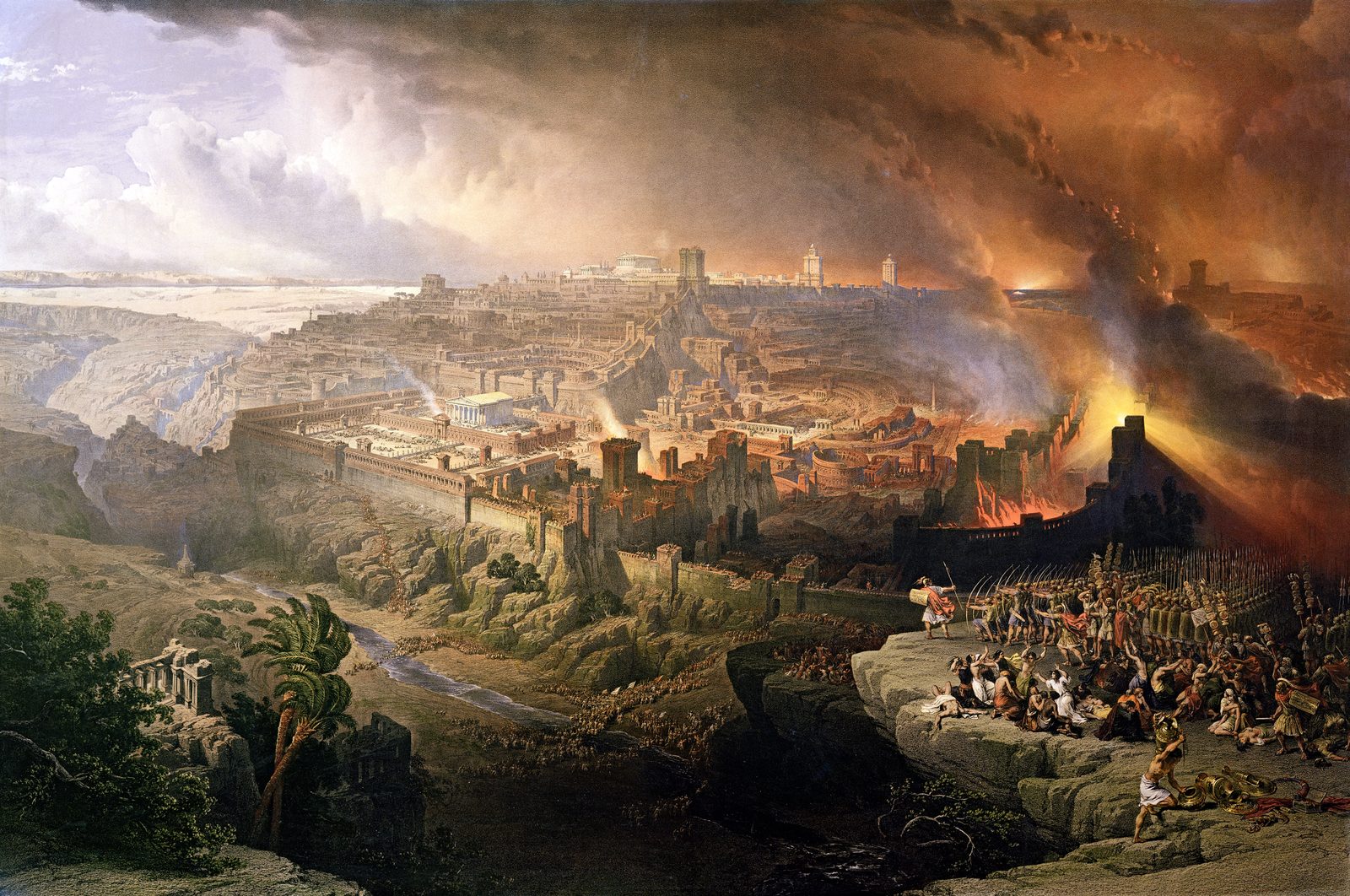
The Siege and Destruction of Jerusalem by the Romans Under the Command of Titus, A.D. 70. David Roberts, 1850. Wikimedia Commons. Public domain.