
Psalm 105
45 verses · Historical psalm
He sent a man before them— Joseph, sold as a slave.
Introduction
Author unstated, the Promise Kept, Book 4: The LORD reigns, Poetry, Psalms Overview.
This psalm names no writer, and its first fifteen verses are sung again in Chronicles on the day David brought the ark to Jerusalem. It tells Israel's story from Abraham to the land of Canaan, and it tells it as the keeping of one promise. Every act in it is God's act, from the famine in Canaan to the water from the rock. Listen for the promise made to the fathers, which stands near the start and returns near the end, and for the purpose the last verse gives to the whole story.
Context
- Who
- The offspring of Abraham and the sons of Jacob, named in verse 6 as the hearers
- What
- A song of praise that retells Israel's history from Abraham to the land as the keeping of one promise.
- Where
- Canaan, Egypt and the wilderness road, recited in Jerusalem.
- When
- Its first fifteen verses were sung when the ark came to Jerusalem, about 1000 BC, by 1 Chronicles 16.
- Why
- To teach Israel that its story is God's faithfulness to His word, and to call it to obey.
Historical context
Verses 1 to 15 stand at 1 Chronicles 16:8 to 22, in the thanksgiving sung on the day the ark came to Jerusalem, and the two passages differ in this store at one point: 1 Chronicles 16:13 reads the offspring of His servant Israel where Psalm 105:6 reads Abraham. The patriarchs of verses 12 and 13 lived as resident foreigners in a land they did not own, and the title prophet at verse 15 comes from Genesis 20:7, where God calls Abraham a prophet. Joseph's shackles and iron collar describe a slave held for trial, and his rise at verses 21 and 22 describes an Egyptian office, a steward over the king's property and his officials. Egypt is called the land of Ham after the son of Noah whose descendant Mizraim stands at Genesis 10:6. The plagues come in the psalm's own order, with darkness first where Exodus 10:21 has it ninth, and the livestock sickness and the boils are left out.
Significance
The psalm told Israel that everything from the famine to the land was the keeping of one promise spoken to Abraham, so their history was a promise being honoured. Its last line gave the purpose of the rescue, that they might keep His statutes and obey His laws, which made the land an obligation as well as a gift.
This chapter in Jewish lifeWhat this chapter is in Jewish life and reading.
How it is read
This psalm and the next stand together in the group this site calls the recitals, two histories set side by side, what God did and what Israel did with it (src/components/book/dossier-content/psalms-structure.ts). The classical commentary reads this one as the first of the pair, the history of what God did.
Rashi reads it verse by verse back into Genesis. The walking from nation to nation in verse 13 he fills out with the sojournings of Abraham in the land of the Philistines, in Egypt and in Canaan, and with Isaac and Jacob after him, "all exiled from one strange place to another strange place" (Rashi on Psalms 105:13:1, Rashi on Psalms, The Judaica Press complete Tanach with Rashi, translated by A. J. Rosenberg, CC-BY). The kings reproved in verse 14 he identifies from Genesis 12:17 and Genesis 20:18 (Rashi on Psalms 105:14:1).
The anointed ones of verse 15 he reads without a messianic sense, writing that they are "My great ones" and that every expression of anointing is an expression of rulership and greatness (Rashi on Psalms 105:15:1, same edition). A Christian reader meets the difference here, since the same verse is often read in the church of the prophets as types of Christ, and the site names the difference rather than settling it in a gloss.
The man sent ahead in verse 17 Rashi names as Joseph, who was sold, citing Genesis 45:5, and the word that came in verse 19 he reads as the decree of God working itself out so that Israel should go down to Egypt (Rashi on Psalms 105:17:1 and 105:19:1). Ibn Ezra and Radak carry ten comments for which Sefaria holds no English version, and they are cited by reference (Ibn Ezra on Psalms 105:2:1 and the nine references beside it).
What the rabbis say
Rashi carries two named sayings on the imprisonment of Joseph. On the irons of verse 18 he reports Rav Huna the son of Idi, who taught that Potiphar's wife fixed a forked spear under Joseph's beard so that bending his face would wound him (Rashi on Psalms 105:18:1, same edition). On verse 22 he reports Rabbi Idi, who read the singular in the word for prince and took it to mean Potiphar (Rashi on Psalms 105:22:1). The site reports both as what the rabbis taught.
The corpus records forty places where the Midrash and the Talmud cite this psalm, thirty eight under Midrash and two under Talmud, and it carries the locator for each one with no text. The Jerusalem Talmud cites verse 9 at Kilayim 9:3:7 and verse 17 at Peah 1:1:39. Bereshit Rabbah reads the psalm seven times, at 6:5, 33:1, 37:3, 53:12, 54:4, 67:9 and 84:7, and Midrash Tehillim treats it at 105:4, 105:5 and 105:7. The site reports where the rabbis cite the verse and reports no saying, because the locator carries none.
Sources: MannaFest, the recitals, Psalms 105 to 106, at src/components/book/dossier-content/psalms-structure.ts, 2026; Rashi, Rashi on Psalms 105, in The Judaica Press complete Tanach with Rashi, translated by A. J. Rosenberg, CC-BY; Ibn Ezra and Radak, their comments on Psalms 105, cited by reference; Sefaria holds no English version; The Midrash and the Talmud, the forty locators on Psalms 105 in scripts/data/sources/sefaria/psalms/105.json.
Psalms 105:1-6
make known His deeds among the nations: The psalm opens with commands and no history yet: give thanks, sing, tell, glory, seek, remember. One of them has no end attached, because His face is to be sought always. Verse 6 names the hearers, Abraham's offspring and Jacob's sons.
Psalms 105:1
“O give thanks unto the Lord,.... These are the words of David, either to the singers, or rather to the whole congregation of Israel, the seed of Abraham, and children of Jacob, Psa 105:6 stirring them up to praise and thankfulness for their mercies, temporal and spiritual; for the Messiah they had hope and expectation of, typified by the ark now brought home; for the word and ordinances, and opportunities of waiting upon God in them; for heaven and happiness, figured by Canaan's land given them to enjoy.”
tell of all His wonders: Verses 1 to 15 appear again at 1 Chronicles 16:8 to 22, the song David gave Asaph when the ark came to Jerusalem. Wonders translates niphla'ot, deeds beyond human power. The rest of the psalm tells them one by one.
Psalms 105:2
“Sing unto him, sing psalms unto him,.... Both vocally and instrumentally, with the voice and upon instruments of music, as were used in David's time. Psalms, hymns, and spiritual songs, are to be sung now, even the song of Moses, and of the Lamb. The wondrous things God had done for his people were sufficient matter for a song; and these were to be put into one, to be transmitted to posterity: it was usual in ancient times to hand down the history of memorable events by a song.”
Glory in His holy name: Glory is a reflexive form of halal, to praise, and here it means to boast in His name. The same root gives the Hallelujah that closes the psalm. Jeremiah 9:24 gives the command to boast in knowing the LORD.
Psalms 105:3
“Glory ye in his holy name,.... In the knowledge of it, as proclaimed in Christ; in being called by his name, and in having the honour to call upon his name; in the holiness of it; and in Christ being made sanctification as well as righteousness, in whom all the seed of Israel are justified and glory; as they may also of interest in him, and communion with him.”
Seek out the LORD and His strength: Seek out is darash, and seek His face is baqash, the verb of verse 3. His strength points to the ark, which Psalm 132:8 calls the ark of Your strength. His face is sought where He is present.
Remember the wonders He has done: Remembering runs through the psalm. The people remember in verse 5, and God remembers His covenant in verse 8 and His promise in verse 42. The judgments He pronounced are the plagues, which Exodus 12:12 calls judgments on Egypt.
Psalms 105:5
“Remember his marvellous works which he hath done,.... Which Aben Ezra interprets of the works of creation; rather they seem to design the works of Providence in favour of the children of Israel: best of all, works of grace done for his saints, none of which are to be forgotten; especially the great work of redemption and salvation, for the remembrance of which, under the New Testament, an ordinance is particularly appointed.”
O offspring of His servant Abraham: At 1 Chronicles 16:13 the line reads Israel His servant, where the psalm has Abraham. Abraham is called His servant again in verse 42. The title opens and closes the recital.
Psalms 105:6
“The seed of Abraham, his servants: the sons of Jacob, his chosen ones. If someone is seed, he is not yet also a son, according to what is written in the gospel: 'If you were the sons of Abraham, you would do the works of your father.' Therefore, that in which they glory, they are not; and if they are seed, they are servants set under fear, not having the perfect love which casts out fear. We are the sons of Jacob, of him who supplanted his brother, and took away his birthright.”
Jerome · written before 420 · Homily 31, on Psalm 104patristic
Psalms 105:7-11
He is the LORD our God: The same promise is called a covenant, a word, an oath, and a decree. It passes from Abraham to Isaac to Jacob without changing. What it promises is one thing, the land of Canaan as an inheritance.
Psalms 105:7
“Rather, "He, Jehovah, is our God." His title, "JEHOVAH," implies that He, the unchangeable, self-existing Being, makes things to be, that is, fulfils His promises, and therefore will not forsake His people.”
Jamieson, Fausset & Brown · Commentary Critical and Explanatory on the Whole Bible (1871)reformed
He remembers His covenant forever: A thousand generations echoes Deuteronomy 7:9, where the LORD keeps His covenant of loving devotion for a thousand generations. At 1 Chronicles 16:15 the line is a command to remember. God's remembering here answers the people's remembering in verse 5.
Psalms 105:8
“The covenant was often ratified. word--answering to "covenant" [Ps 105:9] in the parallel clause, namely, the word of promise, which, according to Ps 105:10, He set forth for an inviolable law. commanded--or, "ordained" (Ps 68:28). to a thousand generations--perpetually.”
Jamieson, Fausset & Brown · Commentary Critical and Explanatory on the Whole Bible (1871)reformed
the oath He swore to Isaac: The covenant is made with Abram at Genesis 15:18 and sworn by oath at Genesis 22:16. At Genesis 26:3 the LORD tells Isaac He will confirm the oath sworn to Abraham. Each patriarch hears it for himself.
He confirmed it to Jacob as a decree: Jacob receives the promise at Bethel, at Genesis 28:13 and again at 35:12, where the land given to Abraham and Isaac is given to him. Decree translates choq, a thing fixed and set down. He is named twice, Jacob and Israel.
Psalms 105:10
“And confirmed the same unto Jacob for a law. Jacob in his wondrous dream (Ge 28:10-15) received a pledge that the Lord's mode of procedure with him would be in accordance with covenant relations: for said Jehovah, "I will not leave thee till I have done that which I have spoken to thee of." Thus, if we may so speak with all reverence, the covenant became a law unto the Lord himself by which he bound himself to act.”
Charles Spurgeon · The Treasury of David, Vol. 5 (1878)Particular Baptist
Portion is chevel, a measuring cord, so the land is ground marked out by line. The promise stands at Genesis 12:7 and 17:8. Deuteronomy 32:9 uses the same word for Jacob as the LORD's own allotted share.
Psalms 105:11
“Heaven is the inheritance we have obtained, Eph. i. And this is the promise which God has promised us (as Canaan was the promise he promised them), even eternal life, 1 John ii.”
Matthew Henry · Commentary on the Whole Bible (1707-1721)puritan
Psalms 105:12-15
When they were few in number: They were few, unsettled, and moving from nation to nation, and kings were rebuked on their account. The title prophet comes from Genesis 20:7, where God calls Abraham a prophet in His own words. At Genesis 26:11 Abimelech warns that whoever harms Isaac will die.
Psalms 105:12
“When they were but a few men in number. bpom ytm. Literally, "homines numeri", men of number; so few as easily to be numbered: in opposition to what their posterity afterwards were, as the sand of the sea, without number. Samuel Chandler.”
Charles Spurgeon · The Treasury of David, Vol. 5 (1878)Particular Baptist
they wandered from nation to nation: Abraham goes down to Egypt at Genesis 12:10 and stays at Gerar in Genesis 20, and Isaac lives at Gerar in Genesis 26. Jacob serves twenty years in Haran. Deuteronomy 26:5 calls the father of the nation a wandering Aramean.
Psalms 105:13
“And they passed from nation to nation. Many think that he speaks of the captivity of the Jews. It is not so. For he speaks of Abraham. He went out from the land of the Chaldeans, and came into Mesopotamia, and from Mesopotamia into the land of promise, and again into Egypt. And from a kingdom to another people. We pass through many kingdoms, in order to reach the land of promise.”
Jerome · written before 420 · Homily 31, on Psalm 104patristic
He rebuked kings on their behalf: Two kings are meant. Pharaoh is struck with plagues over Sarai at Genesis 12:17, and Abimelech of Gerar is warned in a dream at Genesis 20:3. Plagues fall on Egypt long before Moses.
Psalms 105:14
“Fourthly, Even those that touch the prophets, nay that kill the prophets (as many did), cannot do them any harm, any real harm. Lastly, God's anointed prophets are dearer to him than anointed kings themselves. Jeroboam's hand was withered when it was stretched out against a prophet.”
Matthew Henry · Commentary on the Whole Bible (1707-1721)puritan
The patriarchs were never anointed with oil. The plural of mashiach here marks them as men God set apart for Himself. The same word is used of Saul at 1 Samuel 24:6, where David will not lift his hand against the LORD's anointed.
Psalms 105:15
“Saying, Touch not mine anointed,.... Or, "mine anointed ones"; my Christs, as Abraham, Isaac, and Jacob, were, who, though not anointed with material oil, yet were all that, that such were, who in later times were anointed with it.”
1 more voice on this verse
Psalms 105:15
“The patriarch was the prophet, priest, and king of his family. my prophets--in a similar sense, compare Ge 20:7. The "anointed" are those vessels of God, consecrated to His service, "in whom (as Pharaoh said of Joseph, Ge 41:38) the Spirit of God is" [HENGSTENBERG].”
Jamieson, Fausset & Brown · Commentary Critical and Explanatory on the Whole Bible (1871)reformed
Psalms 105:16-22
He called down famine on the land: God calls down the famine and sends a man ahead. Joseph wears shackles and an iron collar, then rules the king's household and teaches his elders wisdom. At verse 19 the word of the LORD refines him, the verb being the metal worker's word for burning dross out of ore.
Psalms 105:16
“Note, All judgments are at God's call, and no place is exempt from their visitation and jurisdiction when God sends them forth with commission. To try the faith of the patriarchs, God broke the whole staff of bread, even in that good land, that they might plainly see God designed them a better country than that was.”
Matthew Henry · Commentary on the Whole Bible (1707-1721)puritan
Joseph, sold as a slave: The sale is at Genesis 37:28. At Genesis 45:5 Joseph tells his brothers that God sent him before them to preserve life, the reading this verse gives. At Genesis 50:20 he says God meant their evil for good.
Psalms 105:17
Not nature but foolishness makes the slave. Not manumission but learning makes a person free. Esau was born free, but he became a slave; Joseph was sold into slavery, but he was raised to power8 so that he might rule those who had purchased him. Yet he did not slight his obligation to work zealously; he clung to the heights of virtue; he preserved the liberty of innocence, the stronghold of blamelessness. So the psalmist beautifully says, "Joseph had been sold into slavery. They had bound his feet with fetters."
Ambrose of Milan · written before 397 · Letter 53patristic
placed his neck in irons: Genesis 39:20 says only that Joseph was placed in the king's prison, so the shackles are a detail the psalm adds. The Hebrew reads that his nephesh came into iron, and nephesh can mean the neck. The Latin Vulgate read it as iron piercing his soul.
Psalms 105:18
Whose feet they hurt with fetters. From this we learn a little more of Joseph's sufferings than we find in the book of Genesis: inspiration had not ceased, and David was as accurate an historian as Moses, for the same Spirit guided his pen. He was laid in iron, or "into iron came his soul." The prayer book version, "the iron entered into his soul, "is ungrammatical, but probably expresses much the same truth. His fetters hurt his mind as well as his body, and well did Jacob say, "The archers shot at him, and sorely grieved him."
Charles Spurgeon · The Treasury of David, Vol. 5 (1878)Particular Baptist
until his prediction came true: His prediction is literally his word, the Hebrew davar. The word came true when the cupbearer was restored and the baker hanged at Genesis 40:21 and 22, as Joseph had said. Two full years passed before the king sent for him.
Psalms 105:19
“Until the time that his word came. God has his times, and his children must wait till his "until" is fulfilled. Joseph was tried as in a furnace, until the Lord's assaying work was fully accomplished. The word of the chief butler was nothing, he had to wait until God's word came, and meanwhile the word of the Lord tried him. He believed the promise, but his faith was sorely exercised. A delayed blessing tests men, and proves their metal, whether their faith is of that precious kind which can endure the fire.”
Charles Spurgeon · The Treasury of David, Vol. 5 (1878)Particular Baptist
The king sent and released him: Genesis 41:14 tells it: Pharaoh sent for Joseph, who was brought quickly from the dungeon, shaved and given fresh clothes. The ruler of peoples is the same king. The title marks the reach of the power that had held Joseph in irons.
Psalms 105:20
“The king sent and loosed him. He was thrust into the roundhouse by an officer, but he was released by the monarch himself. Even the ruler of the people, and let him go free. The tide had turned, so that Egypt's haughty potentate gave him a call from the prison to the palace. He had interpreted the dreams of captives, himself a captive; he must now interpret for a ruler and become a ruler himself. When God means to enlarge his prisoners, kings become his turnkeys.”
Charles Spurgeon · The Treasury of David, Vol. 5 (1878)Particular Baptist
He made him master of his household: Genesis 41:40 is the grant, Joseph set over Pharaoh's house with only the throne above him. The pattern repeats from Genesis 39:4, where Potiphar made him overseer of his house. Now the house is the king's.
Psalms 105:21
“A father to the church that then was, to save the house of Israel from perishing by the famine. He was made great, that he might do good, especially in the household of faith. A figure of Christ that was to come, who, because he humbled himself and took upon him the form of a servant, was highly exalted, and has all judgment committed to him.”
Matthew Henry · Commentary on the Whole Bible (1707-1721)puritan
to instruct his princes as he pleased: The Hebrew verb is asar, to bind, the verb of Genesis 42:24 where Joseph binds Simeon. The man once bound in irons now binds princes as he pleases. The Greek reads instruct, and the Berean follows it.
Psalms 105:22
“The soul that was once bound itself now binds others, even princes. The same moral binding is assigned to the saints (Ps 149:8). teach . . . senators wisdom--the ground of his exaltation by Pharaoh was his wisdom (Ge 41:39); namely, in state policy, and ordering well a kingdom.”
Jamieson, Fausset & Brown · Commentary Critical and Explanatory on the Whole Bible (1871)reformed
Psalms 105:23-25
Then Israel entered Egypt: Egypt is called the land of Ham, whose son Mizraim stands at Genesis 10:6. The growth that alarmed Pharaoh at Exodus 1:7 is credited here to the LORD, who made His people fruitful. The turn in Egypt's heart is credited to Him too.
Psalms 105:23
“And Jacob was a sojourner in the land of Ham. For the just man never dwells in the land, but is a sojourner of the earth.”
Jerome · written before 420 · Homily 31, on Psalm 104patristic
more numerous than their foes: Pharaoh says the same at Exodus 1:9, that the Israelites have become too numerous and too strong. God had promised at Genesis 46:3 to make Jacob a great nation in Egypt. Seventy people went down, by Exodus 1:5.
Psalms 105:24
“And he increased his people exceedingly. For they went down into Egypt in seventy-five souls, and six hundred thousand went out of Egypt.”
Jerome · written before 420 · Homily 31, on Psalm 104patristic
to conspire against His servants: The conspiracy is Exodus 1:10, where the king of Egypt plans to deal shrewdly with His people. Conspire is the rare verb of Genesis 37:18, where Joseph's brothers plot against him. His servants meet the same hate in both.
Psalms 105:25
“Malice is crafty to destroy: Satan has the serpent's subtlety, with his venom. It was God that turned the hearts of the Egyptians against them; for every creature is that to us that he makes it to be, a friend or an enemy. Though God is not the author of the sins of men, yet he serves his own purposes by them.”
Matthew Henry · Commentary on the Whole Bible (1707-1721)puritan
Psalms 105:26-31
He sent Moses His servant: Darkness comes first in the psalm and ninth in Exodus, where it falls at Exodus 10:21. The frogs are the plague that reaches the king's own rooms. Blood in the water, dead fish, frogs, and swarms of gnats follow the darkness here.
Psalms 105:26
“He sent Moses his servant,.... Into Egypt, to deliver his people Israel out of the hands of the Egyptians; in which, as in other things, he approved himself to be a faithful servant to the Lord; of this mission of his, see Exo 3:10. In this he was a type of Christ, who appeared in the form of a servant, and really was one; God's righteous servant as Mediator, though his Son as a divine Person; sent by him to redeem his people out of worse than Egyptian bondage, from sin, Satan, the law, its curse and condemnation.”
wonders in the land of Ham: Exodus 7:3 pairs the same two words, signs and wonders multiplied in the land of Egypt. The Hebrew reads the matters of His signs, divrei ototav. Moses and Aaron carry them out as His agents.
Psalms 105:27
“They showed the words of his signs (so it is in the original), for every plague had an exposition going along with it; they were not, as the common works of creation and providence, silent signs, but speaking ones, and they spoke aloud. They are all or most of them here specified, though not in the order in which they were inflicted.”
Matthew Henry · Commentary on the Whole Bible (1707-1721)puritan
yet they defied His words: The standard Hebrew text carries a negative and reads that they did not defy His word, often taken of Moses and Aaron. The Greek drops the negative, and the Berean follows it. The darkness came at His word.
Psalms 105:28
“Or, rather, the "darkness" here is figurative (Jer 13:16), the literal plague of darkness (Ex 10:22, 23) being only alluded to as the symbol of God's wrath which overhung Egypt as a dark cloud during all the plagues. Hence, it is placed first, out of the historical order. Thus, "They rebelled not (that is, no longer) against His word," refers to the Egyptians.”
Jamieson, Fausset & Brown · Commentary Critical and Explanatory on the Whole Bible (1871)reformed
1 more voice on this verse
Psalms 105:28
“The old translation follows the LXX., and reads it, They were not obedient to his word, which may be applied to Pharaoh and the Egyptians, who, notwithstanding the terror of this plague, would not let the people go; but there is no ground for it in the Hebrew.”
Matthew Henry · Commentary on the Whole Bible (1707-1721)puritan
He turned their waters to blood: The first plague is Exodus 7:20 and 21, where the Nile turns to blood and its fish die. Egypt lived by the Nile's water and fish. Numbers 11:5 remembers the fish Israel ate there freely.
Psalms 105:29
“He turned their waters into blood, and slew their fish. So that the plague was not a mere colouring of the water with red earth, as some suppose, but the river was offensive and fatal to the fish. The beloved Nile and other streams were all equally tainted and ensanguined. Their commonest mercy became their greatest curse. Water is one of the greatest blessings, and the more plentiful it is the better, but blood is a hideous sight to look upon, and to see rivers and pools of it is frightful indeed.”
Charles Spurgeon · The Treasury of David, Vol. 5 (1878)Particular Baptist
Their land teemed with frogs: Teemed is sharats, the verb for swarming life at Genesis 1:20. Exodus 8:3 uses it of the Nile teeming with frogs, and Exodus 1:7 uses it of Israel multiplying in Egypt. The swarm Egypt feared comes back on its own land.
gnats throughout their country: Two plagues stand in one line. Insects translates arov, the swarms of Exodus 8:21, and the gnats of Exodus 8:16 to 19, the plague the magicians call the finger of God. He spoke, and they came, as with the locusts of verse 34.
Psalms 105:32-36
gave them hail for rain: Hail and lightning break the vines and fig trees, and locusts finish whatever is left green. Two of the ten plagues never appear, the livestock sickness at Exodus 9:3 and the boils at Exodus 9:9. The firstborn are called the first of Egypt's own manly strength.
He struck their vines and fig trees: Exodus 9:25 records every tree in the field broken by the hail. Exodus 9:31 names the flax and barley as ruined, while this verse and Psalm 78:47 name the vines. The losses were Egypt's food and wine.
Psalms 105:33
“He smote their vines also, and their fig trees,.... So that they died; for in Psa 78:47, it is said, he "killed" them; and it is not only used in common speech with us, but with classical writers (b) to speak of killing inanimate things, as trees, herbs, &c. That is, the hail smote them, or God by the hail; these are particularly mentioned because most useful, producing grapes and figs. And brake the trees of their coasts: all the trees within the borders of their land, Exo 9:25. (b) "----interice messes", Virgil. Georgic. l.”
young locusts without number: Two words for locust stand here, arbeh and yeleq, the second often taken as the young insect before its wings. Exodus 10:14 says there had never been such a swarm and never would be again. Joel 1:4 uses both words.
consumed the produce of their soil: Produce is literally fruit, and soil is adamah, the tilled ground. Egypt loses the yield of its land here, and at verse 44 Israel receives the fruit of other peoples' labor. Exodus 10:15 says the swarm covered the face of the whole land.
Psalms 105:35
“Did eat up all the herbs. The locusts had devoured every green herb and every blade of grass; and had it not been for the reeds, on which our cattle entirely subsisted while we skirted the banks of the river, the journey must have been discontinued, at least in the line that had been proposed. The larvae, as generally is the case in this class of nature, are much more voracious than the perfect insect; nothing that is green seems to come amiss to them.”
Charles Spurgeon · The Treasury of David, Vol. 5 (1878)Particular Baptist
the firstfruits of all their vigor: The firstborn died at midnight at Exodus 12:29, from the firstborn of Pharaoh on his throne to the firstborn of the captive. Firstfruits of their vigor is the phrase Jacob uses of Reuben at Genesis 49:3. Psalm 78:51 repeats it.
Psalms 105:36
“He smote also all the firstborn in their land,.... Both of men and beasts; the firstborn of the king on the throne, and of the maidservant behind the mill, and of the captive in the dungeon; this was the last plague, and which prevailed upon the Egyptians to let Israel go, Exo 11:5. The chief of all their strength; or the first of their strength; the same in different words as before, their firstborn; see Gen 49:3.”
Psalms 105:37-41
He brought Israel out with silver: The silver and gold come from Exodus 12:35 and 36, and the dread of Israel makes Egypt glad to see them go. None of the tribes stumbled on the way out. The provisions run together, a cloud, a fire, quail, the bread of heaven, and water out of a rock.
Psalms 105:37
“Surely never was the like, that among so many thousands there was not one sick! So false was the representation which the enemies of the Jews, in after-ages, gave of this matter, that they were all sick of a leprosy, or some loathsome disease, and that therefore the Egyptians thrust them out of their land.”
Matthew Henry · Commentary on the Whole Bible (1707-1721)puritan
Egypt was glad when they departed: Exodus 12:33 gives the scene. The Egyptians urged the people to leave in haste, fearing they would all die. The same dread falls on the peoples of Canaan in the song of Exodus 15:16.
Psalms 105:38
“Egypt was glad when they departed, which would not have been the case had the gold and silver been borrowed by the Israelites, for men do not carry their goods into a far country. The awe of God like to see borrowers lad to nay them to be was on Egypt, and they feared his people and were glad to pay them to be gone.”
Charles Spurgeon · The Treasury of David, Vol. 5 (1878)Particular Baptist
He spread a cloud as a covering: In Exodus 13:21 the cloud leads the way. Here it is a covering spread over them, as at Numbers 10:34, where the cloud of the LORD is over them by day. Isaiah 4:5 promises the same cloud and fire as a canopy over Zion.
Psalms 105:39
“He spread a cloud for a covering. Never people were so favoured. What would not travellers in the desert now give for such a canopy? The sun could not scorch them with its burning ray; their whole camp was screened like a king in his pavilion. Nothing seemed to be too good for God to give his chosen nation, their comfort was studied in every way. And fire to give light in the night. While cities were swathed in darkness, their town of tents enjoyed a light which modern art with all its appliances cannot equal.”
Charles Spurgeon · The Treasury of David, Vol. 5 (1878)Particular Baptist
the bread of heaven: Quail come twice, at Exodus 16:13 and Numbers 11:31. Psalm 78:18 to 31 tells the second as a craving punished, while this psalm tells it as a gift. The bread of heaven is the manna of Exodus 16:4, a title John 6:31 to 33 takes up.
He opened a rock: Water gushed from the rock at Horeb in Exodus 17:6 and again at Meribah in Numbers 20:11. Isaiah 48:21 recalls it. Paul says at 1 Corinthians 10:4 that the rock in the desert was Christ.
Psalms 105:41
“He opened the rock, and the waters gushed out. With Moses' rod and his own word he cleft the rock in the desert, and forth leaped abundant floods for their drinking where they had feared to die of thirst. From most unlikely sources the all sufficient God can supply his people's needs; hard rocks become springing fountains at the Lord's command. They ran in the dry places like a river: so that those at a distance from the rock could stoop down and refresh themselves, and the stream flowed on, so that in future journeyings they were supplied.”
Charles Spurgeon · The Treasury of David, Vol. 5 (1878)Particular Baptist
Psalms 105:42-45
He remembered His holy promise: The recital closes on the promise it opened with. What Israel receives is another people's labor, the cities and vineyards of Deuteronomy 6:10 and 11 that they did not build or plant. The last line gives the purpose, that they keep the statutes and obey His laws.
Psalms 105:42
“For he remembered his holy promise, and Abraham his servant. Here is the secret reason for all this grace. The covenant and he for whose sake it was made are ever on the heart of the Most High. He remembered his people because he remembered his covenant. He could not violate that gracious compact for it was sacred to him, —"his holy promise." A holy God must keep his promise holy. In our case the Lord's eye is upon his beloved Son, and his engagements with him.”
Charles Spurgeon · The Treasury of David, Vol. 5 (1878)Particular Baptist
His chosen with shouts of joy: The shouts of joy are the song of Moses and Miriam at Exodus 15:1 and 15:20 to 21. The chosen of verse 6 are the ones brought out here. Egypt was glad in verse 38 to see them go, and Israel sings as it goes.
Psalms 105:43
“And he brought forth his people with joy - With joy at their deliverance from bondage, and for his merciful interposition. And his chosen with gladness - Margin, as in Hebrew, “singing.” See Exo. 15.”
He gave them the lands of the nations: Joshua 24:13 says the same at the close of the conquest, where the LORD gives land and cities built by others. The promise of verse 11 is kept here. Canaan becomes their portion.
Psalms 105:44
“Hence rightly also it is said through the Psalmist: "He gave them the lands of the nations, and they took possession of the labors of the peoples, that they might keep his statutes and observe his law." So therefore in this passage, Truth speaking to the inexperienced disciples promises that the kingdom of God will be seen on earth, so that it might be more faithfully hoped for by them in heaven. From that very kingdom which we now see exalted in the world, let us hope for the kingdom which we believe is to be received in heaven.”
Gregory the Dialogist · written before 604 · Forty Gospel Homilies, Homily 32patristic
keep His statutes and obey His laws: Statutes is chuqqim, the plural of the word for decree in verse 10. God confirmed His decree to Jacob, and the people receive His decrees to keep. The psalm ends with Hallelujah, as Psalm 104 does and Psalm 106 does.
Psalms 105:45
“That they might observe his statutes, and keep his laws. This was the practical design of it all. The chosen nation was to be the conservator of truth, the exemplar of morality, the pattern of devotion: everything was so ordered as to place them in advantageous circumstances for fulfilling this trust. Theirs was a high calling and a glorious election. It involved great responsibilities, but it was in itself a distinguished blessing, and one for which the nation was bound to give thanks. Most justly then did the music close with the jubilant but solemn shout of Hallelujah.”
Charles Spurgeon · The Treasury of David, Vol. 5 (1878)Particular Baptist
How this psalm is built
The form: Covenant history sung as praise, with commands first and the history after them, as Henry classes it.
The patterns in this chapter
| Device | What it does | Where to see it |
|---|---|---|
| Six commands before any history | Verses 1 to 5 give thanks, sing, tell, glory, seek and remember, and none of the history has started yet. Matthew Henry notes that one of the six carries no end, since His face is to be sought always, and the list sets the whole recital as an act of obedience.Matthew Henry, Commentary on the Whole Bible, 1710, on Psalm 105:1. | Psalm 105:1, Psalm 105:2, Psalm 105:3, Psalm 105:4, Psalm 105:5 |
| The one promise under four names | Verses 8 to 10 call the same thing a covenant, a word He ordained, an oath He swore and a decree He confirmed, and pass it from Abraham to Isaac to Jacob without changing what it promises. Albert Barnes reads the four names as one thing said four ways, which is why verse 11 can state the content in a single line.Albert Barnes, Notes, Explanatory and Practical, on the Old and New Testaments, 1832 to 1869, on Psalm 105:8. | Psalm 105:8, Psalm 105:9, Psalm 105:10, Psalm 105:11 |
| The plagues in the psalm's own order | Verses 28 to 36 run darkness first, then blood, frogs, insects, hail, locusts and the firstborn. Darkness is ninth in Exodus 10:21 and first here, and two of the ten never appear at all, the livestock sickness of Exodus 9:3 and the boils of Exodus 9:9. The psalm is arranging rather than reciting.Matthew Henry, Commentary on the Whole Bible, 1710, on Psalm 105:32. | Psalm 105:28, Psalm 105:29, Psalm 105:32, Psalm 105:34, Psalm 105:36 |
| The word that refines | At verse 19 the word of the LORD proves Joseph right, and the Hebrew verb behind it is the metal worker's word for burning the dross out of ore. The line says that the promise tested the man who carried it while he waited in irons.John Gill, Exposition of the Old Testament, 1763, on Psalm 105:19. | Psalm 105:18, Psalm 105:19 |
Its historical value
10 more paragraphs on the patterns
The first fifteen verses of this psalm stand at 1 Chronicles 16:8 to 22, inside the thanksgiving sung on the day the ark came to Jerusalem, and the two can be compared line by line in this store. They agree word for word through the passage with one difference: 1 Chronicles 16:13 reads O offspring of His servant Israel where Psalm 105:6 reads O offspring of His servant Abraham. Psalm 96 carries the next section of the same Chronicles song, so two psalms of this lane's range are drawn from one recorded occasion.
The psalm is also a source for how Israel told its own story. It names no sin of the people anywhere, which is what Psalm 106 exists to do, so the pair together hold the two halves of the same history.
Where it comes from
The title prophet at verse 15 comes from Genesis 20:7, where God calls Abraham a prophet in His own words, and the warning of verse 14 stands at Genesis 26:11, where Abimelech tells his people that whoever harms Isaac will die. Egypt is called the land of Ham at verse 23, whose son Mizraim stands at Genesis 10:6. The growth that alarmed Pharaoh at Exodus 1:7 is credited here to the LORD. The silver and gold of verse 37 come from Exodus 12:35 and 36, where the Egyptians hand it over.
The debated point
Why the plagues are given in this order and why two are missing is the psalm's open question. The plain reading, which Matthew Henry and Albert Barnes both take, is that the psalm selects and arranges for its own purpose rather than reciting Exodus, since it is praise and not a chronicle. The site carries that as the reading the text supports and does not treat the difference as an error in either book.
In the Psalter
Psalm 105 and Psalm 106 are the two halves of one telling. This psalm ends with Hallelujah and Psalm 106 opens with it, and where this one records what God did, the next records what the people did. The psalm follows Psalm 104, which does the same work of recital for the created world.
The door
The ten plagues carries the order this psalm departs from, and The exodus carries the departure of verses 37 to 43.
Keep studying
Studies6
Sources for this chapter
The summary
Jamieson, Fausset & Brown, Commentary Critical and Explanatory; John Calvin, Commentaries; John Wesley, Notes on the Old Testament and Matthew Henry, Complete Commentary.
The form and classifications
Albert Barnes, Notes, Explanatory and Practical, on the Old and New Testaments, 1832 to 1869, on Psalm 105:8; Charles Spurgeon, The Treasury of David, Vol. 4, 1874, on Psalm 105:45 and Matthew Henry, Commentary on the Whole Bible, 1710, on Psalm 105:1.
The exposition
Albert Barnes, Notes on the Book of Psalms; Charles Spurgeon, The Treasury of David; Franz Delitzsch, Biblical Commentary on the Psalms; Jamieson, Fausset and Brown, Commentary Critical and Explanatory on the Whole Bible; John Gill, Exposition of the Old Testament and Matthew Henry, Commentary on the Whole Bible.
The painting
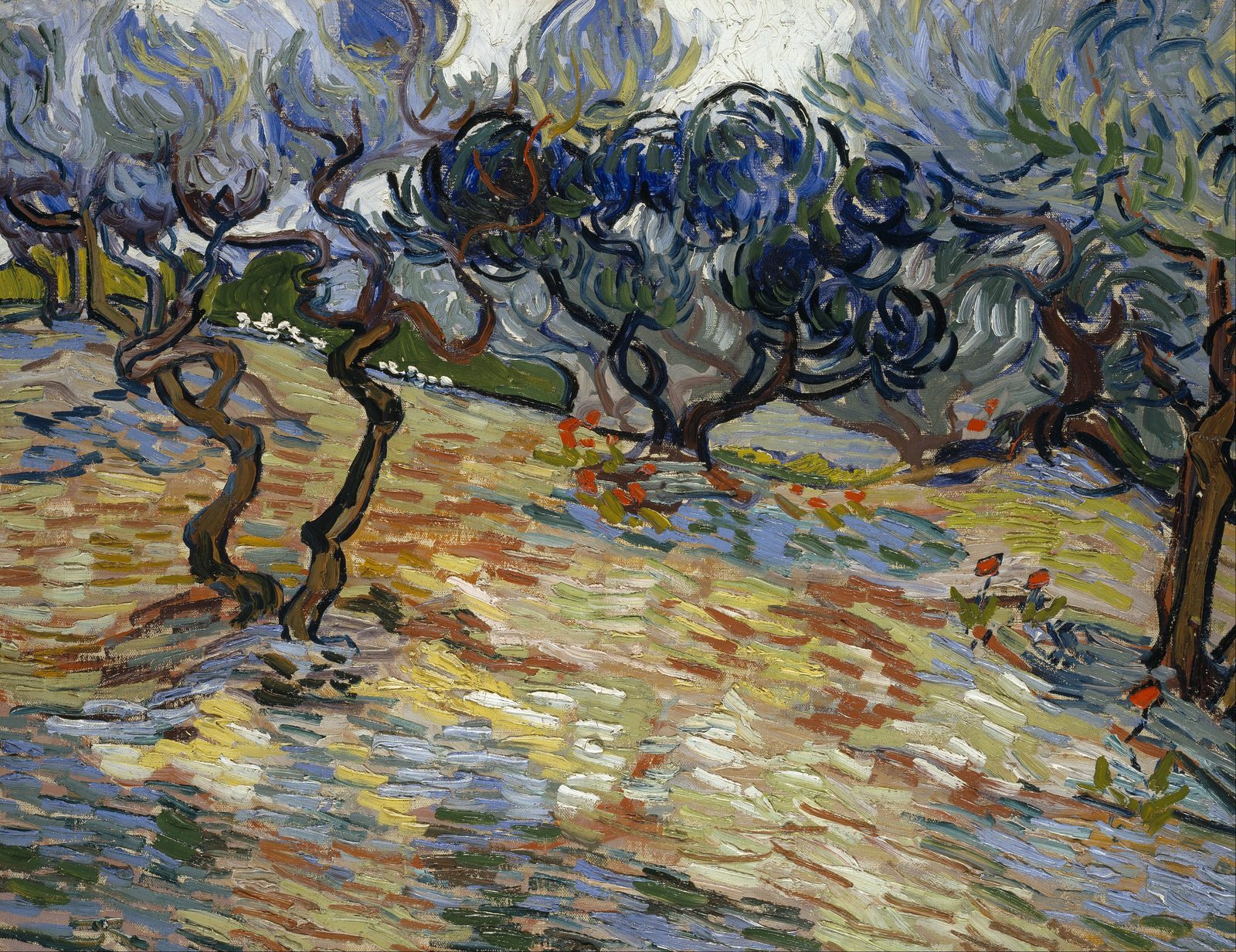
Olive Trees. Vincent van Gogh, Saint-Rémy-de-Provence, November 1889. Wikimedia Commons. Public domain.