
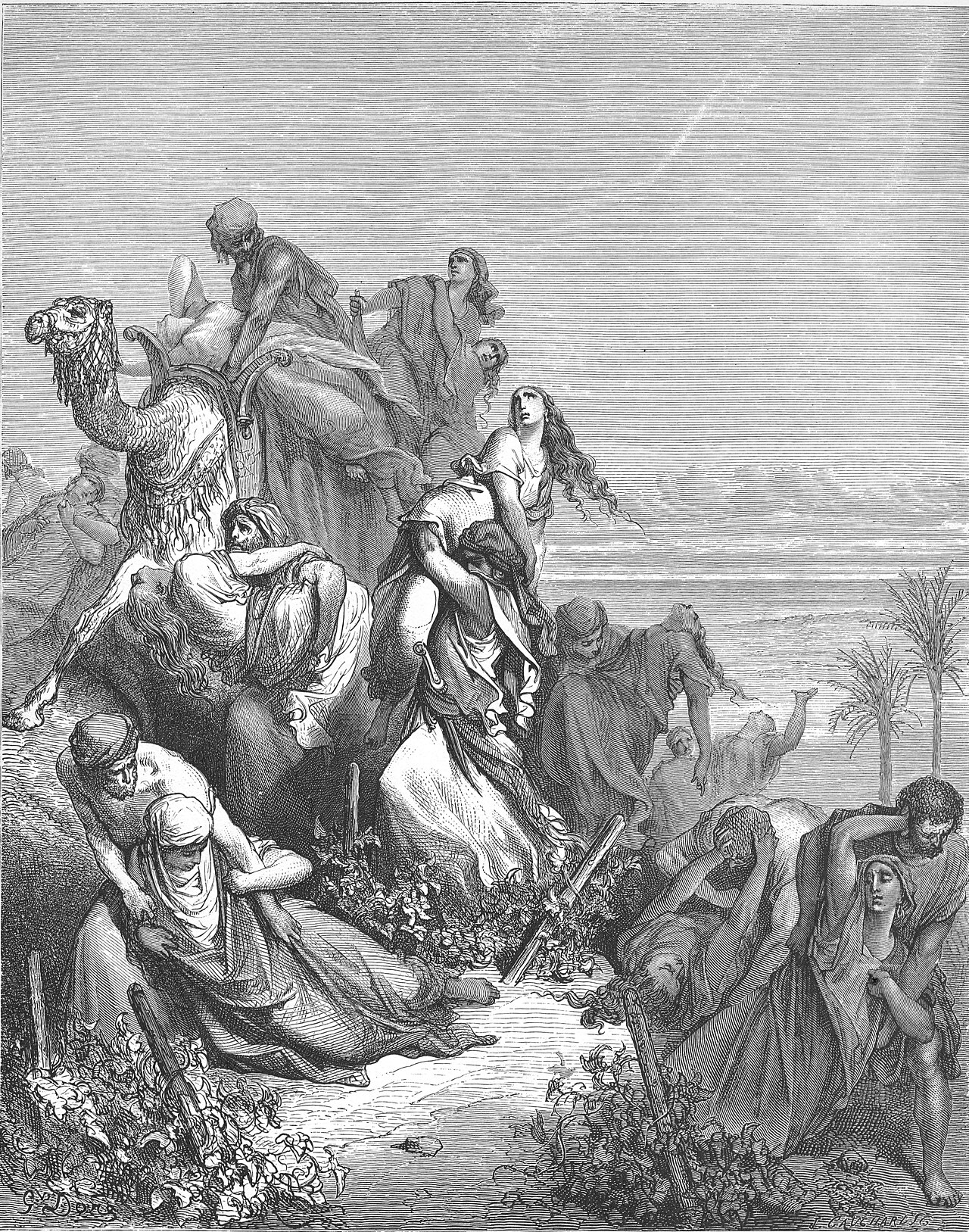
Judgeschapter 21
25 verses · Samuel, by tradition · 11th century BC · History
Now the men of Israel had sworn in Mizpeh, saying, There shall not any of us give his daughter unto Benjamin to wife.
Introduction
Samuel, by tradition, History, Judges Overview.
This chapter was written for Israelites who had watched a nation try to repair a disaster it had caused, and tradition gives the book to Samuel. It closes the book of Judges. It follows the victors after the battle, grieving over the tribe they have almost destroyed and bound by an oath they cannot take back. It asks what happens when a people keeps the letter of its promises and loses their purpose. Listen for the questions the elders ask one another, and for how seldom God is asked. Notice the last sentence, which the book has said before and now says as its final word.
Context
- Who
- Israelites who had watched a nation try to repair a disaster it had caused
- What
- An account of Israel's grief over Benjamin, the destruction of Jabesh-gilead, and the two ways wives were found for the six hundred surviving Benjamites.
- Where
- Bethel where the ark stood, Jabesh-gilead east of the Jordan, and the vineyards outside Shiloh at the yearly feast.
- When
- About 1350 BC, in the months after the war with Benjamin, early in the judges period.
- Why
- To show Israel trying to save a tribe without breaking its oath, and to close the book with its verdict on an age without a king.
Historical context
The account belongs to the assembly and its elders. The six hundred Benjamite survivors at the rock of Rimmon are the men the chapter is about, and every later Benjamite descends from them.
Show the rest of the historical context, 4 more paragraphs
The time is the months after the war, on the four months verse 20:47 gives the survivors at the rock. The dating of the whole appendix rests on Phinehas at 20:28.
The places are three, and each carries one of the chapter's acts. Bethel, where the ark stood and Israel wept and built an altar. Jabesh-gilead, east of the Jordan in Gilead, on ground the war never touched. Shiloh, west of the Jordan, where the tabernacle stood and a yearly feast was kept.
The occasion is an oath that had already been sworn. At the muster of Mizpah the men of Israel swore that no man would give his daughter to Benjamin, and a second oath laid death on any town that failed to appear.
A first hearer knew that an oath sworn by the LORD was binding and could not be set aside at will. That is why the elders look for a road around it. He knew the yearly gathering at Shiloh as a real institution, since Elkanah is still keeping it at 1 Samuel 1:3. And he knew the sentence of Deuteronomy 13:15 and the sparing formula of Numbers 31:17 and 31:18, both of which are applied here to an Israelite town.
Significance
A hearer under a king was watching a nation with no one to arbitrate. Israel keeps the letter of its oath by destroying a second town and then by staging an abduction at a feast of the LORD.
Show the rest of the significance, 2 more paragraphs
The town raided here returns in the story of the first king. Saul the Benjamite rescues Jabesh at 1 Samuel 11, and the men of Jabesh bury his bones at 1 Samuel 31:11 to 13.
The book then closes on its own verdict. There was no king in Israel, and every man did what was right in his own eyes.
This chapter in Jewish lifeWhat this chapter is in Jewish life and reading.
How it is read
Rashi reads the last chapter as Israel working to undo what its own oath had done. On the assembly's grief he glosses the verb used of the missing tribe as removal rather than remembrance, and on the change of mind about Benjamin he says the people reversed themselves and began looking for a way out for the survivors (Rashi on Judges 21:3:1 and 21:6:1, the Metsudah Tanach series, Lakewood, N.J., CC-BY). On the plan itself he states the aim in the elders' own terms: the tribe's ancestral property stood unclaimed, so a way had to be found for the survivors to father children and keep the inheritance in the tribe (Rashi on Judges 21:17:1, same edition). On the four hundred young women from Jabesh Gilead he hands on the test the Talmud describes, "They placed them over the openings of wine barrels. Those with carnal knowledge emitted an aroma, the virgins did not", citing Yevamos 60b (Rashi on Judges 21:12:1, same edition). On the yearly feast at Shiloh he gives the place its bearings, north of Bethel, south of Lebonah and east of the road going up from Bethel to Shechem (Rashi on Judges 21:19:1, same edition). On the answer the elders promise to give the fathers and brothers he glosses their phrase as coming to make war (Rashi on Judges 21:22:1, same edition). Radak and Metzudat David comment across the chapter and the corpus holds no English version of them here, so they stand as citations: Radak on Judges 21:1:1, Radak on Judges 21:9:1, Radak on Judges 21:11:1, Radak on Judges 21:15:1, Radak on Judges 21:25:1, Metzudat David on Judges 21:5:1, Metzudat David on Judges 21:16:1, Metzudat David on Judges 21:18:1 and Metzudat David on Judges 21:21:1.
What the rabbis say
The corpus records forty rabbinic locators on this chapter, thirty-two of them Midrash and eight Talmud, each a locator without text. The oath sworn at Mizpah draws Bava Batra 121a:8, Ein Yaakov, Bava Batra 8:15, Ein Yaakov, Taanit 4:19, Ein Yaakov (Glick Edition), Bava Batra 8:13, Ein Yaakov (Glick Edition), Taanit 4:11, Midrash Tanchuma Buber, Vayishlach 29:1 and Ruth Rabbah, Petichta 3. The cry over the tribe cut off draws Kohelet Rabbah 5:16:1, Midrash Tannaim on Deuteronomy 20:3:1 and Sifrei Devarim 192:2. Jabesh Gilead draws Bereshit Rabbati, Parashat Vayeshev 43, Midrash Tanchuma, Vayeshev 2:10, Pirkei DeRabbi Eliezer 38:18 and Pirkei DeRabbi Eliezer 38:19, and the four hundred young women draw Yevamot 60b:12, Ketubot 10b:3, Ein Yaakov, Yevamot 6:1, Yalkut Shimoni on Torah 382:2 and Yalkut Shimoni on Torah 785:38. The concern for the inheritance draws Bava Batra 116a:2 and Ein Yaakov, Bava Batra 8:5. The second plan and the dancers at Shiloh draw Bereshit Rabbah 65:20, Bereshit Rabbah 73:5, Eikhah Rabbah, Petichta 33, Jerusalem Talmud Taanit 4:7:2, Gittin 7b:4, Midrash Aggadah, Genesis 49:27:1, Midrash Tanchuma, Shmini 2:1, Midrash Tanchuma, Vayechi 14:5 and Tractate Soferim 7:4. The closing line of the book draws Avodah Zarah 25a:14, Midrash Lekach Tov, Deuteronomy 12:8:1, Seder Olam Rabbah 2:2 and Yalkut Shimoni on Nach 22:3. The rabbis teach in these places, and this site reports them as their teaching rather than as a rule of the text.
Sources: Rashi, Rashi on Judges 21:3:1, 21:6:1, 21:12:1, 21:17:1, 21:19:1 and 21:22:1, the Metsudah Tanach series, Lakewood, N.J., CC-BY; Radak, Radak on Judges 21:1:1, 21:9:1, 21:11:1, 21:15:1 and 21:25:1, cited only, no English version in the corpus; Metzudat David, Metzudat David on Judges 21:5:1, 21:16:1, 21:18:1 and 21:21:1, cited only.
The heads below are this chapter's scenes. The numbered points under each are its verses.
A rash oath: no daughters for Benjamin
Judges 21:1-3
The oath is reported here for the first time, though it was sworn at the muster of 20:1 at Mizpah. Israel asks why “one tribe is missing”, treating the loss as an event and passing over what its own army did in chapter 20. They weep at Bethel, where 20:27 and 20:28 put the ark and Phinehas son of Eleazar, whose name sets these chapters early in the period.
Judges 21:1
“Now the men of Israel had sworn - Of this oath we had not heard before; but it appears they had commenced this war with a determination to destroy the Benjamites utterly, and that if any of them escaped the sword no man should be permitted to give him his daughter to wife. By these means the remnant of the tribe must soon have been annihilated.”
Adam Clarke · Commentary on the Bible (1810-1826)evangelical
Clarke reads the weeping before God at Bethel as contrition for what the people had done, once their revenge was spent. Ambrose writes that the end of the war was the end of their anger. Henry says they grieved for a whole tribe of Israel.
Judges 21:2
“The people came to the house of God - Literally, the people came בית־אל to Bethel; this is considered as the name of a place by the Chaldee, Syriac, Arabic, and Septuagint. And wept sore - Their revenge was satisfied, and now reflection brings them to contrition for what they had done.”
Adam Clarke · Commentary on the Bible (1810-1826)evangelical
The people cried to the LORD God of Israel over a missing tribe. Barnes hears an appeal to the covenant in the repeated name Israel, which meant all twelve tribes. Clarke answers that their revenge went too far.
Judges 21:3
“The repetition of the name of Israel is very striking in connection with the title of Yahweh as “God of Israel.” It contains a very forcible pleading of the covenant, and memorial of the promises. The very name “Israel” comprehended all the twelve tribes; with one of them blotted out, the remnant would not be Israel.”
Judges 21:4-5
They build an altar before they offer, which Clarke reads as evidence that the place held no standing altar of its own at that time. Then a second oath surfaces, also unrecorded when it was sworn, laying death on any man who failed to come up to Mizpeh. Two oaths are now on the record inside five verses, and the rest of the chapter is spent working around the first one by means of the second.
Judges 21:4
“Built there an altar - This affords some evidence that this was not a regular place of worship, else an altar would have been found in the place; and their act was not according to the law, as may be seen in several places of the Pentateuch. But there was neither king nor law among them, and they did whatever appeared right in their own eyes.”
Adam Clarke · Commentary on the Bible (1810-1826)evangelical
Henry reads the solemn oath as death for any of the tribes that failed to come to the assembly before the LORD, as a sign that it cared nothing for the crime. Jamieson, Fausset and Brown call the oath inconsiderate.
Judges 21:6-7
They grieve for “their brothers, the Benjamites”, the word Israel used at 20:28 when it asked whether to fight them once more. The grief is over the outcome and not the sentence, since 20:48 had put the cities of Benjamin to the sword and the fire. Verse 7 states the deadlock the last eighteen verses answer, “we have sworn by the LORD”.
Judges 21:6
“There is one tribe cut off from Israel this day--that is, in danger of becoming extinct; for, as it appears from Jud 21:7, they had massacred all the women and children of Benjamin, and six hundred men alone survived of the whole tribe.”
Jamieson, Fausset & Brown · Commentary Critical and Explanatory on the Whole Bible (1871)reformed
The question shows, in Clarke's reading, that every woman of Benjamin had died in the war. He holds that the oath and the slaughter together aimed at ending the tribe. Six hundred men remained.
Judges 21:7
“How shall we do for wives for them - From this it appears that they had destroyed all the Benjamitish women and children! They had set out with the purpose of exterminating the whole tribe, and therefore they massacred the women, that if any of the men escaped, they might neither find wife nor daughter; and they bound themselves under an oath not to give any of their females to any of the remnant of this tribe, that thus the whole tribe might utterly perish.”
Adam Clarke · Commentary on the Bible (1810-1826)evangelical
Jabesh-gilead pays for staying home
Judges 21:8-9
The way out begins with a roll call rather than with a prayer. The people are numbered, one town is found missing from the assembly, and absence at the muster is the whole charge the text records against it. Jabesh sits east of the Jordan in Gilead, on ground the war against Benjamin never touched.
Judges 21:8
“But it appears (Jud 21:11) that, besides acting in fulfilment of their oath, the Israelites had the additional object by this raid of supplying wives to the Benjamite remnant.”
Jamieson, Fausset & Brown · Commentary Critical and Explanatory on the Whole Bible (1871)reformed
The people were counted, and Jabesh-gilead was missing. Henry notes that the death sentence for failing to come up to Mizpah was sworn before anyone knew which town it would fall on. Jamieson, Fausset and Brown see a second aim, wives for the survivors.
Judges 21:10-12
The order to “put to the sword those living in Jabesh-gilead” carries the wording of Deuteronomy 13:15, the law for an Israelite city gone after other gods, though here the offence is absence from Mizpah. Sparing the unmarried women follows the Midian rule of Numbers 31:17 and 18, applied to a town of Israel. Verse 12 brings them to Shiloh “in the land of Canaan”, as Joshua 22:9 phrases it.
Judges 21:10
“And the congregation sent thither twelve thousand men of the valiantest,.... That were in their army; in the Vulgate Latin version it is only 10,000; but the Targum, Septuagint, Syriac, and Arabic versions, and Josephus (c), agree with the Hebrew text.”
Barnes gives the Hebrew behind devote to destruction as cherem. Henry grounds the command in Leviticus 27:29, where a person devoted to destruction must surely be put to death. The ban now falls on the men and women of an Israelite town.
Judges 21:11
“And this is the thing that ye shall do,.... Which they gave them in charge to execute: ye shall utterly destroy every male; without any reserve, young or old, married or unmarried: and every woman that hath lain by man; whether lawfully or unlawfully, in a married or unmarried state.”
1 more voice on this verse
Judges 21:11
“Ye shall utterly destroy - More exactly, “Ye shall devote to utter destruction,” or “cherem” (Lev 27:28 note).”
Barnes explains that the assembly had moved from Bethel to Shiloh, about ten miles, while the twelve thousand were away at Jabesh-gilead. Shiloh was the usual meeting place of the national assembly. The captives are brought there.
Judges 21:12
“To Shiloh - Whither, as the usual place of meeting for the national assembly, the Israelites had moved from Bethel (a distance of about 10 miles), during the expedition of the 12,000 to Jabesh-Gilead.”
Judges 21:13-14
Peace is sent to the six hundred at “the rock of Rimmon”, where 20:47 says they stayed four months, and the women are handed over. The four hundred do not cover six hundred, and the text says so, “there were not enough women for all of them”. Jabesh returns twice in Saul's story, rescued by him at 1 Samuel 11 and burying his bones at 1 Samuel 31:11 to 13.
Judges 21:13
“While the poor distressed Benjamites that were hidden in the rock feared their brethren were contriving to ruin them, they were at the same time upon a project to prefer them; and it was this:-- [1.] There was a piece of necessary justice to be done upon the city of Jabesh-Gilead, which belonged to the tribe of Gad, on the other side Jordan.”
Matthew Henry · Commentary on the Whole Bible (1707-1721)puritan
Ambrose notes that the women given here had lost their fathers, killed for the offence of their town. Clarke counts two hundred men still without wives. The elders must look for another way.
Judges 21:14
“Yet so they sufficed them not - There were six hundred men at Rimmon, and all the young women they saved from Jabesh were only four hundred; therefore, there were two hundred still wanting.”
Adam Clarke · Commentary on the Bible (1810-1826)evangelical
This is the second time within ten verses that the people grieve for Benjamin, and here the sentence lays the loss on the LORD, who “had made a void in the tribes of Israel”. The same stroke is traced to the LORD at Uzzah's death at 2 Samuel 6:8 and at 1 Chronicles 15:13, and in both places it comes from inside Israel rather than from an enemy.
Judges 21:15
“And the people repented them for Benjamin,.... That they had destroyed all their women, and that they had saved no more of the daughters of Jabeshgilead, not a sufficient number to be wives to the Benjaminites: because the Lord had made a breach in the tribes of Israel; by almost destroying one of them; for though this was done by the Israelites, yet by the permission and according to the will of God, and through his overruling providence.”
Wives from the dance at Shiloh, and no king in Israel
Judges 21:16-18
Then the elders of the congregation said: The elders add a reason to solve the problem, “There must be heirs for the survivors of Benjamin”, since the land allotted to Benjamin at Joshua 18:11 to 28 would otherwise pass to nobody. Verse 18 gives the oath in its sharpest form, “Cursed is he who gives a wife to a Benjamite”, in the form of Deuteronomy 27. They keep its letter and look for another road.
Judges 21:16
“6 And the children of Israel repented them for Benjamin their brother, and said, There is one tribe cut off from Israel this day. 7 How shall we do for wives for them that remain, seeing we have sworn by the L ORD that we will not give them of our daughters to wives? 8 And they said, What one is there of the tribes of Israel that came not up to Mizpeh to the L ORD ?”
Matthew Henry · Commentary on the Whole Bible (1707-1721)puritan
1 more voice on this verse
Judges 21:16
“Then the elders of the congregation said....”
Ambrose writes that the elders relented toward their brothers of Benjamin and allowed a deceit so that one tribe of Israel would survive. Jamieson, Fausset and Brown call the plan a new act of violence. The heirs would hold the land of Benjamin.
Judges 21:17
“There must be an inheritance for them that be escaped of Benjamin--As they were the only rightful owners of the territory, provision must be made for transmitting it to their legitimate heirs, and a new act of violence was meditated (Jud 21:19); the opportunity for which was afforded by the approaching festival--a feast generally supposed to be the feast of tabernacles.”
Jamieson, Fausset & Brown · Commentary Critical and Explanatory on the Whole Bible (1871)reformed
The Israelites had sworn that whoever gives a wife to a Benjamite is cursed, and Barnes sets that oath beside Saul's rash oath at 1 Samuel 14:24. He cites Ezekiel 17:15 to 20 for the guilt a broken oath brings. The elders keep their daughters back.
Judges 21:18
“For the children of Israel have sworn - See Jdg 21:1. Compare Saul’s rash oath 1Sa 14:24, and his breach of the oath made to the Gideonites 2Sa 21:2. For the guilt of a broken oath, see Eze 17:15-20; Exo 20:7.”
Judges 21:19-21
The feast is fixed by landmarks, “north of Bethel east of the road that goes up from Bethel to Shechem, and south of Lebonah”, more than a local would need. Barnes takes it for one of the three pilgrim feasts, while Gill argues from the title “feast to the LORD” that it was no fair or market. The daughters' dance becomes an ambush from “the vineyards”.
Judges 21:19
“The Feast was probably the Passover, or one of the three great Jewish Feasts. In these unsettled times men went up to Shiloh (Seilun) only once a year 1Sa 1:3 instead of thrice; only the males kept the Feasts, and therefore the virgins of Shiloh would naturally be the only maidens present, and the public festival would be a likely occasion for their festive dances. It is, however, possible that some particular feast unique to Shiloh is meant, like the yearly sacrifice of David’s family in Bethlehem 1Sa 20:29.”
Clarke observes that the vines were in full leaf at each of the great feasts, so the vineyards could hide a man. Matthew Henry calls the scheme a poor expedient for escaping a broken oath, and he draws the lesson of caution in making vows. The elders give the order.
Judges 21:20
“A sorry salvo is better than none, to save the breaking of an oath: it were much better to be cautious in making vows, that there be not occasion afterwards, as there was here, to say before the angel that it was an error.”
Matthew Henry · Commentary on the Whole Bible (1707-1721)puritan
the daughters of Shiloh come out: Jamieson, Fausset and Brown describe the dances as part of the feast to the LORD, held outside the town with the women by themselves. Henry, citing Bishop Patrick, says the yearly feast was the one time the young women of Israel danced. Each Benjamite is told to catch a wife.
Judges 21:22-23
The answer to the fathers is drafted before the raid, and it turns on one word of the oath, since “you did not actually give them your daughters”. Benjamin takes “the number of women they needed”, goes back to “their own inheritance”, and rebuilds the cities burned at 20:48. Barnes sets the scene beside the seizing of the Sabine women at a Roman festival as Livy tells it.
Judges 21:22
“In strictness it was not a breach of their vow; they had sworn not to give them their daughters, but they had not sworn to fetch them back if they were forcibly taken, so that if there was any fault the elders must be responsible, not the parents. And Quod fieri non debuit, factum valet -- That which ought not to have been done is yet valid when it is done.”
Matthew Henry · Commentary on the Whole Bible (1707-1721)puritan
Clarke notes that no part of Benjamin's land was taken from the tribe, so six hundred men now held what many thousands had held before. Matthew Henry traces Ehud, the second judge, to the Benjamites who rebuilt here. The tribe resettles its own cities.
Judges 21:23
“Compare the very similar account of the rape of the Sabine women by the Romero youths at the festival of the Consualia, as related by Livy.”
Judges 21:24-25
Each man goes back “to his own tribe and clan, each to his own inheritance”. The closing formula falls a fourth time, at 17:6, 18:1, 19:1 and here, and the two adding “everyone did what was right in his own eyes” open and close this block. King in Israel occurs first in Scripture at 17:6, and the demand for one comes at 1 Samuel 8:5.
Judges 21:24
“Every man to his tribe - Though this must have been four months after the war with Benjamin, Jdg 20:47; yet it appears the armies did not disband till they had got the remnant of Benjamin settled, as is here related.”
Adam Clarke · Commentary on the Bible (1810-1826)evangelical
Barnes reads the want of a king in Israel as the root of these disorders, with no authority over the tribes to restrain them. Clarke adds that the writer tells what Israel did in those days without approving it. Each man judged what was right.
Judges 21:25
After a long time spent in this state of indecision and while I was still busily searching for the cause I have mentioned, there came to my mind the book of Judges, which tells how each man did what was right in his own eyes and gives the reason for this in these words: "In those days there was no king in Israel."
Basil of Caesarea · written before 379 · PREFACE ON THE JUDGMENT OF GODpatristic
1 more voice on this verse
Judges 21:25
“The repetition of this characteristic phrase (compare Jdg 17:6; Jdg 18:1; Jdg 19:1) is probably intended to impress upon us the idea that these disorders arose from the want of a sufficient authority to suppress them. The preservation of such a story, of which the Israelites must have been ashamed, is a striking evidence of the divine superintendence and direction as regards the Holy Scriptures.”
How this psalm is built
The form: A narrative of two remedies for one oath, closed by the book's own final sentence, as Barnes classes it.
A The oath that no man will give his daughter to Benjamin
Judges 21:1
B The oath of death on any town absent from Mizpah, which finds Jabesh-gilead
Judges 21:5
X Israel grieves for Benjamin its brother and states the deadlock the rest of the chapter answers
Judges 21:6
B′ Four hundred women brought to Shiloh, and they were not enough
Judges 21:14
A′ The answer drafted for the fathers, that nobody gave a daughter and nobody falls under the curse
Judges 21:22
The patterns in this chapter
| Device | What it does | Where to see it |
|---|---|---|
| There was no king in Israel | The fourth and last statement stands at verse 25, and it carries the second clause about every man doing what was right in his own eyes. The two that carry that clause are 17:6 and this verse, which stand at the first and last verses of the closing block. King in Israel occurs first in all of Scripture at 17:6, inside the book that says there was none, and the demand for one is made at 1 Samuel 8:5.Keil and Delitzsch, Biblical Commentary on the Old Testament: Joshua, Judges, Ruth, 1863, on Judges 21:25. | Judges 17:6, Judges 21:25 |
| The two oaths | Two oaths sworn at Mizpah are reported for the first time in this chapter, neither of them recorded when it was sworn. The first, at verse 1, keeps any man from giving a daughter to Benjamin. The second, at verse 5, lays death on any man who failed to come up to Mizpah. The rest of the chapter works around the first one by means of the second.Adam Clarke, Commentary on the Bible, 1810 to 1826, on Judges 21:5. | Judges 21:1, Judges 21:5, Judges 21:18 |
| They repented for Benjamin | The people grieve for Benjamin twice in ten verses, at verses 6 and 15, and the grief is over the outcome rather than the sentence. Verse 15 lays the loss on the LORD, saying he had made a breach in the tribes of Israel. The same phrase falls twice more in Scripture, of Uzzah at 2 Samuel 6:8 and of the first attempt to carry the ark at 1 Chronicles 15:13. In both places the breach comes from inside Israel.John Gill, Exposition of the Old Testament, 1748 to 1763, on Judges 21:15. | Judges 21:6, Judges 21:15 |
| The law used twice on Israelite towns | The order given to the twelve thousand at verse 10 carries the wording of Deuteronomy 13:15, which is the law written for an Israelite city that has gone after other gods. The offence named in this chapter is failure to appear at Mizpah. The sparing of the unmarried women follows the formula of Numbers 31:17 and 31:18, given about Midian, and it is applied here to a town of Israel.Keil and Delitzsch, Biblical Commentary on the Old Testament: Joshua, Judges, Ruth, 1863, on Judges 21:10 to 12. | Judges 21:10, Judges 21:11, Judges 21:12 |
The structure
8 more paragraphs on the patterns
Three parts and a closing sentence. The oaths, the altar and the grief at verses 1 to 7. Jabesh-gilead at verses 8 to 15. Shiloh at verses 16 to 24. The refrain at verse 25.
The chapter is built so that each remedy is introduced by a restatement of the same deadlock, at verses 7, 16 and 18, and each remedy costs a town or a festival.
Where the chapter reaches
The town raided here returns twice in the story of the first king. Saul the Benjamite rescues Jabesh from Nahash the Ammonite at 1 Samuel 11. The men of Jabesh take his body down from the wall of Beth-shan and bury his bones at 1 Samuel 31:11 to 13. The tribe kept alive by that raid is the tribe Saul comes from.
Verse 24 sends every man back to his tribe, his clan and his inheritance, which is the word the elders used at verse 17 for the thing Benjamin had to be kept alive to hold.
The closing sentence is the fourth of the four, and the second and last to carry the clause about every man doing what was right in his own eyes. That clause is the wording of Deuteronomy 12:8, where Moses forbids that way of living in the land.
The question the book leaves standing
The site's Judges dossier sets the refrain beside Israel's later request for a king at 1 Samuel 8:5 and the LORD's answer at 1 Samuel 8:7. The book's last sentence and Israel's next demand are read together. Ruth opens in the days when the judges ruled and ends on the line of David, which is the other answer the canon puts next to this one.
Keep studying
Sources for this chapter
The summary
Jamieson, Fausset & Brown, Commentary Critical and Explanatory; John Wesley, Notes on the Old Testament and Matthew Henry, Complete Commentary.
The form and classifications
Albert Barnes, Notes on the Old Testament, on Judges 21:22 and Barry G. Webb, The Book of Judges: An Integrated Reading, 1987, and the NICOT commentary, 2012; carried as a proposed structure in the site's Judges dossier.
The exposition
Adam Clarke, Commentary on the Bible; Albert Barnes; Ambrose of Milan; Jamieson, Fausset & Brown, Commentary Critical and Explanatory on the Whole Bible; John Gill, Exposition of the Old Testament; Keil and Delitzsch, Biblical Commentary on the Old Testament: Joshua, Judges, Ruth and Matthew Henry, Commentary on the Whole Bible.