
Jeremiahchapter 33
26 verses · Jeremiah, written by Baruch · 7th to 6th century BC · The Prophets
the sounds of joy and gladness, the voices of the bride and bridegroom, and the voices of those bringing thank offerings into the house of the LORD, saying: ‘Give thanks to the LORD of Hosts, for the LORD is good; His loving devotion endures forever.’ For I will restore the land from captivity as in former times, says the LORD.
Introduction
Jeremiah, written by Baruch, The Prophets, Jeremiah Overview.
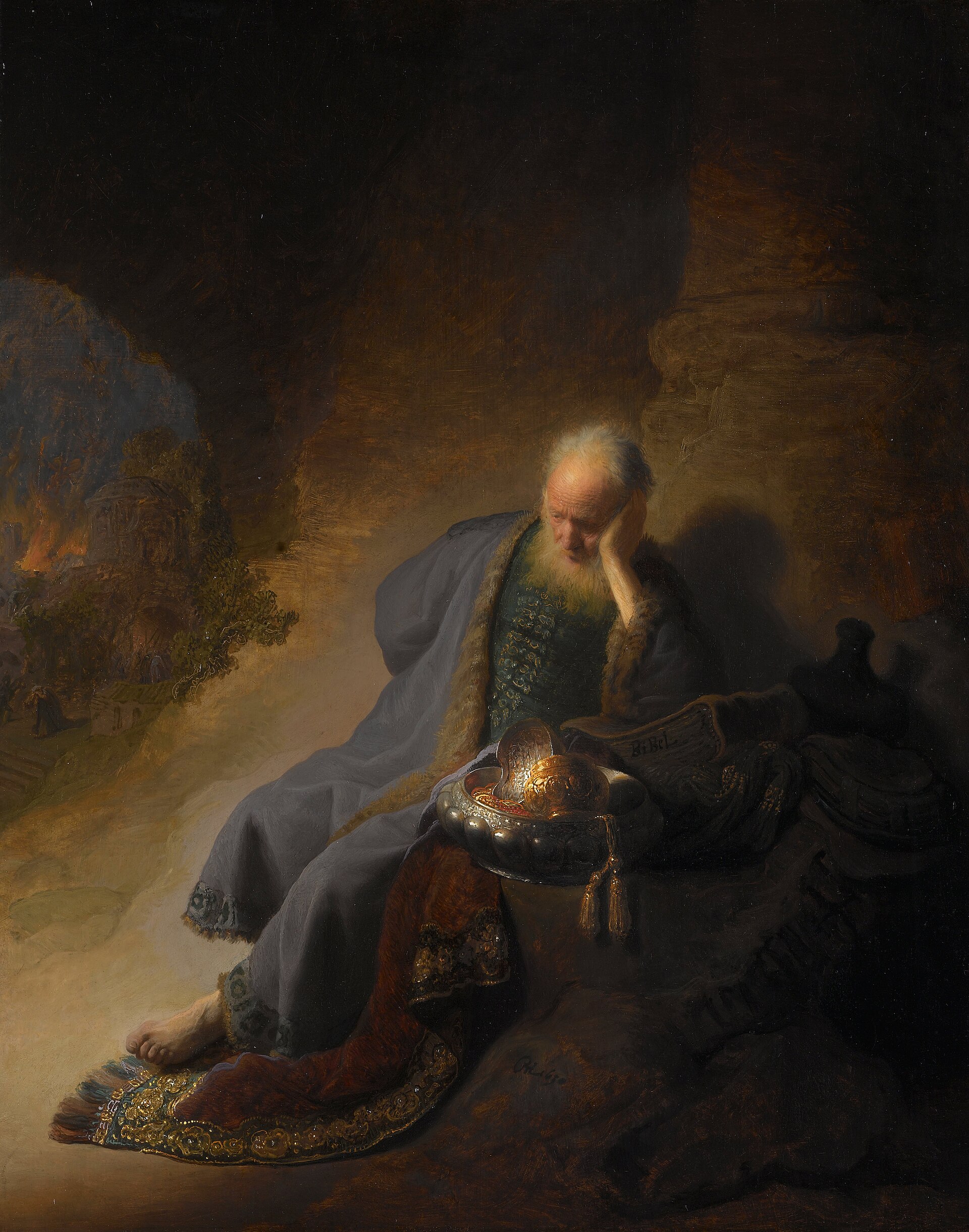
This chapter came to Jeremiah a second time while he was still shut in the guardhouse, in the same months as the field he bought. It stands at the close of the part of the book often called the Book of Consolation, the chapters of promise set among the warnings. Its first hearers could hear the houses of their own city being pulled down to strengthen the wall. The chapter speaks of healing, of the sounds of ordinary life, and of the throne of David and the priesthood. Listen for the promises tied to the fixed order of day and night.
Context
- Who
- A city inside the walls, listening to its own buildings come down
- What
- A second word to the imprisoned prophet promising healing for the city, the return of joy and trade, and a lasting line for David and for the Levitical priests.
- Where
- The court of the guard in Jerusalem, while houses of the city and of the kings of Judah were being torn down for the defence.
- When
- During the last siege of Jerusalem, about 588 to 587 BC, while Jeremiah was still confined.
- Why
- To assure a city at the point of falling that God's covenants with David and with the priests were as fixed as day and night.
Historical context
The chapter names a detail of siege engineering. Houses of the city and houses of the kings of Judah were being torn down to make defences against the siege mounds and the sword. Defenders stripped stone and timber from buildings to plug breaches and raise the inner wall, and the excavated houses of Jerusalem's last decade show the wreckage.
Show the rest of the historical context, 3 more paragraphs
Into that noise comes a promise of sound. In the streets now desolate, without man or beast, there will again be the voice of mirth and the voice of gladness, the voice of the bridegroom and the voice of the bride, and the voices of people bringing thank offerings to the temple.
The image of healing returns from chapter 30, this time with the word for a scar tissue that closes over, I will bring health and healing, and reveal an abundance of prosperity and security. And the ordinary economy comes back with it: shepherds counting flocks under the hand of the one who tallies them, in the hill country, the lowland, the Negev and around Jerusalem.
The chapter closes with two covenants staked against the sky. As surely as day and night keep their appointed times, David will not lack a man to sit on his throne, and the Levitical priests will not lack a man to offer sacrifice. Read in the traditional framework this looks beyond the return from Babylon to the reign of the righteous Branch himself.
Significance
The offer at the head of the chapter, call to me and I will answer you, and tell you great and hidden things you have not known, was made to a man locked up in a courtyard inside a city that was days from falling. That is the setting the first hearers would have supplied automatically.
Show the rest of the significance, 1 more paragraph
The point they needed most is the last one. If God's covenant with day and night can be broken, then his covenant with David can be broken. Otherwise, the throne outlasts the siege.
This chapter in Jewish lifeWhat this chapter is in Jewish life and reading.
What is done
The site's own table in src/lib/hebraic/readings.ts sets this chapter in one prophetic reading of the annual cycle. It is read as the Haftarah of Mishpatim, Jeremiah 34:8 to 34:22 and 33:25 to 33:26, in both rites, on the Sabbath of the portion Exodus 21:1 to 24:18. A congregation keeping that cycle hears the verses of the reference read aloud after the Torah portion of its Sabbath. The reading takes the last two verses of this chapter after the verses of the chapter that follows, so this chapter's close is the close of the Haftarah.
The corpus joins the chapter to the weeks of the Torah portions through the works arranged by portion. Under the thirteenth verse it carries Midrash Tanchuma Buber, Ki Tisa 8:3. Under the nineteenth verse it carries Bereshit Rabbati, Parashat Vayechi 8.
How it is read
Rashi, Metzudat David and Radak carry English on this chapter in the corpus. Rashi is quoted from The Judaica Press complete Tanach with Rashi, translated by A. J. Rosenberg, which Sefaria reports as CC-BY, and the version of each other commentator is named where he is first quoted. Every quotation on this card is held to fifty words or fewer because each translation is modern, and no headword carrying the verse in a translation's wording is quoted.
Rashi reads the call of the third verse as a promise of knowledge, "to inform you of future events" (Rashi on Jeremiah 33:3:1). The houses torn down in the siege were made into mounds for fighting from, and "they make into graves for the corpses of those killed within the city" (Rashi on Jeremiah 33:4:1 and 33:5:1). At the thirteenth verse the flocks are the people: "Israel will come and go under the hands of a king who walks at their head" (Rashi on Jeremiah 33:13:1).
Metzudat David is quoted from the translation Sefaria titles Rabbi Mike Feuer, Jerusalem Anthology, which it reports as CC-BY. The name in the sixteenth verse he takes as the city's: "This is the name which God will call Jerusalem" (Metzudat David on Jeremiah 33:16:1).
The promise to David and to the priests Rashi reads with care. The line will not be cut off "permanently, but if it is discontinued, it will ultimately be reinstated" (Rashi on Jeremiah 33:17:1). The two families of the twenty-fourth verse are "royalty and the priesthood" (Rashi on Jeremiah 33:24:1). The covenant with day and night is the one made with Noah and his sons (Rashi on Jeremiah 33:20:1). At the twenty-fifth verse he reports that the Sages read the covenant as the covenant of the Torah and of circumcision, for whose sake heaven and earth were made. He sets that aside for the plain sense: "But this Midrash does not fit the sequence of the verses" (Rashi on Jeremiah 33:25:1).
Radak is quoted on one note, from the version Sefaria titles Sefaria Community Translation, which it reports as CC0. At the last verse he remarks on the spelling of Isaac's name with the letter sin. He writes, "this is one of four times the appellation for Isaac is written with a sin" (Radak on Jeremiah 33:26:3).
The corpus carries nine further notes on this chapter without an English text. Each is marked linked because Sefaria holds no English version of the ref, so each is cited here and none is quoted. The notes of Metzudat David are cited at Metzudat David on Jeremiah 33:7:1, 33:8:1, 33:10:1 and 33:21:1. The notes of Radak are cited at Radak on Jeremiah 33:9:1, 33:11:1, 33:15:1 and 33:22:1. The note of Malbim is cited at Malbim on Jeremiah 33:14:1.
What the rabbis say
The corpus carries forty rabbinic locators on this chapter and the text of none, so each is cited and linked here rather than quoted. On the first verse it holds Introductions to Amoraic Literature, Part II (Notes and Interpretations for Chapters of the Talmud), Baba Batra, Chapter III 72, Midrash Lekach Tov, Numbers 29:35:1 and Sifrei Bamidbar 151:1. It holds Yalkut Shimoni on Torah 782:20 there as well. On the third verse it holds Mekhilta DeRabbi Yishmael, Tractate Pischa 1:24 and Yalkut Shimoni on Torah 187:2. On the sixth verse it holds Kohelet Rabbah 3:8:2, Midrash Tehillim 120:2, Pirkei DeRabbi Eliezer 34:1 and Shir HaShirim Rabbah 4:5:1. On the seventh verse it holds Otzar Midrashim, Midrash on the Ten Kings 1:9. On the eleventh verse it holds Berakhot 6b:29, Berakhot 6b:33, Devarim Rabbah 2:37, Devarim Rabbah 7:1, Ein Yaakov (Glick Edition), Berakhot 1:28, Ein Yaakov, Berakhot 1:38, Ketubot 8a:6 and Midrash Lekach Tov, Leviticus 7:20:2.
On the twelfth verse it holds Yalkut Shimoni on Torah 830:3. On the thirteenth verse it holds Bamidbar Rabbah 2:11, Bekhorot 54b:12, Bekhorot 54b:15, Midrash Aggadah, Exodus 30:13:1, Midrash Tanchuma Buber, Ki Tisa 8:3, Midrash Tanchuma, Ki Tisa 9:2 and Otzar Midrashim, Midrash Shelosha v'Arba'ah 3:19. On the nineteenth verse it holds Bereshit Rabbati, Parashat Vayechi 8, Midrash Tanchuma, Noach 3:8 and Otzar Midrashim, Midrashim on Missing and Extra Letters 2:7. On the twentieth verse it holds Midrash Tanchuma, Lech Lecha 20:6. On the twenty-fifth verse it holds Aggadat Bereshit 17:1, Aggadat Bereshit 17:2, Avodah Zarah 3a:6, Bamidbar Rabbah 10:1, Bereshit Rabbati, Parashat Bereshit 11 and Bereshit Rabbati, Parashat Lech Lecha 26. It holds Ein Yaakov (Glick Edition), Avodah Zarah 1:3 there as well.
On the twenty-sixth verse it holds Otzar Midrashim, Baraita of The 32 Midot of Aggadah 1:25. The corpus also prints one locator anchored past the chapter's last verse, the twenty-sixth, cited here with the anchor it gives. It prints Yalkut Shimoni on Nach 1054:8 at Jeremiah 33:35. What each of them teaches is a saying of the rabbis, and is reported as theirs wherever this site quotes one. The quotations wait on a fetch that carries the text.
Sources: Rashi, Rashi on Jeremiah 33:3:1 to 33:25:1, The Judaica Press complete Tanach with Rashi, translated by A. J. Rosenberg, reported CC-BY; Metzudat David, Metzudat David on Jeremiah 33:16:1, Rabbi Mike Feuer, Jerusalem Anthology, reported CC-BY; Radak, Radak on Jeremiah 33:26:3, Sefaria Community Translation, reported CC0; Metzudat David, Metzudat David on Jeremiah 33:7:1, 33:8:1, 33:10:1 and 33:21:1, cited by ref because the corpus carries no English text; Radak, Radak on Jeremiah 33:9:1, 33:11:1, 33:15:1 and 33:22:1, cited by ref because the corpus carries no English text; Malbim, Malbim on Jeremiah 33:14:1, cited by ref because the corpus carries no English text; The Sefaria corpus, scripts/data/sources/sefaria/jeremiah/33.json, the 40 Talmud and Midrash locators of this chapter; The site's own files, src/lib/hebraic/readings.ts, printing the Haftarah of Mishpatim, Jeremiah 34:8 to 34:22 and 33:25 to 33:26, for this chapter.
The heads below are this chapter's scenes. The numbered points under each are its verses.
Call Unto Me and I Will Show Thee Great and Hidden Things
Jeremiah 33:1-3
While Jeremiah was still confined in: The word comes while Jeremiah is “still confined in the courtyard of the guard,” the same place as the purchase in chapter 32. Then comes the invitation: “Call to Me, and I will answer and show you great and unsearchable things you do not know.”
Jeremiah 33:1
“Moreover the word of the Lord - This was in the eleventh year of the reign of Zedekiah, Jeremiah being still shut up in prison: but he was now in the court of the prison, where the elders and the king’s officers, etc., might consult him with the greater ease; for they continued to inquire, foolishly thinking, that if he would but prophesy good things, that these must come, or that he had sufficient power with God to induce him to alter his mind, - destroy the Chaldeans, and deliver the city.”
Adam Clarke · Commentary on the Bible (1810-1826)evangelical
the LORD who formed it and established it: The verse never names what the LORD formed. Clarke and Jamieson, Fausset and Brown take the one who made it as the one who will do what he is about to promise. Barnes takes it as whatever the LORD wills, and Calvin, as Jamieson, Fausset and Brown report, as Jerusalem.
Jeremiah 33:2
“Thus saith the Lord the Maker thereof - עשה osah, the doer of it. That is, he who is to perform that which he is now about to promise. Thus translated by Dahler. - Voici ce que dit l’Eternel, qui fait ce qu’il a dit. - “Thus saith the Lord, who doth that which he hath said.” The word Jehovah, not Lord, should be used in all such places as this.”
Adam Clarke · Commentary on the Bible (1810-1826)evangelical
Call to Me, and I will answer: Jamieson, Fausset and Brown give unsearchable the sense of inaccessible, things hard to believe, and take them as the restoration that all had despaired of. Barnes thinks the words are drawn from Isaiah 48:6. Spurgeon notes that this promise came to a man shut in prison.
Jeremiah 33:3
“Call unto eve, and I will answer thee - To me alone it belongs to reveal what is future; and the stupendous things which are now coming are known only to myself. These idolaters go to their gods to get information relative to the issue of the present commotions; but there is no light in them. Ask thou, O Jeremiah, and I will tell thee the great and mighty things which even thou knowest not.”
Adam Clarke · Commentary on the Bible (1810-1826)evangelical
2 more voices on this verse
Jeremiah 33:3
“Call unto me, and I will answer thee,.... This is spoken not to Jerusalem, and the inhabitants of it; but to the prophet, encouraging him to seek the Lord by prayer, promising an answer to him.”
Jeremiah 33:3
“God's promises are not to slacken, but to quicken the prayers of His people (Ps 132:13, 17; Isa 62:6, 7). mighty things--Hebrew, "inaccessible things," that is, incredible, hard to man's understanding [MAURER], namely, the restoration of the Jews, an event despaired of.”
Jamieson, Fausset & Brown · Commentary Critical and Explanatory on the Whole Bible (1871)reformed
Jeremiah 33:4-9
For this is what the LORD: The reversal pairs healing with pardon: “I will bring to it health and healing,” and “I will cleanse them from all the iniquity.” The aim is that the city “will bring Me renown, joy, praise, and glory before all the nations of the earth.”
Jeremiah 33:4
“Thus saith the Lord - This is a new confirmation of what has already been said, viz., The city shall fall, a number of the inhabitants shall perish, the rest shall be carried into captivity; but the nation shall be preserved, and the people return from their captivity.”
Adam Clarke · Commentary on the Bible (1810-1826)evangelical
The Chaldeans are coming to fight: Barnes and Jamieson, Fausset and Brown read the verse with the Jews as the ones who come to fight the Chaldeans. On that reading the men of the city fill the torn-down houses of verse 4 with their own corpses. Either way the houses of defense fill with the dead.
Jeremiah 33:5
They--the Jews; the defenders of the "houses" (Jer 33:4), "come forward to fight with the Chaldeans," who burst into the city through the "thrown-down houses," but all the effect that they produce "is, to fill them (the houses) with" their own "dead bodies."
Jamieson, Fausset & Brown · Commentary Critical and Explanatory on the Whole Bible (1871)reformed
I will bring to it health and healing: The healing answers Jeremiah's own lament at 8:22, where he asked why his people had no cure, as Jamieson, Fausset and Brown note. Barnes reads health and healing as a bandage laid on with medicine. Truth here means stability, a peace that lasts.
Jeremiah 33:6
“We may apply it more generally, and observe, [1.] That peace and truth are the great subject-matter of divine revelation. These promises here lead us to the gospel of Christ, and in that God has revealed to us peace and truth, the method of true peace--truth to direct us, peace to make us easy. Grace and truth, and abundance of both, come by Jesus Christ.”
Matthew Henry · Commentary on the Whole Bible (1707-1721)puritan
2 more voices on this verse
Jeremiah 33:6
“The answer to Jeremiah's mournful question (Jer 8:22). cure--literally, the long linen bandage employed in dressing wounds. truth--that is, stability; I will bring forth for them abundant and permanent peace, that is, prosperity.”
Jamieson, Fausset & Brown · Commentary Critical and Explanatory on the Whole Bible (1871)reformed
Jeremiah 33:6
“Behold I will bring it health and, cure - ארכה aruchah, an extensive plaister; or, as we phrase it, a plaister as large as the sore. I will repair the losses of families by numerous births, and bless the land with fertility.”
Adam Clarke · Commentary on the Bible (1810-1826)evangelical
I will restore Judah and Israel from captivity: Clarke and Jamieson, Fausset and Brown note that the ten northern tribes did not come back with the Jews after seventy years. So they place the full answer in a later time. Barnes reads as in former times as the days before sin provoked the Lord.
Jeremiah 33:7
“The captivity of Judah and the captivity of Israel - This must respect the latter times, for the ten tribes did not return with the Jews at the termination of the seventy years.”
Adam Clarke · Commentary on the Bible (1810-1826)evangelical
I will cleanse them from all the iniquity: The verse promises two things: to cleanse the iniquity and to forgive the sins of rebellion. Jamieson, Fausset and Brown distinguish them, forgiving the punishment and cleansing the stain of guilt, for all iniquity and all sins alike. Matthew Henry links the cleansing to David's prayer in Psalm 51:7.
Jeremiah 33:8
“And I will cleanse them from all their iniquity, whereby they have sinned against me,.... Even by the blood of Christ, which cleanses from all sin, of heart, lip, and life, in allusion to the purifications under the law, 1Jn 1:7; see Eze 36:25; and I will pardon all their iniquities, whereby they have sinned, and whereby they have transgressed against me; for Christ's sake, and through his stoning sacrifice, and upon the foot of full satisfaction made by him.”
2 more voices on this verse
Jeremiah 33:8
“The repetition is in order that the Jews may consider how great is the grace of God in not merely pardoning (as to the punishment), but also cleansing them (as to the pollution of guilt); not merely one iniquity, but all (Mic 7:18).”
Jamieson, Fausset & Brown · Commentary Critical and Explanatory on the Whole Bible (1871)reformed
Jeremiah 33:8
“In allusion to that sprinkling, David prays, Purge me with hyssop. [2.] By sin they have become guilty, and obnoxious to his justice; but he will pardon all their iniquities, will remove the punishment to which for sin they were bound over. All who by sanctifying grace are cleansed from the filth of sin, by pardoning mercy are freed from the guilt of it.”
Matthew Henry · Commentary on the Whole Bible (1707-1721)puritan
this city will bring Me renown: The nations of the earth that saw the city fall will hear of all the good the LORD does for it. Clarke reads their trembling as dread of harming this city. Jamieson, Fausset and Brown see the ungodly tremble and the penitent fear the LORD in awe.
Jeremiah 33:9
“They shall fear and tremble - The surrounding nations shall be persuaded that it is the hand of the Almighty that has wrought this change in your behalf; and shall fear to molest you, and tremble lest they should incur the displeasure of your God by doing you any kind of evil.”
Adam Clarke · Commentary on the Bible (1810-1826)evangelical
1 more voice on this verse
Jeremiah 33:9
“GOD'S ancient people sadly provoked Him with their idolatries from age to age. He was longsuffering to them to the last degree, but at length He grew weary of them and, according to His own words, "He abhorred His own inheritance." He caused them to be carried away into captivity and their land became a desert, or the heritage of strangers. Israel became a scattered people on the brink of national extinction, for their iniquities had hidden the face of the Lord from them.”
The Voice of the Bridegroom Returns; a Branch of Righteousness
Jeremiah 33:10-13
This is what the LORD says: The deserted streets are answered with “the sounds of joy and gladness, the voices of the bride and bridegroom,” the sign the exile has ended. The voices “of those bringing thank offerings into the house of the LORD” tie that joy to restored worship.
Jeremiah 33:10
“Which ye say shall be desolate - Of which ye say, It is desolate ... The prophet first sees Judaea silent and desolate during the 70 years’ captivity: and then describes the two things, men and cattle, without which land is valueless.”
the voices of the bride and bridegroom: The voices of bride and bridegroom that Jeremiah said would cease at 7:34, 16:9 and 25:10 will be heard again. The thanks, His loving devotion endures forever, is the refrain of Psalm 136. Jamieson, Fausset and Brown note it was sung when the house was founded again (Ezra 3:11).
Jeremiah 33:11
“Praise the Lord ... - The customary formula of thanksgiving in many of the later Psalms, and from its occurrence in 2Ch 5:13; 2Ch 7:3, 2Ch 7:6 ff probably a regular part of the liturgical service of the temple. Shall say ... shall bring the sacrifice of praise - Or, say ... as they bring praise, i. e., a thank-offering (see the marginal reference) into the house of the Lord At the first - Before the captivity, and when still unpolluted by the sins which have brought upon it so heavy a chastisement.”
1 more voice on this verse
Jeremiah 33:11
“Note, Nothing is more the praise and honour of a people than to have God the glory of it, the glory both of the power and of the goodness by which it is effected; they shall praise him both as the Lord of hosts and as the God who is good and whose mercy endures for ever.”
Matthew Henry · Commentary on the Whole Bible (1707-1721)puritan
pastures for shepherds to rest their flocks: Barnes reads the scene as a shepherd's camp, with the flocks gathered into the fold at night. The land called empty of man and beast in verse 10 gets both back. Quiet pasture is a picture of peace.
Jeremiah 33:12
“An habitation - “A shepherd’s encampment.” The words, “causing their flocks to lie down,” mean gathering them into the fold at night.”
1 more voice on this verse
Jeremiah 33:12
“The industry of the country, and their return to their original plainness and simplicity, from which, in the corrupt ages, they had sadly degenerated.”
Matthew Henry · Commentary on the Whole Bible (1707-1721)puritan
the one who counts them: The shepherd counts the sheep as they pass under his hand, as Barnes explains. Matthew Henry notes that a flock is numbered so a missing sheep can be sought. The list of regions repeats Jeremiah 32:44 almost word for word.
Jeremiah 33:14-18
Behold, the days are coming, declares: The Branch of 23:5 returns, now dated “In those days and at that time,” and paired with the priestly line. Jerusalem receives the name chapter 23 gave the king, “The LORD Our Righteousness,” so the same righteousness rests on the city and its ruler.
Jeremiah 33:14
“Behold, the days come, saith the Lord,.... Or, "are coming" (t); future times are respected; yet such as would quickly come; five or six hundred years more, and then would be fulfilled what is after promised. This is ushered in with a "behold", as being a matter of importance, and deserving attention, and even as calling for admiration.”
a righteous Branch: The promise repeats Jeremiah 23:5 almost exactly. Wesley sets the righteous Branch against the kings of David's line, most of whom had been unrighteous men. Matthew Henry stresses the Branch's descent from David, the heir with whom the royal covenant stands.
Jeremiah 33:15
“The branch - The kings they had hitherto had of the line of David, were most of them unrighteous men, but God promises that after the captivity, they should have a branch of David who would execute judgment and righteousness in the land, for the protection and government of those that feared him.”
John Wesley · Explanatory Notes upon the Old Testament (1765)evangelical
1 more voice on this verse
Jeremiah 33:15
“Christ is here prophesied of, 1. He is a branch of righteousness, not a usurper, for he grows up unto David, descends from his loins, with whom the covenant of royalty was made, and is that seed with whom that covenant should be established, so that his title is unexceptionable.”
Matthew Henry · Commentary on the Whole Bible (1707-1721)puritan
Jerusalem will dwell securely: At Jeremiah 23:6 the name The LORD Our Righteousness belongs to the king; here it is given to the city. Clarke doubts the two passages mean the same thing. Jamieson, Fausset and Brown read the city as the church, bearing the name because it draws its righteousness from Christ.
Jeremiah 33:16
“16 In those days shall Judah be saved, and Jerusalem shall dwell safely: and this is the name wherewith she shall be called, The L ORD our righteousness. Here is a further prediction of the happy state of Judah and Jerusalem after their glorious return out of captivity, issuing gloriously at length in the kingdom of the Messiah.”
Matthew Henry · Commentary on the Whole Bible (1707-1721)puritan
3 more voices on this verse
Jeremiah 33:16
“And this is the name wherewith she shall be called, The Lord our Righteousness - See what has been said on Jer 23:6 (note), which is generally supposed to be a strictly parallel passage: but they are very different, and I doubt whether they mean exactly the same thing. As to our translation here, it is ignorant, and almost impious; it says that Jerusalem, for that is the antecedent, shall be called The Lord our Righteousness.”
Adam Clarke · Commentary on the Bible (1810-1826)evangelical
Jeremiah 33:16
“In those days shall Judah be saved,.... The elect of God among the Jews; and all such who are Jews inwardly, who truly believe in Christ, and confess his name, and praise him, and give him the glory or salvation.”
Jeremiah 33:16
“Saved - It is the opinion of some that a spiritual salvation and security is promised under these expressions, but by the most and best interpreters, a temporal salvation. This was typical of that spiritual and eternal salvation which is promised to the true Israel of God; as their rest in Canaan typified that rest which remaineth for the people of God.”
John Wesley · Explanatory Notes upon the Old Testament (1765)evangelical
As Sure as My Covenant with Day and Night
David will never lack a man: Barnes names the difficulty: Zedekiah was the last of David's line to sit on the throne in Israel, and Jeremiah foretold its end at 22:30. Wesley reads the promise as kept in Christ, whose kingdom has no end. Barnes too finds it kept in a spiritual sense.
Jeremiah 33:17
“Read literally, these verses promise the permanent restoration of the Davidic throne and (of the Levitical priesthood. As a matter of fact Zedekiah was the last king of David’s line, and the Levitical priest-hood has long passed away. Both these changes Jeremiah himself foretold Jer 22:30; Jer 3:16. In what way then is this apparent contradiction (compare Isa 66:20-23; Ezek. 40–48) to be explained? The solution is probably as follows. It was necessary that the Bible should be intelligible to the people at the time when it was written, and in some degree to the writer.”
2 more voices on this verse
Jeremiah 33:17
“David - That is, apparently a promise relating to Christ, for David's line had failed long since, had it not been continued in Christ, whose kingdom is and shall be an everlasting kingdom.”
John Wesley · Explanatory Notes upon the Old Testament (1765)evangelical
Jeremiah 33:17
“God speaketh once, yea, twice, for the encouragement of his people. We are not only so disobedient that we have need of precept upon precept to bring us to our duty, but so distrustful that we have need of promise upon promise to bring us to our comfort. This word, as the former, came to Jeremiah when he was in prison.”
Matthew Henry · Commentary on the Whole Bible (1707-1721)puritan
the priests who are Levites: Clarke hears the promise made to Phinehas (Numbers 25:13). Theodoret of Cyrus finds it kept in the priests of the new covenant, who offer a spiritual sacrifice after the order of Melchizedek. Wesley reads the man before the LORD as a ministry that lasts to the end of the world.
Jeremiah 33:18
“A man - That is, a ministry to abide in the church to the end of the world, nor is it unusual for God in the Old Testament to express promises to be fulfilled under the gospel by expressions proper to the Old Testament.”
John Wesley · Explanatory Notes upon the Old Testament (1765)evangelical
1 more voice on this verse
Jeremiah 33:18
“The covenant of the priesthood is called a covenant of peace ( Num. xxv. 12 ), of life and peace, Mal. ii. Now we are sure that this covenant is not broken, nor in the least weakened, while Jesus Christ is himself our life and our peace.”
Matthew Henry · Commentary on the Whole Bible (1707-1721)puritan
Jeremiah 33:19-22
And the word of the LORD: “If you can break My covenant with the day and My covenant with the night,” then the covenant with David can be broken. Verse 22 reaches for the largest images, “the sand on the seashore cannot be measured,” to promise the growth of David's line and the Levites.
My covenant with the day: Wesley ties this to the fixed order of Jeremiah 31:35. Jamieson, Fausset and Brown note that covenant with the day is built to match covenant with David in verse 21. Theodoret of Cyrus draws the conclusion: day cannot become night, and the throne of David cannot be destroyed.
Jeremiah 33:20
“My covenant - The same with the ordinances mentioned, chap. xxxi, 35. God's law established in the course of natural causes, by virtue of which the day and night, orderly succeed one another. The succession of the gospel ministry in the church of God to abide for ever, shall be as certain as the succession of darkness and light.”
John Wesley · Explanatory Notes upon the Old Testament (1765)evangelical
My covenant may also be broken with David: The Levites stand beside David in the same sentence, king and priest bound under one covenant. Barnes holds that this promise has been kept in a spiritual sense, since David's throne and the Levitical priesthood both ended. Matthew Henry sees Christ's church lasting to the end.
Jeremiah 33:21
“This intimates that Christ shall have a church on earth to the world's end; he shall see a seed in which he shall prolong his days till time and day shall be no more. Christ's kingdom is an everlasting kingdom; and when the end cometh, and not till then, it shall be delivered up to God, even the Father.”
Matthew Henry · Commentary on the Whole Bible (1707-1721)puritan
the sand on the seashore cannot be measured: The stars and sand repeat the promise of Genesis 22:17. Jamieson, Fausset and Brown note that here it is narrowed to David's house and the Levites, the two on whom the nation's welfare rested. Wesley reads the multiplied seed as the growth of Christians and faithful ministers.
Jeremiah 33:22
“Of David - Christ is himself called David, whose seed and whose Levites are multiplied in the multiplying of Christians and of faithful ministers under the gospel, which are the things here promised.”
John Wesley · Explanatory Notes upon the Old Testament (1765)evangelical
1 more voice on this verse
Jeremiah 33:22
“The blessing there promised belonged to all the tribes; here it is restricted to the family of David and the tribe of Levi, because it was on these that the welfare of the whole people rested. When the kingdom and priesthood flourish in the person of Messiah, the whole nation shall temporally and spiritually prosper.”
Jamieson, Fausset & Brown · Commentary Critical and Explanatory on the Whole Bible (1871)reformed
Jeremiah 33:23-26
Moreover, the word of the LORD: The final word quotes a taunt before answering it: “The LORD has rejected the two families He had chosen.” The answer ties Israel's standing to creation. The LORD would reject “the descendants of Jacob” only if He had not established “My covenant with the day and the night.”
Jamieson, Fausset and Brown take them as Judah and Israel, while Clarke leans toward the royal line of David and the priestly line of Levi. The Lord still calls them his people, and Jamieson, Fausset and Brown find the answer to the taunt in that phrase.
Jeremiah 33:24
“Christ is that seed of David that is to be perpetual dictator to the seed of Abraham, Isaac, and Jacob; and, as this people shall never want such a king, so this king shall never want such a people. Christianity shall continue in the dominion of Christ, and the subjection of Christians to him, till day and night come to an end.”
Matthew Henry · Commentary on the Whole Bible (1707-1721)puritan
the fixed order of heaven and earth: Barnes takes the fixed order of heaven and earth to mean the whole order of nature. His point is that grace stands as firm as nature does. The argument repeats verses 20 and 21, now applied to Jacob's seed as well as David's.
Jeremiah 33:25
“The ordinances of heaven and earth - i. e., the whole order of nature Nature is not more firmly established than God’s purposes in grace.”
the descendants of Jacob: The last verse joins Abraham, Isaac and Jacob to David, so the promise to the patriarchs and the promise to the king stand together. Matthew Henry notes that God repeats his promises because his people are slow to trust. The chapter ends on compassion.
Jeremiah 33:26
“Then will I cast away the seed of Jacob, and David my servant,.... R.”
Keep studying
Studies6
Places1
Sources for this chapter
The summary
Jamieson, Fausset & Brown, Commentary Critical and Explanatory; John Calvin, Commentaries; John Wesley, Notes on the Old Testament and Matthew Henry, Complete Commentary.
The exposition
Adam Clarke, Commentary on the Bible; Albert Barnes; Carl Friedrich Keil, The Prophecies of Jeremiah; Charles Spurgeon, The Metropolitan Tabernacle Pulpit, Sermon No. 619: “The Golden Key Of Prayer” (lightly modernized text, CCEL edition); Jamieson, Fausset & Brown, Commentary Critical and Explanatory on the Whole Bible; John Gill, Exposition of the Old Testament; John Wesley, Explanatory Notes upon the Old Testament; Matthew Henry, Commentary on the Whole Bible and Theodoret of Cyrus, ON JEREMIAH 7:33.18.