
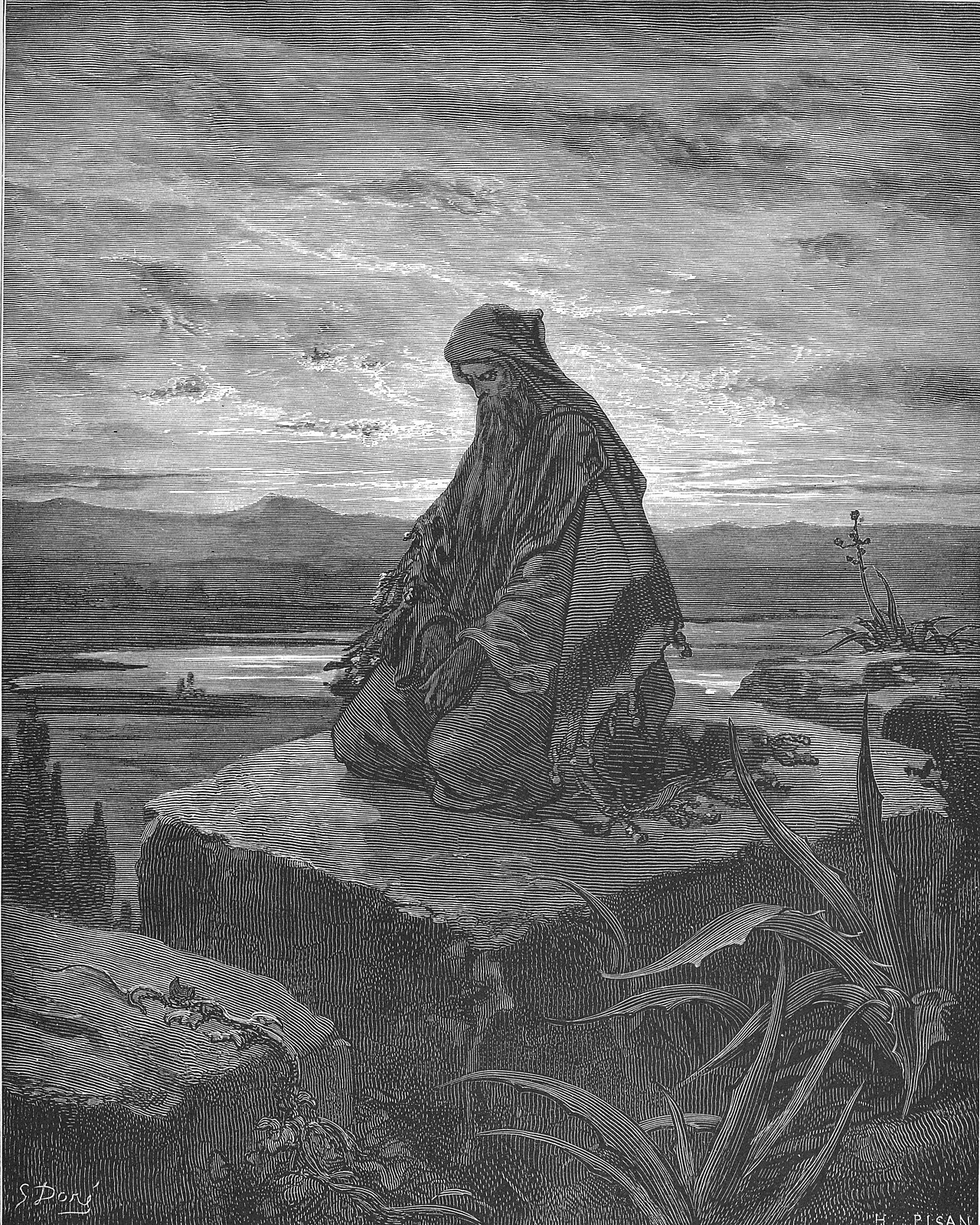
Isaiahchapter 37
38 verses · Isaiah · 8th century BC · The Prophets
Then the angel of the LORD went out and struck down 185,000 men in the camp of the Assyrians. When the people got up the next morning, there were all the dead bodies!
Introduction
Isaiah, The Prophets, Isaiah Overview.
This chapter continues the account of Sennacherib's campaign, and it runs beside 2 Kings 19. It is written for a people who had been told that no god had ever saved a city from Assyria. King Hezekiah goes to the temple twice, and the prophet Isaiah sends him two answers. The chapter holds a prayer, a long reply spoken against the Assyrian king, and a short account of one night. Listen for what Hezekiah asks God to prove, and for how the last lines reach twenty years beyond the siege.
Context
- Who
- A city that had been told by an empire that no god had ever stopped it
- What
- Hezekiah's prayer over the Assyrian letter, God's answer through Isaiah, the destruction of the Assyrian army and the death of Sennacherib.
- Where
- The temple in Jerusalem, the Assyrian camp outside the city, and at the close a temple in Nineveh.
- When
- 701 BC, with Sennacherib's murder following in 681 BC.
- Why
- To show that the LORD alone is God, who saved Jerusalem for His own sake and for David's, and whose word against Assyria came true.
Historical context
Spreading the letter before the LORD is a legal gesture, not a poetic one. When a subject received a document he could not answer, he laid it before his sovereign and asked for a ruling. Hezekiah carries the Assyrian ultimatum into the temple, unrolls it, and puts it down, the whole prayer that follows is a plaintiff handing over the evidence.
Show the rest of the historical context, 4 more paragraphs
Tirhakah, named here as king of Cush, is a real Nubian ruler whose monuments survive. Critics point out that he became pharaoh some years after 701, so he could not have held the title yet; the traditional answer is the ordinary one used in history writing everywhere, a man is named by the title he is best known for, even in an account of his earlier years. Egyptian and Assyrian records agree that an Egyptian-Nubian army did march north in this campaign.
The taunt God sends back to Sennacherib uses Assyria's own boasts. The king had bragged of cutting down the tall cedars of Lebanon and digging wells in foreign lands and drying up rivers with the soles of his troops' feet, all of which appear almost word for word in Assyrian royal inscriptions. God's answer is that he planned it long ago and the emperor was the tool. Then a farmer's promise for the survivors: this year eat what grows of itself, next year what springs from that, and in the third year sow and reap and plant vineyards, two years lost to the war, and normal life in the third.
The deliverance is stated plainly: the angel of the LORD went out and struck a hundred and eighty-five thousand in the Assyrian camp, and in the morning they were dead bodies. Herodotus preserves an Egyptian version of a disaster to Sennacherib's army in which field mice swarmed the camp overnight and ate the bowstrings and shield straps, which many take as a garbled memory of plague, since rodents carry it. What is not in dispute is the silence in Sennacherib's own record: he lists the tribute and the shut-up bird in the cage, and he never claims the one thing he would have shouted about, taking Jerusalem.
The last verses jump twenty years. Sennacherib was murdered by two of his sons while worshipping in the temple of his god Nisroch, and Esarhaddon reigned in his place. Babylonian chronicles record the assassination in 681 BC.
Significance
For the generation inside the walls, the answer to the Rabshakeh's question came in one night, and it came from a direction no strategist had listed.
Show the rest of the significance, 1 more paragraph
The prayer Hezekiah prayed is the reason the chapter exists. He does not ask to be spared for his own sake; he asks that all the kingdoms of the earth may know that you alone are the LORD. He got exactly what he asked for.
This chapter in Jewish lifeWhat this chapter is in Jewish life and reading.
What is done
No part of this chapter is read aloud in the synagogue. The site's own table in src/lib/hebraic/readings.ts printed parashot 0 and haftarah uses 0 for Isaiah 37, and no festival reading for the book. The table records Isaiah only as a source of Haftarot, and none of the Haftarot it records reaches this chapter.
The chapter is met instead in the study of the weekly portions, and the corpus names the doors. Under the twenty-fifth verse it carries Midrash Tanchuma, Bereshit 7:13. Under the twenty-seventh verse it carries Midrash Tanchuma Buber, Re'eh 16:1 and Midrash Tanchuma, Re'eh 17:1. Each of those locators is named for the Torah portion whose study it belongs to.
How it is read
Rashi is quoted here from The Judaica Press complete Tanach with Rashi, translated by A. J. Rosenberg, which Sefaria reports as CC-BY. The corpus carries no English for any other commentator on this chapter. Half of the corpus's entries on this chapter carry no English, so Rashi's notes carry the reading alone. The proof the enemies bring is their success, which they use to praise themselves (Rashi on Isaiah 37:3:1 and 37:4:1). The rumour God will send is the report of Tirhakah king of Cush. Rashi says it draws Sennacherib away for a time, and he returns later before he falls in his own land (Rashi on Isaiah 37:7:1).
Hezekiah's prayer concedes what is true. The kings of Assyria did destroy the nations and their gods (Rashi on Isaiah 37:18:1). God's answer to the boasting king is that his victories were never his own: "this is a decree that emanated from Me many years ago" (Rashi on Isaiah 37:26:1). Rashi cites the rod of God's anger in chapter 10 of this book for it. The heights of the mountains the king boasts of climbing are the Temple mount (Rashi on Isaiah 37:24:1).
The corpus carries twelve further notes on this chapter without an English text, each marked linked because Sefaria holds no English version of the ref. Nine stand cited and unquoted at Metzudat David on Isaiah 37:1:1, 37:8:1, 37:11:1, 37:14:1, 37:16:1, 37:17:1, 37:21:1, 37:22:1 and 37:23:1, and three at Malbim on Isaiah 37:6:1, 37:10:1 and 37:20:1. The commentary entries the corpus carries reach the twenty-seventh of the chapter's thirty-eight verses.
What the rabbis say
The corpus carries forty rabbinic locators on this chapter and the text of none, so each is cited by ref here and none is quoted or paraphrased. On the second verse it holds Tractate Soferim 8:2. On the third verse it holds Bamidbar Rabbah 13:4, Esther Rabbah 7:13, Jerusalem Talmud Shabbat 2:6:5 and Ruth Rabbah 5:6. On the eleventh verse it holds Pesikta DeRav Kahana 18:6. On the twelfth verse it holds Bereshit Rabbah 37:4. On the fifteenth verse it holds Bereshit Rabbati, Parashat Miketz 55 and Kohelet Rabbah 9:18:3.
On the sixteenth verse it holds Bamidbar Rabbah 13:3, Pesikta Rabbati 7:1 and Shemot Rabbah 33:4. On the eighteenth verse it holds Mekhilta DeRabbi Yishmael, Tractate Bachodesh 6:7. On the nineteenth verse it holds Midrash Tannaim on Deuteronomy 11:16:17, Sifrei Devarim 43:16, Yalkut Shimoni on Torah 286:12 and Yalkut Shimoni on Torah 866:1. On the twenty-second verse it holds Yalkut Shimoni on Torah 243:1. On the twenty-fourth verse it holds Avot DeRabbi Natan 27:2, Bamidbar Rabbah 9:24, Ein Yaakov (Glick Edition), Sanhedrin 11:27 and Mekhilta DeRabbi Yishmael, Tractate Shirah 6:7.
On the twenty-fifth verse it holds Ein Yaakov (Glick Edition), Sanhedrin 11:33, Midrash Tanchuma, Bereshit 7:13, Otzar Midrashim, Midrash on The Four Kings 1:2 and Sanhedrin 95b:7. On the twenty-seventh verse it holds Midrash Tanchuma Buber, Re'eh 16:1 and Midrash Tanchuma, Re'eh 17:1. On the twenty-eighth verse it holds Aggadat Bereshit 2:1, Midrash Tehillim 139:3 and Sifrei Aggadah on Esther, Midrash Panim Acherim, Version II 6:20. On the thirtieth verse it holds Seder Olam Rabbah 23:1 and Tractate Soferim 7:1. On the thirty-second verse it holds Megillah 11b:3.
On the thirty-fifth verse it holds Berakhot 10b:13, Kohelet Rabbah 1:1:2 and Otzar Midrashim, Midrash on the Ten Kings 1:9. On the thirty-sixth verse it holds Aggadat Bereshit 67:1, Bamidbar Rabbah 20:13 and Ein Yaakov, Sanhedrin 11:26. What each of them teaches is a saying of the rabbis, and it is reported as theirs wherever this site quotes one. The quotations wait on a fetch that carries the text.
Sources: Rashi, Rashi on Isaiah 37:3:1 to 37:27:1, The Judaica Press complete Tanach with Rashi, translated by A. J. Rosenberg, reported CC-BY; Metzudat David, Metzudat David on Isaiah 37:1:1, 37:8:1, 37:11:1, 37:14:1, 37:16:1, 37:17:1, 37:21:1, 37:22:1 and 37:23:1, cited by ref because the corpus carries no English text; Malbim, Malbim on Isaiah 37:6:1, 37:10:1 and 37:20:1, cited by ref because the corpus carries no English text; The Sefaria corpus, scripts/data/sources/sefaria/isaiah/37.json, the 40 Talmud and Midrash locators of this chapter; The site's own files, src/lib/hebraic/readings.ts, printing no portion, no Haftarah and no festival reading for this chapter, and src/data/bible/chapter-verse-counts.json for the verse count.
The heads below are this chapter's scenes. The numbered points under each are its verses.
Hezekiah in Sackcloth Sends Word to Isaiah
Isaiah 37:1-3
King Hezekiah tore his clothes: Hezekiah meets the taunt with grief and prayer, for he tore his clothes. His message gives a birth image, children have come to the point of birth, but there is no strength to deliver them. Henry sets this beside his father Ahaz, who built an altar to a foreign god.
to the prophet Isaiah son of Amoz: Hezekiah sends his highest officers and the leading priests together, the court and the temple in one embassy. Barnes notes that the priests wear sackcloth for the blasphemy against the God they served. Ahaz, his father, had refused Isaiah's sign at 7:12.
Isaiah 37:2
“And he sent Eliakim - (See the note at Isa 36:3). And the elders of the priests - It was a case of deep importance, and one that pertained in a special manner to the interests of religion; and he, therefore, selected the most respectable embassage that he could to present the case to the prophet. Covered with sackcloth - Religion had been insulted. The God whom the priests served had been blasphemed, and the very temple was threatened, and it was proper that the priests should go with the habiliments of mourning.”
Today is a day of distress: The word for rebuke means chastisement, and Barnes takes it as the LORD's correction of Judah for her sins. The children at the point of birth picture a crisis at its last stage, with no strength left to finish it. The nation cannot deliver itself.
Isaiah 37:4-5
lift up a prayer for the remnant: The embassy names what Rabshakeh has done, sent to defy the living God, and asks the prophet to pray. The request is framed in hope, Perhaps the LORD your God will hear. The phrase the remnant that still survives points ahead to verse 32, where a remnant will go forth.
Isaiah 37:4
“It may be the Lord thy God - The God whom thou dost serve, and in whose name and by whose authority thou dost exercise the prophetic office. Will hear the words - Will come forth and vindicate himself in regard to the language of reproach and blasphemy which has been used. See a similar use of the word ‘hear’ in Exo 2:24; Exo 3:7. To reproach the living God - The revilings of Rabsbakeh were really directed against the true God.”
the servants of King Hezekiah went: The embassy sent at verse 2 arrives here, and the next verse carries the prophet's reply. Gill records a reading that takes verses 3 and 4 as the king's instructions to his servants, which they now deliver. The parallel account stands at 2 Kings 19:5.
Isaiah 37:5
“So the servants of King Hezekiah came to Isaiah. And delivered the above message to him from the king: these servants are mentioned Isa 37:2. Musculus thinks that the third and fourth verses are the words of the king to the messengers, and not of the messengers to the prophet; and that the first clause of the "third" verse should be rendered, "that they might say unto him", &c.; and having received their instructions, here is an account of their going to the prophet with them, which they delivered to him, and which it was not necessary to repeat.”
Isaiah 37:6-7
Isaiah's answer comes, I will put a spirit in him so that he will hear a rumor. All three steps, the spirit, the rumor, and the sword, fall on Sennacherib and none on Jerusalem. The promise that ends it is kept in the chapter's last two verses.
Isaiah 37:6
“Thus shall ye say - כה תאמרון ko tomerun, “thus shall ye (explicitly, earnestly, and positively) say. “The paragogic nun deepens and increases the sense.”
Adam Clarke · Commentary on the Bible (1810-1826)evangelical
I will put a spirit in him: Barnes takes the Hebrew ruach here in its common sense of spirit, an impulse the LORD sets in the king's mind. The rumour of verse 9 and the sword of verse 38 both answer this word. The prophecy runs to the chapter's end.
Isaiah 37:7
“Behold, I will send a blast upon him - Margin, ‘Put a spirit into him.’ The word rendered ‘blast’ (רוח rûach) is commonly rendered ‘spirit.’ It may denote breath, air, soul, or spirit. There is no reason to think that the word is used here in the sense of blast of wind, as our translators seem to have supposed.”
The Letter Spread Out Before the LORD
Isaiah 37:8-9
fighting against Libnah: Rabshakeh's return finds his master already pulled off Lachish and fighting at Libnah. Word of Tirhakah coming to make war forces Sennacherib's hand, and he answers the rumour Isaiah had promised with a second round of threats. Barnes places Tirhakah among the datable figures of the chapter.
Isaiah 37:8
“Rabshakeh returned - From Isa 36:2, we learn that the king of Assyria had sent Rabshakeh from Lachish to Jerusalem; now it is likely that Rabshakeh had besieged that place, and that the king of Assyria had taken his station before this city, and dispatched Rabshakeh against Jerusalem. But, as in the verse above it is said, “he had departed from Lachish,” probably he had been obliged to raise the siege, and sat down before Libnah, which promised an easier conquest.”
Adam Clarke · Commentary on the Bible (1810-1826)evangelical
1 more voice on this verse
Isaiah 37:8
“Libnah--meaning "whiteness," the Blanche-garde of the Crusaders [STANLEY]. EUSEBIUS and JEROME place it more south, in the district of Eleutheropolis, ten miles northwest of Lachish, which Sennacherib had captured (see on Isa 36:2). Libnah was in Judea and given to the priests (1Ch 6:54, 57).”
Jamieson, Fausset & Brown · Commentary Critical and Explanatory on the Whole Bible (1871)reformed
Sennacherib had been warned about Tirhakah: This report is the rumour promised at verse 7, as Barnes notes. Tirhakah came from Cush, the land south of Egypt, and his army was already on the march against Sennacherib. The Assyrian meets the danger by sending a second message to Hezekiah.
Isaiah 37:9
“And he heard say - The report or rumour referred to in Isa 37:7. In what way he heard this is not intimated. It is probable that the preparations which Tirhakah had made, were well known to the surrounding regions, and that he was already on his march against Sennacherib. Tirhakah - This king, who, by Eusebius and by most ancient writers, is called Ταρακὸς Tarakos, was a celebrated conqueror, and had subdued Egypt to himself. He reigned over Egypt eighteen years. When Sennacherib marched into Egypt, Sevechus or Sethon was on the throne.”
Isaiah 37:10-13
your God, in whom you trust, deceive you: The written letter repeats Rabshakeh's speech in a shorter, colder form, naming the gods of Gozan, Haran, and Rezeph. It assumes the LORD is one more national god, of the same kind as the idols of Hamath or Sepharvaim. Hezekiah's own prayer answers that error in verses 18 to 20.
Isaiah 37:10
“Let not thy God deceive thee - The similar message which had been sent by Rabshakeh Isa 36:14-15 had been sent mainly to the people to induce them not to put confidence in Hezekiah, as if he would deceive them by leading them to rely on the aid of Yahweh. As that had failed, he, as a last resort, sent a similar message to Hezekiah himself, designed to alienate his mind from God, and assuring him that resistance would be vain.”
Will you then be spared?: Jerome sets this letter beside the speech of chapter 36. There the people were told that Hezekiah would deceive them, and here the king is told that his God will deceive him. Devoting to destruction is the word Isaiah used of the LORD's own judgment on the nations at 34:2.
Isaiah 37:11
“And shalt thou be delivered? - How will it be possible for you to stand out against the conquerors of the world?”
Destroyed by my fathers means by Sennacherib's predecessors. Gozan lay on the Habor river in northern Mesopotamia, and Barnes notes that Israel's exiles had been settled there at 2 Kings 17:6. Haran was where Abraham's father Terah had settled.
Isaiah 37:12
“Eden--There is an ancient village, Adna, north of Baghdad. Some think Eden to be the name of a region (of Mesopotamia or its vicinity) in which was Paradise; Paradise was not Eden itself (Ge 2:8).”
Jamieson, Fausset & Brown · Commentary Critical and Explanatory on the Whole Bible (1871)reformed
Where are the kings of Hamath: The Rabshakeh had asked where the gods of these cities were, and the letter now asks where their kings are. Barnes notes that people from Ivvah and Sepharvaim were resettled in Samaria at 2 Kings 17:24. Gods and kings alike had fallen.
Isaiah 37:13
“The king of Hamath - (See the note at Isa 36:19). Hena and Ivah - Hena is mentioned in 2Ki 18:34; 2Ki 19:13. It was evidently in Mesopotamia, and was probably the same which was afterward called Ana, situated near a ford of the Euphrates. The situation of Ivah is not certainly known. It was under the Assyrian dominion, and was one of the places from which colonists were brought to Samaria 2Ki 17:24, 2Ki 17:31. Michaelis supposes that it was between Berytus and Tripoli, but was under the dominion of the Assyrians.”
Isaiah 37:14-15
spread it out before the LORD: Hezekiah received the letter from the messengers, read it, and spread it out before the LORD. The enemy's own words lie open in the temple before the God they insult. At verse 4 his servants had asked Isaiah to pray, and here the king goes and prays in person.
Isaiah 37:14
“And read it “And read them” - ויקראם vayikraem. So MS. Bodl. in this place; and so the other copy; instead of ויקראהו vaiyikraehu, “and read It.” And spread it “And spread them” - ויפרשהו vaiyiphresehu. הו hu is upon a rasure in a MS., which probably was at first ם mem. The same mistake as in the foregoing note.”
Adam Clarke · Commentary on the Bible (1810-1826)evangelical
And Hezekiah prayed to the LORD: Clarke notes that 2 Kings 19:15 reads that Hezekiah prayed before the LORD, in the sanctuary where he had spread the letter. The king who once paid Assyria tribute from the temple treasury now brings Assyria's threat into the temple. He answers with prayer.
Isaiah 37:15
Unto the Lord “Before Jehovah” - That is, in the sanctuary. For אל el, the Syriac, Chaldee, and the other copy, 2Ki 19:15, read לפני liphney, “before the face.”
Adam Clarke · Commentary on the Bible (1810-1826)evangelical
Isaiah 37:16-17
enthroned above the cherubim: Hezekiah's prayer names God before it asks anything, O LORD of Hosts, enthroned above the cherubim, the One who made the heavens and the earth. That address already answers the letter's assumption that the LORD is a local god. The petition follows: Incline Your ear, O LORD, and hear.
Incline Your ear, O LORD, and hear: The LORD enthroned above the cherubim, where Barnes notes the sign of his presence rested on the ark, is asked to bend his ear. The words defy the living God repeat Hezekiah's message to Isaiah at verse 4. The living God is set against the dead idols of verse 19.
Isaiah 37:17
“Incline thine ear - This is evidently language taken from what occurs among people. When they are desirous of hearing distinctly, they incline the ear or apply it close to the speaker. Similar language is not unfrequently used in the Scriptures as applicable to God 2Ki 19:16; Psa 86:1; Psa 31:2; Psa 88:2; Dan 9:18. Open thine eyes - This is similar language applied to God, derived from the fact that when we wish to see an object, the eyes are fixed upon it (compare Job 14:3; Job 27:19).”
2 more voices on this verse
Isaiah 37:17
“Incline thine ear, O Lord, and hear,.... The prayer which Hezekiah was now presenting to him, as also the reproach of the enemy: open thine eyes, O Lord, and see; the letter he spread before him, and take notice of the blasphemies in it; and punish for them.”
Isaiah 37:17
“And he accuses Sennacherib of blasphemy: incline, O Lord, your ear: O Lord God of heaven and earth, behold their pride (Jdt 6:15).”
Thomas Aquinas · written before 1274 · Commentary on Isaiahpatristic
Isaiah 37:18-20
have laid waste all these countries: The prayer concedes the letter's facts, and explains them, for they were not gods, but only wood and stone. The petition rests on that concession, so that all the kingdoms of the earth may know that You alone, O LORD, are God. Deliverance is asked as a public demonstration.
Isaiah 37:18
The nations - הארצות haratsoth, “the lands; “instead of this word, which destroys the sense, ten of Kennicott’s and five of De Rossi’s MSS. (one ancient) have here גוים goyim, “nations;” which is undoubtedly the true reading, being preserved also in the other copy; 2Ki 19:17. Another MS. suggests another method of rectifying the sense in this place, by reading מלכם malcam, “their king, “instead of ארצם artsam, “their land;” but it ought to be מלכיהם malcheyhem, “all the countries and their kings.”
Adam Clarke · Commentary on the Bible (1810-1826)evangelical
They have cast their gods into the fire: Barnes notes that burning the gods of the conquered was Assyria's settled policy, while Rome later gave foreign gods a place in its Pantheon. Hezekiah grants the letter its facts. The idols fell because they were wood and stone, and the LORD made the heavens and the earth.
Isaiah 37:19
“And have cast their gods into the fire - This appears to have been the usual policy of the Assyrians and Babylonians. It was contrary to the policy which the Romans afterward pursued, for they admitted the gods of other nations among their own, and even allowed them to have a place in the Pantheon. Their design seems not to have been to alienate the feelings of the vanquished, but to make them feel that they were a part of the same people.”
save us from his hand: Hezekiah asks to be saved so that every kingdom Assyria has boasted of conquering may learn who alone is God. Clarke notes that the word God in the last line is preserved in 2 Kings 19:19 and in some copies here. The BSB follows that fuller reading.
Isaiah 37:20
“Save us “Save us, we beseech thee” - The supplicating particle, נא na, is supplied here from eighteen MSS., three ancient, of Dr. Kennicott, and ten of De Rossi, and from the other copy; 2Ki 19:19. That thou art the Lord, even thou only “That thou Jehovah art the only God” - The word אלהים Elohim, “God, “is lost here in the Hebrew text, but preserved in the other copy; 2Ki 19:19. The Syriac and Septuagint seem here to have had in their copies אלהים Elohim, instead of יהוה Yehovah.”
Adam Clarke · Commentary on the Bible (1810-1826)evangelical
A Hook in Assyria's Nose, a Bridle in His Lips
Isaiah 37:21-22
Because you have prayed to Me concerning Sennacherib: Isaiah's oracle answers the prayer by name: Because you have prayed to Me concerning Sennacherib. The answer returns the taunt upon the taunter: The Virgin Daughter of Zion despises you. The city shakes her head behind you, taking the posture of contempt the Assyrian letters had aimed at the LORD.
Isaiah 37:21
“Whereas thou hast prayed - Because thou hast come to me instead of relying on thy own resources and strength. In 2Ki 19:20, it is, ‘That which thou hast prayed to me against Sennacherib, king of Assyria, I have heard.’”
Barnes notes that the parallel lines mark the start of a poem, and the oracle turns from prose to verse here. The virgin is Jerusalem, pictured as a city no conqueror has taken. She shakes her head at his back as he retreats.
Isaiah 37:22
“The virgin, the daughter of Zion - Jerusalem (see the note at Isa 1:8; compare the note at Isa 23:12). The parallelism in this and the following verses shows that the poetic form of speech is here introduced. Hast despised thee - That is, it is secure from thy contemplated attack. The idea is, that Jerusalem would exult over the ineffectual attempts of Sennacherib to take it, and over his complete overthrow. Hath laughed thee to scorn - Will make thee an object of derision.”
Isaiah 37:23-25
Against the Holy One of Israel!: The oracle names whom the boasting has reached: Against the Holy One of Israel, the title Isaiah uses more than any other book. The king's own words are quoted back to him: I have dug wells and drunk foreign waters. Barnes notes that Assyrian inscriptions make boasts of this kind.
Isaiah 37:23
“When hast thou reproached? - Not an idol. Not one who has no power to take vengeance, or to defend the city under his protection, but the living God. Exalted thy voice - That is, by thy messenger. Thou hast spoken in a loud, confident tone; in the language of reproach and threatening. And lifted up thine eyes on high - To lift up the eyes is an indication of haughtiness and pride. He had evinced arrogance in his manner, and he was yet to learn that it was against the living and true God.”
Through your servants you have taunted the Lord: Clarke notes that 2 Kings 19:23 reads by your messengers, which points to the Rabshakeh and the letter. Isaiah 2:13 names the cedars of Lebanon among the proud things the LORD will bring low. The LORD quotes the boast back to its author.
Isaiah 37:24
“By thy servants “By thy messengers” - The text has עבדיך abdeycha, thy servants; but the true reading seems to be מלאכיך malacheycha, thy messengers, as in the other copy, 2Ki 19:23; and as the Septuagint and Syriac found it in their copies in this place. Reproached the Lord - אדני Adonai: but one of my MSS. has יהוה אדני Yehovah Adonai, Jehovah the Lord. This reading is not found, I think, in any other MS., but several have יהוה Yehovah for אדני Adonai.”
Adam Clarke · Commentary on the Bible (1810-1826)evangelical
I have dug wells: Barnes notes that digging wells in a desert was counted a great feat among eastern peoples. The boast of drying up the streams of Egypt claims a march no river could stop. Isaiah 19:6 had given that power over Egypt's streams to the LORD.
Isaiah 37:25
So Isa 19:4-6, referring to Egypt, "the river--brooks of defense--shall be dried up." HORSLEY, translates the Hebrew for "besieged places," "rocks."
Jamieson, Fausset & Brown · Commentary Critical and Explanatory on the Whole Bible (1871)reformed
Isaiah 37:26-27
Long ago I ordained it: The LORD answers the boast with an authorship older than any campaign: Long ago I ordained it. Each victory the king counted as his own skill is reassigned: Now I have brought it to pass. Verse 27 describes the conquered peoples themselves as grass on the rooftops.
Isaiah 37:26
“Lay waste defended cities into ruinous heaps “Lay waste warlike nations; strong fenced cities” - גלים נצים gallim nitstsim. It is not easy to give a satisfactory account of these two words, which have greatly embarrassed all the interpreters, ancient and modern. For גלים gallim I read גוים goyim, as the Septuagint do in this place, εθνη. The word נצים netsim the Vulgate renders in this place compugnantium; in the parallel place, 2Ki 19:25, pugnantium; and the Septuagint μαχιμων, fighting, warlike.”
Adam Clarke · Commentary on the Bible (1810-1826)evangelical
grass on the rooftops: Devoid of power is short of hand in Hebrew, and Barnes reads their weakness as the LORD's own doing, ordained at verse 26. Grass on a flat roof sprouts fast in thin soil and withers first, the picture of Psalm 129:6. The nations fell like such grass.
Isaiah 37:27
“Therefore - Not because you have so great power; but because I have rendered them incapable of resisting you. Were of small power - Hebrew, ‘Short of hand;’ they were feeble, imbecile, unable to resist you. They were dismayed - Hebrew, ‘They were broken and ashamed.’ Their spirits sank; they were ashamed of their feeble powers of resistance; and they submitted to the ignominy of a surrender. They were as the grass of the field - The same idea is expressed by Sennacherib himself in Isa 10:15, though under a different image (see the note on that verse).”
1 more voice on this verse
Isaiah 37:27
Therefore--not because of thy power, but because I made them unable to withstand thee. grass--which easily withers (Isa 40:6; Ps 37:2). on . . . housetops--which having little earth to nourish it fades soonest (Ps 129:6-8). corn blasted before it be grown up--SMITH translates, "The cornfield (frail and tender), before the corn is grown."
Jamieson, Fausset & Brown · Commentary Critical and Explanatory on the Whole Bible (1871)reformed
Isaiah 37:28-29
I know your sitting down: The LORD answers: I know your sitting down, and your raging against Me. The sentence I will put My hook in your nose pictures a captured animal led by force, as Assyrian art shows captives led. The empire that led nations by hooks is itself led home.
I will put My hook in your nose: Matthew Henry reads the verse against Isaiah 10:6, where the LORD had sent Assyria against Judah, and here the LORD recalls that commission. A hook in the nose and a bit in the mouth were used to lead wild animals. The raging king is led home like a beast.
Isaiah 37:29
“Because thy rage and thy tumult - Or rather, thy pride, thy insolence, thy vain boasting. Therefore will I put my hook in thy nose - This is a most striking expression, denoting the complete control which God had over the haughty monarch, and his ability to direct him as he pleased. The language is taken from the custom of putting a ring or hook in the nose of a wild animal for the purpose of governing and guiding it.”
1 more voice on this verse
Isaiah 37:29
“God had signed Sennacherib's commission against Judah ( ch. x. 6 ); here he supersedes it. He has frightened them, but he must not hurt them, and therefore is discharged from going any further; nay, his commitment is here signed, by which he is clapped up, to answer for what he had done beyond his commission.”
Matthew Henry · Commentary on the Whole Bible (1707-1721)puritan
Isaiah 37:30-32
this will be a sign to you: The sign covers three seasons: This year you will eat what grows on its own, and in the second year what springs from the same. Only in the third year you will sow and reap. The cause is named: The zeal of the LORD of Hosts will accomplish this.
take root below and bear fruit above: The surviving remnant is Judah after the ten northern tribes had been carried away and the Assyrian campaign had wasted her towns, as Barnes explains. The sign of verse 30 about crops becomes a picture of the people. Judah will grow again like a planted field.
Isaiah 37:31
“And the remnant that is escaped - (See the margin.) Those that are left of the Jews. The ten tribes had been carried away; and it is not improbable that the inhabitants of the kingdom of Judah had been reduced by want, and by the siege of Lachish, Libnah, etc. It is not to be supposed that Sennacherib could have invaded the land, and spread desolation for so long a time, without diminishing the number of the people. The promise in the passage is, that those who were left should flourish and increase.”
The zeal of the LORD of Hosts: The closing line repeats Isaiah 9:7 word for word, where the zeal of the LORD of Hosts establishes the throne of David's son. Aquinas joins the two verses. The same zeal guards the remnant and David's throne.
Isaiah 37:32
“He sets out the explanation of the similitude: for out of Jerusalem, below: I will give salvation in Zion (Isa 46:12); and he assigns the reason: the zeal of the Lord of hosts shall do this, above (Isa 9:7) has the same thing.”
Thomas Aquinas · written before 1274 · Commentary on Isaiahpatristic
Isaiah 37:33-35
build up a siege ramp against it: The oracle promises what Rabshakeh's siege never delivers: He will not enter this city or shoot an arrow into it. The tools of a siege are named and denied one by one. The city is defended on two grounds held together, the LORD's own honor and His covenant with David.
Isaiah 37:33
“He shall not come into this city - Sennacherib encamped probably on the northeast side of the city, and his army was destroyed there (see the notes at Isa 10:28 ff.) Nor shoot an arrow there - That is, nor shoot an arrow within the walls of the city. Nor come before it with shields - (See the note at Isa 21:5). The meaning here is, that the army should not be permitted to come before the city defended with shields, and prepared with the means of attack and defense.”
He will go back the way he came: The king who came against the city is sent home by the road he came on, as verse 29 promised. Barnes places the Assyrian camp on the northeast side of the city, where the army met its end. The city itself was never entered.
Isaiah 37:34
“By the way that he came, by the same shall he return,.... Without executing his designs on Jerusalem, or other places; he shall lose his labour, and make the best of his way to his own country, without turning to the right or left, in order to disturb other nations, and enlarge his kingdom, being quite dispirited and confounded by what he shall meet with: and shall not come into this city, saith the Lord; or, unto this city, as before; which is repeated to confirm it, and to show the certainty of it.”
1 more voice on this verse
Isaiah 37:34
“By the way that he came - (Isa 37:29; compare Isa 37:37). And shall not come into this city - (Isa 37:33; compare Isa 29:6-8).”
The LORD gives two reasons, both his own. His name had been blasphemed, and Barnes reads the defence of the city as the answer to that insult. His promise to David, sung at Psalm 132:10, binds him to the city of David's line.
Isaiah 37:35
“And he assigns the reason: and I will protect this city for my own sake, below: for my own sake will I do it (Isa 48:11), and for the sake of David: for your servant David's sake (Ps 131[132]:10).”
Thomas Aquinas · written before 1274 · Commentary on Isaiahpatristic
1 more voice on this verse
Isaiah 37:35
“For I will defend this city - Notwithstanding all that Hezekiah had done to put it in a posture of defense (2Ch 32:1, following) still it was Yahweh alone who could preserve it. For mine own sake - God had been reproached and blasphemed by Sennacherib. As his name and power had been thus blasphemed, he says that he would vindicate himself, and for the honor of his own insulted majesty would save the city.”
The Angel of the LORD, and Sennacherib's End
struck down 185,000 men in the camp: Then the angel of the LORD went out and struck down 185,000 men in the camp of the Assyrians. When the people got up the next morning, “there were all the dead bodies”, a report 2 Kings 19:35 carries as well. The promise of verse 33 is kept.
Isaiah 37:36
“Then the angel - Before “the angel, “the other copy, 2Ki 19:35, adds “it came to pass the same night, that ” - The Prophet Hosea, Hos 1:7, has given a plain prediction of the miraculous deliverance of the kingdom of Judah: - “And to the house of Judah I will be tenderly merciful: And I will save them by Jehovah their God. And I will not save them by the bow; Nor by sword, nor by battle; By horses, nor by horsemen.” - L.”
Adam Clarke · Commentary on the Bible (1810-1826)evangelical
1 more voice on this verse
Isaiah 37:36
“The mouse was the Egyptian emblem of destruction. The Greek Apollo was called Sminthian, from a Cretan word for "a mouse," as a tutelary god of agriculture, he was represented with one foot upon a mouse, since field mice hurt corn.”
Jamieson, Fausset & Brown · Commentary Critical and Explanatory on the Whole Bible (1871)reformed
Isaiah 37:37-38
He returned to Nineveh and stayed there: Sennacherib withdrew, then returned to Nineveh, the ending Isaiah named at verse 7. His death came while he was worshiping in the temple of his god Nisroch, when his sons put him to the sword. The king who mocked gods of wood and stone fell inside the house of one.
Isaiah 37:37
“So Sennacherib departed - Probably with some portion of his army and retinue with him, for it is by no means probable that the whole army had been destroyed. In 2Ch 32:21, it is said that the angel ‘cut off all the mighty men of valor, and the leaders and captains in the camp of the king of Assyria.’ His army was thus entirely disabled, and the loss of so large a part of it, and the consternation produced by their sudden destruction, would of course lead him to abandon the siege.”
in the temple of his god Nisroch: Isaiah records the death in one line, and the sword promised at verse 7 falls in the king's own land. Gill notes that Nisroch's identity is uncertain. Esar-haddon, who took the throne, is named at Ezra 4:2 as the king who settled foreigners in Samaria.
Isaiah 37:38
“And it came to pass, as he was worshipping in the house of Nisroch his god,.... Josephus says (z), in his temple, called Arasce; but Nisroch was the name of his deity he worshipped; though who he was is not certain.”
1 more voice on this verse
Isaiah 37:38
“The eagle was worshipper by the ancient Persians and Arabs. Esar-haddon--In Ezr 4:2 he is mentioned as having brought colonists into Samaria. He is also thought to have been the king who carried Manasseh captive to Babylon (2Ch 33:11).”
Jamieson, Fausset & Brown · Commentary Critical and Explanatory on the Whole Bible (1871)reformed
Keep studying
Studies2
People and groups4
Sources for this chapter
The summary
Jamieson, Fausset & Brown, Commentary Critical and Explanatory; John Calvin, Commentaries; John Wesley, Notes on the Old Testament and Matthew Henry, Complete Commentary.
The exposition
Adam Clarke, Commentary on the Bible; Albert Barnes; Franz Delitzsch, Biblical Commentary on the Prophecies of Isaiah; Jamieson, Fausset & Brown, Commentary Critical and Explanatory on the Whole Bible; Jerome, Commentary on Isaiah; John Gill; Matthew Henry, Commentary on the Whole Bible and Thomas Aquinas, Commentary on Isaiah.