
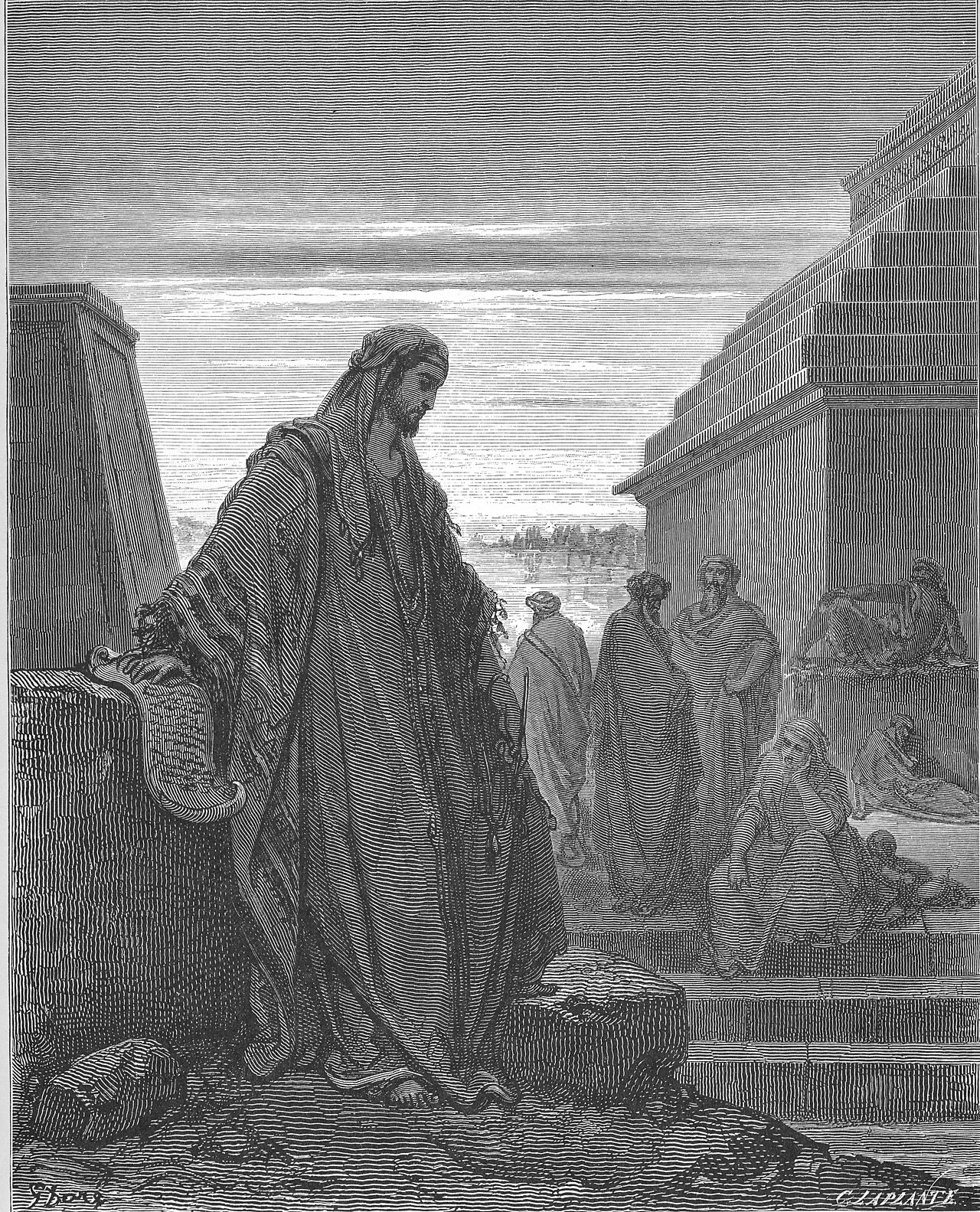
Danielchapter 11
45 verses · Daniel, by tradition · 6th century BC · The Prophets
His forces will rise up and desecrate the temple fortress. They will abolish the daily sacrifice and set up the abomination of desolation.
Introduction
Daniel, by tradition, The Prophets, Daniel Overview.
This chapter is the heart of the final vision, the message the messenger of chapter 10 came to deliver. It was kept for Jews who would live through centuries of war between the kingdoms on either side of their land. It reads like a history book, and its detail is the centre of the argument over when Daniel was written. The kings after Persia are never named, only their titles and their deeds. Listen for the king of the north and the king of the south, and for the people in the middle who know their God.
Context
- Who
- A people about to spend four hundred years as the ground two great powers fought over
- What
- A prophecy of the kings of Persia and Greece and of the long wars between the kings of the north and the south, ending with a king who profanes the sanctuary.
- Where
- The bank of the Tigris, continuing the vision of chapter 10; the events range from Persia and Greece to Egypt, Syria and the land of Judah.
- When
- Given in the third year of Cyrus, about 536 BC; the events described reach from Persia to the Greek kingdoms of the second century BC.
- Why
- To prepare God's people for the persecution to come, so that those who know their God would stand firm and act.
Historical context
This is the most detailed stretch of predictive history in the Bible, and reading it alongside a history book is startling. Persia's later kings, then a mighty Greek king whose realm is broken up and given to others than his posterity, Alexander's empire went to his generals, not his family.
Show the rest of the historical context, 3 more paragraphs
After that the chapter tracks two of those pieces: the "king of the south," the Ptolemies who ruled Egypt, and the "king of the north," the Seleucids who ruled Syria. Judea sat directly between them and changed hands repeatedly. The marriage alliances, the broken treaties, and the back-and-forth campaigns described here all line up with recorded events of the third and second centuries BC.
The chapter's last long section describes a northern king who scorns the God of his fathers, profanes the sanctuary, takes away the daily sacrifice, and sets up an abomination that makes desolate. Antiochus IV did all of this in 167 BC, and the Jewish revolt that followed under the Maccabees is why Hanukkah exists.
The precision here is the whole argument about Daniel's date. A pagan critic named Porphyry made the point in the third century AD: it is so accurate, he said, that it must have been written afterward. Christian readers answered then and answer now that God can tell the future. The book presents itself as a sixth-century record and MannaFest reads it that way. The dispute is old and still live, and it carries weight, the seventy-weeks chronology of chapter 9 rests on the earlier date.
Significance
To anyone living through those centuries, this chapter meant the chaos had a script. Armies marched through their fields without asking, and someone had written down the pattern before it started.
Show the rest of the significance, 1 more paragraph
It also prepared them for the worst of it. When the sacrifices stopped and a pagan altar stood in the temple, the faithful had a text telling them this had been seen, that many would be refined and made white by it, and that it had an end date. That is what let people who "know their God" be strong and act, rather than conclude that God had lost.
This chapter in Jewish lifeWhat this chapter is in Jewish life and reading.
What is done
The long prophecy of the kings of the north and the south is not read in the synagogue. Probed for this lane, the site's own table in src/lib/hebraic/readings.ts printed parashot total 0 and haftarah uses total 0 for Daniel, and no festival reading. The site's book dossier records that Daniel stands among the Writings in the Hebrew Bible rather than among the Prophets, so no weekly portion is drawn from it and no Haftarah either.
The chapter is met in the chronicle Seder Olam Rabbah at 28:1 under the first verse and 30:1 under the third, and in Pirkei DeRabbi Eliezer under the second and the fourth. In the Talmud it is met at Bava Metzia 105a:13 under the fourteenth verse, Rosh Hashanah 13a:13 under the forty-first and Sotah 10a:22 under the forty-fifth.
How it is read
Rashi is the one commentator on this chapter with English in the corpus, quoted from The Judaica Press complete Tanach with Rashi, translated by A. J. Rosenberg, which Sefaria reports as CC-BY at fifty words or fewer. He reads the chapter as history, king by king, and he names his sources as he goes.
The three kings of Persia are read two ways, and Rashi gives both. Seder Olam, chapter 28, names them as Cyrus, Ahasuerus and Darius who rebuilt the Temple. "In the book of Joseph Ben Gorion, however, it is written that Cyrus had a son who succeeded him before the reign of Ahasuerus, named Cambyses" (Rashi on Daniel 11:2:1). The mighty king of the third verse is Alexander of Macedon (Rashi on Daniel 11:3:1). At the fourteenth verse he reports Saadia Gaon's reading that the renegades are "the renegades of Israel and their company" (Rashi on Daniel 11:14:1).
At the eighteenth verse Rashi tells the end of the blasphemer from the book of Josiphon, chapter 20, struck with boils on his way to besiege Jerusalem and dying before he reached Antioch (Rashi on Daniel 11:18:1). At the twentieth he names the one who removes the oppressor: "Mattathias the son of Johanan, who removed the oppressor from Israel, and who is the glory of the kingdom of Israel", who with his descendants are the Hasmoneans (Rashi on Daniel 11:20:1). From the twenty-first verse he reads the contemptible person as Rome, which "will rise and take the kingdom from the Greeks" (Rashi on Daniel 11:21:1).
The corpus carries twenty-four commentary entries on this chapter, the cap its fetch sets, and they stop at the twenty-fourth verse, so what the commentators say on the verses after it is not reported here. The corpus carries one further note on this chapter without an English text, each marked linked because Sefaria holds no English version of the ref. They stand cited and unquoted: Ibn Ezra on Daniel 11:13:1.
What the rabbis say
The corpus carries twenty-nine rabbinic locators on this chapter. Five of them stand in the Talmud and its minor tractates and the rest in the Midrash. The corpus carries the text of none, so each is cited by ref here and never quoted.
On the span Daniel 11:1 to 2 it holds Seder Olam Rabbah 28:1. On the second verse it holds Midrash Lekach Tov on Esther, Introduction 3, Pirkei DeRabbi Eliezer 49:8 and Pirkei DeRabbi Eliezer 49:9. On the third verse it holds Seder Olam Rabbah 30:1. On the fourth verse it holds Pirkei DeRabbi Eliezer 11:18. On the fourteenth verse it holds Bava Metzia 105a:13, Ein Yaakov, Bava Metzia 9:1, Midrash Lekach Tov, Numbers 24:17:1, Otzar Midrashim, Midrashim of Rabbi Shimon bar Yochai, Chapter of Rabbi Shimon Bar Yochai 6 and Otzar Midrashim, Midrashim on The Messiah, Aggadah on The Messiah 4. On the twenty-first verse it holds Bamidbar Rabbah 9:7 and Otzar Midrashim, Midrashim on The Messiah, Aggadah on The Messiah 3.
On the twenty-second verse it holds Otzar Midrashim, Midrashim of Rabbi Shimon bar Yochai, Prayer of Rabbi Shimon Bar Yochai 9. On the twenty-fourth verse it holds Midrash Sekhel Tov, Bereshit 27:39:3. On the thirtieth verse it holds Otzar Midrashim, Midrash on the Ten Kings 1:16 and Otzar Midrashim, Midrashim of Rabbi Shimon bar Yochai, Prayer of Rabbi Shimon Bar Yochai 7. On the thirty-ninth verse it holds Otzar Midrashim, Midrashim of Rabbi Shimon bar Yochai, Chapter of Rabbi Shimon Bar Yochai 4. On the forty-first verse it holds Bereshit Rabbah 44:23, Rosh Hashanah 13a:13 and Yalkut Shimoni on Torah 78:2. On the forty-third verse it holds Jerusalem Talmud Kilayim 8:3:4 and Jerusalem Talmud Shabbat 5:1:3.
On the forty-fifth verse it holds Ein Yaakov (Glick Edition), Sotah 1:29, Ein Yaakov, Sotah 1:35, Otzar Midrashim, Midrashim of Rabbi Shimon bar Yochai, Prayer of Rabbi Shimon Bar Yochai 10, Pirkei DeRabbi Eliezer 12:1, Sotah 10a:22 and Yalkut Shimoni on Torah 95:5.
What each locator teaches is a saying of the rabbis, and it is reported as theirs wherever this site quotes one. The quotations wait on a fetch that carries the text.
Sources: Rashi, Rashi on Daniel 11:1:1 to Daniel 11:24:1, The Judaica Press complete Tanach with Rashi, translated by A. J. Rosenberg, reported CC-BY; Ibn Ezra, Ibn Ezra on Daniel 11:13:1, cited by ref because the corpus carries no English text; The Sefaria corpus, scripts/data/sources/sefaria/daniel/11.json, the 29 Talmud and Midrash locators of this chapter; The site's own files, src/lib/hebraic/readings.ts, probed for this book and printing daniel parashot total 0 and haftarah uses total 0, and src/components/book/dossier-content/daniel.ts on the place of Daniel among the Writings.
The heads below are this chapter's scenes. The numbered points under each are its verses.
Four Persian kings and the mighty Greek broken in four
first year of Darius the Mede: The speaker is still the angel, and him means Darius. Albert Barnes and Matthew Henry read the strengthening as the angel securing the favor of Darius toward the Jews. John Calvin heard the angel claim that the Persian king could do nothing except through him.
Daniel 11:1-4
the first year of Darius the Mede: “Three more kings will arise in Persia,” then a fourth “far richer than all the others” who stirs everyone against Greece. Keil and Barnes identify the fourth as Xerxes, the “mighty king” as Alexander. This precision is why Porphyry disputed the book's date, and Jerome answered him.
Daniel 11:1
“I have not the slightest doubt of my present power to restrain these kings, lest they should pour forth their fury upon the people. The full meaning is this, the king of the Persians is nothing, and can do nothing except through me. I was God's servant in transferring the monarchy of the Medes and Chaldeans to the Persians, as well as that of the Babylonians to the Medes.”
John Calvin · Commentaries (1554)reformed
Three more kings will arise: Readers name the kings differently. Adam Clarke counts Cambyses, Smerdis and Darius son of Hystaspes, with Xerxes as the fourth, and John Wesley says Darius gathered that wealth for Xerxes. Hippolytus counted Darius, Artaxerxes and Xerxes, and made a Darius the fourth.
Daniel 11:2
“There shall stand up yet three kings - Gabriel had already spoken of Cyrus, who was now reigning; and after him three others should arise. These were, 1. Cambyses, the son of Cyrus. 2. Smerdis, the Magian, who was an impostor, who pretended to be another son of Cyrus. And, 3. Darius, the son of Hystaspes, who married Mandane, the daughter of Cyrus. Cambyses reigned seven years and five months; Smerdis reigned only seven months; and Darius Hystaspes reigned thirty-six years.”
Adam Clarke · Commentary on the Bible (1810-1826)evangelical
a mighty king will arise: Jerome, Barnes and Clarke take the mighty king as Alexander the Great, who would rule with great authority over Persia and Greece. Clarke notes he was born a century after Xerxes. Matthew Henry saw the words do as he pleases in Alexander seeking the honor of a god.
Daniel 11:3
“And a mighty king shall stand up - So far as the language here is concerned, it is not said whether this would be in Persia, as a successor of the “fourth king” Dan 11:2, or whether it would be in some other part of the world. The next verse, however, shows that the reference is to Alexander the Great - for to no other one is it applicable.”
1 more voice on this verse
Daniel 11:3
“When Alexander, after he had conquered Asia, would be worshipped as a god, then this was fulfilled, that he shall do according to his will. That is God's prerogative, but was his pretension.”
Matthew Henry · Commentary on the Whole Bible (1707-1721)puritan
toward the four winds of heaven: Jamieson, Fausset and Brown date the kingdom broken toward the four winds from the battle of Ipsus in 301 B.C. Clarke traces how the descendants of Alexander were given up to death, his wife and brother slain. Wesley notes that the four at first ruled as commanders.
Daniel 11:4
“His kingdom shall be broken - Shall, after his death, be divided among his four chief generals, as we have seen before. See Dan 8:22. And not to his posterity - The family of Alexander had a most tragical end: 1. His wife Statira was murdered soon after his death by his other wife Roxana. 2. His brother Aridaeus who succeeded him, was killed, together with his wife Euridice, by command of Olympias, Alexander’s mother, after he had been king about six years and some months. 3. Olympias herself was killed by the soldiers in revenge.”
Adam Clarke · Commentary on the Bible (1810-1826)evangelical
1 more voice on this verse
Daniel 11:4
“Understand this as referring to Alexander, who was certain that his last day was not close and therefore did not have children, who could be the heirs of his reign, and left it to his friends after dividing it into four parts.”
Ephrem the Syrian · written before 373 · Commentary on Daniel 11:3patristic
The kings of the south and north trade war and marriage
The king of the South: Jerome and Clarke take the king of the South as Ptolemy son of Lagus, and Clarke gives the stronger commander as Seleucus. Barnes reckons South and North from the Beautiful Land. Tregelles, cited by Jamieson, Fausset and Brown, set a gap here before the Antichrist of the end.
Daniel 11:5-20
The king of the South: Verses 5 to 20 trace the wars of the South and the North, identified by Barnes and Gill as the Ptolemies and Seleucids. At verse 16 the invader stands in “the Beautiful Land,” and it ends with a king destroyed “though not in anger or in battle”.
Daniel 11:5
“And the king of the south - The angel here leaves the general history of the empire, and confines himself, in his predictions, to two parts of it - the kingdom of the south, and the kingdom of the north; or the kingdoms to the north and the south of Palestine - that of Syria and that of Egypt; or that of the Seleucidae, and that of the Ptolemies.”
1 more voice on this verse
Daniel 11:5
“Holy Scripture handles external history only so far as it is connected with God's people, Israel [JEROME]. TREGELLES puts a chasm between the fourth and fifth verses, making the transition to the final Antichrist here, answering to the chasm (in his view) at Da 8:22, 23. king of . . . south--literally, "of midday": Egypt (Da 11:8, 42), Ptolemy Soter, son of Lagus.”
Jamieson, Fausset & Brown · Commentary Critical and Explanatory on the Whole Bible (1871)reformed
the daughter of the king: Clarke and Jamieson, Fausset and Brown name her Berenice, given in marriage to Antiochus Theos, who put away his wife Laodice. Matthew Henry relates that Antiochus took Laodice back, and she had him, Berenice and her son slain. Her son Seleucus then took his father’s place.
one from her family line: Barnes compares one from her family line to a shoot from a fallen tree, as in Isaiah 11:1, and takes it strictly as her brother. Jerome and Clarke name him Ptolemy Euergetes, who would come against the king of the North. Henry cites Justin: strife in Egypt saved the North.
Daniel 11:7
"And a plant of the bud of her roots shall arise, and he shall come with an army and shall invade the province of the king of the North." After the murder of Berenice and the death of her father, Ptolemy Philadelphus, in Egypt, her brother, who was also named Ptolemy and surnamed Euergetes, succeeded to the throne as the third of his dynasty, being in fact an offshoot of the same plant and a bud of the same root as she was, inasmuch as he was her brother.
Jerome · written before 420 · St. Jerome, Commentary on Daniel, CHAPTER ELEVENpatristic
1 more voice on this verse
Daniel 11:7
“But out of a branch of her roots - Compare the notes at Isa 11:1. The meaning is, that as a branch or shoot springs up from a tree that is decayed and fallen, so there would spring up some one of her family who would come to avenge her. That is, a person is indicated who would be of a common stock with her; or, in other words, if taken strictly, a brother. The phrase “branch of her roots” is somewhat peculiar. The words “her roots” must refer to her family; that from which she sprang.”
take even their gods captive: Jerome records that Ptolemy Euergetes carried off forty thousand talents of silver with vessels and images of the gods. Albert Barnes, citing Jerome, adds that many images were Egyptian idols Cambyses had once taken. Adam Clarke notes Euergetes outlived Seleucus Callinicus by some years.
Daniel 11:8
"And he shall also carry away captive into Egypt their gods and their sculptures and their precious vessels of gold and silver; he shall prevail against the king of the North." And then, when he heard that a rebellion was afoot in Egypt, he ravaged the kingdom of Seleucus and carried off as booty forty thousand talents of silver, and also precious vessels and images of the gods to the amount of two and a half thousand. Among them were the same images which Cambyses had brought to Persia at the time when he conquered Egypt.
Jerome · written before 420 · St. Jerome, Commentary on Daniel, CHAPTER ELEVENpatristic
then return to his own land: The Berean makes the king of the North the invader here. Albert Barnes and Adam Clarke read the older wording, where Ptolemy Euergetes enters the northern kingdom and goes home. Clarke says a revolt in Egypt called him back, or he would have destroyed the kingdom of Callinicus.
Daniel 11:9
“So the king of the south shall come into his kingdom - That is, into the kingdom of the north, or the kingdom of Syria. This verse seems to be a summary of what had been said about his invading Syria. He would come, on account of the wrongs done to his sister, into the kingdom of the north, and would then return again to his own land.”
3 more voices on this verse
Daniel 11:9
"And the king of the South shall enter into the kingdom and shall return to his own land." And he himself retained possession of Syria, but he handed over Cilicia to his friend, Antiochus, that he might govern it, and the provinces beyond the Euphrates he handed over to Xanthippus, another general.
Jerome · written before 420 · St. Jerome, Commentary on Daniel, CHAPTER ELEVENpatristic
Daniel 11:9
“But his sons - He means the sons of the king of the north, shall be incensed with the deeds of Ptolemaeus Euergetes, and his son Ptolemaeus Philopator. One shall come - Antiochus the great, shall pass through Syria and recover what the king of Egypt took from his father. Even to his fortress - To Raphia, which was a strong fortress at the entrance of Egypt.”
John Wesley · Explanatory Notes upon the Old Testament (1765)evangelical
Daniel 11:9
“So the king of the south - Ptolemy Euergetes: - Shall come into his kingdom - That of Seleucus Callinicus. And shall return - Having heard that a sedition had taken place in Egypt, Ptolemy Euergetes was obliged to return speedily in order to repress it; else he had wholly destroyed the kingdom of Callinicus.”
Adam Clarke · Commentary on the Bible (1810-1826)evangelical
his sons will stir up strife: Jerome and Clarke name his sons Seleucus Ceraunus and Antiochus the Great. Clarke records that two of his own commanders poisoned Seleucus. Wesley and Jamieson, Fausset and Brown place the fortress at Raphia near Gaza, where the great army of Antiochus would be broken.
Daniel 11:10
“Antiochus penetrated to Dura (near Cæsarea), where he gave Ptolemy a four months' truce. return--renew the war at the expiration of the truce (so Da 11:13). even to his fortress--Ptolemy's; Raphia, a border-fortress of Egypt against incursions by way of Edom and Arabia-Petræa, near Gaza; here Antiochus was vanquished.”
Jamieson, Fausset & Brown · Commentary Critical and Explanatory on the Whole Bible (1871)reformed
will march out to fight: Adam Clarke names this king Ptolemy Philopator, who succeeded his father Euergetes, and sets the battle at Raphia. Clarke numbers the army of Antiochus at sixty-two thousand foot and six thousand horse. Barnes traces the rage to the invasion of Syria and Palestine.
Daniel 11:11
“The king of the south - Ptolemy Philopater, who succeeded his father Euergetes. Shall come forth and fight with him - He did come forth to Raphia, where he was met by Antiochus, when a terrible battle was fought between these two kings. And he (Antiochus, the king of the north) shall set forth a great multitude - Amounting to sixty-two thousand foot, six thousand horse, and one hundred and two elephants; but yet the multitude was given into his hand, the hand of the king of the south; for Ptolemy gained a complete victory.”
Adam Clarke · Commentary on the Bible (1810-1826)evangelical
1 more voice on this verse
Daniel 11:11
“And the king of the south shall be moved with choler - With anger. That is, that his provinces were invaded, and his strongholds taken - referring particularly to the invasion of Syria and Palestine as mentioned in the previous verse, and the attempt to wrest them out of the hands of the king of Egypt. Nothing would be more natural than that this should occur. And shall come forth and fight with him, even with the king of the north - There were frequent and almost constant wars between these two kingdoms.”
will be proud in heart: Jamieson, Fausset and Brown, citing Polybius, say the king made peace when he might have taken all Syria, and gave his heart to pleasure. Clarke says the triumph left his kingdom no stronger. His own people, Clarke adds, rose up against him.
Daniel 11:12
“His heart shall be lifted up - Had Ptolemy improved his victory, he might have dispossessed Antiochus of his whole empire; but giving way to pride, and a criminally sensual life, he made peace on dishonorable terms; and though he had gained a great victory, yet his kingdom was not strengthened by it, for his subjects were displeased, and rebelled against him, or at least became considerably disaffected.”
Adam Clarke · Commentary on the Bible (1810-1826)evangelical
another army, larger than the first: Clarke dates the return about fourteen years later, when the king of the South was dead and his son Ptolemy Epiphanes a child. Clarke says the larger army and supplies came from a campaign in the east. Matthew Henry notes the boy king gave Antiochus the advantage.
Daniel 11:13
“The king of the north shall return - after certain years - In about fourteen years Antiochus did return, Philopater being dead, and his son Ptolemy Epiphanes being then a minor. He brought a much larger army and more riches; these he had collected in a late eastern expedition.”
Adam Clarke · Commentary on the Bible (1810-1826)evangelical
1 more voice on this verse
Daniel 11:13
“For the king of the north shall return - That is, he shall come again into the regions of Coelo-Syria and Palestine, to recover them if possible from the power of the Egyptian king. And shall set forth a multitude greater than the former - Than he had in the former war when he was defeated. The fact was, that Antiochus, in this expedition, brought with him the forces with which he had successfully invaded the East, and the army had been raised for that purpose, and was much larger than that with which he had formerly attacked Ptolemy.”
Violent ones among your own people: Readers divide on the violent ones among your people. Clarke took them as Jews who forsook the covenant, sided with the king of the South, and hoped to build a temple in Egypt. Matthew Henry takes them as Jews who joined Antiochus against the forces of Egypt.
Daniel 11:14
“Many stand up against the king of the south - Antiochus, and Philip king of Macedon, united together to overrun Egypt. Also the robbers of thy people - The Jews, who revolted from their religion, and joined Ptolemy, under Scopas: - Shall exalt themselves to establish the vision - That is, to build a temple like that of Jerusalem, in Egypt, hoping thereby to fulfil a prediction of Isaiah, Isa 30:18-25, which seemed to intimate that the Jews and the Egyptians should be one people.”
Adam Clarke · Commentary on the Bible (1810-1826)evangelical
build up a siege ramp: Jamieson, Fausset and Brown, with Clarke and Barnes, set this after the army of Scopas was broken at Paneas near the Jordan. Famine then forced Scopas to give up Sidon. Following Jerome, they add that the best troops of Egypt, sent to help, were not able to relieve him.
Daniel 11:15
“So the king of the north - Antiochus the Great. Shall come - Shall come again into these provinces. This occurred after he had vanquished the army of the Egyptians at Paneas. He then took Sidon and Patara, and made himself master of the whole country. - Prideaux, iii. 198. This happened 198 b.c. Scopas, a general of Ptolemy, had been sent by him into Coelo-Syria and Palestine, with a view of subjecting those countries again to Egyptian rule.”
establish himself in the Beautiful Land: The words with destruction in his hand have two readings. Grotius and Clarke allow the sense perfected in his hand, and Clarke notes that the Jews helped Antiochus take Jerusalem from the forces of Scopas. Wesley reads it as the Beautiful Land feeding his army.
Daniel 11:16
“GROTIUS translates, "shall be perfected by him," that is, shall flourish under him. English Version gives a good sense; namely, that Judea was much "consumed" or "desolated" by being the arena of conflict between the combatants, Syria and Egypt.”
Jamieson, Fausset & Brown · Commentary Critical and Explanatory on the Whole Bible (1871)reformed
give him a daughter in marriage: Matthew Henry and Adam Clarke name the daughter as Cleopatra, given in marriage to Ptolemy. Henry says she took her husband's side, so the plot failed. Jerome allows either sense of the aim, to overthrow Ptolemy himself or to overthrow his kingdom.
Daniel 11:17
“He shall also set his face - He shall use all the force he can to master Egypt, and engross it to himself. Upright ones - Many of the religious Jews joined with him: the rest of his army was a profane rabble of rude Heathens.”
John Wesley · Explanatory Notes upon the Old Testament (1765)evangelical
turn his face to the coastlands: Jerome and Clarke list the coastlands he would capture, among them Rhodes and Samos. Clarke names the commander as the Roman consul Acilius. Matthew Henry records that the army of Rome overthrew Antiochus, though his seventy thousand men were many more than their thirty thousand.
Daniel 11:18
"And he shall turn his face to the islands and shall capture many; and she shall cause the prince of her reproach to cease, and his reproach shall be turned upon him." And so he turned his attention to Asia Minor, and by carrying on naval warfare against a large number of islands, he seized Rhodes, Samos, Colophon (variant: Colophonia and Bocla), Phocea and many other islands. But he was opposed by Lucius Scipio Nasica and also his brother, Publius Scipio Africanus, who had vanquished Hannibal.
Jerome · written before 420 · St. Jerome, Commentary on Daniel, CHAPTER ELEVENpatristic
1 more voice on this verse
Daniel 11:18
“Shall he turn his face unto the isles - Antiochus had fitted out a great fleet of one hundred large ships and two hundred smaller, and with this fleet subdued most of the maritime places on the coast of the Mediterranean, and took many of the isles, Rhodes, Samos, Euboea, Colophon, and others. But a prince for his own behalf - Or, a captain. The consul Acilius Glabrio caused the reproach to cease; beat and routed his army at the straits of Thermopylae, and expelled him from Greece.”
Adam Clarke · Commentary on the Bible (1810-1826)evangelical
he will stumble and fall: Adam Clarke traces the flight after defeat through Sardis and Apamea to Antioch, where Antiochus sued for peace and bound himself to a heavy payment. Jerome places his death in the far east of his kingdom. He fell with his whole army fighting the Elymaeans.
Daniel 11:19
"And he shall turn his face to the empire of his own land; and he shall stumble and fall, and shall not be found." And so he took refuge in Apamia and Susa and advanced to the easternmost cities of his realm. And during a war against the Elymaeans he was destroyed together with his entire army.
Jerome · written before 420 · St. Jerome, Commentary on Daniel, CHAPTER ELEVENpatristic
send out a tax collector: Adam Clarke names the king Seleucus Philopator, son of Antiochus the Great, pressed by the yearly tribute owed to Rome. Clarke identifies the tax collector as Heliodorus, sent to seize the money in the Jerusalem temple. Maurer took the glory of the kingdom as Judea.
Daniel 11:20
“Then shall stand up in his estate a raiser of taxes - Seleucus Philopater succeeded his father Antiochus. He sent his treasurer Heliodorus to seize the money deposited in the temple of Jerusalem, which is here called the glory of the kingdom, see 2 Maccabees 9:23. He was so cramped to pay the annual tax to the Romans, that he was obliged to burden his subjects with continual taxes.”
Adam Clarke · Commentary on the Bible (1810-1826)evangelical
A contemptible man who comes in peaceably and takes the kingdom
a despicable person will arise: Barnes takes the despicable person as Antiochus Epiphanes, king from 175 to 163 B.C. Wesley notes the royal honors were his nephew’s by right. Clarke says others had claimed the kingdom, and Antiochus would seize it by flattery of Eumenes.
Daniel 11:21-28
a despicable person will arise: A “despicable person” without royal honors seizes the kingdom “by intrigue,” and Keil and Matthew Henry identify him as Antiochus Epiphanes. A broken prince of the covenant, a deceitful alliance, lavished plunder and lies spoken “at the same table” describe a kingdom held by deceit.
Daniel 11:21
“And in his estate shall stand up a vile person,.... Upon his basis or stand, in the same place where Seleucus Philopator stood, succeeded Antiochus Epiphanes his brother, called "vile", being a very immoral man, given to drunkenness, lasciviousness, uncleanness, and unnatural lusts, and a violent persecutor of the church of God.”
1 more voice on this verse
Daniel 11:21
“And in his estate - In his place. See the notes at Dan 11:7, Dan 11:20. Shall stand up a vile person - There shall succeed to the throne. The reference here is to Antiochus Epiphanes, who reigned from 175 b.c. to 163 b.c. The epithet “vile” here given him was one which his subsequent history showed was eminently appropriate to him in all respects, as a man and as a prince. The Hebrew word rendered “vile” - נבזה nı̂bezeh - properly means one despised or held in contempt, Isa 49:7; Psa 22:6 (7).”
a prince of the covenant: Readers divide over “a prince of the covenant,” swept away with the flood of forces. Jamieson, Fausset and Brown take him as the king of the South, Ptolemy Philometor, son of the sister of Antiochus. Clarke takes him as Onias the high priest, whom Jason put out of his place.
Daniel 11:22
“And with the arms of a flood - The arms which were overflown before him were his competitors for the crown. They were vanquished by the forces of Eumenes and Attalus; and were dissipated by the arrival of Antiochus from Athens, whose presence disconcerted all their measures. The prince of the covenant - This was Onias, the high priest, whom he removed, and put Jason in his place, who had given him a great sum of money; and then put wicked Menelaus in his room, who had offered him a larger sum.”
Adam Clarke · Commentary on the Bible (1810-1826)evangelical
with only a few people: Clarke says Antiochus would come from Rome with few people until Eumenes would help him. Matthew Henry reads the words act deceitfully as a prince who will keep an alliance only while it serves his power. Theodoret saw here Jason taking his brother’s place as high priest.
his fathers and forefathers never did: Readers explain what his fathers never did in two ways. John Wesley takes it as success over Egypt, and Theodoret saw a break with forefathers who had honored the Jewish nation. Jamieson, Fausset and Brown read only for a time as a limit God set.
Daniel 11:24
“Retaining to himself Pelusium, he retired to Judea, where, in revenge for the joy shown by the Jews at the report of his death, which led them to a revolt, he subdued Jerusalem by storm or stratagem. for a time--His rage shall not be for ever; it is but for a time limited by God. CALVIN makes "for a time" in antithesis to "unexpectedly," in the beginning of the verse.”
Jamieson, Fausset & Brown · Commentary Critical and Explanatory on the Whole Bible (1871)reformed
1 more voice on this verse
Daniel 11:24
“Some understand these verses of his first expedition into Egypt, when he came not as an enemy, but as a friend and guardian to the young king Ptolemæus Philometer, and therefore brought with him but few followers, yet those stout men, and faithful to his interest, whom he placed in divers of the strong-holds in Egypt, thereby making himself master of them.”
Matthew Henry · Commentary on the Whole Bible (1707-1721)puritan
against the king of the South: Jamieson, Fausset and Brown count this as the first of three open invasions of Egypt, while Albert Barnes counts four in the reign. Adam Clarke places the battle between Pelusium and Mount Casius. The large army here answers the few people of verse 23.
Daniel 11:25
“This is the first of Antiochus' three (Da 11:29) open invasions of Egypt. against the king of the south--against Ptolemy Philometer. Subsequently, Ptolemy Physcon (the Gross), or Euergetes II, was made king by the Egyptians, as Ptolemy Philometer was in Antiochus' hands. great army--as distinguished from the "small people" (Da 11:23) with which he first came.”
Jamieson, Fausset & Brown · Commentary Critical and Explanatory on the Whole Bible (1871)reformed
Those who eat from his provisions: Barnes takes those who eat from his provisions as the counselors who shared the table of the king of the South. Matthew Henry and Clarke say Antiochus corrupted them with bribes. Jamieson, Fausset and Brown compare 1 Maccabees 1:18, where many fell slain.
Daniel 11:26
“The phrase is used of overflowing numbers, usually in a victorious sense, but here in the sense of defeat, the very numbers which ordinarily ensure victory, hastening the defeat through mismanagement. many shall fall down slain--(1 Maccabees 1:18, "many fell wounded to death").”
Jamieson, Fausset & Brown · Commentary Critical and Explanatory on the Whole Bible (1871)reformed
speak lies at the same table: Clarke names the two kings as Antiochus and his nephew Ptolemy Philometor, after Alexandria had set his younger brother in his place. Jamieson, Fausset and Brown place their meetings at Memphis. Jerome says Antiochus would eat at the same table as Ptolemy while he devised plots against him.
Daniel 11:27
“And both these kings’ hearts shall be to do mischief - Margin, “their hearts.” The meaning is, that their hearts were set on some evil or unjust purpose. The reference here is, evidently, to Antiochus and Ptolemy Philometor, and the time alluded to is when Ptolemy was in the possession of Antiochus, and when they were together forming their plans. Antiochus invaded the country under pretenee of aiding Ptolemy and establishing him in the government, and for the same reason, under pretence of protecting him, he had him now in his possession.”
against the holy covenant: Jerome records that Antiochus, returning from Egypt, despoiled the temple of a great weight of gold. Jamieson, Fausset and Brown, citing 2 Maccabees 5, give eighty thousand slain in Jerusalem and forty thousand sold as slaves. John Wesley reads the covenant as the law of God.
Daniel 11:28
"And his heart shall be against the holy covenant, and he shall succeed and return into his own land." Both the Greek and the Roman historians relate that after Antiochus had been expelled from Egypt and had gone back once more, he came to Judaea, that is, against the holy covenant, and that he despoiled the Temple and removed a huge amount of gold; and then, having stationed a garrison in the citadel, he returned to his own land.
Jerome · written before 420 · St. Jerome, Commentary on Daniel, CHAPTER ELEVENpatristic
1 more voice on this verse
Daniel 11:28
“Then shall he return - Antiochus shall depart with his booty gotten in Egypt. Against the holy covenant - Against the law of God, with the people that worshipped God according to his will.”
John Wesley · Explanatory Notes upon the Old Testament (1765)evangelical
The abomination set up, and the people who know their God
will not be like the first: Jerome dates this invasion two years after the last. Barnes reads the appointed time as fixed by God, and Theodoret took it as the time fit for battle. Piscator, as Jamieson, Fausset and Brown report, counted this a third campaign, set against the first two.
Daniel 11:29-35
will not be like the first: “Ships of Kittim,” commonly taken as the Roman ultimatum, turn him back, and he rages “against the holy covenant”. His forces “abolish the daily sacrifice and set up the abomination of desolation,” the phrase that Jesus cites at Matthew 24:15. Many read Antiochus and a fulfilment beyond him.
Daniel 11:29
“Or, making this the third expedition, the sense is "not as the first or as the second" expeditions [PISCATOR]. Rather "not as the former, so shall be this latter" expedition [GROTIUS].”
Jamieson, Fausset & Brown · Commentary Critical and Explanatory on the Whole Bible (1871)reformed
Ships of Kittim will come: Barnes, following Gesenius, derives Kittim from Cyprus and gives the name to the coastlands of the sea. Gill names the Roman envoy in the ships as Popilius. Matthew Henry finds those who forsake the holy covenant in 1 Maccabees 1:11 to 15.
Daniel 11:30
“For the ships of Chittim shall come against him - Chittim is well known to mean the Roman empire. Antiochus, being now in full march to besiege Alexandria, and within seven miles of that city, heard that ships were arrived there from Rome, with legates from the senate. He went to salute them. They delivered to him the letters of the senate, in which he was commanded, on pain of the displeasure of the Roman people, to put an end to the war against his nephews.”
Adam Clarke · Commentary on the Bible (1810-1826)evangelical
1 more voice on this verse
Daniel 11:30
“Apollonius slew multitudes, dismantled and pillaged the city. They then, from a fortress which they built commanding the temple, fell on and slew the worshippers; so that the temple service was discontinued. Also, Antiochus decreed that all, on pain of death, should conform to the Greek religion, and the temple was consecrated to Jupiter Olympius.”
Jamieson, Fausset & Brown · Commentary Critical and Explanatory on the Whole Bible (1871)reformed
the abomination of desolation: Barnes says readers agree on Antiochus up to this verse and divide from here to the end. Clarke, with both Newtons, takes his forces as Rome. Jamieson, Fausset and Brown, with Jerome, take Antiochus, who would abolish the daily sacrifice, as a type of the Antichrist.
Daniel 11:31
“Some observe that the word Tammidh, which signifies no more than daily, is only here, and in the parallel place, used for the daily sacrifice, as if there were a designed liberty left to supply it either with sacrifice, which was suppressed by Antiochus, or with gospel-worship, which was suppressed by the Antichrist.”
Matthew Henry · Commentary on the Whole Bible (1707-1721)puritan
1 more voice on this verse
Daniel 11:31
“And arms shall stand on his part - Up to this verse there is a general agreement among commentators, that the reference is to Antiochus Epiphanes. From this verse, however, to the end of the chapter, there is no little diversity of opinion.”
the people who know their God: John Chrysostom named the people who know their God as Judas, Simon and John in the Maccabean years. Theodoret pointed to Mattathias, the first to resist Antiochus. Clarke read the flattery as the pressure of Rome on Christians to sacrifice to images of the emperors.
Daniel 11:32
“Such as do wickedly against the covenant - This if understood of the Christian Jews, for the New had now succeeded to the Old, the whole of the Jewish ritual having been abolished, and Jerusalem filled with heathen temples. And he - the Roman power, did all he could by flatteries, as well as threats, to corrupt the Christians, and cause them to sacrifice to the statues of the emperors. But the people that do know their God - The genuine Christians. Shall be strong - Shall be strengthened by his grace and Spirit.”
Adam Clarke · Commentary on the Bible (1810-1826)evangelical
2 more voices on this verse
Daniel 11:32
“This might well be called doing exploits; for to choose suffering rather than sin is a great exploit. And it was by faith, by being strong in faith, that they did those exploits, that they were tortured, not accepting deliverance, as the apostle speaks, probably with reference to that story, Heb. xi.”
Matthew Henry · Commentary on the Whole Bible (1707-1721)puritan
Daniel 11:32
“THE uninspired book of the Maccabees is perhaps the best interpreter of this passage in Daniel. The Prophet, we think, refers to the great persecution under Antiochus, when the followers of Judas Maccabees, knowing their God and keeping close to Him amidst general defection, refused to bow before the idols of Syria.”
Those with insight will instruct many: Barnes and Jerome take those with insight as faithful Jews under Antiochus, who would fall by sword and flame, as the Maccabees record. Clarke takes them as the apostles and early Christians. Tregelles, in Jamieson, Fausset and Brown, says it is the many they instruct who fall.
a little help: Porphyry, Jerome says, made the little help Mattathias. Barnes takes it as small forces that would join the Maccabees, and Jamieson, Fausset and Brown stress how short a time that help would last. Clarke says it is the help granted by Constantine after the persecution of Diocletian.
Daniel 11:34
“Now when they shall fall - When the storm of the tenth persecution under Diocletian, which lasted ten years, fell upon them, they were sorely oppressed. They shall be holpen with a little help - By Constantine; who, while he removed all persecution, and promoted the temporal prosperity of the Christian Church, yet added little to its spiritual perfection and strength. For many, now seeing the Christians in prosperity: - Cleave to them with flatteries - Became Christians Because the Emperor was such.”
Adam Clarke · Commentary on the Bible (1810-1826)evangelical
refined, purified, and made spotless: Jamieson, Fausset and Brown liken the wise, refined and purified, to wheat cleared of chaff and to cloth made white, as in Revelation 7:9. John Chrysostom says the trial would show who among them was true. Barnes suggests a battle that sorted those who fight from principle.
Daniel 11:35
“Image from wheat cleared of its chaff by the wind. make . . . white--image from cloth (Re 7:9). to . . . time of . . . end--God will not suffer His people to be persecuted without limitation (1Co 10:13). The godly are to wait patiently for "the end" of "the time" of trial; "for it is (to last) yet for a time appointed" by God.”
Jamieson, Fausset & Brown · Commentary Critical and Explanatory on the Whole Bible (1871)reformed
The king who exalts himself above every god
magnify himself above every god: Barnes held that the king who will exalt and magnify himself is beyond question Antiochus Epiphanes. Hippolytus heard a new mystery about the time of the end, the Antichrist, and Wesley took Antiochus as a type of him. Theodoret explained the time of wrath as God's retribution.
Daniel 11:36-39
king will do as he pleases: Some older commentators read Antiochus continued; the dispensational line and much of the church read a final adversary beyond him, described at 2 Thessalonians 2:4. He ignores “the one desired by women” and honors “a god of fortresses,” details beyond what history records of Antiochus.
Daniel 11:36
“And the king shall do according to his will - This may apply to Antiochus, who exalted himself above every god, called himself a god, sported with all religion, profaned the temple, etc., etc. But others think an antichristian power in the Church is intended; for in the language of this prophecy king is taken for power, a kingdom, etc. That such a power did spring up in the Church that acted in an arbitrary manner against all laws, human and Divine, is well known.”
Adam Clarke · Commentary on the Bible (1810-1826)evangelical
1 more voice on this verse
Daniel 11:36
“The king - Antiochus was an eminent type of antichrist; to whom many things that follow may be applied by way of accommodation: altho' they principally refer to Antiochus, and had their primary accomplishment in him. For that that is determined - That which God hath decreed to be done by him shall be done; and that which God hath purposed to be done upon him.”
John Wesley · Explanatory Notes upon the Old Testament (1765)evangelical
the one desired by women: Jamieson, Fausset and Brown give three readings of the one desired by women. Maurer took it as the Syrian Venus, whose temple Antiochus would attack, Newton as the forbidding of marriage, and Elliott as the Messiah. Theodoret objected that Antiochus set up altars to Zeus.
Daniel 11:37
"And he shall make no account of the god of his fathers, and he shall be engrossed in lust for women; nor shall he have regard for any of the gods, for he shall rise up against everything." Instead of our rendering, the Septuagint translates: "...and he will not be subject to the lusts of women."
Jerome · written before 420 · St. Jerome, Commentary on Daniel, CHAPTER ELEVENpatristic
The Hebrew for god of fortresses is Maozim, which Jerome says Aquila gave as the God of mighty powers. Matthew Henry takes the god as Jupiter Olympius, brought by Antiochus, and Clarke, following Newton, reads saints and angels as guardians. Theodoret held that the king gave the honor to himself.
Daniel 11:38
"But he shall worship the god Maozim in his place, and a god which his fathers knew not shall he worship with gold and silver and precious stones and things of great price." Instead of "the god Maozim (m'dym)," as the Hebrew has it, Aquila renders, "the God of mighty powers (fortitudinum)," whereas the Septuagint says, "the most mighty God."
Jerome · written before 420 · St. Jerome, Commentary on Daniel, CHAPTER ELEVENpatristic
1 more voice on this verse
Daniel 11:38
“Translate, "He shall honor the god of fortresses on his basis," that is, the base of the statue. NEWTON translates, "And the god 'Mahuzzim' (guardians, that is, saints adored as 'protectors' in the Greek and Roman churches) shall he honor." honour with gold, &c.--Compare Re 17:4 as to Antiochus' antitype, Antichrist.”
Jamieson, Fausset & Brown · Commentary Critical and Explanatory on the Whole Bible (1871)reformed
distributing the land for a price: Jamieson, Fausset and Brown read the verse of Antiochus rewarding those who forsook the covenant with rule and land. Theodoret read it of a king who would raise temples to himself. Newton and Clarke gave the opening as the defenders of Mauzzim.
Daniel 11:39
"And he shall take measures to fortify Maozim, together with a strange god whom he has acknowledged. And he shall increase glory and shall grant them power over many and shall divide the land as a free gift." Theodotion has interpreted as follows: "And he shall conduct these affairs so as to fortify garrisons with a strange god, and with them he shall manifest and increase glory; and he shall cause them to bear rule over many and divide up the land as a free gift." Symmachus rendered it "refuges" instead of "garrisons."
Jerome · written before 420 · St. Jerome, Commentary on Daniel, CHAPTER ELEVENpatristic
1 more voice on this verse
Daniel 11:39
“Antiochus succeeded against Jerusalem, Sidon, Pelusium, Memphis. cause them--Antiochus "caused" his followers and the apostates "to rule over many" Jews, having "divided their land" (Judea), "for gain" (that is, as a reward for their compliance).”
Jamieson, Fausset & Brown · Commentary Critical and Explanatory on the Whole Bible (1871)reformed
The time of the end and his palace between the seas
At the time of the end: Albert Barnes takes the time of the end as the close of the events in view. Adam Clarke held the kings of South and North now stand for later powers, and Jamieson, Fausset and Brown name the Saracens and the Turks. Theodoret looked to the end of the Roman Empire.
Daniel 11:40-45
At the time of the end: At “the time of the end” the northern king sweeps “like a flood,” takes Egypt's riches, and hears “news from the east and the north”. Some read Antiochus, though history does not match him in detail; others, the final campaign.
Daniel 11:40
“At the time of the end shall the king of the south push at him - These kings are to be understood in reference to the times of which the prophet speaks. While the kingdoms of Egypt and Syria were subsisting, the king of the south and the north applied to them exclusively: but they did not exist at the time of which the prophet speaks; therefore other southern and northern powers must be sought.”
Adam Clarke · Commentary on the Bible (1810-1826)evangelical
1 more voice on this verse
Daniel 11:40
“The Saracen Arabs "of the south" "pushed at" the Greek emperor Heraclius, and deprived him of Egypt and Syria. But the Turks of "the north" not merely pushed at, but destroyed the Greek empire; therefore more is said of them than of the Saracens. Their "horsemen" are specified, being their chief strength.”
Jamieson, Fausset & Brown · Commentary Critical and Explanatory on the Whole Bible (1871)reformed
Edom, Moab, and the leaders: Barnes ties the Beautiful Land to verse 16. Jamieson, Fausset and Brown recall that the Maccabees fought Edom, Moab and the Ammonites as allies of Antiochus. They and Clarke also apply the escape to Arab peoples the Turks never subdued.
Daniel 11:41
“And so Daniel has foretold two abominations, one of destruction, one of desolation. What is the one of destruction but what was set up there in the time of Antiochus? And what was the one of desolation but the universal abomination when the Antichrist is near?”
Hippolytus of Rome · written before 235 · Commentary on Daniel 4.53.1-3patristic
the land of Egypt will escape: Jerome says Antiochus fulfilled this only in part. Theodoret says it fits him poorly, since Rome made him leave the land of Egypt. John Gill and Clarke applied it to the Ottoman Turks, who would extend their power over Egypt and rule it as a province.
the Libyans and Cushites: Matthew Henry, citing Polybius, says Antiochus spent the riches of Egypt on a triumph like that of Paulus Aemilius. Theodoret held Antiochus never had control of the Libyans or Cushites. John Gill applied the treasures of gold and silver to the conquest of the Mamelukes by Selim.
Daniel 11:43
“But he shall have power over the treasures of gold and of silver - See the notes at Dan 11:28. Having seized upon the most important places in Egypt, and having possession of the person of the king, he would, of course, have the wealth of Egypt at his disposal, and would return to his land laden with spoils. And over all the precious things of Egypt - The rich lands, the public buildings, the contents of the royal palace, the works of art, and the monuments, and books, and implements of war.”
1 more voice on this verse
Daniel 11:43
“Polybius, in Athenæus, relates that Antiochus, having got together abundance of wealth, by spoiling young Philometer, and breaking league with him, and by the contributions of his friends, bestowed a vast deal upon a triumph, in imitation of Paulus Æmilius, and describes the extravagance of it; here we are told how he got that money which he spent so profusely.”
Matthew Henry · Commentary on the Whole Bible (1707-1721)puritan
news from the east: Jamieson, Fausset and Brown take the news from the east as the campaign on which Antiochus died, his great fury aimed at the Jews. Theodoret objected that the news from Rome came from the west. Clarke says the verse is still to be accomplished.
Daniel 11:44
“But tidings out of the east and out of the north shall trouble him - This part of the prophecy is allowed to be yet unfulfilled; and what is portented, the course of prophetic events will show. Were we to understand it as applying to Antiochus, then the news might be of the preparations which he heard, that the provinces of the east, and Artaxerxes, king of Armenia, on the north were intending to rise up against him.”
Adam Clarke · Commentary on the Bible (1810-1826)evangelical
pitch his royal tents: Barnes explains the royal tents by the way kings of the east would go to battle with their whole court. Ishodad of Merv took the tents to mark his end. Jamieson, Fausset and Brown set beside it Isaiah 14:13, where the last Antichrist sits on the mount of the congregation.
Daniel 11:45
"He shall pitch his palatial tents in a plain, between the sea of Soph and the mountain," where Moses ascended; "he shall pitch his tent there," that is, he will die there.
Ishodad of Merv · written before 850 · Commentary on Daniel 11:45patristic
Keep studying
Studies9
Sources for this chapter
The summary
Jamieson, Fausset & Brown, Commentary Critical and Explanatory; John Calvin, Commentaries; John Wesley, Notes on the Old Testament and Matthew Henry, Complete Commentary.
The exposition
Adam Clarke, Commentary on the Bible; Albert Barnes; Carl Friedrich Keil, Biblical Commentary on the Book of Daniel; Hippolytus of Rome; Ishodad of Merv, COMMENTARY ON DANIEL 11:45; Jamieson, Fausset & Brown, Commentary Critical and Explanatory on the Whole Bible; Jerome, St. Jerome, Commentary on Daniel, CHAPTER ELEVEN; John Calvin, Commentaries; John Chrysostom; John Gill; John Wesley, Explanatory Notes upon the Old Testament; Matthew Henry, Commentary on the Whole Bible and Theodoret of Cyrus.