
2 Kingschapter 2
25 verses · Jeremiah, by tradition · 6th century BC · History
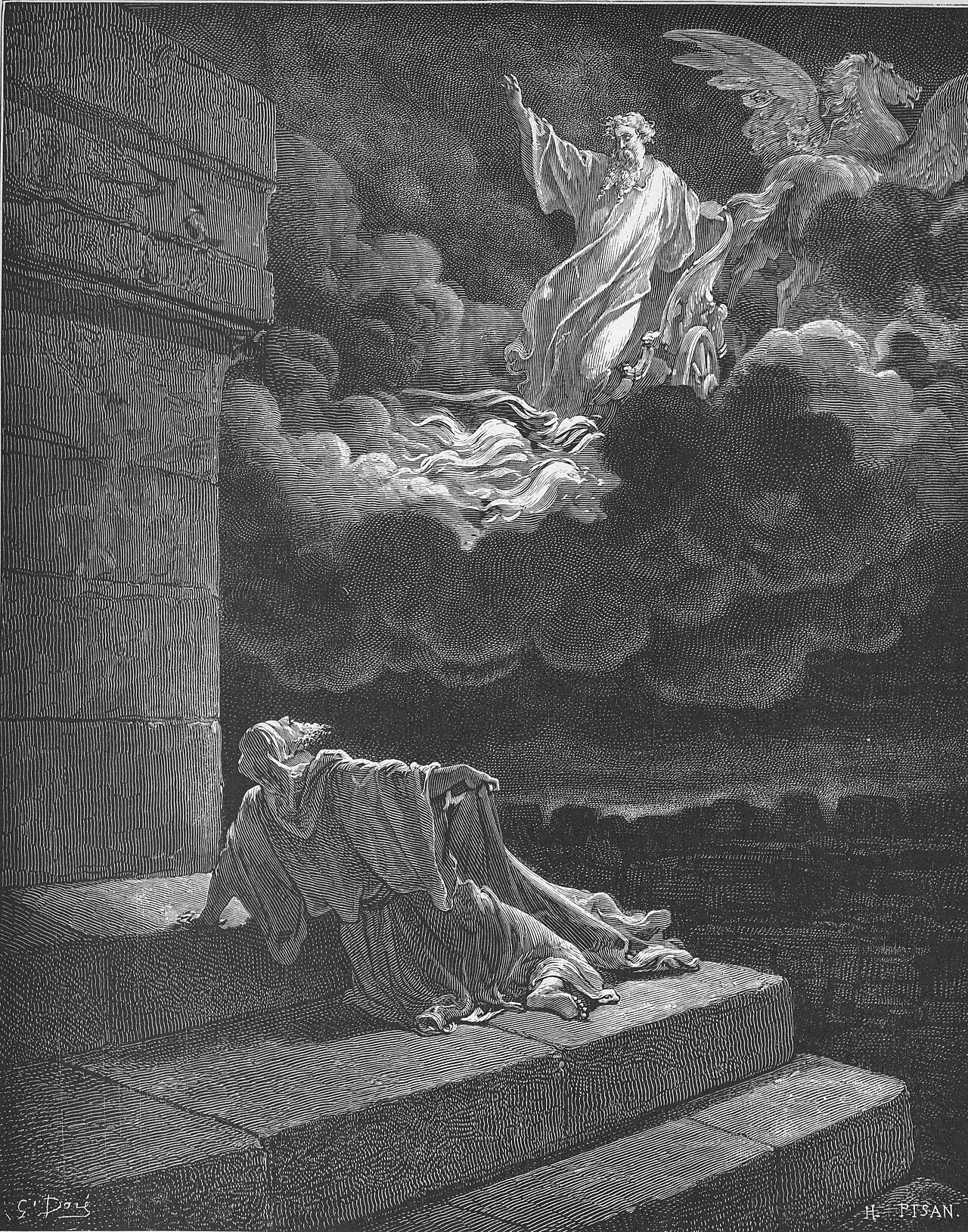
As they were walking along and talking together, suddenly a chariot of fire with horses of fire appeared and separated the two of them, and Elijah went up into heaven in a whirlwind.
Introduction
Jeremiah, by tradition, History, 2 Kings Overview.
This chapter stands at the hinge of the prophetic story in Kings, where one prophet's work ends and another's begins. It was written down in the exile for a people who had outlived their prophets and wondered whether the word of God had outlived them too. The first hearers knew the towns on its road, each a home of prophets in training, and they knew what an eldest son inherited. Listen for one request refused and answered again and again, for the question of an heir, and for a river that marks both a departure and an arrival. Two short signs then show whose power the heir carries.
Context
- Who
- Israelites who wondered whether God's word would go silent when Elijah went
- What
- An account of Elijah taken up to heaven and of Elisha receiving his place, followed by two signs of Elisha's authority.
- Where
- The road from Gilgal through Bethel and Jericho to the Jordan and across it, then back by Jericho and Bethel.
- When
- About 852 BC, at the start of the reign of Joram of Israel.
- Why
- To show that the word of God outlived Elijah and passed to an heir.
Historical context
The chapter belongs to Elijah the Tishbite on his last day and to Elisha son of Shaphat, who holds the prophetic office from here until his death at 13:20. The road the two men take is a circuit of prophetic communities: groups called the sons of the prophets lived together at Bethel and Jericho, guilds or schools of men trained under a leading prophet with their own quarters and shared meals, and they are the reason the news had already spread ahead of the two men.
Show the rest of the historical context, 3 more paragraphs
Crossing the Jordan by striking the water with a rolled cloak puts Elijah's exit at the same river Israel crossed to come in and near where Moses' ministry ended. Elisha's request for a double portion is inheritance language rather than a request for twice the power, since the double portion was the firstborn son's share under Israelite law, so he is asking to be treated as the heir.
Chariots and horses of fire are the language the book uses again later for the armies of heaven, and Elisha's cry that these are the chariots of Israel and its horsemen says that one prophet had been worth more to the nation's defence than its cavalry. The fifty men who insist on searching the hills for three days in case the Spirit dropped him on a mountain are a realistic touch, since they had seen prophets carried off before and they wanted a body.
The two signs that follow test the inheritance. Jericho's spring made the town possible while the water was ruining crops and causing miscarriages, salt in a new bowl was a purification act, and the spring is still flowing today. The Bethel incident is harsher than it reads in old translations: the Hebrew word behind the jeering crowd is naar, whose range runs from infancy to adolescence and which Scripture uses of Joseph at seventeen, and the town was the site of Jeroboam's rival calf shrine. Forty-two of them are mauled by two bears, and Syrian bears lived in that hill country then and were a genuine danger.
Significance
The first hearers were being told that the word of God did not depend on one man's lifespan. The mantle falls, the same river parts, and the sons of the prophets say the spirit of Elijah rests on Elisha.
Show the rest of the significance, 1 more paragraph
The two miracles set the pattern for the ministry that follows: a poisoned spring healed for a whole town, and a public contempt for God's messenger answered where everyone could see it.
This chapter in Jewish lifeWhat this chapter is in Jewish life and reading.
How it is read
This is the chapter of the handoff, and the classical material on it is heavier than on chapter 1 by four times. The corpus keeps thirteen notes, all of them Rashi in the Metsudah Tanach translation of Lakewood, New Jersey, under a CC-BY licence, and the Metsudah footnotes carry Radak, Ralbag, Targum and Metzudat David inside them where those voices answer Rashi. He opens on the wind that takes Elijah up, reading it as a stormy wind and pointing at the same phrase in Ezekiel's opening vision (Rashi on II Kings 2:1:1). The repeated request that Elisha stay behind he reads as an act of modesty. Elijah wished to send him away so that Elisha would not see him being taken, and the Metsudah footnote sets Ralbag's reason beside it, that Elijah did not want the sight to frighten him (Rashi on II Kings 2:2:1).
The sons of the prophets are read closely by the word they choose. They say your master rather than our master, and Rashi draws the inference that their own level of prophecy stood equal to Elijah's, citing the Tosefta (Rashi on II Kings 2:3:1). The mantle struck on the water he explains as a matter of handling, that Elijah rolled it up so that it would be easy to strike with (Rashi on II Kings 2:8:1). The double portion is the one place in the chapter where the classical readings split, and the corpus prints the split rather than settling it. Rashi reads Elisha's request as a hard thing because it asks for more than the giver possesses, and the Metsudah footnote lists three readings side by side, his own of a double portion of Elijah's spirit, Radak's of two thirds against one third shared among all other prophets, and Ralbag's of double the spirit of any other prophet (Rashi on II Kings 2:10:1).
The cry at the parting Rashi reads as a title of teaching rather than of war. Elijah is the endeared teacher who is better for Israel with his prayers than chariots and horsemen, with the Metsudah footnotes giving Ralbag on why a teacher is called father and the Targum on the prayers (Rashi on II Kings 2:12:1). At the Jordan he reads Elisha's question as a claim on the promise just made to him (Rashi on II Kings 2:14:1). The search party is the longest note in the chapter and the one that reaches furthest. Rashi asks how men told the day before that Elijah would be taken could now be looking for the body, and he answers from the Tosefta that from the day Elijah was hidden the Holy Spirit departed from the prophets and was no longer widespread in Israel (Rashi on II Kings 2:16:1). Elisha's yielding to the search he reads as shame, that he gave way lest they say he did not wish to go and meet his teacher (Rashi on II Kings 2:17:1).
The healing of the water and the two bears close the chapter. On the men of Jericho Rashi draws a general rule out of the contradiction in their own report, that a place's charm is perceived by its inhabitants, and cites the tractate where three kinds of such charm are listed (Rashi on II Kings 2:19:1). The source of the water he glosses as the place the water flowed from (Rashi on II Kings 2:21:1). The two notes on the boys at Bethel are where a Christian reader should sit longest, because the tradition is plainly uneasy with the scene and says so. Rashi reads the phrase for the boys as void of commandments, and the Metsudah footnote works the Hebrew, that the word for young can be heard as shaken out or empty of good deeds and the word for little as a measure of how small their faith was, adding on Radak's authority that Elisha was punished for treating them so harshly (Rashi on II Kings 2:23:1). At the next verse Rashi says that Elisha saw no sap of good deed in them or in their descendants, and the footnote reports a second reading, that their hair was cut in the manner of the heathen (Rashi on II Kings 2:24:1). The tradition holds the prophet accountable at the same moment it explains him.
Eleven further notes stand on this chapter with no English text in the corpus and are cited here unquoted. They are Radak on II Kings 2:1:1, 2:2:1, 2:3:1, 2:9:1, 2:11:1, 2:15:1, 2:20:1 and 2:22:1, Malbim on II Kings 2:6:1 and 2:13:1, and Metzudat David on II Kings 2:7:1.
What the rabbis say
The corpus carries forty rabbinic locators on this chapter, thirty-three Midrash and seven Talmud, and the text of none, so each is cited and linked here rather than quoted. The taking up of Elijah draws four at the first verse, Aggadat Bereshit 50:3, Midrash Tanchuma, Vaera 8:1, Pesikta Rabbati 4:1 and Pirkei DeRabbi Eliezer 33:2. The walk down to Bethel draws Midrash Tehillim 15:4, Seder Olam Rabbah 21:2 and Sifrei Bamidbar 153:3. The sons of the prophets at Bethel draw Bereshit Rabbah 25:1, Midrash Lekach Tov, Deuteronomy 6:7:1 and Midrash Lekach Tov, Genesis 5:3:4, and the company at Jericho draws Menachot 11b:3 and Jerusalem Talmud Sanhedrin 10:8:4.
The double portion is the heaviest anchor in the chapter after the ascent itself, drawing Aggadat Bereshit 70:3, Chullin 7b:11 and Ein Yaakov (Glick Edition), Chullin 1:3. The chariot of fire and the whirlwind carry Midrash Tanchuma, Shemot 16:4 at the tenth and eleventh verses together, and Bamidbar Rabbah 12:11, Bamidbar Rabbah 14:3 and Devarim Rabbah 3:17 across the eleventh and twelfth. Elisha's cry and the tearing of his clothes draw Avot DeRabbi Natan 25:3, Ein Yaakov (Glick Edition), Moed Katan 3:11 and Ein Yaakov (Glick Edition), Sanhedrin 7:11, and two of those three sit in tractates about mourning, which is how the tradition files the moment.
The striking of the Jordan draws Devarim Rabbah 10:3, Otzar Midrashim, Baraita of The 32 Midot of Aggadah 1:5 and Yalkut Shimoni on Torah 92:1. The sons of the prophets bowing to Elisha draw Bereshit Rabbati, Parashat Vayechi 20, Mekhilta DeRabbi Yishmael, Tractate Pischa 1:24 and Pesikta DeRav Kahana 16:4. The healing of the water at Jericho carries the largest run of all, seven locators. Bereshit Rabbah 77:1 stands over the whole episode at verses 19 to 22, Ein Yaakov (Glick Edition), Sotah 9:7 and Shemot Rabbah 50:3 stand at the men's complaint, and Mekhilta DeRabbi Shimon Ben Yochai 15:25, Mekhilta DeRabbi Yishmael, Tractate Vayassa 1:17 and Midrash Sekhel Tov, Shemot 15:25:3 stand at the salt in the spring. Three of those six reach back to the bitter water Moses healed at Marah, which is the pairing the tradition makes here.
The boys at Bethel draw the last six. Bava Metzia 87a:16 stands over verses 23 to 25, Ein Yaakov (Glick Edition), Sotah 9:6, Ein Yaakov, Sotah 9:6 and Sotah 46b:22 stand at the mocking, and Pirkei DeRabbi Eliezer 24:7 and Sanhedrin 107b:16 stand at the bears. That the tractate Sotah carries three of the six is worth a reader's notice, because the kept notes above name that same tractate where they report that Elisha was punished for the curse. What each of them teaches is a saying of the rabbis, and is reported as theirs wherever this site quotes one. The quotations wait on a fetch that carries the text.
Sources: Rashi, Rashi on II Kings 2:1:1 to 2:24:1, thirteen notes, the Metsudah Tanach series, Lakewood, N.J, CC-BY; Radak, Radak on II Kings 2:1:1, 2:2:1, 2:3:1, 2:9:1, 2:11:1, 2:15:1, 2:20:1 and 2:22:1, cited by ref because the corpus carries no English text; and reported inside the Metsudah footnotes at 2:10:1, 2:16:1 and 2:23:1; Malbim, Malbim on II Kings 2:6:1 and 2:13:1, cited by ref because the corpus carries no English text; Metzudat David, Metzudat David on II Kings 2:7:1, cited by ref because the corpus carries no English text; The Sefaria corpus, scripts/data/sources/sefaria/2-kings/2.json, the 40 rabbinic locators of this chapter, 33 Midrash and 7 Talmud.
The heads below are this chapter's scenes. The numbered points under each are its verses.
Tarry here: but Elisha will not leave him
the LORD took Elijah up to heaven in a whirlwind: The first verse tells the end before the road begins: the LORD is about to take Elijah up “to heaven in a whirlwind”. Scripture holds one earlier man taken without dying, Enoch at Genesis 5:24.
2 Kings 2:1
“And it came to pass, when the Lord would take up Elijah into heaven by a whirlwind,.... Thereby lifting him up from the earth, and which, as it was the purpose and will of God, Elijah had notice of, as appears by his motions to different places, under a divine direction: that Elijah went with Elisha from Gilgal, where it seems they met, a place where the Israelites first pitched when they came over Jordan, and where the tabernacle was for some time, and was famous for religious services, see Jos 4:19.”
3 more voices on this verseWhat preachers and commentators have said about this verse, in their own words.
2 Kings 2:1
“The events of this chapter are related out of their chronological order. Elijah’s translation did not take place until after the accession of Jehoram in Judah 2Ch 21:12, which was not until the fifth year of Jehoram of Israel 2Ki 8:16. The writer of Kings, having concluded his notices of the ministry of Elijah in chapter 1, and being about to pass in 2 Kings 3 to the ministry of Elisha, thought it best to insert at this point the final scene of Elijah’s life, though it did not occur until several years later.”
2 Kings 2:1
“He looked forward to the evangelical dispensation, and, in the translation of Elijah, gave a type and figure of the ascension of Christ and the opening of the kingdom of heaven to all believers.”
Matthew Henry · Commentary on the Whole Bible (1707-1721)puritan
2 Kings 2:1
“The revelation of this striking event to so many was a necessary part of the dispensation; for it was designed to be under the law, like that of Enoch in the patriarchal age, a visible proof of another state, and a type of the resurrection of Christ.”
Jamieson, Fausset & Brown · Commentary Critical and Explanatory on the Whole Bible (1871)reformed
2 Kings 2:2-3
At Bethel Elisha answers Elijah's request with an oath, “As surely as the LORD lives and as you yourself live, I will not leave you”. He swears it again at Jericho and at the Jordan. Three times Elijah offers him a way out, and three times Elisha stays.
2 Kings 2:2
“Note, Those that are going to heaven themselves ought to be concerned for those they leave behind them on earth, and to leave with them their experiences, testimonies, counsels, and prayers, 2 Pet. i. When Christ said, with triumph, Now I am no more in the world, he added, with tenderness, But these are.”
Matthew Henry · Commentary on the Whole Bible (1707-1721)puritan
1 more voice on this verse
2 Kings 2:2
“Tarry here, I pray thee - He either made these requests through humility, not wishing any person to be witness of the honor conferred on him by God, or with the desire to prove the fidelity of Elisha, whether he would continue to follow and serve him.”
Adam Clarke · Commentary on the Bible (1810-1826)evangelical
the sons of the prophets: Where the Berean reads take your master away from you, the King James has from thy head. Albert Barnes explained the phrase from the classroom, where the teacher sat raised so his feet were level with his pupils' heads. John Wesley saw these schools supplying the temple worship Israel lacked.
2 Kings 2:3
“Came forth to Elisha - It does not appear that any interchange of speech took place between “the sons of the prophets” (see the marginal reference note) and Elijah; but independent revelations had been made to the two “schools” at Bethel and Jericho 2Ki 2:5, and also to Elisha, with respect to Elijah’s coming removal. From thy head - i. e. from his position as teacher and master. The teacher sat on an elevated seat, so that his feet were level with the heads of his pupils (compare Act 22:3).”
1 more voice on this verse
2 Kings 2:3
“In the kingdom of Judah they had priest and Levites, and the temple service. The want of these in the kingdom of Israel, God graciously made up by these colleges, where men were trained up and employed, in the exercises of religion, and whither good people resorted, to solemnize the appointed feasts, with prayer and hearing, tho' they had not conveniencies for sacrifice.”
John Wesley · Explanatory Notes upon the Old Testament (1765)evangelical
2 Kings 2:4-6
The scene plays twice more, at Jericho and at the Jordan, with Elisha swearing the same oath, “I will not leave you”. The sons of the prophets at Jericho know what those at Bethel knew, so two companies of prophets confirm the departure before it happens.
2 Kings 2:4
“And Elijah said unto him, Elisha, tarry here, I pray thee,.... At Bethel: for the Lord hath sent me to Jericho; to the school of the prophets there, to strengthen, encourage, and advise them: and he said, as the lord liveth, &c; using the same form of oath as before: so they came to Jericho; together, which, as the above writer says (i), was four miles from Bethel. (i) Travels, &c. p. 205.”
the sons of the prophets at Jericho: Jericho had lately been rebuilt under Joshua's curse. John Gill notes that the cursed city now held a school of the prophets. Jamieson, Fausset and Brown held that so many witnesses were needed, for the event was meant as visible proof of a life beyond this one.
2 Kings 2:5
“And the sons of the prophets that were at Jericho,.... For though this place was lately rebuilt under a curse to the builder, yet was blessed with a school of the prophets: whose disciples came to Elisha, and said unto him; as in 2Ki 2:3 and to whom he made the same reply.”
The Jordan lay about six miles from Jericho by John Gill's reckoning, the last stage of the road. Gill read Elijah's third request as a wish to be taken up unseen. The two of them went on together.
2 Kings 2:6
“And Elijah said unto him, tarry, I pray thee, here,.... At Jericho, seemingly very desirous to get rid of him, that he might not see his assumption: for the Lord hath sent me to Jordan: where passing that he was to be taken up: and he said, &c; Elisha swore, as before, he would not leave him: and they two went on; to Jordan, which was six miles from Jericho (k). (k) Travels, &c. p. 205.”
2 Kings 2:7-8
stood at a distance: Elijah rolls up his cloak and strikes the Jordan, and the waters part so that the two cross “on dry ground”. The river opened the same way for Israel under Joshua (Joshua 3:17). Now it opens for two men, the cloak doing what the ark did then.
2 Kings 2:7
“Fifty men of the sons of the prophets - We see by this how large were the prophetical schools. It is implied that the “fifty” were only a portion of the school of Jericho. They ascended the abrupt heights behind the town, from where they would command a view of the whole course of the river and of the opposite bank for many miles.”
Elijah took his cloak: The Septuagint names the cloak a sheepskin, and Adam Clarke notes that such skins, with the hair on, marked a prophet's office. Origen read the crossing as a baptism, following Paul, who called Israel's passage through the sea a baptism. Elijah went through the water before he was taken up.
2 Kings 2:8
“We must note in addition that when Elijah was about to be taken up in a whirlwind as into heaven, he took his sheepskin and rolled it up and struck the water, and it was divided on this side and that, and both crossed, that is to say, himself and Elisha. He was better prepared to be taken up after he was baptized in the Jordan, since Paul, as we explained previously, called the more incredible passage through water a baptism.”
Origen of Alexandria · written before 253 · Commentary on the Gospel of John 6.238-39patristic
2 more voices on this verse
2 Kings 2:8
“Took his mantle - Την μηλωτην αυτου, his sheep-skin, says the Septuagint. The skins of beasts, dressed with the hair on, were formerly worn by prophets and priests as the simple insignia of their office. As the civil authority was often lodged in the hands of such persons, particularly among the Jews, mantles of this kind were used by kings and high civil officers when they bore no sacred character.”
Adam Clarke · Commentary on the Bible (1810-1826)evangelical
2 Kings 2:8
“When God will take up his faithful ones to heaven death is the Jordan which, immediately before their translation, they must pass through, and they find a way through it, as safe and comfortable way; the death of Christ has divided those waters, that the ransomed of the Lord may pass over. O death! where is thy sting, thy hurt, thy terror?”
Matthew Henry · Commentary on the Whole Bible (1707-1721)puritan
A chariot of fire, and My father, my father
2 Kings 2:9-10
Elisha asks to “inherit a double portion of your spirit”, the share Deuteronomy 21:17 gives the firstborn son. He asks to stand as Elijah's heir. Elijah calls it “a difficult thing” and makes the answer hang on a sign: if Elisha sees him taken, “it will be yours”.
2 Kings 2:9
“Let a double portion of thy spirit be upon me - Like Solomon, Elisha asks for no worldly advantage, but for spiritual power to discharge his office aright. The “double portion” is that which denotes the proportion of a father’s property which was the right of an eldest son Deu 21:17. Elisha therefore asked for twice as much of Elijah’s spirit as should be inherited by any other of the “sons of the prophets.” He simply claimed, i. e., to be acknowledged as Elijah’s firstborn spiritual son.”
if you see me as: Adam Clarke took the condition to mean that Elisha must stay with Elijah until the moment he was taken. Maximus of Turin preached that the angels who carried the master to heaven also guarded the disciple on earth. Elisha stays and sees.
2 Kings 2:10
“A hard thing - This is what is not in my power, God alone can give this; yet if thou see me taken away from thee, it shall be so. Perhaps this means no more than, “If thou continue with me till I am translated, God will grant this to thee;” for on the mere seeing or not seeing him in the moment in which he was taken away, this Divine gift could not depend.”
Adam Clarke · Commentary on the Bible (1810-1826)evangelical
2 Kings 2:11-12
a chariot of fire with horses of fire appeared: A chariot of fire separates the two men, and Elijah goes up, parted by the chariot rather than carried in it. Elisha cries, “My father, my father, the chariots and horsemen of Israel!”, naming Elijah as Israel's defense. Jehoash speaks the same words over the dying Elisha at 13:14.
2 Kings 2:11
But do not marvel in regard to what is said about Elijah, if, just as something strange happened to him different from all the saints who are recorded, in respect of his having been caught up by a whirlwind into heaven, so his spirit had something of choice excellence, so that not only did it rest on Elisha but also descended along with John at his birth; and that John, separately, "was filled with the Holy Spirit even from his mother's womb," and separately "came before Christ in the spirit and power of Elijah."
Origen of Alexandria · written before 253 · Commentary on the Gospel of Matthew 13.2patristic
2 more voices on this verse
2 Kings 2:11
“Elijah went up ... - No honest exegesis can explain this passage in any other sense than as teaching the translation of Elijah, who was taken from the earth, like Enoch Gen 5:24, without dying. Compare Ecclesiasticus 48:9.”
2 Kings 2:11
“IT seems to me that the departure of Elijah from the world, though of course he did not "die" at all, may furnish us with a very good type of the decease of those saints who, although taken away all of a sudden, are not without some previous intimation that in such a manner they will be removed. There may be some such here. They may know that they have about them a disease which, in all probability, will terminate fatally and suddenly.”
The Chaldee paraphrase renders the cry as my master, my master, and names Elijah's intercession as worth more to Israel than horses and chariots. Adam Clarke judged this the probable sense of the verse.
2 Kings 2:12
“The chariot of Israel and the horsemen thereof - The Chaldee translates these words thus: “My master, my master! who, by thy intercession, wast of more use to Israel than horses and chariots.” This is probably the sense.”
Adam Clarke · Commentary on the Bible (1810-1826)evangelical
Where is Jehovah, the God of Elijah?: the mantle answers
2 Kings 2:13-14
stood on the bank of the Jordan: Elisha takes up the cloak that fell from Elijah, strikes the Jordan with it and asks, “Where now is the LORD, the God of Elijah?” The waters part “to the right and to the left”, as they did for Elijah at verse 8. Elijah's last miracle becomes Elisha's first.
2 Kings 2:13
“Elisha took it up, not as a sacred relic to be worshipped, but as a significant garment to be worn, and a recompence to him for his own garments which he had rent. he loved this cloak ever since it was first cast over him, 1 Kings xix. He that then so cheerfully obeyed the summons of it, and became Elijah's servant, is now dignified with it, and becomes his successor.”
Matthew Henry · Commentary on the Whole Bible (1707-1721)puritan
The Vulgate tells it with a first failure: Elisha strikes the water, and the second blow divides it. Adam Clarke called this a strange turn on the text. John Gill read the question as a call for the LORD himself to act, for the cloak had no power without him.
2 Kings 2:14
“And he took the mantle of Elijah that fell from him, and smote the waters,.... He wrapped it together, as Elijah had done, and smote the waters in like manner, to make trial whether he had the same spirit and power conferred on him: and said, where is the Lord God of Elijah? let him appear now, and show his power as he did by him; he knew the mantle would not do without the Lord, and the exertion of his might: and when he also had smitten the waters, they parted hither and thither; as when Elijah smote them.”
2 more voices on this verse
2 Kings 2:14
“Where is the Lord God of Elijah? - The Vulgate gives a strange turn to this verse: Et percussit aquas, et non sunt divisae; et dixu, Ubi est Deus Eliae etiam nunc? Percussitque aquas, et divisae sunt huc et illuc. “And he smote the waters, but they did not divide; and he said, Where is the God of Elijah even now?”
Adam Clarke · Commentary on the Bible (1810-1826)evangelical
2 Kings 2:14
“Jordan was between him and them; it had been divided to make way for Elijah to his glory; he will try whether it will divide to make way for him to his business, and by that he will know that God is with him, and that he has the double portion of Elijah's spirit. Elijah's last miracle shall be Elisha's first; thus he begins where Elijah left off and there is no vacancy.”
Matthew Henry · Commentary on the Whole Bible (1707-1721)puritan
The sons of the prophets see the parted river and say, “The spirit of Elijah rests on Elisha”, and they bow to the ground. Their response recalls Joshua 1:17, where Israel pledged to obey Joshua as it had obeyed Moses if the LORD was with him as with Moses.
2 Kings 2:15
“I have thought it necessary to dwell some time on the examination of the doctrine of transmigration, because of the suspicion of some who suppose that the soul under consideration was the same in Elijah and in John, being called in the former case Elijah, and in the second case John; and that, not apart from God, had he been called John, as is plain from the saying of the angel who appeared to Zacharias, "Fear not, Zacharias, for thy supplication is heard, and thy wife Elisabeth shall bear thee a son, and thou shalt call his name John;" and…”
Origen of Alexandria · written before 253 · Commentary on the Gospel of Matthew 13.2patristic
1 more voice on this verse
2 Kings 2:15
“They were trained up in the schools; Elisha was taken from the plough; yet when they perceived that God was with him, and that this was the man whom he delighted to honour, they readily submitted to him as their head and father, as the people to Joshua when Moses was dead, Josh. i.”
Matthew Henry · Commentary on the Whole Bible (1707-1721)puritan
2 Kings 2:16-18
The prophets offer fifty men to search, fearing “the Spirit of the LORD has taken him up and put him on one of the mountains”. Obadiah feared the same for Elijah at 1 Kings 18:12. Elisha refuses, then yields, and the fifty search three days and find nothing.
2 Kings 2:16
“Strong men - Able to take such a journey. Lest, &c. - They thought, either that God had not finally taken him away from them, but only for a time; or that God had only taken away his soul, and that his body was cast down into some place, which they desired to seek, that they might give it an honourable burial.”
John Wesley · Explanatory Notes upon the Old Testament (1765)evangelical
1 more voice on this verse
2 Kings 2:16
“Some of them perhaps started this as a demurrer to the choice of Elisha: "Let us first be sure that Elijah has quite gone. Can we think Elijah thus neglected by heaven, that chosen vessel thus cast away as a vessel in which was no pleasure?" 2.”
Matthew Henry · Commentary on the Whole Bible (1707-1721)puritan
to the point of embarrassment: Matthew Henry and John Gill read Elisha's shame as fear of how a refusal would look. A man who held back the search might seem to lack respect for his master, or to guard the office he had just received. Henry allowed that a wise man may yield for peace.
2 Kings 2:17
“And when they urged him until he was ashamed,.... To deny them any longer, being so very pressing and importunate: he said, send; lest they should think he had not the respect for his master he should have had; or was so fond of his office, that he did not choose he should be found alive if he could, and return and reassume it: they sent therefore fifty men; some one way, and some another: and they sought three days, but found him not; and then returned.”
1 more voice on this verse
2 Kings 2:17
“They urged him till he was ashamed to oppose it any further lest he should be thought wanting in his respect to his old master or loth to resign the mantle again. Wise men may yield to that, for the sake of peace and the good opinion of others, which yet their judgment is against as needless and fruitless.”
Matthew Henry · Commentary on the Whole Bible (1707-1721)puritan
who was staying in Jericho: Elisha stays in Jericho while the fifty search, and the city becomes the scene of his next act. Matthew Henry noted that some count Elisha's miracles at double Elijah's number. Two follow at once, healing for Jericho and judgment at Bethel.
2 Kings 2:18
“Some reckon them in number just double. Two are recorded in these verses--a miracle of mercy to Jericho and a miracle of judgment to Bethel, Ps. ci. Here is a blessing upon the waters of Jericho, which was effectual to heal them.”
Matthew Henry · Commentary on the Whole Bible (1707-1721)puritan
Salt in a new cruse heals Jericho's spring
2 Kings 2:19-20
the city’s location is good: The men of Jericho bring a complaint: “the water is bad and the land is unfruitful”, and the Hebrew word behind unfruitful speaks of miscarriage. Elisha asks for “a new bowl” with salt, though salt would make water worse, so the healing cannot be credited to what the bowl held.
2 Kings 2:19
“The water is naught - i. e. “bad.” And the ground barren - Translate “and the land apt to miscarry.” The stream was thought to be the cause of untimely births, abortions, and the like, among the cattle, perhaps also among the people, that drank of it.”
1 more voice on this verse
2 Kings 2:19
“Barren - Either it was so originally, at least, as to that part of the city where the college of the prophets was: or, it became so from the curse of God inflicted upon it, when Hiel rebuilt it. However, upon the prophet's care, it grew exceeding fruitful, and therefore is commended for its fertility in later writers.”
John Wesley · Explanatory Notes upon the Old Testament (1765)evangelical
Albert Barnes read both objects as signs of purity for cleansing a foul stream. The new bowl was untainted by any use, and salt stands in Scripture for incorruption, as in the salt of the covenant at Leviticus 2:13. John Wesley added that the new vessel carried no ritual uncleanness.
2 Kings 2:20
“And he said, bring me a new cruse, and put salt therein,.... One that had never been used, that it might not be thought that the virtue was owing to anything that had been, or was, put into it: and they brought it to him; the pot with the salt in it.”
2 more voices on this verse
2 Kings 2:20
“The “new cruse” and the “salt” are evidently chosen from a regard to symbolizm. The foul stream represents sin, and to cleanse it emblems of purity must he taken. Hence, the clean “new” dish previously unused, and thus untainted; and the salt, a common Scriptural symbol of incorruption (see Lev 2:13; Eze 43:24; Mat 5:13, etc.).”
2 Kings 2:20
“A new cruse - That there might be no legal pollution in it which might offend God, and hinder his miraculous operation. Put salt - A most improper remedy; for salt naturally makes waters brackish, and lands barren. Hereby therefore he would shew, that this was effected solely by the Divine power, which could work either without means, or against them.”
John Wesley · Explanatory Notes upon the Old Testament (1765)evangelical
2 Kings 2:21-22
Elisha casts the salt into the spring itself and speaks in the LORD's name, “I have healed this water”. Salt sown on Shechem at Judges 9:45 marked judgment, and here salt carries healing. The narrator adds that the waters “have been healthy to this day”.
2 Kings 2:21
“The spring of the waters - The spring intended is probably that now called Ain-es-Sultan, which is not much more than a mile from the site of the ancient town. It is described as a large and beautiful fountain of sweet and pleasant water. The springs issuing from the eastern base of the highlands of Judah and Benjamin are to this day generally brackish.”
healthy to this day: Albert Barnes described the spring as a large fountain of sweet water, a mile or so from the ancient town. The springs along the eastern foot of the hills of Judah and Benjamin run brackish to this day. The healed spring still ran sweet.
2 Kings 2:22
“So the waters were healed unto this day, according to the saying of Elisha which he spake.”
1 more voice on this verse
2 Kings 2:22
“Had the abuse done to Elisha been the first offence of that kind, it is probable that it would not have been so severely punished. But mocking the messengers of the Lord, and misusing the prophets, was one of the crying sins of Israel, as we find, 2 Chron. xxxvi.”
Matthew Henry · Commentary on the Whole Bible (1707-1721)puritan
Mockery on the road to Bethel, and two she-bears
2 Kings 2:23-24
On the road up to Bethel, boys from the city jeer at Elisha. They chant “Go up, you baldhead”, the verb the chapter used of Elijah going up at verse 11. John Wesley notes that the Hebrew word rendered boys is used of grown men in Genesis and Ruth.
2 Kings 2:23
“As Beth-el was the older seat of the calf-worship 1Ki 12:32-33; 13:1-32, a prophet of Yahweh was not unlikely to meet with insult there. By the way - i. e. “by the usual road,” probably that which winds up the Wady Suweinit, under hills even now retaining some trees, and in Elisha’s time covered with a dense forest, the haunt of savage animals. Compare 1Ki 13:24; and for the general prevalence of beasts of prey in the country, both earlier and later than this, see Jdg 14:5; 1Sa 17:31; 2Ki 17:25; Amo 5:19, etc.”
1 more voice on this verse
2 Kings 2:23
“Children - Or, young men: as this Hebrew word often signifies. It is more than probable they were old enough to discern between good and evil. The city - Beth-el was the mother-city of idolatry, where the prophets planted themselves, that they might bear witness against it, and dissuade the people from it; though, it seems, they had but small success there.”
John Wesley · Explanatory Notes upon the Old Testament (1765)evangelical
called down a curse on them: Albert Barnes observed that only here does Elisha act as a minister of vengeance, in a ministry otherwise marked by mildness. Caesarius of Arles read the curse as zeal from God for the people's correction, free of private anger. Matthew Henry added that God hates sin even in the young.
2 Kings 2:24
“On this occasion only do we find Elisha a minister of vengeance. Perhaps it was necessary to show, at the outset of his career as a prophet, that he too, so mild and peaceful could, like Elijah, wield the terrors of God’s judgments (1Ki 19:19 note). The persons really punished were, not so much the children, as the wicked parents 2Ki 2:23, whose mouth-pieces the children were, and who justly lost the gift of offspring of which they had shown themselves unworthy.”
2 more voices on this verse
2 Kings 2:24
“Children - This Hebrew word signifies not only young children, but also those who are grown up to maturity, as Gen. xxxii, 22, xxxiv, 4, xxxvii, 30, Ruth i, 5.”
John Wesley · Explanatory Notes upon the Old Testament (1765)evangelical
2 Kings 2:24
“He knew what a generation of vipers those were, and what mischievous enemies they would be to God's prophets if they should live to be men, who began so early to be abusive to them. He intended hereby to punish the parents and to make them afraid of God's judgments. (2.) God must be glorified as a righteous God, that hates sin, and will reckon for it, even in little children.”
Matthew Henry · Commentary on the Whole Bible (1707-1721)puritan
Elisha went on to Mount Carmel: The chapter ends at Carmel, where Elijah stood against the prophets of Baal in 1 Kings 18. From there Elisha returns to Samaria. Elisha's road from Gilgal through Bethel, Jericho and the Jordan has retraced his master's last road before he adds anything of his own.
2 Kings 2:25
“And he went from thence to Mount Carmel,.... Where Elijah used to frequent, and where also there might be a school of the prophets; this, according to Bunting (a), was fifty six miles from Bethel: and from thence he returned to Samaria; the capital of the kingdom of Israel; there to bear his testimony against idolatry, to reprove for it, and reclaim from it; this, as the same writer says (b), was thirty two miles from Carmel. (a) Travels, &c. p. 206. (b) Ibid.”
1 more voice on this verse
2 Kings 2:25
“Carmel - Where Elisha held gatherings for religious purposes 2Ki 4:23-25 during one period of his life, if he did not actually reside there.”
How this psalm is built
The form: A succession narrative built as a road, in which each station tests the heir and the river is crossed twice, as 2 classes it.
The patterns in this chapter
| Device | What it does | Where to see it |
|---|---|---|
| Tarry here, and I will not leave thee | Three times Elijah tells Elisha to stay behind, at Gilgal, at Bethel and at Jericho, and three times Elisha swears the same oath, as the LORD lives and as your soul lives, I will not leave you. This site's published exposition note on 2:4 to 2:6 records that by the time the pair reach the Jordan every human witness has been offered a door out and every one has refused, so the last stretch is walked by two men alone.John Gill and John Wesley, with Matthew Henry and Albert Barnes, Exposition of the Old Testament, 1748 to 1763, Explanatory Notes upon the Old Testament, 1765, Commentary on the Whole Bible, 1710, and Notes on the Old Testament, 1832 to 1869, on 2 Kings 2:2 to 2:6, as this site's published exposition notes on those verses report them. | 2 Kings 2:2, 2 Kings 2:4, 2 Kings 2:6 |
| The river parted twice | Elijah folds his mantle and strikes the water at 2:8 and the two cross on dry ground. Elisha takes up the same mantle at 2:14, strikes the same water and crosses back on the same ground. The two crossings frame the ascension between them, and this site's published exposition note on 2:13 to 2:14 reads Elijah's last miracle as becoming Elisha's first with no gap between the two ministries.John Gill, with Adam Clarke and Keil and Delitzsch, Exposition of the Old Testament, 1748 to 1763, Commentary on the Bible, 1832, and The Books of the Kings, 1872, on 2 Kings 2:7 to 2:14, as this site's published exposition notes on those verses report them. | 2 Kings 2:8, 2 Kings 2:14 |
| My father, my father, the chariots of Israel | Elisha's cry at 2:12 names what Elijah had been to the nation, a stronger defence than any army. This site's published exposition note on 2:11 to 2:12 records that the same cry returns word for word at 13:14, spoken there by king Joash over the dying Elisha himself, so the sentence opens and closes Elisha's own ministry.Matthew Henry and John Wesley, Commentary on the Whole Bible, 1710, and Explanatory Notes upon the Old Testament, 1765, on 2 Kings 2:11 to 2:12, as this site's published exposition note on those verses reports them. | 2 Kings 2:12, 2 Kings 13:14 |
| A double portion, which is the heir's share | The phrase at 2:9 is pi shenayim, and Deuteronomy 21:17 reserves that exact share for a firstborn son claiming his father's inheritance. This site's published exposition note on 2:9 to 2:10 reads the request as asking for the standing of an heir among all the sons of the prophets rather than for twice the miracle-power, and the published study guide states the same reading in its themes table.Albert Barnes, with Jamieson, Fausset and Brown, Notes on the Old Testament, 1832 to 1869, and Commentary Critical and Explanatory on the Whole Bible, 1871, on 2 Kings 2:9 to 2:10, as this site's published exposition note on those verses reports them. | 2 Kings 2:9, Deuteronomy 21:17 |
| The road that retraces the master's ground | The chapter names its stations in order: Gilgal at 2:1, Bethel at 2:2, Jericho at 2:4, the Jordan at 2:6, then back through Jericho at 2:18, up to Bethel at 2:23, and out to Carmel and Samaria at 2:25. This site's published exposition note on 2:25 records that Elisha's authority rests on retracing his master's ground before he adds anything of his own.John Gill and Albert Barnes, Exposition of the Old Testament, 1748 to 1763, and Notes on the Old Testament, 1832 to 1869, on 2 Kings 2:25, as this site's published exposition note on that verse reports them. | 2 Kings 2:1, 2 Kings 2:4, 2 Kings 2:6, 2 Kings 2:23, 2 Kings 2:25 |
The forerunner type, and the New Testament's use
11 more paragraphs on the patterns
This site's published study guide names 2:1 to 2:14 as a forerunner type and states the shape plainly, that a forerunner's ministry ends so that a greater successor's can begin. It sets the passage beside Luke 1:17, where John the Baptist goes before in the spirit and power of Elijah; beside Matthew 11:14, where Jesus names John as Elijah who is to come; and beside Matthew 17:11 to 13, where the disciples are told Elijah has come already. The guide carries the reading as its own and does not press the ascension itself into the type.
The debated concept: the crowd at Bethel
The question of what happened on the road to Bethel is one of seven contested readings this site publishes with their positions and their holders, and the page states no verdict on it. The site's published difficulties section sets out the case in full and carries a door at /featured/elisha-the-double-portion.
The Hebrew word behind the crowd is naar, and the lexicon defines its range from infancy to adolescence with servant as a common further sense. Keil and Delitzsch argue the naarim were of an age to answer for themselves and that the mockery was aimed at the LORD through His prophet. Matthew Henry reads them as children of the town's calf-worshipping households and lays the guilt on the parents who taught them. Both positions are held by serious readers and the site presents them without adjudicating.
Four further details belong to the reading and the site records each. Bethel was the site of Jeroboam's rival calf shrine. The mockery was go up, you baldhead, which throws Elijah's ascension back at his successor on the day he took up the office. Forty-two is a crowd rather than a handful. The same number recurs at 10:14, where Jehu's men kill forty-two men.
This site's published exposition note on 2:23 to 2:24 adds two things: that Wesley reads the mockers as young men old enough to know what they were doing, citing the word's use for adults in Genesis and Ruth, and that Jamieson, Fausset and Brown read them the same way, an idolatrous crowd sarcastically daring the prophet to ascend as his master had. The note records Elisha cursing them in the name of the LORD rather than his own, and Barnes reading the judgment as falling on the parents whose contempt their children repeated.
The insight the text states and the narrator can check
The healing of the spring at 2:19 to 2:22 is the one claim in this chapter the narrator dates from his own side. He writes that the waters were healed unto this day, so the statement was still holding when Kings was compiled. This site's published exposition note on 2:21 to 2:22 records that later travellers identify the spring as Ain es-Sultan near Jericho's ruins, and this site's published head context row for the chapter records that the spring is still flowing today.
The method the text describes is stated as impractical on purpose. Elisha calls for a new bowl and for salt, and salt by nature makes water worse. This site's published exposition note on 2:19 to 2:20 makes the point that whatever happens next cannot be credited to the vessel or to the substance. The same note records that Elisha carries the salt to the spring itself rather than treating the stream downstream, and the published note on 2:21 to 2:22 sets the use of salt here against Judges 9:45, where ground is sown with salt after Abimelech's slaughter, and observes that the commentators mark the reversal without forcing one meaning onto every use of the word.
The school's verdict, and how it was reached
The sons of the prophets watching from Jericho say the spirit of Elijah rests on Elisha and bow to the ground before him. This site's published exposition note on 2:15 makes the point that nothing in the verse rests on Elisha's own claim, since the school reaches its verdict from the evidence of the crossed river alone, and sets the scene beside Joshua 1, where Israel obeyed Joshua once it saw that the LORD was with him as He had been with Moses.
Keep studying
Studies9
Sources for this chapter
The summary
Jamieson, Fausset & Brown, Commentary Critical and Explanatory; John Wesley, Notes on the Old Testament and Matthew Henry, Complete Commentary.
The form and classifications
Albert Barnes, Notes on the Old Testament, 1832 to 1869, on 2 Kings 2:1, as this site's published exposition note on that verse reports him; This site's published exposition of 2 Kings 2, The published notes on 2:2 to 2:3 and on 2:4 to 2:6, which read the repeated dismissal and oath as the pattern the chapter runs on and This site's published study guide to 2 Kings, src/components/book/guides/2-kings/Book2KingsGuide.tsx, the Christ table, which names 2:1 to 2:14 as a forerunner type and sets it beside Luke 1:17, Matthew 11:14 and Matthew 17:11 to 13.
The exposition
Adam Clarke, Commentary on the Bible; Albert Barnes; Caesarius of Arles, Sermon 127.2; Charles Spurgeon, The Metropolitan Tabernacle Pulpit, Sermon No. 2596: Where Is the God of Elijah; Jamieson, Fausset & Brown, Commentary Critical and Explanatory on the Whole Bible; John Gill, Exposition of the Old Testament; John Wesley, Explanatory Notes upon the Old Testament; Keil, The Books of the Kings; Matthew Henry, Commentary on the Whole Bible; Maximus of Turin, Sermon 84.2 and Origen of Alexandria, Commentary on the Gospel of John 6.238-39.