
2 Kings 2:11
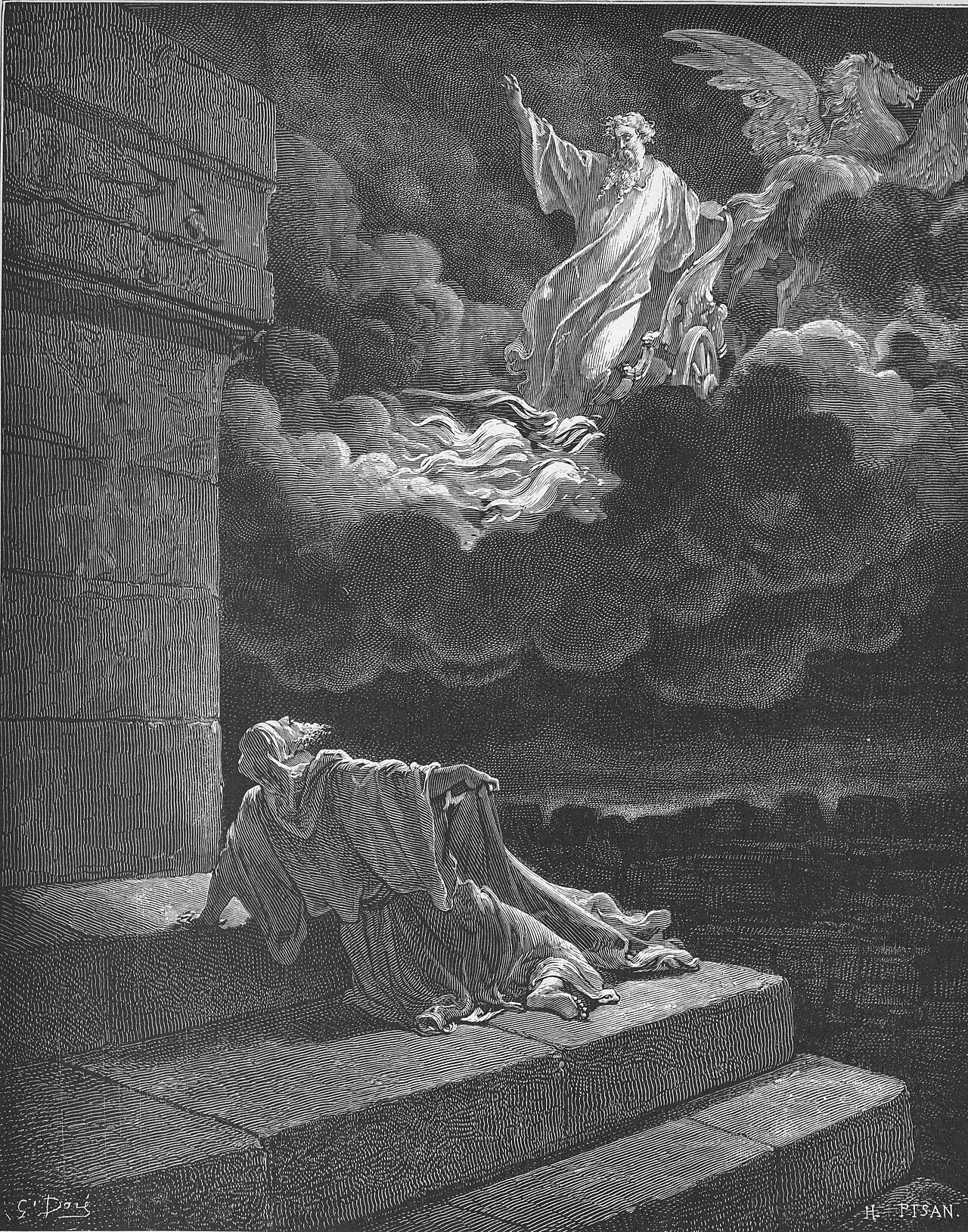
in 2 Kings 2As they were walking along and talking together, suddenly a chariot of fire with horses of fire appeared and separated the two of them, and Elijah went up into heaven in a whirlwind.
BSB
The same verse in ASV and KJV ▾
ASV
And it came to pass, as they still went on, and talked, that, behold, there appeared a chariot of fire, and horses of fire, which parted them both asunder; and Elijah went up by a whirlwind into heaven.
KJV
And it came to pass, as they still went on, and talked, that, behold, there appeared a chariot of fire, and horses of fire, and parted them both asunder; and Elijah went up by a whirlwind into heaven.
⋯
This verse in 2 Kings 2
Commentary
13 notes on this verseBut do not marvel in regard to what is said about Elijah, if, just as something strange happened to him different from all the saints who are recorded, in respect of his having been caught up by a whirlwind into heaven, so his spirit had something of choice excellence, so that not only did it rest on Elisha but also descended along with John at his birth; and that John, separately, "was filled with the Holy Spirit even from his mother's womb," and separately "came before Christ in the spirit and power of Elijah."
This site's exposition
a chariot of fire with horses of fire appeared
on 2 Kings 2:11-12
A chariot of fire separates the two men, and Elijah goes up, parted by the chariot rather than carried in it. Elisha cries, “My father, my father, the chariots and horsemen of Israel!”, naming Elijah as Israel's defense. Jehoash speaks the same words over the dying Elisha at 13:14.
The record, by era
The Church Fathers2 voices
Any one who is filled with astonishment, as he thinks of the ascension of Elijah and his passage in a chariot of fire, must see how much the nature of humankind has been honoured, as, it is thereby taught and has the hope, that it …
A burdened stomach drags down the heart toward vices and depresses the mind to keep it unable to experience heavenly piety. Scripture tells us, "The corruptible body is a load on the soul, and the earthly habitation presses down the mind that muses on many …
The Medieval Church1 voice
The prophets proclaimed the mystery of the Lord's ascension not only by their words but also by their actions. Both Enoch, the seventh [in the line of descent] from Adam, who was transported from the world, and Elijah, who was taken up into heaven, gave …
The Puritans and the Awakening2 voices
A chariot of fire - In this form the angels appeared. The souls of all the faithful, are carried by an invisible guard of angels, into the bosom of Abraham.
And it came to pass, as they still went on and talked,....
6 more voices on this verse
The Puritans and the Awakening1 voice
(2.) He gave a glimpse of that life and immortality which are brought to light by the gospel, of the glory reserved for the bodies of the saints, and the opening of the kingdom of heaven to all believers, as then to Elijah. It was also a figure of Christ's ascension.
The Nineteenth Century5 voices
A commentator
Albert Barnes1798–1870
Notes, Explanatory and Practical, on the Old and New Testaments (1832-1869)
Elijah went up ... - No honest exegesis can explain this passage in any other sense than as teaching the translation of Elijah, who was taken from the earth, like Enoch Gen 5:24, without dying. Compare Ecclesiasticus 48:9.
IT seems to me that the departure of Elijah from the world, though of course he did not "die" at all, may furnish us with a very good type of the decease of those saints who, although taken away all of a sudden, are not without some previous intimation that in such a manner they will be removed. There may be some such here. They may know that they have about them a disease which, in all probability, will terminate fatally and suddenly.
A commentator
Jamieson, Fausset & Brown1802–1910
Commentary Critical and Explanatory on the Whole Bible (1871)
proposed
behold, there appeared a chariot of fire, and horses of fire--some bright effulgence, which, in the eyes of the spectators, resembled those objects. went up by a whirlwind--a tempest or storm wind accompanied with vivid flashes of fire, figuratively used for the divine judgments (Isa 29:6).
quarantine:debris (2026-07-29) — starts-lowercase
IT seems to me that the departure of Elijah from the world, though of course he did not "die" at all, may furnish us with a very good type of the decease of those saints who, although taken away all of a sudden, are not without some previous intimation that in such a manner they will be removed. There may be some such here. They may know that they have about them a disease which, in all probability, will terminate fatally and suddenly. Others of us may have no idea at present that there is prepared for us a sudden death and sudden Glory. We would not shrink from such a death if it were the Lord's will that it should be ours. No, some of us would gladly reach out our hands and grasp so happy a mode of departure! It has always seemed to us to be the preferable way of leaving this world, not to be long sick and disabled, a weariness to those who nurse us and a torment to ourselves, but all of a sudden to shut our eyes on earth and open them on the splendors of Heaven! So to die would be, we think, a blessed mode of resting from our labors and entering into the Presence of our Lord. I. Taking Elijah's case as a guide, we propose tonight to say a few words—and may God make them to edification—about PREPARING FOR OUR DEPARTURE, which is really so near that it is time we began to talk about it. It is much nearer to us than we think. To those of you who have passed fifty, sixty, or 70 years of age, it must, of necessity, be very near. To others of us who are in the prime of life, it is not far off, for I suppose we are all conscious that time flies more swiftly with us, now, than it ever did. The years of our youth seem to have been twice as long as the years are, now, that we are men. It was but yesterday that the buds began to swell and burst—and now the leaves are beginning to fall and soon we shall be expecting to see old winter taking up his accustomed place.
Elijah went up - into heaven - He was truly translated; and the words here leave us no room to indulge the conjecture of Dr. Priestley, who supposes that as “Enoch, (probably Moses), Elijah, and Christ, had no relation to any other world or planet, they are no doubt in this;” for we are told that Elijah went up into heaven; and we know, from the sure testimony of the Scripture, that our blessed Lord is at the right hand of the Majesty on high, ever living to make intercession for us.
How the passage was read
What the Jewish commentators add
On the verses either side of this one
You have made a difficult request. It is impossible [for me] to give you more than I possess. 5 According to Rashi, Elisha apparently asked for a double portion of Eliyahu’s spirit.
1 more on this passage, in their own words ▾
My father, my father! Chariot of Yisroel. My endeared teacher. He referred to Eliyahu as “father,” because one’s disciples are considered like one’s own children, and conversely, the teacher is considered a father.—Ralbag See Rashi in Devarim:7. who is better for Yisroel with his prayers than chariots and horsemen.
This section is reception history: how the passage was read and kept in the Jewish tradition. Where a reading parts from an essential of the Christian faith, the section says so at that point.
Texts and citation data: Sefaria; each excerpt follows its version’s licence. 5 further sources are cited on this chapter that carry no English text this site may quote or only restate the verse.
The words behind it
17 Hebrew wordsEvery Hebrew word of this verse in the order it stands, with what it means and the door to its own study. The last column counts the times a word stands in the whole Bible: the rarer the word, the more the places it appears belong together.
| Hebrew | Sound | Meaning | Word study | In the Bible |
|---|---|---|---|---|
| וַיְהִ֗י | vayhi | and it was | H1961 → | 3559 times |
| הֵ֣מָּה | hemah | they | H1992 → | 553 times |
| הֹלְכִ֤ים | holekhim | [were] walking | H1980 → | 1546 times |
| הָלוֹךְ֙ | halokh | continuously <to walk> | H1980 → | 1546 times |
| וְדַבֵּ֔ר | vedaber | and speaking | H1696 → | 1141 times |
| וְהִנֵּ֤ה | vehineh | and there! | H2009 → | 843 times |
| רֶֽכֶב־ | rekhev- | a chariot of | H7393 → | 119 times |
| אֵשׁ֙ | ʾesh | fire | H784 → | 378 times |
| וְס֣וּסֵי | vesusei | and horses of | H5483 → | 140 times |
| אֵ֔שׁ | ʾesh | fire | H784 → | 378 times |
| וַיַּפְרִ֖דוּ | vaiyafridu | and they separated | H6504 → | |
| בֵּ֣ין | bein | between | H996 → | 407 times |
| שְׁנֵיהֶ֑ם | sheneihem | [the] two of them | H8147 → | 768 times |
| וַיַּ֙עַל֙ | vaiyaal | and he went up | H5927 → | 890 times |
| אֵ֣לִיָּ֔הוּ | ʾeliyahu | Elijah | H452 → | 71 times |
| בַּֽסְעָרָ֖ה | basearah | in the whirlwind | H5591 → | |
| הַשָּׁמָֽיִם׃ | hashamayim | the heavens | H8064 → | 421 times |
וַיְהִ֗יand it was
vayhiH1961 →3559 times
הֵ֣מָּהthey
hemahH1992 →553 times
הֹלְכִ֤ים[were] walking
holekhimH1980 →1546 times
הָלוֹךְ֙continuously <to walk>
halokhH1980 →1546 times
וְדַבֵּ֔רand speaking
vedaberH1696 →1141 times
וְהִנֵּ֤הand there!
vehinehH2009 →843 times
רֶֽכֶב־a chariot of
rekhev-H7393 →119 times
אֵשׁ֙fire
ʾeshH784 →378 times
וְס֣וּסֵיand horses of
vesuseiH5483 →140 times
אֵ֔שׁfire
ʾeshH784 →378 times
וַיַּפְרִ֖דוּand they separated
vaiyafriduH6504 →
בֵּ֣יןbetween
beinH996 →407 times
שְׁנֵיהֶ֑ם[the] two of them
sheneihemH8147 →768 times
וַיַּ֙עַל֙and he went up
vaiyaalH5927 →890 times
אֵ֣לִיָּ֔הוּElijah
ʾeliyahuH452 →71 times
בַּֽסְעָרָ֖הin the whirlwind
basearahH5591 →
הַשָּׁמָֽיִם׃the heavens
hashamayimH8064 →421 times
A shaded row is a word that stands 400 times or fewer in the Bible.
The walk
8 stopsEach card is a verse this one points to, and under it the verses that one points to in turn. Where several paths arrive at the same place, that place is listed first: the text keeps returning to it.
Through
Hebrews 1:14Are not the angels ministering spirits sent to serve those who will inherit salvation?
it leads to
- Psalms 34:7
The angel of the LORD encamps around those who fear Him, and he delivers them.
Reached by 2 separate paths from here.
- Psalms 103:20–21
Bless the LORD, all His angels mighty in strength who carry out His word, who hearken to the voice of His command.
- Psalms 91:11–12
For He will command His angels concerning you to guard you in all your ways.
- Matthew 18:10
See that you do not look down on any of these little ones. For I tell you that their angels in heaven always see the face of My Father in heaven.
- Daniel 6:22
My God sent His angel and shut the mouths of the lions. They have not hurt me, for I was found innocent in His sight, and I have done no wrong against you, O…
- Psalms 34:7
Through
2 Kings 6:17Then Elisha prayed, “O LORD, please open his eyes that he may see.” And the LORD opened the eyes of the young man, and he saw that the hills were full of horses and…
it leads to
- Psalms 68:17
The chariots of God are tens of thousands— thousands of thousands are they; the Lord is in His sanctuary as He was at Sinai.
- Zechariah 6:1–7
And again I lifted up my eyes and saw four chariots coming out from between two mountains—mountains of bronze.
- Acts 26:18
to open their eyes, so that they may turn from darkness to light and from the power of Satan to God, that they may receive forgiveness of sins and an inheritance among those sanctified…
- Psalms 68:17
Where this verse is studied
On this page
Studies8
About 2 Kings
Who and where
1 name in this verse with a page on the site.
This page draws on 11 works. Open the list of works
This page draws on Adam Clarke, Commentary on the Bible; Albert Barnes, Notes, Explanatory and Practical, on the Old and New Testaments (1832-1869); Bede, Homilies on the Gospels 2.15; Charles Spurgeon, The Metropolitan Tabernacle Pulpit, Sermon No. 3116: “Preparing to Depart” (lightly modernized text, CCEL edition); Cosmas Indicopleustes, The Christian Topography, Book 6; Jamieson, Fausset & Brown, Commentary Critical and Explanatory on the Whole Bible; John Gill, Exposition of the Old Testament (1748-1763); John Wesley, Explanatory Notes upon the Old Testament; Matthew Henry, Commentary on the Whole Bible; Origen of Alexandria, COMMENTARY ON THE GOSPEL OF MATTHEW 13.2 and Peter Chrysologus, SERMON 2.