
2 Kings 2:16
in 2 Kings 2“Look now,” they said to Elisha, “we your servants have fifty valiant men. Please let them go and search for your master. Perhaps the Spirit of the LORD has taken him up and put him on one of the mountains or in one of the valleys.” “Do not send them,” Elisha replied.
BSB
The same verse in ASV and KJV ▾
ASV
And they said unto him, Behold now, there are with thy servants fifty strong men; let them go, we pray thee, and seek thy master, lest the Spirit of Jehovah hath taken him up, and cast him upon some mountain, or into some valley. And he said, Ye shall not send.
KJV
And they said unto him, Behold now, there be with thy servants fifty strong men; let them go, we pray thee, and seek thy master: lest peradventure the Spirit of the Lord hath taken him up, and cast him upon some mountain, or into some valley. And he said, Ye shall not send.
⋯
This verse in 2 Kings 2
Commentary
7 notes on this verseStrong men - Able to take such a journey. Lest, &c. - They thought, either that God had not finally taken him away from them, but only for a time; or that God had only taken away his soul, and that his body was cast down into some place, which they desired to seek, that they might give it an honourable burial.
This site's exposition
cast him upon some mountain
on 2 Kings 2:16-18
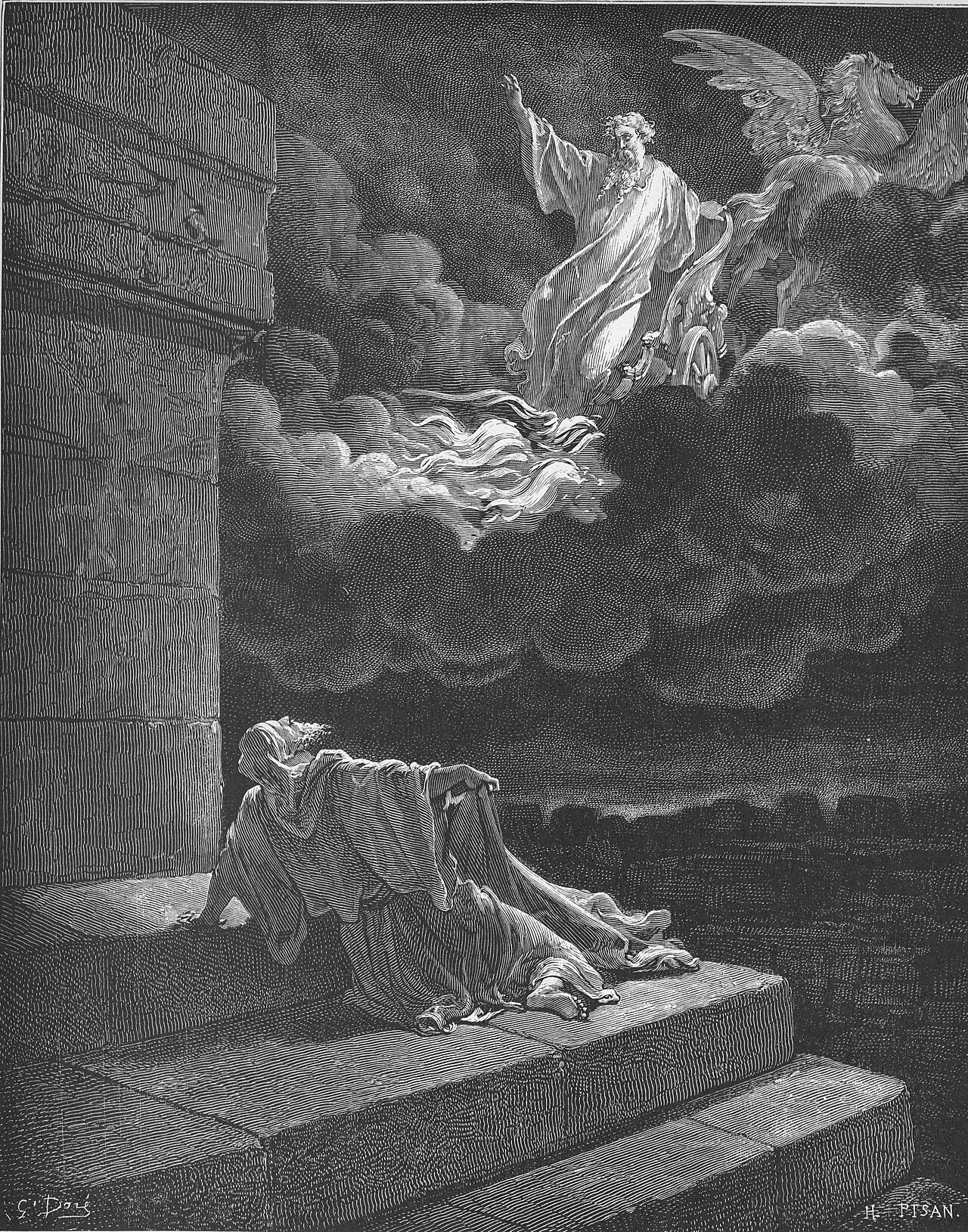
Fifty strong men press Elisha to let them search for Elijah, afraid the Spirit of the Lord has only carried him off and set him down on some mountain or in some valley, the same kind of removal Obadiah once feared for Elijah himself at 1 Kings 18:12. Elisha refuses at first, knowing the search is useless, but yields under their pressing until he was ashamed, and the fifty spend three days combing the country and find nothing. When they return he asks only, did I not say unto you, go not, closing the matter without a lecture.
The record, by era
The Puritans and the Awakening2 voices
Some of them perhaps started this as a demurrer to the choice of Elisha: "Let us first be sure that Elijah has quite gone. Can we think Elijah thus neglected by heaven, that chosen vessel thus cast away as a vessel in which was no pleasure?" 2.
And they said unto him, behold, now, there be with thy servants fifty strong men,....
The Nineteenth Century3 voices
A commentator
Jamieson, Fausset & Brown1802–1910
Commentary Critical and Explanatory on the Whole Bible (1871)
proposed
smote the waters--The waving of the mantle on the river, and the miraculous division of the waters consequent upon it, was an evidence that the Lord God of Elijah was with him, and as this miracle was witnessed by the scholars of the prophets from Jericho, they forthwith recognized the pre-eminence of Elisha, as now the prophet of Israel.
quarantine:debris (2026-07-29) — starts-lowercase
Fifty strong men - Probably the same fifty who are mentioned 2Ki 2:7, and who saw Elijah taken up in the whirlwind. Cast him upon some mountain - Though they saw him taken up towards heaven, yet they thought it possible that the Spirit of the Lord might have descended with him, and left him on some remote mountain or valley. Ye shall not send - He knew that he was translated to heaven, and that therefore it would be useless.
A commentator
Albert Barnes1798–1870
Notes, Explanatory and Practical, on the Old and New Testaments (1832-1869)
proposed
Compare the marginal references. The words “cast him upon some mountain,” rather imply that they expected to find the prophet alive.
The words behind it
29 Hebrew wordsEvery Hebrew word of this verse in the order it stands, with what it means and the door to its own study. The last column counts the times a word stands in the whole Bible: the rarer the word, the more the places it appears belong together.
| Hebrew | Sound | Meaning | Word study | In the Bible |
|---|---|---|---|---|
| וַיֹּאמְר֣וּ | vaiyomeru | and they said | H559 → | 5305 times |
| אֵלָ֡יו | ʾelav | to him | H413 → | 5510 times |
| הִנֵּה־ | hineh- | here! | H2009 → | 843 times |
| נָ֣א | na' | please | H4994 → | 404 times |
| יֵֽשׁ־ | yesh- | there | H3426 → | 140 times |
| אֶת־ | ʾet- | with | H854 → | 929 times |
| עֲבָדֶיךָ֩ | ʾavadeikha | servants your | H5650 → | 799 times |
| חֲמִשִּׁ֨ים | chamishim | [are] fifty | H2572 → | 163 times |
| אֲנָשִׁ֜ים | ʾanashim | men | H582 → | 566 times |
| בְּנֵֽי־ | benei- | sons of | H1121 → | 4930 times |
| חַ֗יִל | chayil | ability | H2428 → | 246 times |
| יֵ֣לְכוּ | yelekhu | let them go | H1980 → | 1546 times |
| נָא֮ | na' | please | H4994 → | 404 times |
| וִיבַקְשׁ֣וּ | vivakshu | so they may search for | H1245 → | 225 times |
| אֶת־ | ʾet- | <obj.> | H853 → | 10935 times |
| אֲדֹנֶיךָ֒ | ʾadoneikha | master<s> your | H113 → | 333 times |
| פֶּן־ | pen- | lest | H6435 → | |
| נְשָׂאוֹ֙ | nesao | it has carried off him | H5375 → | 656 times |
| ר֣וּחַ | ruach | [the] spirit of | H7307 → | 378 times |
| יְהוָ֔ה | yahweh | Yahweh | H3068 → | 6520 times |
| וַיַּשְׁלִכֵ֙הוּ֙ | vaiyashlikhehu | and it has cast him | H7993 → | 125 times |
| בְּאַחַ֣ד | beachad | on one of | H259 → | 971 times |
| הֶהָרִ֔ים | heharim | the mountains | H2022 → | 546 times |
| א֖וֹ | ʾo | or | H176 → | 321 times |
| בְּאַחַ֣ת | beachat | in one of | H259 → | 971 times |
| הַגֵּאָי֑וֹת | hageyaot | the valleys | H1516 → | 59 times |
| וַיֹּ֖אמֶר | vaiyomer | and he said | H559 → | 5305 times |
| לֹ֥א | lo' | not | H3808 → | 5168 times |
| תִשְׁלָֽחוּ׃ | tishlachu | you must send | H7971 → | 845 times |
וַיֹּאמְר֣וּand they said
vaiyomeruH559 →5305 times
אֵלָ֡יוto him
ʾelavH413 →5510 times
הִנֵּה־here!
hineh-H2009 →843 times
נָ֣אplease
na'H4994 →404 times
יֵֽשׁ־there
yesh-H3426 →140 times
אֶת־with
ʾet-H854 →929 times
עֲבָדֶיךָ֩servants your
ʾavadeikhaH5650 →799 times
חֲמִשִּׁ֨ים[are] fifty
chamishimH2572 →163 times
אֲנָשִׁ֜יםmen
ʾanashimH582 →566 times
בְּנֵֽי־sons of
benei-H1121 →4930 times
חַ֗יִלability
chayilH2428 →246 times
יֵ֣לְכוּlet them go
yelekhuH1980 →1546 times
נָא֮please
na'H4994 →404 times
וִיבַקְשׁ֣וּso they may search for
vivakshuH1245 →225 times
אֶת־<obj.>
ʾet-H853 →10935 times
אֲדֹנֶיךָ֒master<s> your
ʾadoneikhaH113 →333 times
פֶּן־lest
pen-H6435 →
נְשָׂאוֹ֙it has carried off him
nesaoH5375 →656 times
ר֣וּחַ[the] spirit of
ruachH7307 →378 times
יְהוָ֔הYahweh
yahwehH3068 →6520 times
וַיַּשְׁלִכֵ֙הוּ֙and it has cast him
vaiyashlikhehuH7993 →125 times
בְּאַחַ֣דon one of
beachadH259 →971 times
הֶהָרִ֔יםthe mountains
heharimH2022 →546 times
א֖וֹor
ʾoH176 →321 times
בְּאַחַ֣תin one of
beachatH259 →971 times
הַגֵּאָי֑וֹתthe valleys
hageyaotH1516 →59 times
וַיֹּ֖אמֶרand he said
vaiyomerH559 →5305 times
לֹ֥אnot
lo'H3808 →5168 times
תִשְׁלָֽחוּ׃you must send
tishlachuH7971 →845 times
A shaded row is a word that stands 400 times or fewer in the Bible.
The walk
8 stopsEach card is a verse this one points to, and under it the verses that one points to in turn. Where several paths arrive at the same place, that place is listed first: the text keeps returning to it.
Through
Acts 8:39When they came up out of the water, the Spirit of the Lord carried Philip away, and the eunuch saw him no more, but went on his way rejoicing.
it leads to
- Ezekiel 8:3
He stretched out what looked like a hand and took me by the hair of my head. Then the Spirit lifted me up between earth and heaven and carried me in visions of God…
Reached by 4 separate paths from here.
- Ezekiel 11:1
Then the Spirit lifted me up and brought me to the gate of the house of the LORD that faces east. And there at the entrance of the gate were twenty-five men. Among them…
Reached by 2 separate paths from here.
- 1 Kings 18:12
I do not know where the Spirit of the LORD may carry you off when I leave you. Then when I go and tell Ahab and he does not find you, he will kill…
- Ezekiel 3:12–14
Then the Spirit lifted me up, and I heard a great rumbling sound behind me: ‘Blessed be the glory of the LORD in His dwelling place!’
Reached by 2 separate paths from here.
- Ezekiel 43:5
Then the Spirit lifted me up and brought me into the inner court, and the glory of the LORD filled the temple.
- Ezekiel 8:3
Through
Ezekiel 3:14So the Spirit lifted me up and took me away, and I went in bitterness and in the anger of my spirit, with the strong hand of the LORD upon me.
it leads to
- Ezekiel 1:3
the word of the LORD came directly to Ezekiel the priest, the son of Buzi, in the land of the Chaldeans by the River Kebar. And there the LORD’s hand was upon him.
Reached by 2 separate paths from here.
- Jeremiah 20:7–9
You have deceived me, O LORD, and I was deceived. You have overcome me and prevailed. I am a laughingstock all day long; everyone mocks me.
- Ezekiel 37:1
The hand of the LORD was upon me, and He brought me out by His Spirit and set me down in the middle of the valley, and it was full of bones.
- Ezekiel 1:3
Where this verse is studied
On this page
Studies3
On this verse
On this chapter
About 2 Kings
Who and where
1 name in this verse with a page on the site.
This page draws on Adam Clarke, Commentary on the Bible; Albert Barnes, Notes, Explanatory and Practical, on the Old and New Testaments (1832-1869); Jamieson, Fausset & Brown, Commentary Critical and Explanatory on the Whole Bible; John Gill, Exposition of the Old Testament; John Gill, Exposition of the Old Testament (1748-1763); John Wesley, Explanatory Notes upon the Old Testament and Matthew Henry, Commentary on the Whole Bible.