
2 Kings 2:10
in 2 Kings 2“You have requested a difficult thing,” said Elijah. “Nevertheless, if you see me as I am taken from you, it will be yours. But if not, then it will not be so.”
BSB
The same verse in ASV and KJV ▾
ASV
And he said, Thou hast asked a hard thing: nevertheless, if thou see me when I am taken from thee, it shall be so unto thee; but if not, it shall not be so.
KJV
And he said, Thou hast asked a hard thing: nevertheless, if thou see me when I am taken from thee, it shall be so unto thee; but if not, it shall not be so.
⋯
This verse in 2 Kings 2
Commentary
9 notes on this verseAngels carry Elijah to heaven while angels guard Elisha on earth. Why is it so amazing if the angels who carried the master were also guarding the disciple? And what is noteworthy if the allegiance which they displayed toward the father they also offer to …
This site's exposition
Ask what I shall do for thee
on 2 Kings 2:9-10
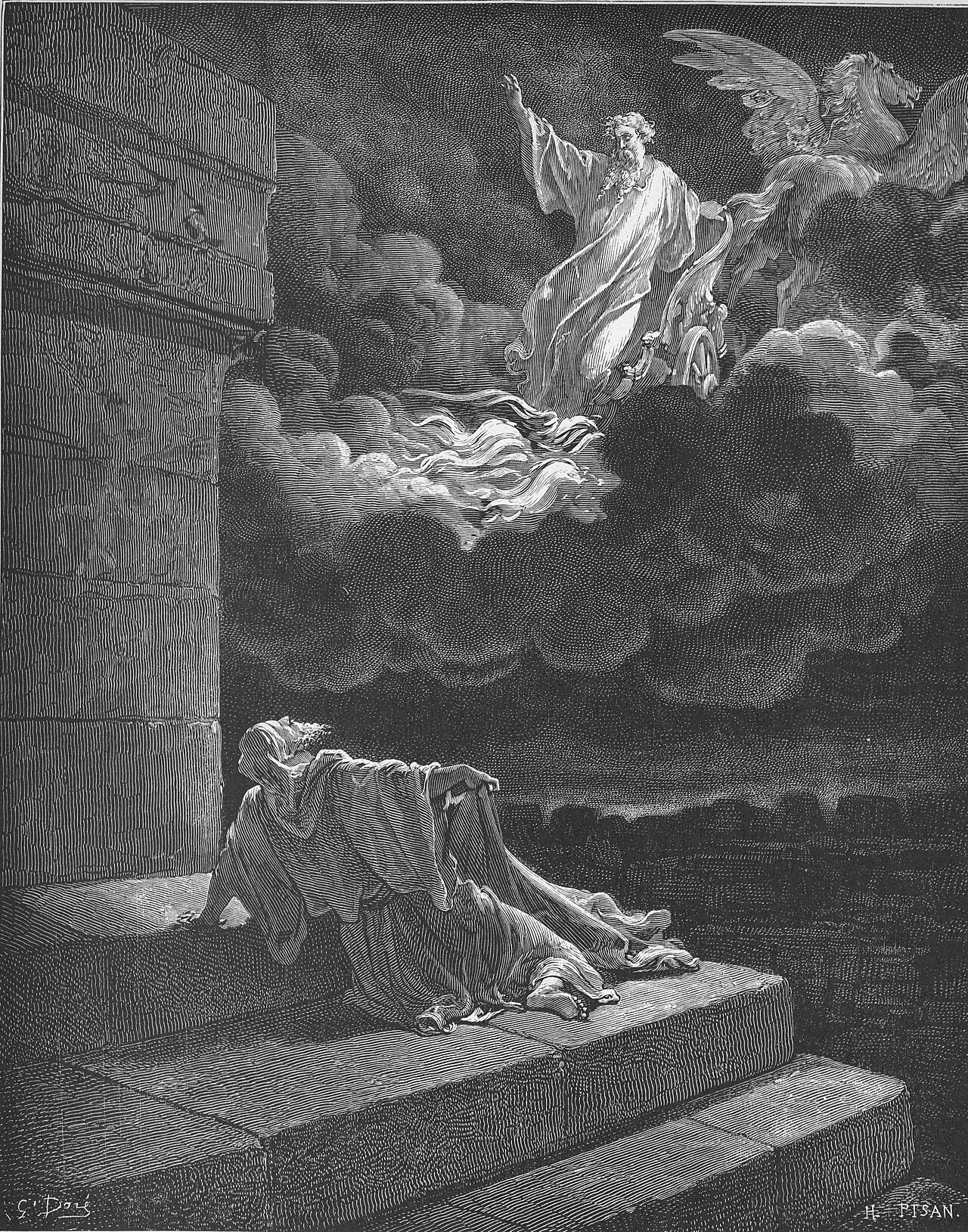
Elijah offers Elisha one request before he is taken, and Elisha asks for a double portion of thy spirit, the exact share Deuteronomy 21:17 reserves for a firstborn son claiming his father's inheritance. The request is not for worldly advantage but for the standing of an heir, Elisha asking to be received as Elijah's spiritual firstborn among all the sons of the prophets rather than merely one disciple among many. Elijah answers honestly that this lies past his own power to grant, a hard thing that only God can give, and sets a sign, whether Elisha sees him taken, that will show whether the request has been heard.
The record, by era
The Church Fathers1 voice
Angels bring Elijah to heaven, then, and angels watch over Elisha on earth. What is there to wonder at if angels, who carried away the master, protected the disciple? And what is noteworthy in the fact that the deference that they showed to the father …
The Puritans and the Awakening3 voices
A hard thing - A rare and singular blessing, which I cannot promise thee, which only God can give; and he gives it only when, and to whom he pleaseth. If thou seest - This sign he proposed, not without the direction of God's Spirit, that hereby he might engage him more earnestly to wait, and more fervently to pray for this mercy.
And he said, thou hast asked a hard thing,....
Those are best prepared for spiritual blessings that are most sensible of their worth and their own unworthiness to receive them. (2.) Provided he kept close to his master, even to the last, and was observant of him: If thou see me when I am taken from thee, it shall be so, otherwise not.
The Nineteenth Century1 voice
A hard thing - This is what is not in my power, God alone can give this; yet if thou see me taken away from thee, it shall be so. Perhaps this means no more than, “If thou continue with me till I am translated, God will grant this to thee;” for on the mere seeing or not seeing him in the moment in which he was taken away, this Divine gift could not depend.
2 more voices on this verse
The Nineteenth Century2 voices
A commentator
Jamieson, Fausset & Brown1802–1910
Commentary Critical and Explanatory on the Whole Bible (1871)
proposed
Thou hast asked a hard thing--an extraordinary blessing which I cannot, and God only, can give. Nevertheless he, doubtless by the secret directions of the Spirit, proposed to Elisha a sign, the observation of which would keep him in the attitude of an anxious waiter, as well as suppliant for the favor. HE IS TAKEN UP TO HEAVEN IN A CHARIOT OF FIRE.
A commentator
Albert Barnes1798–1870
Notes, Explanatory and Practical, on the Old and New Testaments (1832-1869)
proposed
It would be better to omit the words “when I am,” which are not in the original. The sign was to be Elisha’s seeing the actual translation, which he did 2Ki 2:12.
How the passage was read
What the Jewish commentators add
You have made a difficult request. It is impossible [for me] to give you more than I possess. 5 According to Rashi, Elisha apparently asked for a double portion of Eliyahu’s spirit.
This section is reception history: how the passage was read and kept in the Jewish tradition. Where a reading parts from an essential of the Christian faith, the section says so at that point.
Texts and citation data: Sefaria; each excerpt follows its version’s licence. 5 further sources are cited on this chapter that carry no English text this site may quote or only restate the verse.
The words behind it
15 Hebrew wordsEvery Hebrew word of this verse in the order it stands, with what it means and the door to its own study. The last column counts the times a word stands in the whole Bible: the rarer the word, the more the places it appears belong together.
| Hebrew | Sound | Meaning | Word study | In the Bible |
|---|---|---|---|---|
| וַיֹּ֖אמֶר | vaiyomer | and he said | H559 → | 5305 times |
| הִקְשִׁ֣יתָ | hikshita | you have made difficult | H7185 → | |
| לִשְׁא֑וֹל | lishol | to ask | H7592 → | 171 times |
| אִם־ | ʾim- | if | H518 → | 1069 times |
| תִּרְאֶ֨ה | tireh | you will see | H7200 → | 1300 times |
| אֹתִ֜י | ʾoti | <obj.> me | H853 → | 10935 times |
| לֻקָּ֤ח | lukach | taken | H3947 → | 966 times |
| מֵֽאִתָּךְ֙ | meitokh | from with <the> you | H854 → | 929 times |
| יְהִֽי־ | yehi- | may it be | H1961 → | 3559 times |
| לְךָ֣ | lekha | to you | ||
| כֵ֔ן | khen | thus | H3651 → | 771 times |
| וְאִם־ | veim- | and if | H518 → | 1069 times |
| אַ֖יִן | ʾayin | not | H369 → | 789 times |
| לֹ֥א | lo' | not | H3808 → | 5168 times |
| יִהְיֶֽה׃ | yihyeh | it will be | H1961 → | 3559 times |
וַיֹּ֖אמֶרand he said
vaiyomerH559 →5305 times
הִקְשִׁ֣יתָyou have made difficult
hikshitaH7185 →
לִשְׁא֑וֹלto ask
lisholH7592 →171 times
אִם־if
ʾim-H518 →1069 times
תִּרְאֶ֨הyou will see
tirehH7200 →1300 times
אֹתִ֜י<obj.> me
ʾotiH853 →10935 times
לֻקָּ֤חtaken
lukachH3947 →966 times
מֵֽאִתָּךְ֙from with <the> you
meitokhH854 →929 times
יְהִֽי־may it be
yehi-H1961 →3559 times
לְךָ֣to you
lekha
כֵ֔ןthus
khenH3651 →771 times
וְאִם־and if
veim-H518 →1069 times
אַ֖יִןnot
ʾayinH369 →789 times
לֹ֥אnot
lo'H3808 →5168 times
יִהְיֶֽה׃it will be
yihyehH1961 →3559 times
A shaded row is a word that stands 400 times or fewer in the Bible.
The walk
8 stopsEach card is a verse this one points to, and under it the verses that one points to in turn. Where several paths arrive at the same place, that place is listed first: the text keeps returning to it.
Through
John 16:24Until now you have not asked for anything in My name. Ask and you will receive, so that your joy may be complete.
it leads to
- Matthew 7:7–8
Ask, and it will be given to you; seek, and you will find; knock, and the door will be opened to you.
- James 4:2–3
You crave what you do not have; you kill and covet, but are unable to obtain it. You quarrel and fight. You do not have, because you do not ask.
- John 15:11
I have told you these things so that My joy may be in you and your joy may be complete.
- 2 Thessalonians 2:16–17
Now may our Lord Jesus Christ Himself and God our Father, who by grace has loved us and given us eternal comfort and good hope,
- John 16:23
In that day you will no longer ask Me anything. Truly, truly, I tell you, whatever you ask the Father in My name, He will give you.
- Matthew 7:7–8
Through
2 Kings 2:12As Elisha watched, he cried out, “My father, my father, the chariots and horsemen of Israel!” And he saw Elijah no more. So taking hold of his own clothes, he tore them in two.
it leads to
- 2 Kings 13:14
When Elisha had fallen sick with the illness from which he would die, Jehoash king of Israel came down to him and wept over him, saying, “My father, my father, the chariots and horsemen…
- 2 Corinthians 5:2
For in this tent we groan, longing to be clothed with our heavenly dwelling,
- Proverbs 30:4
Who has ascended to heaven and come down? Who has gathered the wind in His hands? Who has bound up the waters in His cloak? Who has established all the ends of the earth?…
- 2 Kings 13:14
Where this verse is studied
On this page
Studies3
On this verse
On this chapter
About 2 Kings
Who and where
1 name in this verse with a page on the site.
This page draws on 9 works. Open the list of works
This page draws on Adam Clarke, Commentary on the Bible; Albert Barnes, Notes on the Old Testament; Albert Barnes, Notes, Explanatory and Practical, on the Old and New Testaments (1832-1869); Jamieson, Fausset & Brown, Commentary Critical and Explanatory on the Whole Bible; John Gill, Exposition of the Old Testament (1748-1763); John Wesley, Explanatory Notes upon the Old Testament; Matthew Henry, Commentary on the Whole Bible; Maximus of Turin, SERMON 84.2 and Maximus of Turin, Commentary (church-history corpus).