
2 Kings 2:13
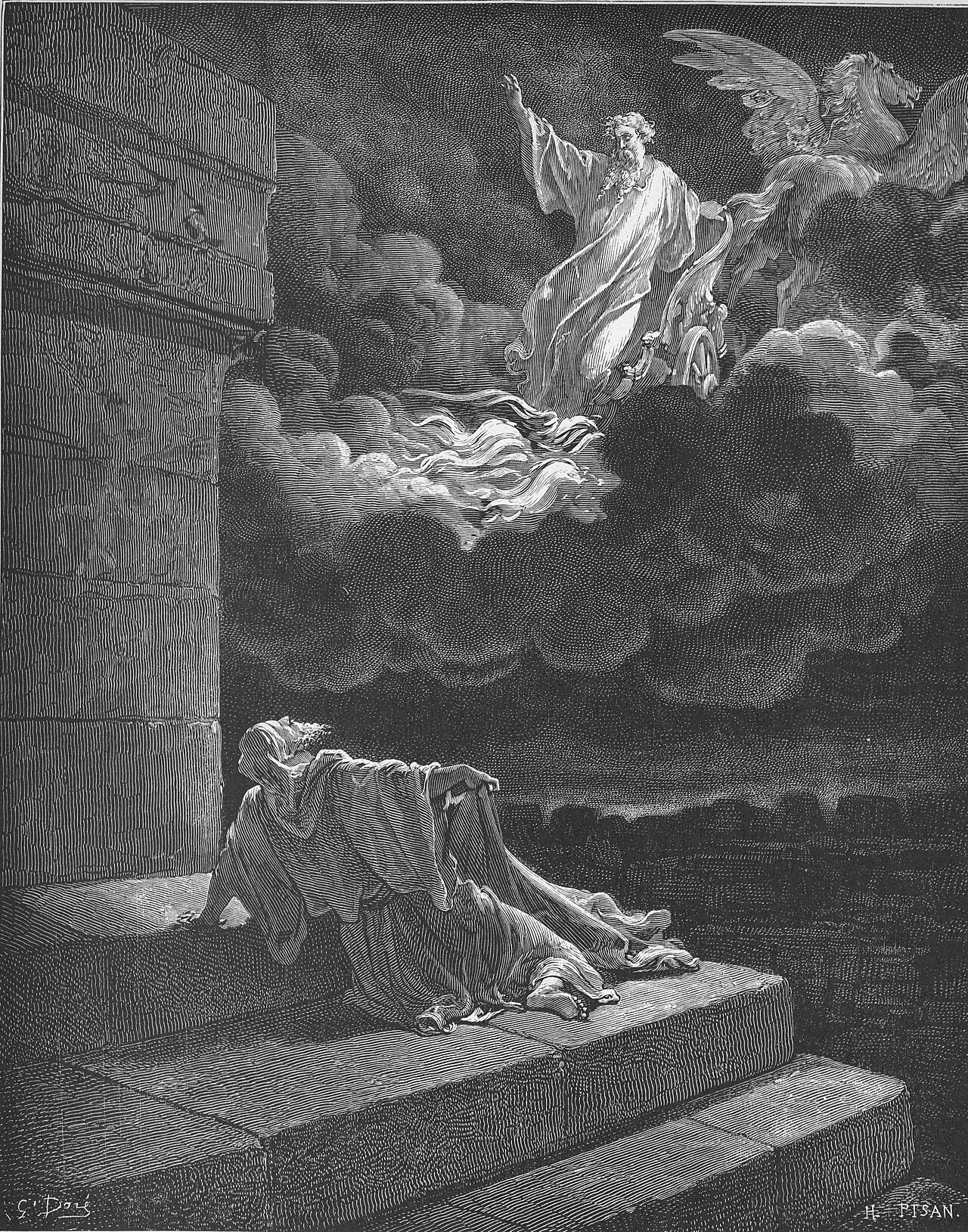
in 2 Kings 2Elisha also picked up the cloak that had fallen from Elijah, and he went back and stood on the bank of the Jordan.
BSB
The same verse in ASV and KJV ▾
ASV
He took up also the mantle of Elijah that fell from him, and went back, and stood by the bank of the Jordan.
KJV
He took up also the mantle of Elijah that fell from him, and went back, and stood by the bank of Jordan;
⋯
This verse in 2 Kings 2
Commentary
7 notes on this verseElisha took it up, not as a sacred relic to be worshipped, but as a significant garment to be worn, and a recompence to him for his own garments which he had rent. he loved this cloak ever since it was first cast over him, 1 Kings xix. He that then so cheerfully obeyed the summons of it, and became Elijah's servant, is now dignified with it, and becomes his successor.
This site's exposition
stood by the bank of Jordan
on 2 Kings 2:13-14
Elisha takes up the mantle that fell from Elijah and carries it back to Jordan alone, and where his master struck the water and asked nothing, Elisha strikes it and asks aloud, where is the Lord God of Elijah. Spurgeon preached a whole sermon from this question, Where Is the God of Elijah, reading it as the standing cry of any generation that has watched an older faith die and wonders whether the same God still answers. The waters part a second time, exactly as they had for Elijah, and Elisha crosses on the same dry ground his master had just walked, Elijah's last miracle becoming Elisha's first with no gap between the two ministries.
The record, by era
The Medieval Church1 voice
The prophets proclaimed the mystery of the Lord's ascension not only by their words but also by their actions. Both Enoch, the seventh [in the line of descent] from Adam, who was transported from the world, and Elijah, who was taken up into heaven, gave …
The Puritans and the Awakening2 voices
Which fell - God so ordering it for Elisha's comfort, and the strengthening of his faith, as a pledge, that together with Elijah's mantle, his Spirit should rest upon him. And Elijah himself was gone to a place, where he needed not the mantle, either to adorn him, or to shelter him from weather, or to wrap his face in.
He took up also the mantle of Elijah that fell from him,.... Which he had now no further need of, and Elisha had, having rent his clothes in two; and this falling into his hands was a token of his succeeding him in his office, and that he should have the double portion of his spirit: and he went back, and stood by the brook of Jordan; at the place where he and Elijah had passed over together.
The Nineteenth Century2 voices
A commentator
Jamieson, Fausset & Brown1802–1910
Commentary Critical and Explanatory on the Whole Bible (1871)
proposed
He took up also the mantle of Elijah--The transference of this prophetic cloak was, to himself, a pledge of his being appointed successor, and it was an outward token to others of the spirit of Elijah resting upon him.
He took - the mantle - The same with which he had been called by Elijah to the prophetic office, and the same by which Elijah divided Jordan. His having the mantle was a proof that he was invested with the authority and influence of his master.
How the passage was read
What the Jewish commentators add
On the verses either side of this one
My father, my father! Chariot of Yisroel. My endeared teacher. He referred to Eliyahu as “father,” because one’s disciples are considered like one’s own children, and conversely, the teacher is considered a father.—Ralbag See Rashi in Devarim:7. who is better for Yisroel with his prayers than chariots and horsemen.
1 more on this passage, in their own words ▾
Where is Adonoy, the God of Eliyahu? That I was promised that a double portion of his spirit would rest upon me. 9 Alternatively, where is God who does not show me His sign as He showed Eliyahu is the splitting of the water?”—Ralbag
This section is reception history: how the passage was read and kept in the Jewish tradition. Where a reading parts from an essential of the Christian faith, the section says so at that point.
Texts and citation data: Sefaria; each excerpt follows its version’s licence. 5 further sources are cited on this chapter that carry no English text this site may quote or only restate the verse.
The words behind it
12 Hebrew wordsEvery Hebrew word of this verse in the order it stands, with what it means and the door to its own study. The last column counts the times a word stands in the whole Bible: the rarer the word, the more the places it appears belong together.
| Hebrew | Sound | Meaning | Word study | In the Bible |
|---|---|---|---|---|
| וַיָּ֙רֶם֙ | vaiyarem | and he took up | H7311 → | 190 times |
| אֶת־ | ʾet- | <obj.> | H853 → | 10935 times |
| אַדֶּ֣רֶת | ʾaderet | [the] cloak of | H155 → | 12 times |
| אֵלִיָּ֔הוּ | ʾeliyahu | Elijah | H452 → | 71 times |
| אֲשֶׁ֥ר | ʾasher | which | H834 → | 5497 times |
| נָפְלָ֖ה | nafelah | it had fallen | H5307 → | 435 times |
| מֵעָלָ֑יו | mealav | from on <the> him | H5921 → | 5755 times |
| וַיָּ֥שָׁב | vaiyashov | and he went back | H7725 → | 1056 times |
| וַֽיַּעֲמֹ֖ד | vaiyaamod | and he stood | H5975 → | 521 times |
| עַל־ | ʾal- | on | H5921 → | 5755 times |
| שְׂפַ֥ת | sefat | [the] bank of | H8193 → | 176 times |
| הַיַּרְדֵּֽן׃ | haiyarden | the Jordan | H3383 → | 182 times |
וַיָּ֙רֶם֙and he took up
vaiyaremH7311 →190 times
אֶת־<obj.>
ʾet-H853 →10935 times
אַדֶּ֣רֶת[the] cloak of
ʾaderetH155 →12 times
אֵלִיָּ֔הוּElijah
ʾeliyahuH452 →71 times
אֲשֶׁ֥רwhich
ʾasherH834 →5497 times
נָפְלָ֖הit had fallen
nafelahH5307 →435 times
מֵעָלָ֑יוfrom on <the> him
mealavH5921 →5755 times
וַיָּ֥שָׁבand he went back
vaiyashovH7725 →1056 times
וַֽיַּעֲמֹ֖דand he stood
vaiyaamodH5975 →521 times
עַל־on
ʾal-H5921 →5755 times
שְׂפַ֥ת[the] bank of
sefatH8193 →176 times
הַיַּרְדֵּֽן׃the Jordan
haiyardenH3383 →182 times
A shaded row is a word that stands 400 times or fewer in the Bible.
The walk
8 stopsEach card is a verse this one points to, and under it the verses that one points to in turn. Where several paths arrive at the same place, that place is listed first: the text keeps returning to it.
Through
2 Kings 2:8And Elijah took his cloak, rolled it up, and struck the waters, which parted to the right and to the left, so that the two of them crossed over on dry ground.
it leads to
- 1 Kings 19:19
So Elijah departed and found Elisha son of Shaphat. He was plowing with twelve teams of oxen, and he was with the twelfth team. Elijah passed by him and threw his cloak around him.
- Exodus 14:21–22
Then Moses stretched out his hand over the sea, and all that night the LORD drove back the sea with a strong east wind that turned it into dry land. So the waters were…
- Joshua 3:14–17
So when the people broke camp to cross the Jordan, the priests carried the ark of the covenant ahead of them.
- 2 Kings 2:14
Then he took the cloak of Elijah that had fallen from him and struck the waters. “Where now is the LORD, the God of Elijah?” he asked. And when he had struck the waters,…
- 1 Kings 19:19
Through
1 Kings 19:19So Elijah departed and found Elisha son of Shaphat. He was plowing with twelve teams of oxen, and he was with the twelfth team. Elijah passed by him and threw his cloak around him.
it leads to
- 2 Kings 2:8
And Elijah took his cloak, rolled it up, and struck the waters, which parted to the right and to the left, so that the two of them crossed over on dry ground.
- 2 Kings 2:8
Through
1 Kings 9:26King Solomon also assembled a fleet of ships at Ezion-geber, which is near Eloth in Edom, on the shore of the Red Sea.
it leads to
- 1 Kings 22:48
Jehoshaphat built ships of Tarshish to go to Ophir for gold, but they never set sail, because they were wrecked at Ezion-geber.
- Deuteronomy 2:8
So we passed by our brothers, the descendants of Esau, who live in Seir. We turned away from the Arabah road, which comes up from Elath and Ezion-geber, and traveled along the road of…
- Numbers 33:35
They set out from Abronah and camped at Ezion-geber.
- 1 Kings 22:48
Where this verse is studied
On this page
Studies3
On this verse
On this chapter
About 2 Kings
Who and where
2 names in this verse with a page on the site.
- PersonDivided kingdomElijahThe Tishbite who shut heaven for three years and a half, called down fire on Carmel, heard the still small voice at Horeb, and wen…
- PersonDivided kingdomElishaElijah's successor with the firstborn's double portion; the prophet of the healed spring, the widow's oil, the Shunammite's son, N…
This page draws on Adam Clarke, Commentary on the Bible; Bede, Homilies on the Gospels 2.15; Charles Spurgeon, The Metropolitan Tabernacle Pulpit, Sermon No. 2596: Where Is the God of Elijah; Jamieson, Fausset & Brown, Commentary Critical and Explanatory on the Whole Bible; John Gill, Exposition of the Old Testament; John Gill, Exposition of the Old Testament (1748-1763); John Wesley, Explanatory Notes upon the Old Testament and Matthew Henry, Commentary on the Whole Bible.