
2 Kings 2:12
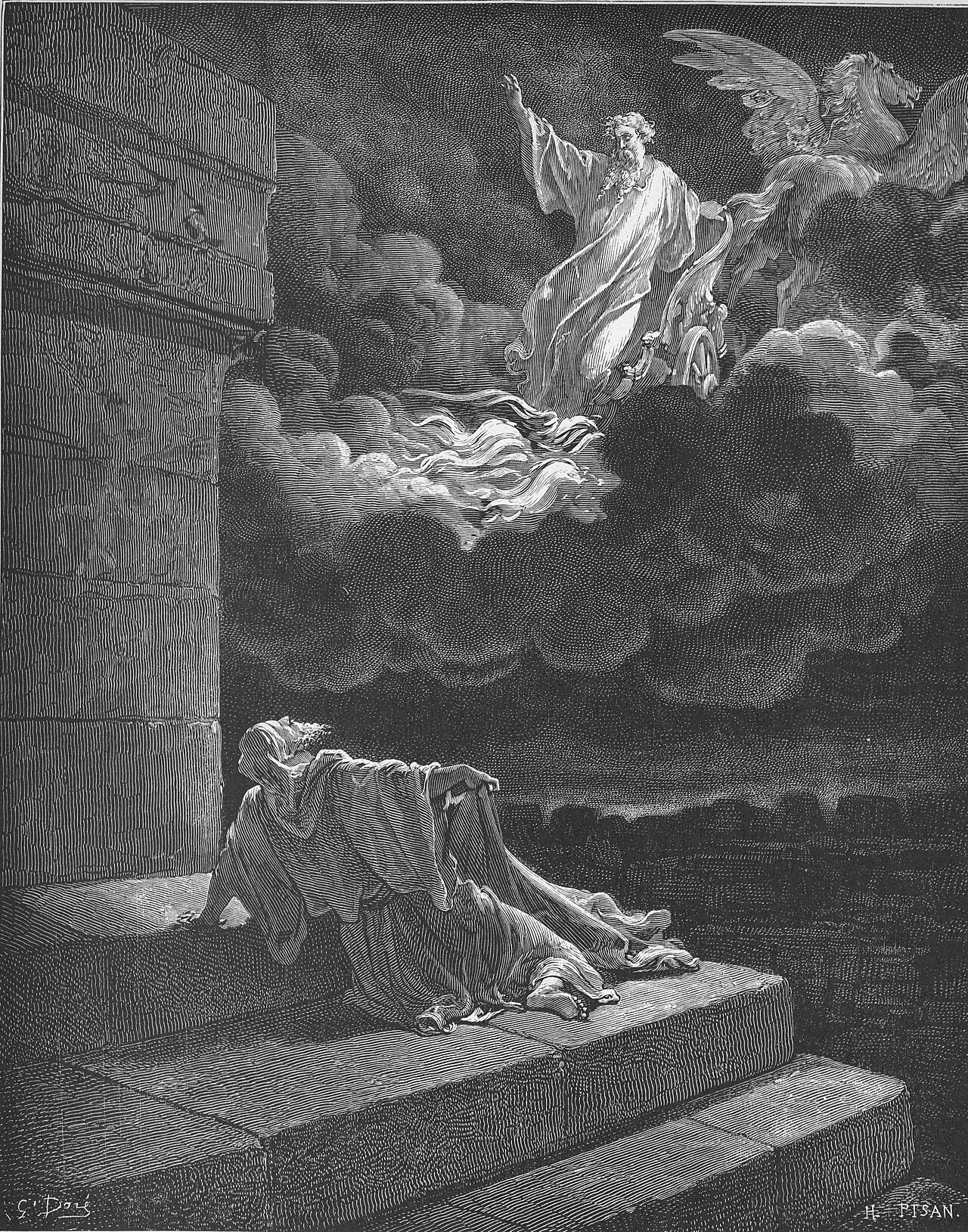
in 2 Kings 2As Elisha watched, he cried out, “My father, my father, the chariots and horsemen of Israel!” And he saw Elijah no more. So taking hold of his own clothes, he tore them in two.
BSB
The same verse in ASV and KJV ▾
ASV
And Elisha saw it, and he cried, My father, my father, the chariots of Israel and the horsemen thereof! And he saw him no more: and he took hold of his own clothes, and rent them in two pieces.
KJV
And Elisha saw it, and he cried, My father, my father, the chariot of Israel, and the horsemen thereof. And he saw him no more: and he took hold of his own clothes, and rent them in two pieces.
⋯
This verse in 2 Kings 2
Commentary
7 notes on this verseThe chariot of Israel and the horsemen thereof - The Chaldee translates these words thus: “My master, my master! who, by thy intercession, wast of more use to Israel than horses and chariots.” This is probably the sense.
This site's exposition
a chariot of fire, and horses of fire
on 2 Kings 2:11-12
A chariot of fire and horses of fire come between the two men while they are still walking and talking, and Elijah goes up by a whirlwind, not by the chariot itself, which parts him from Elisha rather than carrying him. Elisha's cry, my father, my father, the chariot of Israel, and the horsemen thereof, names what Elijah had been to the nation, a stronger defense than any army; the same cry returns word for word in 13:14, spoken this time by king Joash over the dying Elisha himself. Elisha tears his own clothes in two, the mourner's act, and the tear also marks the seam between one prophet's ministry and the next.
The record, by era
The Medieval Church1 voice
The prophets proclaimed the mystery of the Lord's ascension not only by their words but also by their actions. Both Enoch, the seventh [in the line of descent] from Adam, who was transported from the world, and Elijah, who was taken up into heaven, gave …
The Puritans and the Awakening3 voices
He saw his own condition like that of a fatherless child, and laments it accordingly. The chariot, &c. - Who by thy example, and counsels, and prayers, and power with God, didst more for the defense and preservation of Israel than all their chariots and horses.
And Elisha saw it,....
Surely their hearts are hard whose eyes are dry when God, by taking away faithful useful men, calls for weeping and mourning. Though Elijah's departure made way for Elisha's eminency, especially since he was now sure of a double portion of his spirit, yet he lamented the loss of him, for he loved him, and could have served him for ever.
The Nineteenth Century1 voice
A commentator
Albert Barnes1798–1870
Notes, Explanatory and Practical, on the Old and New Testaments (1832-1869)
proposed
The chariot of Israel and the horsemen thereof - These difficult words are probably said of Elijah, whom Elisha addresses as “the true defense of Israel, better than either the chariots or horsemen” which he saw. Hence, his rending his clothes in token of his grief.
How the passage was read
What the Jewish commentators add
My father, my father! Chariot of Yisroel. My endeared teacher. He referred to Eliyahu as “father,” because one’s disciples are considered like one’s own children, and conversely, the teacher is considered a father.—Ralbag See Rashi in Devarim:7. who is better for Yisroel with his prayers than chariots and horsemen.
This section is reception history: how the passage was read and kept in the Jewish tradition. Where a reading parts from an essential of the Christian faith, the section says so at that point.
Texts and citation data: Sefaria; each excerpt follows its version’s licence. 5 further sources are cited on this chapter that carry no English text this site may quote or only restate the verse.
The words behind it
17 Hebrew wordsEvery Hebrew word of this verse in the order it stands, with what it means and the door to its own study. The last column counts the times a word stands in the whole Bible: the rarer the word, the more the places it appears belong together.
| Hebrew | Sound | Meaning | Word study | In the Bible |
|---|---|---|---|---|
| וֶאֱלִישָׁ֣ע | veelisha' | and Elisha | H477 → | 58 times |
| רֹאֶ֗ה | roeh | [was] seeing | H7200 → | 1300 times |
| וְה֤וּא | vehu' | and he | H1931 → | 1879 times |
| מְצַעֵק֙ | metzaek | [was] crying out | H6817 → | 55 times |
| אָבִ֣י׀ | ʾavi | O father my | H1 → | 1212 times |
| אָבִ֗י | ʾavi | father my | H1 → | 1212 times |
| רֶ֤כֶב | rekhev | [the] chariotry of | H7393 → | 119 times |
| יִשְׂרָאֵל֙ | yisrael | Israel | H3478 → | 2507 times |
| וּפָ֣רָשָׁ֔יו | ufarashav | and horsemen its | H6571 → | 57 times |
| וְלֹ֥א | velo' | and not | H3808 → | 5168 times |
| רָאָ֖הוּ | raahu | he saw him | H7200 → | 1300 times |
| ע֑וֹד | od | again | H5750 → | 490 times |
| וַֽיַּחֲזֵק֙ | vaiyachazek | and he took hold | H2388 → | 291 times |
| בִּבְגָדָ֔יו | bivgadav | on clothes his | H899 → | 217 times |
| וַיִּקְרָעֵ֖ם | vaiyikraem | and he tore them | H7167 → | 63 times |
| לִשְׁנַ֥יִם | lishnayim | into two | H8147 → | 768 times |
| קְרָעִֽים׃ | keraim | pieces | H7168 → |
וֶאֱלִישָׁ֣עand Elisha
veelisha'H477 →58 times
רֹאֶ֗ה[was] seeing
roehH7200 →1300 times
וְה֤וּאand he
vehu'H1931 →1879 times
מְצַעֵק֙[was] crying out
metzaekH6817 →55 times
אָבִ֣י׀O father my
ʾaviH1 →1212 times
אָבִ֗יfather my
ʾaviH1 →1212 times
רֶ֤כֶב[the] chariotry of
rekhevH7393 →119 times
יִשְׂרָאֵל֙Israel
yisraelH3478 →2507 times
וּפָ֣רָשָׁ֔יוand horsemen its
ufarashavH6571 →57 times
וְלֹ֥אand not
velo'H3808 →5168 times
רָאָ֖הוּhe saw him
raahuH7200 →1300 times
ע֑וֹדagain
odH5750 →490 times
וַֽיַּחֲזֵק֙and he took hold
vaiyachazekH2388 →291 times
בִּבְגָדָ֔יוon clothes his
bivgadavH899 →217 times
וַיִּקְרָעֵ֖םand he tore them
vaiyikraemH7167 →63 times
לִשְׁנַ֥יִםinto two
lishnayimH8147 →768 times
קְרָעִֽים׃pieces
keraimH7168 →
A shaded row is a word that stands 400 times or fewer in the Bible.
The walk
8 stopsEach card is a verse this one points to, and under it the verses that one points to in turn. Where several paths arrive at the same place, that place is listed first: the text keeps returning to it.
Through
Ephesians 4:8This is why it says: “When He ascended on high, He led captives away, and gave gifts to men.”
it leads to
- Psalms 68:18
You have ascended on high; You have led captives away. You have received gifts from men, even from the rebellious, that the LORD God may dwell there.
- Colossians 2:15
And having disarmed the powers and authorities, He made a public spectacle of them, triumphing over them by the cross.
- Psalms 68:18
Through
Mark 16:19After the Lord Jesus had spoken to them, He was taken up into heaven and sat down at the right hand of God.
it leads to
- Hebrews 1:3
The Son is the radiance of God’s glory and the exact representation of His nature, upholding all things by His powerful word. After He had provided purification for sins, He sat down at the…
Reached by 2 separate paths from here.
- 1 Peter 3:22
who has gone into heaven and is at the right hand of God, with angels, authorities, and powers subject to Him.
- Hebrews 12:2
Let us fix our eyes on Jesus, the author and perfecter of our faith, who for the joy set before Him endured the cross, scorning its shame, and sat down at the right hand…
- Psalms 110:1
The LORD said to my Lord: “Sit at My right hand until I make Your enemies a footstool for Your feet.”
- Romans 8:34
Who is there to condemn us? For Christ Jesus, who died, and more than that was raised to life, is at the right hand of God—and He is interceding for us.
- Hebrews 1:3
Through
Luke 24:51While He was blessing them, He left them and was carried up into heaven.
it leads to
- Acts 1:9
After He had said this, they watched as He was taken up, and a cloud hid Him from their sight.
- Acts 1:9
Where this verse is studied
On this page
Studies3
On this verse
On this chapter
About 2 Kings
Who and where
2 names in this verse with a page on the site.
- PersonDivided kingdomElijahThe Tishbite who shut heaven for three years and a half, called down fire on Carmel, heard the still small voice at Horeb, and wen…
- PersonDivided kingdomElishaElijah's successor with the firstborn's double portion; the prophet of the healed spring, the widow's oil, the Shunammite's son, N…
This page draws on Adam Clarke, Commentary on the Bible; Albert Barnes, Notes, Explanatory and Practical, on the Old and New Testaments (1832-1869); Bede, Homilies on the Gospels 2.15; John Gill, Exposition of the Old Testament (1748-1763); John Wesley, Explanatory Notes upon the Old Testament and Matthew Henry, Commentary on the Whole Bible.