
2 Kings 2:14
in 2 Kings 2Then he took the cloak of Elijah that had fallen from him and struck the waters. “Where now is the LORD, the God of Elijah?” he asked. And when he had struck the waters, they parted to the right and to the left, and Elisha crossed over.
BSB
The same verse in ASV and KJV ▾
ASV
And he took the mantle of Elijah that fell from him, and smote the waters, and said, Where is Jehovah, the God of Elijah? and when he also had smitten the waters, they were divided hither and thither; and Elisha went over.
KJV
And he took the mantle of Elijah that fell from him, and smote the waters, and said, Where is the Lord God of Elijah? and when he also had smitten the waters, they parted hither and thither: and Elisha went over.
⋯
This verse in 2 Kings 2
Commentary
9 notes on this verseAnd he took the mantle of Elijah that fell from him, and smote the waters,.... He wrapped it together, as Elijah had done, and smote the waters in like manner, to make trial whether he had the same spirit and power conferred on him: and said, where is the Lord God of Elijah? let him appear now, and show his power as he did by him; he knew the mantle would not do without the Lord, and the exertion of his might: and when he also had smitten the waters, they parted hither and thither; as when Elijah smote them.
This site's exposition
stood by the bank of Jordan
on 2 Kings 2:13-14
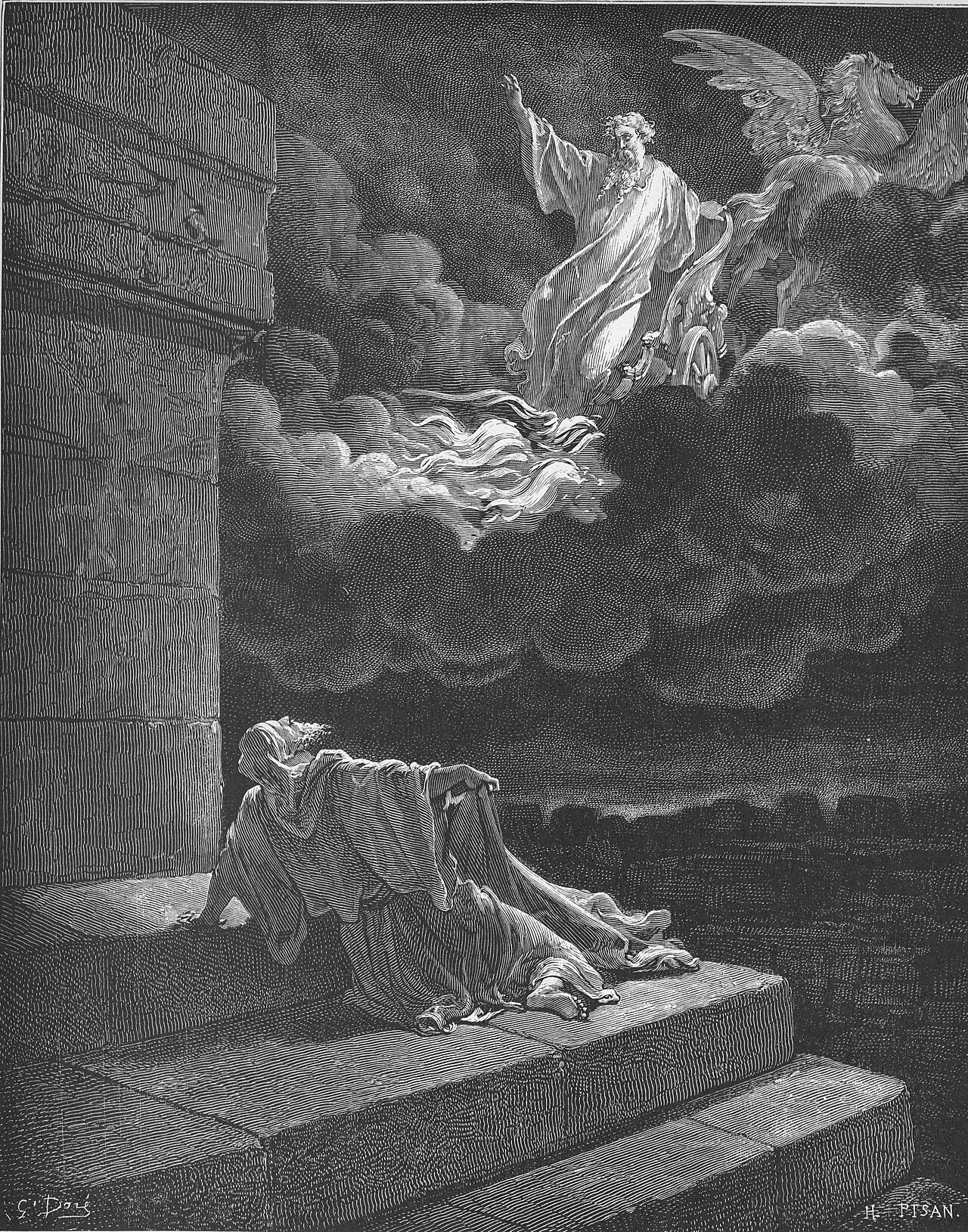
Elisha takes up the mantle that fell from Elijah and carries it back to Jordan alone, and where his master struck the water and asked nothing, Elisha strikes it and asks aloud, where is the Lord God of Elijah. Spurgeon preached a whole sermon from this question, Where Is the God of Elijah, reading it as the standing cry of any generation that has watched an older faith die and wonders whether the same God still answers. The waters part a second time, exactly as they had for Elijah, and Elisha crosses on the same dry ground his master had just walked, Elijah's last miracle becoming Elisha's first with no gap between the two ministries.
The record, by era
The Medieval Church1 voice
The prophets proclaimed the mystery of the Lord's ascension not only by their words but also by their actions. Both Enoch, the seventh [in the line of descent] from Adam, who was transported from the world, and Elijah, who was taken up into heaven, gave …
The Puritans and the Awakening1 voice
Jordan was between him and them; it had been divided to make way for Elijah to his glory; he will try whether it will divide to make way for him to his business, and by that he will know that God is with him, and that he has the double portion of Elijah's spirit. Elijah's last miracle shall be Elisha's first; thus he begins where Elijah left off and there is no vacancy.
The Nineteenth Century3 voices
Where is the Lord God of Elijah? - The Vulgate gives a strange turn to this verse: Et percussit aquas, et non sunt divisae; et dixu, Ubi est Deus Eliae etiam nunc? Percussitque aquas, et divisae sunt huc et illuc. “And he smote the waters, but they did not divide; and he said, Where is the God of Elijah even now?
A commentator
Jamieson, Fausset & Brown1802–1910
Commentary Critical and Explanatory on the Whole Bible (1871)
proposed
smote the waters--The waving of the mantle on the river, and the miraculous division of the waters consequent upon it, was an evidence that the Lord God of Elijah was with him, and as this miracle was witnessed by the scholars of the prophets from Jericho, they forthwith recognized the pre-eminence of Elisha, as now the prophet of Israel.
quarantine:debris (2026-07-29) — starts-lowercase
A commentator
Charles Spurgeon1834–1892
The Metropolitan Tabernacle Pulpit, Sermon No. 2596: “Where Is the God of Elijah?” (lightly modernized text, CCEL edition) · Written before 1892.
proposed
THE great objective for our souls is to seek after our God. We love His House, the place where prayer is apt to be made is very dear to us. But the courts of the Lord's House are dull and dreary if the Lord, Himself, is not there! Our question is not so much, "Where are His courts?" as, "Where is Jehovah, Himself?" Brothers and Sisters, we love beyond expression the ministry of God's Word—it has been unspeakably precious to our spirits! By it we were called into spiritual life and by it our life is fed and nourished.
2 more voices on this verse
The Nineteenth Century2 voices
A commentator
Charles Spurgeon1834–1892
The Metropolitan Tabernacle Pulpit, Sermon No. 2596: “Where Is the God of Elijah?” (lightly modernized text, CCEL edition) · Written before 1892.
proposed
THE great objective for our souls is to seek after our God. We love His House, the place where prayer is apt to be made is very dear to us. But the courts of the Lord's House are dull and dreary if the Lord, Himself, is not there! Our question is not so much, "Where are His courts?" as, "Where is Jehovah, Himself?" Brothers and Sisters, we love beyond expression the ministry of God's Word—it has been unspeakably precious to our spirits! By it we were called into spiritual life and by it our life is fed and nourished. But still, if God, Himself, is not in the Word and with the Word, what does it avail us? Our spirits must be sustained by the Holy Spirit or else they faint and die. In reading a gracious book, or in engaging in private devotion, or in coming into the great assemblies of God's House, our chief question is, "Where is the Lord God of Elijah?"—for if we do not find God in all these things, what have we found? Nothing. Or we have mere husks, whereas the precious, priceless kernel is lost to us! Oh, I wish that we always felt in prayer that we would never leave off praying till we found the God of prayer! I wish that, in our singing, we would always feel that we had not truly praised God at all unless our song had found Him, and every note in it had had some one of His attributes to sing. Oh, what an effort it is, sometimes, to really get at God! We are ready to cry with the poet— "I will approach You—I will force My way through obstacles to You." "I will break through gates of brass, I will leap over the highest wall, but I must get to my God, the living God! Oh, when shall I come and appear before God?" I wish that we were always in this state of mind, that our continual cry might be, "The Lord God of Elijah—we must have Him! We cannot live without Him, we cannot be strong without Him, we cannot rejoice without Him.
A commentator
Albert Barnes1798–1870
Notes, Explanatory and Practical, on the Old and New Testaments (1832-1869)
proposed
Where ... - Some prefer, “Where is the Lord God of Elijah, even he? And when he had smitten, etc.” Or, according to others, “now when he, etc.” Elisha’s smiting of the waters seems to have been tentative. He was not sure of its result. Hence, the form of his invocation - “Where is the Lord God of Elijah? Is He here - i. e. - with me, or is He not?” Answered by the event, he appears never subsequently to have doubted.
How the passage was read
What the Jewish commentators add
Where is Adonoy, the God of Eliyahu? That I was promised that a double portion of his spirit would rest upon me. 9 Alternatively, where is God who does not show me His sign as He showed Eliyahu is the splitting of the water?”—Ralbag
This section is reception history: how the passage was read and kept in the Jewish tradition. Where a reading parts from an essential of the Christian faith, the section says so at that point.
Texts and citation data: Sefaria; each excerpt follows its version’s licence. 5 further sources are cited on this chapter that carry no English text this site may quote or only restate the verse.
The words behind it
25 Hebrew wordsEvery Hebrew word of this verse in the order it stands, with what it means and the door to its own study. The last column counts the times a word stands in the whole Bible: the rarer the word, the more the places it appears belong together.
| Hebrew | Sound | Meaning | Word study | In the Bible |
|---|---|---|---|---|
| וַיִּקַּח֩ | vaiyikach | and he took | H3947 → | 966 times |
| אֶת־ | ʾet- | <obj.> | H853 → | 10935 times |
| אַדֶּ֨רֶת | ʾaderet | [the] cloak of | H155 → | 12 times |
| אֵלִיָּ֜הוּ | ʾeliyahu | Elijah | H452 → | 71 times |
| אֲשֶׁר־ | ʾasher- | which | H834 → | 5497 times |
| נָפְלָ֤ה | nafelah | it had fallen | H5307 → | 435 times |
| מֵֽעָלָיו֙ | mealav | from on <the> him | H5921 → | 5755 times |
| וַיַּכֶּ֣ה | vaiyakeh | and he struck | H5221 → | 499 times |
| אֶת־ | ʾet- | <obj.> | H853 → | 10935 times |
| הַמַּ֔יִם | hamayim | the waters | H4325 → | 581 times |
| וַיֹּאמַ֕ר | vaiyomar | and he said | H559 → | 5305 times |
| אַיֵּ֕ה | ʾaiyeh | where? | H346 → | 45 times |
| יְהוָ֖ה | yahweh | [is] Yahweh | H3068 → | 6520 times |
| אֱלֹהֵ֣י | ʾelohei | [the] God of | H430 → | 2601 times |
| אֵלִיָּ֑הוּ | ʾeliyahu | Elijah | H452 → | 71 times |
| אַף־ | ʾaf- | also | H637 → | |
| ה֣וּא׀ | hu' | he | H1931 → | 1879 times |
| וַיַּכֶּ֣ה | vaiyakeh | and he struck | H5221 → | 499 times |
| אֶת־ | ʾet- | <obj.> | H853 → | 10935 times |
| הַמַּ֗יִם | hamayim | the waters | H4325 → | 581 times |
| וַיֵּֽחָצוּ֙ | vaiyechatzu | and they were divided | H2673 → | |
| הֵ֣נָּה | henah | hither | H2008 → | 49 times |
| וָהֵ֔נָּה | vahenah | and hither | H2008 → | 49 times |
| וַֽיַּעֲבֹ֖ר | vaiyaavor | and he passed over | H5674 → | 556 times |
| אֱלִישָֽׁע׃ | ʾelisha' | Elisha | H477 → | 58 times |
וַיִּקַּח֩and he took
vaiyikachH3947 →966 times
אֶת־<obj.>
ʾet-H853 →10935 times
אַדֶּ֨רֶת[the] cloak of
ʾaderetH155 →12 times
אֵלִיָּ֜הוּElijah
ʾeliyahuH452 →71 times
אֲשֶׁר־which
ʾasher-H834 →5497 times
נָפְלָ֤הit had fallen
nafelahH5307 →435 times
מֵֽעָלָיו֙from on <the> him
mealavH5921 →5755 times
וַיַּכֶּ֣הand he struck
vaiyakehH5221 →499 times
אֶת־<obj.>
ʾet-H853 →10935 times
הַמַּ֔יִםthe waters
hamayimH4325 →581 times
וַיֹּאמַ֕רand he said
vaiyomarH559 →5305 times
אַיֵּ֕הwhere?
ʾaiyehH346 →45 times
יְהוָ֖ה[is] Yahweh
yahwehH3068 →6520 times
אֱלֹהֵ֣י[the] God of
ʾeloheiH430 →2601 times
אֵלִיָּ֑הוּElijah
ʾeliyahuH452 →71 times
אַף־also
ʾaf-H637 →
ה֣וּא׀he
hu'H1931 →1879 times
וַיַּכֶּ֣הand he struck
vaiyakehH5221 →499 times
אֶת־<obj.>
ʾet-H853 →10935 times
הַמַּ֗יִםthe waters
hamayimH4325 →581 times
וַיֵּֽחָצוּ֙and they were divided
vaiyechatzuH2673 →
הֵ֣נָּהhither
henahH2008 →49 times
וָהֵ֔נָּהand hither
vahenahH2008 →49 times
וַֽיַּעֲבֹ֖רand he passed over
vaiyaavorH5674 →556 times
אֱלִישָֽׁע׃Elisha
ʾelisha'H477 →58 times
A shaded row is a word that stands 400 times or fewer in the Bible.
The walk
8 stopsEach card is a verse this one points to, and under it the verses that one points to in turn. Where several paths arrive at the same place, that place is listed first: the text keeps returning to it.
Through
John 14:12Truly, truly, I tell you, whoever believes in Me will also do the works that I am doing. He will do even greater things than these, because I am going to the Father.
it leads to
- Matthew 21:21
“Truly I tell you,” Jesus replied, “if you have faith and do not doubt, not only will you do what was done to the fig tree, but even if you say to this mountain,…
- Mark 16:17
And these signs will accompany those who believe: In My name they will drive out demons; they will speak in new tongues;
- Luke 10:17–19
The seventy-two returned with joy and said, “Lord, even the demons submit to us in Your name.”
- Acts 16:18
She continued this for many days. Eventually Paul grew so aggravated that he turned and said to the spirit, “In the name of Jesus Christ I command you to come out of her!” And…
- Acts 19:12
so that even handkerchiefs and aprons that had touched him were taken to the sick, and the diseases and evil spirits left them.
- Matthew 21:21
Through
Psalms 42:10Like the crushing of my bones, my enemies taunt me, while they say to me all day long, “Where is your God?”
it leads to
- Psalms 42:3
My tears have been my food both day and night, while men ask me all day long, “Where is your God?”
Reached by 2 separate paths from here.
- Joel 2:17
Let the priests who minister before the LORD weep between the portico and the altar, saying, “Spare Your people, O LORD, and do not make Your heritage a reproach, an object of scorn among…
Reached by 2 separate paths from here.
- Psalms 42:3
Through
Psalms 115:2Why should the nations say, “Where is their God?”
it leads to
- Psalms 79:10
Why should the nations ask, “Where is their God?” Before our eyes, make known among the nations Your vengeance for the bloodshed of Your servants.
- Psalms 79:10
Where this verse is studied
On this page
Studies3
On this verse
On this chapter
About 2 Kings
Who and where
2 names in this verse with a page on the site.
- PersonDivided kingdomElijahThe Tishbite who shut heaven for three years and a half, called down fire on Carmel, heard the still small voice at Horeb, and wen…
- PersonDivided kingdomElishaElijah's successor with the firstborn's double portion; the prophet of the healed spring, the widow's oil, the Shunammite's son, N…
This page draws on 9 works. Open the list of works
This page draws on Adam Clarke, Commentary on the Bible; Albert Barnes, Notes, Explanatory and Practical, on the Old and New Testaments (1832-1869); Bede, Homilies on the Gospels 2.15; Charles Spurgeon, The Metropolitan Tabernacle Pulpit, Sermon No. 2596: Where Is the God of Elijah; Charles Spurgeon, The Metropolitan Tabernacle Pulpit, Sermon No. 2596: “Where Is the God of Elijah?” (lightly modernized text, CCEL edition); Jamieson, Fausset & Brown, Commentary Critical and Explanatory on the Whole Bible; John Gill, Exposition of the Old Testament (1748-1763); John Gill, Exposition of the Old Testament and Matthew Henry, Commentary on the Whole Bible.