
2 Kingschapter 25
30 verses · Jeremiah, by tradition · 6th century BC · History
Key verse
And it came to pass in the seven and thirtieth year of the captivity of Jehoiachin king of Judah, in the twelfth month, on the seven and twentieth day of the month, that Evil–merodach king of Babylon in the year that he began to reign did lift up the head of Jehoiachin king of Judah out of prison;
It stands in Jehoiachin lifted out of prison to eat at the king's table, verses 27 to 30.
The chapter
Chapter summary
The ninth year, the tenth month, the tenth day: Nebuchadnezzar encamps against Jerusalem and builds forts round about, and the siege runs to the eleventh year, till famine leaves no bread in the city. The wall is broken, the men of war flee by night, and Zedekiah is overtaken in the plains of Jericho. His sons slain before his eyes, his own eyes put out, and he bound in fetters to Babylon. Nebuzaradan burns the house of Jehovah and every great house and breaks down the walls. Gedaliah's brief governorship at Mizpah ends in murder. The last paragraph is a rumor of hope: Evil-merodach lifts up Jehoiachin's head out of prison and seats him at his table all his days.
Context
History · Jeremiah · 2 Kings overview
The world behind this chapter
2 Kings 25The history
The chapter belongs to Zedekiah until verse 21, then to Gedaliah son of Ahikam, and at the last to Jehoiachin. The time is about eighteen months of siege and then a generation of exile. The siege opens in the ninth year of Zedekiah and the city falls in his eleventh, and the closing scene stands in the thirty-seventh year of Jehoiachin's captivity.
The rest of the history, and what it meant to them
The places are named as the account moves: Jerusalem walled in, the plains of Jericho, Riblah in the land of Hamath, Mizpah, Egypt, and a room in Babylon. The occasion is the rebellion that closed chapter 24.
A first hearer knew that a siege wall built all around a city was the standard Babylonian method, and that famine usually ended it. Blinding a rebel vassal after killing his heirs in front of him was a known punishment for a broken oath. Leaving the poorest of the land to work the vineyards kept the ground producing under a governor.
The fifth month named at verse 8 became a fast still kept generations later, which Zechariah 7 and 8 record. The ostraca found at Lachish, written about 588 BC, are letters from the last months of this war.
What it meant to them
For the exiles this chapter answered the question their whole situation asked. The city fell because the covenant held, and the book had been arguing that from chapter 17 onward.
It also showed them prophecy keeping its word in detail, since Zedekiah was told he would see the king of Babylon and told he would not see Babylon. And it left them something to hold, a man of David's line changing out of prison clothes and eating at a king's table for the rest of his life.
Sources cited
- The Babylonian Chronicles, ABC 5 (BM 21946, the Chronicle of the Chaldean Kings)
- The Lachish Letters (ostraca, c. 588 BC)
- Edwin R. Thiele, The Mysterious Numbers of the Hebrew Kings
- The Jehoiachin ration tablets (Babylon, published by Ernst Weidner, 1939)
Where the chapter sits
2 Kings 25 falls in Manasseh, Josiah, and the fall of Jerusalem (chapters 21–25). Manasseh's long and evil reign; Josiah's reform and the Book of the Law rediscovered; Jehoiakim's rebellion; the 586 BC fall in three deportations; the burning of the temple; Jehoiachin released from prison (25:27–30).
Jerusalem burns; Jehoiachin released. Zedekiah captured; temple burned; walls broken down; at the book's close: Jehoiachin lifted up out of prison and seated at the king's table.
Before it: Hezekiah and the Assyrian crisis, chapters 18–20.
The whole shape of 2 Kings→The structure of this chapter
Threads running through this chapter
- The lamp for David's sakePattern, vv. 27 to 30
The heads below are this chapter's scenes. The numbered points under each are its verses.
A. A breach by night, capture near Jericho, and eyes put out
1. (vv. 1-3)
2 Kings 25:1
“In the ninth year ... - As the final catastrophe approaches, the historian becomes more close and exact in his dates, marking not only the year, but the month and the day, on which the siege began, no less than those on which it closed 2Ki 25:3. From Eze 24:1 we find that on the very day when the host of Nebuchadnezzar made its appearance before Jerusalem the fact was revealed to Ezekiel in Babylonia, and the fate of the city announced to him Eze 24:6-14. The army seems to have at first spread itself over all Judaea.”
2 more voices on this verseWhat preachers and commentators have said about this verse, in their own words.
2 Kings 25:1
“And it came to pass in the ninth year of his reign,.... Of the reign of Zedekiah king of Judah. From hence to the end of 2Ki 25:7, the account exactly agrees with Jer 52:4.”
2 Kings 25:1
“What think you of Nebuchadnezzar? Have you not heard from Scripture that he was bloodthirsty, fierce, with the disposition of a lion? Have you not heard that he disinterred the kings? Have you not heard that he brought the people away into captivity? Have you not heard that he put the king's sons to the sword before Zedekiah's eyes and then blinded him? Have you not heard that he shattered the cherubim?”
Cyril of Jerusalem· written before 386· Catechetical Lecture 2:17-19patristic
2 Kings 25:2
“And the city was besieged, etc. - Nebuchadnezzar, having routed the Egyptian army, returned to Jerusalem, and besieged it so closely that, being reduced by famine, and a breach made in the wall, the Chaldeans entered it on the ninth day of the fourth month, (Wednesday, July 27), Zedekiah and many others endeavoring to make their escape by night.”
Adam Clarke· Commentary on the Bible (1810-1826)evangelical
2 Kings 25:3
“The people - For the common people, but only for the great men. Now they eat their own children for want of food, Lam. iv, 3, &c. Jer. in this extremity, earnestly persuaded the king to surrender; but his heart was hardened to his destruction.”
John Wesley· Explanatory Notes upon the Old Testament (1765)evangelical
in the tenth month: The siege's date is fixed to the day, matching Jer 52:4 almost word for word, and Ezek 24:1-2 has the prophet in Babylon commanded to write down this same day as a sign: son of man, write thee the name of this day, for the king of Babylon set himself against Jerusalem this same day. Two witnesses in two places mark one date. The famine that follows by the eleventh year's fourth month leaves no bread before the wall itself gives way.
2. (vv. 4-5)
2 Kings 25:4
“The city was broken up - Rather, “broken into,” i. e., A breach was made about midnight in the northern wall Eze 9:2, and an entry effected into the second or lower city (see the 2Ki 22:14 note), which was protected by the wall of Manasseh 2Ch 33:14. Precipitate flight followed on the advance of the Babylonians to the “middle gate,” or gate of communication between the upper and the lower cities. This position was only a little north of the royal palace, which the king therefore quitted.”
2 Kings 25:5
“Jeremiah Jer 38:23 and Ezekiel Eze 12:13 had prophesied this capture; and the latter had also prophesied the dispersion of the troops 2Ki 25:14.”
the city was broken up: The escape route by the gate between two walls near the king's garden is recorded in nearly the same words at Jer 39:4, the two accounts running side by side at the moment the wall finally fails. Zedekiah runs for the plain toward Jericho and the army scatters from him, the net of Ezek 12:13 closing exactly as spoken: I will bring him to Babylon, yet shall he not see it. The flight answers a specific prophecy before the capture even lands.
3. (vv. 6-7)
2 Kings 25:6
“To Riblah - See 2Ki 23:33 note. A position from where Nebuchadnezzar could most conveniently superintend the operations against Tyre and Jerusalem. In the absence of the monarch, the siege of Jerusalem was conducted by a number of his officers, the chief of whom were Nebuzar-adan, the captain of the guard, and Nergal-shar-ezer (Neriglissar), the Rab-mag Jer 39:3, Jer 39:13.”
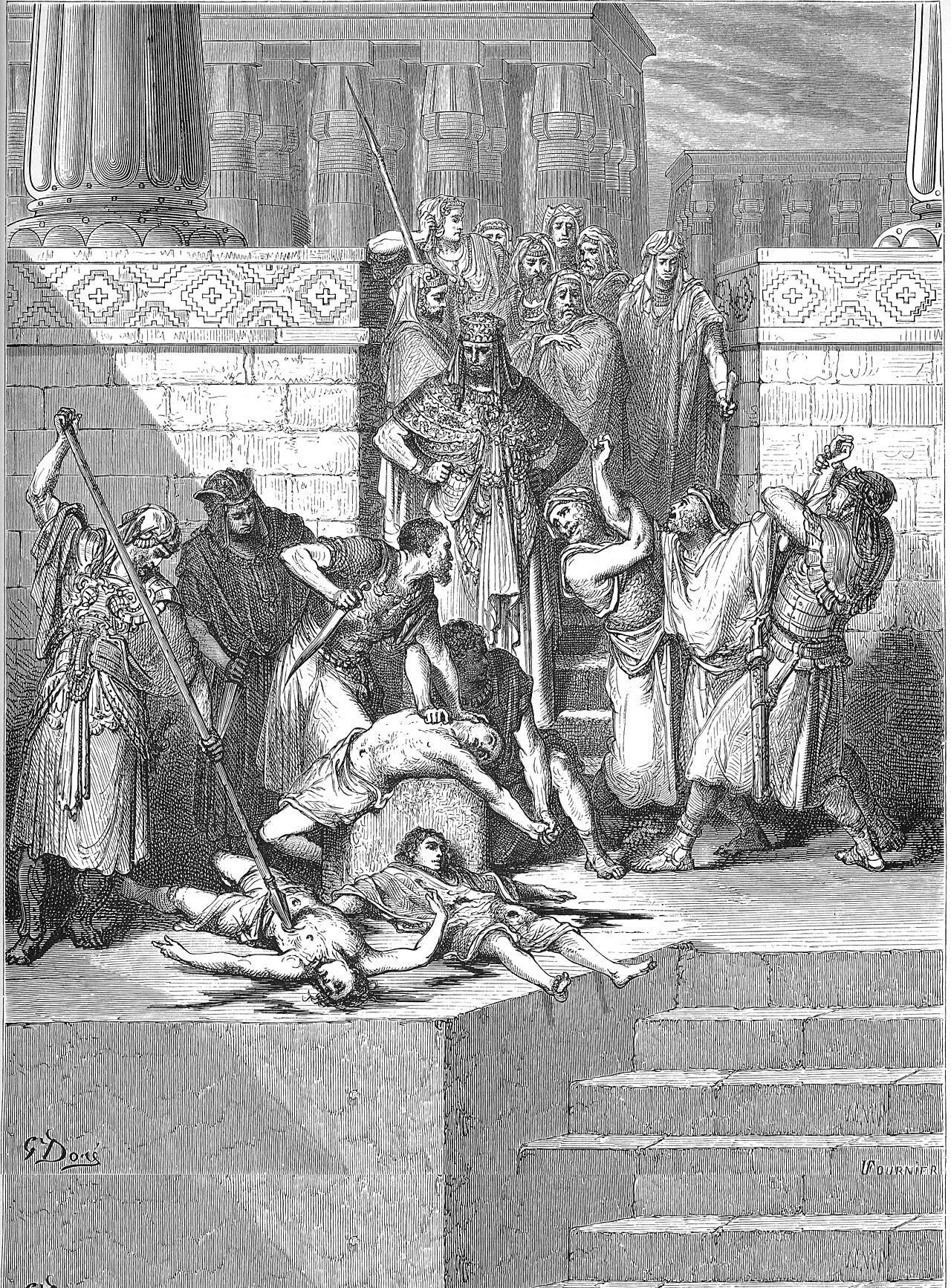
gave judgment upon him: Riblah in the land of Hamath is Nebuchadnezzar's field headquarters, the same place that had already seen Pharaoh-nechoh's judgment on Jehoahaz at 23:33. The sons are slain before the king's own eyes and then those eyes are put out, an order that fulfils two prophecies rather than one: Jer 32:4 promised he would see the king of Babylon eye to eye, and Ezek 12:13 promised he would be carried to Babylon and not see it. Sight is given first and taken second, and both words stand.
B. The house burned, the walls broken, the pillars carried away
1. (vv. 8-10)
2 Kings 25:8
“And in the fifth month, on the seventh day of the month,.... In Jer 52:12 it is the tenth day of the month; which, how to be reconciled; see Gill on Jer 52:12. which is the nineteenth year of King Nebuchadnezzar; who, according to Ptolemy's canon, reigned forty three years; Metasthenes (u) says forty five; and from hence, to the end of 2Ki 25:12 facts are related as in Jer 52:12 whither the reader is referred. (u) De Judicio Temp. & Annal. Pers. fol. 221. 2.”
2 Kings 25:9
“He burnt the house of the Lord - Compare the prophecies of Jeremiah Jer 21:10; Jer 34:2; Jer 38:18, Jer 38:23. Psa 79:1-13 is thought to have been written soon after this destruction of the temple.”
1 more voice on this verse
2 Kings 25:9
“The people having forfeited the promises made concerning it, those promises must be understood of the gospel-temple, which is God's rest for ever. It is observable that the second temple was burnt by the Romans the same month, and the same day of the month, that the first temple was burnt by the Chaldeans, which, Josephus says, was the tenth of August.”
Matthew Henry· Commentary on the Whole Bible (1707-1721)puritan
in the fifth month: The fifth month here becomes the fast Zech 7:3, 7:5 and 8:19 name centuries later, a mourning kept long after the reason for it had passed into history. Nebuzaradan burns the house of the LORD first in the sentence, then the king's house, then every great man's house, the destroyer's order following the builder's own priority of temple before palace. The walls come down last, a formal demolition carried out by the whole army rather than incidental ruin.
2. (vv. 11-12)
2 Kings 25:11
“People - Whom neither the sword nor famine had destroyed, who were eight hundred and thirty two persons, Jer. lii, 29, being members and traders of that city: for it is likely, there were very many more of the country people fled thither, who were left with others of their brethren to manure the land.”
John Wesley· Explanatory Notes upon the Old Testament (1765)evangelical
2 Kings 25:12
“There was probably an intention of seating colonists into the country from some other part of the Empire, as the Assyrians had done in Samaria 2Ki 17:24.”
the rest of the people: The bulk of the surviving population is carried off, and the poorest of the land are left as vinedressers and husbandmen, recorded almost identically at Jer 39:10. Leaving the poor to work the vineyards and fields is the ordinary policy of the conqueror rather than mercy for its own sake, keeping the ground producing under a governor rather than lying wholly to waste. The land is emptied of its leadership and kept, not abandoned.
3. (v. 13)
2 Kings 25:13
“The pillars of brass ... - All the more precious treasures had been already removed from the temple 2Ki 24:13. But there still remained many things, the list of which is given in Jer 52:17-23 much more fully than in this place. Objects in brass, or rather bronze, were frequently carried off by the Assyrians from the conquered nations. Bronze was highly valued, being the chief material both for arms and implements. The breaking up of the pillars, bases, etc., shows that it was for the material, and not for the workmanship, that they were valued.”
1 more voice on this verse
2 Kings 25:13
“When the things signified were sinned away what should the signs stand there for? Ahaz had profanely cut off the borders of the bases, and put the brazen sea upon a pavement of stones ( 2 Kings xvi. 17 ); justly therefore are the brass themselves, and the brazen sea, delivered into the enemy's hand.”
Matthew Henry· Commentary on the Whole Bible (1707-1721)puritan
did the Chaldees break: The two pillars named Jachin and Boaz at their casting, he shall establish and in him is strength, are broken in pieces without their names spoken, the silence itself the point after 1 Ki 7:21 gave them names a worshipper read every time he entered. The molten sea Hiram cast at 1 Ki 7:23-26 goes the same way, and the brass of both is carried to Babylon. What stood roughly three hundred and seventy years from Solomon's dedication ends as scrap metal for a foreign treasury.
4. (vv. 14-17)
2 Kings 25:14
“It was a righteous thing with God to deprive those of the benefit of his worship who had slighted it so long and preferred false worships before it. Those that would have many altars shall now have none. Several of the great men are slain in cold blood--Seraiah the chief priest (who was the father of Ezra as appears, Ezra vii.”
Matthew Henry· Commentary on the Whole Bible (1707-1721)puritan
2 Kings 25:16
“Without weight - The Babylonians did not take the trouble to weigh the brass as they did the gold and silver. In the Assyrian monuments there are representations of the weighing of captured articles in gold and silver in the presence of the royal scribes.”
2 Kings 25:17
Compare with this description the accounts in marginal references. The height of the capital (“three cubits”) must be corrected, in accordance with those passages, to “five cubits.”
the pots, and the shovels: The smaller vessels, pots, shovels, snuffers, spoons and firepans, are taken by their metal, gold set apart from silver, while the bulk brass is simply broken. The pillar's height at eighteen cubits with a three cubit chapiter, the wreathen work and the pomegranates, repeats the casting description of 1 Ki 7:15-16 almost word for word, the inventory that opened the temple's furnishing closing it here in the same terms. The brass of all these vessels was without weight, an echo of the same phrase used of the sea's original casting.
C. Seventy at Riblah: so Judah was carried away out of his landvv. 18-21
took Seraiah the chief priest: Seraiah the chief priest is named as Jehozadak's father at 1 Chr 6:14-15, the priest whose son goes into captivity, and Ezra 7:1 traces Ezra's own priestly line back through this same Seraiah, so the generation that ends the kingdom is also the generation the return will be built from. Zephaniah the second priest is commonly read as the man Zedekiah twice sent to Jeremiah at Jer 21:1 and 37:3, a name that had already crossed the siege narrative before it reaches Riblah. All are slain there, and the chapter closes the formal kingdom in one sentence: so Judah was carried away out of their land.
2 Kings 25:18
“And the captain of the guard took Seraiah the chief priest, and Zephaniah the second priest,.... The sagan, or deputy priest, who officiated for the high priest, when by any means he was rendered unfit and incapable; so Joseph, the son of Ellem, as Josephus (x) relates, officiated for Matthias, when defiled with a nocturnal pollution; and seven days before the day of atonement they always substituted one under the high priest, lest anything of this kind should happen to him (y).”
2 Kings 25:19
“Out of the city - This clause shows that the five persons mentioned in 2Ki 25:18 were taken out of the temple. Five men - Or, “seven men,” according to Jer 52:25. It is impossible to say which of the two numbers is correct. Of them that were in the king’s presence - See the margin. A mode of speech arising from the custom of Eastern rulers to withdraw themselves as much as possible from the view of their subjects.”
2 Kings 25:21
“Now the scripture was fulfilled, The Lord shall bring thee, and the king which thou shalt set over thee, into a nation which thou hast not known, Deut. xxviii. Sin kept their fathers forty years out of Canaan, and now turned them out. The Lord is known by those judgments which he executes, and makes good that word which he has spoken, Amos iii.”
Matthew Henry· Commentary on the Whole Bible (1707-1721)puritan
D. Gedaliah at Mizpah, murdered by a man of the seed royal
1. (vv. 22-24)
2 Kings 25:22
“His father Ahikam was one that countenanced and protected Jeremiah when the princes had vowed his death, Jer. xxvi. It is probable that this Gedaliah, by the advice of Jeremiah, had gone over the Chaldeans, and had conducted himself so well that the king of Babylon entrusted him with the government.”
Matthew Henry· Commentary on the Whole Bible (1707-1721)puritan
1 more voice on this verse
2 Kings 25:22
“Made Gedaliah - ruler - This was no regal dignity; he was only a sort of hind or overseer, appointed to regulate the husbandmen.”
Adam Clarke· Commentary on the Bible (1810-1826)evangelical
2 Kings 25:23
“The captains of the armies - i. e., the officers of the troops who had fled from Jerusalem with Zedekiah 2Ki 25:4, and had then dispersed and gone into hiding 2Ki 25:5. For Mizpah, see Jos 18:26 note. The Netophathite - Netophah, the city of Ephai (compare Jer 40:8), appears to have been in the neighborhood of Bethlehem Neh 7:26; Ezr 2:21-22. The name is perhaps continued in the modern Antubeh, about 2 12 miles S. S. E. of Jerusalem. A Maachathite - Maachah lay in the stony country east of the upper Jordan, bordering upon Bashan Deu 3:14.”
2 Kings 25:24
“As rebels against the Babylonian king, their lives were forfeit. Gedaliah pledged himself to them by oath, that, if they gave no further cause of complaint, their past offences should be forgiven.”
1 more voice on this verse
2 Kings 25:24
“What a fatal breach was made upon them, soon afterwards, by the death of Gedaliah, within two months after he entered upon his government. The utter extirpation of the Jews, for the present, was determined, and therefore it was in vain for them to think of taking root again: the whole land must be plucked up, Jer. xlv.”
Matthew Henry· Commentary on the Whole Bible (1707-1721)puritan
he made Gedaliah the son: Gedaliah's father Ahikam had kept Jeremiah from being put to death at Jer 26:24, and his grandfather Shaphan was the scribe who read the newly found book of the law before Josiah at 22:8-10, three generations serving the same prophetic word across the kingdom's last decades. Gedaliah's oath to the captains, fear not to be the servants of the Chaldees, dwell in the land, matches Jeremiah's own counsel at Jer 27 and 29 to submit and seek the city's peace rather than resist. A family with a record of protecting God's word governs the ruin it could not prevent.
2. (vv. 25-26)
2 Kings 25:25
“Smote Gedaliah - This was at an entertainment which Gedaliah had made for them; see Jer 41:1, etc. He was not content with this murder, but slew fourscore more, who were coming with offerings to the temple, and took several as prisoners, among whom were some of the king’s daughters; and set off to go to the Ammonites: but Johanan, the son of Careah, hearing of these outrages, raised a number of men, and pursued Ishmael upon which Ishmael’s prisoners immediately turned and joined Johanan; so that he, and eight of his accomplices, with difficulty escaped to the Ammonites.”
Adam Clarke· Commentary on the Bible (1810-1826)evangelical
1 more voice on this verse
2 Kings 25:25
“The generous governor, though apprised of his intentions, refused to credit the report, much less to sanction the proposal made by an attached friend to cut off Ishmael. The consequence was, that he was murdered by this same Ishmael, when entertaining him in his own house (Jer 41:1).”
Jamieson, Fausset & Brown· Commentary Critical and Explanatory on the Whole Bible (1871)reformed
2 Kings 25:26
“And all the people, both small and great,.... High and low, rich and poor, among whom were the king's daughters, committed to the care of Gedaliah, and also the prophets Jeremiah and Baruch, see Jer 41:16. and the captains of the armies rose, and came to Egypt; contrary to the express command of God; these were Johanan, and the captain of the forces with him, Jer 43:4. for they were afraid of the Chaldees; lest they should come and avenge the death of Gedaliah, appointed governor of Judea, see Jer 41:17.”
2 more voices on this verse
2 Kings 25:26
“In the twelfth year of king Zedekiah, seventy years before the dominance of the Persians, Nebuchadnezzar campaigned against the Phoenicians and Jews, as Berossus says in his "Researches on the Chaldeans." Juba, writing "On the Assyrians," admits that he took his account from Berossus, testifying to its accuracy. Nebuchadnezzar blinded Zedekiah and removed him to Babylon, deporting the whole people except a few who escaped to Egypt. The captivity lasted for seventy years. Jeremiah and Habakkuk continued to prophesy under Zedekiah, and in the fifth year of his reign Ezekiel was prophesying in Babylon.”
Clement of Alexandria· written before 215· The Stromata Book 1patristic
2 Kings 25:26
“Thus was there a full end made of them by their own folly and disobedience, and Egypt had the last of them, that the last verse of that chapter of threatenings might be fulfilled, after all the rest, Deut. xxviii. 68 , The Lord shall bring thee into Egypt again. These events are more largely related by the prophet Jeremiah, ch. xl. to ch. xlv.”
Matthew Henry· Commentary on the Whole Bible (1707-1721)puritan
of the seed royal: Ishmael is himself of David's line, and the text records the murder without stating a motive beyond that, leaving the fuller account of Baalis king of Ammon's part in Jer 40:14 where it lies, in Jeremiah rather than here. Fear of Chaldean reprisal drives the remnant to Egypt, the exodus run in reverse, small and great together. Jer 43:6-7 records Jeremiah himself carried along against his own counsel, the prophet who had told them not to go forced into the very land he had warned against.
E. Jehoiachin lifted out of prison to eat at the king's table
1. (v. 27)
2 Kings 25:27
“The captivity of Jehoiachin commenced in the year 597 B.C. - the eighth year of Nebuchadnezzar. It terminated 561 B.C. - the first year of Evil-merodach, the son and successor of Nebuchadnezzar. He reigned only two years, being murdered by his brother-in-law, Neriglissar, or Nergal-shar-ezer. He is said to have provoked his fate by lawless government and intemperance.”
2 more voices on this verse
2 Kings 25:27
“Seven and twentieth - Or, on the twenty fifth day, as it is, Jer. lii, 31. For then the decree was made, which was executed upon the twenty seventh day.”
John Wesley· Explanatory Notes upon the Old Testament (1765)evangelical
2 Kings 25:27
Jeremiah calls this son of Jehoiakim Jeconiah, and the Pharaoh Neco called the father of this man, though named Eliakim, Jehoiakim, whom Babylon, having carried off, cast forth before the gate, as the present prophet and Josephus in the tenth book of his Antiquities says. And the other editions have given the signet ring as a seal. And every person who through repentance makes shine again what is according to the image becomes a seal, a ring on the "right hand of God."
Origen of Alexandria· written before 253· FRAGMENTS FROM THE CATENA ON JEREMIAH 14patristic
the captivity of Jehoiachin: The thirty-seventh year and the twelfth month set the date against Jer 52:31, which gives the twenty-fifth day where this verse gives the twenty-seventh, a two-day variance the commentators name honestly rather than resolve. Evil-merodach, Nebuchadnezzar's son and successor, lifts up the head of Jehoiachin in the very year he begins to reign, the same idiom Pharaoh's butler hears at Gen 40:13, restoration and rank rather than a mere accounting. Thirty-seven years is most of a man's working life spent in a Babylonian prison before this word comes.
2. (vv. 28-30)
2 Kings 25:28
“The kings that were with him - Probably captive kings, like Jehoiachin himself. Compare Jdg 1:7.”
2 Kings 25:29
“However the death of afflicted saints is to them such a change as this was to Jehoiachin: it will release them out of their prison, shake off the body, that prison-garment, and open the way to their advancement; it will send them to the throne, to the table, of the King of kings, the glorious liberty of God's children.”
Matthew Henry· Commentary on the Whole Bible (1707-1721)puritan
1 more voice on this verse
2 Kings 25:29
“Evil-merodach gave him garments befitting his rank. To dress a man suitably to his position was the first thought of an Oriental Gen 41:42; Est 8:15; Dan 5:29; Luk 15:22. So again, Oriental kings regarded it as a part of their greatness to feed daily a vast multitude of persons at their courts (see 1Ki 4:22-23). Of these, as here, a certain number had the special privilege of sitting actually at the royal board, while the others ate separately, generally at a lower level. See Jdg 1:7; 2Sa 9:13; 1Ki 2:7; Psa 41:9.”
2 Kings 25:30
“A continual allowance given him of the king - He lived in a regal style, and had his court even in the city of Babylon, being supplied with every requisite by the munificence and friendship of the king. In about two years after this, Evil-merodach was slain in a conspiracy; and it is supposed that Jehoiachin, then about fifty-eight years of age, fell with his friend and protector. Thus terminates the catastrophe of the Jewish kings, people, and state; the consequence of unheard-of rebellions and provocations against the Majesty of heaven.”
Adam Clarke· Commentary on the Bible (1810-1826)evangelical
above the throne of: The lamp promised for David's sake at 1 Ki 11:36, 15:4 and 2 Ki 8:19 narrows across two books to one living man, and here it is kept, not as a throne recovered in Jerusalem but as a captive's seat raised above the other kings at a foreign table. Matt 1:11-12 carries Jechonias by this same name through this exact door into the genealogy of Christ. The prison garments are changed and the phrase all the days of his life is set down twice, once for the bread and once for the allowance, as if written twice to stand against reversal, and the scroll of Kings ends here, on a kept word in a strange land.
This page carries no textual note on 2 Kings 25. Where this site has examined a place the manuscripts differ, the examination is in the manuscripts room. Every place this site examines →
Keep studying
On this page
Studies6
On this book
Sources for this chapter
The summary
Jamieson, Fausset & Brown, Commentary Critical and Explanatory; John Wesley, Notes on the Old Testament and Matthew Henry, Complete Commentary.
The context
Keil, The Books of the Kings and Matthew Henry, Commentary on the Whole Bible.
The exposition
Adam Clarke, Commentary on the Bible; Albert Barnes, Notes on the Old Testament; F. W. Farrar, The Second Book of Kings (Expositor's Bible); Jamieson, Fausset and Brown, Commentary Critical and Explanatory on the Whole Bible; John Gill, Exposition of the Old Testament; John Wesley, Explanatory Notes upon the Old Testament; Keil, The Books of the Kings and Matthew Henry, Commentary on the Whole Bible.