
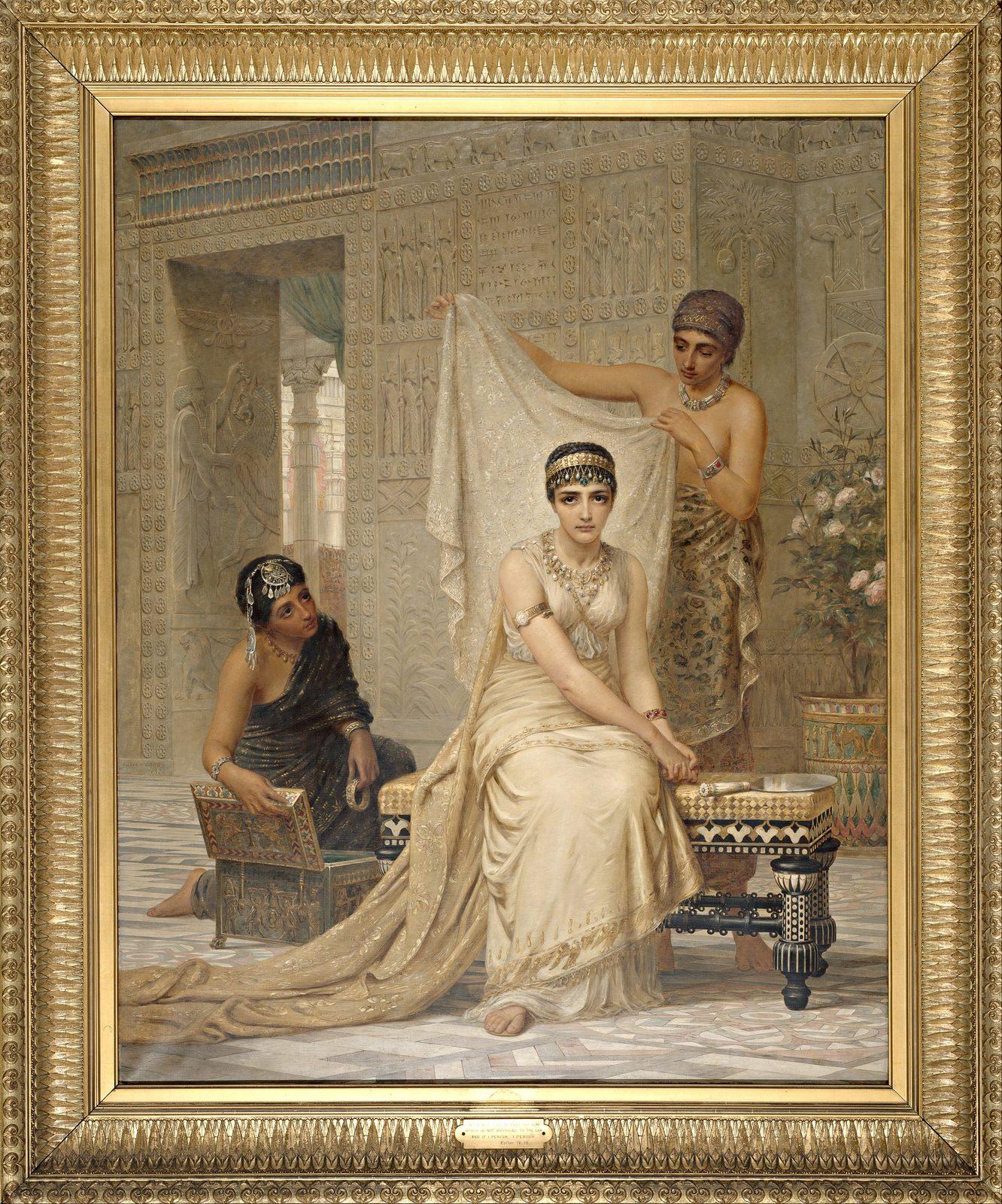
Edwin Long, Queen Esther, 1878. Public domain.
Esther 2 to 9 · Person · Featured Study
Esther the Queen
Esther was a Jewish orphan of Susa, raised by her cousin Mordecai, who became the queen of King Xerxes.
She went in to the king against the law of the inner court.
“Go and assemble all the Jews who can be found in Susa, and fast for me. Do not eat or drink for three days, night or day, and I and my maidens will fast as you do. After that, I will go to the king, even though it is against the law. And if I perish, I perish!”
- The name means
- Hadassah, a myrtle, by Barnes's reading
- Family
- father: Abihail; cousin and foster father: Mordecai; husband: King Xerxes
- Places
- Susa
- First named
- Esther 2:7 “…brought up Hadassah (that is, Esther), the daughter…”
- Last named
- Esther 9:32 “So Esther’s decree confirmed…”
Summary
Esther kept her people secret at Mordecai's word until a decree marked them for death. Then she pleaded for them at her own table and at the feet of the king.
- She was taken to the king in the tenth month, the month of Tebeth, in the seventh year of his reign.
- The king gave her the estate of Haman, and she set Mordecai over it.
- Her Hebrew name, Hadassah, stands only in Esther 2:7.
Where Esther Stands in Scripture
Every verse that names her stands in the book that bears her name.
The Hebrew name Esther stands 55 times in 45 verses.
And Mordecai had brought up Hadassah (that is, Esther), the daughter of his uncle, because she did not have a father or mother. The young woman was lovely in form and appearance, and when her father and mother had died, Mordecai had taken her in as his own daughter.Her story begins in Mordecai's care.
Her Life, Turn by Turn
Her life runs from the house of Hegai to the feet of the king.
Esther moved from hiding her people to pleading for them before the king.
- Placed under the care of Hegai with the young womenThe harem of the palaceEsther 2:8
- Wins the king's love above all the other womenThe royal palaceEsther 2:17
- Fasts three days with her maidensSusaEsther 4:16
- Touches the tip of the gold scepterThe inner courtEsther 5:2
- Holds back her request until a second banquetHer banquetEsther 5:8
- Asks the king for her life and the lives of her peopleHer second banquetEsther 7:3
- Falls weeping at the king's feet to undo Haman's schemeBefore the kingEsther 8:3
- Asks for a second day for the Jews of SusaBefore the kingEsther 9:13
Each turn of her life stands with the verse that records it.
Falls weeping at the king's feet to undo Haman's scheme, Asks for a second day for the Jews of Susa
The Secret She Kept
She hid her people for years and named them on the day she asked for their lives.
Esther did not reveal her people or her lineage, because Mordecai had instructed her not to do so.The charge sets the secret she keeps until Esther 7.
Esther 2:20 adds that she kept it after her crowning, obeying Mordecai as she had under his care.
For my people and I have been sold out to destruction, death, and annihilation. If we had merely been sold as menservants and maidservants, I would have remained silent, because no such distress would justify burdening the king.”Her request names her people to the king for the first time.
Esther 8:1 records that she then told the king how Mordecai was related to her.
Hadassah and Esther
Commentators read her two names as words of two languages.
Albert Barnes derives Hadassah from the Hebrew word for myrtle and takes Esther for her Persian name. He reports the reading of Esther as star and adds that no kindred word is yet known in Old Persian.
John Wesley holds that Hadassah was her name before her marriage and that the king called her Esther after it. Adam Clarke takes Hadassah for her Babylonian name and Esther for a Persian word for a star.
The Circle of Esther
Her father and her cousin stand around her in the text, with six people of the court.
Her family is her father and her cousin, and the rest of her circle belongs to the court of the king.
| Person | Generation | Tie to Esther |
|---|---|---|
| Abihail | 1 | Her father, who was the uncle of Mordecai |
| Mordecai | 2 | Her cousin, who raised her as his own daughter |
| King Xerxes | Her husband, who set the royal crown on her head | |
| Vashti | The queen whose place she took | |
| Hegai | The eunuch in charge of the women, who moved her to the best place in the harem | |
| Shaashgaz | He was the king's eunuch in charge of the concubines | |
| Hathach | One of the king's eunuchs, appointed to serve her | |
| Her maidens | They were given to her in the harem and fasted with her |
Hathach, Her maidens
The Places of Her Life
Her story stands in the citadel of Susa, from the harem to the banquet hall.
Esther moved from the women's house to the inner court of the king.
| Place | What Scripture tells of it |
|---|---|
| The citadel of Susa | The royal city where the young women were gathered under Hegai. |
| The harem | Hegai moved her and her seven maidservants to its best place. |
| The inner court | She stood there in her royal attire on the third day, across from the king's quarters. |
| The banquet hall | She was reclining on a couch there when the king came back from the garden. |
Questions Her Life Raises
Two questions are answered from the text and its commentators.
Why did Mordecai tell her to hide her people?Esther 2:10, with Matthew Poole, C. F. Keil, Albert Barnes and John Gill
Matthew Poole reads the charge as a guard against contempt for her or harm to the whole nation, and sees the hand of God in the secret. Keil holds that a Jewish girl would hardly have received such kind treatment in the harem.
Barnes answers that the Persians held no special contempt for the Jews, and that with her name she may have passed for a Persian. Gill reports Aben Ezra's view that the secret let her keep the law of God in private.
Did Esther sin in becoming the king's wife?Esther 2:17, with Matthew Henry and Joseph Benson
Matthew Henry, in his Concise Commentary, answers that those who charge her with sin forget the custom of the time, by which every woman the king took was his wife. Joseph Benson holds that Mordecai went against the Jewish law if he sought the marriage, and allows that he may have hoped to serve his nation by it.
What the Text Leaves Unsaid
Two questions about her story belong to other studies.
The prayer the Greek additions give her, and the Hebrew book's silence about God, are studied on their own pages.
If I Perish, I Perish
Gill, Poole, Keil and the Cambridge Bible read her answer to Mordecai four ways.
Her answer to Mordecai in Esther 4:16 ends with the words if I perish, I perish.
John Gill hears a woman who readily risked her life for her people and left herself in the hands of God. Matthew Poole reads a choice to go to the king rather than neglect her duty to God and his people.
Keil calls the words an expression of resignation, a full submission to the providence of God. The Cambridge Bible reads them more simply: she accepts the risk and owns that it must be taken.
Voices on Esther
Clement of Rome counted her among the women who faced death for their people.
Clement of Rome (died 99)
1 CLEMENT 55.3-6
Clement wrote near the end of the first century.
“Many women, fortified by the grace of God, have accomplished many heroic actions. The blessed Judith, when the city was besieged, asked permission of the elders to be allowed to go into the foreigners' camp. By exposing herself to danger she went out for love of her country and of the people who were besieged, and the Lord delivered Holophernes into the hand of a woman. To no less danger did Esther, who was perfect in faith, expose herself, in order to save the twelve tribes of Israel that were to be destroyed.”
on Esther 4:16Patristic
The Second Day in Susa
Commentators give three judgments of her request in Esther 9:13.
Esther replied, “If it pleases the king, may the Jews in Susa also have tomorrow to carry out today’s edict, and may the bodies of Haman’s ten sons be hanged on the gallows.”Her request came after five hundred deaths in Susa on the first day.
Justice on enemies still in hidingJohn Gill; Jamieson, Fausset and Brown; Matthew Poole
Gill holds that many enemies had hidden on the first day, and that Esther sought the justice of God and the peace of her people rather than private revenge. Jamieson, Fausset and Brown, and Poole, also read the second day as a guard against enemies who returned when the first decree had run out.
The objection: Ellicott holds that after the first day the Jews were already masters of the city.
A needless slaughterEllicott's Commentary for English Readers
Ellicott finds it impossible to acquit her of blood thirst, since the court already favoured the Jews. He calls the second day needless butchery.
The objection: the Pulpit Commentary holds that we lack the facts to judge, and that Mordecai, who knew the city, likely prompted her.
A judgment the facts do not allowThe Pulpit Commentary; the Cambridge Bible for Schools and Colleges
The Pulpit Commentary grants that the request looks bloodthirsty, yet cannot call it unjustifiable without fuller knowledge. The Cambridge Bible adds that her view of revenge was that of her own time.
The objection: Ellicott holds that the hanging of the dead sons shows the spirit of the request plainly.
The Queen's Last Act
The secret kept in Esther 2 ends in a decree written for all the Jews.
So Esther’s decree confirmed these regulations about Purim, which were written into the record.Her decree set the feast of Purim in writing.
Sources
Scripture is the Berean Standard Bible.
- Strong's Hebrew lexicon, h635 and h1919, with the index of every use.
- Albert Barnes, Notes, Explanatory and Practical, on the Old and New Testaments (1832 to 1869), on Esther 2:7 and 2:10.
- John Wesley, Explanatory Notes upon the Old Testament (1765), on Esther 2:7.
- Adam Clarke, Commentary on the Bible (1832), on Esther 2:7.
- Matthew Poole, Annotations; C. F. Keil, Biblical Commentary (1873); John Gill, Exposition of the Old Testament (1748 to 1763), each on Esther 2:10.
- Matthew Henry, Concise Commentary, on Esther 2:1 to 20; Joseph Benson, Commentary, on Esther 2:10.
- John Gill, Exposition; Matthew Poole, Annotations; C. F. Keil, Biblical Commentary; the Cambridge Bible for Schools and Colleges, each on Esther 4:16.
- John Gill, Exposition; Jamieson, Fausset and Brown; Matthew Poole; Ellicott's Commentary for English Readers; the Pulpit Commentary; the Cambridge Bible for Schools and Colleges, each on Esther 9:13.
- Clement of Rome, 1 Clement 55.3 to 6.
Keep Studying
Read it4
Studies1
People and groups5
Places1
Subjects7
Go further7