
Daniel 6:17
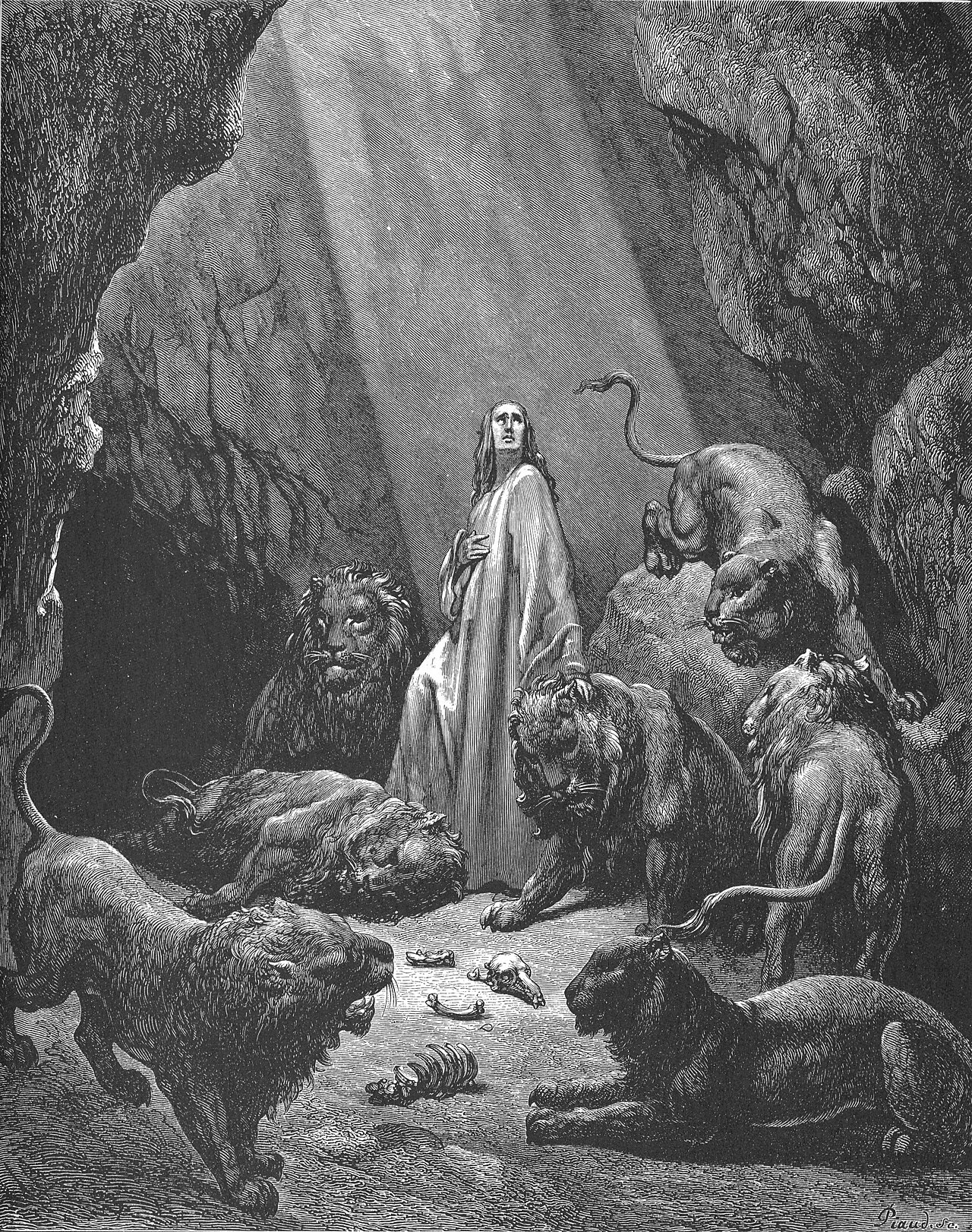
in Daniel 6A stone was brought and placed over the mouth of the den, and the king sealed it with his own signet ring and with the rings of his nobles, so that nothing concerning Daniel could be changed.
BSB
The same verse in ASV and KJV ▾
ASV
And a stone was brought, and laid upon the mouth of the den; and the king sealed it with his own signet, and with the signet of his lords; that nothing might be changed concerning Daniel.
KJV
And a stone was brought, and laid upon the mouth of the den; and the king sealed it with his own signet, and with the signet of his lords; that the purpose might not be changed concerning Daniel.
⋯
This verse in Daniel 6
Commentary
10 notes on this verseVerse 17. "A single stone was brought and placed over the opening of the pit, and the king sealed it with his ring..." He sealed with his ring the rock by which the opening of the pit was shut up, so that the enemies of Daniel might not make any attempt to harm him. For he had entrusted him to the power of God, and although not worried about lions, he was fearful of men. He also sealed it with the ring of his nobles, in order to avoid all ground for suspicion so far as they were concerned.
This site's exposition
threw him into the den
on Daniel 6:16-17
The king says to Daniel, “May your God, whom you serve continually, deliver you!”, words from the king who has just condemned him. The stone is sealed “with his own signet ring and with the rings of his nobles, so that nothing concerning Daniel could be changed”.
This site's exposition
his own signet ring
The double seal guarded against both sides. Jerome read the king's ring as protection from Daniel's enemies, and Hippolytus of Rome read the nobles' rings as their guard against a secret rescue. Adam Clarke and Matthew Henry compared the sealed stone to the sealing of Christ's tomb.
The record, by era
The Church Fathers2 voices
"And they brought a stone and set at the mouth of the den and the king sealed it with his signet ring," [Daniel 6:17] that the matter may not be changed regarding Daniel. And this was a malicious deed, for the satraps were cautious, lest secretly the king command Daniel to be drawn out of the den and so they thought fit to seal the stone. In which manner also the chiefs of the Pharisees did to the Savior having sealed the stone with a guard. [Matthew 27:66]
Certainly it had been decided by Darius to save Daniel from the present danger with any possible means; therefore he sealed the entrance of the den with his own signet and invited the satraps to do the same. This had to be done for two …
The Puritans and the Awakening2 voices
), that unhappy signet with which he had confirmed the law that Daniel falls by. But his lords cannot trust him, unless they add their signets too. Thus, when Christ was buried, his adversaries sealed the stone that was rolled to the door of his sepulchre.
quarantine:debris (2026-07-29) — leading-punctuation+unbalanced-parens
And a stone was brought, and laid upon the mouth of the den,....
The Nineteenth Century1 voice
A commentator
Albert Barnes1798–1870
Notes, Explanatory and Practical, on the Old and New Testaments (1832-1869)
And a stone was brought, and laid upon the mouth of the den - Probably a large flat stone sufficient to cover the mouth of the cave, and so heavy that Daniel could not remove it from within and escape. It was usual then, as it is now, to close up the entrance to sepulchres with a large stone. See Joh 11:38; Mat 27:
2 more voices on this verse
The Nineteenth Century2 voices
A commentator
Jamieson, Fausset & Brown1802–1910
Commentary Critical and Explanatory on the Whole Bible (1871)
proposed
stone . . . sealed--typical of Christ's entombment under a seal (Mt 27:66). Divinely ordered, that the deliverance might be the more striking. his own signet, and . . . of his lords--The concurrence of the lords was required for making laws. In this kingly power had fallen since it was in Nebuchadnezzar's hands.
quarantine:debris (2026-07-29) — starts-lowercase
A stone was brought - All this precaution served the purposes of the Divine Providence. There could be no trick nor collusion here; if Daniel be preserved, it must be by the power of the Supreme God. The same precaution was taken by the Jews, in the case of the burial of our blessed Lord; and this very thing has served as one of the strongest proofs of the certainty of his resurrection and their unmixed wickedness.
The words behind it
17 Hebrew wordsEvery Hebrew word of this verse in the order it stands, with what it means and the door to its own study. The last column counts the times a word stands in the whole Bible: the rarer the word, the more the places it appears belong together.
| Hebrew | Sound | Meaning | Word study | In the Bible |
|---|---|---|---|---|
| וְהֵיתָ֙יִת֙ | veheitayit | and it was brought | H858 → | 16 times |
| אֶ֣בֶן | ʾeven | a stone | H69 → | 8 times |
| חֲדָ֔ה | chadah | one | H2298 → | 14 times |
| וְשֻׂמַ֖ת | vesumat | and it was set | H7761 → | 26 times |
| עַל־ | ʾal- | over | H5922 → | 104 times |
| פֻּ֣ם | pum | [the] mouth of | H6433 → | 6 times |
| גֻּבָּ֑א | guba' | den the | H1358 → | 10 times |
| וְחַתְמַ֨הּ | vechatmah | and he sealed it | H2857 → | |
| מַלְכָּ֜א | malka' | king the | H4430 → | 180 times |
| בְּעִזְקְתֵ֗הּ | beizketeh | with signet-ring his | H5824 → | |
| וּבְעִזְקָת֙ | uveizkat | and with [the] signet-rings of | H5824 → | |
| רַבְרְבָנ֔וֹהִי | ravrevanohi | nobles his | H7261 → | 8 times |
| דִּ֛י | di | that | H1768 → | 345 times |
| לָא־ | la'- | not | H3809 → | 82 times |
| תִשְׁנֵ֥א | tishne' | it will change | H8133 → | 21 times |
| צְב֖וּ | tzevu | anything | H6640 → | |
| בְּדָנִיֵּֽאל׃ | bedaniyel | with Daniel | H1841 → | 57 times |
וְהֵיתָ֙יִת֙and it was brought
veheitayitH858 →16 times
אֶ֣בֶןa stone
ʾevenH69 →8 times
חֲדָ֔הone
chadahH2298 →14 times
וְשֻׂמַ֖תand it was set
vesumatH7761 →26 times
עַל־over
ʾal-H5922 →104 times
פֻּ֣ם[the] mouth of
pumH6433 →6 times
גֻּבָּ֑אden the
guba'H1358 →10 times
וְחַתְמַ֨הּand he sealed it
vechatmahH2857 →
מַלְכָּ֜אking the
malka'H4430 →180 times
בְּעִזְקְתֵ֗הּwith signet-ring his
beizketehH5824 →
וּבְעִזְקָת֙and with [the] signet-rings of
uveizkatH5824 →
רַבְרְבָנ֔וֹהִיnobles his
ravrevanohiH7261 →8 times
דִּ֛יthat
diH1768 →345 times
לָא־not
la'-H3809 →82 times
תִשְׁנֵ֥אit will change
tishne'H8133 →21 times
צְב֖וּanything
tzevuH6640 →
בְּדָנִיֵּֽאל׃with Daniel
bedaniyelH1841 →57 times
A shaded row is a word that stands 400 times or fewer in the Bible.
The walk
8 stopsEach card is a verse this one points to, and under it the verses that one points to in turn. Where several paths arrive at the same place, that place is listed first: the text keeps returning to it.
Through
Acts 12:4He arrested him and put him in prison, handing him over to be guarded by four squads of four soldiers each. Herod intended to bring him out to the people after the Passover.
it leads to
- Proverbs 19:21
Many plans are in a man’s heart, but the purpose of the LORD will prevail.
- Luke 22:33
“Lord,” said Peter, “I am ready to go with You even to prison and to death.”
- Luke 21:12
But before all this, they will seize you and persecute you. On account of My name they will deliver you to the synagogues and prisons, and they will bring you before kings and governors.
- John 13:36–38
“Lord, where are You going?” Simon Peter asked. Jesus answered, “Where I am going, you cannot follow Me now, but you will follow later.”
- Acts 4:28
They carried out what Your hand and will had decided beforehand would happen.
- Proverbs 19:21
Through
Lamentations 3:53They dropped me alive into a pit and cast stones upon me.
it leads to
- Jeremiah 38:9
“My lord the king, these men have acted wickedly in all that they have done to Jeremiah the prophet. They have dropped him into the cistern, where he will starve to death, for there…
- Jeremiah 38:6
So they took Jeremiah and dropped him into the cistern of Malchiah, the king’s son, which was in the courtyard of the guard. They lowered Jeremiah with ropes into the cistern, which had no…
- Jeremiah 37:16
So Jeremiah went into a cell in the dungeon and remained there a long time.
- Jeremiah 38:9
Where this verse is studied
On this page
About Daniel
Who and where
1 name in this verse with a page on the site.
This page draws on 10 works. Open the list of works
This page draws on Adam Clarke, Commentary on the Bible; Albert Barnes, Notes, Explanatory and Practical, on the Old and New Testaments (1832-1869); Carl Friedrich Keil, Biblical Commentary on the Book of Daniel; Ephrem the Syrian, COMMENTARY ON DANIEL 6:17; Hippolytus of Rome, Commentary on Daniel 3.27.3-5; Jamieson, Fausset & Brown, Commentary Critical and Explanatory on the Whole Bible; Jamieson, Fausset, and Brown, Commentary Critical and Explanatory on the Whole Bible; Jerome, St. Jerome, Commentary on Daniel, CHAPTER SIX; John Gill, Exposition of the Old Testament (1748-1763) and Matthew Henry, Commentary on the Whole Bible.