
Ephesians 4:9
in Ephesians 4What does “He ascended” mean, except that He also descended to the lower parts of the earth?
BSB
The same verse in ASV and KJV ▾
ASV
(Now this, He ascended, what is it but that he also descended into the lower parts of the earth?
KJV
(Now that he ascended, what is it but that he also descended first into the lower parts of the earth?
⋯
This verse in Ephesians 4
Commentary
62 notes on this verseBut what is it that ascends except that which also descends into the lower parts of the earth? He who is said to have ascended, ascended because he had descended before. This means: 'But what is it that ascends except that which has also descended.' Therefore, we must look into that which is written elsewhere: 'No one has ascended into heaven except he who descended from heaven, the Son of Man' (John 3:13), how did he ascend before descending?
This site's exposition
he saith, When he ascended up on high, he led captivity captive
on Ephesians 4:8-10
He saith quotes Psalm 68:18, a victory psalm for the ark's ascent to Zion, now read of Christ's ascension; the Hebrew text there reads received gifts among men where Paul writes gave gifts unto men, a known difference some read as Paul's own inspired application, the conquering king receiving tribute in order to distribute it to his own people, and others trace to a Jewish reading tradition already reading the verse that way. Descended first into the lower parts of the earth divides commentators along Tier A lines: the fathers and the creed's own line read a descent to Hades between the cross and the resurrection, Calvin reads the descent as the incarnation itself, humiliation rather than a passage after death, and a third reading takes the lower parts as simply the grave. First Peter 3:19 is the passage most often set beside this one, and none of the three readings is pressed to a verdict here.
The record, by era
The Church Fathers5 voices
A commentator
OecumeniusCommentary on the Epistle to the Ephesians, IV, 7-13 · Written before 550.
proposed
Therefore he said, "When he ascended on high." And that the gift is Christ's grace, and he himself gave it out, listen to David: "And when he ascended on high," he says, "Your magnificence was raised above the heavens." Whom did he lead captive? Us, …
The truth incarnate is that he is said to have descended in order to ascend, unlike humans, who have descended in order to remain there. For by decree they were held in the lower world. But this decree could not hold the Savior. He has …
A commentator
Augustine of HippoLetter 164 (A.D. 414), Sections 2, 3, 6, 8, 10 · Written in the 5th century.
proposed
After having said that "Christ was put to death in the flesh, and quickened in the spirit," the apostle immediately went on to say: "in which also He went and preached unto the spirits in prison; which sometime were unbelieving, when once the long-suffering of God waited in the days of Noah, while the ark was a preparing, wherein few, that is, eight souls were saved by water;" thereafter he added the words: "which baptism also now by a like figure has saved you." [1 Peter 3:18-21] This, therefore, is felt by me to be difficult. If the Lord when He died preached in hell to spirits in prison, why were those who continued unbelieving while the ark was a preparing the only ones counted worthy of this favour, namely, the Lord's descending into hell? For in the ages between the time of Noah and the passion of Christ, there died many thousands of so many nations whom He might have found in hell. I do not, of course, speak here of those who in that period of time had believed in God, as, e.g. the prophets and patriarchs of Abraham's line, or, going farther back, Noah himself and his house, who had been saved by water (excepting perhaps the one son, who afterwards was rejected), and, in addition to these, all others outside of the posterity of Jacob who were believers in God, such as Job, the citizens of Nineveh, and any others, whether mentioned in Scripture or existing unknown to us in the vast human family at any time. I speak only of those many thousands of men who, ignorant of God and devoted to the worship of devils or of idols, had passed out of this life from the time of Noah to the passion of Christ. How was it that Christ, finding these in hell, did not preach to them, but preached only to those who were unbelieving in the days of Noah when the ark was a preparing? […]
For this reason the warders of Hades trembled when they saw Him; and the gates of brass and the bolts of iron were broken. For, lo, the Only-begotten entered, a soul among souls, God the Word with a (human) soul. For His body lay in the tomb, not emptied of divinity; but as, while in Hades, He was in essential being with His Father, so was He also in the body and in Hades. For the Son is not contained in space, just as the Father; and He comprehends all things in Himself. But of His own will he dwelt in a body animated by a soul, in order that with His soul He might enter Hades, and not with His pure divinity.
Something strange is happening - there is a great silence on earth today, a great silence and stillness. The whole earth keeps silence because the King is asleep. The earth trembled and is still because God has fallen asleep in the flesh and he has …
55 more voices on this verse
The Church Fathers37 voices
Sheol saw me and was shattered, and Death ejected me and many with me. I have been vinegar and bitterness to it, and I went down with it as far as its depth. Then the feet and the head it released, because it was not …
He showed all power given by the Father to the Son [Matthew 28:18], who is ordained Lord of things in heaven, and things on earth, and things under the earth, and Judge of all [Philippians 2:10]: of things in heaven, because He was born, the Word of God, before all (ages); and of things on earth, because He became man in the midst of men, to re-create our Adam through Himself; and of things under the earth, because He was also reckoned among the dead, preaching the Gospel to the souls of the saints [1 Peter 3:19], (and) by death overcoming death.
He [John the Baptist] also first preached to those in Hades, becoming a forerunner there when he was put to death by Herod, that there too he might intimate that the Saviour would descend to ransom the souls of the saints from the hand of death.
A commentator
IrenaeusAgainst Heresies (Book IV, Chapter 22), Sections 1-2 · Written before 202.
proposed
As Jeremiah declares, "The holy Lord remembered His dead Israel, who slept in the land of sepulture; and He descended to them to make known to them His salvation, that they might be saved." For this reason also were the eyes of the disciples weighed down when Christ's passion was approaching; and when, in the first instance, the Lord found them sleeping, He let it pass — thus indicating the patience of God in regard to the state of slumber in which men lay; but coming the second time, He aroused them, and made them stand up, in token that His passion is the arousing of His sleeping disciples, on whose account "He also descended into the lower parts of the earth," to behold with His eyes the state of those who were resting from their labours, in reference to whom He did also declare to the disciples: "Many prophets and righteous men have desired to see and hear what ye do see and hear." For it was not merely for those who believed on Him in the time of Tiberius Caesar that Christ came, nor did the Father exercise His providence for the men only who are now alive, but for all men altogether, who from the beginning, according to their capacity, in their generation have both feared and loved God, and practised justice and piety towards their neighbours, and have earnestly desired to see Christ, and to hear His voice. Wherefore He shall, at His second coming, first rouse from their sleep all persons of this description, and shall raise them up, as well as the rest who shall be judged, and give them a place in His kingdom.
A commentator
IrenaeusAgainst Heresies (Book IV, Chapter 33), Section 1 · Written before 202.
proposed
...all the prophets announced His two advents: the one, indeed, in which He became a man subject to stripes, and knowing what it is to bear infirmity, and sat upon the foal of an ass, and was a stone rejected by the builders, and was led as a sheep to the slaughter, and by the stretching forth of His hands destroyed Amalek; while He gathered from the ends of the earth into His Father's fold the children who were scattered abroad, and remembered His own dead ones who had formerly fallen asleep, and came down to them that He might deliver them...
A commentator
IrenaeusAgainst Heresies (Book V, Chapter 31), Section 1-2 · Written before 202.
proposed
Since, again, some who are reckoned among the orthodox go beyond the pre-arranged plan for the exaltation of the just, and are ignorant of the methods by which they are disciplined beforehand for incorruption, they thus entertain heretical opinions. For the heretics, despising the handiwork of God, and not admitting the salvation of their flesh, while they also treat the promise of God contemptuously, and pass beyond God altogether in the sentiments they form, affirm that immediately upon their death they shall pass above the heavens and the Demiurge, and go to the Mother (Achamoth) or to that Father whom they have feigned. Those persons, therefore, who disallow a resurrection affecting the whole man (universam reprobant resurrectionem), and as far as in them lies remove it from the midst [of the Christian scheme], how can they be wondered at, if again they know nothing as to the plan of the resurrection? For they do not choose to understand, that if these things are as they say, the Lord Himself, in whom they profess to believe, did not rise again upon the third day; but immediately upon His expiring on the cross, undoubtedly departed on high, leaving His body to the earth. […]
A commentator
Origen of AlexandriaCommentary on Romans, Book 5, Section 37 · Written before 253.
proposed
If, on the other hand, as it reads in some manuscripts, "even in those who did not sin in the likeness of Adam's transgression," this death, namely that which was keeping souls bound in the underworld, is said to exercise dominion, then we shall understand it to mean that even the saints had fallen prey to that death certainly under the law of dying, even if not under the punishment of sin. But it was on this account that Christ descended into the underworld, not only because he would not be held by death [Acts 2:24], but also in order that he might release those who were held there, as we said, not so much through the crime of transgression as much as by the condition of dying. As it is written, "Many bodies of saints who were sleeping were resurrected with him and entered into the holy city." [Matthew 27:52-53] In this as well the prophet's sayings were fulfilled, in which he said of Christ, "In ascending on high he led captivity captive." [Ephesians 4:8-9] Thus by his own resurrection he has already destroyed the dominions of death, which is also why it is written that he set captivity free.
A commentator
Eusebius of CaesareaChurch History (Book I), Chapter 13, Section 19 · Written before 339.
proposed
But tomorrow assemble for me all your citizens, and I will preach in their presence and sow among them the word of God, concerning the coming of Jesus, how he was born; and concerning his mission, for what purpose he was sent by the Father; and concerning the power of his works, and the mysteries which he proclaimed in the world, and by what power he did these things; and concerning his new preaching, and his abasement and humiliation, and how he humbled himself, and died and debased his divinity and was crucified, and descended into Hades, and burst the bars which from eternity had not been broken, and raised the dead; for he descended alone, but rose with many, and thus ascended to his Father.
The Enemy, therefore, beholding in Him such power, saw also in Him an opportunity for an advance, in the exchange, upon the value of what he held. For this reason he chooses Him as a ransom for those who were shut up in the prison of death. But it was out of his power to look on the unclouded aspect of God; he must see in Him some portion of that fleshly nature which through sin he had so long held in bondage. Therefore it was that the Deity was invested with the flesh, in order, that is, to secure that he, by looking upon something congenial and kindred to himself, might have no fears in approaching that supereminent power; and might yet by perceiving that power, showing as it did, yet only gradually, more and more splendour in the miracles, deem what was seen an object of desire rather than of fear... His choosing to save man is a testimony of his goodness; His making the redemption of the captive a matter of exchange exhibits His justice, while the invention whereby He enabled the Enemy to apprehend that of which he was before incapable, is a manifestation of supreme wisdom... For since, as has been said before, it was not in the nature of the opposing power to come in contact with the undiluted presence of God, and to undergo His unclouded manifestation, therefore, in order to secure that the ransom in our behalf might be easily accepted by him who required it, the Deity was hidden under the veil of our nature, that so, as with ravenous fish, the hook of the Deity might be gulped down along with the bait of flesh, and thus, life being introduced into the house of death, and light shining in darkness, that which is diametrically opposed to light and life might vanish; for it is not in the nature of darkness to remain when light is present, or of death to exist when life is active.
A commentator
Gregory of NyssaOf the three days between the death and resurrection of our Lord Jesus (De tridui inter mortem et resurrectionem domini nostri Jesu), Section 3 · Written before 395.
proposed
What shall we learn of the three days' time? [...] This one hath loosed the oath of death, this one hath comforted the firstborn of the dead, in this one the iron gates of death are broken down, in this one the brass of the rod of hell are broken. Now the prison of death is opened, now the prisoners are declared to be released... As the ruler of darkness could not approach the presence of the Light unimpeded, had he not seen in Him something of flesh, then, as soon as he saw the God-bearing flesh and saw the miracle performed through it by the Deity, he hoped that if he came to take hold of the flesh through death, then he would take hold of all the power contained in it. Therefore, having swallowed the bait of the flesh, he was pierced by the hook of the Deity and thus the dragon was transfixed by the hook.
A commentator
Athanasius of Alexandria296–373
Letter 59 To Epictetus, Sections 5-6 · Written before 373.
proposed
But in the Body which was circumcised, and carried, and ate and drank, and was weary, and was nailed on the tree and suffered, there was the impassible and incorporeal Word of God. This Body it was that was laid in a grave, when the Word had left it, yet was not parted from it, to preach, as Peter says, also to the spirits in prison. And this above all shews the foolishness of those who say that the Word was changed into bones and flesh. For if this had been so, there were no need of a tomb. For the Body would have gone by itself to preach to the spirits in Hades. But as it was, He Himself went to preach, while the Body Joseph wrapped in a linen cloth, and laid it away at Golgotha. And so it is shewn to all that the Body was not the Word, but Body of the Word.
A commentator
Athanasius of Alexandria296–373
Councils of Ariminum and Seleucia, Section 8 · Written before 373.
proposed
We know that He, the Only-begotten Son of God, at the Father's bidding came from the heavens for the abolishment of sin, and was born of the Virgin Mary, and conversed with the disciples, and fulfilled the Economy according to the Father's will, and was crucified, and died and descended into the parts beneath the earth, and regulated the things there, Whom the gate-keepers of hell saw (Job xxxviii. 17, LXX.) and shuddered; and He rose from the dead the third day, and conversed with the disciples, and fulfilled all the Economy, and when the forty days were full, ascended into the heavens, and sitteth on the right hand of the Father, and is coming in the last day of the resurrection in the glory of the Father, to render to every one according to his works.
He departed from Sheol and took up His abode in the Kingdom; that He might seek out a path from Sheol which oppresses all, to the Kingdom which requites all. For our Lord gave His resurrection as a pledge to mortals, that He would remove …
It is the Son, too, who ascends to the heights of heaven, [John 3:13] and also descends to the inner parts of the earth. [Ephesians 4:9]
It is the Son, too, who ascends to the heights of heaven, and also descends to the inner parts of the earth. "He sitteth at the Father's right hand " -not the Father at His own.
But what is that which is removed to Hades after the separation of the body; which is there detained; which is reserved until the day of judgment; to which Christ also, on dying, descended? I imagine it is the souls of the patriarchs.
By ourselves the lower regions (of Hades) are not supposed to be a bare cavity, nor some subterranean sewer of the world, but a vast deep space in the interior of the earth, and a concealed recess in its very bowels; inasmuch as we read that Christ in His death spent three days in the heart of the earth, [Matthew 12:40] that is, in the secret inner recess which is hidden in the earth, and enclosed by the earth, and superimposed on the abysmal depths which lie still lower down. Now although Christ is God, yet, being also man, "He died according to the Scriptures," [1 Corinthians 15:3] and "according to the same Scriptures was buried." With the same law of His being He fully complied, by remaining in Hades in the form and condition of a dead man; nor did He ascend into the heights of heaven before descending into the lower parts of the earth, that He might there make the patriarchs and prophets partakers of Himself. [1 Peter 3:19]
Furthermore in the matter which you placed last in your confidential letter, I am surprised that any intelligent Christian should be in difficulty as to whether when Christ descended to the realms below, his flesh rested in the tomb: for as it truly died and was buried, so it was truly raised the third day.
"But what is 'ascend' except that he also first descended into the lower parts of the earth?" The ascent involves the descent. For since he had previously descended and procured our salvation, he ascended again. For the wall of the lower parts of the earth …
The strong root of your faith, spoken of in days [Philippians 1:5] long gone by, endureth even until now, and bringeth forth fruit to our Lord Jesus Christ, who for our sins suffered even unto death, [but] "whom God raised from the dead, having loosed the pains of Hades." [quoting variant Acts 2:24 found in a few manuscripts of the so-called "Western" text]
Trypho: We ask you first of all to tell us some of the Scriptures which you allege have been completely cancelled. Justin: I shall do as you please... And since this passage from the sayings of Jeremiah is still written in some copies [of the Scriptures] in the synagogues of the Jews (for it is only a short time since they were cut out)... And again, from the sayings of the same Jeremiah these have been cut out: 'The Lord God remembered His dead people of Israel who lay in the graves; and He descended to preach to them His own salvation.'
If, therefore, those who were brought up in the ancient order of things have come to the possession of a new hope, no longer observing the Sabbath, but living in the observance of the Lord's Day, on which also our life has sprung up again by Him and by His death-whom some deny, by which mystery we have obtained faith, and therefore endure, that we may be found the disciples of Jesus Christ, our only Master-how shall we be able to live apart from Him, whose disciples the prophets themselves in the Spirit did wait for Him as their Teacher? And therefore He whom they rightly waited for, being come, raised them from the dead.
He really, and not merely in appearance, was crucified, and died, in the sight of beings in heaven, and on earth, and under the earth. By those in heaven I mean such as are possessed of incorporeal natures; by those on earth, the Jews and Romans, and such persons as were present at that time when the Lord was crucified; and by those under the earth, the multitude that arose along with the Lord. For says the Scripture, "Many bodies of the saints that slept arose," their graves being opened. He descended, indeed, into Hades alone, but He arose accompanied by a multitude; and rent asunder that means of separation which had existed from the beginning of the world, and cast down its partition-wall. He also rose again in three days, the Father raising Him up; and after spending forty days with the apostles, He was received up to the Father, and "sat down at His right hand, expecting till His enemies are placed under His feet."
They then caused to be read a paper which they held in their hands, containing another form of the creed: this had indeed been drawn up at Sirmium, but had been kept concealed, as we have before observed, until their present publication of it at …
A commentator
Melito of SardisNew Fragment #3:4-5, lines 24-36, as quoted by Stuart George Hall in 'Melito of Sardis: On Pascha and Fragments' (2012 revised edition), pp. 62-96 · Written before 180.
proposed
By the cross death is destroyed, and by the cross salvation shines; by the cross the gates of hell are burst, and by the cross the gates of paradise are opened... the cross is the destroyer of hell.
A commentator
Cyril of AlexandriaCommentary on Luke, SERMON XLIX, 9:18-22 · Written before 444.
proposed
For that He utterly abolished death, and effaced destruction, and spoiled hell, and overthrew the tyranny of the enemy, and took away the sin of the world, and opened the gates above to the dwellers upon earth, and united earth to heaven: these things proved Him to be, as I said, in truth God.
But where have the Scriptures said that He was buried, and on the third day shall rise again? By the type of Jonah which also Himself alleges, saying, "As Jonah was three days and three nights in the whale's belly, so shall also the Son of Man be three days and three nights in the heart of the earth." [Matthew 12:40] By the bush in the desert. For even as that burned, yet was not consumed, [Exodus 3:2] so also that body died indeed, but was not holden of death continually. And the dragon also in Daniel shadows out this. For as the dragon having taken the food which the prophet gave, burst asunder in the midst; even so Hades having swallowed down that Body, was rent asunder, the Body of itself cutting asunder its womb and rising again.
As though he had said, Why art thou high-minded? The whole is of God. The Prophet saith in the Psalm, "Thou hast received gifts among men" whereas the Apostle saith, "He gave gifts unto men." The one is the same as the other.
When thou hearest these words, think not of a mere removal from one place to another; for what Paul establishes in the Epistle to the Philippians, that very argument is he also insisting upon here. In the same way as there, when exhorting them concerning lowliness, he brings forward Christ as an example, so does he here also, saying, "He descended into the lower parts of the earth." For were not this so, this expression which he uses, "He became obedient even unto death," were superfluous; whereas from His ascending, he implies His descent, and by "the lower parts of the earth," he means "death," according to the notions of men; as Jacob also said, "Then shall ye bring down my gray hairs with sorrow to the grave." And again as it is in the Psalm, "Lest I become like them that go down into the pit," that is like the dead. Why does he descant upon this region here? And of what captivity does he speak? Of that of the devil; for He took the tyrant captive, the devil, I mean, and death, and the curse, and sin. Behold His spoils and His trophies. "Now this, He ascended, what is it but that He also descended?" This strikes at Paul of Samosata and his school.
When thou hearest these words, think not of a mere removal from one place to another; for what Paul establishes in the Epistle to the Philippians, that very argument is he also insisting upon here. In the same way as there, when exhorting them concerning lowliness, he brings forward Christ as an example, so does he here also, saying, "He descended into the lower parts of the earth." For were not this so, this expression which he uses, "He became obedient even unto death," were superfluous; whereas from His ascending, he implies His descent, and by "the lower parts of the earth," he means "death," according to the notions of men; as Jacob also said, "Then shall ye bring down my gray hairs with sorrow to the grave." And again as it is in the Psalm, "Lest I become like them that go down into the pit," that is like the dead. Why does he descant upon this region here? And of what captivity does he speak? Of that of the devil; for He took the tyrant captive, the devil, I mean, and death, and the curse, and sin. Behold His spoils and His trophies. "Now this, He ascended, what is it but that He also descended?" This strikes at Paul of Samosata and his school. "He that descended, is the same also that ascended far above all the Heavens, that He might fill all things." He descended, saith he, into the lower parts of the earth, beyond which there are none other: and He ascended up far above all things, to that place, beyond which there is none other. This is to show His divine energy, and supreme dominion. For indeed even of old had all things been filled.
Thus the law of God proclaims: when the Highest became lowly, Hell gave way, so that Adam might be lifted from Death; the Lord, having mercy on his own creation, descended into the tomb, and thus through hidden power, he nullified the power of Death. …
Who is my opponent? I, he says, am the Christ. I am the one who destroyed death, and triumphed over the enemy, and trampled Hades under foot, and bound the strong one, and carried off man to the heights of heaven, I, he says, am …
A commentator
Aphrahat the Persian SageDemonstration 17 (Of Christ the Son of God), Section 10 · Written before 345.
proposed
Now Christ was delivered from the sword, and ascended from out of Sheol, and revived and rose the third day, and so God abode for His help.
He was truly laid as Man in a tomb of rock; but rocks were rent asunder by terror because of Him. He went down into the regions beneath the earth, that thence also He might redeem the righteous. For, tell me, could thou wish the living only to enjoy His grace, and that, though most of them are unholy; and not wish those who from Adam had for a long while been imprisoned to have now gained their liberty? Esaias the Prophet proclaimed with loud voice so many things concerning Him; would you not wish that the King should go down and redeem His herald? David was there, and Samuel, and all the Prophets, John himself also, who by his messengers said, Are you He that should come, or look we for another [Matthew 11:3]? Would you not wish that He should descend and redeem such as these? But He who descended into the regions beneath the earth came up again; and Jesus, who was buried, truly rose again the third day. And if the Jews ever worry you, meet them at once by asking thus: Did Jonah come forth from the whale on the third day, and has not Christ then risen from the earth on the third day?
A commentator
Cyril of JerusalemCatechetical Lecture 13, Sections 33-34 · Written before 386.
proposed
He cried to the Father, saying, Father, into Your hands I commend My spirit [Luke 23:46]; I commend it, that I may take it again. And having said these things, He gave up the ghost [Matthew 27:50]; but not for any long time, for He quickly rose again from the dead. The Sun was darkened, because of the Sun of Righteousness [Malachi 4:2]. Rocks were rent, because of the spiritual Rock. Tombs were opened, and the dead arose, because of Him who was free among the dead; He sent forth His prisoners out of the pit wherein is no water [Zechariah 9:11].
That He descended into hell is also evidently foretold in the Psalms, where it is said, "You have brought Me also into the dust of the death." And again, "What profit is there in my blood, when I shall have descended into corruption?" And again, "I descended into the deep mire, where there is no bottom." Moreover, John says, "Are You He that shall come (into hell, without doubt), or do we look for another?" Whence also Peter says that "Christ being put to death in the flesh, but quickened in the Spirit which dwells in Him, descended to the spirits who were shut up in prison, who in the days of Noah believed not, to preach unto them;" where also what He did in hell is declared. Moreover, the Lord says by the Prophet, as though speaking of the future, "You will not leave my soul in hell, neither will You suffer Your Holy One to see corruption." Which again, in prophetic language he speaks of as actually fulfilled, "O Lord, You have brought my soul out of hell: You have saved me from them that go down into the pit"... He returned, therefore, a victor from the dead, leading with Him the spoils of hell. For He led forth those who were held in captivity by death, as He Himself had foretold, when He said, "When I shall be lifted up from the earth I shall draw all unto Me." To this the Gospel bears witness, when it says, "The graves were opened, and many bodies of saints which slept arose, and appeared unto many, and entered into the holy City"...
Light's glittering morn bedecks the sky, heaven thunders forth its victor cry, the glad earth shouts its triumph high, and groaning hell makes wild reply: While he, the King of glorious might, treads down death's strength in death's despite, and trampling hell by victor's right, brings forth his sleeping Saints to light. Fast barred beneath the stone of late in watch and ward where soldiers wait, now shining in triumphant state, He rises Victor from death's gate.
The Medieval Church9 voices
A commentator
Thomas AquinasQuestion 52. Christ's descent into hell, Article 1 · Written before 1274.
proposed
Since it was fitting for Christ to die in order to deliver us from death, so it was fitting for Him to descend into hell in order to deliver us also from going down into hell. Hence it is written (Hosea 13:14): "O death, I …
A commentator
Thomas AquinasQuestion 52. Christ's descent into hell, Article 2 · Written before 1274.
proposed
These words of Peter [1 Peter 3:19] are referred by some to Christ's descent into hell: and they explain it in this sense: "Christ preached to them who formerly were unbelievers, and who were shut up in prison"—that is, in hell—"in spirit"—that is, by His …
A commentator
Thomas AquinasQuestion 52. Christ's descent into hell, Article 4 · Written before 1274.
proposed
I answer that, As Christ, in order to take our penalties upon Himself, willed His body to be laid in the tomb, so likewise He willed His soul to descend into hell. But the body lay in the tomb for a day and two nights, …
A commentator
Thomas AquinasQuestion 52. Christ's descent into hell, Article 6 · Written before 1274.
proposed
When Christ descended into hell, all who were in any part of hell were visited in some respect: some to their consolation and deliverance, others, namely, the lost, to their shame and confusion.
Speaking here of humility, Paul points to Christ as an example, just as in the Epistle to the Philippians (Phil. 2:8), saying: as He did not refuse to descend, so you too should not refuse to humble yourselves through humility. And that He descended is …
A commentator
Theophylact of OhridExposition on the Letter to the Ephesians, Chapter 4, Verses 8 & 9-10 · Written before 1107.
proposed
But he ascended to the summit, either by the cross or by the assumption of heaven, which is even more important, as is clear from what follows. But what captivity does he mean? The captivity of the devil: for he captured the devil, and death, …
Moreover, after your departure I learned from information given me by my most beloved sons the deacons that your Love had said that our Almighty Lord and Saviour Jesus Christ, when He descended into hell, saved all who there acknowledged Him as God, and delivered them from the pains due to them. With regard to this subject I desire that your Charity should think very differently. For, when He descended into hell, He delivered through His grace those only who both believed that He should come and observed His precepts in their lives... Considering, therefore, all these things, hold nothing but what the true faith teaches through the Catholic Church: namely, that the Lord in descending into hell rescued from infernal durance those only whom while living in the flesh He preserved through His grace in faith and good conduct.
A commentator
John DamasceneAn Exposition of the Orthodox Faith (Book III), Chapter 29 · Written before 749.
proposed
The soul when it was deified descended into Hades, in order that, just as the Sun of Righteousness [Malachi 4:2] rose for those upon the earth, so likewise He might bring light to those who sit under the earth in darkness and shadow of death [Isaiah 9:2]: in order that just as He brought the message of peace to those upon the earth, and of release to the prisoners, and of sight to the blind , and became to those who believed the Author of everlasting salvation and to those who did not believe a reproach of their unbelief [1 Peter 3:19], so He might become the same to those in Hades: That every knee should bow to Him, of things in heaven, and things in earth and things under the earth. [Philippians 2:10] And thus after He had freed those who had been bound for ages, straightway He rose again from the dead, showing us the way of resurrection.
In reflecting upon this point, it appears improper for Christ, who is true God, to lower himself, since nothing is more eminent than God. To remove any doubts on this score the Apostle asserts, Now, that he ascended, what is it, but because he also …
The Puritans and the Awakening2 voices
As much as if he had said, "When David speaks of Christ's ascension, he intimates the knowledge he had of Christ's humiliation on earth; for, when it is said that he ascended, this implies that he first descended: for what is it but a proof or demonstration of his having done so?" Into the lower parts of the earth; this may refer either to his incarnation, according to that of David, Ps. cxxxix.
Now that he ascended,....
The Nineteenth Century5 voices
A commentator
Jamieson, Fausset & Brown1802–1910
Commentary Critical and Explanatory on the Whole Bible (1871)
Christ, as Lord of all, took possession first of the earth the unseen world beneath it (some conjecture that the region of the lost is in the central parts of our globe), then of heaven (Ac 2:27, 28). However, all we surely know is, that His soul at death descended to Hades, that is, underwent the ordinary condition of departed spirits of men.
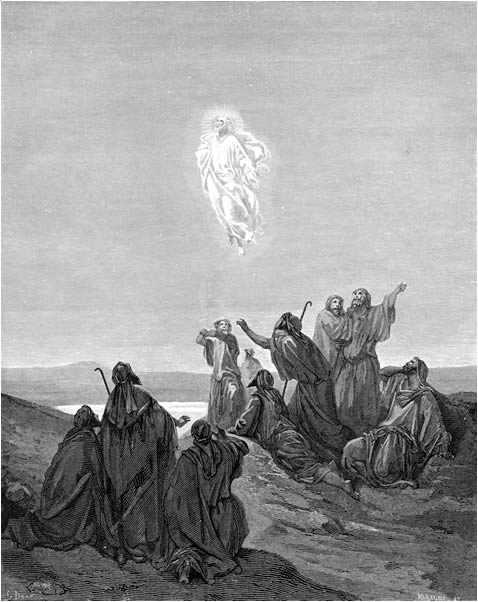
OUR blessed Lord and Master has gone from us. From the mount of Olives, the place where in dread conflict his garments were rolled in blood, he has mounted in triumph to his throne. After having shown himself for forty days amongst his beloved disciples, giving them abundant evidence that he had really risen from the dead, and enriching them by his divine counsels, he was taken up. Slowly rising before them all, he gave them his blessing as he disappeared.
OUR blessed Lord and Master has gone from us. From the mount of Olives, the place where in dread conflict his garments were rolled in blood, he has mounted in triumph to his throne. After having shown himself for forty days amongst his beloved disciples, giving them abundant evidence that he had really risen from the dead, and enriching them by his divine counsels, he was taken up. Slowly rising before them all, he gave them his blessing as he disappeared. Like good old Jacob, whose departing act was to bestow a benediction on his twelve sons and their descendants, so ere the cloud received our Lord out of our sight, he poured a blessing upon the apostles, who were looking upward, and who were the representatives of his church. He is gone! His voice of wisdom is silent for us, his seat at the table is empty, the congregation on the mountain hears him no more. It would be very easy to have found reasons why he should not have gone. Had it been a matter of choice to us, we should have entreated him to tarry with us till the dispensation closed. Unless, peradventure, grace had enabled us to say: “Not as we will! but as thou wilt,” we should have constrained him, saying, “Abide with us.” What a comfort to disciples to have their own beloved teacher visibly with them! What a consolation to a persecuted band to see their leader at their head; difficulties would disappear, problems would be solved, perplexities removed, trials made easy, temptations averted! Let Jesus himself, their own dear Shepherd be near, and the sheep will lie down in security. Had he been here we could have gone to him in every affliction, like those of whom it is said, “they went and told Jesus.” It seemed expedient for him to stay, to accomplish the conversion of the world.
But that he also descended - The meaning of the apostle appears to be this: The person who ascended is the Messiah, and his ascension plainly intimates his descension; that is, his incarnation, humiliation, death, and resurrection.
A commentator
Albert Barnes1798–1870
Notes, Explanatory and Practical, on the Old and New Testaments (1832-1869)
proposed
Now that he ascended - That is, it is affirmed in the Psalm that he “ascended” - “Thou hast ascended on high.” This implies that there must have been a previous “descent;” or, as applicable to the Messiah, “it is a truth that he previously descended.” It is by no means certain that Paul meant to say that the “word” “ascended” demonstrated that there must have been a previous descent; but he probably means that in the case of Christ there was, “in fact,” a descent into the lower parts of the earth first.
Modern Voices2 voices
The final place of torment is Gehenna, which I take as the lake of fire. There is an intermediate place of torment, which is located within Hades. We can tell they are distinct because at a certain point, death and Hades are thrown into the …
"Wilson blithely asserts that the "Jewish name for Elysium was Abraham's bosom, or Paradise". Where is the evidence for that?" This is my "quacks like a duck" argument. Hades had two compartments, Tartarus and Elysium. The New Testament uses the names of two of these …
The words behind it
16 Greek wordsEvery Greek word of this verse in the order it stands, with what it means and the door to its own study. The last column counts the times a word stands in the whole Bible: the rarer the word, the more the places it appears belong together.
| Greek | Sound | Meaning | Word study | In the Bible |
|---|---|---|---|---|
| τὸ | to | <the> | G3588 → | 19766 times |
| δὲ | de | And | G1161 → | 2765 times |
| ἀνέβη, | anebe | He ascended, | G305 → | 82 times |
| τί | ti | what | G5101 → | 563 times |
| ἐστιν | estin | is [this] | G1510 → | 2333 times |
| εἰ | ei | only | G1487 → | 508 times |
| μὴ | me | except | G3361 → | 1066 times |
| ὅτι | hoti | that | G3754 → | 1292 times |
| καὶ | kai | also | G2532 → | 9120 times |
| κατέβη | katebe | He descended | G2597 → | |
| εἰς | eis | into | G1519 → | 1755 times |
| τὰ | ta | the | G3588 → | 19766 times |
| κατώτερα | katotera | lower | G2737 → | |
| μέρη | mere | regions | G3313 → | |
| τῆς | tes | of the | G3588 → | 19766 times |
| γῆς; | ges | earth? | G1093 → | 248 times |
τὸ<the>
toG3588 →19766 times
δὲAnd
deG1161 →2765 times
ἀνέβη,He ascended,
anebeG305 →82 times
τίwhat
tiG5101 →563 times
ἐστινis [this]
estinG1510 →2333 times
εἰonly
eiG1487 →508 times
μὴexcept
meG3361 →1066 times
ὅτιthat
hotiG3754 →1292 times
καὶalso
kaiG2532 →9120 times
κατέβηHe descended
katebeG2597 →
εἰςinto
eisG1519 →1755 times
τὰthe
taG3588 →19766 times
κατώτεραlower
katoteraG2737 →
μέρηregions
mereG3313 →
τῆςof the
tesG3588 →19766 times
γῆς;earth?
gesG1093 →248 times
A shaded row is a word that stands 400 times or fewer in the Bible.
The walk
8 stopsEach card is a verse this one points to, and under it the verses that one points to in turn. Where several paths arrive at the same place, that place is listed first: the text keeps returning to it.
Through
Proverbs 30:4Who has ascended to heaven and come down? Who has gathered the wind in His hands? Who has bound up the waters in His cloak? Who has established all the ends of the earth?…
it leads to
- John 3:13
No one has ascended into heaven except the One who descended from heaven—the Son of Man.
Reached by 2 separate paths from here.
- John 3:13
Through
John 3:13No one has ascended into heaven except the One who descended from heaven—the Son of Man.
it leads to
- Proverbs 30:4
Who has ascended to heaven and come down? Who has gathered the wind in His hands? Who has bound up the waters in His cloak? Who has established all the ends of the earth?…
- John 6:38
For I have come down from heaven, not to do My own will, but to do the will of Him who sent Me.
- Acts 2:34
For David did not ascend into heaven, but he himself says: ‘The Lord said to my Lord, “Sit at My right hand
- John 1:18
No one has ever seen God, but the one and only Son, who is Himself God and is at the Father’s side, has made Him known.
- John 13:3
Jesus knew that the Father had delivered all things into His hands, and that He had come from God and was returning to God.
- Proverbs 30:4
Through
Matthew 12:40For as Jonah was three days and three nights in the belly of the great fish, so the Son of Man will be three days and three nights in the heart of the earth.
it leads to
- Jonah 1:17
Now the LORD had appointed a great fish to swallow Jonah, and Jonah spent three days and three nights in the belly of the fish.
- Matthew 27:63–64
“Sir,” they said, “we remember that while He was alive that deceiver said, ‘After three days I will rise again.’
- Jonah 1:17
Where this verse is studied
About Ephesians
This page draws on 60 works. Open the list of works
This page draws on Adam Clarke, Commentary on the Bible; Albert Barnes, Notes on the New Testament; Albert Barnes, Notes, Explanatory and Practical, on the Old and New Testaments (1832-1869); Ambrose of Milan, Aurora Lucis Rutilat; Ambrosiaster, EPISTLE TO THE EPHESIANS 4.9; Aphrahat the Persian Sage, Demonstration 17 (Of Christ the Son of God), Section 10; Athanasius of Alexandria, Letter 59 To Epictetus, Sections 5-6; Athanasius of Alexandria, Councils of Ariminum and Seleucia, Section 8; Augustine of Hippo, Letter 164 (A.D. 414), Sections 2, 3, 6, 8, 10; Charles Spurgeon, The Metropolitan Tabernacle Pulpit, Sermon No. 982: “The Ascension of Christ” (lightly modernized text, CCEL edition); Commodian, SONG OF TWO PEOPLES; Cyril of Alexandria, Commentary on Luke, SERMON XLIX, 9:18-22; Cyril of Jerusalem, Catechetical Lecture 4, Sections 11-12; Cyril of Jerusalem, Catechetical Lecture 13, Sections 33-34; Douglas Wilson, Hell and Hellenism; Douglas Wilson, Just What Siddhartha Wanted; Ephrem the Syrian, Homily on Our Lord; Epiphanius of Salamis, Homily on Holy Saturday, PG 43.461; Eusebius of Caesarea, Church History (Book I), Chapter 13, Section 19; Gregory of Nyssa, The Great Catechism, Chapter XXIII-XXIV; Gregory of Nyssa, Of the three days between the death and resurrection of our Lord Jesus (De tridui inter mortem et resurrectionem domini nostri Jesu), Section 3; Gregory the Dialogist, Book VII, Letter 15; Hippolytus of Rome, Exegetical Fragments; Hippolytus of Rome, On Christ and Antichrist, Section 26; Hippolytus of Rome, On Christ and Antichrist, Section 45; Ignatius of Antioch, Epistle of Ignatius to the Magnesians; Ignatius of Antioch, Epistle of Ignatius to the Trallians; Irenaeus, Against Heresies (Book IV, Chapter 22), Sections 1-2; Irenaeus, Against Heresies (Book IV, Chapter 33), Section 1; Irenaeus, Against Heresies (Book V, Chapter 31), Section 1-2; Jamieson, Fausset & Brown, Commentary Critical and Explanatory on the Whole Bible; Jerome, Commentary on Ephesians 4:9; John Calvin, Commentary on Ephesians; John Chrysostom, Homily 38 on First Corinthians; John Chrysostom, Homily on Ephesians 11; John Damascene, An Exposition of the Orthodox Faith (Book III), Chapter 29; John Gill, Exposition of the New Testament (1746-1748); Justin Martyr, Dialogue with Trypho, Chapter LXXII; Leo the Great, Letter 15, Section 18; Matthew Henry, Commentary on the Whole Bible; Melito of Sardis, New Fragment #3:4-5, lines 24-36, as quoted by Stuart George Hall in 'Melito of Sardis: On Pascha and Fragments' (2012 revised edition), pp. 62-96; Melito of Sardis, On the Passover, 102; Odes of Solomon, Ode 42, Lines 11-20; Oecumenius, Commentary on the Epistle to the Ephesians, IV, 7-13; Origen of Alexandria, Commentary on Romans, Book 5, Section 37; Polycarp of Smyrna, Epistle to the Philippians 1; Socrates Scholasticus, The Ecclesiastical History, Book II; Tertullian, Against Praxeas, Chapter 30; Tertullian, Against Praxeas; Tertullian, A Treatise on the Soul, Chapter 7; Tertullian, A Treatise on the Soul, Chapter 55; Theodoret of Cyrus, EPISTLE TO THE EPHESIANS 4.9; Theophylact of Ohrid, Commentary on Ephesians; Theophylact of Ohrid, Exposition on the Letter to the Ephesians, Chapter 4, Verses 8 & 9-10; Thomas Aquinas, Question 52. Christ's descent into hell, Article 1; Thomas Aquinas, Question 52. Christ's descent into hell, Article 2; Thomas Aquinas, Question 52. Christ's descent into hell, Article 4; Thomas Aquinas, Question 52. Christ's descent into hell, Article 6; Thomas Aquinas, Commentary on Ephesians and Tyrannius Rufinus, Commentary on the Apostles' Creed.