
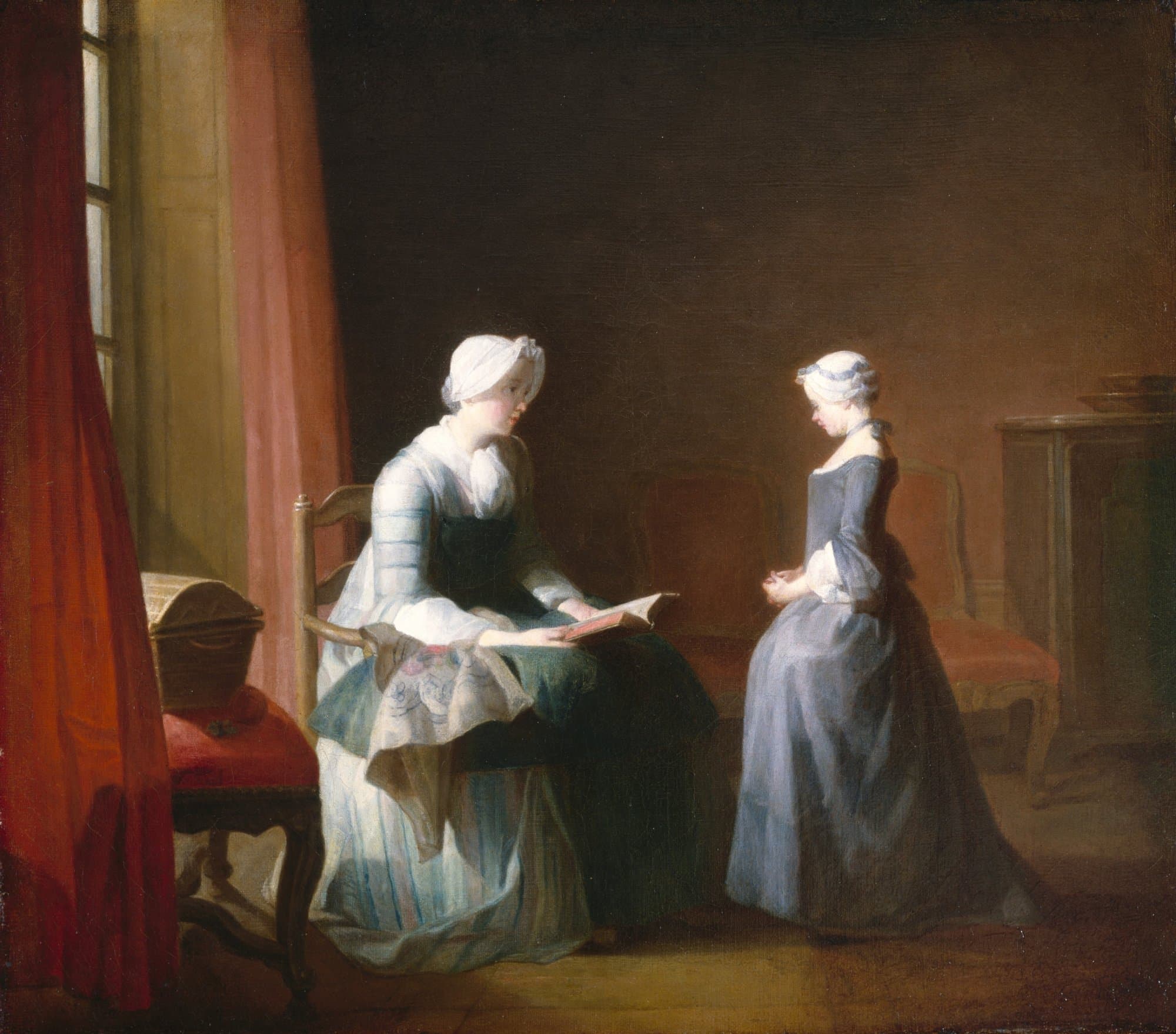
Ephesians 6:4 · Passage · Parenting and Its Trials
Do Not Provoke Your Children
Ephesians 6:4 and Colossians 3:21 come from two letters written in chains (Ephesians 3:1; Colossians 4:18).
Paul gives fathers a single verse in each letter.
Fathers, do not provoke your children to wrath; instead, bring them up in the discipline and instruction of the Lord.
- The passage
- Ephesians 6:4, Colossians 3:21, Ephesians 5:21, Hebrews 12:5 to 11
- Books
- Ephesians, Colossians, Hebrews
- Hold in memory
- Colossians 3:21
Summary
Paul gives a father in the churches of Ephesus and Colossae two duties toward his children, one of restraint and one of care. He must not stir them to anger, and he must take up their upbringing himself. Readers from Tertullian to Albert Barnes have differed over whether the command also speaks to mothers.
- The command to fathers follows the command to children in both letters (Ephesians 6:1 to 3; Colossians 3:20).
- Colossians gives the prohibition its reason, that the children not lose heart.
- Paideia, the discipline of Ephesians 6:4, is the word Hebrews 12 uses for God's discipline of His sons.
The Household Code
Both codes address wives and husbands, children and fathers, slaves and masters.
Do Not Provoke Your Children asks what Paul tells fathers to stop doing and what he tells them to do in its place. It belongs to parenting in its trials, because a parent's anger and harshness can become a trial for the child.
The study sets the commands of Ephesians 6:4 and Colossians 3:21 side by side with the Greek words behind them. It follows the word for discipline into Hebrews 12 and gives three readings of what provokes a child. It also sets out whether the command speaks to mothers as well as fathers, with the holders of each answer.
Submit to one another out of reverence for Christ.The verse opens the household code of Ephesians, so every command that follows, the father's among them, is given under reverence for Christ.
The code of Ephesians runs from that verse to Ephesians 6:9, and the code of Colossians runs from Colossians 3:18 to 4:1.
Two Letters, One Command
Both letters name Tychicus as the one who will bring their readers news of Paul (Ephesians 6:21; Colossians 4:7).
The two verses share their address and their prohibition and part in what comes after it.
| The part | Ephesians 6:4 | Colossians 3:21 |
|---|---|---|
| Who is addressed | “Fathers” | “Fathers” |
| The prohibition | “do not provoke your children to wrath” | “do not provoke your children” |
| The Greek verb | parorgizo | erethizo |
| What follows | “instead, bring them up” | “so they will not become discouraged” |
| The Greek behind it | ektrepho, with the nouns paideia and nouthesia | athumeo |
The six Greek words of the two commands1 figure
Three of the six words stand only twice in the New Testament, and athumeo stands once.
| Word | Sense in Strong's dictionary | Uses | Another use, in the Berean words |
|---|---|---|---|
| parorgizo, παροργίζω, G3949, verb | to anger alongside, i.e. enrage | 2 | Romans 10:19, “I will make you angry” |
| erethizo, ἐρεθίζω, G2042, verb | to stimulate (especially to anger) | 2 | 2 Corinthians 9:2, “your zeal has stirred most of them” |
| ektrepho, ἐκτρέφω, G1625, verb | to rear up to maturity | 2 | Ephesians 5:29, “he nourishes and cherishes it” |
| paideia, παιδεία, G3809, noun | tutorage, i.e. education or training | 6 | 2 Timothy 3:16, “training in righteousness” |
| nouthesia, νουθεσία, G3559, noun | calling attention to, i.e. (by implication) mild rebuke or warning | 3 | 1 Corinthians 10:11, “written down as warnings for us” |
| athumeo, ἀθυμέω, G120, verb | to be spiritless, i.e. disheartened | 1 | No other use in the New Testament |
Instead, Bring Them Up
Ephesians 6:4 names the father's task with one verb and two nouns.
The verb of “bring them up”, ektrepho, is the one Ephesians 5:29 uses for a man's care of his own body, so the task includes feeding and cherishing as well as training.
In the Greek the words “of the Lord” stand after both nouns, so the discipline and the instruction both belong to the Lord.
Hebrews 12:5 to 6 quotes Proverbs 3:11 to 12, and Hebrews 12:7 asks, “For what son is not disciplined by his father?”
What Provokes a Child
Three commentators name severity, grief and quarrelling as ways a father provokes a child.
“Be angry, yet do not sin.” Do not let the sun set upon your anger,The noun of the father's verb, parorgismos, stands in this verse, so the letter has already told its readers what to do with their own anger.
SeverityAdam Clarke
Adam Clarke, in his Commentary on the Bible (1832), wrote on Ephesians 6:4, “Avoid all severity; this will hurt your own souls, and do them no good”.
Grief that breaks the spiritJohn Gill
John Gill, in his Exposition of the New Testament (1746 to 1748), read “discouraged” in Colossians 3:21 as children whose “spirits be broke through grief and trouble”. Such children, he wrote, may at last “grow obdurate, stubborn, and rebellious”.
QuarrellingJohn Chrysostom
John Chrysostom, in his tenth homily on Colossians, read the verse as a charge to fathers: “Make them not more contentious, there are occasions when you ought even to give way”.
Fathers or Parents
Two answers stand, one drawn from the order of the house and one from the Greek plural.
Fathers are named as the heads of the houseAlbert Barnes
Albert Barnes, in his Notes, Explanatory and Practical (1832 to 1869), held that Paul addressed fathers “because they are at the head of the family”. The family's government, he wrote, “is especially committed to them”. A parent, Barnes wrote, has the duty “to command nothing that is unreasonable or improper”.
The objection: the plural that Ephesians 6:4 uses for fathers is the word Hebrews 11:23 uses for “Moses’ parents”.
Mothers are includedJohn Wesley and Tertullian
John Wesley, in his Explanatory Notes upon the New Testament (1755), wrote, “Mothers are included; but fathers are named, as being more apt to be stern and severe”. Jamieson, Fausset and Brown (1871) gave the same reason, that “Fathers are more prone to passion in relation to their children than mothers”. Tertullian, in Against Marcion (Book 5, chapter 18), quoted the verse as “Parents, bring up your children in the fear and admonition of the Lord”.
The objection: Ephesians 6:1 to 2 speaks of “your parents” and of “your father and mother”, and Ephesians 6:4 then turns to “Fathers”.
A Harvest of Righteousness
Hebrews writes to believers who are suffering and calls their trial discipline.
No discipline seems enjoyable at the time, but painful. Later on, however, it yields a harvest of righteousness and peace to those who have been trained by it.The verse holds the last use of paideia in Hebrews 12, so the chapter's teaching on discipline ends with its outcome.
Sources
Scripture is the Berean Standard Bible.
- STEP Bible, Translators Amalgamated Greek New Testament, the tagged text (Tyndale House, Cambridge), CC BY 4.0.
- James Strong, The Exhaustive Concordance of the Bible, with its dictionary of the Greek words (1890)
- Adam Clarke, Commentary on the Bible (1832), on Ephesians 6:4.
- John Gill, Exposition of the New Testament (1746 to 1748), on Colossians 3:21.
- John Chrysostom, Homilies on Colossians, Homily 10, on Colossians 3:21.
- Albert Barnes, Notes, Explanatory and Practical, on the New Testament (1832 to 1869), on Ephesians 6:4.
- John Wesley, Explanatory Notes upon the New Testament (1755), on Ephesians 6:4.
- Robert Jamieson, A. R. Fausset and David Brown, Commentary Critical and Explanatory on the Whole Bible (1871), on Ephesians 6:4.
- Tertullian, Against Marcion, Book 5, chapter 18, translated by Peter Holmes, Ante-Nicene Fathers, volume 3 (Christian Literature Publishing Co., Buffalo, 1885)
Keep Studying
Read it5
Studies1
In this trial7
People and groups9
Doctrines1