
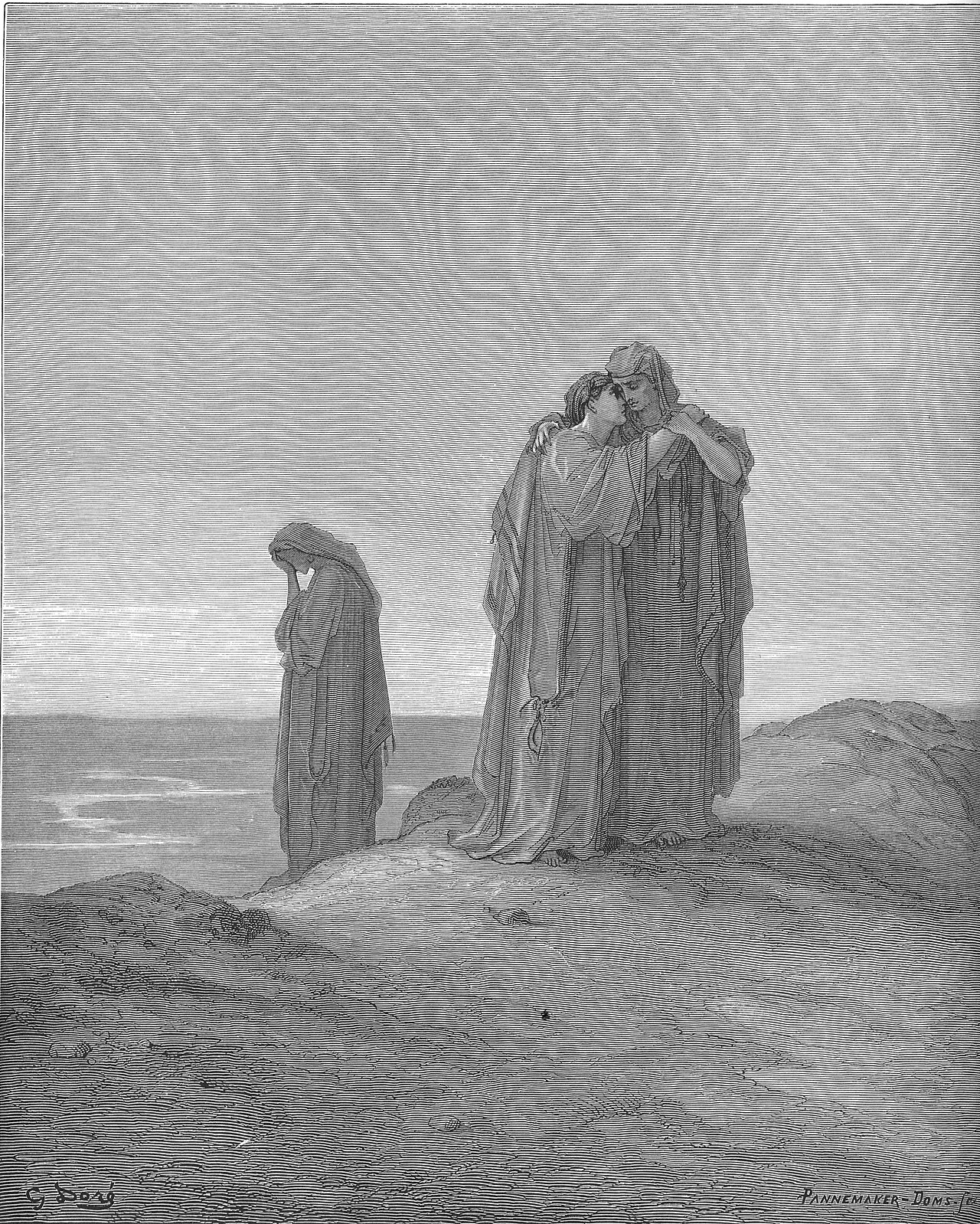
Ruthchapter 1
22 verses · Samuel, by tradition · 10th century BC · History
Now it came to pass in the days when the judges ruled, that there was a famine in the land. And a certain man of Beth–lehem–judah went to sojourn in the country of Moab, he, and his wife, and his two sons.
Introduction
Samuel, by tradition, History, Ruth Overview.
This chapter opens a short story set in the days of the judges, when Israel had no king and little faithfulness. Its writer is not named, and Jewish tradition gives the book to Samuel. It was kept for Israelites who knew Moab as an old enemy and knew how little a widow without sons could hold. The chapter takes a family out of the promised land and brings part of it back. Listen for the words for turning back and for a loyalty no law requires. Notice who speaks of God and what each speaker believes He has done.
Context
- Who
- Israelites who knew Moab as an old enemy and knew what a widow's life was worth
- What
- A narrative of a Bethlehem family that goes to Moab in a famine, loses its three men, and returns as two widows.
- Where
- Bethlehem in Judah, the land of Moab on the plateau east of the Dead Sea, and the road between them.
- When
- In the days when the judges ruled, about 1120 to 1100 BC reckoned back from David, with the return at the beginning of the barley harvest.
- Why
- To show the emptiness the book begins from and the loyalty of a foreign woman who binds herself to the God of Israel.
Historical context
The book names no author and dates itself by one clause, in the days when the judges ruled. Jewish tradition recorded in the Babylonian Talmud at Bava Batra 14b assigns it to Samuel, and most modern commentators treat it as anonymous. Reckoning back from David puts the story about 1120 to 1100 BC, and the certainty is that of an era rather than a year.
Show the rest of the historical context, 3 more paragraphs
Bethlehem means house of bread, and the book opens with no bread in it. Judah's hill country farms on rainfall alone, on terraced slopes with thin soil, so two dry winters in a row finish a family. Moab lies across the Dead Sea rift on a high plateau that catches different weather and was known for grain and flocks, which made the move short and sensible.
It was also a loaded move. Moab had hired Balaam against Israel and drawn Israelite men into the worship of Baal of Peor, and the Law barred Moabites from the assembly to the tenth generation. Moab's god was Chemosh, and the Mesha Stele, a slab set up by a later Moabite king, credits Chemosh with Moab's victories in his own words.
A widow in that world had no independent standing, because property ran through men. Three widows in one household with no surviving sons is a household that has ceased to exist economically. Naomi's advice that her daughters-in-law go back to their mothers' houses is the only kindness she has left to give, and Ruth answers it with a covenant oath sworn under a self-curse.
Significance
Naomi comes home and asks to be called Mara, which means bitter, and says the LORD has brought her back empty. The first hearers were given a woman who states plainly that God has dealt harshly with her, and the story leaves her statement standing for three chapters.
Show the rest of the significance, 1 more paragraph
Against that, a Moabite woman has just sworn covenant loyalty to the God of Israel in language no Israelite in the book of Judges ever managed. Hearers who had come through that book would have felt the contrast at once.
This chapter in Jewish lifeWhat this chapter is in Jewish life and reading.
What is done
Two things done in Jewish life are read out of this chapter by the classical commentators. The first is how a convert is received. Rashi takes Naomi's silence at 1:18 as the ground of a rule of practice. His words are "we neither overburden him [a prospective convert], nor are we meticulous with him". The reference is Rashi on Ruth 1:18:1, The Metsudah Five Megillot, Lakewood, N.J., 2001, CC-BY. The edition's own note names Maseches Yevamos 47b. The second is the calendar. On the barley harvest that closes the chapter Rashi says "The verse speaks about the harvest of the Omer". The edition's note records that the barley for the omer was cut on the second night of Pesach. It was offered the following day. The reference is Rashi on Ruth 1:22:1, same edition. The chapter therefore ends on a dated day of the festival year rather than on a season. This site already carries the other end of that count. The file src/lib/hebraic/feasts.ts records that Shavuot is kept fifty days after Passover. It records that the synagogue reads Ruth at the feast by long custom, citing the Rema on Shulchan Arukh, Orach Chayim 490. Joining the two, so that the chapter closes on the day the count begins and the book is read on the day it ends, is the writer's reading of those two files together.
How it is read
The classical commentators read this chapter as a family punished for leaving the land. They then read it as the making of a convert. Rashi dates the opening "[During the period] before King Shaul reigned, when the generations were administered by judges". He hands on the identification of the judge of the hour, "Ivtzan is Bo'az", citing Maseches Bava Basra 91a. The reference is Rashi on Ruth 1:1:1, The Metsudah Five Megillot, Lakewood, N.J., 2001, CC-BY. On Elimelech he is severe. The man "left Eretz Yisroel for regions out of the land because of stinginess". He was "miserly toward the poor who came to press him", and "therefore he was punished". The reference is Rashi on Ruth 1:1:2, same edition. The deaths that follow are read as a punishment that came by stages. Rashi writes, "First they were struck by financial loss and their camels and their cattle died; afterwards they 'also' died". The reference is Rashi on Ruth 1:5:1, same edition. Naomi's leaving is read as a loss to the place she left. Rashi holds that "the departure of a righteous person from a place is noticeable and makes an impression". The reference is Rashi on Ruth 1:7:1, same edition.
On the question a Christian reader most often assumes is settled against Ruth, the commentators are plain. They are plain on this chapter rather than later in the book. Ibn Ezra states the ruling at the naming of the two sons. "The Moabite women are permitted to Israelites because the scripture only forbids Ammonites and Moabites from entering the assembly, and from marrying Israelite women". The reference is Ibn Ezra on Ruth 1:2:1, Sefaria Community Translation, CC0. This site already records the holders of that reading. They are the Mishnah at Yevamot 8:3 and the discussion in the Babylonian Talmud at Yevamot 76b to 77a, which read the Hebrew forms as masculine. Against it stands the reading that a personal confession is what the statute never anticipated. Both are carried in src/components/book/dossier-content/ruth.ts, and this site states no verdict between them.
Rashi works the marriages from the other side. He holds that Machlon and Chilyon "were not [halachically] married to them because they were gentiles and had not converted". No levirate duty stood on that reading. He takes "We will return with you to your people" as the moment the two women came to convert. The reference is Rashi on Ruth 1:12:1, same edition. Ruth's decision is then weighed as a conversion. Rashi hands on Rabbi Abahu, "Come and see how dear the proselytes are before the Holy One, Blessed Is He". He reads the phrase "the two of them" as Scripture ranking Ruth with Naomi from the moment she decided. The reference is Rashi on Ruth 1:19:1, same edition. Naomi's renaming is read as a plain word study. Ibn Ezra holds that "'Naomi' means something delightful, and 'Mara' is the opposite of delight" (Ibn Ezra on Ruth 1:20:1, Sefaria Community Translation, CC0). Her emptiness is read as two losses at once, "With wealth and sons", with the alternative "that she was pregnant" (Rashi on Ruth 1:21:1, same edition). Malbim comments on this chapter at 1:4, 1:10 and 1:14. The corpus holds no English version of any of the three, so they stand as citations. They are Malbim on Ruth 1:4:1, Malbim on Ruth 1:10:1 and Malbim on Ruth 1:14:1.
What the rabbis say
The corpus records forty rabbinic locators on this chapter, thirty-four Midrash and six Talmud. Every one is a locator without text. This site therefore cites where the rabbis took the chapter up rather than what they said there. The era and the family draw six of them. They are Avot DeRabbi Natan 1:3, Bamidbar Rabbah 10:5 and Bava Batra 91b:7. The other three are Ein Yaakov (Glick Edition), Bava Batra 5:41, Bava Batra 113a:3 and Ein Yaakov (Glick Edition), Sanhedrin 2:17. The Moabite marriages and the deaths that follow draw Ein Yaakov, Sotah 8:3. With them stand Midrash Lekach Tov on Ruth 1:4:1, 1:5:1 and 1:5:2. The return draws Midrash Lekach Tov on Ruth 1:6:1 and Pesikta Rabbati 42:1. The leaving of the place draws Bereshit Rabbah 68:6 and Midrash Lekach Tov on Ruth 1:7:1. Naomi's urging and her answer about sons draw the largest cluster. It runs Midrash Lekach Tov on Ruth 1:8:1, 1:8:2, 1:9:1, 1:9:2, 1:10:1, 1:11:1 and 1:12:1. With them stand Ruth Rabbah (Lerner) 2:16:1, Bava Batra 73a:4 and Ein Yaakov, Bava Batra 5:1. The parting itself, where one daughter-in-law kissed and the other held on, draws two. They are Bereshit Rabbah 70:12 and Ein Yaakov (Glick Edition), Shabbat 15:2. Ruth's confession draws Midrash Lekach Tov on Ruth 1:15:1, 1:16:1, 1:17:1 and 1:17:2. With them stand Ruth Rabbah (Lerner) 2:21:2 and Midrash Lekach Tov, Exodus 12:48:1. That last one is a comment on the law of the stranger at the Passover. The receiving of the convert draws Ein Yaakov (Glick Edition), Yevamot 4:1 and Ein Yaakov, Yevamot 4:8. The arrival in Bethlehem draws Bava Batra 91a:8 and Ein Yaakov (Glick Edition), Bava Batra 5:38. The renaming draws Midrash Lekach Tov on Ruth 1:20:1, Ruth Rabbah (Lerner) 3:5:3 and Midrash Lekach Tov on Ruth 1:21:1. The barley harvest draws Jerusalem Talmud Yevamot 8:3:4.
One saying from outside this corpus already stands on this site. It is read straight out of the parting at 1:14. The page /featured/david-and-goliath quotes Rabbi Yitzhak on Babylonian Talmud Sotah 42b:9. He teaches that the children of the one who kissed, the giants descended from Orpah, will fall into the hand of the children of the one who cleaved, David descended from Ruth. That page records the text as opened at Sefaria and confirmed on 12 August 2026. The same page cites Sotah 42b:7, where Harafa of 2 Samuel 21:16 and Orpah of Ruth 1:4 are read as one woman under two names. The rabbis teach these things in these places. This site reports them as their teaching rather than as a rule of the text.
Sources: Rashi, Rashi on Ruth 1:1:1, 1:1:2, 1:5:1, 1:7:1, 1:12:1, 1:18:1, 1:19:1, 1:21:1 and 1:22:1, The Metsudah Five Megillot, Lakewood, N.J., 2001, CC-BY, 2001; Ibn Ezra, Ibn Ezra on Ruth 1:2:1 and 1:20:1, Sefaria Community Translation, CC0; Malbim, Malbim on Ruth 1:4:1, 1:10:1 and 1:14:1, cited only, no English version in the corpus; The Midrash and the Talmud, the forty locators of scripts/data/sources/sefaria/ruth/1.json, cited by ref alone; MannaFest, the Ruth dossier, src/components/book/dossier-content/ruth.ts, for the holders of the Moabite exclusion reading, 2026; MannaFest, src/app/featured/david-and-goliath/page.tsx, for Babylonian Talmud Sotah 42b:9 and 42b:7, opened at Sefaria and confirmed 2026-08-12, 2026; MannaFest, the readings table, src/lib/hebraic/readings.ts, for the festival reading of Ruth, 2026; MannaFest, the feasts file, src/lib/hebraic/feasts.ts, for the fifty days from Passover and the Rema on Shulchan Arukh, Orach Chayim 490, 2026.
The heads below are this chapter's scenes. The numbered points under each are its verses.
Famine, Moab, and three graves
Ruth 1:1-2
in the days when the judges ruled: The book dates itself inside the period of Judges, so its events run beside the lawless chapters that close that book. A famine drives a man out of Bethlehem, which means house of bread, to Moab, which Deuteronomy 23:3 bars from the assembly of the LORD. Elimelech means my God is king, in a time with no king in Israel, and Naomi means pleasant, which verse 20 undoes.
Ruth 1:1
“Now it came to pass, in the days when the judges ruled,.... So that it appears that this history is of time and things after the affair of Micah, and of the concubine of the Levite, and of the war between Israel and Benjamin; for in those times there was no king nor judge in Israel; but to what time of the judges, and which government of theirs it belongs to, is not agreed on.”
1 more voice on this verseWhat preachers and commentators have said about this verse, in their own words.
Ruth 1:1
“In the days when the Judges ruled - “Judged.” This note of time, like that in Rth 4:7; Jdg 18:1; Jdg 17:6, indicates that this Book was written after the rule of the judges had ceased. The genealogy Rth 4:17-22 points to the time of David as the earliest when the Book of Ruth could have been written. A famine - Caused probably by one of the hostile invasions recorded in the Book of Judges.”
ConnectionsRuth 1:22
Ephrathites were the old clan of Bethlehem in Judah, and the name returns in the blessing at 4:11 and in Micah 5:2. John Wesley reads Mahlon and Chilion as sickness and consumption. The names announce two graves.
Ruth 1:2
“Elimelech--signifies "My God is king." Naomi--"fair or pleasant"; and their two sons, Mahlon and Chilion, are supposed to be the same as Joash and Saraph (1Ch 4:22).”
Jamieson, Fausset & Brown · Commentary Critical and Explanatory on the Whole Bible (1871)reformed
1 more voice on this verse
Ruth 1:2
“Ephrathites - Bethlehem was otherwise called Ephratha. Naomi signifies my amiable or pleasant one: Mahlon and Chilon signify sickness and consumption.”
John Wesley · Explanatory Notes upon the Old Testament (1765)evangelical
Ruth 1:3-5
Three men die in three verses and the text gives no cause for any of them. The sons marry Moabite women, which the law discouraged but did not forbid outright as Deuteronomy 7:3 forbids the seven nations. Verse 5 ends on the woman rather than the men, "without her two sons and without her husband", which is the loss the rest of the book answers.
Ruth 1:3
“Elimelech - died - Probably a short time after his arrival in Moab.”
Adam Clarke · Commentary on the Bible (1810-1826)evangelical
Matthew Henry reports that the Aramaic Targum counts these marriages a breach of the word of the LORD. Deuteronomy 23:3 bars Moabites from the assembly, while the marriage ban of Deuteronomy 7:3 names the seven nations of Canaan and leaves Moab out. The text records no child in ten years.
Ruth 1:4
“All agree that this was ill done. The Chaldee says, They transgressed the decree of the word of the Lord in taking strange wives. If they would not stay unmarried till their return to the land of Israel, they were not so far off but that they might have fetched themselves wives thence.”
Matthew Henry · Commentary on the Whole Bible (1707-1721)puritan
John Gill cites the Targum, which reads the deaths of Mahlon and Chilion as a judgment for taking Moabite wives. The verse itself gives no cause. Naomi was left without her husband and her sons, a widow in Moab with no heir.
Ruth 1:5
“And Mahlon and Chilion died also both of them,.... As well as their father, in the land of Moab, after they had lived with their wives in it about ten years; the Targum is,"because they transgressed the decree of the Word of the Lord, and joined in affinity with strange people, their days were cut off;''or shortened: and the woman was left of her two sons and her husband; deprived both of her husband and her sons, which was a great affliction, aggravated by her being in a strange country; many are the afflictions of the righteous.”
Whither thou goest, I will go
Ruth 1:6-7
What turns her homeward is a report that "the LORD had attended to His people by providing them with food", so the house of bread has bread again. This is the only act of God the chapter reports directly, and it is done offstage in a country she is not in. Everything else in the book happens through ordinary people keeping faith.
Ruth 1:6
“She had heard - By the mouth of an angel, says the Targum. The Lord had visited his people - “Because of the righteousness of Ibzan the judge, and because of the supplications of pious Boaz.” - Targum. It is imagined, and not without probability, that Mahlon and Chilion are the same with Joash and Saraph, mentioned 1Ch 4:22, where the Hebrew should be thus translated, and Joash and Saraph, who married in Moab, and dwelt in Lehem. See the Hebrew.”
Adam Clarke · Commentary on the Bible (1810-1826)evangelical
The road is called the way back for all three women, though only Naomi had ever lived in Judah. For her two daughters-in-law the road back leads to a land they have never seen. Naomi has not yet told them to return.
Ruth 1:7
“By this we see both that Naomi, as became an Israelite, had been very kind and obliging to them and had won their love, in which she is an example to all mothers-in-law, and that Orpah and Ruth had a just sense of her kindness, for they were willing to return it thus far.”
Matthew Henry · Commentary on the Whole Bible (1707-1721)puritan
Ruth 1:8-9
She sends them back and prays for them in one breath, and "loving devotion" renders chesed, the covenant loyalty word, spoken by an Israelite of two Moabite women. She asks for them "rest in the home of your new husband", which Boaz gives Ruth in chapter 3 and Naomi gives up by asking. The kiss and the weeping are the first of two rounds, and the second parts them.
Ruth 1:8
“Accompanying their mother-in-law to the borders of their own land would probably be an act of Oriental courtesy. Naomi with no less courtesy presses them to return. The mention of the mother’s house, which the separation of the women’s house or tent from that of the men facilitates, is natural in her mouth, and has more tenderness in it than father’s house would have had; it does not imply the death of their fathers Rth 2:11.”
Jamieson, Fausset and Brown take the kiss as the usual farewell of the East, so Naomi means this as a parting. The rest she asks for is the settled security of a married home. Naomi seeks the same rest for Ruth at 3:1.
Ruth 1:9
“The Lord grant you that ye may find rest--enjoy a life of tranquillity, undisturbed by the cares, incumbrances, and vexatious troubles to which a state of widowhood is peculiarly exposed. Then she kissed them--the Oriental manner when friends are parting.”
Jamieson, Fausset & Brown · Commentary Critical and Explanatory on the Whole Bible (1871)reformed
Ruth 1:10-13
Naomi argues from the levirate law of Deuteronomy 25:5, where a brother raises up offspring for the dead, and shows it cannot reach them, since there are no more sons. The argument is legally exact, and its aim is to release them. She lays the whole of it on God, "the hand of the LORD has gone out against me", and carries that reading until chapter 4.
Ruth 1:10
“And they said unto her,.... When they had eased themselves in cries and tears, and had recovered their speech: surely we will return with thee unto thy people; to be proselyted, as the Targum; not only to dwell with them, but to worship with them.”
Albert Barnes holds that the duty to marry a dead man's widow reached past his brothers to the nearer relatives, since Boaz was a kinsman and no brother. Naomi reasons only from her own womb. She does not yet name the relatives waiting in Bethlehem.
Ruth 1:11
“See marginal references and notes. The Levirate law probably existed among the Moabites, and in Israel extended beyond the brother in the strict sense, and applied to the nearest relations, since Boaz was only the kinsman of Elimelech Rth 3:12.”
Naomi builds her case as a rising series of conditions: a husband tonight, sons from that night, and long years of waiting while they grow. Each step makes the hope less likely. The argument is built to close the door, and verse 18 shows it failed with Ruth.
Naomi still grants that the LORD rules, and she reads His hand as turned against her. Exodus 9:3 and 1 Samuel 7:13 use the same picture of the hand of the LORD against Egypt and the Philistines. She grieves for her daughters.
Ruth 1:13
“Would you tarry for them till they were grown?....”
1 more voice on this verse
Ruth 1:13
“It is with me, that God has a controversy. This language becomes us, when we are under affliction; tho' many others share in the trouble, yet we are to hear the voice of the rod, as if it spake only to us. But did not she wish to bring them to the worship of the God of Israel?”
John Wesley · Explanatory Notes upon the Old Testament (1765)evangelical
Ruth 1:14-15
Orpah kisses her mother-in-law goodbye and Ruth "clung to her", the verb Genesis 2:24 uses of a man joined to his wife. Orpah does what Naomi twice told her to do, and the text never blames her. Naomi's last argument names the stake, "your sister-in-law has gone back to her people and her gods", so Ruth's choice is a choice of God before it is a choice of country.
Ruth 1:14
“And Orpah kissed her mother-in-law - The Septuagint add, Και επεστρεψεν εις τον λαον αυτης, And returned to her own people. The Vulgate, Syrian, and Arabic, are to the same purpose.”
Adam Clarke · Commentary on the Bible (1810-1826)evangelical
Adam Clarke names Chemosh as the chief god of Moab and holds that both women still worshipped there. On that reading the choice Naomi puts to Ruth is a choice between gods. Ruth's answer names the God of Israel.
Ruth 1:15
“Gone back - unto her gods - They were probably both idolaters, their having been proselytes is an unfounded conjecture. Chemosh was the grand idol of the Moabites. The conversion of Ruth probably commenced at this time.”
Adam Clarke · Commentary on the Bible (1810-1826)evangelical
Ruth 1:16-17
Her vow climbs through six clauses, from where she walks to where she is buried, and its hinge is "your people will be my people, and your God will be my God". She closes with the oath "May the LORD punish me, and ever so severely", sworn by the God she adopts rather than by Chemosh. Here a widow speaks it on a road with nothing to gain.
Ruth 1:16
“Ruth, who surpassed the definition of the Law, and entered into the Church, and became an Israelite, and deserved to be counted among the greater ones of the Lord's family, because of the choice of her mind and not her body, is a great example for us, because in her the figure of our entrance into the Church of the Lord, who are gathered from the nations, preceded.”
Ambrose of Milan · written before 397 · Commentary on Lukepatristic
1 more voice on this verse
Ruth 1:16
“THIS was a very brave, outspoken confession of faith. Please notice that it was made by a woman, a young woman, a poor woman, a widow woman and a foreigner. Remembering all that, I should think there is no condition of gentleness, or of obscurity, or of poverty, or of sorrow which should prevent anybodyfrom making an open confession of allegiance to God when faith in the Lord Jesus Christ has been exercised.”
Charles Spurgeon · written before 1892 · The Metropolitan Tabernacle Pulpit, Sermon No. 2680: “Ruth Deciding for God” (lightly modernized text, CCEL edition)Particular Baptist
This is the oath formula of 1 Samuel 3:17 and 2 Samuel 3:9, and Ruth swears it by the LORD's own name. Adam Clarke notes that she kept it, since 4:15 and 4:16 show Naomi cared for in her old age. Only death may part them.
Ruth 1:17
“The Lord do so to me, and more - May he inflict any of those punishments on me, and any worse punishment, if I part from thee till death. And it appears that she was true to her engagement; for Naomi was nourished in the house of Boaz in her old age, and became the fosterer and nurse of their son Obed, Rth 4:15, Rth 4:16.”
Adam Clarke · Commentary on the Bible (1810-1826)evangelical
The argument stops because it has been answered, and the verse records the silence rather than an agreement. Naomi says nothing to Ruth for the rest of the chapter, and at verse 21 she describes herself as coming home empty while the woman who refused to leave her is standing there. The book lets that stand without comment for three chapters.
Ruth 1:18
“When she saw that she was steadfastly minded to go with her,.... That she was strong in her resolutions, and steadfast in her determinations not to go back to her own country, but to go forward with her; and nothing could move her from the firm purpose of her mind, which was what Naomi wanted to make trial of: then she left speaking unto her: that is, upon that head of returning home; otherwise, no doubt, upon this a close, comfortable, religious conversation ensued, which made their journey the more pleasant and agreeable.”
1 more voice on this verse
Ruth 1:18
“Naomi said, We are commanded to keep 613 precepts. Well, said Ruth, whatever thy people keep I will keep, for they shall be my people. Naomi said, We are forbidden to worship any strange god.”
Matthew Henry · Commentary on the Whole Bible (1707-1721)puritan
Call me not Naomi, call me Mara
Ruth 1:19-21
The town asks "Can this be Naomi?", which shows how much ten years and three graves had changed her. She renames herself Mara, bitter, against Naomi, pleasant, and twice calls God the Almighty, which is Shaddai, the name God used of himself to Abram at Genesis 17:1. Her summary, "I went away full, but the LORD has brought me back empty", is overturned at 4:14-17 by the same women.
Ruth 1:19
“All the city was moved about them - It appears that Naomi was not only well known, but highly respected also at Bethlehem; a proof that Elimelech was of high consideration in that place.”
Adam Clarke · Commentary on the Bible (1810-1826)evangelical
call me Mara: Naomi means pleasant and Mara means bitter, so she asks the women of the city to call her by her grief. The Almighty is Shaddai, the name God gave when He made His covenant with Abraham. Naomi brings her bitter complaint to that God.
Ruth 1:20
“Call me not Naomi - That is, beautiful or pleasant. Call me Mara - That is, bitter; one whose life is grievous to her. The Almighty - שדי Shaddai, He who is self-sufficient, has taken away the props and supports of my life.”
Adam Clarke · Commentary on the Bible (1810-1826)evangelical
1 more voice on this verse
Ruth 1:20
“It is the Lord, 1 Sam. iii. Especially to consider that he who afflicts us is Shaddai, the Almighty, with whom it is folly to contend and to whom it is our duty and interest to submit. It is that name of God by which he enters into covenant with his people: I am God Almighty, God All-sufficient, Gen. xvii.”
Matthew Henry · Commentary on the Whole Bible (1707-1721)puritan
Albert Barnes reads testified against me as a courtroom term, the word for a witness giving evidence against a man, as at Exodus 20:16. Naomi speaks as one charged before God. Ruth stands beside her while she says she came back empty.
Ruth 1:21
“The Lord hath testified against me - The phrase is very commonly applied to a man who gives witness concerning (usually against) another in a court of justice Exo 20:16; 2Sa 1:16; Isa 3:9. Naomi in the bitterness of her spirit complains that the Lord Himself turned against her, and was bringing her sins up for judgment.”
She is called the Moabitess here and again later in the book, so what makes her an outsider is repeated rather than dropped. The closing clause sets the season, "the beginning of the barley harvest", when the gleaning law of Leviticus 19:9 comes into play and chapter 2 can begin. Matthew 1:5 puts this woman in the genealogy of Christ in the same verse as Rahab.
Ruth 1:22
“In the beginning of barley harvest - This was in the beginning of spring, for the barley harvest began immediately after the passover, and that feast was held on the 15th of the month Nisan, which corresponds nearly with our March. The Targum says, “They came to Beth-lehem on that day in which the children of Israel began to mow the sheaf of barley which was to be waved before the Lord.” This circumstance is the more distinctly marked, because of Ruth’s gleaning, mentioned in the succeeding chapter.”
Adam Clarke · Commentary on the Bible (1810-1826)evangelical
How this psalm is built
The form: Narrative prose, the opening scene of a continuous story, which the book page titles Famine, loss, and return at 1:1 to 22, as guide classes it.
The patterns in this chapter
| Device | What it does | Where to see it |
|---|---|---|
| The names say what the chapter does | Bethlehem means house of bread and the chapter opens on a famine there. Elimelech means my God is king, in a book set when Israel had no king. Naomi means pleasant, and verse 20 undoes it when she asks the town to call her Mara, which is bitter.the site's Ruth exposition, note on 1:1 to 2, citing Keil and Delitzsch, Biblical Commentary on the Old Testament: Joshua, Judges, Ruth, 1863, and Matthew Henry, Commentary on the Whole Bible, 1710. | Ruth 1:1, Ruth 1:2, Ruth 1:20 |
| Turn back, said to each woman in turn | The verb shuv, to turn back, runs through the chapter and carries three directions. Naomi tells both women to return home at verses 11 and 12. Orpah goes back to her people and her gods at verse 15. Ruth turns toward a country she has never seen, and verse 22 says Naomi returned with her.the site's Ruth dossier, the word ladder entry for h7725, copied from the site's own lexicon_entries row. | Ruth 1:11, Ruth 1:12, Ruth 1:15, Ruth 1:22 |
| Six clauses to the grave | Ruth's answer runs in rising order from where she walks to where she is buried, and the middle pair is the hinge, your people will be my people and your God will be my God. She closes with the covenant oath formula and swears by the name of the God she is adopting.the site's Ruth exposition, note on 1:16 to 17, citing Keil and Delitzsch, Biblical Commentary on the Old Testament: Joshua, Judges, Ruth, 1863, and Matthew Henry, Commentary on the Whole Bible, 1710. | Ruth 1:16, Ruth 1:17 |
| Out in a famine, home at the harvest | The chapter opens on a famine that drives the family out of the house of bread. It closes on the beginning of the barley harvest, which is the gleaning law of Leviticus 19:9 becoming possible and the whole of chapter 2 waiting on it. Between the two clauses Naomi says she went away full and came back empty.the site's Ruth exposition, notes on 1:19 to 21 and 1:22, citing Keil and Delitzsch, Biblical Commentary on the Old Testament: Joshua, Judges, Ruth, 1863, Adam Clarke, Commentary on the Bible, 1810 to 1826, and Matthew Henry, Commentary on the Whole Bible, 1710. | Ruth 1:1, Ruth 1:21, Ruth 1:22 |
The structure
9 more paragraphs on the patterns
Four movements, and the chapter's clock is the parting. Naomi releases the two women once at verses 8 and 9 and they refuse. She releases them a second time at verses 11 to 13 with a legal argument, and that one parts them. Verse 18 records the silence rather than an agreement, and Naomi says nothing to Ruth for the rest of the chapter.
The law behind Naomi's argument
Naomi argues from the levirate provision of Deuteronomy 25:5, where a brother raises up seed to a dead man. She shows the law cannot reach Orpah and Ruth, since there are no more sons and there will be none. The argument is legally exact and it is meant to release them. Chapter 4 is Boaz taking up a duty this argument proved nobody owed.
The statute standing over the chapter
Deuteronomy 23:3 bars a Moabite from the assembly of the LORD to the tenth generation. Ruth crosses that border in this chapter and the book never cites the statute and never argues with it. What the book does instead is repeat her origin, calling her the Moabitess at 1:22 and four more times, so her standing is never quietly dropped.
Where the chapter reaches
Verse 16 is the confession the dossier uses as evidence in its second contested point, and the reading that personal confession changes her standing rests on it. The closing clause sets the season for chapter 2. Matthew names Ruth in the genealogy of Christ at Matthew 1:5, in the same verse as Rahab.
The name Almighty
Naomi gives her reason twice using the name Almighty, which is Shaddai, the name God used of Himself to Abraham at Genesis 17:1. She is reading her own life by it, and the same townswomen who hear her at verse 19 overturn her summary at 4:14 to 17.
Keep studying
Places1
Words12
Trails1
Subjects1
Sources for this chapter
The summary
Jamieson, Fausset & Brown, Commentary Critical and Explanatory; John Wesley, Notes on the Old Testament and Matthew Henry, Complete Commentary.
The form and classifications
Stephen Bertman, Journal of Biblical Literature, 1965, carried as a proposed chiasm in the site's Ruth dossier; the site's Ruth exposition, note on 1:1 to 2, citing Keil and Delitzsch, Biblical Commentary on the Old Testament: Joshua, Judges, Ruth, 1863, and Matthew Henry, Commentary on the Whole Bible, 1710 and the site's Ruth guide, src/components/book/guides/ruth/RuthGuide.tsx, the movements table, movement I.
The exposition
Adam Clarke, Commentary on the Bible; Albert Barnes, Notes, Explanatory and Practical, on the Old and New Testaments (1832-1869); Jamieson, Fausset & Brown, Commentary Critical and Explanatory on the Whole Bible; John Gill; John Wesley, Explanatory Notes upon the Old Testament; Keil and Delitzsch, Biblical Commentary on the Old Testament: Joshua, Judges, Ruth and Matthew Henry, Commentary on the Whole Bible.