
Numberschapter 21
35 verses · Moses, by tradition · 15th to 13th century BC · The Law
And they journeyed from mount Hor by the way of the Red sea, to compass the land of Edom: and the soul of the people was much discouraged because of the way.
Introduction
Moses, by tradition, The Law, Numbers Overview.
This chapter belongs to the book of Numbers, which Jewish and Christian tradition has long credited to Moses, and it was kept for the generation about to enter the land. It stands at the turn where the years in the desert end and Israel begins to hold ground of its own. The fathers who left Egypt have nearly all died. Listen for the complaint about food that has followed Israel since Exodus, and for the remedy the LORD provides, which Jesus applied to Himself in John 3. Listen also for the old songs and the lost book the writer quotes.
Context
- Who
- A generation winning battles for the first time
- What
- A narrative of a first victory, a plague and its cure, a march north by stages, and the defeat of two Amorite kings.
- Where
- The Negev near Arad, the long road around Edom toward the Red Sea, and the land east of the Jordan from the Arnon to Bashan.
- When
- The fortieth year after the exodus, soon after Aaron's death in the fifth month (Numbers 33:38), about 1406 BC by the count of 1 Kings 6:1, or near 1230 BC on a later dating of the exodus.
- Why
- To show the new generation that the LORD who judged their complaint also healed it and then gave them their first land.
Historical context
The chapter is Moses' account of a march, and it quotes three older pieces inside itself. One is the Book of the Wars of the LORD, which Scripture names here and does not preserve. The other two are the Song of the Well and a taunt song about Heshbon.
Show the rest of the historical context, 5 more paragraphs
The year is the fortieth. One of the stages in verses 10 to 13 carries the end of the sentence, since Deuteronomy 2:14 says the span from Kadesh-barnea to the crossing of the Zered was thirty eight years.
The country is the desert south and east of Edom, then north along the Arnon to the Amorite kingdoms. The Arnon is named as the border between Moab and the Amorites, and that line decided whom Israel was allowed to fight, since Deuteronomy 2:9 forbade any quarrel with Moab.
The occasion is Edom's refusal at 20:21, which forced the long way round and turned the march back south toward the Red Sea.
A first hearer knew that snakes in that desert were a real and lethal hazard. He also knew what a serpent figure on a pole was. Bronze and copper serpent figurines have been excavated at sites across Canaan and at the copper mining shrine at Timna in the Arabah, close to the country Israel was crossing.
He knew that ancient historical writing cited earlier poems and campaign records openly, which is what verse 14 is doing. And he knew what the light bread was that the people said they loathed, since it was the manna of Exodus 16.
Significance
The generation that had watched their parents lose everything by complaining did the same thing on the road and got serpents for it. The remedy asked nothing of them except a look at the thing that was killing them.
Show the rest of the significance, 1 more paragraph
Then they won. After forty years of nothing, Heshbon and Bashan gave them the first land they held and lived in since Egypt, from the Arnon to the Jabbok.
This chapter in Jewish lifeWhat this chapter is in Jewish life and reading.
How it is read
Rashi links the attack at the opening of the chapter to the death of Aaron at the close of the last one. He holds that the Canaanite heard "that Aaron had died and that the clouds of glory had disappeared", and judged himself free to make war (Rashi on Numbers 21:1:1, citing Rosh Hashana 3a). He reads the turn toward the Red Sea in the fourth verse as a retreat of seven stages. He sets Deuteronomy 10:6, which puts the death of Aaron at Moserah, against the account here, which puts it at Mount Hor. His answer is that Israel mourned again at Moserah as though Aaron lay dead there, and he sends the reader to count the stages in the list of Numbers 33 (Rashi on Numbers 21:4:1).
The complaint of the fifth verse is weighed by its grammar in Rashi. Because the people spoke against God and against Moses in one breath, "They placed the servant on a par with his Master" (Rashi on Numbers 21:5:1). He glosses the serpents of the sixth verse as burning because their venom raises a fever (Rashi on Numbers 21:6:1). From the prayer of Moses for the people who had wronged him, Rashi draws a rule of conduct. He of whom forgiveness is sought "should not be so cruel as not to forgive" (Rashi on Numbers 21:7:1).
The serpent of copper is read closely. Rashi glosses the pole as a banner, a thing raised high so that it can stand as a sign (Rashi on Numbers 21:8:1). He then notes that the metal was never commanded. "He had not been told to make it of copper", and Moses chose copper because the Hebrew word for it answers the Hebrew word for a serpent (Rashi on Numbers 21:9:1, citing Genesis Rabbah 31:8).
The longest passage Rashi gives this chapter is the miracle he reads into the fifteenth and sixteenth verses. He takes the valleys of the fifteenth verse as a narrow pass between high mountains. Amorites hid in caves above the road and waited to kill Israel with arrows and stones as they came through. In his account the mountain on the Israelite side moved toward the mountain of Moab, and its jutting rocks entered the caves and killed the men inside. The well that followed Israel then washed the blood and the limbs down into the valley. Israel saw what had been done for them, and sang (Rashi on Numbers 21:15:1 and 21:16:1, drawing on Midrash Tanchuma, Chukat 20 and Berakhot 54b). Rashi reads the song of the well in that light, as a summons to the well to bring up the bodies of the slain (Rashi on Numbers 21:17:1). He takes the princes who dug it as Moses and Aaron (Rashi on Numbers 21:18:1). He also records how the water reached each tribe. Every prince drew a line on the ground from the well to his own banner with his staff, and the water ran along the mark to his camp (Rashi on Numbers 21:20:1).
Two points of conduct close the chapter in Rashi. Israel is said to have sent the messengers to Sihon, and Deuteronomy 2:26 says Moses sent them. He holds that the two verses supplement each other, so "the prince of any generation is the equal of the whole generation" (Rashi on Numbers 21:21:1). He also notes that Israel offered peace to Sihon first, although no command had required the offer (Rashi on Numbers 21:22:1). Sihon refused because the Canaanite kings paid him tribute to keep hostile forces off their land (Rashi on Numbers 21:23:1).
Ibn Ezra comments at two places here and the corpus carries neither text, because the licence Sefaria reports for it does not permit keeping it. He stands cited and unquoted at Ibn Ezra on Numbers 21:10:1 and 21:12:1.
A Christian reader should see where the readings part. The classical reading keeps the serpent inside the account, as a sign raised on a pole for a people bitten in the wilderness. This site carries a christIn entry titled "The Bronze Serpent: lifted up to heal" on John 3:14, in src/components/book/dossier-content/numbers.ts. It reads the healing as coming from looking in faith at what God provided rather than from the object itself. The commentators in the corpus carry no word of that reading, and they are reported here in their own terms.
What the rabbis say
The corpus carries forty locators on this chapter and the text of none, so each is cited and linked here rather than quoted. Thirty-three of them are midrashic and seven are Talmudic. Bamidbar Rabbah carries the heaviest run. It stands at 11:3, 19:20, 19:21, 19:22, 19:23, 19:24, 19:25, 19:27, 19:29, 19:30, 19:31, 19:32, 19:33 and 20:7. Midrash Aggadah stands at Numbers 21:23:1, 21:24:1 and 21:29:1, and at Genesis 3:15:1. Midrash Lekach Tov stands at Numbers 21:11:1, 21:16:1, 21:31:1 and 21:32:1.
The rest of the midrashic locators sit in five works. Bereshit Rabbah stands at 53:10, 70:2 and 70:3. Bereshit Rabbati stands at Parashat Vayeshev 25, Parashat Vayechi 21 and Parashat Lech Lecha 21. Aggadat Bereshit stands at 11:2, 60:1 and 62:2. Eikhah Rabbah stands at 5:9, and the Mekhilta DeRabbi Yishmael at Tractate Vayehi Beshalach 3:16. The Talmudic locators are fewer. Avot DeRabbi Natan stands at 2:4 and 34:5. Avodah Zarah stands at 5a:22, Eruvin at 54a:23, Bava Batra at 78b:14 and Berakhot at 54b, with the Jerusalem Talmud at Ketubot 12:3:16. What each of them teaches is a saying of the rabbis, and is reported as theirs wherever this site quotes one. The quotations wait on a fetch that carries the text, because the corpus holds these locators without it.
Sources: Rashi, Rashi on Numbers 21:1:1 to 21:24:1, the Pentateuch with Rashi's commentary translated by M. Rosenbaum and A. M. Silbermann, 1929 to 1934, public domain; Ibn Ezra, Ibn Ezra on Numbers 21:10:1 and 21:12:1, cited by ref because the licence the corpus reports does not permit keeping the text; The Sefaria corpus, scripts/data/sources/sefaria/numbers/21.json, the 33 Midrash and 7 Talmud locators of this chapter, fetched 2026-09-19; MannaFest, src/components/book/dossier-content/numbers.ts, for the christIn entry on the bronze serpent and John 3:14.
The heads below are this chapter's scenes. The numbered points under each are its verses.
A vow, and the place called Hormah
Numbers 21:1-3
Israel vows before the battle and the terms are destruction of the cities rather than plunder. The place is called Hormah, a name Numbers 14:45 had already used for the ground where the fathers were driven back after going up without leave, and Judges 1:17 records the name being given again by Judah and Simeon. Keil and Delitzsch read 14:45 as using the later name in advance, and the three passages stand in the text as they are written.
Numbers 21:1
“King Arad the Canaanite - Rather, “the Canaanite, the king of Arad.” Arad stood on a small hill, now called Tel-Arad, 20 miles south of Hebron. In the south - See Num 13:17, Num 13:22. By the way of the spies - i. e. through the desert of Zin, the route which the spies sent out by Moses 38 years before had adopted (compare Num 13:21). He fought against Israel - This attack (compare Num 20:1 and note), can hardly have taken place after the death of Aaron.”
1 more voice on this verseWhat preachers and commentators have said about this verse, in their own words.
Numbers 21:1
“Some think that he was an Amalekite, but this error is refuted by the fact that the Amalekites had already attempted in vain to interrupt the journey of the people. Nor is it credible that after so great a slaughter, they would have endeavored to do so again, especially since their territories remained untouched.”
John Calvin · Commentaries (1554)reformed
The vow follows a loss, since the king of Arad had just taken some Israelites prisoner. Jamieson, Fausset and Brown read it as a people made to feel their own weakness and turning to God for help, and they point to Leviticus 27 for the law of things devoted. Matthew Henry notes that the vow was made through the elders.
Numbers 21:2
“They, by their elders, in prayer for success, vowed a vow. Noe, When we are desiring and expecting mercy from God we should bind our souls with a bond that we will faithfully do our duty to him, particularly that we will honour him with the mercy we are in the pursuit of.”
Matthew Henry · Commentary on the Whole Bible (1707-1721)puritan
John Wesley holds that a chosen force did this work and then returned to the camp in the wilderness. He asks why the whole people did not press on into Canaan from the south. His answer is that other nations had to be conquered first, Moses had to die, and the entry was to come over the Jordan. The victory was real, yet the road still turned away.
Numbers 21:3
“He called the name of the place - Render it as: “the name of the place was called.” The transitive verb here is, by a common Hebrew idiom, equivalent to an impersonal one. Hormah - i. e. “Ban.” See Num 14:45 and note.”
Look at the serpent of brass and live
Numbers 21:4-5
The long route to bypass the land of Edom is the cost of Edom's refusal at 20:21. The complaint holds two things at once, no bread and we detest this wretched food, which is the manna of Exodus 16. In Exodus such complaints were answered with food or water, and from Numbers 11:1 onward they are answered with fire, plague, and here snakes.
Matthew Henry sets the complaint beside the victory at Hormah just before it, won by the same people who now speak as if they were abandoned. Jamieson, Fausset and Brown answer the charge from the record itself. On the strength of this food the people had marched for forty years. The manna had carried them the whole way.
Numbers 21:5
“This light bread - הקלקל hakkelokel, a word of excessive scorn; as if they had said, This innutritive, unsubstantial, cheat - stomach stuff.”
Adam Clarke · Commentary on the Bible (1810-1826)evangelical
1 more voice on this verse
Numbers 21:5
“Against God - Against Christ, their chief conductor, whom they tempted, 1 Cor. x, 19. Thus contemptuously did they speak of Manna, whereas it appears it yielded excellent nourishment, because in the strength of it they were able to go so many and such tedious journeys.”
John Wesley · Explanatory Notes upon the Old Testament (1765)evangelical
ConnectionsExodus 15:24
Numbers 21:6-7
The Hebrew behind the venomous snakes is saraph, the burning one, the word behind the seraphim of Isaiah 6:2. The confession, We have sinned by speaking against the LORD and against you, names the sin in full before asking for the remedy. Moses interceded for the people who had spoken against him, and 1 Corinthians 10:9 names this episode for the church.
Numbers 21:6
“The only known remedy consists in sucking the wound, or, in the case of cattle, in the application of ammonia. The exact species of serpents that caused so great mortality among the Israelites cannot be ascertained. They are said to have been "fiery," an epithet applied to them either from their bright, vivid color, or the violent inflammation their bite occasioned.”
Jamieson, Fausset & Brown · Commentary Critical and Explanatory on the Whole Bible (1871)reformed
1 more voice on this verse
Numbers 21:6
“Fiery serpents - הנחשים השרפים hannechashim hasseraphim. I have observed before, on Gen. iii., that it is difficult to assign a name to the creature termed in Hebrew nachash; it has different significations, but its meaning here and in Gen. iii. is most difficult to be ascertained. Seraphim is one of the orders of angelic beings, Isa 6:2, Isa 6:6; but as it comes from the root שרף saraph, which signifies to burn, it has been translated fiery in the text.”
Adam Clarke · Commentary on the Bible (1810-1826)evangelical
The people asked that the snakes be taken away, and the next verse shows God answering another way. Matthew Henry observes that the serpents stayed. The bitten were healed instead, and the cure came by the hand of Moses, so that the people might learn not to speak against God and Moses again. Henry adds that affliction taught them to value prayers they had scorned.
Numbers 21:7
“This peculiar method of cure was designed, in the first instance, to show that it was the efficacy of God's power and grace, not the effect of nature or art, and also that it might be a type of the power of faith in Christ to heal all who look to Him because of their sins (Joh 3:14, 15; see also on 2Ki 18:4).”
Jamieson, Fausset & Brown · Commentary Critical and Explanatory on the Whole Bible (1871)reformed
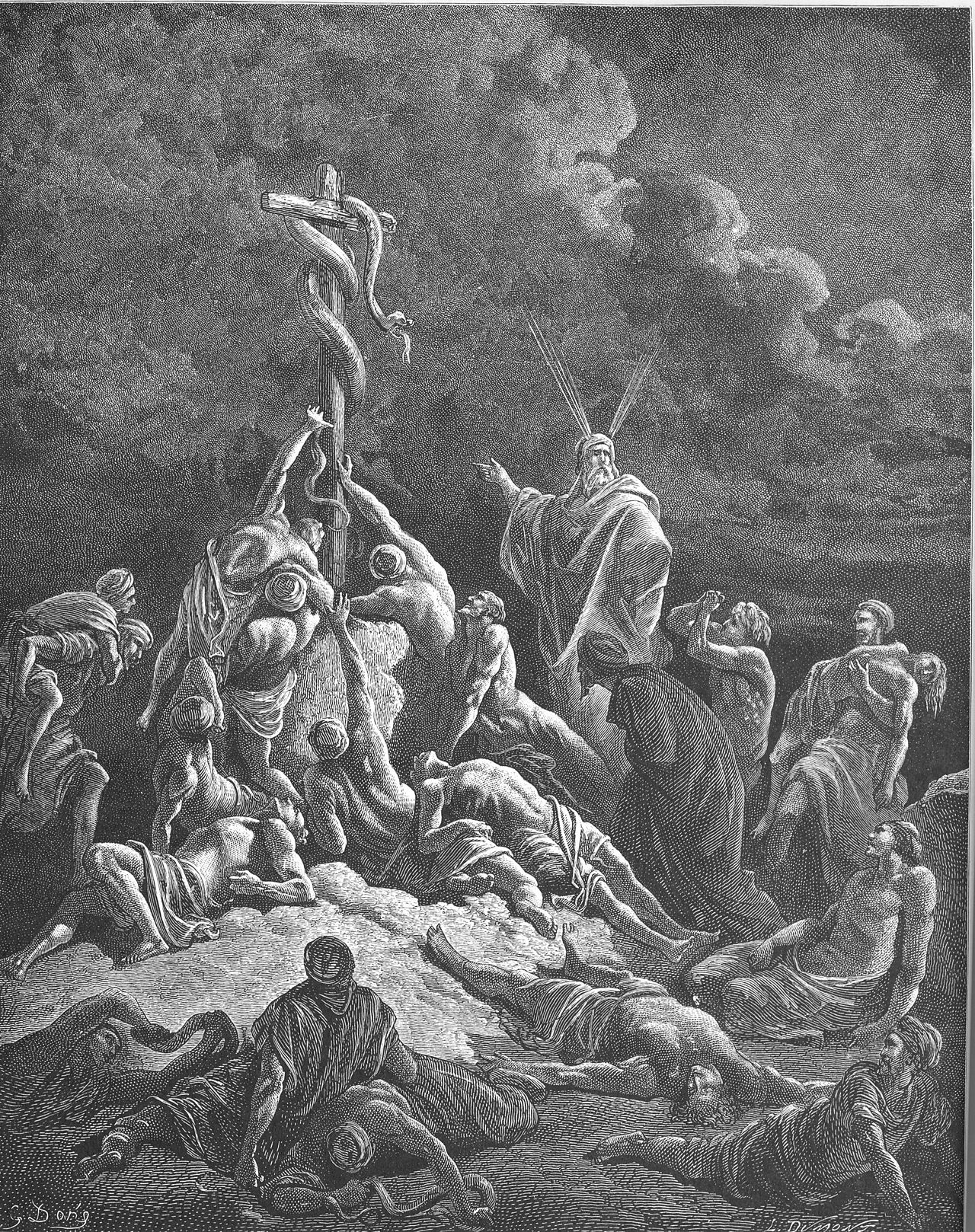
The remedy is a likeness of what is killing them, lifted where the camp can see it, and the whole cure is a look. The promise covers anyone who is bitten. John 3:14 applies it: Just as Moses lifted up the snake in the wilderness, so the Son of Man must be lifted up, a type the New Testament states itself.
Numbers 21:8
“Make thee a fiery serpent - Literally, make thee a seraph. And put it upon a pole - על נס al nes, upon a standard or ensign.”
Adam Clarke · Commentary on the Bible (1810-1826)evangelical
2 more voices on this verse
Numbers 21:8
“Many things were done in figure which were done in former times. For when he said that the fathers who were bitten by serpents in the desert could not be healed in any other way except that Moses hung up a brazen serpent, and when this was seen, those deadly bites and injurious effects of the poison were cured, he added: But these things were done in figure to instruct us (1 Corinthians 10:6).”
Ambrose of Milan · written before 397 · Apology for the Prophet David, Chapter IIIpatristic
Numbers 21:8
“The serpent signified Christ, who was in the likeness of sinful flesh, though without sin, as this brazen serpent had the outward shape, but not the inward poison, of the other serpents: the pole resembled the cross upon which Christ was lifted up for our salvation: and looking up to it designed our believing in Christ.”
John Wesley · Explanatory Notes upon the Old Testament (1765)evangelical
God said to make a fiery serpent, and Moses made a bronze snake, and the Hebrew words for serpent and bronze share their consonants. At 2 Kings 18:4 Hezekiah demolished the bronze snake called Nehushtan, for up to that time the Israelites had burned incense to it. The cure had become an idol.
Numbers 21:9
“And Moses made a serpent of brass - נחש נחשת nechash nechosheth. Hence we find that the word for brass or copper comes from the same root with nachash, which here signifies a serpent, probably on account of the color; as most serpents, especially those of the bright spotted kind, have a very glistening appearance, and those who have brown or yellow spots appear something like burnished brass: but the true meaning of the root cannot be easily ascertained.”
Adam Clarke · Commentary on the Bible (1810-1826)evangelical
1 more voice on this verse
Numbers 21:9
“That brazen serpent was hung up as a remedy for the biting serpents, not as a type of him that suffered for us but as a contrast. It saved those that looked upon it, not because they believed it to live but because it was killed, and killed with it were the powers that were subject to it, being destroyed as it deserved. And what is the fitting epitaph for it from us? "O death, where is your sting? O grave, where is your victory?" You are overthrown by the cross.”
Gregory of Nazianzus · written before 390 · ORATION 45.22patristic
Connections2 Kings 18:4, John 3:14
Spring up, O well: songs on the march
Numbers 21:10-13
Four stages bring Israel to the border of Moab, and one of them closes the sentence passed at Kadesh. Deuteronomy 2:14 counts thirty-eight years until they crossed the Brook of Zered, until that entire generation of fighting men had perished. The Arnon is the border between the Moabites and the Amorites, and Deuteronomy 2:9 forbids any quarrel with Moab.
Numbers 21:10
“The earlier stations in this part of their journey were Zalmonah and Punon Num 33:41-42. Oboth was north of Punon, east of the northern part of Edom, and is pretty certainly the same as the present pilgrim halting-place el-Ahsa. Ije (“ruinous heaps”) of Abarim, or Iim of Abarim, was so called to distinguish it from another Iim in southwestern Canaan Jos 15:29. Abarim denotes generally the whole upland country on the east of the Jordan. The Greek equivalent of the name is Peraea.”
Albert Barnes gives the name as the ruinous heaps of Abarim, with Abarim meaning the upland country east of the Jordan. John Gill places the camp on the east side of Moab and links this wilderness with Deuteronomy 2:8 and Judges 11:18. Israel kept to the edge of Moab. It did not cross Moabite ground.
Numbers 21:11
“And they journeyed from Oboth,.... How long they stayed there is not certain: and pitched at Ijeabarim; which, according to Bunting (k), was sixteen miles from Oboth; Jarchi says it was the way that passengers pass by Mount Nebo to the land of Canaan, and which divides between the land of Moab and the land of the Amorites: in the wilderness which is before Moab; called the wilderness of Moab, Deu 2:8. towards the sunrising; the east side of the land of Moab, Jdg 11:18. (k) Ut supra. (Travels of the Patriarchs, &c. 83.)”
The word rendered valley means a brook valley. Jamieson, Fausset and Brown describe a woody brook valley whose torrent rises in the mountains east of Moab and flows west into the Dead Sea. John Gill takes this to be the station called Dibon-gad in Numbers 33:45. If so, the two lists name one camp in two ways.
Numbers 21:12
“From thence they removed, and pitched in the valley of Zered. Or the brook Zered, as in Deu 13:14 that is near it: this seems to be the same station with Dibongad, Num 33:45, and which, according to the above writer, was sixteen miles from Ijeabarim.”
1 more voice on this verse
Numbers 21:12
“They - pitched in the valley of Zared - נחל זרד nachal zared. This should be translated the brook Zared, as it is in Deu 2:13, Deu 2:14. This stream has its origin in the mountains eastward of Moab, and runs from east to west, and discharges itself into the Dead Sea.”
Adam Clarke · Commentary on the Bible (1810-1826)evangelical
John Wesley reads the other side as this side of the Arnon, since Israel had not yet crossed the river when it camped. He adds that the land beyond had once been Moab's until Sihon took it. Jamieson, Fausset and Brown name the river El-Mojib, a deep, broad and rapid stream. The river made a hard frontier.
Numbers 21:13
“The Arnon, now the Wady Mojeb, an impetuous torrent, divided the territory which remained to the Moabites from that which the Amorites had wrested from them, Num 21:26.”
1 more voice on this verse
Numbers 21:13
“This is added to reconcile two seemingly contrary commands of God, the one that of not meddling with the land of the Moabites, Deut. ii, 9, the other that of going over Arnon and taking possession of the land beyond it, Deut. ii, 24, because, saith he, it is not now the land of the Moabites, but of the Amorites.”
John Wesley · Explanatory Notes upon the Old Testament (1765)evangelical
Numbers 21:14-15
the book of the wars of the Lord: Scripture names the Book of the Wars of the LORD and does not preserve it, as Joshua 10:13 and 2 Samuel 1:18 cite the book of Jasher. The quoted lines are compressed, and translators read either a string of place names or a fragment of a war song. The King James opens with what he did in the Red sea, where the Berean reads Waheb in Suphah.
Numbers 21:14
“The brooks - The brook, the plural number for the singular, as the plural number rivers is used concerning Jordan, Psalm 7iv, 15, and concerning Tigris, Nahum ii, 6, and concerning Euphrates, Psalm 1xxxvii, 1, all which may be to called because of the several little streams into which they were divided.”
John Wesley · Explanatory Notes upon the Old Testament (1765)evangelical
Jamieson, Fausset and Brown call Ar the capital of Moab. Matthew Henry notes at verse 28 that Sihon never took Ar, which stayed the chief city of Moab after the rest was lost. The quoted lines trace the frontier up to that city and stop there. Henry adds that Israel kept the order to use no hostility against Moab.
Numbers 21:15
“To the dwelling of Ar - Ar (compare Num 21:28; Isa 15:1) was on the bank of the Arnon, lower down the stream than where the Israelites crossed. Near the spot where the upper Arnon receives the tributary Nahaliel Num 21:19, there rises, in the midst of the meadow-land between the two torrents, a hill covered with the ruins of the ancient city (Jos 13:9, Jos 13:16; compare Deu 2:36).”
Numbers 21:16-17
Water is promised at Beer before anybody asks for it, and the words are gather the people together, and I will give them water. At verse 5 these same people had said there is no water, and in chapter 20 the want of water cost Moses the land. Here Israel sings over a well, and the song before this one was at the Red sea in Exodus 15:1.
Numbers 21:16
“WE have remarked in our reading that the children of Israel were continually changing their places and that there was usually a great difference between one station and the next. So, also, we are constantly varying in our experience, and the variations are sometimes exceedingly remarkable. You observe, in the neighborhood of the text, that the people pitched their tents at one time by the brooks of Arnon. There appears to have been an exceedingly abundance of water where they then were, but nevertheless they removed into the wilderness where there was not a single drop to quench their thirst.”
2 more voices on this verse
Numbers 21:16
“I will give them water - In a miraculous manner. Before they prayed, God granted, and prevented them with the blessings of goodness. And as the brasen serpent was the figure of Christ, so is this well a figure of the spirit, who is poured forth for our comfort, and from him flow rivers of living waters.”
John Wesley · Explanatory Notes upon the Old Testament (1765)evangelical
Numbers 21:16
“Beer is probably the “Well,” afterward known as Beer-elim, the “well of heroes” Isa 15:8.”
Spring up, O well: The Hebrew verb is ascend. John Wesley reads the line as either a prediction that the water would rise or a prayer that it might. Matthew Henry hears both, a prayer for promised water and a shout of joy as it came up. Henry, like Wesley, reads the well as a figure of the Spirit and cites John 7:38.
Numbers 21:17
“This song, recognized by all authorities as dating from the earliest times, and suggested apparently by the fact that God in this place gave the people water not from the rock, but by commanding Moses to cause a well to be dug, bespeaks the glad zeal, the joyful faith, and the hearty cooperation among all ranks, which possessed the people. In after time it may well have been the water-drawing song of the maidens of Israel.”
2 more voices on this verse
Numbers 21:17
“Spring up - Hebrew. ascend, that is, let thy waters, which now lie hid below in the earth, ascend for our use. It is either a prediction that it should spring up, or a prayer that it might.”
John Wesley · Explanatory Notes upon the Old Testament (1765)evangelical
Numbers 21:17
“With joy must we draw water out of the wells of salvation, Isa. xi. As the brazen serpent was a figure of Christ, who is lifted up for our cure, so is this well a figure of the Spirit, who is poured forth for our comfort, and from whom flow to us rivers of living waters, John vii.”
Matthew Henry · Commentary on the Whole Bible (1707-1721)puritan
Numbers 21:18-20
The well is God's gift, and the nobles of the people hollowed it out with their staffs, both in one verse. The word the Berean gives as scepters is read of Moses directing the work and of the ruler's staff Genesis 49:10 puts between Judah's feet. The stages end where the top of Pisgah overlooks the wasteland, where Moses will be shown the land at Deuteronomy 34:1.
Numbers 21:18
“The princes digged the well - with their staves - This is not easily understood. Who can suppose that the princes dug this well with their staves? And is there any other idea conveyed by our translation? The word חפרו chapharu, which is translated they digged, should be rendered they searched out, which is a frequent meaning of the root; and במשענתם bemishanotham, which we render with their staves, should be translated on their borders or confines, from the root שען shaan, to lie along. With these corrections the whole song may be read thus: - Spring up, O well!”
Adam Clarke · Commentary on the Bible (1810-1826)evangelical
from Nahaliel to Bamoth: John Wesley notes that Mattanah, Nahaliel and Bamoth do not appear among the camps listed in Numbers 33. He takes them as places Israel passed through without pitching. Albert Barnes gives Nahaliel as brook of God and Bamoth as high places. He identifies Bamoth with Bamoth-baal, the height where Balak brings Balaam at 22:41.
Albert Barnes reads the valley in Moab as the field of Moab, the upland pastures cut by a ravine. He takes the wasteland as the wastes of the Dead Sea, and says that from this ridge Israel first saw that sea and the Jordan valley. John Wesley places Pisgah at the top of the hills of Abarim. Israel looked down toward the Jordan from here.
Numbers 21:20
“In the country of Moab - Rather, in the field of Moab: the upland pastures, or flat downs, intersected by the ravine of Wady Waleh. Pisgah, which looketh toward Jeshimon - Or, “toward the waste.” See Num 33:47. Pisgah was a ridge of the Abarim mountains, westward from Heshbon. From the summit the Israelites gained their first view of the wastes of the Dead Sea and of the valley of the Jordan: and Moses again ascended it, to view, before his death, the land of promise.”
Sihon of Heshbon falls
Numbers 21:21-23
Israel asks Sihon what it asked Edom at 20:17, passage by the King’s Highway with nothing taken. Edom refused and Israel turned aside, but Sihon comes out to fight, so the outcome follows from who attacked whom. Deuteronomy 2:30 adds a reason Numbers withholds, that the LORD your God had made his spirit stubborn and his heart obstinate.
Numbers 21:21
“And Israel sent messengers unto Sihon king of the Amorites,.... Who were one of the nations of the Canaanites, and a principal and powerful one, and who were devoted to destruction, and their land designed for the people of Israel; see Gen 15:16, at this time Sihon was their king, to whom Moses, in the name of Israel, sent a very peaceable message from the wilderness of Kedemoth, which lay near his country, Deu 2:26, saying; as follows.”
John Wesley holds that Israel meant these terms and would have kept them if Sihon had given quiet passage. John Gill observes that the road through Sihon's land was the shorter way to the Jordan. A peaceful march was offered first. Wesley adds that the offer made the war that followed a defence, and Israel's title to the land clear to all.
Numbers 21:22
“Let me pass through thy land,.... Through some part of it, which would have been a shorter way to the river Jordan, over which Israel was to pass into the land of Canaan; the terms proposed, or things to be observed in their passage, which they would bind themselves strictly to, are the same that were made to the king of Edom. See Gill on Num 20:17.”
Sihon went out into the wilderness, beyond his own border, to meet Israel. Matthew Henry points to Judges 11:20, where Jephthah says Sihon did not trust Israel to pass through. Henry reads it as policy that ruined its maker. Jamieson, Fausset and Brown say the refusal of a respectful message was resented, and Sihon was beaten in battle.
Numbers 21:24-25
This is the first land Israel takes and lives in since Egypt, from the Arnon to the Jabbok, and the cities are occupied, not levelled. Genesis 15:16 had said the iniquity of the Amorites is not yet complete, and the Amorite is the first nation dispossessed. The Jabbok is where Jacob wrestled at Genesis 32:22-24.
Numbers 21:24
“Jabbok (now Wady Zerka: compare Gen 32:22) runs eastward under Rabbah of the children of Ammon, thence westward, and reaches the Jordan, 45 miles north of the Arnon. It was between Rabbah and Gerasa that it formed the Ammonite boundary.”
The Hebrew calls the villages daughters, as John Gill notes. Gill adds that these cities were given to Reuben and Gad, and Numbers 32:3 lists several of them by name. Albert Barnes places Heshbon on the high plateau due east of the point where the Jordan enters the Dead Sea, conspicuous from every part of that plateau.
Numbers 21:25
“Heshbon - Now Heshban, a ruined city, due east of the point where the Jordan enters the Dead Sea; conspicuous from all parts of the high plateau on which it stands, but concealed, like the rest of the plateau, from the valley beneath.”
Numbers 21:26-27
Heshbon was Moabite ground until Sihon took it from the former king of Moab, and the detail matters because Deuteronomy 2:9 forbade Israel to take Moab's land. Jephthah argues the case at Judges 11:12-27 three hundred years later. The chapter then hands the account to the poets.
Numbers 21:26
“For Heshbon was the city of Sihon, etc. - It appears therefore that the territory now taken from Sihon by the Israelites was taken from a former king of Moab, in commemoration of which an epikedion or war song was made, several verses of which, in their ancient poetic form, are here quoted by Moses.”
Adam Clarke · Commentary on the Bible (1810-1826)evangelical
1 more voice on this verse
Numbers 21:26
“The Israelites did not take it out of the hands of the Moabites, they had before lost it to the Amorites, and were constrained to give up their pretensions to it; and, when Israel had taken it from the Amorites, they were under no obligation to restore it to the Moabites, whose title to it was long since extinguished.”
Matthew Henry · Commentary on the Whole Bible (1707-1721)puritan
Albert Barnes notes that the word for poets is the one that gives the Book of Proverbs its title. Numbers uses it again for Balaam's oracles at 23:7, and Isaiah 14:4 uses it for a taunt over Babylon. John Wesley hears the call to Heshbon as Sihon speaking to his people, or the people urging one another to hold the city. Either way, the city is now Sihon's.
Numbers 21:27
“Wherefore they that speak in proverbs say,.... The historical writers of those times, among the Amorites, who were usually poets, and wrote the history of the wars between the Moabites and Amorites in verse; as Homer among the Greeks wrote the wars of Troy; and the compositions of those ancient bards were short and compendious, and wrapped up in proverbial sayings, and enigmatical and figurative expressions, that they might be the better retained in memory, and therefore were called proverbialists.”
1 more voice on this verse
Numbers 21:27
“They that speak in proverbs - The original word is almost equivalent to “the poets.” The word supplies the title of the Book of Proverbs itself; and is used of the parable proper in Eze 17:2; of the prophecies of Balsam in Num 23:7-10; Num 24:3-9; etc.; and of a song of triumph over Babylon in Isa 14:4.”
Numbers 21:28-30
The song is an Amorite victory piece about the fall of Moab, made when Heshbon was taken from Moab, and Moses puts it into the record now that the singers themselves have fallen. Chemosh is named as the god of Moab, the god 1 Kings 11:7 says Solomon built a high place for. Jeremiah 48:45-46 takes these same lines up again against Moab centuries later, so a taunt made by Amorites ends in the prophets.
Numbers 21:28
“A fire - The fury of war, which is fitly compared to fire. Out of Heshbon - That city which before was a refuge and defense to all the country, now is turned into a great annoyance.”
John Wesley · Explanatory Notes upon the Old Testament (1765)evangelical
O people of Chemosh: The he who gave up his sons is Chemosh himself, as John Wesley and Jamieson, Fausset and Brown both read it. The god is pictured handing over his own worshippers as refugees and captives. Wesley takes this verse and the next as Israel's comment on the Amorite song. On that reading the line marks a god unable to save.
Numbers 21:29
“Chemosh - The national God of the Moabites (compare the marginal references). The name probably means “Vanquisher,” or “Master.” The worship of Chemosh was introduced into Israel by Solomon 1Ki 11:7; 2Ki 23:13. It was no doubt to Chemosh that Mesha, king of Moab, offered up his son as a burnt-offering 2Ki 3:26-27. In the first six lines Num 21:27-28 the poet imagines for the Amorites a song of exultation for their victories over Moab, and for the consequent glories of Heshbon, their own capital.”
The speaker here is read two ways. Matthew Henry takes the we as the Amorites, boasting that the country as far as Dibon and Nophah was now theirs. John Wesley takes it as Israel, saying that where Moab and its god failed, Israel with God's help has overthrown Sihon. On Wesley's reading, Heshbon perishes by being taken from Sihon.
Numbers 21:30
“Though you feeble Moabites, and your God too, could not resist Sihon, we Israelites, by the help of our God, have shot, with success and victory, at them, at Sihon and his Amorites. Heshbon - The royal city of Sihon, and by him lately repaired, Is perished - Is taken away from Sihon, and so is all his country, even as far as Dibon.”
John Wesley · Explanatory Notes upon the Old Testament (1765)evangelical
Numbers 21:31-32
The verb settles what the last chapters had only promised, that Israel dwelt in the land of the Amorites. Jaazer is spied out and taken, and the tribes who see this pasture will ask for it at 32:1-5, where Reuben and Gad name Jazer and Gilead as a place for cattle. The request that splits the inheritance across Jordan begins with the ground taken in this verse.
Numbers 21:31
“Thus Israel dwelt in the land of the Amorites. Not the land of the Moabites; and by those means before mentioned; by conquering Sihon their king, they came into the possession of it, and took up their dwelling in it; this was the beginning of the conquest of the Canaanites, and an earnest and pledge of inheriting their land promised unto them; the Israelites that dwelt here were the tribes of Reuben and Gad.”
Moses sends spies again, and this time the report ends in a city taken. Albert Barnes places Jazer probably at ruins ten miles north of Heshbon, and says its capture virtually completed the conquest of the Amorite kingdom. John Wesley counts it among the cities Sihon had once taken from Moab. It now passed from Sihon to Israel.
Numbers 21:32
“Jaazer - To he identified probably with the ruins Sir or es-Sir 10 miles north of Heshbon. The occupation of it by the Israelites virtually completed their conquest of the Amorite kingdom; and prepared the way for the pastoral settlements in it which they not long after established Num 32:35.”
Og of Bashan falls
Numbers 21:33-34
God tells Moses, Do not fear him, for I have delivered him into your hand, the assurance Joshua and Caleb gave at 14:9. Deuteronomy 3:11 adds that Og remained of the remnant of the Rephaim, with a bed of iron nine cubits long. That ties him to the Rephaim of Genesis 14:5 and back to the report of the ten spies at 13:33.
Numbers 21:33
“In these apparently unimportant words is contained the record of the Israelite Num 32:39 occupation of Gilead north of the Jabbok; a territory which, though populated, like southern Gilead, by the Amorites (Deu 3:9; Jos 2:10, etc.), formed part of the domain of Og king of Bashan, who was himself of a different race Deu 3:2; Jos 12:5; Jos 13:11. We are not told whether they were led there by express warrant of God, or whether their advance upon Bashan was provoked by Og and his people.”
2 more voices on this verse
Numbers 21:33
“Bashan was famous for the best timber (witness the oaks of Bashan), and the best breed of cattle, witness the bulls and kine of Bashan, and the lambs and rams of that country, which are celebrated, Deut. xxxii. Wicked men do their utmost to secure themselves and their possessions against the judgments of God, but all in vain, when their day comes, on which they must fall.”
Matthew Henry · Commentary on the Whole Bible (1707-1721)puritan
Numbers 21:33
“Og--a giant, an Amoritish prince, who, having opposed the progress of the Israelites, was defeated. The Lord said unto Moses, Fear him not--a necessary encouragement, for Og's gigantic stature (De 3:11) was calculated to inspire terror.”
Jamieson, Fausset & Brown · Commentary Critical and Explanatory on the Whole Bible (1871)reformed
The promise is spoken as already done, I have delivered him, and Matthew Henry reads it as a thing as good as finished. Henry also notes that these victories came while Moses still lived. He sees them as comfort to Moses, who would not see the conquest completed, and as encouragement for the war in Canaan under Joshua.
Numbers 21:34
“God gave Israel these successes, while Moses was yet with them, both for his comfort (that he might see the beginning of that glorious work, which he must not live to see the finishing of) and for the encouragement of the people in the war of Canaan under Joshua. Though this was to them in comparison but as the day of small things, yet it was an earnest of great things.”
Matthew Henry · Commentary on the Whole Bible (1707-1721)puritan
None is left alive and the land is possessed, which closes a chapter that opened with a Canaanite king taking Israelites prisoner. Psalm 135:10-11 and Psalm 136:19-20 keep Sihon king of the Amorites and Og king of Bashan in Israel's praise by name, so these two battles became liturgy. The generation sentenced at Kadesh is gone and its children are taking ground.
Numbers 21:35
“So they smote him, and his sons - There is a curious note of Dr. Lightfoot here, of which I should think it wrong to deprive the reader. “Sihon and Og conquered, A. M. 2553. Of the life of Moses, 120. From the Exodus, 40. It is now six and twenty generations from the creation, or from Adam to Moses; and accordingly doth Psalm 136, rehearse the durableness of God’s mercy six and twenty times over, beginning the story with the creation, and ending it in the conquest of Sihon and Og.”
Adam Clarke · Commentary on the Bible (1810-1826)evangelical
How this psalm is built
The form: Narrative with two quoted songs and a citation from a book Scripture names and does not preserve, as Clarke classes it.
The patterns in this chapter
| Device | What it does | Where to see it |
|---|---|---|
| Saraph, the burning one | The word rendered fiery at verse 6 is saraph, the burning one. It is the word behind the seraphim of Isaiah 6:2 and the fiery flying serpent of Isaiah 14:29. The thing sent and the thing lifted are named with the same word. | Numbers 21:6, Numbers 21:8 |
| Serpent and brass, sharing their consonants | God said to make a fiery serpent and Moses made it of brass, and the Hebrew words for serpent and for brass share their consonants. Hezekiah broke the object centuries later and called it Nehushtan, a piece of brass, which 2 Kings 18:4 records.Adam Clarke, Commentary on the Bible, 1832, on Numbers 21:9. | Numbers 21:9 |
| Let us pass through your land | The request put to Edom at 20:17 is put again to Sihon at verse 22 in nearly the same words, with the highway kept and field and vineyard and well left alone. Edom refused and Israel turned aside. Sihon refused and came out to fight. | Numbers 21:22, Numbers 21:23 |
| The stages from the desert to Moab | Verses 10 to 20 move the camp by named stops, Oboth, Iye-abarim, the Zered valley, the Arnon, Beer, Mattanah, Nahaliel, Bamoth and the valley in Moab below Pisgah. One of those stops carries the end of the sentence passed at Kadesh. | Numbers 21:10, Numbers 21:12, Numbers 21:16, Numbers 21:19, Numbers 21:20 |
| Spring up, O well | The Song of the Well at verses 17 and 18 is a work song sung over water that God promised before anyone asked for it. At verse 5 these same people had said there is no water. The chapter sets the complaint and the song five verses apart. | Numbers 21:5, Numbers 21:17, Numbers 21:18 |
The chapter is built on a change in how complaint is answered. In Exodus a complaint of this kind was answered with food or water. From Numbers 11:1 onward the same complaints are answered with fire, with plague, and here with serpents.
11 more paragraphs on the patterns
Bronze and copper serpent figurines have been excavated at sites across Canaan and at the copper mining shrine at Timna in the Arabah, close to the country Israel was crossing. The site's own dossier for this book carries the object's later history. Israel kept it, and by Hezekiah's day people were burning incense to it, so the king broke it in pieces and called it Nehushtan.
The quoted lines from the Book of the Wars of the LORD are compressed, and the translators divide over them. Some read a string of place names and others a fragment of a war song. The American Standard Version opens it as Vaheb in Suphah where the King James has what he did in the Red Sea.
One of the stages carries the end of the sentence passed at Kadesh. Deuteronomy 2:14 says the span from Kadesh-barnea to the crossing of the Zered was thirty eight years, until all the generation of the men of war were gone from the camp.
The New Testament's use
John 3:14 to 15 applies verse 8 to the Son of Man in so many words, as Moses lifted up the serpent in the wilderness, even so must the Son of Man be lifted up. That makes this one of the few types in the Torah that the New Testament states outright. The dossier for this book reads the healing as coming from looking in faith at what God provided, and the object is the thing looked at.
1 Corinthians 10:9 names this episode among the things written for the church, and the warning there is against testing Christ as they did.
The debated point
Hormah is named at verse 3, and Numbers 14:45 had already used the name for the ground where the fathers were driven back. Judges 1:17 records the name being given again by Judah and Simeon. Keil and Delitzsch read 14:45 as using the later name in advance. The three passages stand in the text as they are written.
A second point stands at verse 18. The phrase rendered by the direction of the lawgiver is read of Moses commanding the work, and it is also read of the ruler's staff, the word Genesis 49:10 puts between Judah's feet. John Calvin and Adam Clarke divide over which is meant.
Where to go deeper
The serpent lifted on the pole is owed a feature page, and this row carries the full presentation until it stands. The country the chapter crosses is set out at the wilderness, and the generation that crossed it at the wilderness generation. The bread they loathed at verse 5 is set out at manna.
Keep studying
People1
Words12
Trails1
Sources for this chapter
The summary
Jamieson, Fausset & Brown, Commentary Critical and Explanatory; John Calvin, Commentaries; John Wesley, Notes on the Old Testament and Matthew Henry, Complete Commentary.
The context
C. H. Spurgeon, The Mysteries of the Brazen Serpent and Matthew Henry, Commentary on the Whole Bible.
The form and classifications
Adam Clarke, Commentary on the Bible, 1832, on Numbers 21:14; Albert Barnes, Notes, Explanatory and Practical, on the Old and New Testaments, 1832 to 1869, on Numbers 21:10 and Keil and Delitzsch, Biblical Commentary on the Old Testament: The Pentateuch, on Numbers 21:24.
The exposition
Adam Clarke, Commentary on the Bible; Albert Barnes; Chuck Missler, Learn the Bible in 24 Hours; Jamieson, Fausset & Brown, Commentary Critical and Explanatory; John Calvin, Commentary on the Four Last Books of Moses Arranged in the Form of a Harmony; John Gill; John Wesley, Notes on the Old Testament; Keil and Delitzsch, Biblical Commentary on the Old Testament: The Pentateuch and Matthew Henry.