
Numbers 21:6
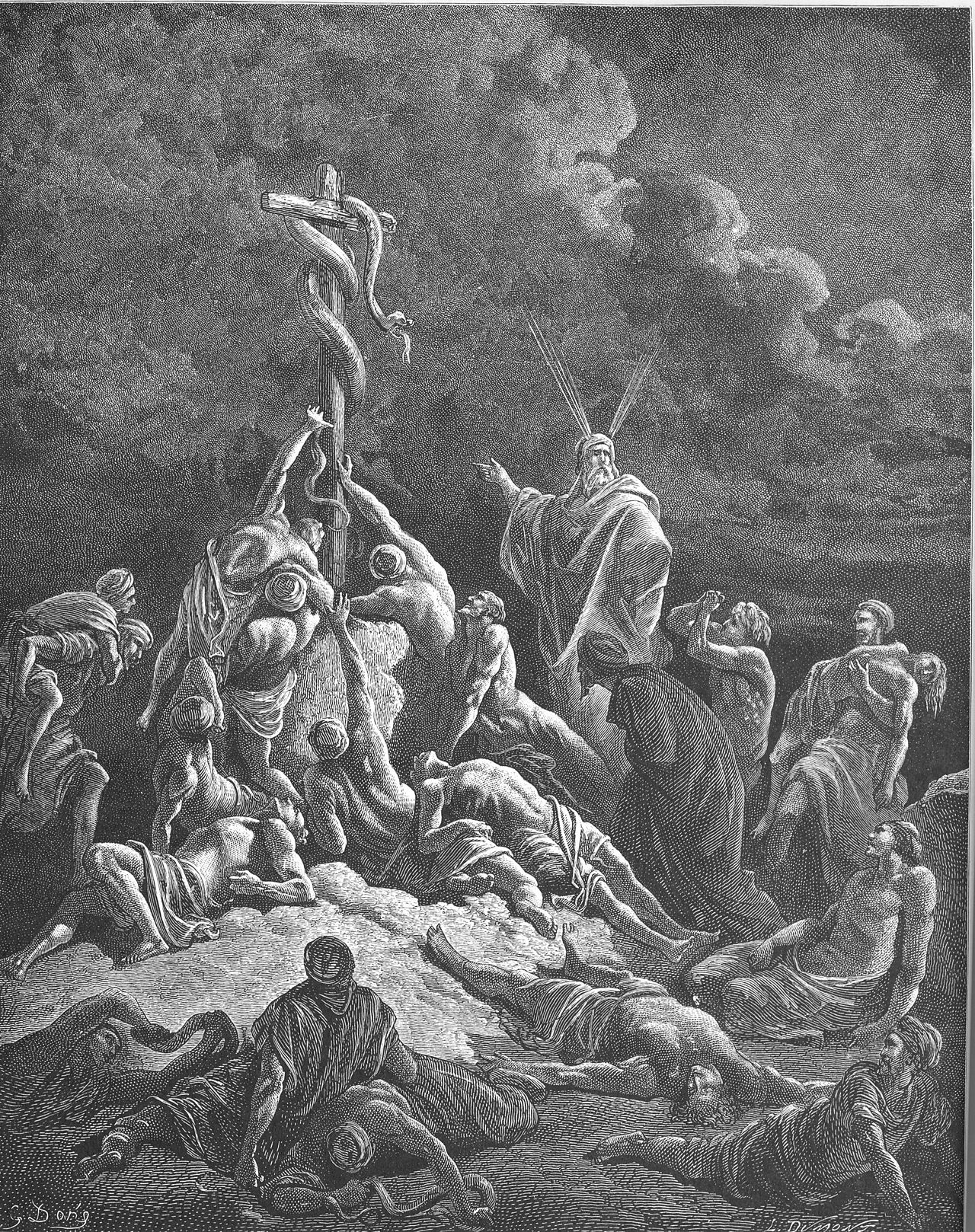
in Numbers 21So the LORD sent venomous snakes among the people, and many of the Israelites were bitten and died.
BSB
The same verse in ASV and KJV ▾
ASV
And Jehovah sent fiery serpents among the people, and they bit the people; and much people of Israel died.
KJV
And the Lord sent fiery serpents among the people, and they bit the people; and much people of Israel died.
⋯
This verse in Numbers 21
Commentary
14 notes on this verseFiery serpents - הנחשים השרפים hannechashim hasseraphim. I have observed before, on Gen. iii., that it is difficult to assign a name to the creature termed in Hebrew nachash; it has different significations, but its meaning here and in Gen. iii. is most difficult to be ascertained. Seraphim is one of the orders of angelic beings, Isa 6:2, Isa 6:6; but as it comes from the root שרף saraph, which signifies to burn, it has been translated fiery in the text.
This site's exposition
the Lord sent fiery serpents among the people
on Numbers 21:6-7
The word rendered fiery is saraph, the burning one, the same word behind the seraphim of Isaiah 6:2 and the fiery flying serpent of Isaiah 14:29. The confession repeats verse 5 back exactly, that they had spoken against the Lord and against Moses, so the sin is named in full before the remedy is asked for. Moses prays for people who had just spoken against him, as he did at 11:2 and at 14:13, and 1 Corinthians 10:9 names this episode by name among the things written for the church.
The record, by era
The Church Fathers1 voice
A commentator
Philoxenus of Mabbug13 Ascetic Discourses, Discourse 7 -- Second Discourse on the Fear of God · Written before 523.
proposed
And that He might increase in them this fear, immediately, by the mouth of offence, the rod of His chastisement was revealed, and after the offence the Chastiser gave them no respite, because their servitude was not worthy of His longsuffering. Above their head the …
The Medieval Church1 voice
The wounds caused by the fiery serpent are the poisonous enticements of the vices, which afflict the soul and bring about its spiritual death. The people were murmuring against the Lord. They were stricken by the serpents' bites. This provides an excellent instance of how …
The Puritans and the Awakening3 voices
Christ was lifted up by the rulers of the Jews, who were the successors of Moses. (3.) That which cured was shaped in the likeness of that which wounded. So Christ, though perfectly free from sin himself, yet was made in the likeness of sinful flesh ( Rom. viii.
quarantine:debris (2026-07-29) — unbalanced-parens
Fiery serpents - There were many such in this wilderness, which having been hitherto restrained by God, are now let loose and sent among them. They are called fiery from their effects, because their poison caused an intolerable heat and burning and thirst, which was aggravated with this circumstance of the place, that here was no water, ver. 5.
And the Lord sent fiery serpents among the people,....
7 more voices on this verse
The Puritans and the Awakening1 voice
Justly are those made to feel God's judgments that are not thankful for his mercies. These serpents are called fiery, from their colour, or from their rage, or from the effects of their bitings, inflaming the body, putting it immediately into a high fever, scorching it with an insatiable thirst.
The Nineteenth Century6 voices
A commentator
Jamieson, Fausset & Brown1802–1910
Commentary Critical and Explanatory on the Whole Bible (1871)
The only known remedy consists in sucking the wound, or, in the case of cattle, in the application of ammonia. The exact species of serpents that caused so great mortality among the Israelites cannot be ascertained. They are said to have been "fiery," an epithet applied to them either from their bright, vivid color, or the violent inflammation their bite occasioned.
I HAVE frequently expounded to you the type of the bronze serpent as our Lord interprets it in the third of John. I thought it meet, tonight, to take that type in its connection and look at the original circumstances which led to the setting of it up—for while the general doctrine of looking for salvation to Christ as the bronze serpent is always to be preached and is most usefully set forth in the midst of the unconverted—yet I take it that its original institution teaches us much which ought not to be overlooked.
I HAVE frequently expounded to you the type of the bronze serpent as our Lord interprets it in the third of John. I thought it meet, tonight, to take that type in its connection and look at the original circumstances which led to the setting of it up—for while the general doctrine of looking for salvation to Christ as the bronze serpent is always to be preached and is most usefully set forth in the midst of the unconverted—yet I take it that its original institution teaches us much which ought not to be overlooked. It is very clear that this type has its first voice to the people of God, for it was among Israel—among the nominal people of God—that this bronze serpent was first needed and first set up. And while the instruction which it gives is wide as the universe, for whoever looks shall live, nevertheless it has an inner circle to which it, first of all, addresses itself—the professed members of the Church of God. The Book of Numbers might be called, without any impropriety, "Moses' Pilgrim's Progress." It contains a full account of the progress of the pilgrims through the wilderness until they came to the promised land. And, like Bunyan's "Pilgrim's Progress," it is not only a history of any one person or nation, but it is the picture of the life of all God's people. Probably no one among us will pass through all the troubles of the Israelites, so as to become in one person an epitome of all wilderness experience, and yet even this may be, for so it was with David, and so it has been with others by whom the Lord would instruct His Church. This, however, is exceptional. But, take the whole of us together as the Church of God, and you will find that our lives are mirrored, pictured and foreseen in the travels of God's chosen people from the land of Egypt to Canaan. I am afraid that many of us can see ourselves even in the passage before us.
A commentator
Charles Spurgeon1834–1892
The Metropolitan Tabernacle Pulpit, Sermon No. 3214: “Two Wilderness Incidents” (lightly modernized text, CCEL edition) · Written before 1892.
proposed
OUR text is a long one, but we must have it all in order to get the sense of the passage, so as to contrast the two wilderness incidents which are here mentioned and to learn how we may use them to our own spiritual profit. I. So, in the first place, LET US CONTRAST THESE TWO WILDERNESS INCIDENTS. First of all, let us examine the details of the first incident. We learn, from this part of the narrative, that the children of Israel were in real danger.
A commentator
Charles Spurgeon1834–1892
The Metropolitan Tabernacle Pulpit, Sermon No. 3214: “Two Wilderness Incidents” (lightly modernized text, CCEL edition) · Written before 1892.
proposed
OUR text is a long one, but we must have it all in order to get the sense of the passage, so as to contrast the two wilderness incidents which are here mentioned and to learn how we may use them to our own spiritual profit. I. So, in the first place, LET US CONTRAST THESE TWO WILDERNESS INCIDENTS. First of all, let us examine the details of the first incident. We learn, from this part of the narrative, that the children of Israel were in real danger. They were attacked by a ferocious foe who, being probably aware that he was doomed to destruction, determined to anticipate the contest by fighting against the Israelites while they were unprepared, and so injuring them as much as he could. Arad appears to have been a king of some considerable power and his skill in warfare is proved by the fact that he was at least partially successful against the Israelites, for he, "took some of them prisoners." So that the people were in real danger. And have you not noticed, dear Friends, that God's people often behave best when they are in their worst case? Usually, when they are in imminent peril, they cry to their God to deliver them, and so they soon obtain relief—but when they make trouble for themselves by a willful fretfulness of spirit—then it is that they lose their confidence in God and, instead of playing the man, they play the fool! You must have noticed how often accidents happen to people when they are engaged in play rather than when they are at work. I always warn our friends to be especially careful when they are leaving for a holiday, for I have observed how frequently they come back with signs of having suffered injuries of one kind or another, though they have been perfectly well while occupied with their usual avocations. It is very much the same in spiritual things.
A commentator
Albert Barnes1798–1870
Notes, Explanatory and Practical, on the Old and New Testaments (1832-1869)
proposed
Fiery serpents - The epithet Deu 8:15; Isa 14:29; Isa 30:6 denotes the inflammatory effect of their bite. The peninsula of Sinai, and not least, the Arabah, abounds in mottled snakes of large size, marked with fiery red spots and wavy stripes, which belong to the most poisonous species, as the formation of the teeth clearly show.
The words behind it
13 Hebrew wordsEvery Hebrew word of this verse in the order it stands, with what it means and the door to its own study. The last column counts the times a word stands in the whole Bible: the rarer the word, the more the places it appears belong together.
| Hebrew | Sound | Meaning | Word study | In the Bible |
|---|---|---|---|---|
| וַיְשַׁלַּ֨ח | vayshalach | and he sent | H7971 → | 845 times |
| יְהוָ֜ה | yahweh | Yahweh | H3068 → | 6520 times |
| בָּעָ֗ם | baam | among the people | H5971 → | 1873 times |
| אֵ֚ת | ʾet | <obj.> | H853 → | 10935 times |
| הַנְּחָשִׁ֣ים | hanechashim | the snakes | H5175 → | 31 times |
| הַשְּׂרָפִ֔ים | haserafim | the saraphs | H8314 → | |
| וַֽיְנַשְּׁכ֖וּ | vaynashekhu | and they bit | H5391 → | 16 times |
| אֶת־ | ʾet- | <obj.> | H853 → | 10935 times |
| הָעָ֑ם | haam | the people | H5971 → | 1873 times |
| וַיָּ֥מָת | vaiyamot | and it died | H4191 → | 839 times |
| עַם־ | ʾam- | a people | H5971 → | 1873 times |
| רָ֖ב | rav | numerous | H7227 → | 454 times |
| מִיִּשְׂרָאֵֽל׃ | miyisrael | from Israel | H3478 → | 2507 times |
וַיְשַׁלַּ֨חand he sent
vayshalachH7971 →845 times
יְהוָ֜הYahweh
yahwehH3068 →6520 times
בָּעָ֗םamong the people
baamH5971 →1873 times
אֵ֚ת<obj.>
ʾetH853 →10935 times
הַנְּחָשִׁ֣יםthe snakes
hanechashimH5175 →31 times
הַשְּׂרָפִ֔יםthe saraphs
haserafimH8314 →
וַֽיְנַשְּׁכ֖וּand they bit
vaynashekhuH5391 →16 times
אֶת־<obj.>
ʾet-H853 →10935 times
הָעָ֑םthe people
haamH5971 →1873 times
וַיָּ֥מָתand it died
vaiyamotH4191 →839 times
עַם־a people
ʾam-H5971 →1873 times
רָ֖בnumerous
ravH7227 →454 times
מִיִּשְׂרָאֵֽל׃from Israel
miyisraelH3478 →2507 times
A shaded row is a word that stands 400 times or fewer in the Bible.
The walk
8 stopsEach card is a verse this one points to, and under it the verses that one points to in turn. Where several paths arrive at the same place, that place is listed first: the text keeps returning to it.
Through
1 Corinthians 10:9We should not test Christ, as some of them did, and were killed by snakes.
it leads to
- Numbers 21:5–6
and spoke against God and against Moses: “Why have you led us up out of Egypt to die in the wilderness? There is no bread or water, and we detest this wretched food!”
- Psalms 78:18
They willfully tested God by demanding the food they craved.
- Hebrews 3:8–11
do not harden your hearts, as you did in the rebellion, in the day of testing in the wilderness,
- Exodus 17:2
So the people contended with Moses, “Give us water to drink.” “Why do you contend with me?” Moses replied. “Why do you test the LORD?”
- Psalms 78:56
But they tested and disobeyed God Most High, for they did not keep His decrees.
- Numbers 21:5–6
Through
Isaiah 30:6This is the burden against the beasts of the Negev: Through a land of hardship and distress, of lioness and lion, of viper and flying serpent, they carry their wealth on the backs of…
it leads to
- Deuteronomy 8:15
He led you through the vast and terrifying wilderness with its venomous snakes and scorpions, a thirsty and waterless land. He brought you water from the rock of flint.
- Deuteronomy 8:15
Through
Deuteronomy 8:15He led you through the vast and terrifying wilderness with its venomous snakes and scorpions, a thirsty and waterless land. He brought you water from the rock of flint.
it leads to
- Numbers 20:11
Then Moses raised his hand and struck the rock twice with his staff, so that a great amount of water gushed out, and the congregation and their livestock were able to drink.
- Numbers 20:11
Through
Jeremiah 8:17“For behold, I will send snakes among you, vipers that cannot be charmed, and they will bite you,” declares the LORD.
it leads to
- Ecclesiastes 10:11
If the snake bites before it is charmed, there is no profit for the charmer.
- Ecclesiastes 10:11
Where this verse is studied
On this page
Studies3
On this verse
On this chapter
About Numbers
This page draws on 11 works. Open the list of works
This page draws on Adam Clarke, Commentary on the Bible; Albert Barnes, Notes, Explanatory and Practical, on the Old and New Testaments (1832-1869); Bede, Homilies on the Gospels 2.18; Charles Spurgeon, The Metropolitan Tabernacle Pulpit, Sermon No. 1722: “The First Setting Up of the Bronze Serpent” (lightly modernized text, CCEL edition); Charles Spurgeon, The Metropolitan Tabernacle Pulpit, Sermon No. 3214: “Two Wilderness Incidents” (lightly modernized text, CCEL edition); Jamieson, Fausset & Brown, Commentary Critical and Explanatory on the Whole Bible; John Gill, Exposition of the Old Testament; John Gill, Exposition of the Old Testament (1748-1763); John Wesley, Explanatory Notes upon the Old Testament; Matthew Henry, Commentary on the Whole Bible and Philoxenus of Mabbug, 13 Ascetic Discourses, Discourse 7 -- Second Discourse on the Fear of God.