
Numbers 21:9
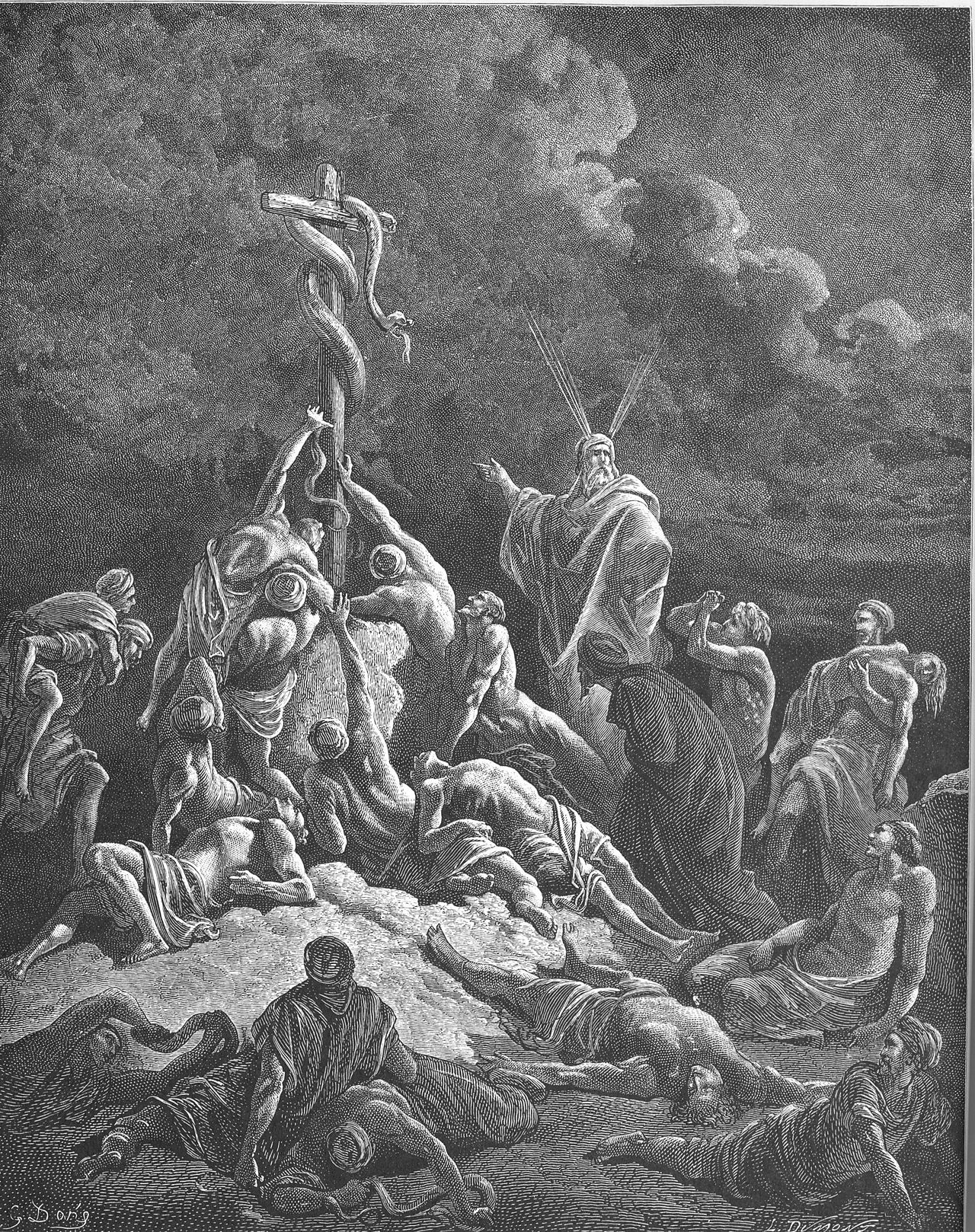
in Numbers 21So Moses made a bronze snake and mounted it on a pole. If anyone who was bitten looked at the bronze snake, he would live.
BSB
The same verse in ASV and KJV ▾
ASV
And Moses made a serpent of brass, and set it upon the standard: and it came to pass, that if a serpent had bitten any man, when he looked unto the serpent of brass, he lived.
KJV
And Moses made a serpent of brass, and put it upon a pole, and it came to pass, that if a serpent had bitten any man, when he beheld the serpent of brass, he lived.
⋯
This verse in Numbers 21
Commentary
14 notes on this verseMany things were done in figure which were done in former times. For when he said that the fathers who were bitten by serpents in the desert could not be healed in any other way except that Moses hung up a brazen serpent, and when this was seen, those deadly bites and injurious effects of the poison were cured, he added: But these things were done in figure to instruct us (1 Corinthians 10:6).
This site's exposition
So Moses made a bronze snake
Moses made the fiery serpent of bronze, and the Hebrew words for serpent and bronze share their consonants. At 2 Kings 18:4 Hezekiah demolished the bronze snake called Nehushtan, for up to that time the Israelites had burned incense to it. The cure had become an idol.
The record, by era
The Church Fathers4 voices
That brazen serpent was hung up as a remedy for the biting serpents, not as a type of him that suffered for us but as a contrast. It saved those that looked upon it, not because they believed it to live but because it was killed, and killed with it were the powers that were subject to it, being destroyed as it deserved. And what is the fitting epitaph for it from us? "O death, where is your sting? O grave, where is your victory?" You are overthrown by the cross.
For tell me, was it not God who commanded by Moses that no image or likeness of anything which was in heaven above or which was on the earth should be made, and yet who caused the brazen serpent to be made by Moses in the wilderness, and set it up for a sign by which those bitten by serpents were saved? Yet is He free from unrighteousness. For by this, as I previously remarked, He proclaimed the mystery, by which He declared that He would break the power of the serpent which occasioned the transgression of Adam, and [would bring] to them that believe on Him [who was foreshadowed] by this sign, i.e., Him who was to be crucified, salvation from the fangs of the serpent, which are wicked deeds, idolatries, and other unrighteous acts.
To be made whole of a serpent is a great sacrament. What is it to be made whole of a serpent by looking upon a serpent? It is to be made whole of death by believing in one dead. And nevertheless Moses feared and fled. What is it that Moses fled from that serpent? What, brethren, save that which we know to have been done in the gospel? Christ died, and the disciples feared and withdrew from that hope wherein they had been.
A commentator
Ephrem the SyrianCOMMENTARY ON TATIAN'S DIATESSARON 16:15 · Written before 373.
proposed
The serpent struck Adam in paradise and killed him. [It also struck] Israel in the camp and annihilated them. "Just as Moses lifted up the serpent in the desert, the Son of Man will be lifted up." Just as those who looked with bodily eyes …
The Puritans and the Awakening1 voice
And Moses made a serpent of brass,....
7 more voices on this verse
The Puritans and the Awakening1 voice
God ordered Moses to make the representation of a fiery serpent, which he did, in brass, and set it up on a very long pole, so that it might be seen from all parts of the camp, and every one that was stung with a fiery serpent was healed by looking up to this serpent of brass.
The Nineteenth Century6 voices
And Moses made a serpent of brass - נחש נחשת nechash nechosheth. Hence we find that the word for brass or copper comes from the same root with nachash, which here signifies a serpent, probably on account of the color; as most serpents, especially those of the bright spotted kind, have a very glistening appearance, and those who have brown or yellow spots appear something like burnished brass: but the true meaning of the root cannot be easily ascertained.
A commentator
Jamieson, Fausset & Brown1802–1910
Commentary Critical and Explanatory on the Whole Bible (1871)
This peculiar method of cure was designed, in the first instance, to show that it was the efficacy of God's power and grace, not the effect of nature or art, and also that it might be a type of the power of faith in Christ to heal all who look to Him because of their sins (Joh 3:14, 15; see also on 2Ki 18:4).
I HAVE frequently expounded to you the type of the bronze serpent as our Lord interprets it in the third of John. I thought it meet, tonight, to take that type in its connection and look at the original circumstances which led to the setting of it up—for while the general doctrine of looking for salvation to Christ as the bronze serpent is always to be preached and is most usefully set forth in the midst of the unconverted—yet I take it that its original institution teaches us much which ought not to be overlooked.
THIS discourse, when it shall be printed, will make 1,500 of my sermons which have been published regularly, week after week. This is certainly a remarkable fact. I do not know of any instance in modern times in which 1,500 sermons have thus followed each other from the press from one person and have continued to command a large circle of readers. I desire to utter most hearty thanksgivings to God for Divine help in thinking out and uttering these sermons, sermons which have not merely been printed, but have been read with eagerness and have also been translated into foreign tongues. These sermons are publicly being read on this very Sabbath in hundreds of places where a minister cannot be found. These sermons God has blessed to the conversion of multitudes of souls. I may and I must joy and rejoice in this great blessing which I most heartily ascribe to the undeserved favor of the Lord! I thought the best way in which I could express my thankfulness would be to preach Jesus Christ, again, and set Him forth in a sermon in which the simple Gospel should be made as clear as a child's alphabet. I hope that in closing the list of 1,500 discourses, the Lord will give me words which will be blessed more than any which have preceded them, to the conversion of those who hear it or read it. May those who sit in darkness because they do not understand the freeness of salvation and the easy method by which it may be obtained be brought into the light by discovering the way of peace through believing in Christ Jesus! Forgive this prelude. My thankfulness would not permit me to withhold it. Concerning our text and the serpent of brass. If you turn to John's Gospel you will notice that its commencement contains a sort of orderly list of types taken from Holy Scripture. It begins with the creation.
THIS discourse, when it shall be printed, will make 1,500 of my sermons which have been published regularly, week after week. This is certainly a remarkable fact. I do not know of any instance in modern times in which 1,500 sermons have thus followed each other from the press from one person and have continued to command a large circle of readers.
I HAVE frequently expounded to you the type of the bronze serpent as our Lord interprets it in the third of John. I thought it meet, tonight, to take that type in its connection and look at the original circumstances which led to the setting of it up—for while the general doctrine of looking for salvation to Christ as the bronze serpent is always to be preached and is most usefully set forth in the midst of the unconverted—yet I take it that its original institution teaches us much which ought not to be overlooked. It is very clear that this type has its first voice to the people of God, for it was among Israel—among the nominal people of God—that this bronze serpent was first needed and first set up. And while the instruction which it gives is wide as the universe, for whoever looks shall live, nevertheless it has an inner circle to which it, first of all, addresses itself—the professed members of the Church of God. The Book of Numbers might be called, without any impropriety, "Moses' Pilgrim's Progress." It contains a full account of the progress of the pilgrims through the wilderness until they came to the promised land. And, like Bunyan's "Pilgrim's Progress," it is not only a history of any one person or nation, but it is the picture of the life of all God's people. Probably no one among us will pass through all the troubles of the Israelites, so as to become in one person an epitome of all wilderness experience, and yet even this may be, for so it was with David, and so it has been with others by whom the Lord would instruct His Church. This, however, is exceptional. But, take the whole of us together as the Church of God, and you will find that our lives are mirrored, pictured and foreseen in the travels of God's chosen people from the land of Egypt to Canaan. I am afraid that many of us can see ourselves even in the passage before us.
The words behind it
18 Hebrew wordsEvery Hebrew word of this verse in the order it stands, with what it means and the door to its own study. The last column counts the times a word stands in the whole Bible: the rarer the word, the more the places it appears belong together.
| Hebrew | Sound | Meaning | Word study | In the Bible |
|---|---|---|---|---|
| וַיַּ֤עַשׂ | vaiyaas | and he made | H6213 → | 2628 times |
| מֹשֶׁה֙ | mosheh | Moses | H4872 → | 765 times |
| נְחַ֣שׁ | nechash | a snake of | H5175 → | 31 times |
| נְחֹ֔שֶׁת | nechoshet | bronze | H5178 → | 140 times |
| וַיְשִׂמֵ֖הוּ | vaysimehu | and he put it | H7760 → | 584 times |
| עַל־ | ʾal- | on | H5921 → | 5755 times |
| הַנֵּ֑ס | hanes | the standard | H5251 → | 21 times |
| וְהָיָ֗ה | vehayah | and it was | H1961 → | 3559 times |
| אִם־ | ʾim- | if | H518 → | 1069 times |
| נָשַׁ֤ךְ | nashakh | it had bitten | H5391 → | 16 times |
| הַנָּחָשׁ֙ | hanachash | the snake | H5175 → | 31 times |
| אֶת־ | ʾet- | <obj.> | H853 → | 10935 times |
| אִ֔ישׁ | ʾish | anyone | H376 → | 1663 times |
| וְהִבִּ֛יט | vehibit | and he looked | H5027 → | 69 times |
| אֶל־ | ʾel- | to | H413 → | 5510 times |
| נְחַ֥שׁ | nechash | [the] snake of | H5175 → | 31 times |
| הַנְּחֹ֖שֶׁת | hanechoshet | <the> bronze | H5178 → | 140 times |
| וָחָֽי׃ | vachai | and he lived | H2421 → | 282 times |
וַיַּ֤עַשׂand he made
vaiyaasH6213 →2628 times
מֹשֶׁה֙Moses
moshehH4872 →765 times
נְחַ֣שׁa snake of
nechashH5175 →31 times
נְחֹ֔שֶׁתbronze
nechoshetH5178 →140 times
וַיְשִׂמֵ֖הוּand he put it
vaysimehuH7760 →584 times
עַל־on
ʾal-H5921 →5755 times
הַנֵּ֑סthe standard
hanesH5251 →21 times
וְהָיָ֗הand it was
vehayahH1961 →3559 times
אִם־if
ʾim-H518 →1069 times
נָשַׁ֤ךְit had bitten
nashakhH5391 →16 times
הַנָּחָשׁ֙the snake
hanachashH5175 →31 times
אֶת־<obj.>
ʾet-H853 →10935 times
אִ֔ישׁanyone
ʾishH376 →1663 times
וְהִבִּ֛יטand he looked
vehibitH5027 →69 times
אֶל־to
ʾel-H413 →5510 times
נְחַ֥שׁ[the] snake of
nechashH5175 →31 times
הַנְּחֹ֖שֶׁת<the> bronze
hanechoshetH5178 →140 times
וָחָֽי׃and he lived
vachaiH2421 →282 times
A shaded row is a word that stands 400 times or fewer in the Bible.
The walk
8 stopsEach card is a verse this one points to, and under it the verses that one points to in turn. Where several paths arrive at the same place, that place is listed first: the text keeps returning to it.
Through
Hebrews 12:2Let us fix our eyes on Jesus, the author and perfecter of our faith, who for the joy set before Him endured the cross, scorning its shame, and sat down at the right hand…
it leads to
- Micah 7:7
But as for me, I will look to the LORD; I will wait for the God of my salvation. My God will hear me.
- 1 Peter 3:18
For Christ also suffered for sins once for all, the righteous for the unrighteous, to bring you to God. He was put to death in the body but made alive in the Spirit,
- 1 Peter 2:23–24
When they heaped abuse on Him, He did not retaliate; when He suffered, He made no threats, but entrusted Himself to Him who judges justly.
- Hebrews 1:3
The Son is the radiance of God’s glory and the exact representation of His nature, upholding all things by His powerful word. After He had provided purification for sins, He sat down at the…
- Philippians 1:6
being confident of this, that He who began a good work in you will carry it on to completion until the day of Christ Jesus.
- Micah 7:7
Through
John 12:32And I, when I am lifted up from the earth, will draw everyone to Myself.”
it leads to
Through
John 6:40For it is My Father’s will that everyone who looks to the Son and believes in Him shall have eternal life, and I will raise him up at the last day.”
it leads to
- John 5:24
Truly, truly, I tell you, whoever hears My word and believes Him who sent Me has eternal life and will not come under judgment. Indeed, he has crossed over from death to life.
- John 5:24
Where this verse is studied
On this page
About Numbers
Who and where
1 name in this verse with a page on the site.
This page draws on 12 works. Open the list of works
This page draws on Adam Clarke, Commentary on the Bible; Ambrose of Milan, Apology for the Prophet David, Chapter III; Augustine of Hippo, EXPLANATION OF THE PSALMS 74:4; Charles Spurgeon, The Metropolitan Tabernacle Pulpit, Sermon No. 1722: “The First Setting Up of the Bronze Serpent” (lightly modernized text, CCEL edition); Charles Spurgeon, The Metropolitan Tabernacle Pulpit, Sermon No. 1500: “Number 1500, Or Lifting Up the Bronze Serpent” (lightly modernized text, CCEL edition); Ephrem the Syrian, COMMENTARY ON TATIAN'S DIATESSARON 16:15; Gregory of Nazianzus, ORATION 45.22; Jamieson, Fausset & Brown, Commentary Critical and Explanatory on the Whole Bible; John Gill, Exposition of the Old Testament; John Gill, Exposition of the Old Testament (1748-1763); Justin Martyr, Dialogue with Trypho, Chapter XCIV and Matthew Henry, Commentary on the Whole Bible.