
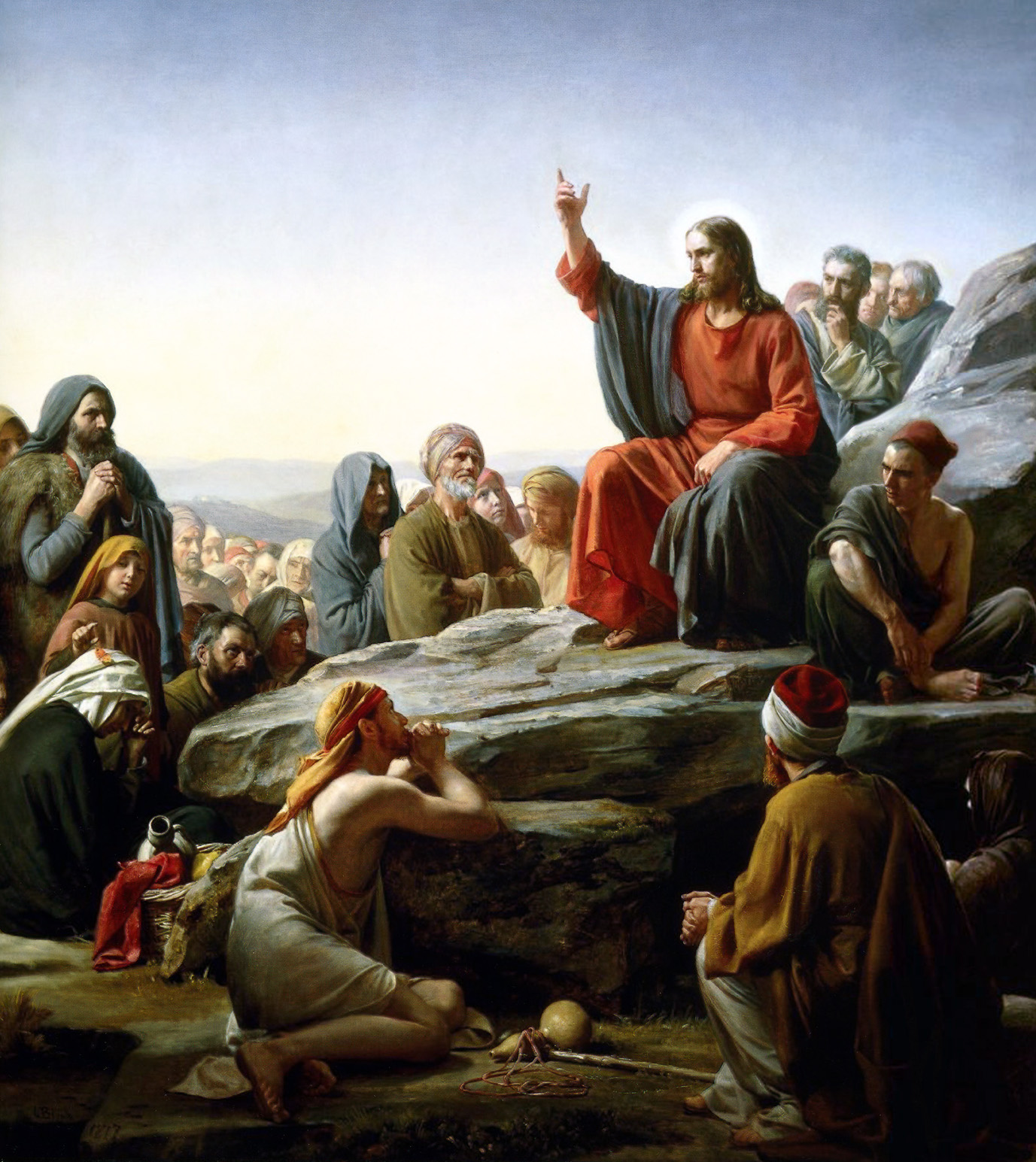
Matthewchapter 16
28 verses · Matthew, by tradition · AD 50 to 65 · The Gospels
When Jesus came to the region of Caesarea Philippi, He questioned His disciples: “Who do people say the Son of Man is?”
Introduction
Matthew, by tradition, The Gospels, Matthew Overview.
This chapter holds the turning point of Matthew's Gospel. Jesus has taken His disciples far to the north, away from the crowds, to a city named in honour of Caesar. There He asks them the question every reader of the Gospel must also answer. Listen for Peter's answer and for the promise Jesus attaches to it. Then listen for how quickly the same disciple is rebuked when Jesus speaks of what waits for Him in Jerusalem. Read it as the hinge where the Gospel turns toward the cross.
Context
- Who
- Jewish readers who needed to know on what ground the church stood
- What
- The demand for a sign, the warning about the leaven of the Pharisees and Sadducees, Peter's confession, the first prediction of the passion and the call to take up the cross.
- Where
- The shore of the Sea of Galilee, then the district of Caesarea Philippi at the foot of Mount Hermon, north of the lake.
- When
- Near the close of the Galilean ministry, about AD 29 on the common dating, some months before the final Passover.
- Why
- To bring the disciples to confess who Jesus is, and then to teach them that the Christ must suffer and that following Him means taking the same road.
Historical context
The place is the point. Caesarea Philippi lay at the northern edge of the land, beside a great spring gushing from a cliff at the base of Mount Hermon. The site had been a shrine of the Greek god Pan for centuries, its rock face cut with niches for idols, and Philip the tetrarch had rebuilt the town and named it for Caesar. It was, in short, the most pagan ground in the region.
Show the rest of the historical context, 3 more paragraphs
The demand for a sign from heaven came from an unlikely alliance. Pharisees and Sadducees disagreed about nearly everything, resurrection, angels, the authority of tradition, and their appearing together shows how far the opposition had consolidated.
The answer about the weather is the folk forecasting of any coastal country: red sky at evening, fine tomorrow; red and threatening at morning, storm coming. They could read the sky and not the times.
The keys given to Peter carry an Old Testament echo a Jewish reader would catch. In Isaiah, a royal steward is given the key of the house of David, the officer who controls access to the king. Binding and loosing was standard rabbinic language for declaring a thing forbidden or permitted.
Significance
In front of a cliff full of idol niches and a temple to Caesar, Peter says: you are the Messiah, the Son of the living God. Matthew's readers, worshipping in a world of many lords, knew exactly what it cost to say that sentence out loud.
Show the rest of the significance, 1 more paragraph
But the second half is what would have unsettled them most. The moment the confession is made, Jesus begins to say he must suffer and be killed, and Peter, who just got it right, gets it violently wrong. A crucified Messiah was still the hardest thing for a Jewish believer to explain, and Matthew shows the first disciple choking on it too.
The heads below are this chapter's scenes. The numbered points under each are its verses.
Demanding a Sign; Beware the Leaven
Matthew 16:1-2
the Pharisees and Sadducees came and tested Jesus: The Pharisees held to oral tradition and a future resurrection and the Sadducees rejected both. Yet here the Pharisees and Sadducees came and tested Jesus together. They asked Him to show them a sign from heaven, something grander than the healings already done on earth.
Matthew 16:1
“See also Mar 8:11-12. The Pharisees also, and the Sadducees - See the notes at Mat 3:7. Tempting - That is, trying him - feigning a desire to see evidence that he was the Messiah, but with a real desire to see him make the attempt to work a miracle and fail, so that they might betray him and ruin him. A sign from heaven - Some miraculous appearance in the sky.”
2 more voices on this verseWhat preachers and commentators have said about this verse, in their own words.
Matthew 16:1
“7, 8 , and yet unanimous in their opposition to Christ; because his doctrine did equally overthrow the errors and heresies of the Sadducees, who denied the existence of spirits and a future state; and the pride, tyranny, and hypocrisy of the Pharisees, who were the great imposters of the traditions of the elders. Christ and Christianity meet with opposition on all hands.”
Matthew Henry · Commentary on the Whole Bible (1707-1721)puritan
Matthew 16:1
“In these verses we find our Lord assailed by the untiring enmity of the Pharisees and Sadducees. As a general rule these two sects were at enmity between themselves; in persecuting Christ, however, they made common cause. Truly it was an unholy alliance! Yet how often we see the same thing in the present day. Men of the most opposite opinions and habits will agree in disliking the Gospel, and will work together to oppose its progress. “There is no new thing under the sun” ( Ecclesiastes 1:9 ).”
J.C. Ryle · Expository Thoughts on the Gospels: Matthew (1856)Reformed Evangelical
Matthew Henry lists the signs the leaders missed. The sceptre had departed from Judah, the weeks of Daniel were running out, and the miracles showed the kingdom at hand. Jerome makes the same charge against men who were thought experts in the law.
Matthew 16:2
“When it is evening - There are certain signs of fair and foul weather, which ye are in the constant habit of observing, and which do not fail. - The signs of the times: the doctrine which I preach, and the miracles which I work among you, are as sure signs that the day-spring from on high has visited you for your salvation; but if ye refute to hear, and continue in darkness, the red and gloomy cloud of vindictive justice shall pour out such a storm of wrath upon you as shalt sweep you from the face of the…”
Adam Clarke · Commentary on the Bible (1810-1826)evangelical
2 more voices on this verse
Matthew 16:2
“This is not found in most codices: it is clear that from the arrangement and stability of the elements, both fair and rainy days can be predicted. However, the scribes and Pharisees, who seemed to be experts in the law, could not understand the advent of the Savior from the prophecy of the prophets.”
Jerome · written before 420 · Commentary on Matthewpatristic
Matthew 16:2
“Can ye not discern the signs of the times? [1.] "Do you not see that the Messiah is come?" The sceptre was departed from Judah, Daniel's weeks were just expiring, and yet they regarded not. The miracles Christ wrought, and the gathering of the people to him, were plain indications that the kingdom of heaven was at hand, that this was the day of their visitation.”
Matthew Henry · Commentary on the Whole Bible (1707-1721)puritan
Matthew 16:3-4
interpret the appearance of the sky: Jesus answers with a weather saying about a red sky. He presses the point: You know how to interpret the appearance of the sky, but not the signs of the times. The sign refused is the sign of Jonah, given already in 12:39-41, and He left them and went away.
Matthew 16:3
“And in the morning, it will be foul weather today,.... When you rise in the morning, and take a survey of the heavens, it is a very usual thing with you to say, it is like to be windy or rainy weather today, for the sky is red and lowring; which shows, that the clouds are so thick that the sun cannot pierce through them, and its face is not seen; so that it may be reasonably concluded they will issue in rain, or wind, or both. O ye hypocrites.”
1 more voice on this verse
Matthew 16:3
“The sky is red and lowering - The signs of fair and foul weather were observed in a similar manner among the Romans, and indeed among most other people. Many treatises have been written on the subject: thus a poet: - Caeruleus pluviam denunciant, Igneus euros Sin Maculae incipient Rutilo immiscerier Igni, Omnia tunc pariter Vento Nimbisque videbis Fervere Virg. Geor. i. l.”
Adam Clarke · Commentary on the Bible (1810-1826)evangelical
A wicked and adulterous generation: Adam Clarke explains adulterous from the picture in Scripture of Israel as married to the Most High and unfaithful to him. He reads the verb as seeking sign upon sign. Hilary of Poitiers notes that elsewhere Jesus dismisses the crowds, and here he leaves these men to their unbelief.
Matthew 16:4
“A wicked and adulterous generation,.... He says the same things here, as he did to the Pharisees on a like occasion, in Mat 12:39. And he left them; as persons hardened, perverse, and incurable, and as unworthy to be conversed with: and departed: to the ship which brought him thither, and went in it to the other side of the sea of Galilee; see Mar 8:13.”
3 more voices on this verse
Matthew 16:4
“Wicked and adulterous generation - The Jewish people are represented in the Sacred Writings as married to the Most High; but, like a disloyal wife, forsaking their true husband, and uniting themselves to Satan and sin. Seeketh after a sign, σημειον επιζητει, seeketh sign upon sign, or, still another sign.”
Adam Clarke · Commentary on the Bible (1810-1826)evangelical
Matthew 16:4
“Now he called them evil because their wicked deeds had made them evil people (evil because of deliberate wickedness) and adulterous because when the Pharisees and Sadducees left their metaphoric spouse, the true word, they committed adultery, with falsehood and the law of sin.Assume there are two laws: the law of our bodies, which is in conflict with the law of our mind.”
Origen of Alexandria · written before 253 · Commentary on Matthew 12.4patristic
Matthew 16:4
“A wicked and adulterous generation - Ye would seek no further sign, did not your wickedness, your love of the world, which is spiritual adultery, blind your understanding.”
John Wesley · Explanatory Notes upon the New Testament (1755)evangelical
Matthew 16:5-7
the disciples forgot to take bread: Crossing the lake, the disciples forgot to take bread. When Jesus said, Beware of the leaven of the Pharisees and Sadducees, they concluded, It is because we did not bring any bread. Barnes notes that they heard a spiritual warning through a present worry.
Matthew 16:5
“The account in these verses is also recorded in Mar 8:13-21. Mat 16:5 And when his disciples were come to the other side - That is, to the other side of the Sea of Galilee. Mark says that he entered into a ship again, and departed to the other side. The conversation with the Pharisees and Sadducees had been on the western side of the Sea of Galilee. See the notes at Mat 15:39. They crossed from that side again to the east. Had forgotten to take bread - That is, had forgotten to lay in a sufficient supply.”
2 more voices on this verse
Matthew 16:5
“When his disciples were come to the other side,.... Of the sea, as Munster's Hebrew Gospel adds, to Bethsaida, Mar 8:22 as they were either in the ship, or going from the shore to the said place, they recollected themselves, that they had forgotten to take bread: having but one loaf, as Mark says, in the ship; the seven baskets of fragments being either expended, or given away to the poor, of their own accord, or by Christ's orders.”
Matthew 16:5
“How had they no bread, seeing that as soon as they had filled seven baskets they entered into the boat, and came into the parts of Magedan? There they hear that they ought to take heed of the leaven of the Pharisees and Sadducees. But the Scripture is witness that they had forgotten to take the baskets with them.”
Jerome · written before 420 · Catena Aurea by Aquinaspatristic
Adam Clarke names the leaven as pride, hypocrisy and love of the world, and he warns that a man's creed shapes his temper and conduct. Jerome links the warning to Paul in 1 Corinthians 5:6, where a little leaven works through the whole lump. One word covers two rival parties.
Matthew 16:6
“Then Jesus said unto them,.... Either taking occasion from the disciples observing that they had forgot to take bread with them, or on account of what passed between him and the Pharisees and Sadducees, he gave the following advice to his disciples; take heed and beware of the leaven of the Pharisees and of the Sadducees.”
3 more voices on this verse
Matthew 16:6
“Beware of the leaven - What the leaven of Pharisees and Sadducees was has been already explained, see Mat 16:1. Bad doctrines act in the soul as leaven does in meal; they assimulate the whole Spirit to their own nature. A man’s particular creed has a greater influence on his tempers and conduct than most are aware of. Pride, hypocrisy, and worldly-mindedness, which constituted the leaven of the Pharisees and Sadducees, ruin the major part of the world.”
Adam Clarke · Commentary on the Bible (1810-1826)evangelical
Matthew 16:6
“Beware of the leaven of the Pharisees - That is, of their false doctrine: this is elegantly so called; for it spreads in the soul, or the Church, as leaven does in meal. They reasoned among themselves - What must we do then for bread, since we have taken no bread with us? Why reason ye - Why are you troubled about this?”
John Wesley · Explanatory Notes upon the New Testament (1755)evangelical
Matthew 16:6
“But now they forgot; we will hope it was because their minds and memories were filled with better things. Note, Christ's disciples are often such as have no great forecast for the world. Here is the caution Christ gave them, to beware of the leaven of the Pharisees.”
Matthew Henry · Commentary on the Whole Bible (1707-1721)puritan
Adam Clarke, following Lightfoot, notes that Jews rarely used leaven as a figure for teaching, which left the disciples puzzled. John Chrysostom traces the confusion to their lingering worry over Jewish food rules and purifications. John Gill observes that the words it is are supplied.
Matthew 16:7
“After Jesus said this, the disciples thought to themselves (not aloud but in their hearts), "We did not bring bread." Then they said something else, like "If we had bread, then we wouldn't need the yeast from the Pharisees and Sadducees, but since we don't have bread, we are at risk of taking their yeast.”
Origen of Alexandria · written before 253 · Commentary on Matthew 12:5patristic
2 more voices on this verse
Matthew 16:7
“Either what should be the meaning of this caution of Christ's, and upon what account he should say this to them; or they were anxiously concerned what they should do for provision: saying, because we have taken no bread; for the phrase, "it is", is a supplement, and is not in the original text, which confines the sense to the first way of interpretation; the words may be read without it, and confirms the other sense, and which receives strength from what follows.”
Matthew 16:7
“They reasoned - For, as Lightfoot observes, the term leaven was very rarely used among the Jews to signify doctrine, and therefore the disciples did not immediately apprehend his meaning. In what a lamentable state of blindness is the human mind? Bodily wants are perceived with the utmost readiness, and a supply is sought with all speed. But the necessities of the soul are rarely discovered, though they are more pressing than those of the body, and the supply of them of infinitely more importance.”
Adam Clarke · Commentary on the Bible (1810-1826)evangelical
Matthew 16:8-10
Jesus says You of little faith for the fourth time, after 6:30, 8:26 and 14:31. He ties it to memory: Do you not remember the five loaves for the five thousand? The failure He names is a fear that forgets what those meals had already shown about Him.
Matthew 16:8
“When Jesus perceived, he said - Αυτοις, unto them, is wanting in BDKLMS, and twenty others; one of the Syriac, the Armenian, Ethiopia, Vulgate, and most of the Itala; also in Origen, Theophylact, and Lucifer Calaritanus. Mill approves of the omission, and Griesbach has left it out of the text. O ye of little faith - There are degrees in faith, as well as in the other graces of the Spirit. Little faith may be the seed of great faith, and therefore is not to be despised.”
Adam Clarke · Commentary on the Bible (1810-1826)evangelical
1 more voice on this verse
Matthew 16:8
“This should serve to excuse a fault, Peradventure it was an oversight. See how easily Christ forgave his disciples' carelessness, though it was in such a material point as taking bread; and do likewise. But that which he chides them for is their little faith.”
Matthew Henry · Commentary on the Whole Bible (1707-1721)puritan
how many basketfuls you gathered?: Matthew Henry reads the baskets as memorials, kept to hold the mercy in mind as the pot of manna was kept in the ark. The leftovers of those meals would have fed the disciples now. The one who supplied such a surplus then could supply their present need.
Matthew 16:9
“Do ye not understand,.... Meaning either the sense of the advice he had now given; or rather his almighty power displayed in the two miracles of feeding five thousand at one time, and four thousand at another, with a very small quantity of provision; for to this the word "understand" refers, as well as the following: neither remember the five loaves of the five thousand, and how many baskets ye took up?”
2 more voices on this verse
Matthew 16:9
“Do you not remember the five loaves, and the five thousand men, and how many baskets you took up? Cannot he then who fed so many, feed you?”
Thomas Aquinas · written before 1274 · Commentary on Matthewpatristic
Matthew 16:9
“Do ye not yet understand - the five loaves - neither the seven - See the notes on Mat 14:14, etc. How astonishing is it that these men should have any fear of lacking bread, after having seen the two miracles which our blessed Lord alludes to above! Though men quickly perceive their bodily wants, and are querulous enough till they get them supplied, yet they as quickly forget the mercy which they had received; and thus God gets few returns of gratitude for his kindnesses.”
Adam Clarke · Commentary on the Bible (1810-1826)evangelical
the seven loaves for the four thousand: John Gill notes how recent the second feeding was, only a little while before, with seven large baskets left over. John Chrysostom hears strength and mildness together in this reproof. Jesus names the numbers of loaves, people and baskets so that the disciples will weigh the proof themselves.
Matthew 16:10
“Neither the seven loaves of the four thousand,.... Have you forgot the other miracle done but a very little while ago, when I fed four thousand men, beside women and children, with seven loaves and a few small fishes; and how many baskets ye took up? no less than seven large baskets; and am I not able to provide for you? distress not yourselves about this matter; give not way to unbelief, which must argue great stupidity and insensibility.”
Matthew 16:11-12
I was not telling you about bread?: Clarke notes that the disciples through this part of the Gospel are slow at first and understand once Jesus states the meaning plainly. The warning covers two parties who agreed on almost nothing else, the legalism of the Pharisees and the rationalism of the Sadducees.
Matthew 16:11
Some were distracted by the use of bread and yeast. In order to clarify and enlighten them in a still symbolic way that he was not speaking about literal bread but about yeast as representing teaching, Jesus adds, "How is it that you do not understand that I was not talking to you about bread? Beware of the yeast of the Pharisees and Sadducees."
Origen of Alexandria · written before 253 · Commentary on Matthew 12.6patristic
1 more voice on this verse
Matthew 16:11
“How is it that ye do not understand - We are not deficient in spiritual knowledge, because we have not had sufficient opportunities of acquainting ourselves with God; but because we did not improve the advantages we had. How deep and ruinous must our ignorance be, if God did not give line upon line, precept upon precept, here a little and there a little!”
Adam Clarke · Commentary on the Bible (1810-1826)evangelical
the teaching of the Pharisees and Sadducees: John Chrysostom notes that Jesus left the meaning unspoken. The reproof of verse 11 alone woke the disciples to it and drew them away from Jewish food observances. Jerome carries the figure further: if the leaven is false teaching, the loaves that fed the crowds signify true teaching.
Matthew 16:12
“By occasion of the precept, which the Savior had commanded, saying: Beware of the leaven of the Pharisees and Sadducees, He teaches them what the five loaves and the seven signify: the five thousand men, and the four thousand, who were fed in the wilderness. Although the greatness of the miracles is clear, yet something else is shown in spiritual understanding. For if the leaven of the Pharisees and Sadducees signifies not bodily bread, but perverse traditions and heretical doctrines, why do the foods, with which the people of God are nourished, not signify the true and complete teaching?”
Jerome · written before 420 · Commentary on Matthewpatristic
Peter's Confession and the Keys of the Kingdom
Matthew 16:13-15
the region of Caesarea Philippi: Caesarea Philippi lay around a spring long sacred to Pan, where a temple to Caesar's divinity stood. There Jesus asks, Who do people say the Son of Man is. The popular answers, John the Baptist, Elijah, Jeremiah or one of the prophets, all place Him among Israel's prophets.
Matthew 16:13
“This Philip was the brother of Herod, the tetrarch of Ituræa, and the region of Trachonitis, who gave to the city, which is now called Panæas, the name of Cæsarea in honour of Tiberius Cæsar. Beautifully is the question put, Whom do men say that the Son of Man is? For they who speak of the Son of Man, are men: but they who understood His divine nature are called not men but Gods.”
Jerome · written before 420 · Catena Aurea by Aquinaspatristic
3 more voices on this verse
Matthew 16:13
“See also Mar 8:27-29, and Luk 9:18-20. Cesarea Philippi - There were two cities in Judea called Caesarea. One was situated on the borders of the Mediterranean (See the notes at Act 8:40), and the other was the one mentioned here. This city was greatly enlarged and ornamented by Philip the tetrarch, son of Herod, and called Caesarea in honor of the Roman emperor, Tiberius Caesar. To distinguish it from the other Caesarea the name of Philip was added to it, and it was called Caesarea Philippi, or Caesarea of Philippi.”
Matthew 16:13
THIS is one of the earliest places in the New Testament in which we find any mention of the Church. Jesus says, in verse eighteen, "I will build My Church." It is very significant that our Lord should connect with the Church the right idea of Himself. In our text we have the test question which must be put to everyone who is to be admitted into the assembly of the Lord—"Whom do you say that I am?" The first question to be put to one who would join the Church is, "What do you think of Jesus?"
Matthew 16:13
There are words in this passage which have led to painful differences and divisions among Christians. Men have striven and contended about their meaning till they have lost sight of all charity, and yet have failed to carry conviction to one another’s minds. Let it suffice us to glance briefly at the controverted words, and then pass on to more practical lessons. What then are we to understand, when we read that remarkable saying of our Lord’s, “Thou art Peter, and upon this rock I will build my church?”
J.C. Ryle · Expository Thoughts on the Gospels: Matthew (1856)Reformed Evangelical
John Wesley explains the mention of Jeremiah from a tradition that he or another ancient prophet would rise again before the Messiah came. Matthew Henry ties the guess of Elijah to the promise that God would send Elijah. Jerome thought it idle to seek the cause of each error.
Matthew 16:14
“And they said, some say that thou art John the Baptist,.... It was the opinion of some of the Jews, that he was John the Baptist risen from the dead. This notion was spread, and prevailed in Herod's court, and he himself, at last, gave into it.”
1 more voice on this verse
Matthew 16:14
“Jeremiah, or one of the prophets - There was at that time a current tradition among the Jews, that either Jeremiah, or some other of the ancient prophets would rise again before the Messiah came.”
John Wesley · Explanatory Notes upon the New Testament (1755)evangelical
Hilary of Poitiers notices the change of words: the first question asked about the Son of Man, which his body plainly showed him to be. This one asks who he is beyond what they see. Matthew Henry adds that men taught so closely are expected to know him more clearly.
Matthew 16:15
“As the result of all, I am taken for John the Baptist, for Elias, for Jeremias, for one of the prophets. Yet some there are that have beheld My glory, the glory as of the Only-begotten of the Father, and I shall hear their voice, for it is sweet.”
Jamieson, Fausset & Brown · Commentary Critical and Explanatory on the Whole Bible (1871)reformed
1 more voice on this verse
Matthew 16:15
“The disciples had themselves been better taught than others; had, by their intimacy with Christ, greater advantages of getting knowledge than others had. Note, It is justly expected that those who enjoy greater plenty of the means of knowledge and grace than others, should have a more clear and distinct knowledge of the things of God than others.”
Matthew Henry · Commentary on the Whole Bible (1707-1721)puritan
Peter joins Israel's title for the promised anointed king, the Christ, with the confession that Jesus is the Son of the living God. Henry calls this the fullest confession any disciple had made, beyond the words in the boat at 14:33, Truly You are the Son of God.
Matthew 16:16
“Peter's answer is short, but it is full, and true, and to the purpose; Thou art the Christ, the Son of the Living God. Here is a confession of the Christian faith, addressed to Christ, and so made an act of devotion.”
Matthew Henry · Commentary on the Whole Bible (1707-1721)puritan
3 more voices on this verse
Matthew 16:16
“Peter did not say "you are a Christ" or "a son of God" but "the Christ, the Son of God." For there are many christs by grace, who have attained the rank of adoption [as sons], but [there is] only one who is by nature the Son of God. Thus, using the definite article, he said, the Christ, the Son of God. And in calling him Son of the living God, Peter indicates that Christ himself is life and that death has no authority over him.”
Cyril of Alexandria · written before 444 · FRAGMENT 190patristic
Matthew 16:16
“Thou art the Christ, the Son of the living God - Every word here is emphatic - a most concise, and yet comprehensive, confession of faith. The Christ, or Messiah, points out his divinity, and shows his office; the Son - designates his person: on this account it is that both are joined together so frequently in the new covenant. Of the living God Του Θεου, του ζωντος, literally, of God the Living One. The C. Bezae has for Του ζωντος the Living One, Του σωζοντος, the Savior, and the Cant. Dei Salvatoris, of God the Savior.”
Adam Clarke · Commentary on the Bible (1810-1826)evangelical
Matthew 16:16
“And Simon Peter answered and said,.... Either of his own accord, and for himself, being a warm, zealous, and forward man; one that dearly loved Christ, truly believed in him, and was ready to make a confession of him; or, as the mouth of the rest, in their name, and with their consent; or, at least, as full well knowing the sentiments of their minds.”
Jesus replied, Blessed are you, Simon son of Jonah. He gave the reason: this was not revealed to you by flesh and blood, but by My Father in heaven. My Father in heaven answers verse 16's Son of the living God, so the Father bears His witness to the confession.
Matthew 16:17
“Blessed art thou, Simon Bar-jona - Or Simon, son of Jonah; so Bar-jonah should be translated, and so it is rendered by our Lord, Joh 1:42. Flesh and blood - i.e. Man; - no human being hath revealed this; and though the text is literal enough, yet every body should know that this is a Hebrew periphrasis for man; and the literal translation of it here, and in Gal 1:16, has misled thousands, who suppose that flesh and blood signify carnal reason, as it is termed, or the unregenerate principle in man.”
Adam Clarke · Commentary on the Bible (1810-1826)evangelical
3 more voices on this verse
Matthew 16:17
“And Jesus answered and said unto him,.... Not waiting for any other declaration from them; but taking this to be the sense of them all, he said, blessed art thou Simon Bar Jona, or son of Jona, or Jonas, as in Joh 1:42. His father's name was Jonah, whence he was so called: so we read (i) of R. Bo bar Jonah, and of a Rabbi of this very name (k), ר שמעון בר יונא, Rabbi Simeon bar Jona; for Simon and Simeon are one, and the same name.”
Matthew 16:17
“Nor is Jesus above giving indication of the deep satisfaction which this speech yielded Him, and hastening to respond to it by a signal acknowledgment of Peter in return. Simon Bar-jona--or, "son of Jona" (Joh 1:42), or "Jonas" (Joh 21:15).”
Jamieson, Fausset & Brown · Commentary Critical and Explanatory on the Whole Bible (1871)reformed
Matthew 16:17
“Note, The revealing of Christ to us and in us is a distinguishing token of God's good will, and a firm foundation of true happiness; and blessed are they that are thus highly favoured. Perhaps Christ discerned something of pride and vain-glory in Peter's confession; a subtle sin, and which is apt to mingle itself even with our good duties.”
Matthew Henry · Commentary on the Whole Bible (1707-1721)puritan
on this rock I will build My church: In Greek Peter is petros, a stone, and the rock is petra. Roman Catholic teaching and some fathers read petra as Peter in his office, Chrysostom and most Protestants as his confession. Others read it as Christ, from 1 Corinthians 10:4 and 1 Peter 2:4-8.
Matthew 16:18
“On this rock - Alluding to his name, which signifies a rock, namely, the faith which thou hast now professed; I will build my Church - But perhaps when our Lord uttered these words, he pointed to himself, in like manner as when he said, Destroy this temple, John ii, 19; meaning the temple of his body.”
John Wesley · Explanatory Notes upon the New Testament (1755)evangelical
4 more voices on this verse
Matthew 16:18
“Even in the Greek it is imperfectly represented. In French, as WEBSTER and WILKINSON remark, it is perfect, Pierre--pierre. I will build my Church--not on the man Simon Bar-jona; but on him as the heavenly-taught confessor of a faith.”
Jamieson, Fausset & Brown · Commentary Critical and Explanatory on the Whole Bible (1871)reformed
Matthew 16:18
“As much as to say, You have said to me, Thou art Christ, the Son of the living God, therefore I say unto thee, not in a mere speech, and that goes not on into operation; but I say unto thee, and for Me to speak is to make it sor, that thou art Peter.”
Jerome · written before 420 · Catena Aurea by Aquinaspatristic
Matthew 16:18
“These “gates” are not physical gates, but rather the governmental plans or decisions of hell.”
Matthew 16:18
"Now," saith Christ, "this is that great truth upon which I will build my church. " 1. Take away this truth itself, and the universal church falls to the ground. If Christ be not the Son of God, Christianity is a cheat, and the church is a mere chimera; our preaching is vain, your faith is vain, and you are yet in your sins, 1 Cor. xv.
Matthew Henry · Commentary on the Whole Bible (1707-1721)puritan
the keys of the kingdom of heaven: Keys pictured stewardship in Israel's Scriptures, as in Isaiah 22:22, and binding and loosing were rabbinic terms for forbidding and permitting. The Roman Catholic tradition reads the verse as Peter's primacy handed to his successors. The Protestant traditions generally read it as declarative authority given to Peter for the apostles.
Matthew 16:19
“And I will give unto thee the keys of the kingdom of heaven,.... By the kingdom of heaven is meant the Gospel, which comes from heaven, declares the king Messiah to be come, speaks of things concerning his kingdom, is the means of setting it up, and enlarging it, displays the riches of his grace, and gives an account of the kingdom of heaven, and of persons' right unto it, and meetness for it.”
4 more voices on this verse
Matthew 16:19
“The keys of the kingdom - By the kingdom of heaven, we may consider the true Church, that house of God, to be meant; and by the keys, the power of admitting into that house, or of preventing any improper person from coming in. In other words, the doctrine of salvation, and the full declaration of the way in which God will save sinners; and who they are that shall be finally excluded from heaven; and on what account.”
Adam Clarke · Commentary on the Bible (1810-1826)evangelical
Matthew 16:19
“Christ was declaring His church would have spiritual keys (authority) to lock the gates (government) of hell and open the gates (government) of heaven.”
Matthew 16:19
“I will give thee the keys of the kingdom of heaven - Indeed not to him alone, (for they were equally given to all the apostles at the same time, John xx, 21, 22, 23;) but to him were first given the keys both of doctrine and discipline. He first, after our Lord's resurrection, exercised the apostleship, Acts i, 15.”
John Wesley · Explanatory Notes upon the New Testament (1755)evangelical
Matthew 16:19
“As first in confessing Christ, Peter got this commission before the rest; and with these "keys," on the day of Pentecost, he first "opened the door of faith" to the Jews, and then, in the person of Cornelius, he was honored to do the same to the Gentiles. Hence, in the lists of the apostles, Peter is always first named.”
Jamieson, Fausset & Brown · Commentary Critical and Explanatory on the Whole Bible (1871)reformed
tell anyone that He was the Christ: Then He admonished the disciples not to tell anyone that He was the Christ, keeping quiet the very confession He had just praised. Wesley notes that the charge comes only after the confession is secure among the disciples. The next verse shows why the silence could not last.
Matthew 16:20
“Then charged he his disciples that they should tell no man that he was Jesus the Christ--Now that He had been so explicit, they might naturally think the time come for giving it out openly; but here they are told it had not. Announcement of His Approaching Death and Rebuke of Peter (Mt 16:21-28). The occasion here is evidently the same.”
Jamieson, Fausset & Brown · Commentary Critical and Explanatory on the Whole Bible (1871)reformed
3 more voices on this verse
Matthew 16:20
“Then charged he his disciples to tell no one that he was the Christ. Jesus himself had not said it expressly even to his apostles, but left them to infer it from his doctrine and miracles. Neither was it proper the apostles should say this openly, before that grand proof of it, his resurrection.”
John Wesley · Explanatory Notes upon the New Testament (1755)evangelical
Matthew 16:20
“When then above He sends His disciples to preach, and commands them to proclaim His advent, this seems contrary to His command here, that they should not say that He is Jesus the Christ. To me it seems that it is one thing to preach Christ, and another to preach Jesus the Christ. Christ is a common title of dignity, Jesus the proper name of the Saviour.”
Jerome · written before 420 · Catena Aurea by Aquinaspatristic
Matthew 16:20
“Then charged he his disciples - ΔιεϚειλατο, he strictly charged them. Some very good MSS. have επετιμησεν, he severely charged - comminatus est, - he threatened. These are the readings of the Cod. Bezae, both in the Greek and Latin. The Christ - The common text has Jesus the Christ; but the word Jesus is omitted by fifty-four MSS., some of which are not only of the greatest authority, but also of the greatest antiquity. It is omitted also by the Syriac, later Persic, later Arabic, Slavonic, six copies of the Itala, and several of the fathers.”
Adam Clarke · Commentary on the Bible (1810-1826)evangelical
The Cross Foretold; Take Up Your Own
Jesus began to show His disciples: From that time on marks a turn in the Gospel, the first of three plain predictions of the passion. The Greek dei, must, sets the suffering, death and rising as necessity. Barnes notes that here the disciples first hear the cross named plainly.
Matthew 16:21
“In the beginning of these verses we find our Lord revealing to his disciples a great and startling truth. That truth was his approaching death upon the cross. For the first time he places before their minds the astounding announcement that “He must go to Jerusalem and suffer ˆ and ˆ be killed”. He had not come on earth to take a kingdom, but to die. He had not come to reign and be ministered to; but to shed his blood as a sacrifice, and to give his life as a ransom for many.”
J.C. Ryle · Expository Thoughts on the Gospels: Matthew (1856)Reformed Evangelical
2 more voices on this verse
Matthew 16:21
“From that time Jesus began to tell his disciples, that he must suffer many things - Perhaps this expression, began, always implied his entering on a set and solemn discourse. Hitherto he had mainly taught them only one point, That he was the Christ. From this time he taught them another, That Christ must through sufferings and death enter into his glory.”
John Wesley · Explanatory Notes upon the New Testament (1755)evangelical
Matthew 16:21
“See also Mar 7:31-33; Luk 9:22. “From that time forth.” This was the first intimation that he gave that he was to die in this cruel manner. He had taken much pains to convince them that he was the Messiah; he saw by the confession of Peter that they were convinced, and he then began to prepare their minds for the awful event which was before him. Had he declared this when he first called them they would never have followed him. Their minds Were not prepared for it. They expected a temporal, triumphant prince as the Messiah.”
Matthew 16:22-23
took Him aside and began to rebuke Him: The disciple just blessed by Jesus now took Him aside and began to rebuke Him, and Jesus answered, Get behind Me, Satan. The name recalls chapter 4, where Satan showed Him all the kingdoms of the world and offered them without the cross.
Matthew 16:22
“Then Peter took him - Προσλαβομενος - took him up - suddenly interrupted him, as it were calling him to order - see Wakefield. Some versions give προσλαβομενος the sense of calling him aside. The word signifies also to receive in a friendly manner - to embrace; but Mr. Wakefield’s translation agrees better with the scope of the place. A man like Peter, who is of an impetuous spirit, and decides without consideration upon every subject, must of necessity be often in the wrong. Be it far from thee Lord - Ιλεως σοι Κυριε. Be merciful to thyself Lord.”
Adam Clarke · Commentary on the Bible (1810-1826)evangelical
1 more voice on this verse
Matthew 16:22
“Yea, so far is this advice, favour thyself, from being fit for a Christian either to give or take, that if any man will come after Christ, his very first step is to deny, or renounce himself: in the room of his own will, to substitute the will of God, as his one principle of action.”
John Wesley · Explanatory Notes upon the New Testament (1755)evangelical
a stumbling block to Me: Jamieson, Fausset and Brown draw on Mark 8:33, where Jesus turns and looks at the disciples before the rebuke. Peter had said aloud what the others felt, so all of them needed the check. Adam Clarke renders Satan by its Hebrew sense, adversary.
Matthew 16:23
“And if even then a Prodicus or Valentinus stood by, suggesting that one must not confess on the earth before men, and must do so the less in truth, that God may not (seem to) thirst for blood, and Christ for a repayment of suffering, as though He besought it with the view of obtaining salvation by it for Himself also, he would have immediately heard from the servant of God what the devil had from the Lord: "Get thee behind me, Satan; thou art an offence unto me.”
Tertullian · written before 220 · Scorpiacepatristic
1 more voice on this verse
Matthew 16:23
“Get thee behind me, Satan - Υπαγε οπισω μου σατανα. Get behind me, thou adversary. This is the proper translation of the Hebrew word שטן Satan, from which the Greek word is taken. Our blessed Lord certainly never designed that men should believe he called Peter, Devil, because he, through erring affection, had wished him to avoid that death which he predicted to himself. This translation, which is literal, takes away that harshness which before appeared in our Lord’s words.”
Adam Clarke · Commentary on the Bible (1810-1826)evangelical
take up his cross: would have struck first-century hearers with literal weight. A condemned man carried the crossbeam of his own execution to the place of death. Clarke reads deny himself as a renunciation of the self's own claim to direct its life, going further than giving up comfort.
Matthew 16:24
“Whose sense what is written in the Gospel of Matthew: If anyone wants to come after me, let him deny himself (Matth. 16. 24). What is self-denial? or how does one who follows the Savior deny himself? On this matter I have spoken briefly in the third book of his commentary on Matthew: He who lays down the old man with his works denies himself, saying: And yet I live, but not me, but Christ lives in me (Galatians 2:20) and takes up his cross and is crucified to the world.”
Jerome · written before 420 · Letter 121, Chapter 3patristic
3 more voices on this verse
Matthew 16:24
“Will come after me - i.e. to be my disciple. This discourse was intended to show Peter and the rest of the disciples the nature of his kingdom; and that the honor that cometh from the world was not to be expected by those who followed Christ. The principles of the Christian life are: First. To have a sincere desire to belong to Christ - If any man be Willing to be my disciple, etc. Secondly. To renounce self-dependence, and selfish pursuits - Let him deny Himself. Thirdly.”
Adam Clarke · Commentary on the Bible (1810-1826)evangelical
Matthew 16:24
“Should we not consider all crosses, all things grievous to flesh and blood, as what they really are, as opportunities of embracing God's will at the expense of our own? And consequently as so many steps by which we may advance toward perfection? We should make a swift progress in the spiritual life, if we were faithful in this practice.”
John Wesley · Explanatory Notes upon the New Testament (1755)evangelical
Matthew 16:24
In order to see the connection of these verses we must remember the mistaken impressions of our Lord’s disciples as to the purpose of his coming into the world. Like Peter they could not bear the idea of the crucifixion. They thought that Jesus had come to set up an earthly kingdom; they did not see that he must needs suffer and die. They dreamed of worldly honors and temporal rewards in their Master’s service; they did not understand that true Christians, like Christ, must be made “perfect through suffering.”
J.C. Ryle · Expository Thoughts on the Gospels: Matthew (1856)Reformed Evangelical
Matthew 16:25-26
whoever wants to save his life: The saying turns on the Greek psyche, rendered life in verse 25 and soul in verse 26, so clinging to the one costs the other. What will it profit a man if he gains the whole world, yet forfeits his soul poses a bargain no one would knowingly strike.
Matthew 16:25
“This may be understood in two ways. First thus; if any lover of this present life spares his life, fearing to die, and supposing that his life is ended with this death; he seeking in this way to save his life, shall lose it, estranging it from life eternal. But if any, despising the present life, shall contend for the truth unto death, he shall lose his life as far as this present life is concerned, but forasmuch as he loses it for Christ, he shall the more save it for life eternal.”
Origen of Alexandria · written before 253 · Catena Aurea by Aquinaspatristic
1 more voice on this verse
Matthew 16:25
“For whosoever will save his life - That is, shall wish to save his life - at the expense of his conscience, and casting aside the cross, he shall lose it - the very evil he wishes to avoid shall overtake him; and he shall lose his soul into the bargain. See then how necessary it is to renounce one’s self! But whatsoever a man loses in this world, for his steady attachment to Christ and his cause, he shall have amply made up to him in the eternal world.”
Adam Clarke · Commentary on the Bible (1810-1826)evangelical
what can a man give in exchange for his soul?: Jerome sets the question beside Isaiah 43:3-4, where Egypt and Ethiopia are given as a ransom for Israel. For the soul, Jerome offers only the cup of salvation. Origen weighs giving goods to the poor as a ransom, and concludes a man owns nothing that could buy his soul back.
Matthew 16:26
“For what is a man profited,.... Such persons, though they are only seeking their own profit, will find themselves most sadly mistaken; for of what advantage will it be to such a man, if he shall gain the whole world; all that is precious and valuable in it; all the power, pleasures, and riches of it; if with Alexander, he had the government of the whole world, and with Solomon, all the delights of it; and was possessed with the wealth of Croesus, and Crassus, and lose his own soul?”
3 more voices on this verse
Matthew 16:26
“Lose his own soul - Or, lose his life, την ψυχην αυτου. On what authority many have translated the word ψυχη, in the 25th verse, life, and in this verse, soul, I know not, but am certain it means life in both places. If a man should gain the whole world, its riches, honors, and pleasures, and lose his life, what would all these profit him, seeing they can only be enjoyed during life? But if the words be applied to the soul, they show the difficulty - the necessity - and importance of salvation.”
Adam Clarke · Commentary on the Bible (1810-1826)evangelical
Matthew 16:26
“But what exchange will a man give for his soul? For Israel, Egypt and Ethiopia are given in exchange, and Syene (Isaiah XLIII, 3, 4): for the human soul, that alone is the retribution, which the Psalmist sings: What shall I render to the Lord for all that He has rendered to me? I will take the cup of salvation, and will invoke the name of the Lord (Psalm CXV (Psalm 116 in this reader's Bible), 3).”
Jerome · written before 420 · Commentary on Matthewpatristic
Matthew 16:26
"O shame," exclaims BENGEL, "to be put to shame before God, Christ, and angels!" The sense of shame is founded on our love of reputation, which causes instinctive aversion to what is fitted to lower it, and was given us as a preservative from all that is properly shameful.
Jamieson, Fausset & Brown · Commentary Critical and Explanatory on the Whole Bible (1871)reformed
Matthew 16:27-28
will come in His Father’s glory: Verse 28, some who are standing here will not taste death before they see the Son of Man coming in His kingdom, has three readings. The readings are the transfiguration six days later at 17:1, the nearest answer in the text, the resurrection and Pentecost, and the fall of Jerusalem.
Matthew 16:27
“For the Son of man shall come in the glory of his Father - This seems to refer to Dan 7:13, Dan 7:14. “Behold, one like the Son of man came - to the ancient of Days - and there was given him dominion, and glory, and a kingdom, that all people, and nations, and languages should serve him.” This was the glorious Mediatorial kingdom which Jesus Christ was now about to set up, by the destruction of the Jewish nation and polity, and the diffusion of his Gospel through the whole world.”
Adam Clarke · Commentary on the Bible (1810-1826)evangelical
will not taste death before they see the Son of Man: Jerome reads the promise as an answer to a hidden worry. The apostles heard of deaths at hand and glory far off, so Jesus set a present reward beside the present fear. Cyril of Alexandria sees Peter and the sons of Zebedee in the words some who are standing here.
Matthew 16:28
“And as an emblem of this, there are some here who shall live to see the Messiah coming to set up his mediatorial kingdom, with great power and glory, by the increase of his Church, and the destruction of the temple, city, and polity of the Jews.”
John Wesley · Explanatory Notes upon the New Testament (1755)evangelical
1 more voice on this verse
Matthew 16:28
“I must confess that I have frequently read this verse with but a vague sense of its profound impressiveness and I have passed it over rapidly because I did not understand it clearly. Though well acquainted with the usual interpretations, none of them had ever satisfied my mind. It seemed to me as if the text had awakened surprise without suggesting a simple obvious meaning, and therefore the good commentators had invented explanations and offered suggestions widely different one from another, but all equally obscure and improbable.”
Keep studying
Studies16
Words12
Subjects1
Sources for this chapter
The summary
Jamieson, Fausset & Brown, Commentary Critical and Explanatory; John Calvin, Commentaries; John Wesley, Explanatory Notes Upon the New Testament and Matthew Henry, Complete Commentary.
The context
E. B. Pusey, The Minor Prophets: A Commentary.
The exposition
Adam Clarke, Commentary on the Bible; Albert Barnes, Notes, Explanatory and Practical, on the Gospels; Augustine of Hippo, Harmony of the Gospels; Charles Spurgeon, The Gospel of the Kingdom; Cyril of Alexandria, FRAGMENT 195; Hilary of Poitiers; Jamieson, Fausset & Brown, Commentary Critical and Explanatory on the Whole Bible; Jerome; John Calvin, Commentary on a Harmony of the Evangelists; John Chrysostom; John Gill; John Lightfoot, Horae Hebraicae et Talmudicae on Matthew; John Wesley, Explanatory Notes upon the New Testament; Matthew Henry, Commentary on the Whole Bible and Origen of Alexandria, Catena Aurea by Aquinas.