
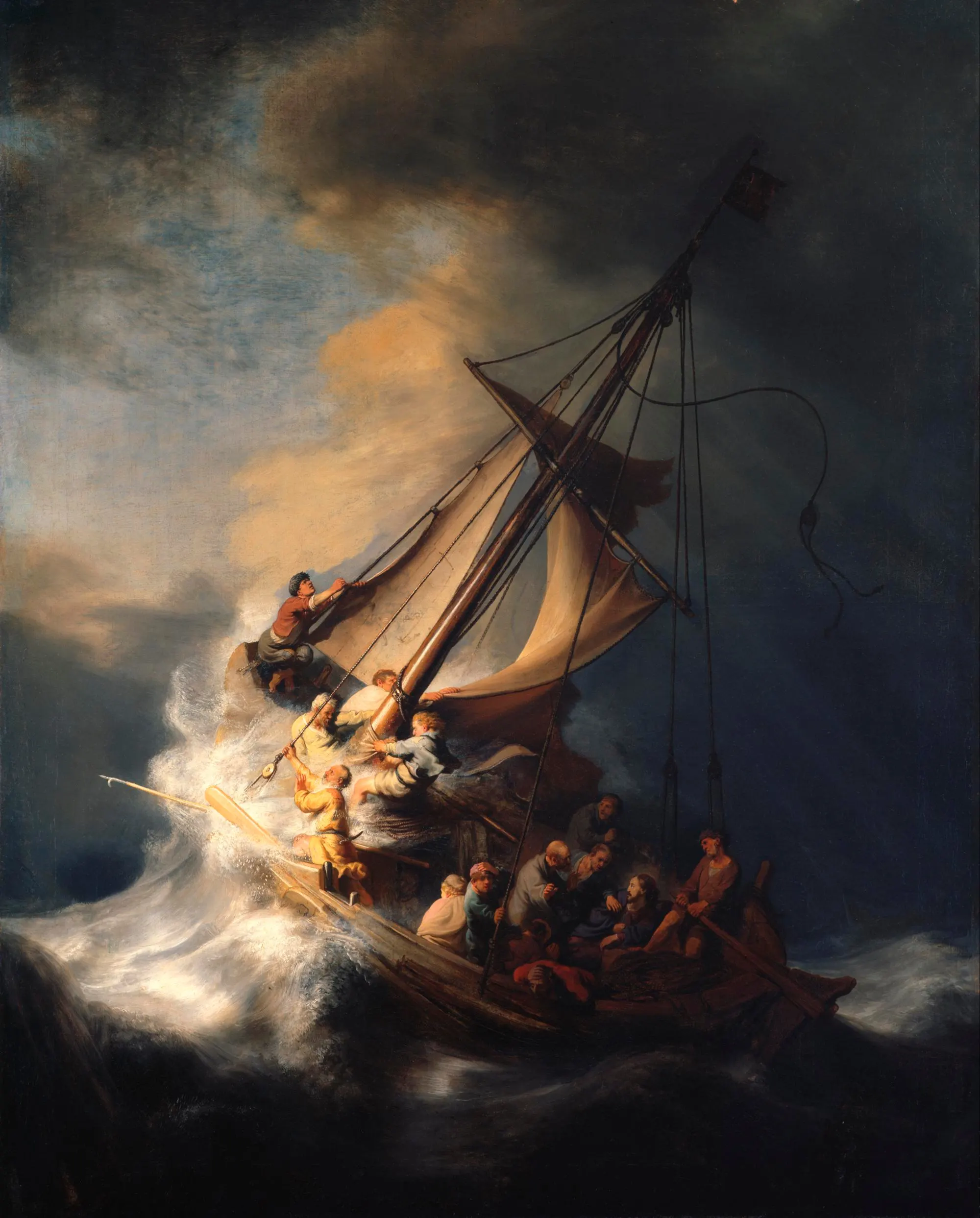
Markchapter 8
38 verses · Mark · AD 55 to 65 · The Gospels
Then Jesus called the crowd to Him along with His disciples, and He told them, “If anyone wants to come after Me, he must deny himself and take up his cross and follow Me.
Introduction
Mark, The Gospels, Mark Overview.
Mark reaches the turning point of his Gospel in this chapter. He wrote for believers in Rome who had seen condemned men carry their crossbeams through the streets, and who knew what following Jesus might cost them. The chapter begins with bread and blindness, and it moves to the first open confession of who Jesus is. Listen for the questions Jesus asks His disciples, and for how much and how little they see. Listen also for the change in what He teaches once the confession is made. Read it as the hinge on which the whole book turns toward Jerusalem.
Context
- Who
- Roman readers who had watched condemned men carry their own crossbeams
- What
- A second feeding in Gentile country, a healing in two stages at Bethsaida, Peter's confession, and the first prediction of Jesus' death.
- Where
- The Decapolis, a boat on the lake, Bethsaida, and the villages near Caesarea Philippi in the far north.
- When
- The turning point of the ministry, about AD 29.
- Why
- To show the disciples coming to see who Jesus is, and to teach that the Christ must suffer and that His followers must take up their cross.
Historical context
The second feeding happens in Gentile country, and the numbers differ from the first, four thousand, seven loaves, seven baskets. The disciples' blankness afterwards, with two feedings behind them, is the point Mark is making about their slowness.
Show the rest of the historical context, 3 more paragraphs
Bethsaida's exact site is genuinely uncertain. Two mounds near where the Jordan enters the lake have been excavated and argued for, and scholars have not settled it. What is clear is that it lay in Philip's territory, just outside Galilee.
The blind man healed there is unique in the Gospels: the healing comes in two stages, with a first attempt leaving him seeing people like walking trees. Mark places it immediately before Peter half-sees who Jesus is, right about the title, wrong about the cross.
The saying about taking up a cross was not a figure of speech in Rome. Mark's readers had seen the condemned dragged through the streets carrying the crossbeam to the execution ground, and they knew that a man on that road was already legally dead. Some of them expected to walk it.
Significance
This is the hinge of Mark. Up to here the question is who he is; from here the road runs to Jerusalem, and the first prediction of the suffering comes in this chapter.
Show the rest of the significance, 1 more paragraph
For a church facing arrest under Nero, the demand was brutally direct: whoever wants to save his life will lose it. And the reassurance was equally direct, being ashamed of him now, in this adulterous and sinful generation, is the one thing that will be remembered when he comes in his Father's glory.
The heads below are this chapter's scenes. The numbered points under each are its verses.
Four Thousand Fed in a Desert Place
Mark 8:1-3
the crowd once again became very large: Jesus names what moves Him: I have compassion for this crowd, because they have already been with Me three days and have nothing to eat. Before any disciple names the danger, He does: they will faint along the way.
Mark 8:1
“After the Lord had performed the former miracle concerning the multiplication of the loaves, now again, a fitting occasion presents itself, and He takes the opportunity of working a similar miracle; wherefore it is said, In those days, the multitude being very great, and having nothing to eat, Jesus called his disciples unto him, and, saith unto them, I have compassion on the multitude, because they have now been with me three days, and have nothing to eat.”
Theophylact of Ohrid · written before 1107 · Catena Aurea by Aquinaspatristic
2 more voices on this verseWhat preachers and commentators have said about this verse, in their own words.
Mark 8:1
“Once more we see our Lord feeding a great multitude with a few loaves and fish. He knew the heart of man. He saw the rise of cavilers and skeptics, who would question the reality of the wonderful works He performed. By repeating the mighty miracle here recorded, He stops the mouth of all who are not wilfully blind to evidence. Publicly, and before four thousand witnesses, He shows His almighty power a second time. Let us observe in this passage how great is the kindness and compassion of our Lord Jesus Christ .”
Mark 8:1
“It was an old saying among the Puritans, Grown bread and the gospel are good fare. As Christ has a compassion for all that are in wants and straits, so he has a special concern for those that are reduced to straits by their zeal and diligence in attending on him. Christ said, I have compassion on the multitude.”
Matthew Henry · Commentary on the Whole Bible (1707-1721)puritan
Jamieson, Fausset and Brown observe that this deep feeling in the Lord's heart always came before some great act of relief. Adam Clarke adds that whatever food the crowd had brought was now spent. Their need was immediate.
Mark 8:2
“I have compassion on the multitude--an expression of that deep emotion in the Redeemer's heart which always preceded some remarkable interposition for relief.”
Jamieson, Fausset & Brown · Commentary Critical and Explanatory on the Whole Bible (1871)reformed
they will faint along the way: Jamieson, Fausset and Brown note that the eager crowd had not planned food for so long a stay, but the Lord had thought of it. Gregory the Dialogist draws a lesson for preachers: hearers need a word of comfort, or they sink under the toil of this life.
Mark 8:3
And if I send them away fasting to their own houses, they will faint by the way--In their eagerness they seem not to have thought of the need of provisions for such a length of time; but the Lord thought of it. In Matthew (Mt 15:32) it is, "I will not send them away fasting"--or rather, "To send them away fasting I am unwilling."
Jamieson, Fausset & Brown · Commentary Critical and Explanatory on the Whole Bible (1871)reformed
2 more voices on this verse
Mark 8:3
“I know thy works, and where thou dwellest, Rev. ii. Christ would by no means have them go home fasting, for it is not his manner to send those empty way from him, that in a right manner attend on him. The doubts of Christians are sometimes made to work for the magnifying of the power of Christ.”
Matthew Henry · Commentary on the Whole Bible (1707-1721)puritan
Mark 8:3
“And if I send them away fasting to their own houses,.... Greek, "to their own house", or home; but all the Oriental versions render it as we do, in the plural, "their own houses", or habitations; and it seems from hence that they were now tasting, and at least had had no food all that day, whatever they might have the day before, which it not certain.”
Mark 8:4-9
The disciples' question, Where in this desolate place could anyone find enough bread, comes as though the five thousand fed earlier were forgotten. Jesus feeds them from seven loaves, and the disciples picked up seven basketfuls of broken pieces that were left over.
Mark 8:4
“And his disciples answered him,.... The Syriac version renders it, "say unto him"; and the Persic and Ethiopic, "said unto him"; forgetting the late miracle of feeding five thousand with five loaves and two fishes, when they had now a less number, and more provisions: from whence can a man satisfy these men with bread here in the wilderness? from what place, and by what ways and means can it be thought, that such a quantity of bread can be got at any rate in a desert, as to satisfy so large a number of hungry men?”
2 more voices on this verse
Mark 8:4
“From whence can a man satisfy these men with bread here in the wilderness?--Though the question here is the same as when He fed the five thousand, they evidently now meant no more by it than that they had not the means of feeding the multitude; modestly leaving the Lord to decide what was to be done.”
Jamieson, Fausset & Brown · Commentary Critical and Explanatory on the Whole Bible (1871)reformed
Mark 8:4
“In our Father's house, in our Master's house, there is bread enough, and to spare; there is a fulness in Christ, which he communicates to all that passes through his hands; so that from it we receive, and grace for grace, John i. Those need not fear wanting, that have Christ to live upon.”
Matthew Henry · Commentary on the Whole Bible (1707-1721)puritan
Jamieson, Fausset and Brown explain that here, as at the first feeding, it mattered that the exact number of loaves be brought out. Ryle gives the reason for a second feeding. Before four thousand witnesses, Christ answered those who would doubt his works.
Mark 8:5
“Ignorance was not His reason for asking them, but that from their answering seven, the miracle might be noised abroad, and become more known in proportion to the smallness of the number.”
Remigius of Rheims · written before 533 · Catena Aurea by Aquinaspatristic
gave thanks and broke them: John Gill notes that the disciples set the bread before the people as told, obedient even while forgetful and slow to believe. Augustine takes the scene as a picture of preaching. The one who breaks the bread of Scripture hands on what is not his own.
Mark 8:6
“And he commanded the people to sit down on the ground,.... See Gill on Mat 15:35; and he took the seven loaves, and gave thanks, and brake them; See Gill on Mat 15:36; and gave to his disciples to set before them, the multitude, and they did set them before the people; in which they were obedient to their Lord's commands, though they were so forgetful, unbelieving, and stupid.”
a few small fish: Adam Clarke points out that the parallel account at Matthew 15:36 does not notice this separate blessing of the fish. Mark sets the two acts apart. The bread is given thanks for first, and then the fish are blessed and served.
Mark 8:7
“The small fishes blessed are the books of the New Testament, for our Lord when risen asks for a piece of broiled fish; or else in these little fishes, we receive the saints, seeing that in the Scriptures of the New Testament are contained the faith, life, and sufferings of them who, snatched away from the troubled waves of this world, have given us by their example spiritual refreshment.”
Pseudo-Jerome · Catena Aurea by Aquinaspatristic
seven basketfuls of broken pieces: John Gill notes the baskets matched the loaves, seven for seven. John Wesley reads the miracle as proof that Christ can feed the soul, since he fed the body without means. Augustine adds that the fragments were not lost; they were kept for the whole church.
Mark 8:8
“So they did eat, and were filled,.... Christ and his disciples, and the whole multitude: they not only had some, but they had all enough, a full meal. It was surprising that it could be divided so, is that every one should have a bit; but that they should all be satisfied to the full, is amazing: and they took up of the broken meat that was left seven baskets; as many as there were loaves; See Gill on Mat 15:37.”
1 more voice on this verse
Mark 8:8
“So they did eat - This miracle was intended to demonstrate, that Christ was the true bread which cometh down from heaven; for he who was almighty to create bread without means to support natural life, could not want power to create bread without means to support spiritual life.”
John Wesley · Explanatory Notes upon the New Testament (1755)evangelical
about four thousand men were present: John Gill notes from Matthew that the count was of men, besides women and children. Jamieson, Fausset and Brown contrast the two feedings. After the five thousand the crowd wanted to take him by force and make him king, but no such excitement is recorded here.
Mark 8:9
“And they that had eaten were about four thousand,.... That is, men, besides women and children, as Matthew observes; See Gill on Mat 15:38. and he sent them away; some that came dumb, with their speech, and deaf, with their hearing; others that were maimed, with perfect healing of their wounds, and with their limbs sound and whole; others that came lame, he dismissed leaping; and others that were blind, with their sight restored to them, and all of them full.”
2 more voices on this verse
Mark 8:9
“From the lesser number of men [four thousand], less remains; from the greater number [five thousand6], more is left over. Four thousand men—fewer certainly in number, but greater in faith. The one who is greater in faith eats more, and because he does, there is less left over! I wish that we, too, might eat more of the hardy bread of holy writ, so that there would be less left over for us to learn.”
Jerome · written before 420 · Tractate on the Gospel of Mark, Homily 78patristic
Mark 8:9
“It might be added, that in the one case the people, in a frenzy of enthusiasm, would have taken Him by force to make Him a king; in the other case no such excitement is recorded.”
Jamieson, Fausset & Brown · Commentary Critical and Explanatory on the Whole Bible (1871)reformed
Mark 8:10-13
went to the district of Dalmanutha: When the Pharisees demand a sign from heaven, Jesus sighed deeply in His spirit, Mark's window into His grief. He answers that no sign will be given to this generation, and He left them and crossed to the other side.
Mark 8:10
“After that our Lord had worked the miracle of the loaves, He immediately retires into another spot, lest on account of the miracle, the multitudes should take Him to make Him a king; wherefore it is said, And straightway he entered into a ship with his disciples, and came into the parts of Dalmanutha.”
Theophylact of Ohrid · written before 1107 · Catena Aurea by Aquinaspatristic
The Leaven of the Pharisees and of Herod
demanding from Him a sign from heaven: John Gill explains that the arguing was the Pharisees' usual way of disputing by question and answer. John Chrysostom asks what sign they wanted, perhaps the sun held back or thunderbolts brought down. Such signs, he says, met an enemy in Pharaoh's day.
Mark 8:11
“And the Pharisees came forth,.... Out of their houses; who dwelt in the coasts of Magdala, and parts of Dalmanutha, and came to Jesus, hearing of his being arrived in their neighbourhood: and began to question with him; or to dispute with him, it being their manner to carry on disputations by questions and answers. The Persic version has the question they put, and about which they disputed, "if thou art the Christ"; in proof of which they required a sign: seeking of him a sign from heaven, tempting him; See Gill on Mat 16:1.”
sighed deeply in His spirit: John Gill takes the sigh as proof that Jesus had a human soul, open to grief though free of sin. Albert Barnes explains the refusal. The sign withheld is the kind they asked for, one from heaven, while Matthew records the sign of Jonah.
Mark 8:12
“See this passage explained in Mat 16:1-12. Mar 8:12 Sighed deeply in his spirit - His heart was deeply affected at their wickedness and hypocrisy. The word “spirit” here is taken as the seat of the emotions, passions, affections. He drew groans deeply from his breast. No sign be given - That is, no such sign as they asked, to wit, a sign “from heaven.” He said a sign should be given, the same as was furnished by Jonas, Mat 16:4. But this was not what they “asked,” nor would it be given “because” they asked it.”
3 more voices on this verse
Mark 8:12
“And he sighed deeply in his Spirit,.... In his human soul; and which shows that he had one, and was subject to grief and sorrow, and all passions and infirmities, excepting sin.”
Mark 8:12
“And he sighed deeply in his spirit - Or having deeply groaned - so the word αναστεναξας properly means. He was exceedingly affected at their obstinacy and hardness of heart. See Mat 16:1-4.”
Adam Clarke · Commentary on the Bible (1810-1826)evangelical
Mark 8:12
“He groaned (so some), being grieved for the hardness of their hearts, and the little influence that his preaching and miracles had had upon them. The infidelity of those that have long enjoyed the means of conviction, is a great grief to the Lord Jesus; it troubles him, that sinners should thus stand in their own light, and put a bar in their own door.”
Matthew Henry · Commentary on the Whole Bible (1707-1721)puritan
got back into the boat: John Gill reads the departure as a verdict on hardened men. The boat carried him across toward Bethsaida, where Mark 8:22 finds him next. Matthew Henry adds that a sign from heaven had already been given at his baptism, public enough for any who attended.
Mark 8:13
“And he left them,.... As a perverse and hardened generation of men, and as such with whom it was not worth while to discourse: and entering into the ship again; which brought him over, and waited for him: departed to the other side; of the sea of Galilee, towards Bethsaida, Mar 8:22.”
1 more voice on this verse
Mark 8:13
“The Lord leaves the Pharisees as incorrigible people. For one should linger where there is hope of correction, but where the evil is incorrigible, one must flee from there.”
Theophylact of Ohrid · written before 1107 · Commentary on Markpatristic
Mark 8:14-21
the disciples had forgotten to take bread: Jesus warns against the leaven of the Pharisees and of Herod, and the disciples think He spoke of bread. He walks them through both feedings by the numbers, twelve and seven, and His last question, Do you still not understand, is left unanswered.
Mark 8:14
“Now the disciples had, forgotten to take bread,.... At Dalmanutha, or Magdala, or whatever place in those parts they were at, before they took shipping, as was their usual method. Neither had they in the ship with them more than one loaf; for thirteen passengers of them. The Persic version reads the whole thus: "and they forgot to take bread with them, not indeed one loaf, and there was no bread with them in the ship"; See Gill on Mat 16:5.”
Ryle takes the leaven as teaching, following Matthew's parallel. He names the self-righteousness and formalism of the Pharisees, and the worldliness and skepticism of Herod's court. Ryle judges that false teaching within has harmed the church more than persecution from without.
Mark 8:15
“Let us notice the solemn warning which our Lord gives to His disciples at the beginning of this passage. He says, "Take heed, beware of the leaven of the Pharisees and of the leaven of Herod." We are not left to conjecture the meaning of this warning. This is made clear by the parallel passage in Matthew's Gospel. We there read that Jesus did not mean the leaven of "bread," but the leaven of "doctrine." The self-righteousness and formalism of the Pharisees — the worldliness and skepticism of the courtiers of Herod, were the object of our Lord's caution.”
discuss with one another: John Gill explains that the disciples heard the warning as a quiet rebuke for their own carelessness about food. Jamieson, Fausset and Brown set the two scenes side by side. Jesus has just faced the hardness of the Pharisees, and now he meets the dullness of his own disciples.
Mark 8:16
“And they reasoned among themselves,.... Upon Christ's giving this caution, and recollecting with themselves, that they had forgot to buy any provisions, and take with them: saying, it is because we have no bread; that he says these words; tacitly chiding and reproving us, for our want of thought and care; See Gill on Mat 16:7.”
1 more voice on this verse
Mark 8:16
“And they reasoned among themselves, saying, It is because we have no bread--But a little while ago He was tried with the obduracy of the Pharisees; now He is tried with the obtuseness of His own disciples.”
Jamieson, Fausset & Brown · Commentary Critical and Explanatory on the Whole Bible (1871)reformed
Do you have such hard hearts?: Charles Spurgeon observes that the disciples thought Jesus shared their worry and had shaped his words as a rebuke. His mind held no anxious care about bread for himself or for them. They had been with him long and still misread him.
John Gill takes the eyes in two senses. With their bodily eyes they had watched the miracles yet taken little notice of them. The eyes of their understanding had been opened by Christ, yet they still saw things darkly.
Mark 8:18
“Having eyes, see ye not?.... Meaning perhaps both the eyes of their bodies, and of their understandings: they had bodily eyes, and with them saw the miracles he wrought, and yet took little notice of them; and the eyes of their understandings were enlightened by Christ, and yet saw things but very darkly: and having ears, hear ye not?”
When I broke the five loaves for the five thousand: John Gill observes that the fragments filled twelve baskets, more than double the five loaves Jesus began with. Jamieson, Fausset and Brown add that the two accounts name a different kind of basket for each feeding. The twelve here were the smaller kind.
Mark 8:19
“When I brake the five loaves among five thousand,.... This, with what follows, chiefly regards the last question: how many baskets full of fragments took ye up? do not you remember? have you forgot what was so lately done? surely you cannot: they say unto him, twelve. Their memories were hereby refreshed, and they call to mind the exact number of the baskets of fragments that were taken up, which were above double the number of the loaves, the multitude were fed with.”
1 more voice on this verse
Mark 8:19
“THE disciples had come on board the vessel and had forgotten to bring bread with them—good men's memories sometimes fail them. For that reason they were greatly disturbed in mind and they supposed that Jesus was also disquieted and that He had shaped His speech so as to give them an indirect rebuke when He mentioned the leaven of the Pharisees. How little they understood His mind, though they had been so long a time with Him! His thoughts were not occupied about bread for Himself and neither was there any carking care in His heart about bread for them.”
the seven loaves for the four thousand: Jamieson, Fausset and Brown note that the seven baskets here were the much larger kind. John Gill adds that so recent a miracle could not have slipped their memory. Yet they reasoned as if it had never happened.
Mark 8:20
“And when the seven among four thousand,.... That is, when seven loaves were broken among four thousand men, how many baskets full of fragments took ye up? this surely you must remember, it being so recent an action, but just done, as it were: and they said, seven; for this, as yet, could not have slipped their memories; though they had, been reasoning among themselves because of their straitness of provisions, as if these things had never been done.”
John Chrysostom hears strong displeasure in the question and says Jesus nowhere else rebukes them so sharply. He had let them speak freely before. Now he reminds them of the numbers so they will recall the past and listen more closely.
Mark 8:21
“Even the different kind of baskets used at the two miraculous feedings, so carefully noted in the two narratives, are here also referred to; the one smaller, of which there were twelve, the other much larger, of which there were seven.”
Jamieson, Fausset & Brown · Commentary Critical and Explanatory on the Whole Bible (1871)reformed
The Blind Man of Bethsaida Sees in Stages
Mark 8:22-23
brought a blind man and begged Jesus to touch him: At Bethsaida begins the one miracle in the Gospels worked in two stages. Jesus took the blind man by the hand and led him out of the village, away from a crowd waiting for an instant sign.
Mark 8:22
“We do not know the reason of the peculiar means employed by our Lord Jesus Christ, in working the miracle recorded in these verses. We see a blind man miraculously healed. We know that a word from our Lord's mouth, or a touch of His hand would have been sufficient to effect a cure. But we see Jesus taking this blind man by the hand — leading him out of the town — spitting on his eyes — putting His hands on him, and then, and not until then, restoring his sight.”
3 more voices on this verse
Mark 8:22
“They came, then, to Bethsaida, into the village of Andrew and Peter, James and John. Bethsaida means "house of fishers," and, in truth, from this house, hunters and fishermen are sent into the whole world. Ponder the text. The historical facts are clear, the literal sense is obvious. But we must now search into its spiritual message. That he came to Bethsaida, that there was a blind man there, that he departed, what is there remarkable about all that?”
Jerome · written before 420 · HOMILY 79patristic
Mark 8:22
“And he cometh to Bethsaida,.... The city of Andrew, Peter, and Philip, Joh 1:44; a fishing town, which was situated by the sea of Galilee. Beza's ancient copy, and the Gothic version, wrongly read "Bethany".”
Mark 8:22
“OUR Savior very frequently healed the sick by a touch, for He intended to impress upon us the truth that the infirmities of fallen humanity can only be removed by contact with His own blessed humanity. He had, however, other lessons to teach, and therefore He adopted other methods of action in healing the sick. Moreover, it was wise for other reasons to manifest variety in His methods.”
led him out of the village: Charles Spurgeon notes that friends brought this man to Christ. Matthew Henry explains the spittle and the touch as help for a faith that was very weak. Adam Clarke reads the hand that led him out as a proof of Christ's readiness to help.
Mark 8:23
“He could have cured him, as he did others, with a word speaking, but thus he was pleased to assist his faith which was very weak, and to help him against his unbelief. And this spittle signified the eye-salve wherewith Christ anoints the eyes of those that are spiritually blind, Rev. iii. That the cure was wrought gradually, which was not usual in Christ's miracles.”
Matthew Henry · Commentary on the Whole Bible (1707-1721)puritan
1 more voice on this verse
Mark 8:23
“Led him out of the town - Why this was done the sacred writers have not told us. It might have been to avoid the collecting of a multitude, and thus to have escaped the designs of the Pharisees who were attempting to take his life, and chiefly on a charge of sedition and of exciting the people.”
Mark 8:24-26
The man's first report, I can see the people, but they look like trees walking around, shows a healing still in progress. Mark sets this two-stage healing between the disciples' dim sight at 8:18 and Peter's confession at 8:29.
Mark 8:24
“I see men as trees, walking - His sight was so imperfect that he could not distinguish between men and trees, only by the motion of the former.”
Adam Clarke · Commentary on the Bible (1810-1826)evangelical
he could see everything clearly: Jamieson, Fausset and Brown suggest the first touch restored the eyes and the second gave the power to use them. Adam Clarke sees Christ showing himself sovereign over his own gifts. He could have healed in a moment and chose to work in stages.
Mark 8:25
“Every man clearly - Could see their form and features. His sight was completely restored. Though our Lord did not by this, probably, “intend” to teach any lesson in regard to the way in which the mind of a sinner is enlightened, yet it affords a striking illustration of it. Sinners are by nature blind, 2Co 4:4; 1Jn 2:11; Joh 9:39. The effect of religion, or of the influence of the Holy Spirit, is to open the eyes, to show the sinner his condition and his danger, and to lead him to “look” on him as a Saviour.”
3 more voices on this verse
Mark 8:25
“Christ laid his hands upon his eyes that he might see all things clearly, so through visible things he might understand things invisible, which the eye has not seen, that after the film of sin is removed, he might clearly behold the state of his soul with the eye of a clean heart.”
Jerome · written before 420 · Tractate on the Gospel of Mark, Homily 5patristic
Mark 8:25
“After that he had put his hands again upon his eyes,.... By the former account it does not appear on what part of him he put his hands; but this determines it; and from hence it seems plain, that he first spit on his eyes, and then closed them, and put his hands on them; which last action of his he repeated, though not the former: and made him look up. This is omitted in the Syriac, Persic, and Ethiopic versions.”
Mark 8:25
“After that he put his hands again upon his eyes, and made him look up; and he was restored, and saw every man clearly--Perhaps the one operation perfectly restored the eyes, while the other imparted immediately the faculty of using them. It is the only recorded example of a progressive cure, and it certainly illustrates similar methods in the spiritual kingdom.”
Jamieson, Fausset & Brown · Commentary Critical and Explanatory on the Whole Bible (1871)reformed
Adam Clarke infers that the man's home lay outside Bethsaida, since going there did not require entering the village. No other Gospel records this miracle, he notes. Jamieson, Fausset and Brown add that time apart would do the man himself good.
Mark 8:26
“He sent him away to his house - So it appears that this person did not belong to Bethsaida, for, in going to his house, he was not to enter into the village. This miracle is not mentioned by any other of the evangelists. It affords another proof that Mark did not abridge Matthew’s Gospel.”
Adam Clarke · Commentary on the Bible (1810-1826)evangelical
1 more voice on this verse
Mark 8:26
“Mystically, however, Bethsaida is interpreted, 'the house of the valley', that is, the world, which is the vale of tears. Again, they bring to the Lord a blind man, that is, one who neither sees what he has been, what he is, nor what he is to be. They ask Him to touch him, for what is being touched, but feeling compunction?.”
Jerome · written before 420 · Commentary (church-history corpus)patristic
You Are the Christ; Get Behind Me, Satan
Mark 8:27-28
went on to the villages around Caesarea Philippi: Near Caesarea Philippi, a region of pagan shrines and Caesar's claimed divinity, Jesus asks, Who do people say I am. The answers show the nation had sensed something prophetic in Him without yet reaching the confession.
Mark 8:27
“Note, Though it is a small thing for us to be judged of men, yet it may sometimes do us good to know what people say of us, not that we may seek our own glory, but that we may hear our faults. Christ asked them, not that he might be informed, but that they might observe it themselves, and inform one another.”
Matthew Henry · Commentary on the Whole Bible (1707-1721)puritan
1 more voice on this verse
Mark 8:27
“The circumstances here recorded are of great importance. They took place during a journey, and arose out of a conversation "by the way." Happy are those journeys, in which time is not wasted on trifles, but redeemed as far as possible for the consideration of serious things. Let us observe the variety of opinions about Christ , which prevailed among the Jews. Some said that He was John the Baptist — some Elijah — and others one of the prophets. In short every kind of opinion appears to have been current, excepting that one which was true.”
John Gill notes that Herod and others took Jesus for John the Baptist, and that the Jews expected Elijah in person before the Messiah came. Ryle sums up the list. Every opinion was current except the true one.
Mark 8:28
“They answer that some take Him for John, others for Elijah; for many thought that John had risen, as Herod also supposed, and that upon his resurrection he had received the power of miracles, whereas during his lifetime John had not performed a single sign.”
Theophylact of Ohrid · written before 1107 · Commentary on Markpatristic
Peter's answer, You are the Christ, is the hinge of the book. Chapters one through eight ask who Jesus is, and the chapters after ask what kind of Christ He will be.
Mark 8:29
“And he saith unto them, but whom say ye that I am?.... It was for the sake of this question he put the former; See Gill on Mat 16:15; and Peter answereth and saith unto him, thou art the Christ; the Messiah that was long ago promised and so often prophesied of in the books of Moses and the prophets; and whom the Jews have so much and long expected.”
1 more voice on this verse
Mark 8:29
“To be a Christian indeed, is, sincerely to believe that Jesus is the Christ, and to act accordingly; and that he is so, plainly appears by his wondrous works.”
Matthew Henry · Commentary on the Whole Bible (1707-1721)puritan
Jesus warned them not to tell anyone about Him: , one more of the silence orders Mark has recorded since chapter one. The order comes right after Peter's confession and right before Jesus first teaches plainly that He must suffer, at 8:31.
Mark 8:31-33
the Son of Man must suffer many things: Peter rebukes Jesus for saying the Son of Man must suffer many things, and Jesus answers, Get behind Me, Satan. Within four verses Peter goes from confessing the Christ to hearing the name Satan.
Mark 8:31
“Therefore did the Lord also say to His disciples after the resurrection, "O thoughtless ones, and slow of heart to believe all that the prophets have spoken! Ought not Christ to have suffered these things, and to enter into His glory?" And again does He say to them: "These are the words which I spoke unto you while I was yet with you, that all things must be fulfilled which were written in the law of Moses, and in the prophets, and in the Psalms, concerning Me.”
Irenaeus · written before 202 · Against Heresies Book IIIpatristic
He spoke this message quite frankly: Adam Clarke notes that Mark alone adds that Jesus spoke this plainly, so that the disciples began to understand him. Matthew Henry hears in Peter's rebuke the language of the greatest affection. Even so, Peter took too great a liberty.
Mark 8:32
“And he spake that saying openly,.... Concerning his sufferings, death, and resurrection from the dead. He not only spoke it before them all, but in plain words, without a figure; so that it might be, and was clearly understood by them; and he spake it as the word will also bear, not only very freely, but likewise boldly, with an undaunted courage, with intrepidity of mind; being not in the least discouraged, nor showing any concern or fear about what was to befall him: and Peter took him, and began to rebuke him.”
1 more voice on this verse
Mark 8:32
“And he spake that saying - Concerning the certainty and necessity of his sufferings - openly: with great plainness, παρῥησια, confidence, or emphasis, so that the disciples now began fully to understand him. This is an additional observation of St. Mark. For Peter’s reproof, see on Mat 16:22 (note), etc.”
Adam Clarke · Commentary on the Bible (1810-1826)evangelical
John Chrysostom explains Peter's fall so soon after his confession. The Father had revealed that Jesus was the Christ, but the mystery of the cross had not yet been revealed. Matthew Henry adds that Peter took the kingdom to be temporal and human, when it is spiritual and divine.
Mark 8:33
“The cross of Christ, the great instance of God's power and wisdom, was to some a stumbling-block, and to others foolishness. (2.) Peter spoke as one that did not rightly understand, nor had duly considered, the nature of Christ's kingdom; he took it to be temporal and human, whereas it is spiritual and divine.”
Matthew Henry · Commentary on the Whole Bible (1707-1721)puritan
Take Up the Cross and Follow Me
Mark 8:34-37
take up his cross and follow Me: Jesus called the crowd to Him along with His disciples, so the demand to take up his cross and follow Me reaches everyone. The cross was Rome's instrument of execution.
Mark 8:34
“And when he called the people - To hear a truth of the last importance, and one that equally concerned them all. Let him deny himself - His own will, in all things small and great, however pleasing, and that continually: And take up his cross - Embrace the will of God, however painful, daily, hourly, continually. Thus only can he follow me in holiness to glory.”
John Wesley · Explanatory Notes upon the New Testament (1755)evangelical
2 more voices on this verse
Mark 8:34
“If you wish to be the Lord's disciple, it is necessary you "take your cross, and follow the Lord: " your cross; that is, your own straits and tortures, or your body only, which is after the manner of a cross.”
Tertullian · written before 220 · On Idolatrypatristic
Mark 8:34
“Whosoever will come after me - It seems that Christ formed, on the proselytism of the Jews, the principal qualities which he required in the proselytes of his covenant. The first condition of proselytism among the Jews was, that he that came to embrace their religion should come voluntarily, and that neither force nor influence should be employed in this business. This is also the first condition required by Jesus Christ, and which he considers as the foundation of all the rest: - If a man be willing to come after me.”
Adam Clarke · Commentary on the Bible (1810-1826)evangelical
whoever loses his life for My sake: Augustine explains that the life to be lost is that part of oneself unduly attached to the earth. It loves this life and neglects the life to come. John Chrysostom stresses the words for My sake, since suffering follows Christ only when it is borne for him.
Mark 8:35
“For he that will save his life shall lose it; and he that shall lose his life for my sake and the gospel's shall save it. Thus it is said to the faithful: He that will save his life shall lose it; and he that shall lose his life for my sake shall save it. As if it were said to the farmer: If you keep your grain, you lose it; if you sow it, you renew it. For who does not know that when grain is cast as seed, it perishes from sight, it fails in the earth?”
Gregory the Dialogist · written before 604 · Forty Gospel Homilies, Homily 32patristic
1 more voice on this verse
Mark 8:35
“Are we invited by the words and works of Christ to follow him? Let us sit down, and count the cost, whether we can prefer our advantages by Christ before life itself, whether we can bear to think of losing our life for Christ's sake and the gospel's.”
Matthew Henry · Commentary on the Whole Bible (1707-1721)puritan
gain the whole world, yet forfeit his soul?: John Chrysostom links this question to the verse before. A man who escapes the cross by saving his life has gained nothing if he loses his soul. Matthew Henry cites Bishop Hooper on the night before his martyrdom: eternal death is more bitter, and eternal life is more sweet.
Mark 8:36
"True it is," said Bishop Hooper, the night before he suffered martyrdom, "that life is sweet, and death is bitter, but eternal death is more bitter, and eternal life is more sweet. " As the happiness of heaven with Christ, is enough to countervail the loss of life itself for Christ, so the gain of all the world in sin, is not sufficient to countervail the ruin of the soul by sin.
Matthew Henry · Commentary on the Whole Bible (1707-1721)puritan
2 more voices on this verse
Mark 8:36
“Many men have been made bankrupts through inattention to their books. No man ever loses anything by counting the cost, knowing his own expenditure, and keeping his debtor and creditor pretty closely up; but many men have been ruined by attempts which have been suggested by a spirit of speculation, and fostered by a negligence of their own concerns, combined with absolute ignorance of their real financial position.”
Mark 8:36
“From some-ah, misery!-all these things have fallen away, and have passed from memory. They indeed did not wait to be apprehended ere they ascended, or to be interrogated ere they denied. Many were conquered before the battle, prostrated before the attack. Nor did they even leave it to be said for them, that they seemed to sacrifice to idols unwillingly. They ran to the market-place of their own accord; freely they hastened to death, as if they had formerly wished it, as if they would embrace an opportunity now given which they had always desired.”
Cyprian · written before 258 · Treatise III. On the Lapsed.patristic
in exchange for his soul?: John Gill reads the question as one of ransom. The whole world would be no equal price for a soul, and riches do not profit in the day of wrath. Having nothing else to give, a man who loses his soul has lost it past all recovery.
Mark 8:37
“Or what shall a man give in exchange for his soul? To deliver it out of its miserable state and condition; all the riches of the world, and the whole world itself, are not an equivalent to it, or a sufficient ransom for it; riches will not profit in the day of wrath, or deliver a soul from damnation, and ruin: wherefore, if he had the whole world, he could not redeem his soul with it; and he has nothing else to give for it, and therefore it is past all recovery: See Gill on Mat 16:26.”
ashamed of Me and My words: The verse gives Mark's first plain statement of a coming in His Father’s glory with the holy angels. It is distinct from the resurrection just predicted, and chapter thirteen takes it up again.
Mark 8:38
“Whosoever therefore shall be ashamed of me, and of my words, in this adulterous and sinful generation, of him shall the Son of man be ashamed. Something like this we had, Matt. x. But it is here expressed more fully.”
Matthew Henry · Commentary on the Whole Bible (1707-1721)puritan
4 more voices on this verse
Mark 8:38
“Whosoever - shall be ashamed of me - Our Lord hints here at one of the principal reasons of the incredulity of the Jews, - they saw nothing in the person of Jesus Christ which corresponded to the pompous notions which they had formed of the Messiah. If Jesus Christ had come into the world as a mighty and opulent man, clothed with earthly glories and honors, he would have had a multitude of partisans, and most of them hypocrites.”
Adam Clarke · Commentary on the Bible (1810-1826)evangelical
Mark 8:38
"Him who will confess Me, I also will confess before My Father." How will he confess, fleeing? How flee, confessing? "Of him who shall be ashamed of Me, will I also be ashamed before My Father." If I avoid suffering, I am ashamed to confess. "Happy they who suffer persecution for My name's sake." Unhappy, therefore, they who, by running away, will not suffer according to the divine command. "He who shall endure to the end shall be saved." How then, when you bid me flee, do you wish me to endure to the end?
Tertullian · written before 220 · On Flight in Persecutionpatristic
Mark 8:38
“For this purpose the disciples of Christ must be bold and courageous, that they may be always ready for martyrdom. Now confession of Christ, though it is regarded by the greater part of men as a trifling matter, is here represented to be a main part of divine worship, and a distinguished exercise of godliness.”
John Calvin · Commentaries (1554)reformed
Mark 8:38
“Whosoever shall be ashamed of me and of my words - That is, avowing whatever I have said (particularly of self denial and the daily cross) both by word and action.”
John Wesley · Explanatory Notes upon the New Testament (1755)evangelical
Keep studying
Studies6
People and groups1
Words12
Subjects1
Sources for this chapter
The summary
Jamieson, Fausset & Brown, Commentary Critical and Explanatory; John Calvin, Commentaries; John Wesley, Explanatory Notes Upon the New Testament and Matthew Henry, Complete Commentary.
The exposition
Adam Clarke, Commentary on the Bible; Albert Barnes; Alexander Maclaren, Expositions of Holy Scripture, Mark; Augustine of Hippo; Charles Spurgeon; Gregory the Dialogist, Catena Aurea by Aquinas; J. C. Ryle, Expository Thoughts on the Gospels, Mark; J.C. Ryle, Expository Thoughts on the Gospels: Mark (lightly modernized text, Grace Gems edition); Jamieson, Fausset & Brown, Commentary Critical and Explanatory on the Whole Bible; John Chrysostom; John Gill; John Wesley, Explanatory Notes upon the New Testament and Matthew Henry, Commentary on the Whole Bible.