
Mark 8:34
in Mark 8Then Jesus called the crowd to Him along with His disciples, and He told them, “If anyone wants to come after Me, he must deny himself and take up his cross and follow Me.
BSB
The same verse in ASV and KJV ▾
ASV
And he called unto him the multitude with his disciples, and said unto them, If any man would come after me, let him deny himself, and take up his cross, and follow me.
KJV
And when he had called the people unto him with his disciples also, he said unto them, Whosoever will come after me, let him deny himself, and take up his cross, and follow me.
⋯
This verse in Mark 8
Commentary
23 notes on this verseIf you wish to be the Lord's disciple, it is necessary you "take your cross, and follow the Lord: " your cross; that is, your own straits and tortures, or your body only, which is after the manner of a cross.
This site's exposition
take up his cross and follow Me
on Mark 8:34-37
Jesus called the crowd to Him along with His disciples, so the demand to take up his cross and follow Me reaches everyone. The cross was Rome's instrument of execution, and the call rests on a paradox, whoever wants to save his life will lose it. Then He asks What does it profit a man to gain the whole world, yet forfeit his soul, and what can a man give in exchange for his soul.
The record, by era
The Church Fathers5 voices
A commentator
Augustine of HippoSERMONS ON NEW TESTAMENT LESSONS 46.1 · Written in the 5th century.
proposed
How hard and painful does this appear! The Lord has required that "whoever will come after him must deny himself." But what he commands is neither hard nor painful when he himself helps us in such a way so that the very thing he requires may be accomplished.… For whatever seems hard in what is enjoined, love makes easy.
Turn, rather, to these teachings, my very dear friend: take up your cross and follow the Lord. For, when I noticed that you were being slowed down in your divine purpose by your preoccupation with domestic cares, I felt that you were being carried and dragged along by your cross rather than that you were carrying it. What else does the cross mean than the mortality of this flesh? This is our very own cross which the Lord commands us to carry that we may be as well armed as possible in following him. We suffer momentarily until death is swallowed up in victory. Then this cross itself will be crucified. The cross will be nailed to the fear of God. We would hardly be able to carry it now if it forever resisted us with free and unfettered limbs. There is no other way for you to follow the Lord except by carrying it, for how can you follow him if you are not his?
What he commands is not difficult, since he helps to effect what he commands.… Just as we are lost through loving ourselves, so we are found by denying ourselves. Love of self was the ruin of the first man. If he had not loved himself …
"Your cross" means your own anxieties and your sufferings in your own body, which itself is shaped in a way already like a cross.
(Hom. in Matt. 55) As if He would say to Peter, Thou indeed dost rebuke Me, who am willing to undergo My passion, but I tell thee, that not only is it wrong to prevent Me from suffering, but neither canst thou be saved unless thou thyself diest. Again He says, Whosoever wishes to come after me; as if He said, I call you to those good things which a man should wish for, I do not force you to evil and burdensome things; for he who does violence to his hearer, often stands in his way; but he who leaves him free, rather draws him to himself. And a man denies himself when he cares not for his body, so that whether it be scourged, or whatever of like nature it may suffer, he bears it patiently. (ubi sup.) But He says not, a man should not spare himself, but what is more, that he should deny himself, as if he had nothing in common with himself, but face danger, and look upon such things as if another were suffering; and this is really to spare himself; for parents then most truly act kindly to their children, when they give them up to their masters, with an injunction not to spare them. Again, He shows the degree to which a man should deny himself, when He says, And take up his cross, by which He means, even to the most shameful death.
16 more voices on this verse
The Church Fathers1 voice
What does this mean, "take up a cross"? It means he will bear with whatever is troublesome, and in this very act he will be following me. When he has begun to follow me according to my teaching and precepts, he will find many people …
The Medieval Church8 voices
Because our Lord and Redeemer came into the world as a new man, he gave new precepts to the world. For he set the newness of himself in opposition to our old life nourished in vices. For what did the old, what did the carnal man know except to hold onto his own things, to seize what belongs to others if he could, or to covet them if he could not? But the heavenly physician applies remedies that counteract each and every vice. For just as in the art of medicine hot things are cured by cold and cold things by hot, so our Lord set forth teachings contrary to sins, so that he might command continence to the unchaste, generosity to the greedy, gentleness to the wrathful, and humility to the proud. Certainly when he set forth new commandments to those following him, he said: "Unless someone renounces all that he possesses, he cannot be my disciple." As if he were saying openly: You who through your old life covet what belongs to others, through the pursuit of a new way of life give away even your own things. But let us hear what he says in this reading: "Whoever wishes to come after me, let him deny himself." There it is said that we should deny our possessions; here it is said that we should deny ourselves. And perhaps it is not difficult for a person to leave behind his possessions, but it is very difficult to leave behind himself. For it is a lesser thing to deny what one has, but it is a very great thing to deny what one is. To those coming to him, the Lord commanded that we renounce our possessions, because all of us who come to the contest of faith take up a struggle against evil spirits. But evil spirits possess nothing of their own in this world. Therefore we must wrestle naked against those who are naked. For if someone clothed wrestles with someone naked, he is thrown to the ground more quickly because he has something by which he can be seized. […]
And having called the crowd with his disciples, he said to them, "If anyone wishes to follow me, let him deny himself, etc." After showing his disciples the mystery of his passion and resurrection, he urges them together with the crowd to follow the example …
Since Peter was opposing Christ, Who desired to give Himself over to Crucifixion, Christ calls the people and speaks aloud, directing His words primarily against Peter: You do not approve of My taking the Cross, but I say to you that neither you nor anyone …
After showing to His disciples the mystery of His passion and resurrection, He exhorts them, as well as the multitude, to follow the example of His passion. Wherefore it goes on; And when he had called the people unto him with his disciples also, he said unto them, Whosoever wishes to come after me, let him deny himself.
(ubi sup.) For we deny ourselves, when we avoid what we were of old, and strive to reach that point, whither we are newly called. And the cross is taken up by us, when either our body is pained by abstinence, or our soul afflicted by fellow-feeling for our neighbour.
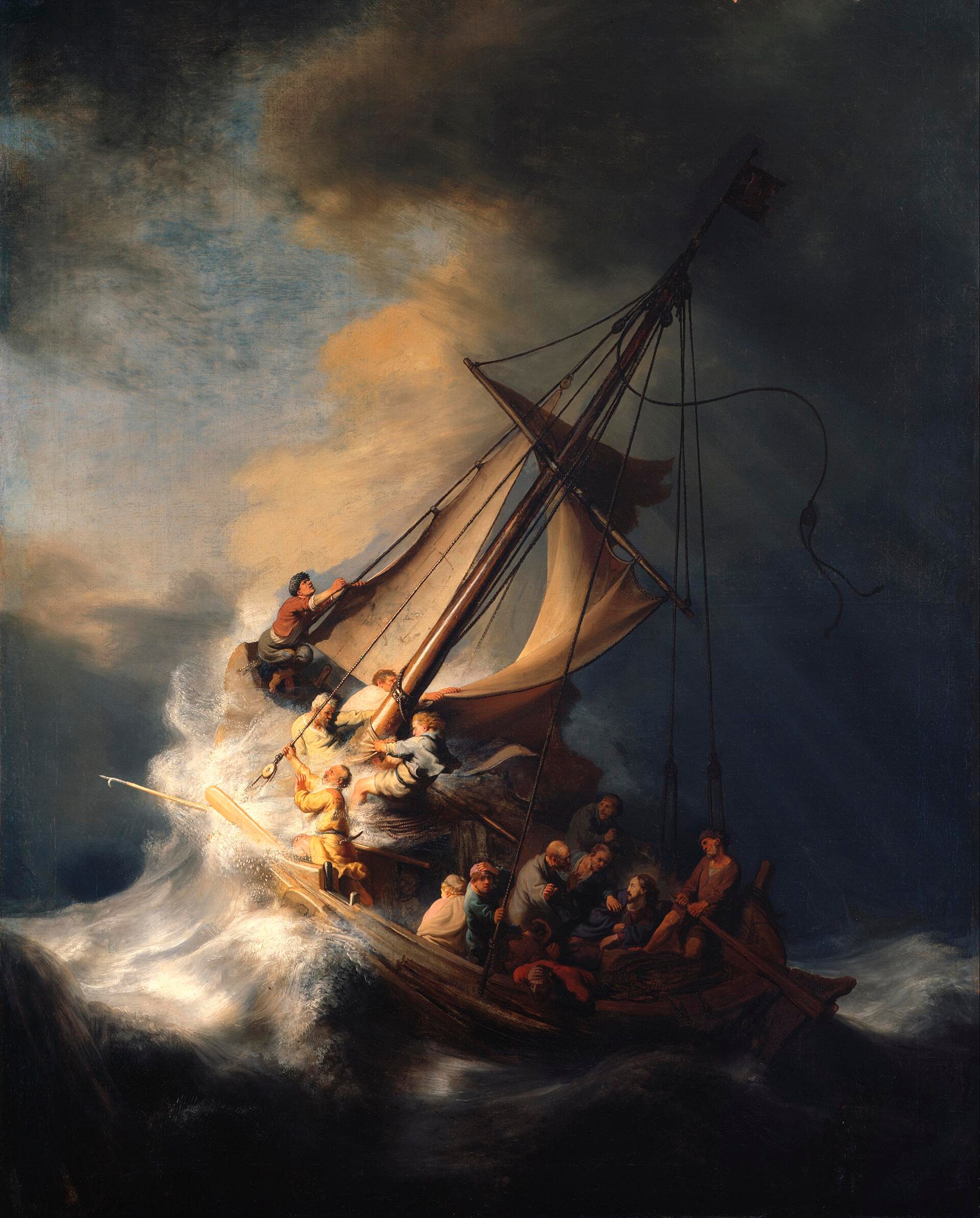
Or else, as a skilful pilot, foreseeing a storm in a calm, wishes his sailors to be prepared; so also the Lord says, If any one will follow me, &c.
And let him take up his cross and follow me. For indeed, the cross is taken up in two ways: either through the affliction of the body by abstinence, or through the affliction of the soul by compassion for one's neighbor. Let us consider how …
For a man who denies another, be it brother or father, does not sympathize with him, nor grieve at his fate, though he be wounded and die; thus we ought to despise our body, so that if it should be wounded or hurt in any way, we should not mind its suffering. For at that time the cross appeared shameful, because malefactors were fixed to it. But because after the cross we must have a new strength, He adds, and follow me.
The Puritans and the Awakening4 voices
And when he called the people - To hear a truth of the last importance, and one that equally concerned them all. Let him deny himself - His own will, in all things small and great, however pleasing, and that continually: And take up his cross - Embrace the will of God, however painful, daily, hourly, continually. Thus only can he follow me in holiness to glory.
Those that will be Christ's patients must attend on him, converse with him, receive instruction and reproof from him, as those did that followed him, and must resolve they will never forsake him. They must not be solicitous, no, not for the life of the body, when they cannot keep it without quitting Christ,
32 ), and here is little or no addition or alternation as to the circumstances. That our Lord Jesus was greatly followed; The multitude was very great (
quarantine:debris (2026-07-29) — leading-citation-number
And when he had called the people unto him,....
The Nineteenth Century3 voices
Whosoever will come after me - It seems that Christ formed, on the proselytism of the Jews, the principal qualities which he required in the proselytes of his covenant. The first condition of proselytism among the Jews was, that he that came to embrace their religion should come voluntarily, and that neither force nor influence should be employed in this business. This is also the first condition required by Jesus Christ, and which he considers as the foundation of all the rest: - If a man be willing to come after me.
A commentator
J.C. Ryle1816–1900
Expository Thoughts on the Gospels: Mark (lightly modernized text, Grace Gems edition) (1857)
proposed
The words of our Lord Jesus Christ in this passage are peculiarly weighty and solemn. They were spoken to correct the mistaken views of His disciples, as to the nature of His kingdom. But they contain truths of the deepest importance to Christians in every age of the Church. The whole passage is one which should often form the subject of private meditation. We learn, for one thing, from these verses, the absolute necessity of self-denial, if we would be Christ's disciples, and be saved . What says our Lord?
A commentator
J.C. Ryle1816–1900
Expository Thoughts on the Gospels: Mark (lightly modernized text, Grace Gems edition) (1857)
proposed
The words of our Lord Jesus Christ in this passage are peculiarly weighty and solemn. They were spoken to correct the mistaken views of His disciples, as to the nature of His kingdom. But they contain truths of the deepest importance to Christians in every age of the Church. The whole passage is one which should often form the subject of private meditation. We learn, for one thing, from these verses, the absolute necessity of self-denial, if we would be Christ's disciples, and be saved . What says our Lord? "Whoever will come after Me, let him deny himself, and take up his cross, and follow Me." Salvation is undoubtedly all of grace. It is offered freely in the Gospel to the chief of sinners, without money and without price. "By grace are you saved through faith, and that not of yourselves; it is the gift of God — not of works, lest any man should boast." (Ephes. 2:8, 9.) But all who accept this great salvation, must prove the reality of their faith by carrying the cross after Christ. They must not think to enter heaven without trouble, pain, suffering, and conflict on earth. They must be content to take up the cross of DOCTRINE, and the cross of PRACTICE — the cross of holding a faith which the world despises, and the cross of living a life which the world ridicules as too strict, and righteous overmuch. They must be willing to crucify the flesh, to mortify the deeds of the body, to fight daily with the devil, to come out from the world and to lose their lives, if needful, for Christ's sake and the Gospel's. These are hard sayings, but they admit of no evasion. The words of our Lord are plain and unmistakable. If we will not carry the cross, we shall never wear the crown. Let us not be deterred from Christ's service by fear of the cross. Heavy as that cross may seem, Jesus will give us grace to bear it. "I can do all things through Christ who strengthens me." (Phil.
The words behind it
26 Greek wordsEvery Greek word of this verse in the order it stands, with what it means and the door to its own study. The last column counts the times a word stands in the whole Bible: the rarer the word, the more the places it appears belong together.
| Greek | Sound | Meaning | Word study | In the Bible |
|---|---|---|---|---|
| καὶ | kai | And | G2532 → | 9120 times |
| προσκαλεσάμενος | proskalesamenos | having called to [Him] | G4341 → | 28 times |
| τὸν | ton | the | G3588 → | 19766 times |
| ὄχλον | ochlon | crowd | G3793 → | 175 times |
| σὺν | sun | with | G4862 → | 128 times |
| τοῖς | tois | the | G3588 → | 19766 times |
| μαθηταῖς | mathetais | disciples | G3101 → | 260 times |
| αὐτοῦ | autou | of Him | G846 → | 5565 times |
| εἶπεν | eipen | He said | G2036 → | 925 times |
| αὐτοῖς· | autois | to them; | G846 → | 5565 times |
| εἴ | ei | If | G1487 → | 508 times |
| τις | tis | anyone | G5100 → | 528 times |
| θέλει | thelei | desires | G2309 → | 208 times |
| ὀπίσω | opiso | after | G3694 → | 35 times |
| μου | mou | Me | G3165 → | 1936 times |
| ἀκολουθεῖν, | akolouthein | to follow, | G190 → | 90 times |
| ἀπαρνησάσθω | aparnesastho | he should deny | G533 → | 11 times |
| ἑαυτὸν | he'auton | himself | G1438 → | 322 times |
| καὶ | kai | and | G2532 → | 9120 times |
| ἀράτω | arato | he should take up | G142 → | 100 times |
| τὸν | ton | the | G3588 → | 19766 times |
| σταυρὸν | stauron | cross | G4716 → | 27 times |
| αὐτοῦ | autou | of him | G846 → | 5565 times |
| καὶ | kai | and | G2532 → | 9120 times |
| ἀκολουθείτω | akoloutheito | he should follow | G190 → | 90 times |
| μοι. | moi | Me. | G3165 → | 1936 times |
καὶAnd
kaiG2532 →9120 times
προσκαλεσάμενοςhaving called to [Him]
proskalesamenosG4341 →28 times
τὸνthe
tonG3588 →19766 times
ὄχλονcrowd
ochlonG3793 →175 times
σὺνwith
sunG4862 →128 times
τοῖςthe
toisG3588 →19766 times
μαθηταῖςdisciples
mathetaisG3101 →260 times
αὐτοῦof Him
autouG846 →5565 times
εἶπενHe said
eipenG2036 →925 times
αὐτοῖς·to them;
autoisG846 →5565 times
εἴIf
eiG1487 →508 times
τιςanyone
tisG5100 →528 times
θέλειdesires
theleiG2309 →208 times
ὀπίσωafter
opisoG3694 →35 times
μουMe
mouG3165 →1936 times
ἀκολουθεῖν,to follow,
akoloutheinG190 →90 times
ἀπαρνησάσθωhe should deny
aparnesasthoG533 →11 times
ἑαυτὸνhimself
he'autonG1438 →322 times
καὶand
kaiG2532 →9120 times
ἀράτωhe should take up
aratoG142 →100 times
τὸνthe
tonG3588 →19766 times
σταυρὸνcross
stauronG4716 →27 times
αὐτοῦof him
autouG846 →5565 times
καὶand
kaiG2532 →9120 times
ἀκολουθείτωhe should follow
akoloutheitoG190 →90 times
μοι.Me.
moiG3165 →1936 times
A shaded row is a word that stands 400 times or fewer in the Bible.
The walk
8 stopsEach card is a verse this one points to, and under it the verses that one points to in turn. Where several paths arrive at the same place, that place is listed first: the text keeps returning to it.
Through
John 10:27My sheep listen to My voice; I know them, and they follow Me.
it leads to
- John 10:16
I have other sheep that are not of this fold. I must bring them in as well, and they will listen to My voice. Then there will be one flock and one shepherd.
- John 10:14
I am the good shepherd. I know My sheep and My sheep know Me,
- 1 Corinthians 8:3
But the one who loves God is known by God.
- Revelation 3:20
Behold, I stand at the door and knock. If anyone hears My voice and opens the door, I will come in and dine with him, and he with Me.
- John 10:3–4
The gatekeeper opens the gate for him, and the sheep listen for his voice. He calls his own sheep by name and leads them out.
- John 10:16
Through
Galatians 5:24Those who belong to Christ Jesus have crucified the flesh with its passions and desires.
it leads to
- Romans 6:6
We know that our old self was crucified with Him so that the body of sin might be rendered powerless, that we should no longer be slaves to sin.
- Romans 13:14
Instead, clothe yourselves with the Lord Jesus Christ, and make no provision for the desires of the flesh.
- Romans 8:13
For if you live according to the flesh, you will die; but if by the Spirit you put to death the deeds of the body, you will live.
- Romans 6:6
Where this verse is studied
On this page
Studies4
On this chapter
About Mark
This page draws on 19 works. Open the list of works
This page draws on Adam Clarke, Commentary on the Bible; Augustine of Hippo, SERMONS ON NEW TESTAMENT LESSONS 46.1; Augustine of Hippo, LETTER 243, TO LAETUS; Bede, On the Gospel of Mark; Bede, Catena Aurea by Aquinas; Caesarius of Arles, SERMONS 159; Caesarius of Arles, SERMONS 159.5; Gregory the Dialogist, Forty Gospel Homilies, Homily 32; J. C. Ryle, Expository Thoughts on the Gospels, Mark; J.C. Ryle, Expository Thoughts on the Gospels: Mark (lightly modernized text, Grace Gems edition); John Chrysostom, Catena Aurea by Aquinas; John Gill, Exposition of the New Testament (1746-1748); John Wesley, Explanatory Notes upon the New Testament; Matthew Henry, Commentary on the Whole Bible; Pseudo-Jerome, Catena Aurea by Aquinas; Tertullian, On Idolatry; Tertullian, ON IDOLATRY 12; Theophylact of Ohrid, Commentary on Mark and Theophylact of Ohrid, Catena Aurea by Aquinas.