
Mark 8:10
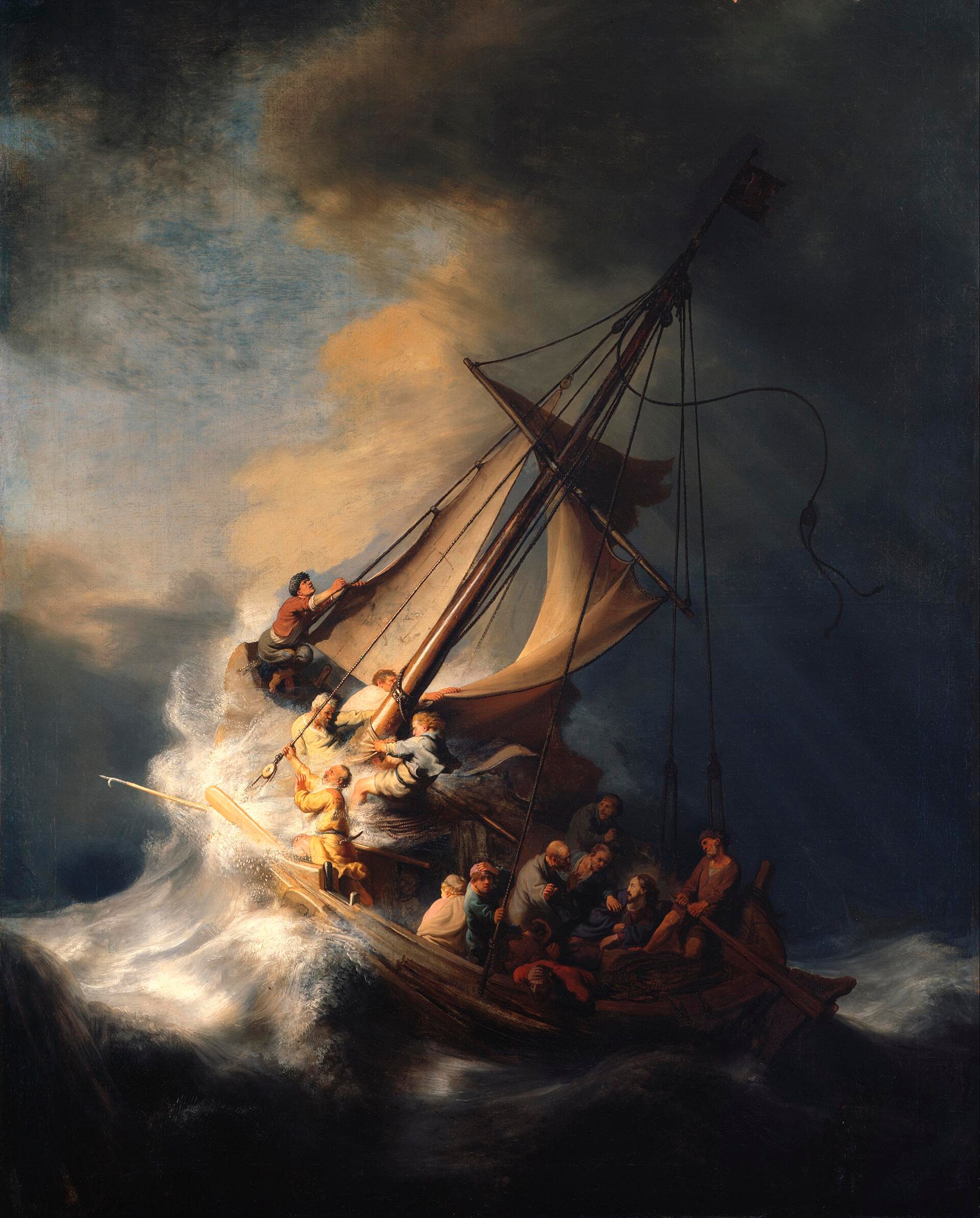
in Mark 8He got into the boat with His disciples and went to the district of Dalmanutha.
BSB
The same verse in ASV and KJV ▾
ASV
And straightway he entered into the boat with his disciples, and came into the parts of Dalmanutha.
KJV
And straightway he entered into a ship with his disciples, and came into the parts of Dalmanutha.
⋯
This verse in Mark 8
Commentary
11 notes on this verseAfter that our Lord had worked the miracle of the loaves, He immediately retires into another spot, lest on account of the miracle, the multitudes should take Him to make Him a king; wherefore it is said, And straightway he entered into a ship with his disciples, and came into the parts of Dalmanutha.
This site's exposition
the parts of Dalmanutha
on Mark 8:10-13
The parts of Dalmanutha receive Jesus for only as long as it takes the Pharisees to arrive tempting him, seeking of him a sign from heaven, a demand the bench reads as bad faith since he had already given more signs than the nation could account for. He sighed deeply in his spirit, Mark's own window into the Lord's grief, and answers that there shall no sign be given unto this generation, the only recorded outright refusal of a sign in the Gospels. He then leaves them exactly as he found them, entering the ship again for the other side, the abruptness itself a comment on the encounter.
The record, by era
The Church Fathers2 voices
Now in Matthew we read that He entered into the parts of Magdala. But we cannot doubt that it is the same place under another name; for several manuscripts even of St. Mark have only Magdala.
After his account of the miracle of the seven loaves, Mark subjoins the same transition as is given us in Matthew, only with this difference: Matthew's expression for the locality is not Dalmanutha, as is read in certain codices, but Magedan. There is no reason, however, for questioning the fact that it is the same place that is intended under both names. For most codices, even of Mark's Gospel, give no other reading than that of Magedan.
The Medieval Church2 voices
After the miracle of the loaves, the Lord immediately departs to another place, fearing that the people, as a result of such a miracle, might revolt and decide to make Him king.
And immediately getting into the boat with His disciples, He came to the region of Dalmanutha. For in Matthew we read: "And after sending away the crowd, He got into the boat and came to the region of Magadan" (Matthew 15). It is not to …
The Puritans and the Awakening1 voice
And straightway he entered into a ship, with his disciples,.... As soon as ever he had, dismissed the multitude, he took shipping with his disciples; for he was at the sea of Galilee, either at a place near it, or upon the shore of it; see Mar 7:31; and came into the parts of Dalmanutha; which Matthew calls, "the coasts of Magdala"; See Gill on Mat 15:
4 more voices on this verse
The Nineteenth Century4 voices
A commentator
J.C. Ryle1816–1900
Expository Thoughts on the Gospels: Mark (lightly modernized text, Grace Gems edition) (1857)
Once more we see our Lord feeding a great multitude with a few loaves and fish. He knew the heart of man. He saw the rise of cavilers and skeptics, who would question the reality of the wonderful works He performed. By repeating the mighty miracle here recorded, He stops the mouth of all who are not wilfully blind to evidence. Publicly, and before four thousand witnesses, He shows His almighty power a second time. Let us observe in this passage how great is the kindness and compassion of our Lord Jesus Christ .
A commentator
Jamieson, Fausset & Brown1802–1910
Commentary Critical and Explanatory on the Whole Bible (1871)
proposed
And straightway he entered into a ship--"into the ship," or "embarked." with his disciples, and came into the parts of Dalmanutha--In Matthew (Mt 15:39) it is "the coasts of Magdala." Magdala and Dalmanutha were both on the western shore of the lake, and probably not far apart.
A commentator
J.C. Ryle1816–1900
Expository Thoughts on the Gospels: Mark (lightly modernized text, Grace Gems edition) (1857)
proposed
Once more we see our Lord feeding a great multitude with a few loaves and fish. He knew the heart of man. He saw the rise of cavilers and skeptics, who would question the reality of the wonderful works He performed. By repeating the mighty miracle here recorded, He stops the mouth of all who are not wilfully blind to evidence. Publicly, and before four thousand witnesses, He shows His almighty power a second time. Let us observe in this passage how great is the kindness and compassion of our Lord Jesus Christ . He saw around Him a "very great multitude," who had nothing to eat. He knew that the great majority were following Him from no other motive than idle curiosity, and had no claim whatever to be regarded as His disciples. Yet when He saw them hungry and destitute, He pitied them — "I have compassion on the multitude, because they have now been with me three days, and have nothing to eat." The feeling heart of our Lord Jesus Christ appears in these words. He has compassion even on those who are not His people — the faithless, the graceless, the followers of this world. He feels tenderly for them, though they know it not. He died for them, though they care little for what He did on the cross. He would receive them graciously, and pardon them freely, if they would only repent and believe on Him. Let us ever beware of measuring the love of Christ by any human measure. He has a special love, beyond doubt, for His own believing people. But He has also a general love of compassion, even for the unthankful and the evil. His love "passes knowledge." (Ephes. 3:19.) Let us strive to make Jesus our pattern in this, as well as in everything else. Let us be kind, and compassionate, and piteous, and courteous to all men. Let us be ready to do good to all men, and not only to friends and the household of faith.
A commentator
Albert Barnes1798–1870
Notes, Explanatory and Practical, on the Old and New Testaments (1832-1869)
proposed
Dalmanutha - In Mat 15:39 it is said that he came into the coasts of “Magdala.” See the note on the place.
The words behind it
15 Greek wordsEvery Greek word of this verse in the order it stands, with what it means and the door to its own study. The last column counts the times a word stands in the whole Bible: the rarer the word, the more the places it appears belong together.
| Greek | Sound | Meaning | Word study | In the Bible |
|---|---|---|---|---|
| Καὶ | kai | And | G2532 → | 9120 times |
| εὐθὺς | euthus | immediately | G2112 → | 87 times |
| ἐμβὰς | embas | having climbed | G1684 → | 16 times |
| εἰς | eis | into | G1519 → | 1755 times |
| τὸ | to | the | G3588 → | 19766 times |
| πλοῖον | ploion | boat | G4143 → | 67 times |
| μετὰ | meta | with | G3326 → | 461 times |
| τῶν | ton | the | G3588 → | 19766 times |
| μαθητῶν | matheton | disciples | G3101 → | 260 times |
| αὐτοῦ | autou | of Him | G846 → | 5565 times |
| ἦλθεν | elthen | He came | G2064 → | 628 times |
| εἰς | eis | into | G1519 → | 1755 times |
| τὰ | ta | the | G3588 → | 19766 times |
| μέρη | mere | district | G3313 → | |
| Δαλμανουθά. | dalmanoutha | of Dalmanutha. | G1148 → |
ΚαὶAnd
kaiG2532 →9120 times
εὐθὺςimmediately
euthusG2112 →87 times
ἐμβὰςhaving climbed
embasG1684 →16 times
εἰςinto
eisG1519 →1755 times
τὸthe
toG3588 →19766 times
πλοῖονboat
ploionG4143 →67 times
μετὰwith
metaG3326 →461 times
τῶνthe
tonG3588 →19766 times
μαθητῶνdisciples
mathetonG3101 →260 times
αὐτοῦof Him
autouG846 →5565 times
ἦλθενHe came
elthenG2064 →628 times
εἰςinto
eisG1519 →1755 times
τὰthe
taG3588 →19766 times
μέρηdistrict
mereG3313 →
Δαλμανουθά.of Dalmanutha.
dalmanouthaG1148 →
A shaded row is a word that stands 400 times or fewer in the Bible.
The walk
1 stopEach card is a verse this one points to, and under it the verses that one points to in turn. Where several paths arrive at the same place, that place is listed first: the text keeps returning to it.
Through
Matthew 15:39After Jesus had dismissed the crowds, He got into the boat and went to the region of Magadan.
it leads to
- Matthew 14:22
Immediately Jesus made the disciples get into the boat and go on ahead of Him to the other side, while He dismissed the crowds.
- Matthew 14:22
Where this verse is studied
On this page
Studies4
On this verse
About Mark
This page draws on 11 works. Open the list of works
This page draws on Albert Barnes, Notes, Explanatory and Practical, on the Gospels; Albert Barnes, Notes, Explanatory and Practical, on the Old and New Testaments (1832-1869); Augustine of Hippo, Catena Aurea by Aquinas; Augustine of Hippo, HARMONY OF THE GOSPELS 2.51; Bede, On the Gospel of Mark; J.C. Ryle, Expository Thoughts on the Gospels: Mark (lightly modernized text, Grace Gems edition); Jamieson, Fausset & Brown, Commentary Critical and Explanatory on the Whole Bible; John Gill, Exposition of the New Testament (1746-1748); Matthew Henry, Commentary on the Whole Bible; Theophylact of Ohrid, Catena Aurea by Aquinas and Theophylact of Ohrid, Commentary on Mark.