
Judgeschapter 7
25 verses · BSBJudges book hub →
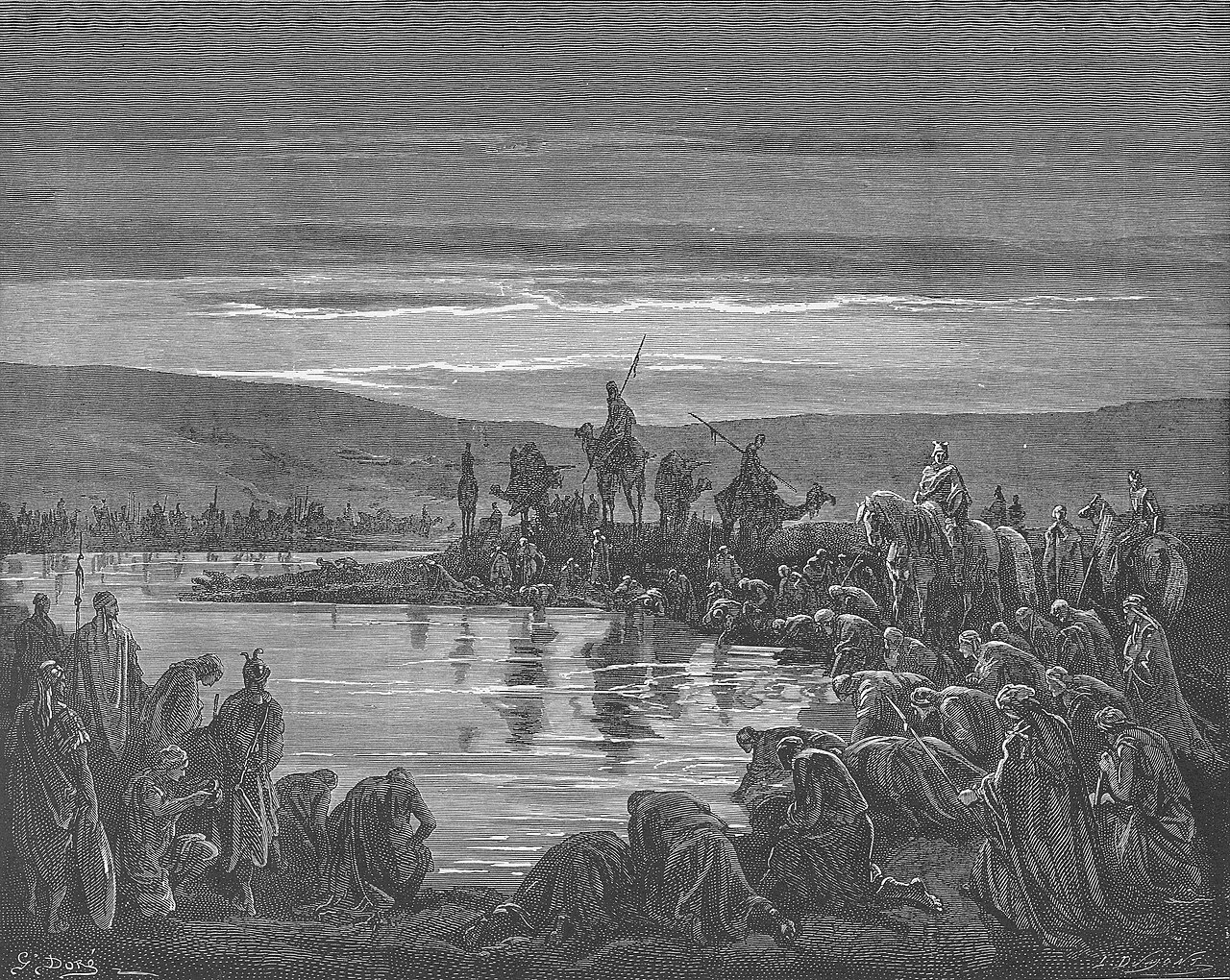
Gideon Chooses 300 Soldiers, Gustave Doré, Doré's English Bible (1866), public domain
Key verse
The three companies blew their horns and shattered their jars. Holding the torches in their left hands and the horns in their right hands, they shouted, “A sword for the LORD and for Gideon!”
It stands in scene C of the chapter, verses 16 to 25.
The chapter
Chapter summary
Jehovah's problem with Gideon's army is that it is too large: 'lest Israel vaunt themselves against me, saying, Mine own hand hath saved me.' Twenty-two thousand fearful go home; of the rest, the water test at the spring of Harod leaves three hundred who lapped like a dog. Gideon creeps down to the camp and overhears a Midianite recount his dream of a cake of barley bread tumbling into the tent, and worships. Then the night attack: trumpets in every hand, torches inside empty pitchers, the cry 'The sword of Jehovah and of Gideon,' and a host turning its swords on itself in flight. Ephraim takes the waters and the princes Oreb and Zeeb.
Context
History · Samuel · Judges overview
Where the chapter sits
Judges 7 falls in The twelve judges (chapters 3–16). Othniel, Ehud, Shamgar, Deborah, Gideon, Tola, Jair, Jephthah, Ibzan, Elon, Abdon, Samson (and Abimelech as anti-judge). Seven oppression-deliverance cycles.
Three hundred with torches. ‘The people that are with thee are too many’; the Midianite rout.
Before it: Incomplete conquest; programmatic cycle, chapters 1–2. After it: Appendix: diagnosis of Israel, chapters 17–21.
The whole shape of Judges→The world behind this chapter
Judges 7The history
Armies in that world camped by water and fought at dawn. The spring of Harod still runs at the base of Gilboa, and from that shoulder of hill you look straight down onto the plain where the camel camp lay. Whittling thirty-two thousand men to three hundred is a deliberate reversal of every rule of ancient warfare, where a commander's first report was always his troop count.
The rest of the history, and what it meant to them
The night was divided into three watches, and the middle watch, roughly ten at night to two in the morning, was chosen because the guard had just changed and the camp was at its deepest sleep. Three hundred men split into three companies could ring a camp at a distance and appear to be three whole units.
The trick is in the equipment. Each man carried a ram's horn in one hand and a torch inside a clay jar in the other, so no hand was free for a weapon, that is the point. The jar hid the flame until the moment of smashing. In a real assault, one trumpeter signaled for perhaps a hundred men, so three hundred horns sounding at once told a waking army it was surrounded by tens of thousands. Panic in a camp packed with camels and horses did the killing.
The barley loaf in the enemy soldier's dream is a jab of its own. Barley was the poor man's grain, the bread of people scraping by after their wheat had been stolen, and in the dream one stale round of it flattens the tent of a raiding lord.
What it meant to them
The explicit reason given for the reduction is that Israel must not say my own hand has saved me. For first hearers who lived under the constant temptation to trust chariots, alliances, and manpower, that sentence was the sermon of the chapter.
It also gave them a night they could picture: three hundred farmers standing still in the dark holding pots, while the LORD set the enemy's swords against each other.
Sources cited
- Yigael Yadin, The Art of Warfare in Biblical Lands in the Light of Archaeological Study
- Keil and Delitzsch, Biblical Commentary on the Old Testament: Joshua, Judges, Ruth
A. Thirty-two thousand cut down to three hundred
1. (vv. 1-3)
a.The name Jerubbaal was given at 6:32, after Gideon pulled down his father's altar, and it carries the sense of let Baal plead against him. The man who leads Israel against Midian goes into the field under a name that argues with Baal. Harod means trembling, and the well is named for what happens three verses later when twenty and two thousand men go home afraid. The proclamation at verse 3 is Deuteronomy 20:8 being carried out, where the law told the officers to send the fearful home before a battle.
Judges 7:1, 1 voiceWhat preachers and commentators have said about this verse, in their own words.
Judges 7:1
“The well of Harod - i. e. of trembling, evidently so called from the people who were afraid Jdg 7:3. It is identified with great probability with Ain Jalud, a spacious pool at the foot of Gilboa; (by Conder, with Ain el Jem’ain (the spring of the two troops)). Moreh was, probably, the little Hermon, the Jebel ed-Duhy of the Arabs, which encloses the plain two or three miles north of Gilboa, which shuts it in on the south.”
Judges 7:2, 1 voice
Judges 7:2
“The people that are with thee are too many - Had he led up a numerous host against his enemies, the excellence of the power by which they were discomfited might have appeared to be of man and not of God. By the manner in which this whole transaction was conducted, both the Israelites and Midianites must see that the thing was of God. This would inspire the Israelites with confidence, and the Midianites with fear.”
Adam Clarke· Commentary on the Bible (1810-1826)evangelical
Judges 7:3, 3 voices
Judges 7:3
Does not the leader of our army, the Lord and Savior Jesus Christ, call out now to his soldiers and say, Whoever is "fearful and anxious of heart," let him not come to war with me? For this is also what he says in the Gospels in other words but with the same meaning: "Whoever does not take his own cross and come after me is not worthy of me," and again: "Whoever does not renounce all that he has cannot be my disciple."
Origen of Alexandria· written before 253· HOMILIES ON JUDGES 9.1patristic
Judges 7:3
“The proclamation was in accordance with the Law (see the marginal reference). No mountain of the name of Gilead is known in this locality, and it has been conjectured that the right reading is Gilboa. Others think that this may be a form of proclamation customary in Manasseh.”
Judges 7:3
“Now therefore . . ., proclaim in the ears of the people, saying, Whosoever is fearful . . . let him return--This proclamation was in terms of an established law (De 20:8).”
Jamieson, Fausset & Brown· Commentary Critical and Explanatory on the Whole Bible (1871)reformed
2. (vv. 4-6)
a.Verse 2 has already given the reason for both tests, that the people are too many for me to give the Midianites into their hands, so the cutting down is the work rather than an obstacle to it. The text records what the men did at the water and never says what it distinguished. Albert Barnes reads the lappers as the watchful men who kept their eyes on the enemy while they drank, John Gill says plainly that it is hard to tell whether the action showed weakness or courage, and a third reading takes it as a means of separating out a number with no judgment on the men at all. Where the text gives no reason, none is supplied here.
Judges 7:4, 1 voice
Judges 7:4
“Try - The word used for refining metals by separating the dross from the pure ore. They who threw themselves on the ground and drank freely were the more self-indulgent; while they who, remembering the near presence of the enemy, slaked their thirst with moderation, and without being off their guard for an instant, were the true soldiers of the army of God.”
Judges 7:5, 1 voice
Judges 7:5
“Every one that lappeth of the water - as a dog - The original word ילק yalok is precisely the sound which a dog makes when he is drinking.”
Adam Clarke· Commentary on the Bible (1810-1826)evangelical
Judges 7:6, 1 voice
Judges 7:6
“The number of them that lapped - From this account it appears that some of the people went down on their knees, and putting their mouths to the water, sucked up what they needed; the others stooped down, and taking up water in the hollow of their hands, applied it to their mouth.”
Adam Clarke· Commentary on the Bible (1810-1826)evangelical
3. (vv. 7-8)
a.Thirty and two thousand is what verse 3 implies when twenty and two thousand leave and ten thousand remain, and three hundred is under one man in a hundred of what Gideon started with. What the three hundred keep is food and trumpets, and the trumpets are handed out here, eight verses before any reader learns what they are for. Verse 8 closes by putting the host of Midian beneath him in the valley, which is where verse 1 put them, so the ground has not moved and only the army has.
Judges 7:7, 1 voice
Judges 7:7
“And the Lord said unto Gideon, by the three hundred men that lapped I will save and deliver the Midianites into thine hand,.... It is hard to say what character this action of the three hundred is expressive of, whether of weakness or of courage.”
B. A barley loaf tumbling through an enemy's dream
1. (vv. 9-11)
a.The condition in verse 10 is put to Gideon before he says anything, but if thou fear to go down, so the strengthening is offered rather than requested. In chapter 6 he had asked for confirmation three times, at the meal that burned up at 6:21 and the fleece wet and then dry at 6:37 and 6:39, and here a fourth comes without his asking. Verse 3 had sent the fearful home, and the man left in command is met at the point of the same fear instead of being dismissed for it. Phurah appears in these two verses and nowhere else in Scripture.
Judges 7:11, 1 voice
Judges 7:11
“The armed men - The word is rendered harnessed in Exo 13:18 (see the note). The most probable meaning of the word is arrayed in divisions or ranks.”
2. (vv. 12-14)
a.The figure is turned around from Numbers 13:33, where the spies said that in their own sight they were as grasshoppers before the giants, and here it is the enemy who fills the valley like grasshoppers. Barley was the poor man's grain and the food of beasts, and 6:11 had Gideon threshing wheat inside a winepress to hide it from these same raiders, so the cake in the dream is the cheapest thing a stripped country could bake. The comfort Gideon is sent down to hear is spoken by a Midianite, who names Gideon and says that God delivered Midian into his hand, so the outcome is stated in the enemy camp before Israel says it.
Judges 7:13, 2 voices
Judges 7:13
“A cake of barley bread - i. e. such a cake as could hardly be eaten by men, it was so vile: a term expressive of the contempt of the Midianites for the people of Israel. A tent - The tent, meaning, probably, the tent of the king of Midian, or of the captain of the host.”
Judges 7:13
“The circumstance of the cake, too, was very significant. Barley was usually the food of the poor, and of beasts; but most probably, from the widespread destruction of the crops by the invaders, multitudes must have been reduced to poor and scanty fare.”
Jamieson, Fausset & Brown· Commentary Critical and Explanatory on the Whole Bible (1871)reformed
Judges 7:14, 1 voice
Judges 7:14
“His fellow answered, &c. - As there are many examples of significant dreams, given by God to Heathens, so some of them had the gift of interpreting dreams; which they sometimes did by divine direction as in this case.”
John Wesley· Explanatory Notes upon the Old Testament (1765)evangelical
3. (v. 15)
Judges 7:15-16
a.Gideon worships inside the enemy's lines on the strength of a stranger's dream, and it is the first worship recorded of him since he built the altar at 6:24. Each man carries a trumpet, an empty pitcher and a lamp burning inside the pitcher, which fills both hands, and the three hundred draw no sword anywhere in the chapter. Matthew Henry sets the breaking of the pitchers beside the treasure in earthen vessels of 2 Corinthians 4:7, and that is his reading rather than a link the New Testament makes.
C. Trumpets, pitchers, torches, and a rout in the dark
1. (v. 16)
Judges 7:16, 2 voices
Judges 7:16
“For the same reason was it that when Gideon was about to overcome the Midianites, he commanded three hundred men to take pitchers, and to hold lighted torches inside the pitchers, and trumpets in their right hands. Our predecessors have preserved the explanation received from the apostles, that the pitchers are our bodies, fashioned of clay, which do not know fear if they burn with the fervor of the grace of the Spirit, and bear witness to the passion of the Lord Jesus with a loud confession of the voice.”
Ambrose of Milan· written before 397· On the Holy Spirit 1.143-46patristic
Judges 7:16
“He divided the three hundred men - Though the victory was to be from the Lord, yet he knew that he ought to use prudential means; and those which he employed on this occasion were the best calculated to answer the end. If he had not used these means, it is not likely that God would have delivered the Midianites into his hands. Sometimes, even in working a miracle, God will have natural means used: Go, dip thyself seven times in Jordan. Go, wash in the pool Siloam.”
Adam Clarke· Commentary on the Bible (1810-1826)evangelical
2. (vv. 17-18)
a.The whole plan is imitation, look on me and do likewise, and there is no signal in it beyond watching the man in front. The Midianite in verse 14 had called it the sword of Gideon, and the cry Gideon gives his men puts another name in front of his own, the sword of the Lord, and of Gideon. Verse 2 had said the army was cut down lest Israel say mine own hand hath saved me, and the shout still carries a man's name while naming God first.
Judges 7:18, 2 voices
Judges 7:18
“The sword of the Lord, and of Gideon - The word חרב chereb, “sword,” is not found in this verse, though it is necessarily implied, and is found in Jdg 7:20. But it is found in this place in the Chaldee, Syriac, and Arabic, and in eight of Kennicott’s and De Rossi’s MSS. The reading appears to be genuine.”
Adam Clarke· Commentary on the Bible (1810-1826)evangelical
Judges 7:18
“Of Gideon - He mentions his own name, together with God's, not out of arrogance, as if he would equal himself with God; but from prudent policy, because his name was grown formidable to them, and so was likely to further his design.”
John Wesley· Explanatory Notes upon the Old Testament (1765)evangelical
3. (vv. 19-21)
a.the beginning of the middle: The middle watch begins near midnight and the sentries had only just been posted, so the men on duty were the least settled and the camp behind them was asleep. Israel divided the night into three watches, which is why Exodus 14:24 can speak of the morning watch as a fixed part of the night. The three hundred break their pitchers and then do nothing further, and verse 21 says they stood every man in his place while the host ran and cried and fled, which is the posture Moses called for at Exodus 14:13.
Judges 7:19, 1 voice
Judges 7:19
“The middle watch - The old Jewish division of the night was three watches of four hours each. They are alluded to in Exo 14:24; 1Sa 11:11; Psa 63:6; Psa 90:4; Psa 119:148; Psa 130:6; Lam 2:19. After the Jews fell under the power of the Romans, they used the Roman division of four watches of three hours each Mat 14:25; Mar 13:35. “The beginning” of the watch would be about eleven o’clock at night.”
Judges 7:20, 2 voices
Judges 7:20
“They go forth therefore to battle with trumpets, with lamps, and with pitchers. This, as we have said, was an unusual order of battle. They sounded with the trumpets, and the pitchers were held in their left hands. But lamps were placed within the pitchers; but, when the pitchers were broken, the lamps appeared, and by their flashing light the affrighted enemies are put to flight. By the trumpets is designated therefore the loud voice of preachers, by the lamps the brightness of their miracles, by the pitchers the frailness of their bodies.”
Gregory the Dialogist· written before 604· Morals on the Book of Job 30.25patristic
Judges 7:20
“Blew the trumpets, and brake the pitchers - How astonishing must the effect be, in a dark night, of the sudden glare of three hundred torches, darting their splendor, in the same instant, on the half-awakened eyes of the terrified Midianites, accompanied with the clangour of three hundred trumpets, alternately mingled with the thundering shout of חרב ליהוה ולגדעון chereb layhovah ulegidon, “A sword for the Lord and for Gideon!” Origen, in his ninth homily on this book, makes these three hundred men types of the preachers of the Gospel; their trumpets of the preaching of Christ crucified; and their lights or torches, of the holy conduct of righteous men.”
Adam Clarke· Commentary on the Bible (1810-1826)evangelical
Judges 7:21, 1 voice
Judges 7:21
“The effect to the Midianites would be, that they were surrounded by a mighty host. Their own camp being in darkness, as soon as the confusion of flight began they would mistake friends for foes, and fleers for pursuers.”
4. (vv. 22-23)
a.The only sword work in the chapter is Midian's own, and the same thing is recorded at 1 Samuel 14:20 when the Philistine host turns on itself and at 2 Chronicles 20:23 when Ammon and Moab destroy each other. The tribes named in verse 23 are Naphtali, Asher and Manasseh, three of the four Gideon had summoned at 6:35, so the men sent home in verses 3 and 7 come back for the pursuit. The battle is won by three hundred and the chase is worked by the nation.
Judges 7:22, 1 voice
Judges 7:22
“Fled to Beth-shittah - This is no where else mentioned in Scripture. Zererath - This and Tabbath are nowhere else to be found. Abel-meholah - This was the birth-place of the prophet Elisha, 1Ki 19:16. It was beyond Jordan, in the tribe of Manasseh, 1Ki 4:12. The Zartanah, mentioned in this last quoted verse, was probably the same as Zererath. Its situation corresponds well with Abel-meholah.”
Adam Clarke· Commentary on the Bible (1810-1826)evangelical
5. (vv. 24-25)
a.Ephraim is called after the fighting rather than before it, and 8:1 opens with that tribe complaining about exactly this. Holding the waters and the fords of Jordan shuts the escape route, which is the tactic Ehud used at 3:28. Oreb means raven and Zeeb means wolf, and the rock and the winepress carry their names afterward from what happened at them. Isaiah 10:26 reaches back to this day at the rock of Oreb, and Psalm 83:11 names both princes in a prayer asking God to do it again.
Judges 7:24, 1 voice
Judges 7:24
“Take before them the waters unto Beth-barah - This is probably the same place as that mentioned Joh 1:28, where the Hebrews forded Jordan under the direction of Joshua. To this place the Midianites directed their flight that they might escape into their own country; and here, being met by the Ephraimites, they appear to have been totally overthrown, and their two generals taken.”
Adam Clarke· Commentary on the Bible (1810-1826)evangelical
Judges 7:25, 2 voices
Judges 7:25
“They who were glorying in their army, whose king was the Assyrian and who used to boast "I will scale the heavens," not only fell down to earth but on the ground became dung."Make their nobles." What nobles? Those who fight against your people. "Like Oreb and Zeeb; all their chiefs like Zebah and Zalmunna." I suppose you have read in the book of Judges the story of Gideon, who is also called Jerubbaal, how he outwitted those four kings while fighting for the people of God and put an end to them.”
Jerome· written before 420· HOMILIES ON THE PSALMS 15 (PS 82)patristic
Judges 7:25
“And they took two princes of the Midianites, Oreb and Zeeb,.... The one signifies a "raven", and the other a "wolf"; which were either nicknames given them because of their voraciousness and cruelty, or which they took themselves, or their ancestors before them, to make themselves terrible to others; so the Romans had the families of the Corvini, &c. and they slew Oreb upon the rock Oreb; perhaps they found him in a cave of the rock, and dragging him out slew him, from whence the rock afterwards had its name.”
The text of this chapter
This page carries no textual note on Judges 7. Where this site has examined a place the manuscripts differ, the examination is in the manuscripts room. Every place this site examines →
This page draws on 11 works. Open for the list.
This page draws on Adam Clarke; Albert Barnes; Ambrose of Milan, On the Holy Spirit 1.143-46; Gregory the Dialogist, Morals on the Book of Job 30.25; Jamieson, Fausset & Brown; Jerome, HOMILIES ON THE PSALMS 15 (PS 82); John Gill; John Wesley, Explanatory Notes upon the Old Testament (1765); Keil and Delitzsch, Biblical Commentary on the Old Testament: Joshua, Judges, Ruth; Matthew Henry, Commentary on the Whole Bible and Origen of Alexandria, HOMILIES ON JUDGES 9.1.
Keep studying
On this page