
Judges 7:8
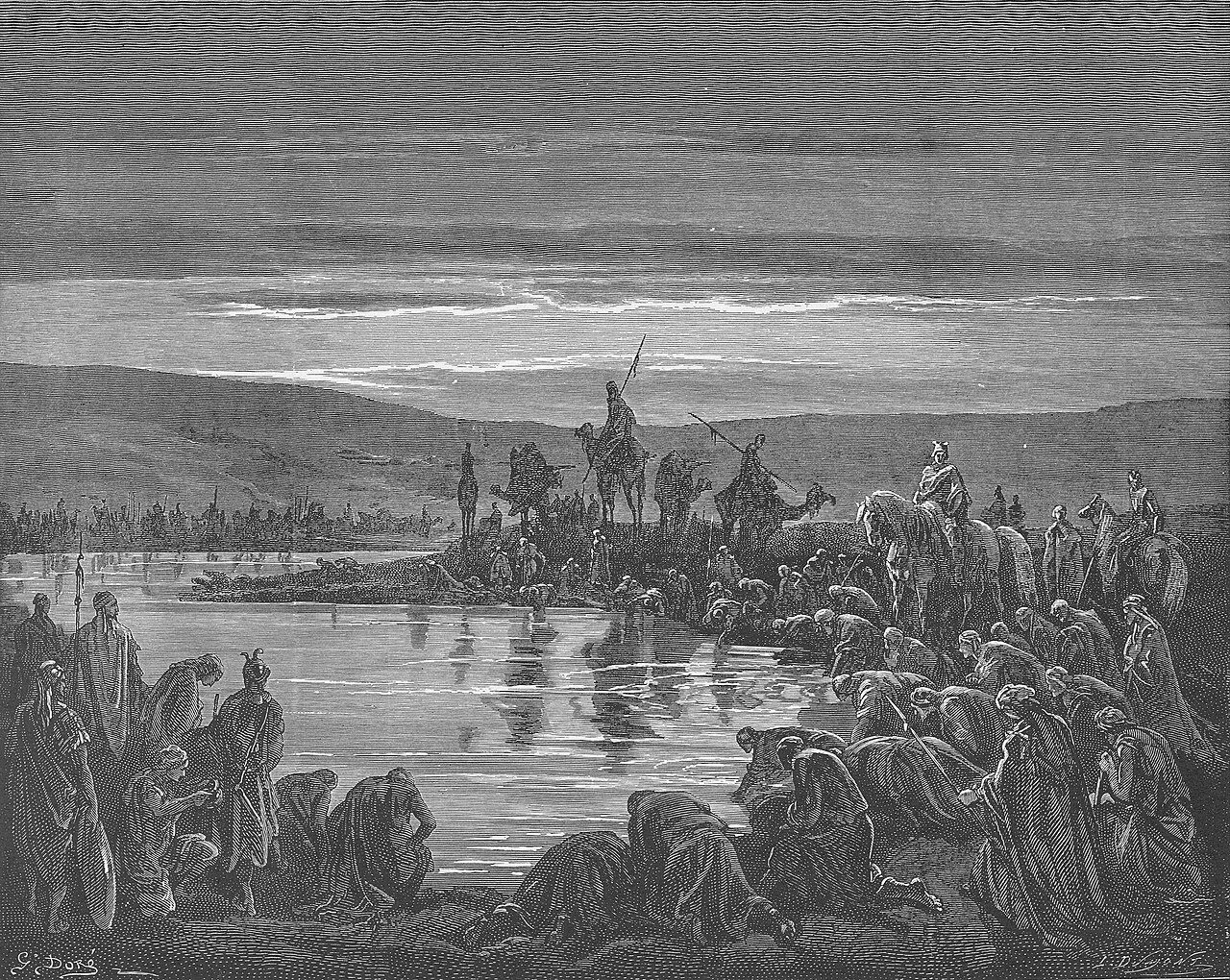
in Judges 7So Gideon sent the rest of the Israelites to their tents but kept the three hundred men, who took charge of the provisions and rams’ horns of the others. And the camp of Midian lay below him in the valley.
BSB
The same verse in ASV and KJV ▾
ASV
So the people took victuals in their hand, and their trumpets; and he sent all the men of Israel every man unto his tent, but retained the three hundred men: and the camp of Midian was beneath him in the valley.
KJV
So the people took victuals in their hand, and their trumpets: and he sent all the rest of Israel every man unto his tent, and retained those three hundred men: and the host of Midian was beneath him in the valley.
⋯
This verse in Judges 7
Commentary
7 notes on this verseThis site's exposition
With the three hundred men who lapped
on Judges 7:7-8
Thirty-two thousand is implied when twenty-two thousand leave and ten thousand remain, so three hundred is under one man in a hundred. Verse 8 ends with "the camp of Midian lay below him in the valley", where verse 1 put it, so only the army has moved.
This site's exposition
who took charge of the provisions
Albert Barnes explains that the three hundred took the horns from the men sent home, so each had a horn and a jar. Matthew Henry reads what follows as God supplying recruits for Gideon's faith in place of recruits for his army. The army shrinks and the equipment stays.
The record, by era
The Puritans and the Awakening2 voices
So the people took victuals in their hands and their trumpets,.... That is, the three hundred took victuals of those that departed, as much as was necessary for them, and also their trumpets, being directed thereunto by Gideon, no doubt; perhaps they took all the trumpets they had; however, as many as would furnish every man with one.
Gideon's army being diminished as we have found it was, he must either fight by faith or not at all; God therefore here provides recruits for his faith, instead of recruits for his forces. He furnishes him with a good foundation to build his faith upon.
The Nineteenth Century3 voices
A commentator
Jamieson, Fausset & Brown1802–1910
Commentary Critical and Explanatory on the Whole Bible (1871)
proposed
the host of Midian was beneath him in the valley--Attention to the relative position of the parties is of the greatest importance to an understanding of what follows. HE IS ENCOURAGED BY THE DREAM AND THE INTERPRETATION OF THE BARLEY CAKE.
quarantine:debris (2026-07-29) — starts-lowercase
So the people took victuals - The three hundred men that he reserved took the victuals necessary for the day’s expenditure, while the others were dismissed to their tents and their houses as they thought proper.
A commentator
Albert Barnes1798–1870
Notes, Explanatory and Practical, on the Old and New Testaments (1832-1869)
proposed
The sense is, “And they (the three hundred) took the victuals and trumpets of the people (all the people of Jdg 7:7) into their hands.” so that each of the three hundred should have a trumpet and a pitcher.
The words behind it
24 Hebrew wordsEvery Hebrew word of this verse in the order it stands, with what it means and the door to its own study. The last column counts the times a word stands in the whole Bible: the rarer the word, the more the places it appears belong together.
| Hebrew | Sound | Meaning | Word study | In the Bible |
|---|---|---|---|---|
| וַיִּקְח֣וּ | vaiyikchu | and they took | H3947 → | 966 times |
| אֶת־ | ʾet- | <obj.> | H853 → | 10935 times |
| צֵדָה֩ | tzedah | provision[s] | H6720 → | |
| הָעָ֨ם | haam | the people | H5971 → | 1873 times |
| בְּיָדָ֜ם | beyadam | in hand their | H3027 → | 1618 times |
| וְאֵ֣ת | veet | and <obj.> | H853 → | 10935 times |
| שׁוֹפְרֹֽתֵיהֶ֗ם | shofroteihem | trumpets their | H7782 → | 72 times |
| וְאֵ֨ת | veet | and <obj.> | H853 → | 10935 times |
| כָּל־ | kol- | every | H3605 → | 5413 times |
| אִ֤ישׁ | ʾish | <the> man of | H376 → | 1663 times |
| יִשְׂרָאֵל֙ | yisrael | Israel | H3478 → | 2507 times |
| שִׁלַּח֙ | shilach | he sent away | H7971 → | 845 times |
| אִ֣ישׁ | ʾish | each | H376 → | 1663 times |
| לְאֹֽהָלָ֔יו | leohalav | to tents his | H168 → | 345 times |
| וּבִשְׁלֹשׁ־ | uvishlosh- | and on three | H7969 → | 432 times |
| מֵא֥וֹת | meot | hundred<s> | H3967 → | 581 times |
| הָאִ֖ישׁ | haish | the man | H376 → | 1663 times |
| הֶֽחֱזִ֑יק | hechezik | he kept hold | H2388 → | 291 times |
| וּמַחֲנֵ֣ה | umachaneh | and [the] camp of | H4264 → | 215 times |
| מִדְיָ֔ן | midyan | Midian | H4080 → | 59 times |
| הָ֥יָה | hayah | it was | H1961 → | 3559 times |
| ל֖וֹ | lo | to <the> him | ||
| מִתַּ֥חַת | mitachat | from under | H8478 → | 505 times |
| בָּעֵֽמֶק׃ פ | baemek | in the valley | H6010 → | 69 times |
וַיִּקְח֣וּand they took
vaiyikchuH3947 →966 times
אֶת־<obj.>
ʾet-H853 →10935 times
צֵדָה֩provision[s]
tzedahH6720 →
הָעָ֨םthe people
haamH5971 →1873 times
בְּיָדָ֜םin hand their
beyadamH3027 →1618 times
וְאֵ֣תand <obj.>
veetH853 →10935 times
שׁוֹפְרֹֽתֵיהֶ֗םtrumpets their
shofroteihemH7782 →72 times
וְאֵ֨תand <obj.>
veetH853 →10935 times
כָּל־every
kol-H3605 →5413 times
אִ֤ישׁ<the> man of
ʾishH376 →1663 times
יִשְׂרָאֵל֙Israel
yisraelH3478 →2507 times
שִׁלַּח֙he sent away
shilachH7971 →845 times
אִ֣ישׁeach
ʾishH376 →1663 times
לְאֹֽהָלָ֔יוto tents his
leohalavH168 →345 times
וּבִשְׁלֹשׁ־and on three
uvishlosh-H7969 →432 times
מֵא֥וֹתhundred<s>
meotH3967 →581 times
הָאִ֖ישׁthe man
haishH376 →1663 times
הֶֽחֱזִ֑יקhe kept hold
hechezikH2388 →291 times
וּמַחֲנֵ֣הand [the] camp of
umachanehH4264 →215 times
מִדְיָ֔ןMidian
midyanH4080 →59 times
הָ֥יָהit was
hayahH1961 →3559 times
ל֖וֹto <the> him
lo
מִתַּ֥חַתfrom under
mitachatH8478 →505 times
בָּעֵֽמֶק׃ פin the valley
baemekH6010 →69 times
A shaded row is a word that stands 400 times or fewer in the Bible.
The walk
8 stopsEach card is a verse this one points to, and under it the verses that one points to in turn. Where several paths arrive at the same place, that place is listed first: the text keeps returning to it.
Through
1 Corinthians 15:52in an instant, in the twinkling of an eye, at the last trumpet. For the trumpet will sound, the dead will be raised imperishable, and we will be changed.
it leads to
- Matthew 24:31
And He will send out His angels with a loud trumpet call, and they will gather His elect from the four winds, from one end of the heavens to the other.
Reached by 2 separate paths from here.
- 1 Thessalonians 4:16–17
For the Lord Himself will descend from heaven with a loud command, with the voice of an archangel, and with the trumpet of God, and the dead in Christ will be the first to…
- John 5:28
Do not be amazed at this, for the hour is coming when all who are in their graves will hear His voice
- John 5:25
Truly, truly, I tell you, the hour is coming and has now come when the dead will hear the voice of the Son of God, and those who hear will live.
- Isaiah 27:13
And in that day a great ram’s horn will sound, and those who were perishing in Assyria will come forth with those who were exiles in Egypt. And they will worship the LORD on…
- Matthew 24:31
Through
Leviticus 25:9Then you are to sound the horn far and wide on the tenth day of the seventh month, the Day of Atonement. You shall sound it throughout your land.
it leads to
- Leviticus 23:24
“Speak to the Israelites and say, ‘On the first day of the seventh month you are to have a day of rest, a sacred assembly announced by trumpet blasts.
- Leviticus 23:24
Through
Joshua 6:4Have seven priests carry seven rams’ horns in front of the ark. Then on the seventh day, march around the city seven times, while the priests blow the horns.
it leads to
- 2 Chronicles 20:17
You need not fight this battle. Take up your positions, stand firm, and see the salvation of the LORD on your behalf, O Judah and Jerusalem. Do not be afraid or discouraged. Go out…
- Revelation 16:1
Then I heard a loud voice from the temple saying to the seven angels, “Go, pour out on the earth the seven bowls of God’s wrath.”
- 2 Chronicles 20:17
Where this verse is studied
About Judges
Who and where
1 name in this verse with a page on the site.
This page draws on Adam Clarke, Commentary on the Bible; Albert Barnes, Notes, Explanatory and Practical, on the Old and New Testaments; Albert Barnes, Notes, Explanatory and Practical, on the Old and New Testaments (1832-1869); Jamieson, Fausset & Brown, Commentary Critical and Explanatory on the Whole Bible; John Gill, Exposition of the Old Testament (1748-1763); Keil and Delitzsch, Biblical Commentary on the Old Testament: Joshua, Judges, Ruth and Matthew Henry, Commentary on the Whole Bible.