
Judges 7:5
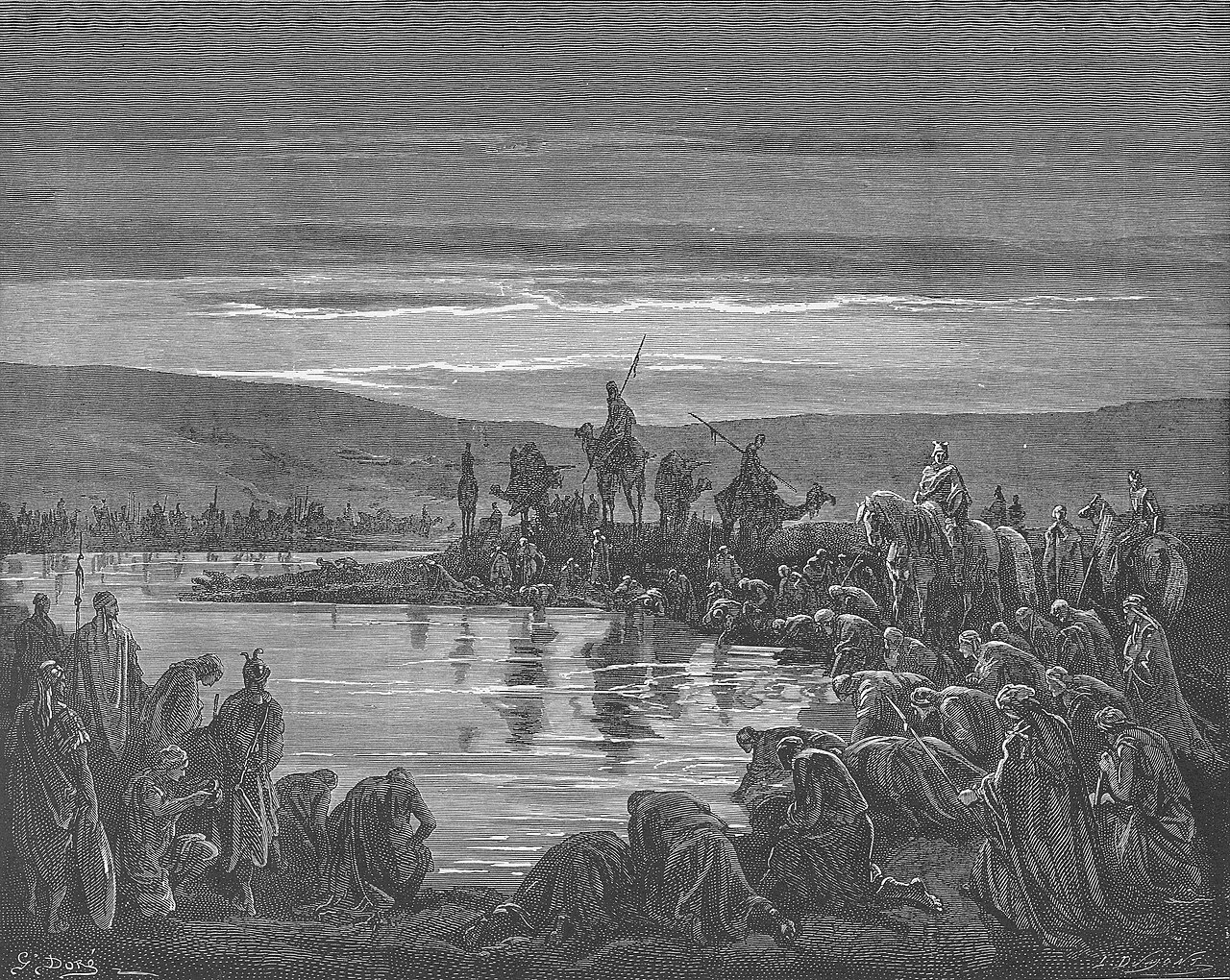
in Judges 7So Gideon brought the people down to the water, and the LORD said to him, “Separate those who lap the water with their tongues like a dog from those who kneel to drink.”
BSB
The same verse in ASV and KJV ▾
ASV
So he brought down the people unto the water: and Jehovah said unto Gideon, Every one that lappeth of the water with his tongue, as a dog lappeth, him shalt thou set by himself; likewise every one that boweth down upon his knees to drink.
KJV
So he brought down the people unto the water: and the Lord said unto Gideon, Every one that lappeth of the water with his tongue, as a dog lappeth, him shalt thou set by himself; likewise every one that boweth down upon his knees to drink.
⋯
This verse in Judges 7
Commentary
10 notes on this verseEvery one that lappeth of the water - as a dog - The original word ילק yalok is precisely the sound which a dog makes when he is drinking.
This site's exposition
There are still too many people
on Judges 7:4-6
Verse 2 has already given the reason for both tests, so the cutting down is the work itself, and the text never says what the drinking showed. Albert Barnes reads the lappers as watchful men with their eyes on the enemy, and John Gill finds it hard to tell whether the act showed weakness or courage. A third reading sees only a way of setting apart a number.
This site's exposition
lap the water with their tongues like a dog
Adam Clarke notes that the Hebrew verb for lapping imitates the sound a dog makes when it drinks. The LORD names the test, and Gideon's part is only to separate the two groups. The water does the sorting.
The record, by era
The Church Fathers3 voices
A commentator
Augustine of HippoEXPLANATIONS OF THE PSALMS 68.29 · Written in the 5th century.
proposed
Dogs are commendable, not abominable. They observe fidelity toward their master, and before his house they bark against enemies. He has not simply said "of dogs" but "of your dog." Nor are their teeth praised, but their tongue is: for it was not indeed to no purpose, not without a great mystery, that Gideon was bidden to lead those alone who should lap the water of the river like dogs. Of such sort not more than three hundred among so great a multitude were found. In this number is the sign of the cross because of the letter T [tau], which signifies three hundred in the Greek numeral characters.
Dogs should not always be taken in an evil sense; otherwise the prophet would not blame "dogs not able to bark and loving to dream." Doubtless they would be praiseworthy dogs if they both knew how to bark and loved to watch. And certainly those three hundred men—a most sacred number according to the letter of the cross10—would not have been chosen to win the victory because they lapped water as dogs do, unless some great mystery were signified. Good dogs watch and bark to protect their house and their master, their flock and their shepherd. Finally, even here in the praises offered by the church, when a selection is made from this prophecy, it is the tongue of dogs that is mentioned, not their teeth.
Limiting one's intake of water helps a great deal to obtain temperance. This was well understood by the three hundred Israelites accompanying Gideon just when they were preparing to attack Midian.
The Medieval Church2 voices
A commentator
Gregory the DialogistMorals on the Book of Job, Book 30.74 · Written before 604.
proposed
And they are brought to the river, to drink the waters; and whoever drank the waters with bended knees, were removed from the struggle of war. For by the waters is designated the doctrine of wisdom, but by the unbended knee righteous conduct. They therefore who are reported to have bent their knees, while drinking the water, retired from the strife of battles, having been forbidden; because Christ proceeds to battle against the enemies of the faith, with those who when they drink the streams of doctrine, distort not the uprightness of their actions.
A commentator
BonaventureCollations on the Hexaemeron, Collation 19 · Written in the 13th century.
proposed
This was marked in the case of Gedeon where those who were tested by the water, that is, those who lapped it like dogs, fought the battle and won, while those who bent their knee to drink were turned away. And those who had won …
2 more voices on this verse
The Puritans and the Awakening1 voice
So he brought them down to the water,....
The Nineteenth Century1 voice
A commentator
Jamieson, Fausset & Brown1802–1910
Commentary Critical and Explanatory on the Whole Bible (1871)
proposed
bring them down unto the water--When the wandering people in Asia, on a journey or in haste, come to water, they do not stoop down with deliberation on their knees, but only bend forward as much as is necessary to bring their hand in contact with the stream, and throw it up with rapidity, and at the same time such address, that they do not drop a particle.
quarantine:debris (2026-07-29) — starts-lowercase
The words behind it
27 Hebrew wordsEvery Hebrew word of this verse in the order it stands, with what it means and the door to its own study. The last column counts the times a word stands in the whole Bible: the rarer the word, the more the places it appears belong together.
| Hebrew | Sound | Meaning | Word study | In the Bible |
|---|---|---|---|---|
| וַיּ֥וֹרֶד | vaiyored | and he brought down | H3381 → | 381 times |
| אֶת־ | ʾet- | <obj.> | H853 → | 10935 times |
| הָעָ֖ם | haam | the people | H5971 → | 1873 times |
| אֶל־ | ʾel- | to | H413 → | 5510 times |
| הַמָּ֑יִם ס | hamayim | the water | H4325 → | 581 times |
| וַיֹּ֨אמֶר | vaiyomer | and he said | H559 → | 5305 times |
| יְהוָ֜ה | yahweh | Yahweh | H3068 → | 6520 times |
| אֶל־ | ʾel- | to | H413 → | 5510 times |
| גִּדְע֗וֹן | gidon | Gideon | H1439 → | 39 times |
| כֹּ֣ל | kol | every | H3605 → | 5413 times |
| אֲשֶׁר־ | ʾasher- | [one] who | H834 → | 5497 times |
| יָלֹק֩ | yalok | he will lap up | H3952 → | 7 times |
| בִּלְשׁוֹנ֨וֹ | bilshono | with tongue his | H3956 → | |
| מִן־ | min- | some of | H4480 → | 1188 times |
| הַמַּ֜יִם | hamayim | the water | H4325 → | 581 times |
| כַּאֲשֶׁ֧ר | kaasher | just as | H834 → | 5497 times |
| יָלֹ֣ק | yalok | it laps up | H3952 → | 7 times |
| הַכֶּ֗לֶב | hakelev | the dog | H3611 → | |
| תַּצִּ֤יג | tatzig | you will set | H3322 → | 16 times |
| אוֹתוֹ֙ | ʾoto | <obj.> him | H853 → | 10935 times |
| לְבָ֔ד | levad | <to> alone | H905 → | 200 times |
| וְכֹ֛ל | vekhol | and every | H3605 → | 5413 times |
| אֲשֶׁר־ | ʾasher- | [one] who | H834 → | 5497 times |
| יִכְרַ֥ע | yikhra' | he will bow down | H3766 → | 36 times |
| עַל־ | ʾal- | on | H5921 → | 5755 times |
| בִּרְכָּ֖יו | birkav | knees his | H1290 → | 25 times |
| לִשְׁתּֽוֹת׃ | lishtot | to drink | H8354 → | 217 times |
וַיּ֥וֹרֶדand he brought down
vaiyoredH3381 →381 times
אֶת־<obj.>
ʾet-H853 →10935 times
הָעָ֖םthe people
haamH5971 →1873 times
אֶל־to
ʾel-H413 →5510 times
הַמָּ֑יִם סthe water
hamayimH4325 →581 times
וַיֹּ֨אמֶרand he said
vaiyomerH559 →5305 times
יְהוָ֜הYahweh
yahwehH3068 →6520 times
אֶל־to
ʾel-H413 →5510 times
גִּדְע֗וֹןGideon
gidonH1439 →39 times
כֹּ֣לevery
kolH3605 →5413 times
אֲשֶׁר־[one] who
ʾasher-H834 →5497 times
יָלֹק֩he will lap up
yalokH3952 →7 times
בִּלְשׁוֹנ֨וֹwith tongue his
bilshonoH3956 →
מִן־some of
min-H4480 →1188 times
הַמַּ֜יִםthe water
hamayimH4325 →581 times
כַּאֲשֶׁ֧רjust as
kaasherH834 →5497 times
יָלֹ֣קit laps up
yalokH3952 →7 times
הַכֶּ֗לֶבthe dog
hakelevH3611 →
תַּצִּ֤יגyou will set
tatzigH3322 →16 times
אוֹתוֹ֙<obj.> him
ʾotoH853 →10935 times
לְבָ֔ד<to> alone
levadH905 →200 times
וְכֹ֛לand every
vekholH3605 →5413 times
אֲשֶׁר־[one] who
ʾasher-H834 →5497 times
יִכְרַ֥עhe will bow down
yikhra'H3766 →36 times
עַל־on
ʾal-H5921 →5755 times
בִּרְכָּ֖יוknees his
birkavH1290 →25 times
לִשְׁתּֽוֹת׃to drink
lishtotH8354 →217 times
A shaded row is a word that stands 400 times or fewer in the Bible.
Where this verse is studied
About Judges
Who and where
1 name in this verse with a page on the site.
This page draws on 10 works. Open the list of works
This page draws on Adam Clarke, Commentary on the Bible; Albert Barnes, Notes on the Old Testament; Augustine of Hippo, EXPLANATIONS OF THE PSALMS 68.29; Augustine of Hippo, LETTER 149; Bonaventure, Collations on the Hexaemeron, Collation 19; Evagrius Ponticus, PRAKTIKOS 17; Gregory the Dialogist, Morals on the Book of Job, Book 30.74; Jamieson, Fausset & Brown, Commentary Critical and Explanatory on the Whole Bible; John Gill, Exposition of the Old Testament and John Gill, Exposition of the Old Testament (1748-1763).