
Judges 7:3
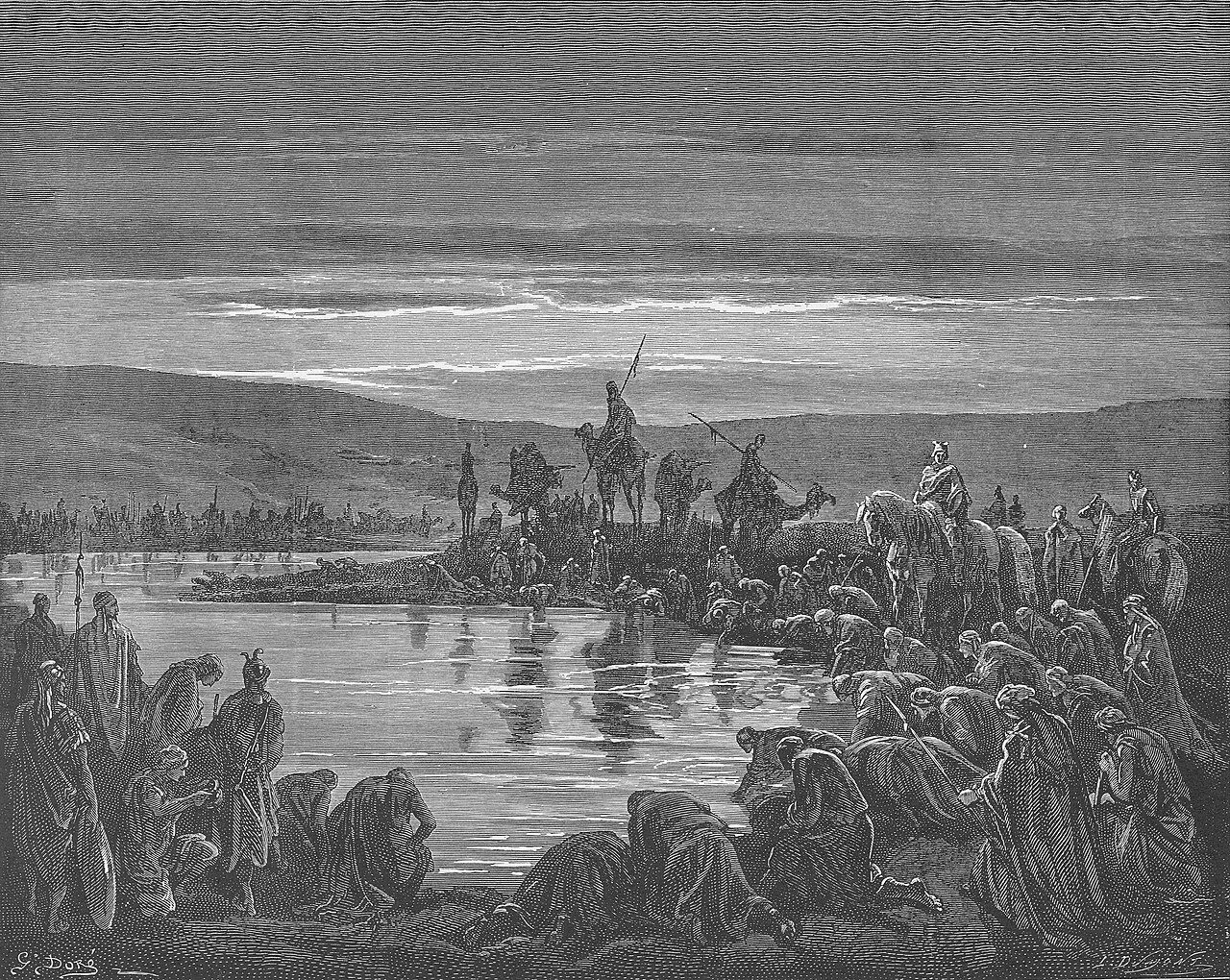
in Judges 7Now, therefore, proclaim in the hearing of the people: ‘Whoever is fearful and trembling may turn back and leave Mount Gilead.’” So twenty-two thousand of them turned back, but ten thousand remained.
BSB
The same verse in ASV and KJV ▾
ASV
Now therefore proclaim in the ears of the people, saying, Whosoever is fearful and trembling, let him return and depart from mount Gilead. And there returned of the people twenty and two thousand; and there remained ten thousand.
KJV
Now therefore go to, proclaim in the ears of the people, saying, Whosoever is fearful and afraid, let him return and depart early from mount Gilead. And there returned of the people twenty and two thousand; and there remained ten thousand.
⋯
This verse in Judges 7
Commentary
9 notes on this verseDoes not the leader of our army, the Lord and Savior Jesus Christ, call out now to his soldiers and say, Whoever is "fearful and anxious of heart," let him not come to war with me? For this is also what he says in the Gospels in other words but with the same meaning: "Whoever does not take his own cross and come after me is not worthy of me," and again: "Whoever does not renounce all that he has cannot be my disciple."
This site's exposition
camped beside the spring of Harod
on Judges 7:1-3
The name Jerubbaal sends Israel's leader into the field under a name that argues with Baal. Harod means trembling, and verse 3 sends home the "fearful and trembling", "twenty-two thousand of them". The proclamation carries out Deuteronomy 20:8, where the law told the officers to send the fearful home.
This site's exposition
Whoever is fearful and trembling
Albert Barnes notes that no Mount Gilead is known in this area. He records two answers: the reading may be Gilboa, or a proclamation form used in Manasseh. Origen of Alexandria applies the verse to Christ, who calls to war only those who will take up the cross.
The record, by era
The Puritans and the Awakening3 voices
) now took heart, when the worst was over, and were ready enough to divide the spoil, though backward to make the onset. Those also that might not fight though they had a mind to it, and were disbanded by order from God, did not as those, 2 Chron. xxv.
quarantine:debris (2026-07-29) — leading-punctuation+unbalanced-parens
Now therefore go to, proclaim in the ears of the people,....
Sin stared them in the face, and therefore they durst not look death in the face. Note, Fearful faint-hearted people are not fit to be employed for God; and, among those that are enlisted under the banner of Christ, there are more such than we think there are.
The Nineteenth Century2 voices
A commentator
Albert Barnes1798–1870
Notes, Explanatory and Practical, on the Old and New Testaments (1832-1869)
The proclamation was in accordance with the Law (see the marginal reference). No mountain of the name of Gilead is known in this locality, and it has been conjectured that the right reading is Gilboa. Others think that this may be a form of proclamation customary in Manasseh.
A commentator
Jamieson, Fausset & Brown1802–1910
Commentary Critical and Explanatory on the Whole Bible (1871)
Now therefore . . ., proclaim in the ears of the people, saying, Whosoever is fearful . . . let him return--This proclamation was in terms of an established law (De 20:8).
1 more voice on this verse
The Nineteenth Century1 voice
Whosoever is fearful and afraid, let him return - from Mount Gilead - Gideon was certainly not at Mount Gilead at this time, but rather near Mount Gilboa. Gilead was on the other side of Jordan. Calmet thinks there must either have been two Gileads, which does not from the Scripture appear to be the case, or that the Hebrew text is here corrupted, and that for Gilead we should read Gilboa. This reading, though adopted by Houbigant, is not countenanced by any MS., nor by any of the versions. Dr. Hales endeavors to reconcile the whole, by the supposition that there were in Gideon’s army many of the eastern Manassites, who came from Mount Gilead; and that these probably were more afraid of their neighbors, the Midianites, than the western tribes were; and therefore proposes to read the text thus: Whosoever from Mount Gilead is fearful and afraid, let him return (home) and depart early. So there returned (home) twenty-two thousand of the people. Perhaps this is on the whole the best method of solving this difficulty. There returned of the people twenty and two thousand - Gideon’s army was at this time thirty-two thousand strong, and after the above address twenty-two thousand went away. How astonishing, that in thirty-two thousand men there should be found not less than twenty-two thousand poltroons, who would neither fight for God nor their oppressed country! A state of slavery debases the mind of man, and renders it incapable of being influenced by the pure principles of patriotism or religion. In behalf of the army of Gideon we may say, if the best appointed armies in Europe had the same address, bona fide, from their generals as the Israelites had, at least an equal proportion would return home.
The words behind it
22 Hebrew wordsEvery Hebrew word of this verse in the order it stands, with what it means and the door to its own study. The last column counts the times a word stands in the whole Bible: the rarer the word, the more the places it appears belong together.
| Hebrew | Sound | Meaning | Word study | In the Bible |
|---|---|---|---|---|
| וְעַתָּ֗ה | veatah | and therefore | H6258 → | 433 times |
| קְרָ֨א | kera' | proclaim | H7121 → | 733 times |
| נָ֜א | na' | please | H4994 → | 404 times |
| בְּאָזְנֵ֤י | beazenei | in [the] ears of | H241 → | 187 times |
| הָעָם֙ | haam | the people | H5971 → | 1873 times |
| לֵאמֹ֔ר | lemor | <to> saying | H559 → | 5305 times |
| מִֽי־ | mi- | who? | H4310 → | 423 times |
| יָרֵ֣א | yare' | [is] fearful | H3373 → | |
| וְחָרֵ֔ד | vechared | and trembling | H2730 → | |
| יָשֹׁ֥ב | yasho | let him go back | H7725 → | 1056 times |
| וְיִצְפֹּ֖ר | veyitzpor | and he may go | H6852 → | |
| מֵהַ֣ר | mehar | from [the] mountain of | H2022 → | 546 times |
| הַגִּלְעָ֑ד | hagilad | <the> Gilead | H1568 → | 134 times |
| וַיָּ֣שָׁב | vaiyashov | and it returned | H7725 → | 1056 times |
| מִן־ | min- | of | H4480 → | 1188 times |
| הָעָ֗ם | haam | the people | H5971 → | 1873 times |
| עֶשְׂרִ֤ים | ʾesrim | twenty | H6242 → | 315 times |
| וּשְׁנַ֙יִם֙ | ushenayim | and two | H8147 → | 768 times |
| אֶ֔לֶף | ʾelef | thousand | H505 → | 505 times |
| וַעֲשֶׂ֥רֶת | vaaseret | and ten | H6235 → | 176 times |
| אֲלָפִ֖ים | ʾalafim | thousand<s> | H505 → | 505 times |
| נִשְׁאָֽרוּ׃ ס | nisharu | they remained | H7604 → | 133 times |
וְעַתָּ֗הand therefore
veatahH6258 →433 times
קְרָ֨אproclaim
kera'H7121 →733 times
נָ֜אplease
na'H4994 →404 times
בְּאָזְנֵ֤יin [the] ears of
beazeneiH241 →187 times
הָעָם֙the people
haamH5971 →1873 times
לֵאמֹ֔ר<to> saying
lemorH559 →5305 times
מִֽי־who?
mi-H4310 →423 times
יָרֵ֣א[is] fearful
yare'H3373 →
וְחָרֵ֔דand trembling
vecharedH2730 →
יָשֹׁ֥בlet him go back
yashoH7725 →1056 times
וְיִצְפֹּ֖רand he may go
veyitzporH6852 →
מֵהַ֣רfrom [the] mountain of
meharH2022 →546 times
הַגִּלְעָ֑ד<the> Gilead
hagiladH1568 →134 times
וַיָּ֣שָׁבand it returned
vaiyashovH7725 →1056 times
מִן־of
min-H4480 →1188 times
הָעָ֗םthe people
haamH5971 →1873 times
עֶשְׂרִ֤יםtwenty
ʾesrimH6242 →315 times
וּשְׁנַ֙יִם֙and two
ushenayimH8147 →768 times
אֶ֔לֶףthousand
ʾelefH505 →505 times
וַעֲשֶׂ֥רֶתand ten
vaaseretH6235 →176 times
אֲלָפִ֖יםthousand<s>
ʾalafimH505 →505 times
נִשְׁאָֽרוּ׃ סthey remained
nisharuH7604 →133 times
A shaded row is a word that stands 400 times or fewer in the Bible.
The walk
8 stopsEach card is a verse this one points to, and under it the verses that one points to in turn. Where several paths arrive at the same place, that place is listed first: the text keeps returning to it.
Through
Revelation 21:8But to the cowardly and unbelieving and abominable and murderers and sexually immoral and sorcerers and idolaters and all liars, their place will be in the lake that burns with fire and sulfur. This…
it leads to
- 1 Corinthians 6:9–10
Do you not know that the wicked will not inherit the kingdom of God? Do not be deceived: Neither the sexually immoral, nor idolaters, nor adulterers, nor men who submit to or perform homosexual…
- Revelation 2:11
He who has an ear, let him hear what the Spirit says to the churches. The one who overcomes will not be harmed by the second death.
- Ephesians 5:5–6
For of this you can be sure: No immoral, impure, or greedy person (that is, an idolater), has any inheritance in the kingdom of Christ and of God.
- Revelation 22:15
But outside are the dogs, the sorcerers, the sexually immoral, the murderers, the idolaters, and everyone who loves and practices falsehood.
- Revelation 20:14–15
Then Death and Hades were thrown into the lake of fire. This is the second death—the lake of fire.
- 1 Corinthians 6:9–10
Through
Matthew 20:16So the last will be first, and the first will be last.”
it leads to
- Matthew 22:14
For many are called, but few are chosen.”
Reached by 2 separate paths from here.
- Matthew 19:30
But many who are first will be last, and the last will be first.
- Matthew 22:14
Through
Revelation 17:14They will make war against the Lamb, and the Lamb will triumph over them, because He is Lord of lords and King of kings; and He will be accompanied by His called and chosen…
it leads to
- Romans 8:30
And those He predestined, He also called; those He called, He also justified; those He justified, He also glorified.
- Romans 8:30
Where this verse is studied
On this page
Studies6
On this verse
About Judges
This page draws on 9 works. Open the list of works
This page draws on Adam Clarke, Commentary on the Bible; Albert Barnes, Notes on the Old Testament; Albert Barnes, Notes, Explanatory and Practical, on the Old and New Testaments; Albert Barnes, Notes, Explanatory and Practical, on the Old and New Testaments (1832-1869); Jamieson, Fausset & Brown, Commentary Critical and Explanatory on the Whole Bible; John Gill, Exposition of the Old Testament (1748-1763); Keil and Delitzsch, Biblical Commentary on the Old Testament: Joshua, Judges, Ruth; Matthew Henry, Commentary on the Whole Bible and Origen of Alexandria, HOMILIES ON JUDGES 9.1.