
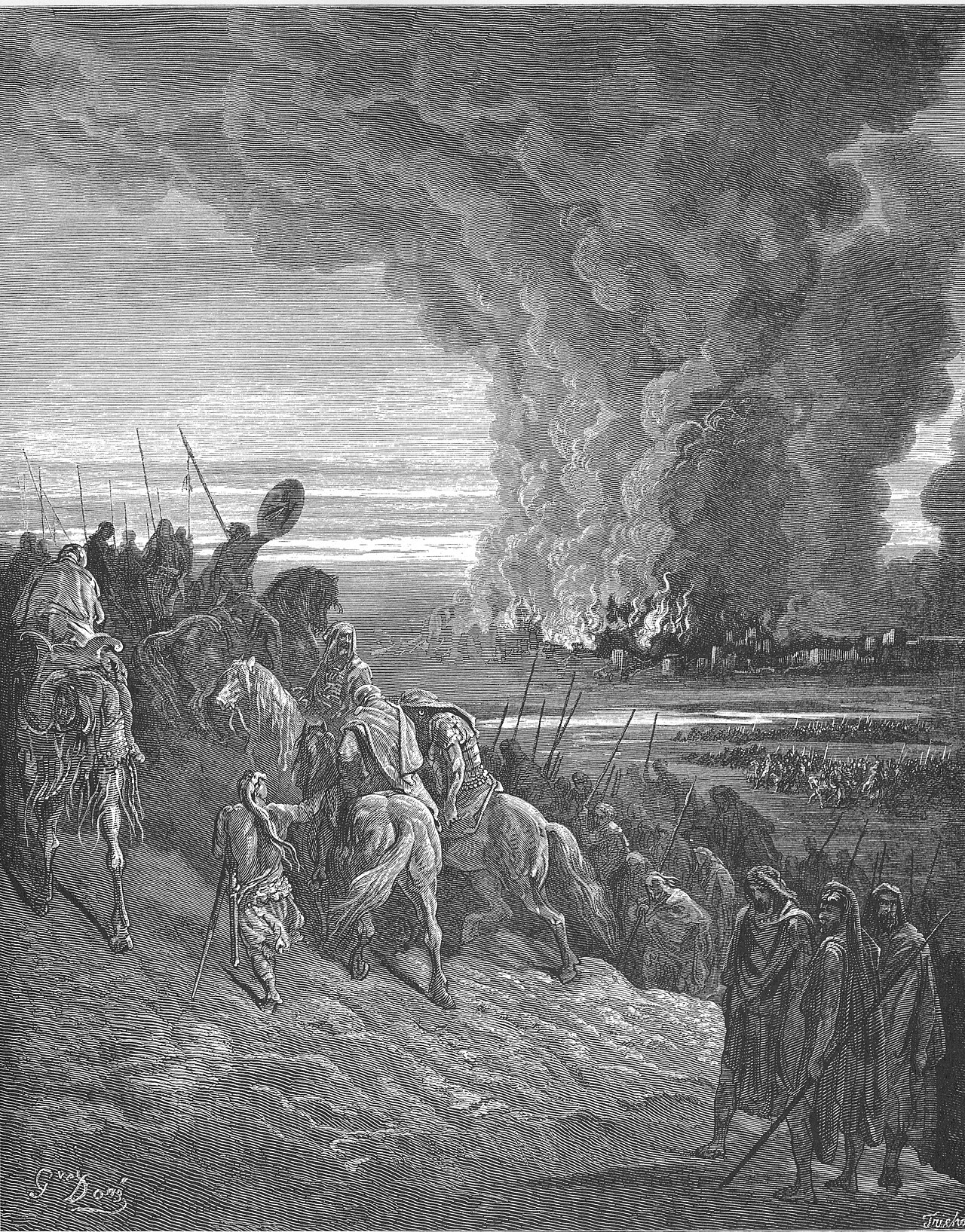
Joshuachapter 8
35 verses · Joshua, by tradition · 15th or 13th century BC · History
And the Lord said unto Joshua, Fear not, neither be thou dismayed: take all the people of war with thee, and arise, go up to Ai: see, I have given into thy hand the king of Ai, and his people, and his city, and his land:
Introduction
Joshua, by tradition, History, Joshua Overview.
This chapter turns defeat into victory and then moves from the battlefield to a mountain where the law is read aloud. It was written for a people who needed to see that restored obedience brought God's help back. The battle is told as a plan given by God, with every stage carried out in order. Listen for the words of encouragement God repeats from the book's first chapter. Notice the change in what the people may take from the city. The last scene gathers the whole nation, children and foreigners included, around the law.
Context
- Who
- An army given the tactic by God after its own plan had failed
- What
- The capture of Ai by an ambush that God prescribes, and the building of an altar and the reading of the law at Mount Ebal.
- Where
- Ai and the valley below it, then Mount Ebal and Mount Gerizim near Shechem.
- When
- Soon after the judgment on Achan, in the first year in the land.
- Why
- To show that Israel's restored obedience brought God's help back, and to bind the nation to the covenant inside the land.
Historical context
The chapter belongs to Joshua, to an ambush set behind the city and to the whole assembly at Shechem. The ambush is God's own instruction at verse 2, where the plan that failed was the one the spies proposed at 7:3.
Show the rest of the historical context, 6 more paragraphs
A first hearer knew the ground. Ai and Bethel stand about three miles apart, and Bethel empties itself into the field alongside Ai at verse 17. Adam Clarke takes it that the fighting strength of Bethel had already been moved into Ai as the stronger place to hold.
The spear held out at verse 18 is a signal. Adam Clarke takes it for a standard carrying a flag, which is what would make it readable to men lying a mile off behind a town. John Gill sets Joshua's steady arm beside Exodus 17:12, where Moses' hands were held up while Joshua fought Amalek below.
The body of the king comes down at sundown because Deuteronomy 21:22 to 23 requires it. Joshua does the same with five kings at 10:26 to 27, and Paul quotes that law at Galatians 3:13.
Where Ai stood is argued. Et-Tell is the long standing identification and was excavated by Joseph Callaway from 1964 to 1976, and it shows no occupation at all in the Late Bronze Age. Bryant Wood proposed nearby Khirbet el-Maqatir, excavated from 1995, and reported a small fortified Late Bronze site with a gate on the north. The site's published dossier states plainly that the identification is argued rather than settled and that the difficulty at et-Tell is real.
The altar at Ebal answers Deuteronomy 27:4 to 6 to the letter, whole stones with no iron lifted on them, which is the law of the altar at Exodus 20:25. Deuteronomy 27:2 and 27:4 had the stones plastered first, and writing on a plastered face is the Egyptian method the generation out of Egypt knew.
The ground is Shechem, where Abram built his first altar at Genesis 12:6 to 7 and where Jacob bought his field at Genesis 33:18 to 20. Adam Zertal excavated a structure on Mount Ebal from 1982 to 1989 and read it as this altar. Aharon Kempinski answered in Biblical Archaeology Review in 1986 that it is an Iron Age I watchtower.
Significance
The words God gives Joshua after the defeat are the words he had already given him before anything went wrong, at 1:9. The spoil is granted outright to the people here, and it is the same kind of goods Achan was stoned for taking one chapter earlier.
Show the rest of the significance, 2 more paragraphs
The ceremony at Ebal was the first covenant act inside the land, and Deuteronomy 11:29 and 27:11 to 26 had set it up. These two verses are the one place in Scripture that records it carried out.
Verse 35 lists who heard it, the women, the little ones and the strangers among them, which is exactly the assembly Deuteronomy 31:12 named for the reading of the law. The rule of Exodus 12:49 is kept in the first thing Israel does as a nation in Canaan.
This chapter in Jewish lifeWhat this chapter is in Jewish life and reading.
How it is read
The first thing the classical commentary marks in this chapter is the change in the rule about spoil. Rashi is quoted from the Metsudah Publications Book of Joshua of 1997, which Sefaria reports as CC-BY. On the permission given at the second verse he writes four words. "You shall no longer consecrate the spoils" (Rashi on Joshua 8:2:1). What Achan died for is now allowed, and the tradition says so without softening it.
The ambush is read as a piece of tactics, and Rashi works it closely. The word for drawing the defenders out he takes from the noun for a pocket, so the army is drawn out of the pocket of the city. He offers a second derivation from a verb for dragging away (Rashi on Joshua 8:6:1). The verb at the seventh verse he reads with the Targum as driving out (Rashi on Joshua 8:7:1). He fixes the geography, with Ai east of Bethel and the ambush west of Ai (Rashi on Joshua 8:9:1). The five thousand men of the twelfth verse are a second ambush, set nearer the city than the first (Rashi on Joshua 8:12:1). The Metsudah note beside him reports a reading of their task. They were to strike the men of Ai from behind while Joshua turned to face them. The spear stretched out at the eighteenth verse is the signal, given to the nearer party because the thirty thousand were too far off to see it (Rashi on Joshua 8:18:1).
Two small notes tell a Christian reader something about how the men of Ai are read. Rashi takes the appointed time of the fourteenth verse as an hour the men of Ai had fixed by astrology, "for they were sorcerers and diviners" (Rashi on Joshua 8:14:1). The feigned flight of the fifteenth verse he derives from a word for being struck, so Israel gave the appearance of men already beaten (Rashi on Joshua 8:15:1). The positioning of the thirteenth verse he illustrates from the siege language used of Ben-Hadad in the book of Kings (Rashi on Joshua 8:13:1). At the twentieth verse the word for hands means strength, and at the twenty-second the others who come out of the city are the ambush party that fired it (Rashi on Joshua 8:20:1 and 8:22:1). Joshua going up at the tenth verse is read as the leader doing what the rebuke of the chapter before required of him (Rashi on Joshua 8:10:1).
The altar on Mount Ebal is where the classical reading and the manuscripts both have something to say, and the two should be held apart. Rashi states his position at the thirtieth verse. "This parasha is not in chronoligical order" (Rashi on Joshua 8:30:1). He holds that the altar was built on the day Israel crossed the Jordan, and he reasons it from the next verse, which says the work was done as Moses had commanded. He also identifies these stones with the stones carried out of the riverbed in the fourth chapter. After the altar was built the whitewash was scraped off and the stones were brought to Gilgal (Rashi on Joshua 8:32:1). What was written on them is left open in the same note. Some hold it was Deuteronomy alone, which is itself called the copy of the law. Some hold it was the Ten Words as Deuteronomy records them. Most, Rashi reports, hold that the whole Torah was written from beginning to end. The Metsudah note carries a second dispute beside it, and names the tractate Sotah at 35 for it. Rabbi Judah has the writing done first and the whitewash laid over it. Rabbi Shimon has the whitewash laid first, so that the writing could be read. This site records separately that the Masoretic Text, the Septuagint and the Qumran scroll of Joshua place this ceremony at three different points in the account. That evidence stands with its holders named, at src/components/book/dossier-content/joshua.ts. The card states no position on the order.
The corpus carries ten further notes on this chapter without an English text. Five stand cited and unquoted at Radak on Joshua 8:8:1, 8:11:1, 8:16:1, 8:24:1 and 8:29:1. Three stand at Metzudat David on Joshua 8:1:1, 8:4:1 and 8:5:1, and two at Malbim on Joshua 8:3:1 and 8:31:1.
What the rabbis say
The corpus carries forty rabbinic locators on this chapter and the text of none, so each is cited and linked here rather than quoted. On the first verse it holds Megillah 10b:6 and Midrash Tannaim on Deuteronomy 20:1:15. On the second, the spoil now permitted, it holds Sanhedrin 44a:18, Ein Yaakov, Sanhedrin 6:6 and Ein Yaakov (Glick Edition), Sanhedrin 6:7. On the third it holds Midrash Tanchuma, Tetzaveh 9:2.
The ambush draws a run through two tractates. On the ninth verse the corpus holds Ein Yaakov (Glick Edition), Eiruvin 6:2, and on the tenth the third chapter of the book of Joshua in Sefer HaYashar. On the thirteenth, the night Joshua spent in the valley, it holds Megillah 3a:21, Sanhedrin 44b:2, Eruvin 63b:5, Ein Yaakov, Megillah 1:4 and Ein Yaakov (Glick Edition), Megillah 1:4.
The burning of the city carries the next set. On the seventeenth verse the corpus holds Shir HaShirim Rabbah 4:8:3, and on the eighteenth Shemot Rabbah 38:4. On the twentieth it holds Midrash Lekach Tov, Numbers 8:2:3, on the twenty-first Jerusalem Talmud Sotah 7:5:6, and on the twenty-second Midrash Tanchuma, Shemot 29:1. On the twenty-fourth it holds an entry from the Introductions to Tanaitic Literature on Sifrei Numbers 354.
The ceremony at Ebal is the most heavily worked passage in the chapter, and the tractate Sotah carries most of it. On the thirtieth verse the corpus holds Jerusalem Talmud Sotah 7:3:2 and Jerusalem Talmud Megillah 1:12:2. Beside them stand Bamidbar Rabbah 14:1 and Midrash Lekach Tov on Lamentations 1:1:3, with Ein Yaakov, Sanhedrin 11:10 and Shabbat 5:14, and the Glick Edition at Sanhedrin 11:13 and Shabbat 5:9. On the thirty-first, the altar of unhewn stones, it holds Mekhilta DeRabbi Shimon Ben Yochai 20:21 and Yalkut Shimoni on Torah 878:2. On the thirty-third, the people standing half against each mountain, it holds Bamidbar Rabbah 19:9, Jerusalem Talmud Sotah 7:4:1, 7:4:2 and 7:4:8, Ein Yaakov, Sotah 7:19, and the Glick Edition at Sotah 7:18 and 7:19. On the thirty-fourth, the reading of the blessing and the curse, it holds Jerusalem Talmud Sotah 7:2:1, 7:3:1 and 7:4:3. On the thirty-fifth it holds Jerusalem Talmud Sotah 7:5:1. What each of them teaches is a saying of the rabbis, and is reported as theirs wherever this site quotes one. The quotations wait on a fetch that carries the text.
Sources: Rashi, Rashi on Joshua 8:2:1 to 8:32:1, the Book of Joshua, Metsudah Publications, 1997, reported CC-BY; Targum Jonathan, the rendering of the verb at Joshua 8:7 as driving out, as Rashi reports it at Rashi on Joshua 8:7:1; Rabbi Judah and Rabbi Shimon, the dispute over the whitewash and the writing on the stones, reported with the tractate Sotah at 35 in the Metsudah edition's note at Rashi on Joshua 8:32:1; Radak, Radak on Joshua 8:8:1, 8:11:1, 8:16:1, 8:24:1 and 8:29:1, cited by ref because the corpus carries no English text; Metzudat David, Metzudat David on Joshua 8:1:1, 8:4:1 and 8:5:1, cited by ref because the corpus carries no English text; Malbim, Malbim on Joshua 8:3:1 and 8:31:1, cited by ref because the corpus carries no English text; The Sefaria corpus, scripts/data/sources/sefaria/joshua/8.json, the 40 Talmud and Midrash locators of this chapter; The site's own files, src/components/book/dossier-content/joshua.ts, the manuscripts section on the three places the Ebal account stands in the Masoretic Text, the Septuagint and 4QJoshua-a.
The heads below are this chapter's scenes. The numbered points under each are its verses.
An ambush set behind the city
Joshua 8:1-2
After the defeat God gives Joshua the words of 1:9 again, “Do not be afraid or discouraged”. The ambush of verse 2 is God’s own instruction, where the plan that failed at 7:3 was the spies’. The plunder and livestock are granted to the people here, the same kind of goods Achan was stoned for taking from Jericho.
Joshua 8:1
“The first place, however, is due to the promise, Fear not, for I have delivered it into thy hands: for although it is verbally directed to Joshua, it belongs in common to the whole people, as it was most necessary that all to a man should be freed from anxiety and furnished with new confidence.”
John Calvin · Commentaries (1554)reformed
1 more voice on this verseWhat preachers and commentators have said about this verse, in their own words.
Joshua 8:1
“God rouses Joshua from his dejection Jos 7:6, and bids him lmarch against Ai with the main body. Though Ai was but a small city (compare Jos 8:25 and Jos 7:3), yet the discouragement of the people rendered it inexpedient to send a second time a mere detachment against it; and the people of Ai had, as appears from Jos 8:17, help from Bethel, and possibly from other places also. It was fitting too that all the people should witness with their own eyes the happy consequences of having faithfully put away the sin which had separated them from God.”
John Wesley reads the order to treat Ai as Jericho was treated as meant to restore the dread of Israel that the first defeat at Ai had weakened among the Canaanites. Some have questioned whether an ambush is lawful. John Gill answers that the Lord appointed this one himself, so the question has no room here.
Joshua 8:2
“And thou shalt do to Ai and her king as thou didst to Jericho and her king,.... Burn the one and slay the other: only the spoil thereof, and the cattle thereof, shall ye take for a prey unto yourselves; which they were not allowed to do at Jericho: lay thee an ambush for the city behind it; at the west side of it: some have called in question the lawfulness of the ambush, but, as this was appointed by the Lord, there is no room for it.”
Joshua 8:3-4
Verse 3 sends 30,000 men and verse 12 sets 5,000 in the same place, and the difference is read three ways. Barnes suspects a copyist’s error in the number, and Henry takes verse 12 as the account doubling back on one ambush of five thousand. Others read a main force with a smaller detachment drawn from it, and the chapter records both figures without reconciling them.
Joshua 8:3
“Thirty thousand men - comparing Jos 8:3 and Jos 8:12 (“five thousand men”), there is probably a mistake in the numbers of this verse, where an early copyist may have written the sign for 30,000 instead of that for 5,000. Sent them away by night - The selected 5,000 would accordingly post themselves in the main ravine between Ai and Bethel in the night and early morning.”
1 more voice on this verse
Joshua 8:3
“Out of this number a detachment of five thousand was sent forward to conceal themselves in the immediate precincts of the town, in order to seize the first opportunity of throwing themselves into it [Jos 8:12].”
Jamieson, Fausset & Brown · Commentary Critical and Explanatory on the Whole Bible (1871)reformed
Behind the city means its west side, as verse 9 later states. John Gill explains the order to stay close. The ambush had to be near enough to enter the town as soon as its fighting men were drawn out eastward to meet the army of Israel.
Joshua 8:4
“And he commanded them, saying,.... At the time he sent them away: behold, ye shall lie in wait against the city, even behind the city; that is, on the west side of it, Jos 8:9, go not very far from the city, but be ye all ready; to enter into it, as soon as the forces are drawn out eastward to meet the army of Israel.”
Joshua 8:5-8
Joshua tells the men what will happen before it happens, and the enemy’s expected words, “as they did before”, rest on the thirty-six killed at 7:5. The men of Ai have a real victory behind them and will believe a second flight. Verse 8 puts the whole plan under the command of the LORD, the ground Joshua was given in verse 2.
Matthew Henry reads the victory Ai won at 7:5 through Isaiah 10, where Assyria is the rod God uses to correct his own people. Ai had served that purpose for one day. Once the correction was over, Henry says, the rod itself was thrown into the fire, though its men had meant only to destroy Israel.
Joshua 8:6
“God had made use of them only for the rebuking of Israel, with a purpose, when the correction was over, to throw the rod itself into the fire; howbeit, they meant not so, but it was in their heart to destroy and cut off, Isa. x.”
Matthew Henry · Commentary on the Whole Bible (1707-1721)puritan
The ambush is to rise at the signal Joshua gives in verse 18, and John Gill adds a lookout posted to watch the flight from a distance. Joshua speaks of the outcome as certain. Gill grounds that confidence in the promise of verse 1, where the city was already given into his hand.
Joshua 8:7
“Then ye shall rise up from the ambush,.... When they should see a signal made, that in Jos 8:18; and when their watch, they might set in a proper place, should see Israel flee, and the men of Ai at a distance from their city, pursuing, and give notice of it to the ambush: and seize upon the city; enter into it, and take possession of it, its fortresses, and secure its passes: for the Lord your God will deliver it into your hand; Joshua expresses himself with great confidence, having the promise of God, and relying on it.”
Adam Clarke reads this as a signal fire for its smoke. The spoil was to be divided among the people, and burning the whole town at this point would have destroyed it. The full burning of Ai comes at verse 28, after the plunder had been taken.
Joshua 8:8
“Ye shall set the city on fire - Probably this means no more than that they should kindle a fire in the city, the smoke of which should be an indication that they had taken it. For as the spoils of the city were to be divided among the people, had they at this time set fire to the city itself, all the property must have been consumed, for the five thousand men did not wait to save any thing, as they immediately issued out to attack the men of Ai in the rear.”
Adam Clarke · Commentary on the Bible (1810-1826)evangelical
Joshua 8:9-11
The whole army goes up this time, where the spies at 7:3 had said two or three thousand would do. Joshua spends the night among the people and musters them at first light, and Clarke marks the word at verse 10 as the one for inspecting a rank. The valley named in verse 11 lies between the camp and the town, and Joshua goes down into it at verse 13.
the elders of Israel: The elders march at the head of the people. John Gill gives two readings of who they were: the seventy who served Joshua as a council, or officers leading their own companies. Albert Barnes puts the march from Gilgal to Ai at about fifteen miles.
Joshua 8:10
“Numbered the people - ויפקד את העם vaiyiphkod eth haam, he visited the people - inspected their ranks to see whether every thing was in perfect readiness, that in case they should be needed they might be led on to the attack.”
Adam Clarke · Commentary on the Bible (1810-1826)evangelical
The main army camps north of Ai with the valley between, and verse 12 sets the ambush on the west. John Gill places the ambush on that side of the town. The pursuit of verse 15 runs the other way, toward the wilderness, so the men of Ai are drawn away from the side where the ambush waits.
Joshua 8:12-13
about five thousand men: Joshua goes into the valley while it is still night, so at daylight the king of Ai sees one body of men and neither the ambush behind his city nor the host to the north. Barnes reads the king’s mistake from that, taking the men in the valley for a detachment like the one he had beaten. Jamieson, Fausset and Brown identify the ravine with the wady below the tell.
Joshua 8:12
“That we - I and the twenty five thousand with me. Sent them - The same party. Among the people - Hebrew. that people, the people of war as they are called, ver. 11, that is, the main body of the host consisting of thirty thousand.”
John Wesley · Explanatory Notes upon the Old Testament (1765)evangelical
1 more voice on this verse
Joshua 8:12
“If we admit such a seeming disturbance in the order of the narrative (of which, perhaps, similar instances might be cited from the other scripture histories), it seems most probable that there was but one ambushment, which consisted only of 5000, enough for such a purpose.”
Matthew Henry · Commentary on the Whole Bible (1707-1721)puritan
The purpose of this night descent is read two ways. Matthew Henry takes it as going to set the troops in order for the attack. He also records the conjecture of Bishop Patrick that Joshua went into the valley alone to pray for a blessing on the enterprise.
Joshua 8:13
“Joshua went down by night into the valley where He would be seen at daylight by the men of Ai, and was accompanied no doubt by a picked body of troops. The king of Ai, in the morning, would see neither the ambush in his rear, nor the whole of the great host of Israel among the hills away to the north on his left; but supposing, as it appears, that the Israelites before him were a body detached as on the former occasion to assail his city, he sallied out promptly to attack them.”
1 more voice on this verse
Joshua 8:13
“Joshua himself took up his position on the north side of "the ravine"--the deep chasm of the wady El-Murogede; "that night"--means, while it was dark, probably after midnight, or very early in the morning (Joh 20:1).”
Jamieson, Fausset & Brown · Commentary Critical and Explanatory on the Whole Bible (1871)reformed
Ai burned, its king hanged on a tree
Joshua 8:14-15
the king of Ai saw: The king moves fast and early, and the verse says so twice. Barnes reads the appointed time as an appointed place, ground fixed beforehand, which suits a king who had fought on that field before. Then comes the clause the chapter turns on, that he did not know of the ambush behind the city, the one thing in the account he does not know.
Joshua 8:14
“At a time appointed - Rather, “at the place appointed,” i. e. some spot suitable for the drawing up of his men, which had been assigned beforehand. This was “before the plain,” i. e. it was at the entrance of the depressed tract of land which runs down to the Jordan valley, up which lay the route of the Israelites from Gilgal to Ai.”
The flight goes toward the wilderness, which John Gill, following Kimchi, takes as pasture land for cattle. He suggests it may be the wilderness of Beth-aven at 18:12. John Wesley places it between Ai and Jericho.
Joshua 8:15
“And Joshua and all Israel made as if they were beaten before them,.... Or smitten, as some of them might be in the pursuit: and fled by the way of the wilderness; not a barren desert, but, according to Kimchi and Ben Melech, a place for the pasture of cattle; though perhaps it is the same with the wilderness of Bethaven, Jos 18:12. Epiphanius (w) makes mention of the wilderness of Bethel and Ephraim as near Jericho. (w) Contr. Haeres. l. 1. tom. 2.”
Joshua 8:16-17
Bethel empties itself into the field with Ai, the two towns about three miles apart, and Clarke takes it that Bethel’s fighting men had already moved into Ai. This chapter never records Bethel taken. Its king is listed among the defeated at 12:16, and Judges 1:22-25 tells of the house of Joseph taking the town later.
Joshua 8:16
“All the people - Namely, all that were able to bear arms, for old men and children were unfit for the pursuit or fight; and that they were yet left, may seem from ver. 24, 25.”
John Wesley · Explanatory Notes upon the Old Testament (1765)evangelical
The words or Bethel are missing from the Septuagint. Jamieson, Fausset and Brown record that some eminent scholars reject them as a later addition to the text. John Wesley reads not a man as every man fit for war, which leaves in the town only those unfit for war.
Joshua 8:17
“There was not a man left in Ai or Beth-el - It is very likely that the principal strength of Beth-el had been previously brought into Ai, as the strongest place to make a stand in; Beth-el being but about three miles distant from Ai, and probably not greatly fortified. Therefore Ai contained on this occasion all the men of Beth-el - all the warriors of that city, as well as its own troops and inhabitants.”
Adam Clarke · Commentary on the Bible (1810-1826)evangelical
1 more voice on this verse
Joshua 8:17
“It may be remarked, however, that the words, "or Beth-el," are not in the Septuagint, and are rejected by some eminent scholars, as an interpolation not found in the most ancient manuscripts.”
Jamieson, Fausset & Brown · Commentary Critical and Explanatory on the Whole Bible (1871)reformed
Joshua 8:18-19
The gesture is commanded before it is made, with the promise “into your hand I will deliver the city” attached. Clarke takes the lance as a standard with a flag, readable to men lying a mile off behind the town. Behind it stands Exodus 17:11, where Israel prevailed while Moses held up his hand, and the man fighting in the valley that day was Joshua.
Joshua 8:18
“Stretch out the spear - It is very probable that Joshua had a flag or ensign at the end of his spear, which might be easily seen at a considerable distance; and that the unfurling or waving of this was the sign agreed on between him and the ambush. (see Jos 8:13, and the preceding observations on Jos 8:1 (note), observation 6); and on seeing this flag or ensign unfurled, the men who lay in ambush arose and entered the city, making the fire previously agreed on. See Jos 8:8.”
Adam Clarke · Commentary on the Bible (1810-1826)evangelical
1 more voice on this verse
Joshua 8:18
“Stretch out the spear - This was, either, 1. for a sign to his host present with him, to stop their flight, and make head against the pursuers: or, 2. for a signal to the liers in wait, or, 3. as a token of God's presence and assistance with them, and of their victory.”
John Wesley · Explanatory Notes upon the Old Testament (1765)evangelical
The verse moves at speed. Adam Clarke refers this fire back to his reading at verse 8, a fire lit to be seen. The five thousand could not stop to plunder, he says, since they had to come out at once against the men of Ai.
Joshua 8:19
“Set the city on fire - See on Jos 8:8 (note).”
Adam Clarke · Commentary on the Bible (1810-1826)evangelical
Joshua 8:20-22
Israel runs this tactic against Benjamin at Gibeah in Judges 20, with an ambush, a feigned flight and a signal of smoke, and at Judges 20:40 the Benjamites look back to see the city burning. The tactic God prescribes here against a Canaanite city is turned on an Israelite tribe two books later. The men of Ai are caught between the two forces and “could not escape in any direction”.
Joshua 8:20
“They had no power to flee this way or that way - They were in utter consternation; they saw that the city was taken, they found themselves in the midst of their foes; that their wives, children, and property, had fallen a prey to their enemies, in consequence of which they were so utterly panic-struck as to be incapable of making any resistance.”
Adam Clarke · Commentary on the Bible (1810-1826)evangelical
Israel reads the capture from the smoke, which John Gill pictures rising in large columns. Gill notes that the verse can open with for rather than when, as Junius, Tremellius and Piscator render it. Read that way, it explains the turn in verse 20.
No quarter was given, and John Gill notes the one exception. The king of Ai was kept alive, as the next verse records, and brought to Joshua. His sentence waits until verse 29, where he is hanged and then buried under a heap of stones at the city gate.
Joshua 8:22
“And the other issued out of the city against them,.... That is, the ambush, or at least a part of them: so that they were in the midst of Israel, some on this side, and some on that side; or, as we commonly say, they were between two fires, the ambush on one side, the army of Israel on the other: and they smote them, so that they let none of them remain or escape; not one was saved alive, excepting their king, as in Jos 8:23; no quarter was given them, nor any suffered to make their escape.”
1 more voice on this verse
Joshua 8:22
“You will read in the Holy Scriptures about the battles of the just ones, about the slaughter and carnage of murderers, and that the saints spare none of their deeply rooted enemies. If they do spare them, they are even charged with sin, just as Saul was charged because he had preserved the life of Agag king of Amalek. You should understand the wars of the just by the method I set forth above, that these wars are waged by them against sin. But how will the just ones endure if they reserve even a little bit of sin?”
Origen of Alexandria · written before 253 · HOMILIES ON JOSHUA 8.7patristic
Joshua 8:23-25
Twelve thousand is the whole population, men and women counted together, so the spies at 7:3 were right that the town was small. What they had wrong was what the size of a town had to do with the outcome, since the defeat came from the accursed thing named at 7:11. Clarke reads verse 24 of those left inside, the women and children and old men, since the fighting strength had gone out after Israel.
Joshua 8:23
“And the king of Ai they took alive,.... They spared him, and reserved him for a more shameful death: and brought him to Joshua; their general; delivering him into his hands as his prisoner, to do will, him as seemed good in his sight.”
Matthew Henry reads the killing at Ai as a sentence God had already passed on its wickedness, with Israel acting as the ministers of his justice. The verse records two stages. Israel finishes the men in the field first, and only then returns to the town.
Joshua 8:24
“Returned unto Ai, and smote it with the edge of the sword. - This must refer to the women, children, and old persons, left behind; for it is likely that all the effective men had sallied out when they imagined the Israelites had fled. See Jos 8:16.”
Adam Clarke · Commentary on the Bible (1810-1826)evangelical
John Gill divides the twelve thousand between those killed in the field and those killed in the town, by the army and the ambush together. Adam Clarke's reading of verse 17 bears on the figure. If the fighting men of Bethel had been gathered inside Ai, the dead of that day included them.
Joshua 8:25
“And so it was, that all that fell that day,.... Partly in the city, and partly in the field, both by the ambush and the army: both of men and women: were twelve thousand, even all the men of Ai; so that the city was not a very large one, and the numbers of inhabitants were comparatively but few, as in Jos 7:3.”
Joshua 8:26-27
Joshua holds out the lance until the work is done, and Gill sets it beside Exodus 17:12, where Moses’ hands stayed steady while Joshua fought Amalek below. The younger man now holds the posture once held over him. Verse 27 notes the plunder taken “as the LORD had commanded Joshua”, because a man had taken plunder without that word one chapter earlier.
Joshua 8:26
“For Joshua drew not his hand back wherewith he stretched out his spear,.... But continued it, and that stretched out: until he had utterly destroyed all the inhabitants of Ai; just as the hand of Moses was held up, and kept held up until Amalek was discomfited by Joshua, Exo 17:12.”
1 more voice on this verse
Joshua 8:26
“Joshua drew not his hand back - He was not only the general, but the standard-bearer or ensign of his own army, and continued in this employment during the whole of the battle. See on Jos 8:18 (note). Some commentators understand this and Jos 8:18 figuratively, as if they implied that Joshua continued in prayer to God for the success of his troops; nor did he cease till the armies of Ai were annihilated, and the city taken and destroyed.”
Adam Clarke · Commentary on the Bible (1810-1826)evangelical
Matthew Henry sets this spoil beside the goods Israel carried out of Egypt at Exodus 12:35-36, much of which went into the tabernacle in the wilderness. Ai repays that outlay with interest, in his reading. He cites Proverbs 13:22, on the wealth of the sinner stored up for the righteous.
Joshua 8:27
“Only the cattle and the spoil - In the case of Jericho these were all consigned to destruction, and therefore it was criminal to take any thing pertaining to the city, as we have already seen; but in the case before us the cattle and spoils were expressly given to the conquerors by the order of God. See Jos 8:2.”
Adam Clarke · Commentary on the Bible (1810-1826)evangelical
The name Ai means a ruin or heap, so the verse leaves the place as its name already called it. Its site is disputed: et-Tell is the long-standing identification, pressed by the absence of a Late Bronze town there, while Bryant Wood and the excavators of Khirbet el-Maqatir argue for that site. Jamieson, Fausset and Brown record that the tell’s local name in their day was the heap of stones.
Joshua 8:28
“Joshua burnt Ai, and made it an heap for ever--"For ever" often signifies "a long time" (Ge 6:3). One of the remarkable things with regard to the tell we have identified with Ai is its name--the tell of the heap of stones--a name which to this day remains [VAN DE VELDE].”
Jamieson, Fausset & Brown · Commentary Critical and Explanatory on the Whole Bible (1871)reformed
1 more voice on this verse
Joshua 8:28
“And, though there was no curse entailed upon him that should rebuild it, yet, it seems, it was not rebuilt unless it be the same with Aijah, which we read of, long after, Neh. xi. Some think it was not rebuilt because Israel had received a defeat before it, the remembrance of which should be buried in the ruins of the city.”
Matthew Henry · Commentary on the Whole Bible (1707-1721)puritan
The body comes down at sunset because Deuteronomy 21:22-23 requires it, and Joshua does the same with five kings at 10:26-27. The pile of rocks over him is the second in the book, after Achan’s at 7:26. Paul quotes that law at Galatians 3:13, of everyone hung on a tree, and reads it of the cross.
Joshua 8:29
“An immense cairn was raised over his grave--an ancient usage, still existing in the East, whereby is marked the sepulchre of persons whose memory is infamous.”
Jamieson, Fausset & Brown · Commentary Critical and Explanatory on the Whole Bible (1871)reformed
The law read aloud between Ebal and Gerizim
Joshua 8:30-31
Ebal stands at Shechem, about twenty miles north of Ai through country not yet taken, and the text gives no account of the march. The altar answers Deuteronomy 27:4-6, “an altar of uncut stones on which no iron tool has been used”, the law of Exodus 20:25. The Samaritan Pentateuch reads Gerizim for Ebal at Deuteronomy 27:4, the ground of the Samaritan claim the woman raises at John 4:20.
Joshua 8:30
“The account of this solemnity is very brief. An acquaintance with Deut. 27 is evidently presupposed; and the three several acts of which the solemnity consisted are only so far distinctly named as is necessary to show that the commands of Moses there given were fully carried out by Joshua. It is difficult to escape the conviction that these verses are here out of their proper and original place.”
burnt offerings: Deuteronomy 27:6-7 had ordered both kinds of offering. John Gill reads them as thanks for the good land Israel had been brought into. Matthew Henry sees the whole act at Ebal as a renewal of the covenant on first taking possession, so that Israel would know on what terms it held the land.
Joshua 8:31
“As Moses the servant of the Lord commanded the children of Israel, as it is written in the book of the law of Moses,.... Deu 27:5, an altar of whole stones, on which no man hath lift up any iron; See Gill on Exo 20:25; see Gill on Deu 27:5, and; see Gill on Deu 27:6, and they offered thereon burnt offerings unto the Lord, and sacrificed peace offerings; by way of thanksgiving for the good land they were introduced into, and this was what they were ordered to do by Moses, Deu 27:6.”
1 more voice on this verse
Joshua 8:31
“I myself think that perhaps the holy apostles are able to be such whole and undefiled stones, making one altar all together on account of their unanimity and concord. For thus "praying unanimously" and opening their mouths all together, they are reported to have said, "You, Lord, you who know the hearts of all." Therefore, those of one mind who were able to pray with one voice and one spirit, they are perhaps the worthy ones who all together ought to build one altar, upon which Jesus may offer sacrifices to the Father.”
Origen of Alexandria · written before 253 · HOMILIES ON JOSHUA 9.2patristic
a copy of the law: What was written on the stones is read three ways, the ten commandments, the blessings and curses of Deuteronomy 27 and 28, or the whole law, and the verse settles none of them. Deuteronomy 27:2 and 27:4 had the stones coated with plaster, the Egyptian method that generation knew. The word for the copy is the one Deuteronomy 17:18 uses of the book a king was to write out.
Joshua 8:32
“A copy of the law of Moses - משנה תורת mishneh torath, the repetition of the law; that is, a copy of the blessings and curses, as commanded by Moses; not a copy of the Decalogue, as some imagine, nor of the book of Deuteronomy, as others think; much less of the whole Pentateuch; but merely of that part which contained the blessings and curses, and which was to be read on this solemn occasion. See the note on Deu 27:3.”
Adam Clarke · Commentary on the Bible (1810-1826)evangelical
1 more voice on this verse
Joshua 8:32
“Upon the stones - Not upon the stones of the altar, which were to be rough and unpolished, ver. 31, but upon other stones, smooth and plaistered, as is manifest from Deut. xxvii, 2.”
John Wesley · Explanatory Notes upon the Old Testament (1765)evangelical
The tribes stand as Deuteronomy 27:12-13 assigned them, half before Gerizim and half before Ebal, with the ark between. The foreigner stands beside the citizen, the rule of Exodus 12:49 kept in the first covenant act inside the land. The ground is Shechem, where Abram built his first altar in Genesis 12:6-7, Jacob bought his field in Genesis 33:18-20, and Joseph’s bones are buried at 24:32.
Joshua 8:33
“All Israel - That is, the whole congregation, old and young, male and female. That side - Some on one side of it, and some on the other. Mount Gerizim - These two places were in the tribe of Ephraim, not far from Shechem, as appears both from scripture, and from other authors.”
John Wesley · Explanatory Notes upon the Old Testament (1765)evangelical
Joshua 8:34-35
Deuteronomy 11:29 and 27:11-26 set this ceremony up, and these verses are the one place Scripture records it carried out. The hearers include “the women, the little ones, and the foreigners who lived among them”, the assembly Deuteronomy 31:12 named for the reading of the law. The passage stands after 9:2 in the Greek and earlier in one Qumran scroll, which differ on its place only.
Joshua 8:34
“Afterward - After the altar was built, and the stones plaistered and writ upon. He read - That is, he commanded the priests or Levites to read, Deut. xxvii, 14.”
John Wesley · Explanatory Notes upon the Old Testament (1765)evangelical
There was not a word: John Wesley takes this verse to mean that Joshua read the whole law, more than the blessings and curses alone. Matthew Henry notes that Moses had preached Deuteronomy to them only weeks before, and that it is good to hear twice what God has spoken once, from Psalm 62:11. Joshua read it all again.
Joshua 8:35
“Read not - Therefore he read not the blessings and curses only, as some think, but the whole law, as the manner was when all Israel, men and women, were assembled together, or the ten commandments.”
John Wesley · Explanatory Notes upon the Old Testament (1765)evangelical
How this psalm is built
The form: A battle account by ambush, followed by a covenant ceremony that belongs with Deuteronomy 27 rather than with the campaign, as Keil and Delitzsch classes it.
The patterns in this chapter
| Device | What it does | Where to see it |
|---|---|---|
| As at the first | The phrase falls twice in two verses as Joshua tells the men what will happen before it happens. The thirty-six who died at 7:5 are what makes the feint work. Verse 8 puts the whole of it under the commandment of the LORD, which is Joshua standing on the ground he was given at verse 2 rather than on his own judgment.John Gill and Keil and Delitzsch, Exposition of the Old Testament, 1748 to 1763, and Biblical Commentary on the Old Testament: Joshua, Judges, Ruth, 1863, cited in the site's published exposition of Joshua 8:5-8. | Joshua 8:5, Joshua 8:6, Joshua 8:8 |
| He wist not that there were liers in ambush | The narrator steps out of the action at verse 14 to say what the king of Ai does not know. Joshua has put himself in the valley in the dark, so what the king sees at daylight is a body of men in front of him and nothing behind his city. Albert Barnes reads the king's mistake out of that, that he took the men in the valley for a detachment like the one he had beaten before.Albert Barnes and Matthew Henry, Notes on the Old Testament and Commentary on the Whole Bible, 1710, cited in the site's published exposition of Joshua 8:14-15. | Joshua 8:13, Joshua 8:14 |
| The spear held out until the work was done | The gesture at verse 18 is commanded before it is made, with the promise attached to it. Adam Clarke takes the spear for a standard carrying a flag, which is what would make it readable to men lying a mile off behind a town. John Gill sets verse 26 beside Exodus 17:12, where Moses' hands were steady until the going down of the sun while Joshua fought Amalek below. The younger man now holds the posture that was once held over him.Adam Clarke and John Gill, Commentary on the Bible, 1832, and Exposition of the Old Testament, 1748 to 1763, cited in the site's published exposition of Joshua 8:18-19 and 8:26-27. | Joshua 8:18, Joshua 8:26 |
| Six tribes against Gerizim and six against Ebal | The tribes stand as Deuteronomy 27:12 and 27:13 assigned them, with the ark and the priests the Levites between the two halves. Verse 35 lists who heard the reading, the women, the little ones and the strangers among them, which is the assembly Deuteronomy 31:12 named. The stranger stands beside the man born in Israel, which is the rule of Exodus 12:49 kept in the first covenant act inside the land.Keil and Delitzsch and Matthew Henry, Biblical Commentary on the Old Testament: Joshua, Judges, Ruth, 1863, and Commentary on the Whole Bible, 1710, cited in the site's published exposition of Joshua 8:33. | Joshua 8:33, Joshua 8:35 |
| A heap, which is what the name already called it | The Hebrew name of the town means a ruin or a heap, so the sentence at verse 28 leaves the place as the thing its name had always said. Jamieson, Fausset and Brown record that the local name of the tell in their own day was the heap of stones. The heap raised over the king at the gate is the second such heap in the book, after the one piled over Achan at 7:26.Jamieson, Fausset and Brown, Commentary Critical and Explanatory on the Whole Bible, 1871, cited in the site's published exposition of Joshua 8:28. | Joshua 8:28, Joshua 8:29 |
The debated concept: where Ai stood
16 more paragraphs on the patterns
The site's published dossier carries the identification as argued rather than settled, and states that the difficulty at the traditional site is real.
Et-Tell is the long standing identification. Joseph Callaway excavated it from 1964 to 1976 and found no occupation at all in the Late Bronze Age. That leaves Joshua 8 with no city to destroy at either proposed conquest date, which is the strongest objection any site in this book faces.
Bryant Wood proposed nearby Khirbet el-Maqatir, excavated from 1995, as the biblical Ai. He reported a small fortified Late Bronze site with a gate on the north, which matches the ambush account. The objection is that the identification is recent and rests on a smaller body of published material than et-Tell has.
The site's guide carries the same contest in its cast entry for Ai and points the reader to its contested points.
The debated concept: thirty thousand or five thousand
Verse 3 sends thirty thousand men and verse 12 sets five thousand in the same place on the same night. The difference is read three ways, and the chapter offers no reconciliation of its own.
Albert Barnes suspects that an early copyist wrote the sign for thirty thousand where five thousand stood. Matthew Henry takes verse 12 as the account doubling back on a single ambush of five thousand. Others read two bodies, a main force with the smaller detachment drawn out of it.
The three orders of the Ebal account
The site's published dossier records that the three main witnesses agree on the event and differ on where it stands in the book. The Masoretic Text carries the Ebal altar at 8:30 to 35, after the fall of Ai. The Septuagint carries it after 9:2. The Qumran scroll 4QJoshua-a, of about 100 to 50 BC, places the building of the altar near the crossing of the Jordan, earlier in the account.
Eugene Ulrich published the fragments and argued that the Qumran order is the older one. His study of 4QJoshua-a and Joshua's first altar in the promised land appeared in 1994, and his edition in Discoveries in the Judaean Desert XIV, 1995. Emanuel Tov reads the shorter Greek of Joshua as reflecting an earlier Hebrew edition rather than a translator's abridgement, in Textual Criticism of the Hebrew Bible, third edition, 2012. What differs among the three is where the account stands, and this page takes no side on the order.
The Samaritan Pentateuch reads Gerizim instead of Ebal at Deuteronomy 27:4. That variant is the ground of the Samaritan claim for their own mountain, which the woman raises at John 4:20.
The New Testament's use
The body of the king comes down at sundown because Deuteronomy 21:22 and 21:23 require it. Paul quotes that law at Galatians 3:13, that cursed is everyone who hangs on a tree, and reads it of the cross. The site's published exposition of verse 29 carries the link.
John 4:20 stands behind the other half of the chapter. The woman at the well names the mountain her fathers worshipped on, which is Gerizim, and the Samaritan reading of Deuteronomy 27:4 is where that claim comes from.
The historical value
Deuteronomy 11:29 and 27:11 to 26 set the Ebal ceremony up, and verses 30 to 35 are the one place in Scripture that records it carried out. The site's published dossier records Adam Zertal's excavation of a structure on Mount Ebal from 1982 to 1989, which he read as this altar. Aharon Kempinski answered in Biblical Archaeology Review in 1986 that the structure is an Iron Age I watchtower. The dossier carries both readings with their holders.
Keep studying
Studies1
Places1
Sources for this chapter
The summary
Jamieson, Fausset & Brown, Commentary Critical and Explanatory; John Calvin, Commentaries; John Wesley, Notes on the Old Testament and Matthew Henry, Complete Commentary.
The form and classifications
John Gill, Exposition of the Old Testament, 1748 to 1763, cited in the site's published exposition of Joshua 8:5-8; Keil and Delitzsch, Biblical Commentary on the Old Testament: Joshua, Judges, Ruth, 1863, cited in the site's published exposition of Joshua 8:30-31 and Matthew Henry, Commentary on the Whole Bible, 1710, cited in the site's published exposition of Joshua 8:1-2.
The exposition
Adam Clarke, Commentary on the Bible; Albert Barnes, Notes on the Old Testament; Jamieson, Fausset & Brown, Commentary Critical and Explanatory on the Whole Bible; John Gill, Exposition of the Old Testament; John Wesley, Explanatory Notes upon the Old Testament; Keil and Delitzsch, Biblical Commentary on the Old Testament: Joshua, Judges, Ruth and Matthew Henry, Commentary on the Whole Bible.