
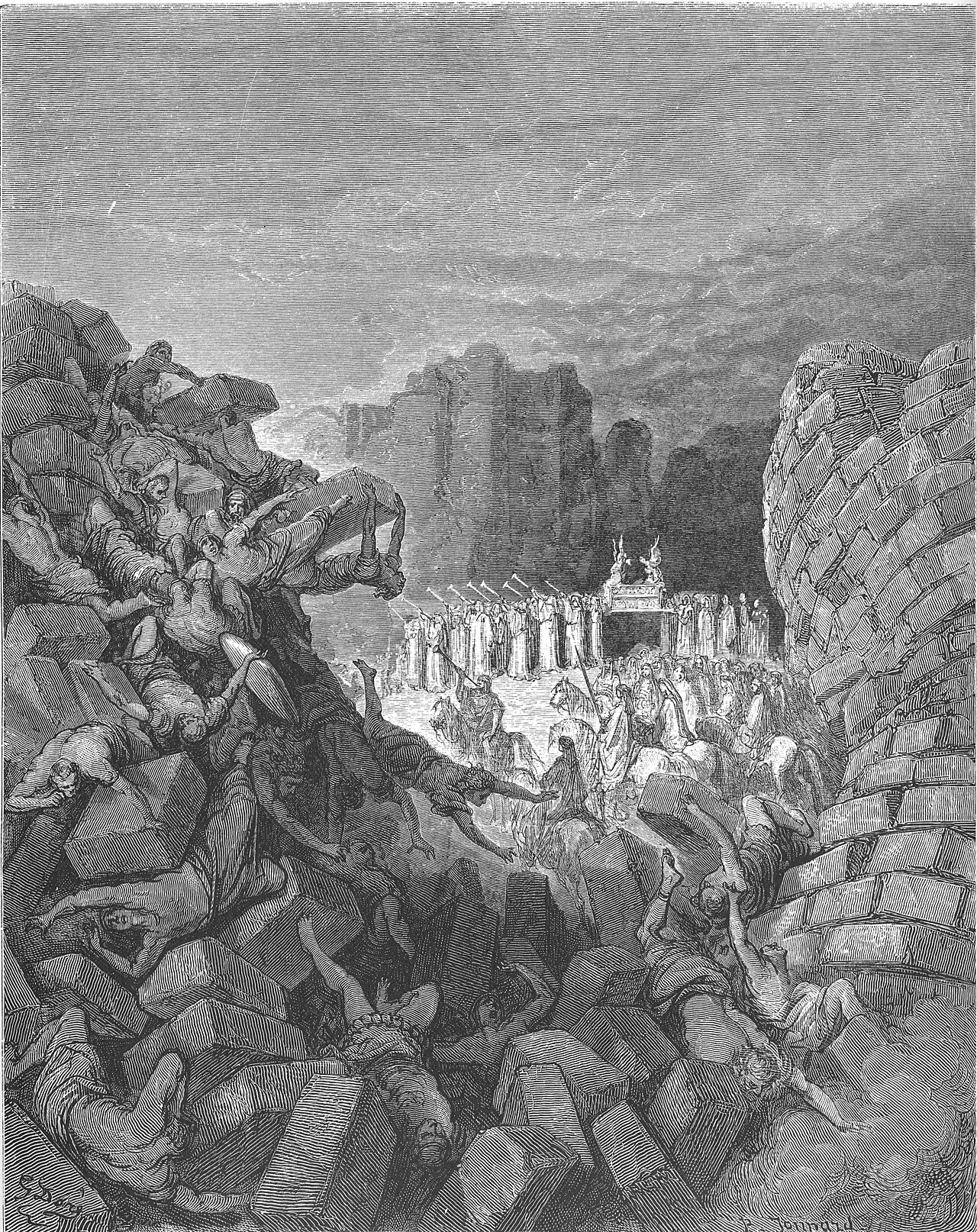
Joshuachapter 6
27 verses · Joshua, by tradition · 15th or 13th century BC · History
Now Jericho was straitly shut up because of the children of Israel: none went out, and none came in.
Introduction
Joshua, by tradition, History, Joshua Overview.
This chapter tells how the first city of Canaan fell, and it is one of the best known stories in the Old Testament. It was written for a people who needed to remember that the land was given before it was won. The plan it records uses almost none of an army's weapons, and it runs on a count of days and a count of circuits. Listen for the silence that is ordered and the moment it ends. Notice the one household that is spared and the reason given. The chapter closes with a curse that later history remembers.
Context
- Who
- An army given a plan that used none of its weapons
- What
- The fall of Jericho after seven days of marching around its walls, the ban placed on the city, and the rescue of Rahab's household.
- Where
- Jericho, tightly shut up against Israel, and the ground around its wall.
- When
- The days after the first Passover in the land, over seven days that end on the seventh with the city's fall.
- Why
- To show that the LORD gave Israel the first city of the land, and that Israel took it by obeying His word.
Historical context
The chapter belongs to Joshua, to seven priests with seven horns, to the men of war and to Rahab's household. Verse 1 stands outside the action to explain it, and Albert Barnes reads it as a parenthesis resuming the captain's word broken off at 5:14.
Show the rest of the historical context, 5 more paragraphs
The city is barred from the inside, so nobody is coming out to fight and nobody is getting in to help. Jericho guards the ford and the road up into the hill country, which is why an army crossing at that reach has to deal with it first.
A first hearer knew the instrument. The horns are rams' horns, the yobel horn that Leviticus 25:9 sounds to open the jubilee, the year in which land returns to the family that held it. Keil and Delitzsch make that the reason for the instrument chosen.
The number seven governs the whole instruction, seven priests, seven horns, six days and seven circuits on the seventh. No ramp, no siege engine and no assault order is given, and the only weapon named in the plan is a shout.
The ban is the other thing a first hearer knew. The Hebrew word is cherem, and a thing under cherem is handed over to God and put past any human use. The metals go into the treasury as consecrated things rather than to the men who carried them out.
The mound at Tell es-Sultan has been dug three times and is disputed on date rather than on ruin. John Garstang dug from 1930 to 1936 and dated a burned city with collapsed walls to roughly 1400 BC. Kathleen Kenyon re-excavated from 1952 to 1958 with tighter method and redated that destruction to about 1550 BC. Bryant Wood re-examined Kenyon's own pottery and argued for a date near 1400 BC in Biblical Archaeology Review in 1990. Piotr Bienkowski answered him in the same magazine that year. Radiocarbon results published by Hendrik Bruins and Johannes van der Plicht in Radiocarbon in 1995 supported the earlier destruction date.
Significance
The promise at verse 2 is in the past tense, that God has given Jericho into Joshua's hand, and it is spoken before a man has moved. Joshua repeats that tense back to the people at verse 16 while the wall is still standing.
Show the rest of the significance, 2 more paragraphs
The silence ordered at verse 10 covers shouting, noise and any word at all, and what ends it is a shout released on command. The sound that takes the city is obedience rather than a cry the men work themselves into.
Rahab is exempted by name and on a stated ground, because she hid the messengers, and the exemption is announced before the walls fall. Verse 25 says she dwelt in Israel unto this day, which tells a reader the account was written while her family were still known.
This chapter in Jewish lifeWhat this chapter is in Jewish life and reading.
How it is read
This is the one chapter of the twelve where the corpus carries Radak in English, and he is the commentator who sets the terms. He is quoted from the Sefaria Community Translation, which Sefaria reports as CC0. On the order to circle the city he puts a limit on the whole enterprise of explanation. "Don't ask the reason for the decision of the Creator why there was need for this encircling" (Radak on Joshua 6:3:1). The sevens then get an answer anyway, of a careful kind. The purpose of the circling with the blast was to separate the people in the city from the wall that would fall. Every nation would then see that God fights for Israel without sword or spear. Radak adds that seven carries weight in the science of his day, and points to the seven altars and the seven heifers, and to the counting of days.
Rashi works the chapter in short glosses, and he is quoted from the Metsudah Publications Book of Joshua of 1997, which Sefaria reports as CC-BY. The Targum renders the shut gates as iron gates reinforced with copper bars (Rashi on Joshua 6:1:1). The horns of the fourth verse are rams' horns, and the long blast of the fifth is the final blast drawn out (Rashi on Joshua 6:4:1 and 6:5:1). The armed men who go in front are the men of Reuben and Gad, because Gad were fighters (Rashi on Joshua 6:9:1). The rearguard is Dan, the tribe that travelled last and gathered the stragglers (Rashi on Joshua 6:13:1).
The seventh day is read as a Sabbath, and that is where the chapter becomes a question of law. Rashi states it plainly. "This was on the Shabbos" (Rashi on Joshua 6:15:1). Fighting and killing were permitted that day because the siege had been ordered by God through Joshua. The consecration of the city in the seventeenth verse follows from the same day, since the day was holy and it was fitting that everything taken be holy (Rashi on Joshua 6:17:1). The Metsudah edition prints a note beside him reporting a division. Radak holds that Joshua issued the ban by divine ordination, and also reports the Sages holding that Joshua issued it on his own authority. That division matters to a Christian reader, because it is the tradition asking on whose word the ban on Jericho rested. This site argues the ban and its grounds at /featured/the-canaanite-conquest, and treats the city at /featured/fall-of-jericho.
Rahab is followed past the fall of the city, and this is the fullest thing the corpus carries about her. Radak reads the sparing of her household as the keeping of the oath the spies swore. He then offers a second reading of the same verb, that Joshua gave her means to live on. It was "money or an inheritance from which they could live", and Radak calls this the correct explanation (Radak on Joshua 6:25:1). He then records a homily that Joshua took Rahab as a wife, and that when the notables of Israel saw it they attached themselves to her father's house. The objection is the prohibition on marrying the seven nations, and Radak reports two answers to it. One is that Rahab and her father's house were foreigners from outside the seven. The other is that she converted while the spies were still in Jericho, before Israel entered the land. He notes that this last answer depends on reading the prohibition as binding only while such a people remain what they were. Rashi, on the same scene, asks why the spies are called men, angels and lads in three different verses. They moved like lads, and on the first night they had guarded themselves from sin like angels (Rashi on Joshua 6:23:1).
The corpus carries thirteen further notes on this chapter without an English text. Six stand cited and unquoted at Radak on Joshua 6:2:1, 6:7:1, 6:8:1, 6:10:1, 6:11:1 and 6:19:1. Four stand at Malbim on Joshua 6:6:1, 6:21:1, 6:22:1 and 6:24:1, and three at Metzudat David on Joshua 6:12:1, 6:16:1 and 6:20:1.
What the rabbis say
The corpus carries forty rabbinic locators on this chapter and the text of none, so each is cited and linked here rather than quoted. On the first verse, the shut city, it holds Nedarim 56b:7, Jerusalem Talmud Nedarim 7:6:2, Midrash Sekhel Tov, Shemot 16:10:49 and the second chapter of the book of Joshua in Sefer HaYashar.
The circling and the horns draw the tractates of the new year. On the third and fourth verses the corpus holds Yalkut Shimoni on Nach 15:18 and 15:17. On the fifth, the long blast, it holds Jerusalem Talmud Rosh Hashanah 3:2:1, Jerusalem Talmud Berakhot 9:1:32 and Ein Yaakov, Rosh Hashanah 3:1. On the sixth it holds Sotah 33b:12. On the ninth, the armed men before the ark, it holds Midrash Lekach Tov, Numbers 10:25:1 and Shir HaShirim Rabbah 4:4:3. On the tenth it holds Bereshit Rabbati, Parashat Vayechi 10, and on the twelfth Mekhilta DeRabbi Yishmael, Tractate Vayehi Beshalach 6:12.
The seventh day carries the weight a Sabbath reading would lead a reader to expect. On the fourteenth verse the corpus holds Jerusalem Talmud Moed Katan 2:4:3. On the fifteenth it holds Jerusalem Talmud Shabbat 1:8:6, Bamidbar Rabbah 14:1 and Bereshit Rabbah 47:10. On the sixteenth it holds Tanna DeBei Eliyahu Rabbah 18:8.
The ban and the fall carry the rest. On the seventeenth verse the corpus holds Bamidbar Rabbah 23:6, Ein Yaakov, Moed Katan 3:13 and Midrash Tanchuma Buber, Masei 4:1. On the nineteenth, the silver and gold given to the treasury, it holds Midrash Tanchuma, Nasso 28:1 and Midrash Tanchuma Buber, Nasso 31:1. On the twentieth, the wall falling flat, it holds Berakhot 54b:11, Bamidbar Rabbah 15:15 and 20:20. On the twenty-first it holds Yalkut Shimoni on Torah 346:10 and Ein Yaakov (Glick Edition), Sanhedrin 6:7. On the twenty-third, where Rahab's household is brought out, it holds Jerusalem Talmud Berakhot 4:4:11, Jerusalem Talmud Sanhedrin 10:2:8 and Kohelet Rabbah 5:6:1. On the twenty-fifth it holds Pesikta DeRav Kahana 13:5 and Sifrei Zuta 10:29:1. On the twenty-sixth, the curse on rebuilding the city, it holds Jerusalem Talmud Sanhedrin 10:2:5, Bamidbar Rabbah 10:5 and Ein Yaakov (Glick Edition), Sanhedrin 11:137. On the twenty-seventh it holds Bamidbar Rabbah 13:5 and Bereshit Rabbah 39:11 and 42:3. What each of them teaches is a saying of the rabbis, and is reported as theirs wherever this site quotes one. The quotations wait on a fetch that carries the text.
Sources: Radak, Radak on Joshua 6:3:1 and 6:25:1, the Sefaria Community Translation, reported CC0; and on Joshua 6:2:1, 6:7:1, 6:8:1, 6:10:1, 6:11:1 and 6:19:1 cited by ref because the corpus carries no English text; Rashi, Rashi on Joshua 6:1:1 to 6:23:1, the Book of Joshua, Metsudah Publications, 1997, reported CC-BY; Targum Jonathan, the rendering of the shut gates of Jericho, as Rashi reports it at Rashi on Joshua 6:1:1; Malbim, Malbim on Joshua 6:6:1, 6:21:1, 6:22:1 and 6:24:1, cited by ref because the corpus carries no English text; Metzudat David, Metzudat David on Joshua 6:12:1, 6:16:1 and 6:20:1, cited by ref because the corpus carries no English text; The Sefaria corpus, scripts/data/sources/sefaria/joshua/6.json, the 40 Talmud and Midrash locators of this chapter.
The heads below are this chapter's scenes. The numbered points under each are its verses.
Seven priests, seven trumpets, one silent circuit
Joshua 6:1-2
Verse 1 stands outside the action: the city is barred from within, so no one comes out to fight or gets in to help. Barnes reads it as a parenthesis resuming the Commander’s word of 5:14. The promise is past tense, “I have delivered Jericho into your hand”, spoken before anyone moves, and Joshua repeats that tense at verse 16 while the wall still stands.
Joshua 6:1
“It did shut up, and it was shut up (so it is in the margin); it did shut up itself, being strongly fortified both by art and nature, and it was shut up by the obstinacy and resolution of the inhabitants, who agreed never to surrender nor so much as sound a parley; none went out as deserters or to treat of peace, nor were any admitted in to offer peace.”
Matthew Henry · Commentary on the Whole Bible (1707-1721)puritan
1 more voice on this verseWhat preachers and commentators have said about this verse, in their own words.
Joshua 6:1
“This verse is strictly parenthetical. It is inserted to explain the declaration commenced Jos 5:14, and interrupted by Joshua’s question and obeisance Jos 5:14-15, but resumed in Jos 6:2. Straitly shut up - See the margin, i. e., not only shut, but barred and bolted.”
Clarke takes the speaker to be the Commander of 5:14, whose words run on after the parenthesis of verse 1, and he judges the chapter break unnatural. From 24:11 he suggests that fighters of all seven nations were inside the walls. The promise names the trained soldiers too.
Joshua 6:2
“And the Lord said unto Joshua - This is the same person who in the preceding chapter is called the captain or prince of the Lord’s host, the discourse being here continued that was begun at the conclusion of the preceding chapter, from which the first verses of this are unnaturally divided. I have given into thine hand Jericho, etc. - From Jos 24:11, it seems as if there had been persons of all the seven Canaanitish nations then in Jericho, who might have come together at this time to help the king of Jericho against the invading Israelites.”
Adam Clarke · Commentary on the Bible (1810-1826)evangelical
Joshua 6:3-5
Seven governs the whole instruction: seven priests, seven trumpets, six days and then seven circuits on the seventh. The horns are rams' horns, the yobel horn that Leviticus 25:9 sounds to open the jubilee, the year land returns to the family that held it, and Keil and Delitzsch make that the reason for the instrument chosen. No ramp, no siege engine and no assault order is given, and the only weapon named in the plan is a shout.
Joshua 6:3
“And ye shall compass the city, all ye men of war,.... Joshua their chief commander under the Lord, and all that were able to make war, even all above twenty years of age; these were to compass the city, not in the form of a siege, but by a procession around it: and go round about the city once; or one time, for the first once in a day, and no more: thus shall thou do six days; one after another; that is, go round it, once every day, for such a time.”
2 more voices on this verse
Joshua 6:3
“Ye shall compass the city - In what order the people marched round the city does not exactly appear from the text. Some think they observed the same order as in their ordinary marches in the desert; (see the note on Num 10:14, and see the plans, Num 2:2 (note)); others think that the soldiers marched first, then the priests who blew the trumpets, then those who carried the ark, and lastly the people.”
Adam Clarke · Commentary on the Bible (1810-1826)evangelical
Joshua 6:3
“The command of the Lord as to the mode in which the fall of Jericho should be brought about is given in these verses in a condensed form. Further details (see Jos 6:8-10, Jos 6:16-17, etc.), were, no doubt, among the commands given to Joshua by the Angel. Jos 6:4 Trumpets of ram’s horns - Render rather here and in Jos 6:5-6, Jos 6:8, etc., “trumpets of jubilee” (compare Lev 25:10 note). The instrument is more correctly rendered “cornet” (see Lev 25:9, note).”
Clarke disputes the translation rams' horns. He says no ancient version except the Aramaic Targum gives it that sense, and he takes the instruments to be the jubilee trumpets, made of horn or perhaps of silver. Jamieson, Fausset and Brown render the Hebrew horns of jubilee, the bent trumpets that proclaimed that year.
Joshua 6:4
“Seven trumpets of rams’ horns - The Hebrew word יובלים yobelim does not signify rams’ horns; (see the note on Lev 25:11); nor do any of the ancient versions, the Chaldee excepted, give it this meaning. The instruments used on this occasion were evidently of the same kind with those used on the jubilee, and were probably made of horn or of silver; and the text in this place may be translated, And seven priests shall bear before the ark the seven jubilee trumpets, for they appear to have been the same kind as those used on the jubilee.”
Adam Clarke · Commentary on the Bible (1810-1826)evangelical
Literally, the wall will fall under itself. Clarke reports Jewish and Christian writers who had the ground open and swallow the wall, and answers that the text says only that it fell from its foundations. Henry sees the whole plan as a test of whether Israel would obey an order that looked foolish.
Joshua 6:5
“The wall of the city shall fall down flat - Several commentators, both Jews and Christians, have supposed that the ground under the foundation of the walls opened, and the wall sunk into the chasm, so that there remained nothing but plain ground for the Israelites to walk over. Of this the text says nothing: - ונפלה חומת העיר תחתיה venaphelah chomath hair tachteyha, literally translated, is, The wall of the city shall fall down Under Itself; which appears to mean no more than, The wall shall fall down From Its Very Foundations.”
Adam Clarke · Commentary on the Bible (1810-1826)evangelical
Joshua 6:6-7
Joshua passes on the orders in the words he received, and the ark sits inside the column. The ark had gone before the people into the Jordan at 3:6 and 3:11, and Numbers 10:35 gives the call said whenever it set out, for the LORD to rise and scatter His enemies. The armed men walk ahead and the rest behind, so the fighting men escort a chest.
Joshua 6:6
“And Joshua the son of Nun called the priests,.... Not the Levites and Kohathites, whose business it was in common to bear the ark, but upon this occasion the priests; not all of them, but as many as were sufficient for the purpose: and said unto them, take up the ark of the covenant; by putting the staves into the rings of it, and so carry it, Exo 25:14; see Num 7:9, and let seven priests bear seven trumpets of rams' horns before the ark of the Lord: See Gill on Jos 6:4.”
The Hebrew text reads they said. Barnes takes it that Joshua gave the order through the officers of the people, as at 1:10. Gill reads the people told to march as the unarmed part of the camp, and has the armed men go ahead to guard the ark and the priests against a sally from the city.
Joshua 6:7
“And he said unto the people, pass on, and compass the city,.... The women and children, the young men under twenty years of age, the unarmed part of the camp, as distinguished from the armed men: and let him that is armed pass on before the ark of the Lord; to guard the ark, protect the priests, and defend the people, should any sally be made by the enemy upon them.”
1 more voice on this verse
Joshua 6:7
“He said - The reading in the Hebrew text is “they said.” Joshua no doubt issued his orders through the “officers of the people” (compare Jos 1:10). Him that is armed - i. e. the warriors generally, not a division only. “The rereward” Jos 6:9 was merely a detachment, and not a substantial portiere of the host; and was told off, perhaps, from the tribe of Dan (compare the marginal reference) to close the procession and guard the ark from behind.”
Joshua 6:8-9
The order of march is fixed and the text prints it twice, here and again at verses 12 to 13: armed men, seven priests blowing, the ark, the rereward. Rereward is the King James word for a rear guard, and Isaiah 52:12 uses it of God himself closing the line behind Israel. The trumpets sound continually, so what a barred city hears for six days is one noise repeated.
Who made up the rear guard is disputed. Barnes suggests a detachment, perhaps from Dan, told off to close the procession and guard the ark from behind. Clarke derives the Hebrew word from a verb meaning to gather up, and allows that it could mean the baggage carriers or simply people following in no set order.
Joshua 6:9
“The rereward came after the ark - The word מאסף measseph, from אסף asaph, to collect or gather up, may signify either the rereward, as our translation understands it, or the people who carried the baggage of the army; for on the seventh day this was necessary, as much fighting might be naturally expected in the assault, and they would need a supply of arms, darts, etc., as well as conveniences for those who might happen to be wounded: or the persons here intended might be such as carried the sacred articles belonging to the ark, or merely such people…”
Adam Clarke · Commentary on the Bible (1810-1826)evangelical
Joshua 6:10-11
Joshua had commanded the people: The silence is ordered in three clauses covering shouting, noise and any word at all, which is heavier than a march order requires. What ends it is a shout released on command at a moment Joshua names, so the sound that takes the city is obedience rather than a cry the men work themselves into. Then the circuit is made once, the people lodge in the camp, and that is the whole of day one.
Joshua 6:10
“The Lord divided the Jordan that His people might pass through dry-shod. This miracle greatly dispirited the Canaanites, and so prepared the way for an easy triumph for the invading Israelites. You would have naturally expected that the Lord would have bid His people avail themselves immediately of this terror to strike a heavy blow at once, and press on with might and main before the enemy could take a breath and so sweep the land clear of the adversaries in a single campaign. But it was not so.”
Gill places the camp at Gilgal, so each circuit began and ended there. Henry imagines the watchers on the wall asking whether this was the army they had feared, and quotes Bishop Hall that the wicked think God is jesting while he prepares their judgment. The first day ends without a blow struck.
Joshua 6:11
“Is this the people we thought so formidable? Are these their methods of attack?" Thus they cried peace and safety, that the destruction might be the more terrible when it came. Wicked men (says bishop Hall) think God in jest when he is preparing for their judgment; but they will be convinced of their mistake when it is too late.”
Matthew Henry · Commentary on the Whole Bible (1707-1721)puritan
The seventh day, the shout, the wall flat
Joshua 6:12-14
These verses repeat verses 8 to 11 almost word for word, and the repetition is the point: six days pass, the same thing happens, and the text records nothing happening. Seven consecutive days of marching means one of them fell on a sabbath, which Henry and Clarke both raise, and the chapter gives neither exemption nor comment. The text never says the people were told in advance how long this would go on.
Joshua 6:12
“And Joshua rose early in the morning,.... Of the second day; to take care of, direct, and prepare everything for another procession on that day; so active and diligent was he to do the will and work of God, exactly and punctually: and the priests took up the ark of the Lord; and carried it about as they had done the day before.”
Gill notes that the Hebrew doubles the verb, going they went, and reads it as a march with no halt until the circuit was done. The horns sound the whole way round. Gill also cites the Aramaic Targum, which keeps the priests blowing as they walk, as it does at verse 9.
Joshua 6:13
“And seven priests bearing seven trumpets of rams' horns before the ark of the Lord,.... See Gill on Jos 6:4, went on continually; or, "going they went" (b): kept on going, making no stop at all, until they had compassed the city: and blew with the trumpets; as they went along: and the armed men went before them, but the rereward came after the ark of the Lord; which the Targum paraphrases as on Jos 6:9, the priests going on, and blowing with the trumpets; See Gill on Jos 6:9. (b) הלכים הלוך "euntes eundo", Montanus.”
Clarke doubts that the whole nation walked the circuit each day, since the fighting men alone numbered close to six hundred thousand. He judges Jericho a small city. In his reading a chosen part of the army was enough for the march, and the text gives no figure for it.
Joshua 6:14
“So they did six days - It is not likely that the whole Israelitish host went each day round the city. This would have been utterly impossible: the fighting men alone amounted to nearly 600,000, independently of the people, who must have amounted at least to two or three millions; we may therefore safely assert that only a select number, such as was deemed necessary for the occasion, were employed. Jericho could not have been a large city: and to reduce it could not have required a hundredth part of the armed force under the command of Joshua.”
Adam Clarke · Commentary on the Bible (1810-1826)evangelical
Joshua 6:15-16
The seventh day begins at dawn and runs seven circuits, seven times the cost of each day before. Joshua’s order to shout because “the LORD has given you the city” uses the tense God used at verse 2, spoken with the wall still up. The shout falls at the end of the thirteenth circuit, after days of silence.
Joshua 6:15
“On the seventh day - Most probably a Sabbath day. The rising early would be necessary to give time for encompassing the city seven times. Jericho appears to have been a city of considerable size and population; and each passage of the large host round it could hardly have taken less than an hour and a half. Thus, with the necessary intervals of rest, the evening would be at hand when Joshua gave the signal to shout Jos 6:16; and the work of slaughter was probably commenced just as the hours of the Sabbath were passed.”
1 more voice on this verse
Joshua 6:15
“And it came to pass on the seventh day,.... Which Jarchi says was the Sabbath day, and which is a common notion of the Jews (c); but whether it was or not, it is certain that one of these seven days must be a sabbath, in which the several things ordered were done, and the procession made.”
Wesley gives three purposes for the shout: to declare faith in the promise, to encourage Israel, and to strike terror into the city. Henry calls it a shout of prayer answering the trumpets. Numbers 10:9 says the trumpet blown in battle brings Israel to the Lord's remembrance, and Henry reads the horns that way.
Joshua 6:16
“Shout - To testify your faith in God's promise, and thankfulness for this glorious mercy; to encourage yourselves and brethren, and to strike a terror into your enemies. Given you the city - It is given to them, to be devoted to God, as the first, and perhaps the worst of all the cities of Canaan.”
John Wesley · Explanatory Notes upon the Old Testament (1765)evangelical
1 more voice on this verse
Joshua 6:16
“This was a shout of faith; they believed that the walls of Jericho would fall, and by this faith the walls were thrown down. It was a shot of prayer, an echo to the sound of the trumpets which proclaimed the promise that God would remember them; with one accord, as one man, they cry to heaven for help, and help comes in.”
Matthew Henry · Commentary on the Whole Bible (1707-1721)puritan
Joshua 6:17-19
The city is placed under the ban, the Hebrew cherem, by which a thing is handed to God and put past human use, and chapter 7 shows what one man taking it costs. Rahab is exempted by name, “because she hid the spies we sent”, before the walls fall. The metals go into the LORD’s treasury, so the ban moves the spoil out of Israel’s reach.
Joshua 6:17
“Accursed - Better as in margin, (“devoted” (Lev 27:28 note). In other cases the inhabitants only of the towns were slain; their cattle and property became the booty of the victors. But Jericho, as the first Canaanite city that was captured, was devoted by Israel as first-fruits to God, as a token that Israel received all the land from Him. Every living thing was put to death (Rahab and her household excepted) as a sacrifice to God, and the indestructible goods were Jos 6:19 brought into the treasury of the sanctuary.”
Jamieson, Fausset and Brown point to Leviticus 27:28 and note that under such a ban no booty could be taken at all. Wesley explains how one theft could curse the camp. God might punish the many for the sin of one, or use it as occasion to punish sins of their own.
Joshua 6:18
“A curse - By provoking God to punish them for your sin, in which they may be one way or other involved; or the whole camp having sins of their own, God might take what occasion he saw fit to inflict this punishment.”
John Wesley · Explanatory Notes upon the Old Testament (1765)evangelical
1 more voice on this verse
Joshua 6:18
This is what is indicated by these words: Take heed that you have nothing worldly in you, that you bring down with you to the church neither worldly customs nor faults nor equivocations of the age. But let all worldly ways be anathema to you. Do not mix mundane things with divine; do not introduce worldly matters into the mysteries of the church.This is what John also sounds with the trumpet of his epistle, saying, "Do not love the world or the things that are in the world." And likewise Paul: "Do not," he says, "be conformed to this world."
Origen of Alexandria · written before 253 · HOMILIES ON JOSHUA 7.4patristic
Only the metal was kept. Verse 24 records it placed in the treasury after the city burned, so the metals are the only goods of Jericho that pass through the fire. Clarke sets beside this a custom Ward recorded among the Brahmins of India, who would take gold and silver from any caste but count food or clothing from the lowest a degradation.
Joshua 6:19
“And when temples, idols, groves, and other things of the sort are authorized to be torn down, although it is evident when we do this that we are not honoring but despising them, still we should not take away anything for private, or at least personal, use so that our purpose in tearing down must be manifest as devotion, not cupidity.”
Augustine of Hippo · written before 430 · LETTER 47patristic
1 more voice on this verse
Joshua 6:19
“But all the silver, and gold - shall come into the treasury - The Brahmins will receive from any caste, however degraded, gold, silver, etc.: but to receive from Shoodras food, garments, etc., would be considered a great degradation. - Ward.”
Adam Clarke · Commentary on the Bible (1810-1826)evangelical
Hebrews 11:30 names the falling wall as an act of faith and 11:31 names Rahab, so the wall and the woman inside it stand side by side. The people charge “straight into the city”, on every side at once. The date of Tell es-Sultan is disputed: Garstang read its fallen walls as Joshua’s Jericho near 1400 BC, Kathleen Kenyon redated them to about 1550, and Bryant Wood reopened Garstang’s case.
Joshua 6:20
“The people shouted with a great shout, that the wall fell down - There has been much learned labor spent to prove that the shouting of the people might be the natural cause that the wall fell down! To wait here, either to detail or refute any such arguments, would be lost time: enough of them may be seen in Scheuchzer.”
Adam Clarke · Commentary on the Bible (1810-1826)evangelical
2 more voices on this verse
Joshua 6:20
“An abstract of this story we find among the trophies of faith, Heb. xi. "By faith the walls of Jericho fell down, after they were compassed about seven days." The Siege of Jericho. 1 Now Jericho was straitly shut up because of the children of Israel: none went out, and none came in.”
Matthew Henry · Commentary on the Whole Bible (1707-1721)puritan
Joshua 6:20
“And did Joshua, the son of Nun, err in recognizing the leader of the heavenly host? But after he believed, he forthwith conquered, being found worthy to triumph in the battle of faith. Again, he did not lead forth his armed ranks into the fight, nor did he overthrow the ramparts of the enemy's walls, with battering rams or other engines of war, but with the sound of the seven trumpets of the priests. Thus the blare of the trumpet and the badge of the priest brought a cruel war to an end.”
Ambrose of Milan · written before 397 · Exposition of the Christian Faith 5.10.126patristic
One verse carries out the ban, stated without softening or explanation. The ground is laid long before: Genesis 15:16 says the iniquity of the Amorites is not yet complete, and Leviticus 18:24-28 places it in what the inhabitants had done. Serious readers differ sharply over how to hold this verse, and the verse gives one clause and no discussion.
Joshua 6:21
“And they utterly destroyed all that was in the city,.... All the inhabitants of it, by the direction of Joshua, and according to the order of the Lord, Deu 7:1; being guilty of capital crimes, which deserved death, as idolatry, incest, &c. both men and women, young and old; neither sex nor age were spared: and ox, and sheep, and ass, with the edge of the sword; in which creatures chiefly lay the substance of the eastern people; see Job 1:3.”
Rahab brought out; Jericho left under a curse
Joshua 6:22-23
The two men sent in are the two who swore the oath in chapter 2, so those who gave the word must keep it. The terms of 2:12-14 covered her father, mother, brothers and sisters, and verse 23 adds “her whole family”. They are settled “outside the camp of Israel” for the moment, where a foreign household waited before being received.
Joshua 6:22
“They were best able to do it who knew her and her house, and they were fittest to do it, that it might appear it was for the sake of her kindness to them that she was thus distinguished and had her life given her for a prey. All her kindred were saved with her; like Noah she believed to the saving of her house; and thus faith in Christ brings salvation to the house, Acts xvi.”
Matthew Henry · Commentary on the Whole Bible (1707-1721)puritan
Rahab's house stood in the town wall, as 2:15 records. Gill raises the difficulty, since the wall fell flat, and Barnes answers that the stretch of wall holding her house must have stood. Gill says the young men knew the house again by the scarlet cord hanging from its window.
Joshua 6:23
“And the young men that were spies went in, and brought out Rahab,.... Not only went into the city, but into Rahab's house, which they knew again by the scarlet thread hung out at the window of it. But here a difficulty occurs, how they could be said to go into her house, when it was built on the town wall, Jos 2:15; and that was now fallen down flat.”
1 more voice on this verse
Joshua 6:23
“The part of the wall adjoining Rahab’s house had not fallen along with the rest. Rahab and “all that she had,” i. e., the persons belonging to her household, were brought out and “left without the camp of Israel.” These words literally “made to rest outside the camp of Israel” - indicate that being still in their paganism, they were separated from the camp of the Lord. This was only for a time. They desired, and eventually obtained, admission to the covenant of the chosen people of God Jos 6:25.”
Joshua 6:24-25
The words “she has lived among the Israelites to this day” show the account was written while her family were still known. Matthew 1:5 puts her in the line of Christ as the mother of Boaz. Henry, Gill and many after them read the scarlet cord of 2:18 as a figure of the blood, a link the New Testament does not make, so the reading carries their names.
Joshua 6:24
“Only the silver, and the gold - they put into the treasury, etc. - The people were to have no share of the spoils, because they had no hand in the conquest. God alone overthrew the city; and into his treasury only the spoils were brought. This is one proof that the agitation of the air, by the sound of the people’s voice, was not the cause of the fall of the city walls.”
Adam Clarke · Commentary on the Bible (1810-1826)evangelical
1 more voice on this verse
Joshua 6:24
“The preservation of Rahab the harlot, or inn-keeper, who perished not with those that believed not, Heb. xi. The public faith was engaged for her safety by the two spies, who acted therein as public persons; and therefore, though the hurry they were in at the taking of the town was no doubt very great, yet Joshua took effectual care for her preservation.”
Matthew Henry · Commentary on the Whole Bible (1707-1721)puritan
Wesley reads her rescue as showing that the order to root out the Canaanites carried an exception for any who cast off their wickedness in time and submitted to Israel. Clarke takes to this day as evidence that the book could have come from Joshua's own hand. He allows that later notes may have crept into the text.
Joshua 6:25
“Even unto this day - These words are rightly noted as implying that the narrative was written not long after the occurrences which it records.”
1 more voice on this verse
Joshua 6:25
“The harlot olive - For that general command of rooting out the Canaanites seems to have had some exception, in case any of them had sincerely and seasonably cast off their wickedness, and submitted to the Israelites.”
John Wesley · Explanatory Notes upon the Old Testament (1765)evangelical
Joshua 6:26-27
The curse names a price in sons, the firstborn at the foundation and the youngest at the gates. In Ahab’s day 1 Kings 16:34 records it fulfilled when Hiel of Bethel rebuilt Jericho at the cost of Abiram and Segub. People live at the site before that, at Judges 3:13 and 2 Samuel 10:5, so the curse holds its walls, and the chapter closes on the promise of 1:5 kept.
Joshua 6:26
“Joshua adjured them at that time--that is, imposed upon his countrymen a solemn oath, binding on themselves as well as their posterity, that they would never rebuild that city. Its destruction was designed by God to be a permanent memorial of His abhorrence of idolatry and its attendant vices.”
Jamieson, Fausset & Brown · Commentary Critical and Explanatory on the Whole Bible (1871)reformed
1 more voice on this verse
Joshua 6:26
“In his youngest son - That is, he shall lose all his children in the work, the first at the beginning, others in the progress of it by degrees, and the youngest in the close of it, when the gates use to be set up. This was fulfilled, 1 Kings xvi, 34.”
John Wesley · Explanatory Notes upon the Old Testament (1765)evangelical
The Aramaic Targum renders the first clause the Word of the Lord was with Joshua, and Henry and Wesley both read that Word as Christ, the same presence that was with Moses. Henry adds that the fame made Joshua feared by the Canaanites. Gibeon acts on it at 9:3.
Joshua 6:27
“The word of the Lord was with him - (So the Chaldee:) Even Christ himself, the same that was with Moses. Nothing makes a man appear more truly great, than to have the evidences of God's presence with him.”
John Wesley · Explanatory Notes upon the Old Testament (1765)evangelical
How this psalm is built
The form: A siege account in which the siege is a ritual circuit, with the ban and its one named exemption attached, as Keil and Delitzsch classes it.
The patterns in this chapter
| Device | What it does | Where to see it |
|---|---|---|
| Seven through the whole instruction | Seven priests carry seven horns, the circuit runs six days, and the seventh day takes seven circuits. The horns are rams' horns, the yobel horn that Leviticus 25:9 sounds to open the jubilee, the year in which land returns to the family that held it. Keil and Delitzsch make that the reason for the instrument chosen. No ramp, no siege engine and no assault order is given, and the only weapon named in the plan is a shout.Keil and Delitzsch, Biblical Commentary on the Old Testament: Joshua, Judges, Ruth, 1863, cited in the site's published exposition of Joshua 6:3-5. | Joshua 6:3, Joshua 6:4, Joshua 6:15 |
| The order of march printed twice | The column is set down at verses 8 and 9 and again at verses 12 to 13 in almost the same words: armed men, seven priests blowing, the ark, and the rear guard. The repetition is the point, since six days pass and the text records nothing happening. Rereward is the King James word for a rear guard, and Isaiah 52:12 uses it of God himself closing the line behind Israel.Keil and Delitzsch and Albert Barnes, Biblical Commentary on the Old Testament: Joshua, Judges, Ruth, 1863, and Notes on the Old Testament, cited in the site's published exposition of Joshua 6:8-9. | Joshua 6:8, Joshua 6:9, Joshua 6:13 |
| I have given it into thine hand, said before the wall moves | The promise at verse 2 is in the past tense and is spoken before a man has moved. Joshua repeats that tense back to the people at verse 16, with the wall still standing. The chapter closes at verse 27 on the promise of 1:5 and 1:9 kept, that the LORD was with Joshua. The site's published exposition of verses 1 and 2 marks the tense and the order.Albert Barnes and Jamieson, Fausset and Brown, Notes on the Old Testament and Commentary Critical and Explanatory on the Whole Bible, 1871, cited in the site's published exposition of Joshua 6:1-2. | Joshua 6:2, Joshua 6:16, Joshua 6:27 |
| Silence held, then one shout | The silence is ordered at verse 10 in three clauses, covering shouting, noise and any word at all. It is heavier than a march order requires. What ends it is a shout released on command at a moment Joshua names, so the sound that takes the city is obedience rather than a cry the men work themselves into. No Israelite has been permitted a word through any of the thirteen circuits.Matthew Henry and Adam Clarke, Commentary on the Whole Bible, 1710, and Commentary on the Bible, 1832, cited in the site's published exposition of Joshua 6:10-11. | Joshua 6:10, Joshua 6:16, Joshua 6:20 |
The debated concept: when Jericho fell, and whether the archaeology fits
14 more paragraphs on the patterns
The site's published dossier carries the excavation history of Tell es-Sultan with the excavators named, and the mound is disputed on date rather than on ruin.
John Garstang dug from 1930 to 1936. He dated a violently destroyed and burned city with collapsed walls to roughly 1400 BC, which fits a conquest beginning about 1406.
Kathleen Kenyon re-excavated from 1952 to 1958 with tighter stratigraphic method. She re-dated that destruction to about 1550 BC and concluded that the site was largely unoccupied when a thirteenth-century Israel would have arrived. Her ground is the pottery sequence read stratum by stratum, and it is the majority position.
Bryant Wood re-examined Kenyon's own pottery and argued for a date near 1400 BC, in Biblical Archaeology Review in 1990. He pointed to local Cypriot-ware distributions, storage jars still full of grain, and collapsed mudbrick forming a ramp. Piotr Bienkowski answered him in the same magazine that year, defending Kenyon's chronology. Radiocarbon results published by Hendrik Bruins and Johannes van der Plicht in Radiocarbon in 1995 supported the earlier destruction date.
Which reading a student holds depends on the exodus date, which the site's published dossier sets out as the prior question. The page states no verdict on either.
The debated concept: the ground of the ban
The site's published dossier carries two readings of the conquest commands, each with its holders.
The first holds that the ban is judgment on a ripened wickedness delayed four centuries. Its ground is the text's own stated reasons at Genesis 15:16, Leviticus 18:24 to 28 and Deuteronomy 9:5, and the exemption of Rahab in this chapter and of Gibeon in chapter 9. This is the reading the site itself holds.
The second holds that the accounts describe campaigns against fortified military centres, told in the summarizing rhetoric ancient conquest reports used. It is held by K. Lawson Younger Jr. in Ancient Conquest Accounts, 1990, and by Kenneth Kitchen. Its ground is the comparison with Egyptian and Assyrian royal inscriptions, which report total destruction in language their own later texts contradict.
The New Testament's use
Hebrews 11:30 names the fall of the walls as an act of faith, after they were compassed about seven days. The very next verse names Rahab. The site's published exposition of verse 20 marks that the New Testament sets the falling wall and the woman living inside it in consecutive sentences.
Matthew 1:5 puts Rahab in the line of Christ as the mother of Boaz, and James 2:25 reads her as justified by works when she received the messengers. Scripture calls her the harlot every time it names her, here and at Hebrews 11:31 and James 2:25.
The curse and its discharge
The curse at verse 26 names a price in sons, the firstborn at the foundation and the youngest at the gates. It is discharged by name at 1 Kings 16:34, in the days of Ahab. Hiel the Bethelite builds Jericho there and loses both sons, according to the word the LORD spoke by Joshua the son of Nun. People live at the site long before that, at Judges 3:13 and 2 Samuel 10:5, so what the curse holds is the walling and gating of the place.
Keep studying
Studies6
Places1
Sources for this chapter
The summary
Jamieson, Fausset & Brown, Commentary Critical and Explanatory; John Calvin, Commentaries; John Wesley, Notes on the Old Testament and Matthew Henry, Complete Commentary.
The form and classifications
Albert Barnes and Keil and Delitzsch, Biblical Commentary on the Old Testament: Joshua, Judges, Ruth, 1863, cited in the site's published exposition of Joshua 6:3-5.
The exposition
Adam Clarke, Commentary on the Bible; Albert Barnes, Notes on the Old Testament; Jamieson, Fausset & Brown, Commentary Critical and Explanatory on the Whole Bible; John Gill, Exposition of the Old Testament; John Wesley, Explanatory Notes upon the Old Testament; Keil and Delitzsch, Biblical Commentary on the Old Testament: Joshua, Judges, Ruth and Matthew Henry, Commentary on the Whole Bible.