
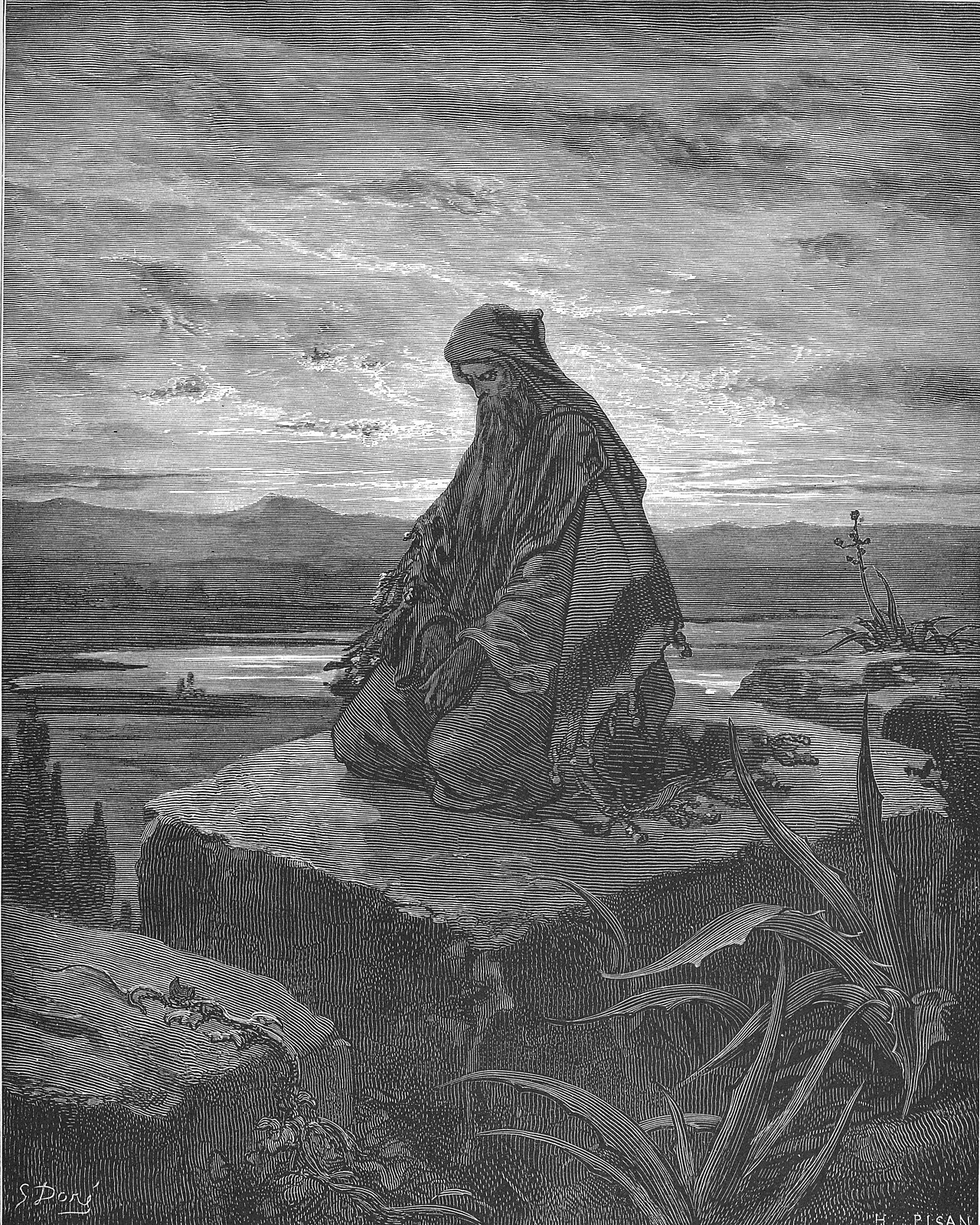
Isaiahchapter 7
25 verses · Isaiah · 8th century BC · The Prophets
Therefore the Lord Himself will give you a sign: Behold, the virgin will be with child and will give birth to a son, and will call Him Immanuel.
Introduction
Isaiah, The Prophets, Isaiah Overview.
This chapter records Isaiah's meeting with King Ahaz during the war that Damascus and Samaria brought against Judah. Its first hearers were a frightened king and a capital watching two armies come up the road. It is a narrative with a message and a sign at its centre. Listen for the names of the two sons in the chapter and what each name means. Notice the offer the king is given and how he answers it. Mark the change of subject in the last part, where the danger comes from a greater power. The chapter asks a reader where trust is placed in a crisis.
Context
- Who
- A frightened king and a capital watching two armies come up the road
- What
- Isaiah's word to Ahaz that the alliance of Aram and Israel will fail, the king's refusal of a sign, and the sign of Immanuel with the warning of Assyria.
- Where
- The end of the conduit of the upper pool, on the road to the Launderer's Field outside Jerusalem.
- When
- The Syro-Ephraimite war under Ahaz, about 735 to 734 BC.
- Why
- To call the house of David to trust God rather than seek Assyria's help, and to give a sign of God's presence and faithfulness.
Historical context
The crisis is documented on both sides. Rezin of Damascus and Pekah of Israel had formed a bloc against Assyria and wanted Judah in it. Ahaz refused, so they marched to depose him and put a man they called the son of Tabeel on David's throne. Isaiah's contempt is in the phrasing, he will not even give Pekah his royal title, calling him only the son of Remaliah.
Show the rest of the historical context, 4 more paragraphs
The meeting place is a practical one. Ahaz is out inspecting the water. Jerusalem's spring lay outside the wall in the valley, and an open channel carried its water along the slope to a pool; in a siege, water was the whole question. The launderers' field beside it was where cloth was washed and bleached, work that needed running water, open ground to spread the cloth, and enough distance from the houses that nobody had to smell the stale urine and alkali used to scour the wool.
Isaiah brings his son, whose name means a remnant shall return, a walking two-edged message, since it promises both that some come back and that only some do. Ahaz, meanwhile, was already drafting his own answer: he emptied the temple and palace treasuries and bought Assyrian protection. Tiglath-pileser III's own annals list a king of Judah among his tribute-payers, and by 732 BC Damascus was destroyed and Rezin dead, exactly as Isaiah said, and exactly at the price Isaiah warned about.
The sign given to a refusing king turns on one Hebrew word, almah. It means a young woman of marriageable age, and every use in the Old Testament fits an unmarried one; critics argue it says no more than that, since Hebrew has a narrower word for virgin. The answer the traditional view gives is that Jewish translators themselves, making the Greek version two centuries before Christ, chose the word for virgin, and Matthew read it that way. Many hold that the sign had a near fulfillment in a child born in Ahaz's own day whose growing-up marked the clock, and its full weight in the birth Matthew names.
The last picture is a wrecked economy. Curds and honey sound rich; they are not. They are what you eat when the fields are gone, the cattle roam untended, and a man keeps one cow and two sheep on the ruins of a vineyard that once had a thousand vines.
Significance
The first hearers were being asked one question: which do you fear, the two kings on the road or the God in the room? Ahaz dressed up his unbelief as piety, I will not put the LORD to the test, and then paid Assyria instead.
Show the rest of the significance, 1 more paragraph
The name Immanuel, God with us, lands on that. Judah was being told that God's presence was the deciding fact in the crisis, whether the king used it or not, and the same presence that saves an unbelieving nation from Damascus can bring Assyria down on it next.
This chapter in Jewish lifeWhat this chapter is in Jewish life and reading.
What is done
The first six verses of this chapter are read aloud in the Ashkenazi synagogue as part of the Haftarah of Yitro. The site's table in src/lib/hebraic/readings.ts gives that Haftarah as Isaiah 6:1 to 7:6 and 9:5 to 9:6. The probe printed the Ashkenazi rite only for this chapter, because the Sephardi Haftarah of the same Sabbath ends at Isaiah 6:13. The rest of the chapter, the sign of Immanuel with it, is read in neither rite.
How it is read
Rashi is the main commentator on this chapter in the corpus, quoted here from The Judaica Press complete Tanach with Rashi, translated by A. J. Rosenberg, which Sefaria reports as CC-BY. Ibn Ezra is quoted from the Commentary of Ibn Ezra on Isaiah, translated by M. Friedlander in 1873, which Sefaria reports as Public Domain.
Rashi reads the chapter as a word to Ahaz in the war with Aram and Israel. The king's lineage is traced in the first verse because "the merit of his forebears stood him" in good stead (Rashi on Isaiah 7:1:1). Shear-jashub, the prophet's son, is "The small remnant that will return to Me through you" (Rashi on Isaiah 7:3:1). Ahaz refuses a sign because "I do not wish that His Name be hallowed through Me" (Rashi on Isaiah 7:12:1).
On the fourteenth verse the corpus keeps one note of Rashi. It reads the sign as given to Ahaz against his will: "He will give you a sign by Himself, against Your will" (Rashi on Isaiah 7:14:1). The notes that follow set the sign in the days of Ahaz. The child eats cream and honey "for our land shall be replete with all good" (Rashi on Isaiah 7:15:1). Before he knows to choose the good, the lands of Rezin and Pekah are abandoned (Rashi on Isaiah 7:16:1). Rashi's note on the next chapter names the child as the son the prophetess called Immanuel (Rashi on Isaiah 8:3:1).
A Christian reader knows this verse from Matthew 1:22 to 1:23, where it is read of the birth of Jesus. The classical Jewish reading in the corpus places the sign in the reign of Ahaz and Hezekiah. The two readings part on this verse, and each tradition holds its own.
What the rabbis say
The corpus carries 40 rabbinic locators on the verses of this chapter, 7 in the Talmud and 33 in the Midrash. It carries the text of none, so each is cited by ref here and never quoted or paraphrased. The verse numbers are the Hebrew ones the corpus prints.
On verse 1 it holds Bereshit Rabbah 42:3, Bereshit Rabbah 63:1 and Ein Yaakov (Glick Edition), Megillah 1:8. On verse 2 it holds Bereshit Rabbah 16:3, Mekhilta DeRabbi Shimon Ben Yochai 20:15 and Midrash Lekach Tov on Ruth 1:1:1. On verse 3 it holds Ein Yaakov (Glick Edition), Sanhedrin 11:84, Jerusalem Talmud Sanhedrin 10:1:12 and Sanhedrin 104a:6. On verse 6 it holds Bamidbar Rabbah 18:21 and Jerusalem Talmud Avodah Zarah 1:1:3. On verse 7 it holds Seder Olam Rabbah 22:1.
On verse 8 it holds Midrash Lekach Tov, Genesis 41:1:4, Midrash Sekhel Tov, Bereshit 41:1:1 and Seder Olam Rabbah 28:1. On verse 11 it holds Aggadat Bereshit 49:4, Avot DeRabbi Natan, Recension B 43:26 and Bereshit Rabbah 44:8. On verse 12 it holds Pirkei DeRabbi Eliezer 9:4. On verse 13 it holds Midrash Aggadah, Genesis 37:6:1. On verse 14 it holds Midrash Lekach Tov, Exodus 2:8:3, Midrash Sekhel Tov, Bereshit 24:43:2 and Midrash Sekhel Tov, Shemot 2:8:2.
On verse 15 it holds Bamidbar Rabbah 14:2. On verse 16 it holds Pirkei DeRabbi Eliezer 17:14. On verse 18 it holds Bamidbar Rabbah 18:22, Midrash Tanchuma Buber, Chukat 1:6 and Midrash Tanchuma, Chukat 1:1. On verse 19 it holds Ein Yaakov (Glick Edition), Megillah 1:10, Ein Yaakov, Megillah 1:16 and Megillah 10b:20. On verse 20 it holds Ein Yaakov (Glick Edition), Sanhedrin 11:35, Otzar Midrashim, The Ten Exiles, The Travails of R' Jacob 20 and Sanhedrin 95b:15.
On verse 21 it holds Bamidbar Rabbah 13:20, Bamidbar Rabbah 13:5 and Bereshit Rabbah 48:10. On verse 25 it holds Jerusalem Talmud Nazir 9:6:2, Midrash Shmuel 2:8 and Yalkut Shimoni on Torah 604:5.
What each of them teaches is a saying of the rabbis, and is reported as theirs wherever this site quotes one. The quotations wait on a fetch that carries the text.
Sources: Rashi, Rashi on Isaiah 7:1:1 to 7:24:1, The Judaica Press complete Tanach with Rashi, translated by A. J. Rosenberg, reported CC-BY; Ibn Ezra, Ibn Ezra on Isaiah 7:5:1, Commentary of Ibn Ezra on Isaiah - trans. by M. Friedlander, 1873, reported Public Domain; The Sefaria corpus, scripts/data/sources/sefaria/isaiah/7.json, the 40 Talmud and Midrash locators on the verses of this chapter; The site's own files, src/lib/hebraic/readings.ts, probed for Isaiah 7: the Haftarah of Yitro, Isaiah 6:1 to 7:6 and 9:5 to 9:6, in the Ashkenazi rite.
The heads below are this chapter's scenes. The numbered points under each are its verses.
Two Smoking Firebrands, and a King Whose Heart Shakes
Isaiah 7:1-2
Now in the days that Ahaz: Rezin king of Aram and Pekah son of Remaliah march on Jerusalem to force Ahaz into their alliance against Assyria. Though the siege fails, the fear remains. The chapter belongs to the Syro-Ephraimite war that 2 Kings 16 and 2 Chronicles 28 narrate from the political side.
Isaiah 7:1
“Ahaz--In the first years of his reign the design of the two kings against Judah was carried out, which was formed in Jotham's reign (2Ki 15:37). Syria--Hebrew, Aram (Ge 10:22, 23), originally the whole region between the Euphrates and Mediterranean, including Assyria, of which Syria is an abbreviation; here the region round Damascus, and along Mount Libanus.”
Jamieson, Fausset & Brown · Commentary Critical and Explanatory on the Whole Bible (1871)reformed
1 more voice on this verseWhat preachers and commentators have said about this verse, in their own words.
Isaiah 7:1
“In the days of Ahaz - Ahaz began to reign about 738 years before Christ. By a comparison of 2Ki 16:5, ..., with 2Ch 28:5, etc., it will be seen that Judea was twice invaded by Rezin and Pekah in the reign of Ahaz; see the Analysis of the chapter. That Rezin ... - This confederacy was formed in the time of Jotham; 2Ki 15:37. But it was not carried into execution during his reign.”
the hearts of Ahaz and his people trembled: Ephraim is a name for the northern kingdom of Israel, as Barnes explains, and the Hebrew for in league with means rests on. The court is called the house of David, and Henry reads the title as a reminder of God's covenant with David in Psalm 89.
Isaiah 7:2
“And it was told the house of David - That is, the royal family; or the king and princes; the government. Ahaz was the descendant and successor of David. Syria is confederate with Ephraim - Ephraim was one of the tribes of Israel, and the kingdom of Israel was often called “Ephraim,” or the kingdom of Ephraim; in the same way as the tribes of Judah and Benjamin were called the kingdom of Judah. The phrase, ‘is confederate with,’ is in Hebrew ‘resteth on;’ see the margin.”
1 more voice on this verse
Isaiah 7:2
“This degenerate royal family is called the house of David, to put us in mind of that article of God's covenant with David ( Ps. lxxxix. 30-33 ), If his children forsake my law, I will chasten their transgression with the rod; but my loving-kindness will I not utterly take away, which is remarkably fulfilled in this chapter.”
Matthew Henry · Commentary on the Whole Bible (1707-1721)puritan
Isaiah 7:3-6
The Lord sends Isaiah to meet Ahaz "at the end of the aqueduct," likely where the king was inspecting Jerusalem's water against a siege. Shear-jashub, whose name means a remnant shall return, is a sign walking beside his father: judgment is coming, and it will not be total.
Isaiah 7:3
“Then said the Lord - In regard to the purposes for which Isaiah was sent to meet Ahaz, and the reason why this place was selected, see the Analysis of the chapter. Thou and Shear-ashub - The meaning of the name “Shear-jashub” is, ‘the remnant shall return.’ The names which Isaiah gave to his sons were significant or emblematic of some important events which were to occur to the Jews.”
1 more voice on this verse
Isaiah 7:3
“The upper pool is still to be seen, about seven hundred yards from the Jaffa gate. The highway leading to the fullers' field, which was in a position near water for the purposes of washing, previous to drying and bleaching, the cloth, was probably alongside the aqueduct.”
Jamieson, Fausset & Brown · Commentary Critical and Explanatory on the Whole Bible (1871)reformed
Rezin and Pekah look like a blaze to Ahaz, and Isaiah calls them the smoking ends of two sticks. Barnes explains the figure as fuel almost spent and harmless. The same verse names Pekah only as the son of Remaliah, which Barnes reads as contempt.
Isaiah 7:4
“Take heed, &c.--that is, See that thou be quiet (not seeking Assyrian aid in a fit of panic). tails--mere ends of firebrands, almost consumed themselves (about soon to fall before the Assyrians, Isa 7:8), therefore harmless. smoking--as about to go out; not blazing. son of Remaliah--Pekah, a usurper (2Ki 15:25).”
Jamieson, Fausset & Brown · Commentary Critical and Explanatory on the Whole Bible (1871)reformed
1 more voice on this verse
Isaiah 7:4
“The Syriac omits וארם vearam, “and Syria;” the Vulgate reads מלך ארם melech aram, “king of Syria:” one or the other seems to be the true reading. I prefer the former: or, instead of וארם ובן vearam uben, read ופקח בן vepekach ben, and pekah son, MS.”
Adam Clarke · Commentary on the Bible (1810-1826)evangelical
has plotted your ruin: Gill counts two parties in the plot, the kingdoms of Aram and Ephraim. The king of Aram goes unnamed, and Pekah is called only the son of Remaliah, as if his father were a private man. Gill reads both as deliberate contempt.
Isaiah 7:5
“Because Syria, Ephraim, and the son of Remaliah,.... Not that there were three parties in the counsel and confederacy against Judah, only two, the kingdoms of Syria and Ephraim, or Israel; the king of the former is not mentioned at all, and the latter only as if he was the son of a private person, which is purposely done by way of contempt: have taken evil counsel against thee: which is expressed in the next verse; saying; as follows.”
The allies meant to set a king of their own choosing on the throne of David, ending the line the LORD had promised to keep. Aquinas gives the meaning of Tabeal as God is good. Barnes reads the plan as conquest followed by tribute.
Isaiah 7:6
“And vex it - Margin, ‘Weaken it.’ Probably the word means to throw into consternation or fear, by besieging it - “Gesenius.” And let us make a breach therein - Let us break down the walls, etc. And set a king - Subdue it, and make it tributary to the allied kingdoms of Syria and Ephraim. The son of Tabeal - Nothing more is known of this person.”
1 more voice on this verse
Isaiah 7:6
Rouse it up, like someone resting in sleep, and draw it away, that is, let us draw it into our power. The son of Tabeel, literally, a certain man, or an idol of our god; Tabeel means "God is good."
Thomas Aquinas · written before 1274 · Commentary on Isaiahpatristic
Isaiah 7:7-9
The Lord answers the coalition's plan, "It will not arise; it will not happen." The sixty-five years look past this war to the later Assyrian deportations. Verse 9 ends on a Hebrew wordplay, one root behind believing and standing firm, so that unbelief and instability are named as one failure.
Within sixty-five years Ephraim will be shattered: The sixty-five years are counted in more than one way. Henry reports the view that they run from the prophecy of Amos, and a later view that they reach the last desolation under Esarhaddon. Then Ephraim ceased to be a people.
Isaiah 7:8
“But it is hard to allow that. Others make it to be sixty-five years from the time that the prophet Amos first foretold the ruin of the kingdom of the ten tribes; and some late interpreters make it to look as far forward as the last desolation of that country by Esarhaddon, which was about sixty-five years after this; then Ephraim was so broken that it was no more a people.”
Matthew Henry · Commentary on the Whole Bible (1707-1721)puritan
If you do not stand firm in your faith: Isaiah plays on one Hebrew root, to believe and to be made firm, and Spurgeon titled his sermon on the verse No Fixity Without Faith. Gill reads verses 8 and 9 together: Pekah will rule Israel and never Judah. The choice left to Ahaz is trust.
Isaiah 7:9
“And the head of Ephraim - The capital city of Ephraim, or of Israel. Is Samaria - This was long the capital of the kingdom of Israel. For a description of this city, see the notes at Isa 28:1. The meaning of the prophet is, that Samaria should continue to be the head of Ephraim; that is, Jerusalem should not be made its capital. If ye will not believe, surely ye shall not be established - There is considerable variety in the interpretation of these words, though the general sense is evident.”
The Sign of Immanuel: God With Us
Isaiah 7:10-11
Again the LORD spoke to Ahaz: The Lord speaks to Ahaz a second time and offers a sign anywhere in creation. Ahaz may name his own proof, from the grave to the sky, so the refusal that follows cannot be laid to a stingy offer. Isaiah's rebuke treats that refusal as trying the patience of God.
Isaiah 7:10
“For the one and the same Spirit of God, who proclaimed by the prophets what and of what sort the advent of the Lord should be, did by these elders give a just interpretation of what had been truly prophesied; and He did Himself, by the apostles, announce that the fulness of the times of the adoption had arrived, that the kingdom of heaven had drawn nigh, and that He was dwelling within those that believe on Him who was born Emmanuel of the Virgin.”
Irenaeus · written before 202 · Against Heresies (Book III, Chapter 21), Section 4patristic
The sign may come from Sheol below or heaven above. Barnes says the words of the prophet had made no impression on Ahaz, so the LORD offers a sign to him. Irenaeus heard in the depth and the height the Christ who descended and ascended, in Ephesians 4:9 and 10.
Isaiah 7:11
“But what Isaiah said, "From the height above, or from the depth beneath," was meant to indicate, that "He who descended was the same also who ascended." But in this that he said, "The Lord Himself shall give you a sign," he declared an unlooked-for thing with regard to His generation, which could have been accomplished in no other way than by God the Lord of all, God Himself giving a sign in the house of David.”
Irenaeus · written before 202 · Against Heresies (Book III, Chapter 21), Section 6patristic
1 more voice on this verse
Isaiah 7:11
“Ask thee - Ask for “thyself;” ask a sign that shall be convincing to “thyself,” since thou dost not fully credit the words of the prophet. It is evident that the words of the prophet had made no impression on the mind of Ahaz. God, therefore, proposes to him to ask any “proof or demonstration” which he might select; anything that would be an indication of divine power that should put what the prophet had said beyond doubt. Had Ahaz put confidence in God, he would have believed what the prophet said without miraculous proof.”
Isaiah 7:12-13
But Ahaz replied: Ahaz refuses in pious language, "I will not test the LORD," echoing Deuteronomy's ban, though God had offered the sign. Isaiah's reply turns to the house of David, the address moving from singular to plural, as Gill and Clarke note. The sign is given to that wider house.
Isaiah 7:12
“I will not ask - In this case Ahaz assumed the appearance of piety, or respect for the command of God. In Deu 6:16, it is written, ‘Thou shalt not tempt the Lord thy God;’ and Ahaz perhaps had this command in his eye. It was a professed reverence for God.”
The address widens from Ahaz to the whole house of David, and Gill includes the family and counselors who shared his refusal. In verse 11 the LORD was called your God. Jerome notes that the prophet now speaks, and he speaks of the patience of my God.
Isaiah 7:13
“And when He says, "Hear, O house of David," [Isaiah 7:13] He performed the part of one indicating that He whom God promised David that He would raise up from the fruit of his belly (ventris) an eternal King, is the same who was born of the Virgin, herself of the lineage of David.”
Irenaeus · written before 202 · Against Heresies (Book III, Chapter 21), Section 5patristic
3 more voices on this verse
Isaiah 7:13
“O house of David - Isa 7:2. By this is to be understood not only the king himself, but the princes and rulers. Perhaps in addressing him thus, there was implied no small irony and reproach. David confided in God. But “Ahaz,” his descendant, feared to “tempt” God! As if God could not aid him! Worthy descendant he of the pious and devoted David! Is it a small thing - You are not satisfied with wearying people, but you would also fatigue and wear out the patience of God.”
Isaiah 7:13
“Nothing is more grievous to the God of heaven than to be distrusted. " Will you weary my God? Will you suppose him to be tired and unable to help you, or to be weary of doing you good? Whereas the youths may faint and be weary, you may have tired all your friends, the Creator of the ends of the earth faints not, neither is weary. " ch. xl.”
Matthew Henry · Commentary on the Whole Bible (1707-1721)puritan
Isaiah 7:13
“Isaiah as yet had given no outward proof that he was from God; but now God has offered a sign, which Ahaz publicly rejects. The sin is therefore now not merely against "men," but openly against "God." Isaiah's manner therefore changes from mildness to bold reproof.”
Jamieson, Fausset & Brown · Commentary Critical and Explanatory on the Whole Bible (1871)reformed
Therefore the Lord Himself will: Almah names a young woman of marriageable age without by itself requiring virginity as bethulah does. The Septuagint, two centuries before Christ, rendered it parthenos, virgin. Matthew 1:23 quotes that rendering of Jesus, and the text allows both horizons, a near clock in Ahaz's day and the fulfillment Matthew names.
Isaiah 7:14
“Isaiah tells of the mystery of our faith and hope: "Behold, a virgin shall conceive, and bear a son, and shall call his name Emmanuel." I know that the Jews are accustomed to meet us with the objection that in Hebrew the word almah does not mean a virgin but "a young woman." And, to speak truth, a virgin is properly called bethulah, but a young woman, or a girl, is not almah but naarah! What then is the meaning of almah?”
Jerome · written before 420 · Against Jovinianus 1.32patristic
2 more voices on this verse
Isaiah 7:14
“The Lord “Jehovah” - For אדני Adonai, twenty-five of Kennicott’s MSS., nine ancient, and fourteen of De Rossi’s, read יהוה Jehovah. And so Isa 7:20, eighteen MSS. Immanuel - For עמנואל Immanuel, many MSS. and editions have עמנו אל immanu El, God with us.”
Adam Clarke · Commentary on the Bible (1810-1826)evangelical
Isaiah 7:14
“The New Testament application of such prophecies is not a strained "accommodation"; rather the temporary fulfilment of an adaptation of the far-reaching prophecy to the present passing event, which foreshadows typically the great central end of prophecy, Jesus Christ (Re 19:10).”
Jamieson, Fausset & Brown · Commentary Critical and Explanatory on the Whole Bible (1871)reformed
Cross references
Isaiah 7:14
- Quoted inMatthew 1:22“All this took place to fulfill what the Lord had said through the prophet:”
the ARCHETYPE fulfillment formula: hina plerothe to rhethen hypo kyriou dia tou prophetou legontos ('that it might be fulfilled which was spoken by the Lord through the prophet, saying'), pleroo V-APS-3S + rhethen V-APP-NSN together; contested source (LXX parthenos vs MT almah, both readings at full strength on the page)
- Quoted inMatthew 1:23“Behold, the virgin will be with child and will give birth to a son, and they will call Him Immanuel” (which means, “God with us”).
Matthew fulfillment formula 'that it might be fulfilled which was spoken by the Lord through the prophet' (contested: LXX parthenos vs MT almah, both readings at full strength on the verse page)
ConnectionsMatthew 1:23, Psalms 89:3
Isaiah 7:15-16
By the time He knows: The "curds and honey" allow two readings: the diet of a land stripped to pasture by invasion, or the ordinary food of a weaned child. Before the boy can "reject evil and choose good," the land of the two kings Ahaz dreads, Aram and Israel, "will be laid waste."
Isaiah 7:15
“Butter and honey - The word rendered “butter” (חמאה chem'âh), denotes not butter, but thick and curdled milk. This was the common mode of using milk as an article of food in the East, and is still. In no passage in the Old Testament does butter seem to be meant by the word. Jarchi says, that this circumstance denotes a state of plenty, meaning that the land should yield its usual increase notwithstanding the threatened invasion. Eustatius on this place says, that it denotes delicate food.”
the land of the two kings you dread will be laid waste: Barnes reads the land as one because Aram and Ephraim were then bound in one alliance. Jerome dates the fulfillment by the capture of Samaria in the sixth year of Hezekiah, recorded in 2 Kings 18. The measure of time is a child's early years.
Isaiah 7:16
“The land that thou abhorrest - The land concerning which thou art so much “alarmed or distressed;” that is, the united land of Syria and Ephraim. It is mentioned here as ‘the land,’ or as one land, because they were united then in a firm alliance, so as to constitute, in fact, or for the purposes of invasion and conquest, one people or nation. The phrase, ‘which thou abhorrest,’ means properly, which thou loathest, the primary idea of the word - קוץ qûts - being to feel a nausea, or to vomit.”
The Razor Hired from Beyond the River
Isaiah 7:17-19
The LORD will bring on you: The sign turns to warning: a time unlike any since Ephraim split from Judah, when "He will bring the king of Assyria" against Ahaz's house. Ahaz had sought Assyria's help against Aram and Israel, and the power he leans on is the one the Lord now brings against him.
Isaiah 7:17
“The Lord shall bring ... - The prophet having assured Ahaz that his kingdom should be free from the invasion that then threatened it, proceeds, however, to state to him that it would be endangered from another source. Thy father’s house - The royal family - the princes and nobles. Days that have not come - Times of calamity that have not been equalled. From the day that Ephraim departed from Judah - From the time of the separation of the ten tribes from the tribes of Judah and Benjamin.”
1 more voice on this verse
Isaiah 7:17
“And - Upon thy sons and successors, the kings of Judah. Departed - When ten tribes revolted from thy father's house. The king - Who may well be called their plague or calamity, as he is called the rod of God's anger, chap. x, 5.”
John Wesley · Explanatory Notes upon the Old Testament (1765)evangelical
the flies at the farthest streams of the Nile: The LORD whistled for the nations in 5:26 and whistles again here. Egypt is the fly of the Nile and Assyria the bee, and Barnes takes both as armies. Clarke names the kings who came, Sennacherib and Pharaoh Necho among them.
Isaiah 7:18
“Rivers - Of the river Nile, which may be called rivers, either for its greatness, or because towards the end of it, it is divided into seven streams. When the Chaldeans had in good measure subdued the Egyptians, it is probable great numbers of the Egyptian soldiers listed themselves in the Chaldean army, and with them invaded the land of Judah.”
John Wesley · Explanatory Notes upon the Old Testament (1765)evangelical
1 more voice on this verse
Isaiah 7:18
“Hiss for the fly “Hist the fly” - See note on Isa 5:26. Egypt, and - Assyria - Sennacherib, Esarhaddon, Pharaoh-necho, and Nebuchadnezzar, who one after another desolated Judea.”
Adam Clarke · Commentary on the Bible (1810-1826)evangelical
in the steep ravines and clefts of the rocks: The swarm settles everywhere, from the ravines to the watering holes. Barnes keeps the image of flies and bees and reads it as armies covering the whole land. Aquinas notes the places named, valleys for water and rocks for defense, as the ones an army holds.
Isaiah 7:19
“And they shall come - The idea in this verse is, that they would spread over the land, and lay it waste. The poetic image of flies and bees is kept up; meaning, that the armies would be so numerous as to occupy and infest all the land. And shall rest - As bees do. Thus the “locusts” are said to have “rested” in all the land of Egypt; Exo 10:14. In the desolate valleys - The word translated “valleys” usually means “a valley with a brook,” or a brook itself.”
the Lord will use a razor: r hired from beyond the Euphrates," to shave head, legs and beard. The loss of the beard was the deepest public shame. Gill and Clarke note Assyria was hired in the sense that Ahaz's own tribute paid for the army God turns against him.
Isaiah 7:20
“The river - That is, the Euphrates: הנהר hanahar. So read the Septuagint and two MSS. Shall the Lord shave with a razor that is hired “Jehovah shall shave by the hired razor” - To shave with the hired razor the head, the feet, and the beard, is an expression highly parabolical, to denote the utter devastation of the country from one end to the other; and the plundering of the people, from the highest to the lowest, by the Assyrians, whom God employed as his instrument to punish the Jews.”
Adam Clarke · Commentary on the Bible (1810-1826)evangelical
1 more voice on this verse
Isaiah 7:20
“And so the prophet notes the just judgment of God, in scourging them with a rod of their own making. By - By the successive kings of the Assyrian empire, Sennacherib, Esarhaddon, and especially by Nebuchadnezzar. The head - By these metaphorical expressions he signifies the total destruction of their state, from head to foot, from the highest to the lowest.”
John Wesley · Explanatory Notes upon the Old Testament (1765)evangelical
Isaiah 7:21-22
On that day a man: A man will raise "a young cow and two sheep," a picture of farming so reduced that a household counting flocks is glad of three. Yet those few give milk enough that curds become the diet of "all who remain," the abundance coming because so few remain to share it.
Isaiah 7:21
“In that day - In the time specified in the previous verses - in the judgments that should be brought upon the land by the Egyptians and Assyrians. A man shall nourish - Hebrew ‘Make to live:’ that is, he shall own, or feed. A young cow - The Hebrew denotes a heifer that gives milk. The state which is denoted by this is that of great poverty.”
all who remain in the land will eat curds and honey: Curds and honey appeared in verse 15 as the child's food. Here they are what the few survivors eat, and Aquinas reads them as the diet of a land without bread. Barnes adds that milk abounds when fields lie untilled and become open pasture.
Isaiah 7:22
“For the abundance of milk ... - On account, or by means of the great quantity of milk. This image also denotes that the land should be desolate, and abandoned by its inhabitants. Such a range would the cow and sheep have in the lands lying waste and uncultivated, that they would yield abundance of milk. For butter and honey - This shall be the condition of all who are left in the land. Agriculture shall be abandoned, The land shall be desolate.”
1 more voice on this verse
Isaiah 7:22
“Second, from the slightness of provisions: butter and honey, because of the lack of bread: they that were fed delicately have died in the streets (Lam 4:5).”
Thomas Aquinas · written before 1274 · Commentary on Isaiahpatristic
Isaiah 7:23-25
a thousand vines worth a thousand: Land of "a thousand vines worth a thousand shekels of silver" will grow only "briers and thorns." Hills "once tilled by the hoe" return to pasture, farmland undone by the invasion. The oracle that opened with a king's fear of an army ends with the land gone back to wilderness.
Isaiah 7:23
“And it shall come to pass in that day; that every place shall be,.... Barren and unfruitful, for want of men to till the ground: where there were a thousand vines at a thousand silverlings; which were so good, as to be sold or let out for so many silver shekels (m); or the fruit of them came to such a price; see Son 8:11, it shall even be for briers and thorns; for want of persons to stock the ground and cultivate it. (m) Which was about two shillings and sixpence of our money.”
1 more voice on this verse
Isaiah 7:23
“The remainder of this chapter is a description of great desolation produced by the invasion of the Assyrians. “Where there were a thousand vines.” Where there was a valuable vineyard. In every place, that is, that was well cultivated and valuable. At a thousand silverlings - The word rendered ‘silvertings’ here - כסף keseph - denotes, properly, silver, of any amount. But it is also used to denote the silver coin which was in use among the Jews, the shekel.”
Men will go there with bow and arrow: Gill gives the Jewish readings: men carry bow and arrow for fear of wild beasts, or of thieves. Barnes takes the land as a place of hunting. The thousand vines of 7:23 are now briers and thorns.
Isaiah 7:24
“With arrows and with bows shall men come thither,.... For fear of wild beasts, serpents, and scorpions, as Jarchi; or in order to hunt them, as others; or because of thieves and robbers, as Aben Ezra: because all the land shall become briers and thorns; among which such creatures, and such sort of men, would hide themselves.”
2 more voices on this verse
Isaiah 7:24
“With arrows and with bows ... - This is a continuation of the description of its desolation. So entirely would it be abandoned, so utterly desolate would it be, that it would become a vast hunting-ground. It would be covered with shrubs and trees that would afford a convenient covert for wild beasts; and would yield to its few inhabitants a subsistence, not by cultivation, but by the bow and the arrow. There can scarcely be a more striking description of utter desolation. But, perhaps, the long captivity of seventy years in Babylon literally fulfilled it.”
Isaiah 7:24
“In the multitude of thieves: with arrows and with bows, namely, when you flee, they will enter, below: fear, and the pit, and the snare are upon you and upon the inhabitants of the earth (Isa 24:17).”
Thomas Aquinas · written before 1274 · Commentary on Isaiahpatristic
the hills once tilled by the hoe: Vines were often planted on hills, Barnes says, and he points back to the fertile hill of 5:1. Henry sees the curse of Genesis 3:18 in the briers and thorns. The hills once tilled become places for oxen and sheep.
Isaiah 7:25
“And on all hills ... - All the fertile places in the mountains that used to be cultivated with the spade. Vineyards were often planted on the sides of hills; and those places were among the most productive and fertile in the land; see Isa 5:1. The mattock - The spade; the garden hoe; or the weeding-hook. An instrument chiefly used, probably, in vineyards. There shall not come thither - There shall not be. The fear of briers and thorns - This does not make sense; or if it does, it is not a sense consistent with the connection.”
2 more voices on this verse
Isaiah 7:25
“Fourth, in the fear of their enemies, for they will tend the mountains and abandon the plains: and as for the hills: and all her cities shall be wastes (Jer 49:13), and: you endeavor to lay hold on the height of the hill (Jer 49:16).”
Thomas Aquinas · written before 1274 · Commentary on Isaiahpatristic
Isaiah 7:25
“It shall be left at large for oxen to run in and less cattle. See the effect of sin and the curse; it has made the earth a forest of thorns and thistles, except as it is forced into some order by the constant care and labour of man.”
Matthew Henry · Commentary on the Whole Bible (1707-1721)puritan
Keep studying
Studies15
Sources for this chapter
The summary
Jamieson, Fausset & Brown, Commentary Critical and Explanatory; John Calvin, Commentaries; John Wesley, Notes on the Old Testament and Matthew Henry, Complete Commentary.
The exposition
Adam Clarke, Commentary on the Bible; Albert Barnes; Charles Spurgeon, The Metropolitan Tabernacle Pulpit, Sermon No. 2305: “No Fixity Without Faith” (lightly modernized text, CCEL edition); Franz Delitzsch, Biblical Commentary on the Prophecies of Isaiah; Irenaeus, Against Heresies (Book III, Chapter 21), Section 6; Jerome, Commentary on Isaiah; John Gill; Joseph Addison Alexander, Commentary on the Prophecies of Isaiah; Matthew Henry, Commentary on the Whole Bible and Thomas Aquinas, Commentary on Isaiah.