
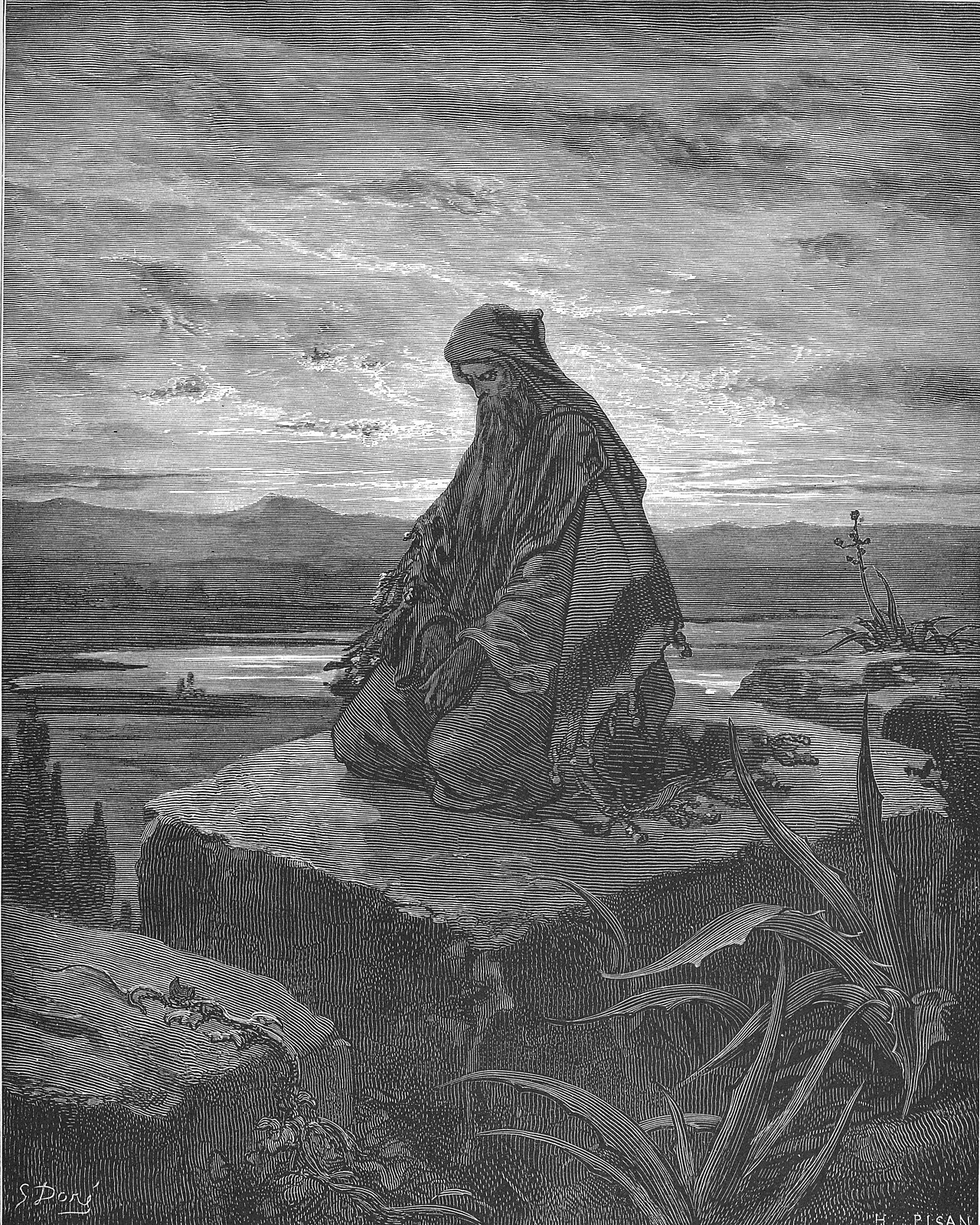
Isaiahchapter 44
28 verses · Isaiah · 8th century BC · The Prophets
who says of Cyrus, ‘My shepherd will fulfill all that I desire,’ who says of Jerusalem, ‘She will be rebuilt,’ and of the temple, ‘Let its foundation be laid.’”
Introduction
Isaiah, The Prophets, Isaiah Overview.
Isaiah wrote this chapter for exiles living in the world's capital of image making, where carved gods were carried through the streets at every festival. It opens with a promise of the Spirit poured out on Israel's children. At its centre stands the longest description of idol making in the Bible, followed step by step from the forest to the workshop. Listen for the plain question the idol maker never asks himself. The chapter ends by naming the ruler who will order Jerusalem rebuilt, long before he was born.
Context
- Who
- Exiles living in the world capital of religious image-making
- What
- A promise of the Spirit, a satire on idol making, and the naming of Cyrus as the LORD's shepherd.
- Where
- Spoken to the exiles in Babylon, and reaching forward to the ruins of Jerusalem and its temple.
- When
- Spoken about 700 to 690 BC by the book's own reading; Cyrus took Babylon in 539 BC.
- Why
- To show that the LORD alone is God and Redeemer, and that the idols of Babylon are the work of human hands.
Historical context
The satire is the most detailed workshop description in the Bible, and it is accurate at every step. The blacksmith works the metal over the coals with tongs, shapes it with hammers, and works with the strength of his arms until he is hungry and his strength fails and he gets thirsty and faint. Ordinary shop conditions. Then the woodworker: he stretches out his measuring line, marks the shape with a scribing tool, works it with planes and a compass, and makes it in the figure of a man, to live in a house.
Show the rest of the historical context, 3 more paragraphs
The wood itself gets a history. He cut down a cedar, or a cypress or an oak, or he planted a fir and the rain made it grow. Then the same log is divided. Half of it he burns in the fire, over that half he roasts meat and eats his fill, and warms himself and says, aha, I am warm, I have seen the fire. And out of the rest he makes a god, his carved image, and falls down to it and prays and says, deliver me, for you are my god. The line that lands is the plainest one: he does not consider, and no one has the sense to say, half of it I burned.
Then Cyrus, named. He is called God's shepherd, who will fulfil all his pleasure, saying to Jerusalem, you shall be built, and to the temple, your foundation shall be laid. Cyrus took Babylon in 539 BC, about a century and a half after Isaiah spoke, and the naming of him this far in advance is the sharpest point in the argument over who wrote this book. Two things the traditional view answers with: the courtroom chapters have just made advance prediction God's own proof of deity, so a name given early is the exhibit rather than the problem; and Josephus records that Cyrus was shown this prophecy about himself and was moved by it.
One line in the same paragraph is a piece of military engineering. God says he dries up the deep and the rivers. Herodotus reports that the Persians took Babylon by diverting the Euphrates upstream until the river channel under the walls was shallow enough to wade.
Significance
Exiles were living in the most impressive religious capital in the world, walking past processions and gilded statues every festival. This chapter told them what they were looking at: expensive carpentry, secured with nails, that could not save the man who paid for it.
Show the rest of the significance, 1 more paragraph
Against it stands the promise that opens and closes the chapter, I have blotted out your transgressions like a thick cloud, and your sins like a mist; return to me, for I have redeemed you. A cloud is gone by afternoon, and nobody can find where it went.
This chapter in Jewish lifeWhat this chapter is in Jewish life and reading.
What is done
Most of this chapter is read aloud in the synagogue. The site's table in src/lib/hebraic/readings.ts records Isaiah 43:21 to 44:23 as the Haftarah of the portion Vayikra, which reads Leviticus 1:1 to 5:26, in both the Ashkenazi and the Sephardi rites. The reading ends at the twenty-third verse, so the last five verses of the chapter stand outside it.
How it is read
Rashi is quoted here from The Judaica Press complete Tanach with Rashi, translated by A. J. Rosenberg, which Sefaria reports as CC-BY, and Ibn Ezra from the Commentary of Ibn Ezra on Isaiah translated by M. Friedlander in 1873, which Sefaria reports as public domain. Rashi hears the chapter's opening as a call to return to the Torah (Rashi on Isaiah 44:1:1). The water poured on the thirsty is the spirit poured on Jacob's descendants (Rashi on Isaiah 44:3:1). At the fourth verse he reads the growth of Israel as growth "through the proselytes who will join them" (Rashi on Isaiah 44:4:1). The one who says "I am the Lord's" at the fifth verse is the perfectly righteous (Rashi on Isaiah 44:5:1). Ibn Ezra reads the two titles of the sixth verse as two times in Israel's life. God is King while they are in their land and redeemer while they are in exile (Ibn Ezra on Isaiah 44:6:1).
The satire of the idol maker is read closely. The idols are witnesses to their worshippers' shame, since they neither see nor know (Rashi on Isaiah 44:9:1). A carpenter burns half the tree for warmth and bows to the other half (Rashi on Isaiah 44:15:1 and 44:19:1). At the twentieth verse Rashi gives two readings of the man who feeds on ashes. The worshipper calls the half-burnt image his provider, or he makes himself the companion of an idol that is ash (Rashi on Isaiah 44:20:1). Ibn Ezra adds a note on where knowledge and understanding sit in the brain (Ibn Ezra on Isaiah 44:18:1).
The Haftarah of Vayikra ends at the twenty-third verse, whose verb Rashi glosses as the opening of the mouth (Rashi on Isaiah 44:23:1). The verse before it calls the people back: God erased their transgressions like a thick cloud in Egypt and in the desert, "Now too, return to Me" (Rashi on Isaiah 44:22:1). The One who formed Jacob from the womb has been his help since the children struggled in the womb, which Rashi cites from Genesis 25:22 (Rashi on Isaiah 44:24:1).
What the rabbis say
The corpus carries forty rabbinic locators on this chapter and the text of none, so each is cited by ref here and none is quoted or paraphrased. On the first verse it holds Midrash Tanchuma, Beshalach 15:1 and Midrash Tehillim 111:2. On the second verse it holds Avot DeRabbi Natan, Recension B 43:18 and Midrash Tehillim 78:3. On the third verse it holds Midrash Aggadah, Deuteronomy 8:15:2 and Midrash Aggadah, Numbers 24:7:2. On the fourth verse it holds Bereshit Rabbati, Parashat Bereshit 17 and Esther Rabbah 9:2. On the fifth verse it holds Avot DeRabbi Natan 36:1 and Bamidbar Rabbah 8:2.
On the sixth verse it holds Bereshit Rabbah 63:8 and Bereshit Rabbah 81:2. On the seventh verse it holds Midrash Tehillim 3:2. On the eighth verse it holds Midrash Sekhel Tov, Bereshit 41:16:2 and Otzar Midrashim, Pesikta, Pesikta Chadata 12. On the ninth verse it holds Avodah Zarah 2a:6 and Jerusalem Talmud Avodah Zarah 1:2:2. On the eleventh verse it holds Bereshit Rabbah 24:7 and Bereshit Rabbati, Parashat Vayetze 51.
On the thirteenth verse it holds Bereshit Rabbah 21:2 and Midrash Aggadah, Genesis 5:2:2. On the fourteenth verse it holds Otzar Midrashim, Midrashim of Rabbi Akiba, The Small Letters and their Purposes 22. On the sixteenth verse it holds Midrash Lekach Tov, Exodus 21:35:7 and Pirkei DeRabbi Eliezer 26:2. On the seventeenth verse it holds Bamidbar Rabbah 9:47 and Mekhilta DeRabbi Shimon Ben Yochai 15:1. On the eighteenth verse it holds Bamidbar Rabbah 16:6 and Bereshit Rabbah 38:4.
On the twenty-first verse it holds Midrash Lekach Tov, Numbers 15:40:1. On the twenty-second verse it holds Aggadat Bereshit 14:1 and Eikhah Rabbah 1:23. On the twenty-third verse it holds Devarim Rabbah 10:4 and Mekhilta DeRabbi Yishmael, Tractate Shirah 6:22. On the twenty-fourth verse it holds Bereshit Rabbah 1:3 and Bereshit Rabbah 3:8. On the twenty-fifth verse it holds Bamidbar Rabbah 20:20 and Ein Yaakov (Glick Edition), Gittin 5:6.
On the twenty-sixth verse it holds Bereshit Rabbah 78:3. On the twenty-seventh verse it holds Eikhah Rabbah, Petichta 23. On the twenty-eighth verse it holds Pirkei DeRabbi Eliezer 32:1. What each of them teaches is a saying of the rabbis, and it is reported as theirs wherever this site quotes one. The quotations wait on a fetch that carries the text.
Sources: Rashi, Rashi on Isaiah 44:1:1 to 44:24:1, The Judaica Press complete Tanach with Rashi, translated by A. J. Rosenberg, reported CC-BY; Ibn Ezra, Ibn Ezra on Isaiah 44:2:1 to 44:18:1, Commentary of Ibn Ezra on Isaiah, translated by M. Friedlander, 1873, reported public domain; The Sefaria corpus, scripts/data/sources/sefaria/isaiah/44.json, the 40 Talmud and Midrash locators of this chapter; The site's own files, src/lib/hebraic/readings.ts, the Haftarah of Vayikra (both rites, Isaiah 43:21 to 44:23), and src/data/bible/chapter-verse-counts.json for the verse count.
The heads below are this chapter's scenes. The numbered points under each are its verses.
I Will Pour Water on Him That Is Thirsty
Isaiah 44:1-3
But now listen, O Jacob My servant: opens the chapter on the servant language of chapter 43. Do not be afraid comes a third time in two chapters, now with the name Jeshurun. Verse 3 joins water and Spirit, and I will pour out My Spirit on your descendants.
Isaiah 44:1
“Yet now hear - This should be read in immediate connection with the previous chapter. ‘Notwithstanding you have sinned, yet now hear the gracious promise which is made in regard to your deliverance.’”
the word of the LORD, your Maker: Jamieson, Fausset and Brown compare the Maker who formed Jacob from the womb with Isaiah 1:2, a father who nourished and raised his children. The name Jeshurun appears in Deuteronomy 32:15. Jerome notes the Septuagint renders it beloved, and the Hebrew teachers read it as the upright one of God.
Isaiah 44:2
“The sense is similar to that in Isa 1:2, "I have nourished and brought up children." Jesurun--A diminutive term of endearment applied to Israel. The full title of affection was Israelun; contracted it became Jeshurun, with an allusion to the Hebrew root, jashar, "upright," "perfect" (see on Isa 42:19, note on "He that is perfect") [GESENIUS], (De 32:15).”
Jamieson, Fausset & Brown · Commentary Critical and Explanatory on the Whole Bible (1871)reformed
pour water on the thirsty land: Barnes reads the water as a figure. In Isaiah, streams and floods often stand for abundant blessing from God, as in Isaiah 35:6 and 7. The second half of the verse names the Spirit and the blessing outright, and Barnes takes that parallel as the key to the first half.
Isaiah 44:3
“For I will pour water - Floods, rivers, streams, and waters, are often used in the Scriptures, and especially in Isaiah, to denote plenteous divine blessings, particularly the abundant influences of the Holy Spirit (see the note at Isa 35:6-7). That it here refers to the Holy Spirit and his influences, is proved by the parallel expressions in the subsequent part of the verse.”
Isaiah 44:4-6
like willows by flowing streams: They will sprout among the grass like willows by flowing streams pictures the growth the water of verse 3 brings. Verse 5 gives ways of claiming the covenant. Verse 6 states the claim, I am the first and I am the last, and there is no God but Me.
Isaiah 44:4
“Rather, "The seed shall spring up as willows among the grass beside canals of water" [HORSLEY]. Or, "They shall spring up among the grass (that is, luxuriantly; for what grows in the midst of grass grows luxuriantly) as willows by the water-courses," which makes the parallel clauses better balanced [MAURER].”
Jamieson, Fausset & Brown · Commentary Critical and Explanatory on the Whole Bible (1871)reformed
1 more voice on this verse
Isaiah 44:4
“They shall spring up as among the grass “They shall spring up as the grass among the waters” - בבין חציר bebeyn chatsir, “They shall spring up to the midst of, or rather, in among, the grass. “This cannot be right: eleven MSS., and thirteen editions, have כבין kebeyn, or כבן keben. Twenty-four MSS. read it without the י yod, בבן beben, in the son of the grass; and so reads the Chaldee; בבן beben, in the son of the grass.”
Adam Clarke · Commentary on the Bible (1810-1826)evangelical
will write on his hand: Gill reads the verse as the fruit of the apostles' preaching, when Gentiles came to belong to the LORD. Procopius of Gaza saw it lived out. Christians of his day would call themselves Jacob or Israel, and the names made them bold to face martyrdom.
Isaiah 44:5
“One shall say, I am the Lord's,.... This expresses the success of the apostles' ministry, not only among the Jews, but more especially among the Gentiles, who were not called by the name of Jacob and Israel; but now should call themselves by those names, as the following clauses show, being called by grace and converted; when they should openly profess their faith in Christ, claim their interest in him, and acknowledge his property in them, and not be ashamed of the name of Christians; and this one, and another, even many should do.”
1 more voice on this verse
Isaiah 44:5
“The former view is simpler. surname himself . . . Israel--MAURER and GESENIUS interpret this as the Hebrew sanctions, answering to their rendering of the parallel second clause, "calls blandly (speaks in honorable terms of) the name of Israel." Retaining English Version, we must, from the Hebrew understand it thus, "Surname himself by the honorable name of Israel" (Isa 45:4).”
Jamieson, Fausset & Brown · Commentary Critical and Explanatory on the Whole Bible (1871)reformed
the King and Redeemer of Israel: Athanasius answered the Arians from this verse. The words first and only, he argued, leave room for the Son, who is the Word and Wisdom of that one God and himself God. Matthew Henry joins the titles King and Redeemer, holding the LORD redeems Israel because he is its King.
Isaiah 44:6
“He is the Lord, Jehovah, self-existent and self-sufficient; and he is the Lord of hosts, of all the hosts of heaven and earth, of angels and men. That he stands in relation to, and has a particular concern for, his church. He is the King of Israel and his Redeemer; therefore his Redeemer because his King; and those that take God for their King shall have him for their Redeemer.”
Matthew Henry · Commentary on the Whole Bible (1707-1721)puritan
1 more voice on this verse
Isaiah 44:6
“For God is one and only and first. But this is not said to the denial of the Son; perish the thought. For he is in that One and First and Only, as being of that One and Only and First the only Word and Wisdom and Radiance. And he too is the First, as the fullness of the godhead of the First and Only, being whole and full God.”
Athanasius of Alexandria · written before 373 · Discourses Against the Arians 3.23patristic
ConnectionsRevelation 1:8, Revelation 22:13
Isaiah 44:7-8
since I established an ancient people: The LORD opens a new round of the trial with “Who then is like Me”. “You are My witnesses” repeats the refrain of chapter 43. The verdict follows in “Is there any God but Me”, with “There is no other Rock” as its answer.
Isaiah 44:7
“To cure them of their inclination to idolatry, which was the sin that did most easily beset them and to reform them from which they were sent into Babylon. As the rod of God is of use to enforce the word, so the word of God is of use to explain the rod, that the voice of both together may be heard and answered.”
Matthew Henry · Commentary on the Whole Bible (1707-1721)puritan
There is no other Rock: Aquinas hears the call to stop fearing as the LORD's assurance that he will not fail the test of his own divinity. Jerome ties the call back to Sinai, where Israel first learned that images are nothing. The title Rock recalls the Song of Moses.
Isaiah 44:8
“Fear ye not - תרהו - to tirehu never occurs. Perhaps it should be תיראו tireu, fear ye. Two MSS. read תירהו tirehu, and one of mine תהרו taharu.”
Adam Clarke · Commentary on the Bible (1810-1826)evangelical
The Carpenter Who Warms Himself and Worships the Rest
Isaiah 44:9-11
All makers of idols are nothing: opens the satire, and the makers become witnesses against their work, Their witnesses fail to see or comprehend. They answer the true witnesses named in verse 8. Verse 11 gathers every workman to stand and answer, and it promises shame for the whole trade.
Isaiah 44:9
“They that make a graven image - A graven image is one that is cut, or sculptured out of wood or stone, in contradistinction from one that is molten, which is made by being cast. Here it is used to denote an image, or an idol-god in general.”
casts an idol which profits him nothing?: Jamieson, Fausset and Brown hear sarcasm in the question. A god fashioned by the man who then worships it is a contradiction, and Paul says in 1 Corinthians 8:4 that an idol is nothing. Barnes rejects the change Lowth made to join this verse to the shame in verse 9.
Isaiah 44:10
“Who hath formed a god - The Septuagint reads this verse in connection with the close of the previous verse, ‘But they shall be ashamed who make a god, and all who sculpture unprofitable things.’ This interpretation also, Lowth, by a change in the Hebrew text on the authority of a manuscript in the Bodleian library, has adopted. This change is made by reading כי kı̂y instead of מי mı̂y in the beginning of the verse. But the authority of the change, being that of a single MS. and the Septuagint, is not sufficient. Nor is it necessary.”
Behold, all his companions: Barnes takes the companions to be everyone joined in making the idol, the same word as Hosea 4:17, where Ephraim is joined to idols. Maker, worshiper and idol form one fellowship. They share one end, and shame falls on the whole company when its gods cannot help.
Isaiah 44:11
“Behold, all his fellows - All that are joined in making, and in worshipping it, are regarded as the fellows, or the companions (חברין chăbērâyn) of the idol-god (see Hos 4:17 - ‘Ephraim is joined to idols’). They and the idols constitute one company or fellowship, intimately allied to each other. Shall be, ashamed - Shall be confounded when they find that their idols cannot aid them.”
Isaiah 44:12-17
The blacksmith takes a tool: The blacksmith and the woodworker are described at length, and the smith grows hungry making a god that cannot feed him. The woodworker cuts down cedars. He burns half of it, and from the rest he makes a god and prays to it, Save me, for you are my god.
Isaiah 44:12
“Perhaps it was a piece of superstition among them for the workman not to eat or drink while he was making a god. The plates with which the smith was to cover the image, or whatever iron-work was to be done about it, he fashioned with hammers, and made it all very exact, according to the model given him.”
Matthew Henry · Commentary on the Whole Bible (1707-1721)puritan
1 more voice on this verse
Isaiah 44:12
“The smith with the tongs, etc. “The smith cutteth off a portion of iron” - מעצד meatstsed, Participium Pihel of עצד atsad, to cut; still used in that sense in the Arabic. See Simonis Lex. Hebrews The Septuagint and Syriac take the word in this form: but they render it sharpeneth the iron. See Castell. Lex. in voce. The sacred writers are generally large and eloquent upon the subject of idolatry; they treat it with great severity, and set forth the absurdity of it in the strongest light.”
Adam Clarke · Commentary on the Bible (1810-1826)evangelical
The woodworker extends a measuring line: Jamieson, Fausset and Brown name the carver's tools as a stylus to scratch the outline, chisels for the carving and a compass for symmetry. They call its human beauty irony. Matthew Henry adds that the carver gives his god the noblest shape, the shape of a weak and dying creature.
Isaiah 44:13
“Or best, the stylus or graver, with which the incision of the outline is made [GESENIUS]. planes--rather, "chisels" or "carving tools," for a plane would not answer for carving. compass--from a Hebrew root, "to make a circle"; by it, symmetry of form is secured. according to . . . beauty of a man--irony.”
Jamieson, Fausset & Brown · Commentary Critical and Explanatory on the Whole Bible (1871)reformed
2 more voices on this verse
Isaiah 44:13
“The form in which it is made is that of a man, a poor, weak, dying creature; but it is the noblest form and figure that he is acquainted with, and, being his own, he has a peculiar fondness for it and is willing to put all the reputation he can upon it.”
Matthew Henry · Commentary on the Whole Bible (1707-1721)puritan
Isaiah 44:13
“The carpenter - The axe is made Isa 44:12, and the carpenter now proceeds to the construction of the god. Stretcheth out his rule - For the purpose of laying out his work, or measuring it. The word rendered here ‘rule,’ however (קו qâv), means properly “a line”; and should be so rendered here. The carpenter stretches out a line, but not a rule. He marketh it out with a line - He marks out the shape; the length, and breadth, and thickness of the body, in the rough and unhewn piece of wood.”
He cuts down cedars: Matthew Henry pictures the idol-maker choosing the tallest tree of the forest, or planting a quicker tree of his own and waiting on the rain. His god owes its very growth to rain from heaven. Aquinas points to Jeremiah 10:3, where the idol is a tree cut from the forest.
Isaiah 44:14
“Or, as some read it, which hath strengthened or lifted up itself among the trees of the forest, the tallest and strongest he can pick out. Or, it may be, it pleases his fancy better to take an ash, which is of a quicker growth, and which was of his own planting for this use, and which has been nourished with rain from heaven.”
Matthew Henry · Commentary on the Whole Bible (1707-1721)puritan
1 more voice on this verse
Isaiah 44:14
“As to its material cause: he has cut down cedars, which are also used for base purposes: the works of the hand of the workman has cut a tree out of the forest (Jer 10:3).”
Thomas Aquinas · written before 1274 · Commentary on Isaiahpatristic
It serves as fuel for man: Justin Martyr made the same case to the emperor. Idols fashioned by craftsmen, set in shrines and called gods, are soulless and dead, and so Christians would bring them no sacrifice. Jamieson, Fausset and Brown point out one tree supplies the fire for his bread and the god he worships.
Isaiah 44:15
“The same tree that furnishes the material for the god is in part used as fuel for a fire to cook his meals and warm himself! thereto--rather, "he falleth down before them," that is, such images [MAURER].”
Jamieson, Fausset & Brown · Commentary Critical and Explanatory on the Whole Bible (1871)reformed
1 more voice on this verse
Isaiah 44:15
“And neither do we honour with many sacrifices and garlands of flowers such deities as men have formed and set in shrines and called gods; since we see that these are soulless and dead, and have not the form of God (for we do not consider that God has such a form as some say that they imitate to His honour), but have the names and forms of those wicked demons which have appeared. For why need we tell you who already know, into what forms the craftsmen, carving and cutting, casting and hammering, fashion the materials?”
Justin Martyr · written before 165 · The First Apology, Chapter IXpatristic
he roasts meat on that half: The verse lingers on ordinary comfort. A man eats his roast and warms himself, and his cry is the only speech until he prays to the other half in verse 17. Jamieson, Fausset and Brown note that one tree supplies the fuel and the god alike.
Isaiah 44:16
“With part thereof he eateth flesh - That is, he prepares flesh to eat, or prepares his food. He roasteth roast - He roasts meat.”
1 more voice on this verse
Isaiah 44:16
“With part “And with part” - Twenty-three MSS., the Septuagint, and Vulgate add the conjunction ו vau, and ועל veal.”
Adam Clarke · Commentary on the Bible (1810-1826)evangelical
From the rest he makes a god: Matthew Henry quotes the Roman poet Martial. The one who carves a face makes no god, and the one who prays to it makes the god. Clarke lists four postures of Hebrew worship, from bowing the head to lying flat, and the carver gives such worship to a graven image.
Isaiah 44:17
“He falleth down unto it - There were four forms of adoration used among the Hebrews: 1. השתחוה Hishtachavah, The prostration of the whole body. 2. קדד Kadad, The bowing of the head. 3. כרע Cara, The bending of the upper part of the body down to the knees. 4. ברך Barach, Bowing the knee, or kneeling. See on Isa 49:23 (note).”
Adam Clarke · Commentary on the Bible (1810-1826)evangelical
Isaiah 44:18-20
shut their eyes so they cannot see: They do not comprehend or discern names the idol maker's blindness as a judgment, the language 6:10 first spoke over the nation. Yet no one considers the plain question, Shall I bow down to a block of wood? He feeds on ashes, and his deluded heart has led him astray.
Isaiah 44:18
“He hath shut their eyes “Their eyes are closed up” - The Septuagint, Chaldee, and Vulyate, for טח tach, read טחו tachu. See note on Isa 6:10.”
Adam Clarke · Commentary on the Bible (1810-1826)evangelical
no one considers in his heart: The idol-maker's own day is retold in his words, bread baked and meat roasted, and still he asks nothing. Detestable is the Law's word for an idol. Theodoret reads this failure to reason as folly, and he holds that only the Spirit promised in verse 3 can deliver it.
Isaiah 44:19
“And none considereth in his heart - Margin, ‘Setteth to.’ He does not place the subject near his heart or mind; he does not think of it.”
He feeds on ashes: Clarke calls feeding on ashes a proverb for wasted labor. Hosea 12:1 uses the same figure when it pictures Ephraim feeding on the wind. The lie in his right hand is the idol he holds, and his deluded heart keeps him from naming it.
Isaiah 44:20
“He feedeth on ashes - He feedeth on that which affordeth no nourishment; a proverbial expression for using ineffectual means, and bestowing labor to no purpose. In the same sense Hosea says, “Ephraim feedeth on wind.” Hos 12:1.”
Adam Clarke · Commentary on the Bible (1810-1826)evangelical
I Have Blotted Out Thy Transgressions as a Thick Cloud
Isaiah 44:21-22
Remember these things, O Jacob: turns the satire's evidence on the servant. I have blotted out your transgressions like a cloud, and your sins like a mist pictures the pardon of 43:25 as a cloud that passes. Return to Me, for I have redeemed you makes the pardon an invitation.
Isaiah 44:21
“Two great truths are abundantly made out in these verses:-- I. That the people of God are a happy people, especially upon account of the covenant that is between them and God. The people of Israel were so as a figure of the gospel Israel.”
Matthew Henry · Commentary on the Whole Bible (1707-1721)puritan
your sins like a mist: Clarke hears an allusion to the smoke of the sin offering, scattered. Spurgeon notes the promise came to idolatrous Israel, who had forsaken “the fountain of living water” for “broken cisterns” at Jeremiah 2:13. Still the call stands, “Return to Me, for I have redeemed you.”
Isaiah 44:22
“I have blotted out, as a thick cloud, thy transgressions, and, as a cloud, thy sins “I have made thy transgressions vanish away like a cloud, and thy sins like a vapor” - Longinus admired the sublimity of the sentiment, as well as the harmony of the numbers, in the following sentence of Demosthenes: Τουτο το ψηφισμα τον τοτε τῃ πολει τερισταντα κινδυνον παρελθειν εποιησεν ὡσπερ νεφος. “This decree made the danger then hanging over the city pass away like a cloud.” Probably Isaiah alludes here to the smoke rising up from the sin-offering, dispersed speedily by the wind.”
Adam Clarke · Commentary on the Bible (1810-1826)evangelical
1 more voice on this verse
Isaiah 44:22
“THIS declaration was not made to a pious and praying people, who kept near their God, but was spoken to idolatrous Israel—to those who, after having drunk from the fountain of living waters, turned aside to drink the drops that were to be found in broken cisterns.”
Charles Spurgeon · written before 1892 · The Metropolitan Tabernacle Pulpit, Sermon No. 2563: “Grace for the Guilty” (lightly modernized text, CCEL edition)Particular Baptist
Sing for joy, O heavens: calls creation to celebrate a redemption Jacob cannot yet see. Its call to the mountains, you forests and all your trees, answers the idol maker's trees. For the LORD has redeemed Jacob, and revealed His glory in Israel joins rescue and glory as one act.
Isaiah 44:23
“Call to inanimate nature to praise God; for it also shall share in the coming deliverance from "the bondage of corruption" (Ro 8:20, 21). done it--effected redemption for both the literal and spiritual Israel. lower parts, &c.--antithetical to "heavens"; "mountains," "forest," and "tree," are the intermediate objects in a descending gradation (see Ps 96:11, 12).”
Jamieson, Fausset & Brown · Commentary Critical and Explanatory on the Whole Bible (1871)reformed
2 more voices on this verse
Isaiah 44:23
“It is matter of comfort to us to see God's glory interested in the deliverances of the church; for therefore he will certainly redeem Jacob, because thus he will glorify himself. And this assures us that he will perfect the redemption of his saints by Jesus Christ, because there is a day set when he will be glorified and admired in them all.”
Matthew Henry · Commentary on the Whole Bible (1707-1721)puritan
Isaiah 44:23
NO DOUBT THIS PROPHECY had a fulfillment in the restoration of the captive Jews from Babylon, in the rebuilding of the temple, and the completion of the walls of Jerusalem. This made the nation rejoice with unspeakable joy, and made them cry, "Sing together, ye waste places of Jerusalem; for the Lord hath comforted his people, he hath redeemed Jerusalem."
Cyrus My Shepherd Shall Say: Jerusalem, Be Built
Isaiah 44:24-26
who alone stretched out the heavens: I am the LORD, who has made all things, who alone stretched out the heavens renews the creation claim. Verse 25 turns the same power on false prediction. Verse 26 confirms the message of His servant and says of Jerusalem, She will be inhabited, while the city still stood.
Isaiah 44:24
And when the prophet says concerning the creation, "That stretches forth the heavens alone," and when God says, "I only stretch out the heavens," it is made plain to everyone that in the "Only" is signified also the Word of the Only, in whom "all things were made" and without whom "was made not one thing."
Athanasius of Alexandria · written before 373 · Discourses Against the Arians 3.24.9patristic
1 more voice on this verse
Isaiah 44:24
“Note, The work of redemption which God has by his Son wrought for us encourages us to hope for all promised blessings from him. He that has redeemed us at so vast an expense will not lose his purchase.”
Matthew Henry · Commentary on the Whole Bible (1707-1721)puritan
foils the signs of false prophets: Barnes notes that the word for signs, othoth, is the one usually used for miracles. The LORD breaks the signs diviners offer as proof. Matthew Henry carries the verse forward to the gospel, where those who come to know Christ count their former learning as foolishness beside him.
Isaiah 44:25
“That frustrateth - Hebrew, ‘Breaking:’ that is, destroying, rendering vain. The idea is, that that which necromancers and diviners relied on as certain demonstration that what they predicted would be fulfilled, God makes vain and inefficacious. The event which they predicted did not follow, and all their alleged proofs that they were endowed with divine or miraculous power he rendered vain. The tokens - Hebrew, אתות 'othôth - ‘Signs.’ This word is usually applied to miracles, or to signs of the divine interposition and presence.”
1 more voice on this verse
Isaiah 44:25
“Finding they cannot go on with their projects, they are forced to quit them; and so he makes the judges fools, and makes their knowledge foolish. Those that are made acquainted with Christ see all the knowledge they had before to be foolishness in comparison with the knowledge of him.”
Matthew Henry · Commentary on the Whole Bible (1707-1721)puritan
confirms the message of His servant: Barnes weighs two readings of the servant, Isaiah himself or the prophets, and leans to the prophets, for the word messengers is plural. Jamieson, Fausset and Brown see the Messiah as the last and fullest of those messengers, citing Malachi 3:1. They take counsel to mean prediction of the future.
Isaiah 44:26
“That confirmeth the word of his servant - Probably the word ‘servant’ here is to be taken in a collective sense, as referring to the prophets in general who had foretold the return of the Jews to their own land, and the rebuilding of Jerusalem. Or it may be, that the prophet refers more particularly to himself as having made a full prediction of this event. The parallel expression, ‘his messengers,’ however, is in the plural number, and thus it is rendered probable that the word here refers to the prophets collectively.”
1 more voice on this verse
Isaiah 44:26
“Antitypically, and ultimately, Messiah, who is the consummating embodiment of all the prophets and messengers of God (Mal 3:1; Joh 10:36); hence the singular, "His servant." counsel--predictions; prophets' counsels concern the future (compare "counsellor," Isa 41:28).”
Jamieson, Fausset & Brown · Commentary Critical and Explanatory on the Whole Bible (1871)reformed
Isaiah 44:27-28
who says to the depths of the sea: Be dry, and I will dry up your currents names the power over water the exodus showed. Verse 28 first names Cyrus, My shepherd will fulfill all that I desire, a foreign king called shepherd of a people not his own. It foretells the temple, Let its foundation be laid.
Isaiah 44:27
"The deep" is applied to Euphrates as "sea" (Jer 51:32, 36). "Rivers" refers to the artificial canals from the Euphrates made to irrigate the country; when it was turned off into a different bed (namely, a lake, forty miles square, which was originally formed to receive the superfluous water in an inundation), the canals became dry.
Jamieson, Fausset & Brown · Commentary Critical and Explanatory on the Whole Bible (1871)reformed
1 more voice on this verse
Isaiah 44:27
“That saith to the deep, Be dry - Lowth supposes, that this refers to the fact that Cyrus took Babylon by diverting from their course the waters of the river Euphrates, and thus leaving the bed of the river dry, so that he could march his army under the walls of the city (see the notes at Isa. 13; 14) With this interpretation, also, Vitringa, John II Michaelis, Grotius, Rosenmuller, and some others, accord.”
who says of Cyrus: Jerome explains why the Septuagint differs here. Read with the letter resh, the word is shepherd, and read with daleth it means one who understands, two letters told apart by a stroke. Gill records that the name Cyrus, Coresh in Hebrew, is said in Persian to mean the sun.
Isaiah 44:28
“That saith of Cyrus, He is my shepherd “Who saith to Cyrus, Thou art my shepherd” - Pastor meus es; Vulg. The true reading seems to be רעי אתה roi attah; the word אתה attah, has probably been dropped out of the text. The same word is lost out of the text, Psa 119:57. It is supplied in the Septuagint by the word ει, thou art. Saying to Jerusalem - For ולאמר velemor, the Septuagint and Vulgate read האומר haomer.”
Adam Clarke · Commentary on the Bible (1810-1826)evangelical
2 more voices on this verse
Isaiah 44:28
“That saith of Cyrus, he is my shepherd,.... Or Coresh, as his name in the Hebrew language is; and in the Persian tongue signifies the "sun"; from whence he had his name, as Ctesias (q) and Plutarch (r) say; to which the Hebrew word "cheres", which signifies the "sun", has some affinity; though Joseph Scaliger (s) would have the name of Cyrus to signify "food" in the Persian language, and which answers to his character as a shepherd.”
Isaiah 44:28
“Cyrus - Whom God here mentions by his proper name, two hundred years before he was born, that this might be an undeniable evidence of the exactness of God's fore-knowledge, and a convincing argument to conclude this dispute between God and idols.”
John Wesley · Explanatory Notes upon the Old Testament (1765)evangelical
Keep studying
Studies9
Places1
Words12
Subjects1
Sources for this chapter
The summary
Jamieson, Fausset & Brown, Commentary Critical and Explanatory; John Calvin, Commentaries; John Wesley, Notes on the Old Testament and Matthew Henry, Complete Commentary.
The exposition
Adam Clarke, Commentary on the Bible; Albert Barnes; Athanasius of Alexandria, Discourses Against the Arians 3.23; Charles Spurgeon, The Metropolitan Tabernacle Pulpit, Sermon No. 2563: “Grace for the Guilty” (lightly modernized text, CCEL edition); Franz Delitzsch, Biblical Commentary on the Prophecies of Isaiah; Jamieson, Fausset & Brown, Commentary Critical and Explanatory on the Whole Bible; Jerome, Commentary on Isaiah; John Calvin, Commentary on the Book of the Prophet Isaiah; John Gill; Justin Martyr, The First Apology, Chapter IX; Matthew Henry, Commentary on the Whole Bible; Procopius of Gaza, COMMENTARY ON ISAIAH 44:1-5; Theodoret of Cyrus, COMMENTARY ON ISAIAH 13:44.20 and Thomas Aquinas, Commentary on Isaiah.