
Genesischapter 46
34 verses · Moses, by tradition · 15th to 13th century BC · The Law
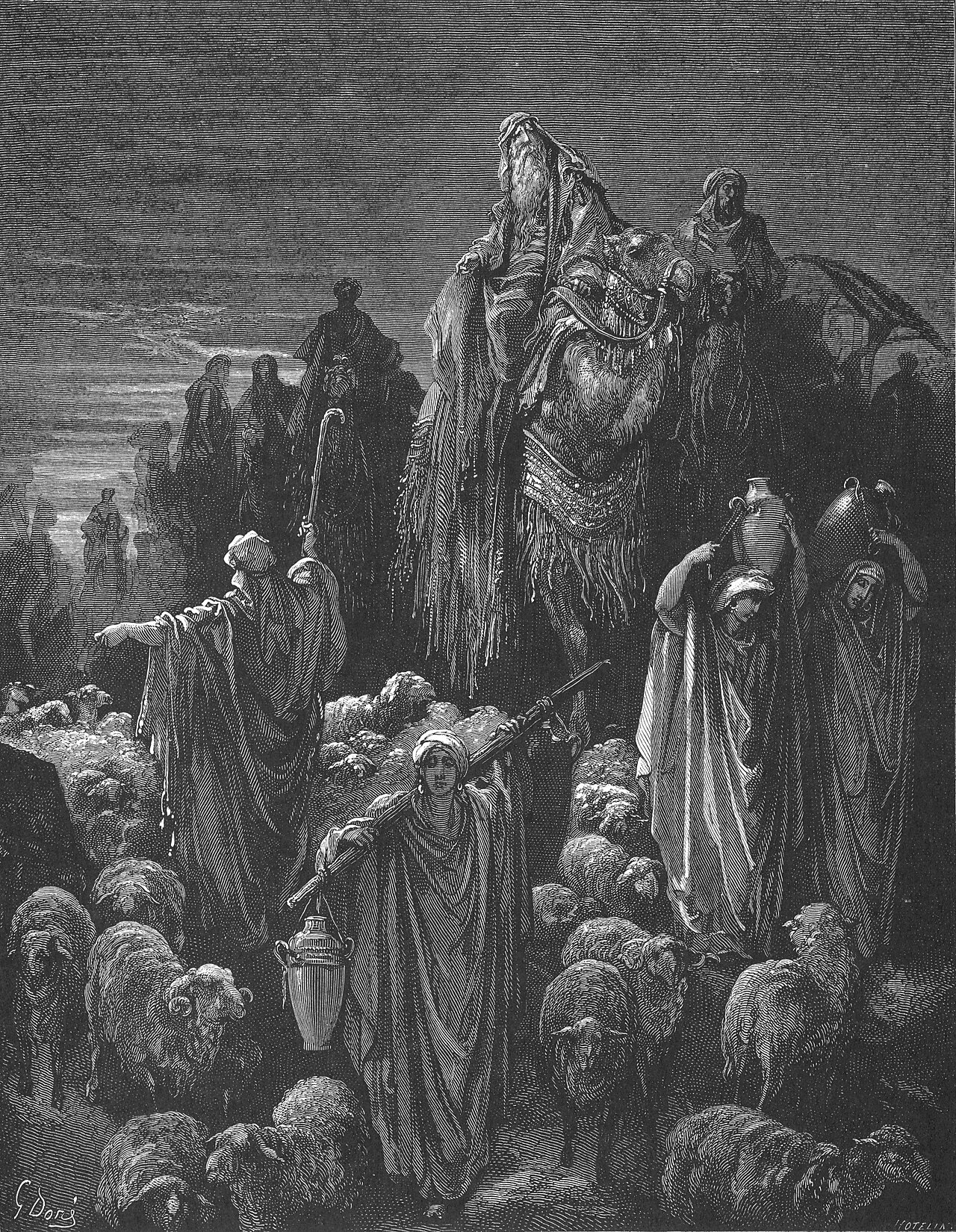
So Israel set out with all that he had, and when he came to Beersheba, he offered sacrifices to the God of his father Isaac.
Introduction
Moses, by tradition, The Law, Genesis Overview.
Here a family of seventy leaves the land God promised them, and Genesis stops to name every one of them. Jacob is an old man, and the last time his grandfather went down to Egypt it went badly. Israel heard this chapter on the road back out, a nation grown from these names. Listen for the promise given at night before the wagons move, since it governs the four centuries that follow. The long list of names is part of the teaching and repays a slow reading. The chapter closes on how shepherds will live among farmers.
Context
- Who
- Israel in the wilderness, seventy people grown into a nation and walking the road back
- What
- A narrative of Jacob's move to Egypt under God's promise at Beersheba, with the roll of the seventy who went down.
- Where
- Beersheba in the south of Canaan, and then Goshen in the eastern Nile delta.
- When
- About 1875 BC on the traditional chronology, the year Jacob's household went down.
- Why
- To show that God sent Israel into Egypt with a promise to make them a great nation there and to bring them up again.
Historical context
The chapter is Jacob's, since he sacrifices at the last town in the land, receives a word from God at night, and takes his whole house out of Canaan. The time is the second famine year, and the place is Beersheba first and the eastern delta after, Beersheba being his father's ground, where the LORD had appeared to Isaac at 26:24.
Show the rest of the historical context, 3 more paragraphs
The occasion is a departure that needed permission, since Isaac had been forbidden to go down to Egypt at 26:2. Jacob is sent down with a promise attached, that God will make him a great nation there and will bring him up again. The roll of seventy names is a household register of the kind kept for officials receiving an immigrant clan.
What a first hearer knew about Goshen is why it was the right piece of Egypt. It is well watered pasture on the fringe of the settled Nile land, close to the Asiatic frontier and away from the temple cities. James K. Hoffmeier records Egyptian border documents that describe letting Semitic herdsmen in with their flocks to keep them alive.
The coaching at verses 33 and 34 turns on an Egyptian attitude. Shepherds were detestable to Egyptians, which is a settled agricultural country's contempt for the herding peoples on its border, and here it works in the family's favour.
Significance
Seventy people went down. The generation hearing this had come out numbering hundreds of thousands, which is the promise of Beersheba paid in full.
Show the rest of the significance, 1 more paragraph
The contempt that put them in Goshen is what kept them there, separate and still a family when the exodus came.
This chapter in Jewish lifeWhat this chapter is in Jewish life and reading.
How it is read
This chapter is a genealogy set inside a journey, and the classical readers work both halves. Rashi takes the sacrifice at Beersheba as a question about which father is named, and answers from a rule of honour: "The duty of honouring one's father is more imperative than that of honouring one's grandfather", on Genesis Rabbah 94:5 (Rashi on Genesis 46:1:2, the Pentateuch with Rashi's commentary by M. Rosenbaum and A. M. Silbermann, 1929 to 1934, public domain). The doubled name in the night vision he reads as warmth, "The repetition of the name is a mark of affection", citing the Sifra (Rashi on Genesis 46:2:1). The command not to fear he grounds in Jacob's grief at leaving the land, on Pirkei DeRabbi Eliezer 39, and the promise to bring him up again he reads as a promise of burial: "Here He promised him that he would be buried in the Holy Land", on the Jerusalem Talmud at Sotah 1:10 (Rashi on Genesis 46:3:1 and 46:4:1). In the name lists he supplies the identifications the text leaves out, naming the granddaughters who came down, "these were Serah, the daughter of Asher, and Jochebed, the daughter of Levi" (Rashi on Genesis 46:7:1), and he explains why Rachel alone is called Jacob's wife in the list. At the meeting in Goshen he keeps one detail: "He himself harnessed the horses to the chariot being eager to show honour to his father", on Genesis Rabbah 95 (Rashi on Genesis 46:29:1). Ramban explains the order of the lists as a convention of Scripture, "It is customary for Scripture to first enumerate the sons of the mistresses together" (Ramban on Genesis 46:18:1, the Commentary on the Torah by Ramban, translated and annotated by Charles B. Chavel, Shilo Publishing House, New York, 1971 to 1976, CC-BY), and he reads Joseph's brief to his brothers closely: "Joseph told them that they are shepherds but that they do not tend to the cattle of others" (Ramban on Genesis 46:32:1). Sforno notices that the sons are called the children of Israel here for the first time and reads the change of name as the mark of what they become from this journey on (Sforno on Genesis 46:5:1, translated by Eliyahu Munk, HaChut Hameshulash, CC-BY). Ibn Ezra comments here at 46:21:1, 46:23:1 and 46:27:1 and Malbim at 46:33:1, and the corpus holds no English of either under a licence permitting quotation, so they stand as citations.
What the rabbis say
The corpus records forty rabbinic locators on this chapter, thirty-six of them Midrash and four Talmud. Bamidbar Rabbah is the densest work here, cited at 2:11, 3:8, 8:4, 11:2, 13:20, 14:8, 14:21 and 21:8, which is what a list of the tribes draws from a midrash on the book of Numbers. Bereshit Rabbati is cited at Parashat Vayigash 3, 4, 8, 33, 36 and 39 and at Parashat Vayishlach 52, Midrash Sekhel Tov at Bereshit 46:6:1, 46:9:1, 46:11:1, 46:18:1, 46:22:1 and 46:33:1, and Bereshit Rabbah at 55:8, 61:4, 94:4, 94:5, 94:7, 96:5 and 96:2. Aggadat Bereshit is cited at 64:2, 64:3 and 79:1, Midrash Aggadah at Genesis 46:7:1 and at Numbers 26:40:4, Midrash Lekach Tov at Genesis 46:32:1 and at Numbers 26:15:1, and Mekhilta DeRabbi Shimon Ben Yochai at 14:2. The four Talmud locators are Berakhot 13a:12 at the calling of the name, Berakhot 56b:19 at the promise of the descent, Avodah Zarah 9b:3 at the setting out and Bava Batra 143b:6 in the name lists. Rashi hands on further sayings with their locators, among them Genesis Rabbah 94:5 and 95, the Sifra at Vayikra Dibbura d'Nedavah chapter 1 12, Pirkei DeRabbi Eliezer 39, Yevamot 13b and the Jerusalem Talmud at Sotah 1:10.
Sources: Rashi, Rashi on Genesis 46:1:1, 46:1:2, 46:2:1, 46:3:1, 46:4:1, 46:6:1, 46:7:1, 46:8:1, 46:10:1, 46:15:1, 46:19:1, 46:26:1, 46:28:1, 46:29:1, 46:30:1, 46:31:1 and 46:34:1, the Pentateuch with Rashi's commentary by M. Rosenbaum and A. M. Silbermann, 1929 to 1934, public domain; Ramban, Ramban on Genesis 46:18:1 and 46:32:1, the Commentary on the Torah by Ramban (Nachmanides), translated and annotated by Charles B. Chavel, Shilo Publishing House, New York, 1971 to 1976, CC-BY; Sforno, Sforno on Genesis 46:5:1, translated by Eliyahu Munk, HaChut Hameshulash, CC-BY; Ibn Ezra, Ibn Ezra on Genesis 46:21:1, 46:23:1 and 46:27:1, cited only, no English version in the corpus under a licence permitting quotation; Malbim, Malbim on Genesis 46:33:1, cited only; Midrash, Bamidbar Rabbah 2:11, 3:8, 8:4, 11:2, 13:20, 14:8, 14:21 and 21:8; Bereshit Rabbati, Parashat Vayigash 3, 4, 8, 33, 36 and 39 and Parashat Vayishlach 52; Midrash Sekhel Tov, Bereshit 46:6:1, 46:9:1, 46:11:1, 46:18:1, 46:22:1 and 46:33:1 and 43:32:5; Bereshit Rabbah 55:8, 61:4, 94:4, 94:5, 94:7, 96:2 and 96:5; Aggadat Bereshit 64:2, 64:3 and 79:1; Midrash Aggadah, Genesis 46:7:1 and Numbers 26:40:4; Midrash Lekach Tov, Genesis 46:32:1 and Numbers 26:15:1; Mekhilta DeRabbi Shimon Ben Yochai 14:2; the Sifra at Vayikra Dibbura d'Nedavah chapter 1 12 and Pirkei DeRabbi Eliezer 39, as Rashi cites them; Babylonian Talmud, Berakhot 13a:12 and 56b:19, Avodah Zarah 9b:3, Bava Batra 143b:6; Yevamot 13b as Rashi cites it; Jerusalem Talmud, Sotah 1:10, as Rashi cites it at Rashi on Genesis 46:4:1.
The heads below are this chapter's scenes. The numbered points under each are its verses.
Do Not Fear to Go Down
Genesis 46:1-2
he offered sacrifices to the God of his father Isaac: Beersheba is the last town in the land on the road to Egypt, and Israel stops to sacrifice before he crosses out of it. The ground is his father's, where the LORD appeared to Isaac at 26:24 and named himself the God of Abraham. God speaks that night in a vision and calls the old name twice, Jacob, Jacob. He answers, Here I am.
Genesis 46:1
“In his devotion he had an eye to God as the God of his father Isaac, that is, a God in covenant with him, for by Isaac the covenant was entailed upon him. He offered sacrifices, extraordinary sacrifices, besides those at his stated times.”
John Wesley · Explanatory Notes upon the Old Testament (1765)evangelical
2 more voices on this verseWhat preachers and commentators have said about this verse, in their own words.
Genesis 46:1
NOTICE in this passage the two names which are mentioned. "Israel took his journey and God spoke unto Israel in the visions of the night and said, Jacob, Jacob." "Jacob" was the name of his weakness—"Israel" was the title of his strength. "Jacob" was the name of his birth-nature—"Israel" was the name of his new and spiritual nature. When Israel set out to go down into Egypt and see his son Joseph, he started in great vigor and strength for an old man—faith made him full of force. Therefore we read, "Israel took his journey."
Genesis 46:1
“Israel took his journey with all that he had--that is, his household; for in compliance with Pharaoh's recommendation, he left his heavy furniture behind.”
Jamieson, Fausset & Brown · Commentary Critical and Explanatory on the Whole Bible (1871)reformed
God spoke to Israel in a vision: God calls Israel by his old name twice, as the angel of the LORD called Abraham at 22:11 and God called Moses at Exodus 3:4. Jacob answers as his grandfather did, here I am. These are the last words God speaks in Genesis, given the night before the family goes down to Egypt.
Genesis 46:2
“God spake unto Israel--Here is a virtual renewal of the covenant and an assurance of its blessings. Moreover, here is an answer on the chief subject of Jacob's prayer and a removal of any doubt as to the course he was meditating.”
Jamieson, Fausset & Brown · Commentary Critical and Explanatory on the Whole Bible (1871)reformed
Do not be afraid to go down to Egypt: Isaac had been told to stay out of Egypt at 26:2, and Jacob is sent down with a promise attached. God speaks to the fear first, telling Jacob not to be afraid to go down. Then comes the promise, that He will make a great nation there. The nation is made outside the land.
Genesis 46:3
“Fear not to go down into Egypt - It appears that there had been some doubts in the patriarch’s mind relative to the propriety of this journey; he found, from the confession of his own sons, how little they were to be trusted. But every doubt is dispelled by this Divine manifestation. 1. He may go down confidently, no evil shall befall him. 2. Even in Egypt the covenant shall be fulfilled, God will make of him there a great nation.”
Adam Clarke · Commentary on the Bible (1810-1826)evangelical
1 more voice on this verse
Genesis 46:3
“It appears fitting indeed after these things, to contemplate and look into what God says to Israel himself through the vision and how he sends him to Egypt strengthening and encouraging him as if he were setting out to some struggles. For he says, "Fear not to descend into Egypt." This is to say, you shall contend "against principalities and powers and against the rulers of this world of this darkness"—which is figuratively called Egypt—fear not, be not afraid.”
Origen of Alexandria · written before 253 · HOMILIES ON GENESIS 15.5patristic
I will go down with you to Egypt, and I will surely bring you back: The going down and the coming up are promised in one breath, so the Exodus is spoken before the bondage begins. Joseph's own hands will close your eyes is the personal half, and it is kept within this book. Jacob's body goes back to Canaan at 50:13, and the nation comes up generations later. Matthew 2:15 reads Hosea 11:1 of Christ called out of Egypt.
Genesis 46:4
“Our God himself also exhorts that people with his own prophecy and promises them advancement in the faith, the fruit of his gift, for he says to them, "Joseph shall put his hand on your eyes." It was not that the holy patriarch was troubled as to who should close his eyes, although in the clear understanding of it a natural love is also being expressed. For we often desire to embrace those whom we love.”
Ambrose of Milan · written before 397 · ON JOSEPH 14.83patristic
1 more voice on this verse
Genesis 46:4
“I will also surely bring thee up again--As Jacob could not expect to live till the former promise was realized, he must have seen that the latter was to be accomplished only to his posterity. To himself it was literally verified in the removal of his remains to Canaan; but, in the large and liberal sense of the words, it was made good only on the establishment of Israel in the land of promise.”
Jamieson, Fausset & Brown · Commentary Critical and Explanatory on the Whole Bible (1871)reformed
Genesis 46:5-6
Jacob departed from Beersheba: They go down in the wagons Pharaoh sent, with their children and their wives. They take the livestock and the possessions they had acquired in Canaan. The land itself stays behind them, and they carry out only what they had gathered in it. Jacob and all his offspring go into Egypt together.
They also took the livestock: Pharaoh had told them at 45:20 to pay no regard to their goods, and they brought the herds anyway. The flocks were their trade, and at 46:32 Joseph presents them to Pharaoh as shepherds with their livestock. The animals earn them Goshen.
The house goes down whole, sons and grandsons, daughters and granddaughters, with nobody left behind. Genesis names his offspring four ways in one verse, so the count takes in the women as well as the men. Matthew Henry notes they went the more willingly for holding none of Canaan yet. Jacob took all of them with him to Egypt.
Genesis 46:7
“It is probable that they had continued to live together in common with their father; and therefore when he went they all went, which perhaps they were the more willing to do, because, though they had heard that the land of Canaan was promised them, yet, to this day, they had none of it in possession.”
Matthew Henry · Commentary on the Whole Bible (1707-1721)puritan
Seventy Souls Who Came to Egypt
Genesis 46:8-11
these are the names of the sons of Israel: The roll opens with Reuben, Jacob's firstborn, who loses the birthright in chapter 49 for what he did with his father's bed. Simeon and Levi stand next, the two who took Shechem by the sword, and the same blessing answers their anger. Shaul is marked the son of a Canaanite woman, one of the few mothers named in the list. Exodus 1:1 repeats the line and counts from it.
Genesis 46:8
“These are the names of the children of Israel - It may be necessary to observe here, First, that several of these names are expressed differently elsewhere, Jemuel for Nemuel, Jachin for Jarib, Gershon for Gershom, etc.; compare Num 26:12; 1Ch 4:24. But it is no uncommon case for the same person to have different names, or the same name to be differently pronounced; See Clarke on Gen 25:18 (note).”
Adam Clarke · Commentary on the Bible (1810-1826)evangelical
1 more voice on this verse
Genesis 46:8
“In the speech of Stephen (Ac 7:14) the number is stated to be seventy-five; but as that estimate includes five sons of Ephraim and Manasseh (1Ch 7:14-20), born in Egypt, the two accounts coincide.”
Jamieson, Fausset & Brown · Commentary Critical and Explanatory on the Whole Bible (1871)reformed
Hanoch, Pallu, Hezron, and Carmi: Reuben's four sons become the four clans of his tribe in Numbers 26:5 to 6. Names repeat across the tribes. A Hezron stands in Judah's line at verse 12, and Achan's father at Joshua 7:1 is a Carmi of Judah.
Genesis 46:9
“And the sons of Reuben, Hanoch, and Phallu, and Hezron, and Carmi. From whom came the families named after them, of which they were the heads, Num 26:5.”
Jemuel, Jamin, Ohad, Jachin, Zohar: Numbers 26:12 to 13 lists the clans of Simeon with five names. Ohad is missing there, Jemuel appears as Nemuel, and Zohar as Zerah. Ohad founded no clan that the later census records.
Gershon, Kohath, and Merari: Levi's three sons head the families that carry the tabernacle in Numbers 3 and 4. Kohath is the grandfather of Moses and Aaron. The tribe scattered at 49:7 for its anger becomes the tribe of the priests.
Genesis 46:11
“And the sons of Levi, Gershon, Kohath, and Merari. From these sprung the priests and Levites, see Num 3:1.”
The sons of Judah: Er, Onan, Shelah, Perez, and Zerah: Judah's line is the only one in the roll with deaths written into it, Er and Onan, who died in the land of Canaan. The line runs on through Perez and Zerah, the twins Tamar bore him in chapter 38. Perez broke through ahead of the scarlet thread, the younger set before the elder again. Ruth ends by tracing David back to Perez.
Genesis 46:12
“The sons of Pharez were Hezron and Hamul - It is not likely that Pharez was more than ten years of age when he came into Egypt, and if so he could not have had children; therefore it is necessary to consider Hezron and Hamul as being born during the seventeen years that Jacob sojourned in Egypt, See Clarke on Gen 46:8 (note): and it appears necessary, for several reasons, to take these seventeen years into the account, as it is very probable that what is called the going down into Egypt includes the seventeen years which Jacob spent there.”
Adam Clarke · Commentary on the Bible (1810-1826)evangelical
Genesis 46:13-15
The sons of Issachar: Tola, Puvah, Job, and Shimron: Issachar and Zebulun complete Leah's six sons, and her branch is the largest in the count, thirty-three of the seventy. She is the wife Jacob had not chosen, and the LORD opened her womb at 29:31 while Rachel stayed barren. Out of Leah come Levi and Judah, the priesthood and the kingship. Dinah stands in her total, the only daughter named.
Genesis 46:13
“And the sons of Issachar, Tola, and Phuvah; and Job, and Shimron. The first of these was the father of a numerous race in the days of David, their number was 22,600; See Gill on 1Ch 7:2; the second is called Puah, and the third Jashub, and the fourth Shimrom, 1Ch 7:1; and were all the heads of families, as appears from the places referred to.”
Sered, Elon, and Jahleel: Each of Zebulun's three sons gives his name to a clan in Numbers 26:26. A later Elon of Zebulun judges Israel for ten years at Judges 12:11. The seventy who go down become the clans who come up.
Genesis 46:14
“And the sons of Zebulun, Sered, and Elon, and Jahleel. Whose names are the same in Num 26:26.”
The total number of sons and daughters was thirty-three: The names listed under Leah come to thirty-two once Er and Onan are left out as dead and Dinah is added. Jacob himself makes the thirty-third, and verse 8 sets him at the head of the roll. The seventy of verse 27 counts him the same way.
Genesis 46:16-18
The sons of Gad: Ziphion, Haggi: Gad and Asher are Zilpah's, and between them they bring sixteen, more than Rachel's fourteen. The list keeps saying who gave whom to whom, Zilpah to Leah and Bilhah to Rachel, both out of Laban's hand. Laban is the man Jacob worked twenty years for. Serah, Asher's daughter, is the second woman named in the roll after Dinah.
Genesis 46:16
“And the sons of Gad,.... A son of Jacob by Zilpah, Leah's maid; for the historian, before he proceeds to give an account of his sons by Rachel, finishes the account of all his sons by Leah and her maid: Ziphion, and Haggi, Shuni, and Ezbon, and Eri, and Arodi, and Areli; in all seven; the same number is given, and in the same order, Num 26:15.”
Heber and Malchiel: The roll reaches a fourth generation here, with Jacob's great-grandsons Heber and Malchiel. Both return as clans of Asher in Numbers 26:45. Serah is named there as well, at 26:46.
Genesis 46:17
“And the sons of Asher,.... Another son of Jacob by Leah's maid Zilpah, whose sons were: Jimnah, and Ishuah, and Isui, and Beriah, and Serah their sister; who is called Sarah, Num 26:46, and by the Septuagint here.”
Laban gave Zilpah to Leah at 29:24, on the night Jacob was deceived at his wedding. Leah gave her to Jacob at 30:9, when she had stopped bearing. Two gifts made in a family quarrel produce two tribes.
Genesis 46:18
“These are the sons of Zilpah, whom Laban gave to Leah his daughter,.... To be her maid, when she was married to Jacob, by whom he had Gad and Asher: and these she bare unto Jacob, even sixteen souls; not that Zilpah bare sixteen children to Jacob, for she bore but two; but the children and grandchildren of these two with them made sixteen.”
Genesis 46:19-22
The sons of Jacob’s wife Rachel: Rachel alone is called Jacob's wife in the roll, though she has been dead since chapter 35 and Leah bore him twice as many sons. Her two are Joseph and Benjamin. Manasseh and Ephraim are counted in, born in Egypt to Asenath, daughter of Potiphera, priest of On. In chapter 48 a blind man crosses his hands over those two and says he knows which is which.
Genesis 46:19
“The sons Rachel, Jacob's wife,.... The wife of his affection and choice, his principal wife, yea, his only lawful wife; Zilpah and Bilhah were his concubines, and as for Leah, she was imposed and forced upon him: Joseph and Benjamin; the first was in Egypt already, the other now went down with Jacob.”
Potiphera, priest of On: On is the city the Greeks called Heliopolis, near modern Cairo, a centre of the worship of the sun. The sons of a priest's daughter from that city are counted with the house of Israel. Jacob adopts both as his own at 48:5.
Genesis 46:20
“And unto Joseph in the land of Egypt were born Manasseh and Ephraim,.... And therefore not to be reckoned with those that went down with Jacob thither; for which reason the clause, "in the land of Egypt", is inserted, see Gen 41:50, which Asenath the daughter of Potipherah, priest of On, bare unto him; here again the Targum of Jonathan makes Asenath to be the daughter of Dinah, who it says was educated in the house of Potipherah prince of Tanis; See Gill on Gen 41:50.”
1 more voice on this verse
Genesis 46:20
“Unto Joseph - were born Manasseh and Ephraim - There is a remarkable addition here in the Septuagint, which must be noticed: Εγενοντο δε υἱοι Μανασση, οὑς ετεκεν αυτῳ ἡ παλλακη ἡ Συρα, τον Μαχιρ· Μαχιρ δε εγεννησε τον Γαλααδ. Υἱοι δε Εφραιμ αδελφου Μανασσῃ, Σουταλααμ και Τααμ. Υἱοι δε Σουταλααμ, Εδεμ· These were the sons of Manasseh whom his Syrian concubine bore unto him: Machir; and Machir begat Galaad. The sons of Ephraim, Manasseh’s brother, were Sutalaam and Taam; and the sons of Sutalaam, Edem.”
Adam Clarke · Commentary on the Bible (1810-1826)evangelical
The sons of Benjamin: Ten sons stand under Benjamin, whom Judah called a boy at 44:30. Numbers 26:40 makes Ard and Naaman sons of Bela, and so Benjamin's grandsons. The roll gives the house by its founding heads, and some of them were born after the move to Egypt.
Genesis 46:21
“And the sons of Benjamin,.... The second son of Jacob by his wife Rachel; whose sons were Belah, and Becher, and Ashbel, Gera, and Naaman, Ehi, and Rosh, Muppim, and Huppim, and Ard; in all one hundred and ten.”
These are the sons of Rachel: Rachel died giving birth to her second son at 35:18. Fourteen descendants stand under her name here, a larger house than she lived to see. Her grave on the road to Bethlehem stays in Canaan while her line goes down to Egypt.
Genesis 46:22
“These are the sons of Rachel, which were born to Jacob,.... That is, sons and grandsons: all the souls were fourteen; two sons, Joseph and Benjamin; twelve grandsons, two of Joseph's, and ten of Benjamin's.”
Genesis 46:23-25
The son of Dan: Hushim: The Hebrew heading reads sons of Dan with one name under it, Hushim. John Gill takes the plural as the form the list keeps, and the Berean gives it as the son of Dan. Bilhah's two sons bring seven, and with Zilpah's sixteen that puts nearly a third of the seventy in the handmaids' line. The twelve tribes stand on four mothers.
Genesis 46:23
“And the sons of Dan, Hushim. He had but one son, wherefore the plural is put for the singular, see Gen 46:7; Aben Ezra thinks he had two sons, and that one of them was dead, and therefore not mentioned; but the other way best accounts for the expression; though, as Schmidt observes, the plural may be indefinitely put, and the sense be this, as for the sons of Dan, there was only one, whose name was Hushim. Dan was a son of Jacob by Bilhah, Rachel's maid, as the following was another.”
The sons of Naphtali: Naphtali's four sons give his tribe its four clans in Numbers 26:48 to 49. The four names become a tribe. At the first census in Numbers 1:43 the tribe of Naphtali counts 53,400 men able to serve in the army.
Genesis 46:24
“And the sons of Naphtali, Jahzeel, and Guni, and Jezer, and Shillem. The last is called Shallum in 1Ch 7:13.”
Bilhah came to Rachel from Laban at 29:29. Rachel gave her to Jacob at 30:3 so she could have children through her, and Dan and Naphtali were named by Rachel as her own. Bilhah is also the woman Reuben lay with at 35:22.
Genesis 46:25
“These are the sons of Bilhah, which Laban gave unto Rachel his daughter,.... To be her maid, when she was married to Jacob: and she bare these unto Jacob, all the souls were seven; not that she bare seven sons to Jacob, she bore but two, Dan and Naphtali; but the children of these with them made seven, one of Dan's, and four of Naphtali's, who went down with Jacob into Egypt.”
Genesis 46:26-27
The count is given twice, sixty-six who came from his own body and seventy for the whole house once Joseph and his two sons are added. Acts 7:14 says seventy-five, following the Greek text, which counts in grandsons of Ephraim and Manasseh born in Egypt. Jerome works the arithmetic through against the Hebrew. Exodus 1:5 repeats the seventy, and by 1:7 the land is filled with them.
Genesis 46:26
“All the souls that came with Jacob into Egypt,.... These are in parcels before mentioned, but here they are brought to a sum total; and by this phrase are excluded those that died before, as Er and Onan, and those that were in Egypt before, as Joseph and his two sons; and I should think also all that were born in Egypt afterwards, even while Jacob was living: those reckoned are only such: which came out of his loins: such as were his seed and offspring.”
seventy in all: Seventy is also the number of the nations listed in Genesis 10. Deuteronomy 10:22 looks back on the seventy who went to Egypt, and says the LORD made them as numerous as the stars in the sky. The promise of 15:5 is measured from Jacob's small family.
Genesis 46:27
Therefore Jacob went down to Egypt together with seventy-five people, and his son Joseph came to meet him. After seeing him Jacob said, "I see you, son, now I can die willingly."
Quodvultdeus · written before 450 · BOOK OF PROMISES AND PREDICTIONS OF GOD 1.32.44patristic
3 more voices on this verse
Genesis 46:27
“When Jacob himself removed to a land of plenty, he would not leave any of his children behind him to starve in a barren land. [2.] Though the accomplishment of promises is always sure, yet it is often slow. It was now 215 years since God had promised Abraham to make of him a great nation ( ch. xii.”
Matthew Henry · Commentary on the Whole Bible (1707-1721)puritan
Genesis 46:27
“Why did sacred Scripture indicate the number to us precisely? So that we might be in a position to know how God's prediction took effect that said, "I will make you into a great nation there." You see, from those seventy-five persons the people of Israel grew into six hundred thousand. You notice how it was not idly or to no purpose that it taught us the number of those that went down to Egypt, but for us to know from how few that great number came and not to lose confidence in God's promises.”
John Chrysostom · written before 407 · HOMILIES ON GENESIS 65.7patristic
Genesis 46:27
“Therefore seventy-five souls go down into Egypt, just as it is written, and this in the mystical sense is the number of forgiveness. For after such great hardness, after such great sins, they would be considered unworthy unless there were granted them the forgiveness of sins. Judah—that is, the confession of sin—goes to meet Joseph. The people of the Jews that is to come sends him ahead as a forerunner of itself.”
Ambrose of Milan · written before 397 · ON JOSEPH 14.84-85patristic
Reunion in the Land of Goshen
sent Judah ahead of him to Joseph: Jacob sends Judah ahead to Joseph to get directions to Goshen. Adam Clarke reads the errand as given him on the strength of the speech he made in chapter 44. The brother who proposed the sale is now the one sent first. Genesis keeps putting Judah in front until chapter 49 hands him the sceptre.
Genesis 46:28
“He sent Judah before him unto Joseph - Judah was certainly a man of sense, and also an eloquent man; and of him Joseph must have had a very favorable opinion from the speech he delivered before him, Gen 44:18, etc.; he was therefore chosen as the most proper person to go before and announce Jacob’s arrival to his son Joseph.”
Adam Clarke · Commentary on the Bible (1810-1826)evangelical
Genesis 46:29-30
Joseph prepared his chariot: The governor of Egypt has his chariot made ready to drive out to a shepherd. He presents himself to his father, embraces him, and weeps profusely. Israel's answer is that he can die now, having seen the face and known that Joseph is alive. Adam Clarke hears Simeon in the temple at Luke 2:29 saying the same thing over a different child.
Genesis 46:29
“And Joseph made ready his chariot - מרכבתו mercabto. In Gen 41:43, we have the first mention of a chariot, and if the translation be correct, it is a proof that the arts were not in a rude state in Egypt even at this early time. When we find wagons used to transport goods from place to place, we need not wonder that these suggested the idea of forming chariots for carrying persons, and especially those of high rank and authority.”
Adam Clarke · Commentary on the Bible (1810-1826)evangelical
At 37:35 Jacob said he would go down to Sheol mourning for his son. Seeing Joseph alive ends the mourning, and by 47:28 Israel lives seventeen more years in Egypt. The day he says he can die waits until chapter 49.
Genesis 46:30
“Now let me die, since I have seen thy face - Perhaps old Simeon had this place in view when, seeing the salvation of Israel, he said, Lord, now lettest thou thy servant depart in peace, etc., Luk 2:29.”
Adam Clarke · Commentary on the Bible (1810-1826)evangelical
1 more voice on this verse
Genesis 46:30
“Now let me die - Not but that it was farther desirable to live with Joseph, and to see his honour and usefulness; but he had so much satisfaction in this first meeting, that he thought it too much to desire or expect any more in this world.”
John Wesley · Explanatory Notes upon the Old Testament (1765)evangelical
Genesis 46:31-32
Joseph goes up to the throne himself and puts his own name behind his brothers before Pharaoh hears a word from them. Matthew Henry sets the two scenes beside each other, the brothers once contriving to be rid of him, and Joseph now contriving to settle them well. He tells Pharaoh what the men are. They are shepherds, and their flocks and herds have come with them.
Genesis 46:31
“But how shall he dispose of his brethren? Time was when they were contriving to get rid of him; now he is contriving to settle them to their satisfaction and advantage: this is rendering good for evil.”
Matthew Henry · Commentary on the Whole Bible (1707-1721)puritan
The men are shepherds: Joseph gives Pharaoh the answer before the question is asked, and at 47:3 the question comes as he expected. He names two trades, keepers of flocks and men of livestock. Both belong on grazing land at the edge of Egypt.
Genesis 46:32
“And the men are shepherds,.... That was their occupation and employment, by which they got their livelihood.”
Genesis 46:33-34
Joseph coaches them to answer with the plain fact, that they have raised livestock since their youth. Abraham and Isaac had each stood before a foreign king and shaded the truth about a wife, and each time the king rebuked him. Here the truth is told and the land is granted. Shepherds are detestable to the Egyptians, and that is what keeps the household on ground of its own.
Genesis 46:33
“And it shall come to pass, when Pharaoh shall call you,.... Order them to come before him, to see them, and have some conversation with them: and shall say, what is your occupation? or your works (c), their business and employment, whether they exercised any manufacture or handicraft, and what it was. (c) מעשיכם "opus vestrum", Pagninus, Montanus, "opera vestra", Junius & Tremellius, Piscator, Drusius.”
Detestable translates toevah, the word used at 43:32 for Egyptians eating with Hebrews. The same scorn kept Joseph's table apart from his brothers' table. Exodus 8:26 uses it again, when Moses says Israel's sacrifices would be detestable to the Egyptians.
Genesis 46:34
“Thy servants trade hath been about cattle - “The land of Goshen, called also the land of Rameses, lay east of the Nile, by which it was never overflowed, and was bounded by the mountains of the Thebaid on the south, by the Nile and Mediterranean on the west and north, and by the Red Sea and desert of Arabia on the east. It was the Heliopolitan nome or district, and its capital was called On.”
Adam Clarke · Commentary on the Bible (1810-1826)evangelical
How this psalm is built
The form: Narrative with a genealogy inside it, the vision at Beersheba and the roll of the house of Jacob, as Henry classes it.
The patterns in this chapter
| Device | What it does | Where to see it |
|---|---|---|
| Jacob, Jacob | God calls the old name twice at verse 2 and the man answers, Here I am. The same doubled call stands over Abraham at 22:11 and over Moses at Exodus 3:4. What follows is the answer to the fear rather than to the question, since verse 3 opens with the words do not be afraid to go down to Egypt.Matthew Henry, Commentary on the Whole Bible, 1710, on Genesis 46:2. | Genesis 46:2, Genesis 46:3 |
| I will go down with you, and I will surely bring you back | Verse 4 gives the descent and the return in one sentence, so the coming up out of Egypt is promised before the going down happens. Jamieson, Fausset and Brown read the personal half of the promise, that Joseph's own hands will close your eyes, as the answer to the fear of dying away from home. Jacob's body is carried back to Canaan at 50:13 and the nation comes up generations later.Jamieson, Fausset & Brown, Commentary Critical and Explanatory on the Whole Bible, 1871, on Genesis 46:4. | Genesis 46:4, Genesis 50:13 |
| The roll of the house, counted by mothers | The list runs by the four mothers and gives its own totals in the Berean text in the store. Leah has thirty-three at verse 15, Zilpah sixteen at verse 18, Rachel fourteen at verse 22 and Bilhah seven at verse 25. Verse 26 counts sixty-six who came from Jacob's own body and verse 27 counts seventy for the whole house. John Gill and Adam Clarke both read the roll as the register of the nation that will come up out of Egypt, and Exodus 1:5 repeats the seventy.John Gill, Exposition of the Old Testament, 1748 to 1763, on Genesis 46:27. | Genesis 46:15, Genesis 46:18, Genesis 46:22, Genesis 46:25, Genesis 46:26, Genesis 46:27 |
The debated concept
9 more paragraphs on the patterns
The number of the household is the standing textual question of this chapter. The Hebrew gives sixty-six at verse 26 and seventy at verse 27, and Exodus 1:5 repeats the seventy. Stephen says seventy-five at Acts 7:14, following the Greek text of Genesis, which counts in further descendants of Joseph born in Egypt. Jerome works the arithmetic through against the Hebrew in his Hebrew Questions on Genesis. The two totals count different things rather than contradict one another, and a reader meeting the seventy-five in Acts is reading the Septuagint's count of the same house.
The heading at verse 23 is a smaller case of the same kind. The Hebrew reads sons of Dan with one name under it, and John Gill takes the plural as the form the list keeps throughout, while the Berean text gives it as the son of Dan. The Hebrew stands and the English chooses.
The historical value
Verse 34 states an Egyptian attitude as the reason for the settlement in Goshen, that all shepherds are detestable to the Egyptians. The chapter uses the attitude rather than complaining of it, since a people Egypt will not mix with is a people that can keep its own ground, its own flocks and its own name for four hundred years. The same separation stands behind the three tables at 43:32.
The divine connection
The promise at verses 3 and 4 is the hinge of the book's last quarter. Isaac had been told at 26:2 to stay out of Egypt, and Jacob is sent down with a promise attached, that God will make him into a great nation there and will bring him back. The nation is therefore made outside the land of promise, which is what Exodus opens on.
God had told Abram at 15:13 that his descendants would be strangers in a land not their own for four hundred years. Chapter 46 is the day that begins, and the family walks into it on the strength of a sentence spoken at night in Beersheba.
How the rest of Scripture reads this chapter
Stephen tells the chapter at Acts 7:14 and 15, that Joseph sent for his father Jacob and all his relatives, seventy-five in all, and that Jacob went down to Egypt where he and our fathers died. Exodus 1:1 to 5 repeats the roll in short form and gives the seventy, and the book of Exodus begins where this chapter ends.
Keep studying
Sources for this chapter
The summary
Jamieson, Fausset & Brown, Commentary Critical and Explanatory; John Calvin, Commentaries; John Wesley, Notes on the Old Testament and Matthew Henry, Complete Commentary.
The context
Chuck Missler, Learn the Bible in 24 Hours and Matthew Henry, Commentary on the Whole Bible.
The form and classifications
Jamieson, Fausset & Brown, Commentary Critical and Explanatory on the Whole Bible, 1871, on Genesis 46:4; Jerome, Hebrew Questions on Genesis, on Genesis 46:26 and 46:27 and Matthew Henry, Commentary on the Whole Bible, 1710, on Genesis 46:1.
The exposition
Adam Clarke, Commentary on the Bible; Chuck Missler, The Book of Genesis; Jamieson, Fausset & Brown, Commentary Critical and Explanatory on the Whole Bible; Jerome, Hebrew Questions on Genesis; John Calvin, Commentary on Genesis; John Gill, Exposition of the Old Testament; John Wesley, Explanatory Notes upon the Old Testament and Matthew Henry, Commentary on the Whole Bible.