
Genesischapter 12
20 verses · Moses, by tradition · 15th to 13th century BC · The Law
In Jewish life
The reading
Weekly portion 3 of 54
לֶךְ־לְךָ Lech-Lecha, Genesis 12:1 to 17:27
Read with it: Isaiah 40:27 to 41:16.
The verse numbers here are the ones a Hebrew Bible carries, which differ from an English Bible by a verse or two in several places. The Sephardi reading is named only where this site records a difference; communities vary beyond what is listed. What these books are, and how a Christian reader meets them →
What is done
This chapter opens the third portion of the annual cycle, and the portion runs from its first verse to the end of Genesis 17 (src/lib/hebraic/readings.ts). A congregation hears the call of Abram, the covenant of the pieces and the sign of circumcision in one sitting. The card above carries the portion and the prophetic reading set beside it.
How it is read
Rashi is quoted here from the public domain Rosenbaum and Silbermann edition, and Radak from the CC-BY translation of Eliyahu Munk, HaChut Hameshulash.
Rashi reads the words of the call as spoken for the good of the man who is called. The going is for his own benefit, since he would have children there and would be known through the world (Rashi on Genesis 12:1:1, citing Rosh Hashanah 16b and Midrash Tanchuma, Lech Lecha 3). He reads the three blessings of the second verse against the three things travel costs a man. Travel breaks up family life, spends wealth and loses a name, so children, wealth and a great name are promised (Rashi on Genesis 12:2:1, citing Genesis Rabbah 39:11).
On the blessing of the families of the earth Rashi gives the plain sense before the sayings. A man will say to his son that he should become like Abraham, as Israel later blesses children by Ephraim and Manasseh (Rashi on Genesis 12:3:1). Radak reads the going out of the fourth verse as trust rather than obedience alone. Abram asked for no further word, because he believed the promise would be kept (Radak on Genesis 12:4:2).
The souls gotten in Haran are read two ways by Rashi. The plain sense is the servants they had acquired. The other is that Abraham brought the men "beneath the sheltering wings of the Shechinah" and Sarah brought the women. The text counts that as making them (Rashi on Genesis 12:5:1, citing Genesis Rabbah 39:14). He reads the famine of the tenth verse as a test of whether Abram would question the command that sent him to that land (Rashi on Genesis 12:10:1, citing Pirkei DeRabbi Eliezer 26).
Ibn Ezra carries three comments on this chapter that the corpus holds by reference alone, and one comment of Rashi is held the same way. They are Ibn Ezra on Genesis 12:1:1, 12:3:1 and 12:18:1, and Rashi on Genesis 12:17:1.
What the rabbis say
Rashi carries three sayings of the rabbis on this chapter, and each stands here as what they taught.
The first is on the beauty of Sarai. Rashi reports the Midrash that Abram had never seen it until then, because both of them were so modest. He reports a second saying, that travel makes a person plain and that she had kept her beauty through it (Rashi on Genesis 12:11:1, citing Midrash Tanchuma, Lech Lecha 5 and Genesis Rabbah 40:4). He gives the plain sense beside both, that the danger of Egypt was what made him speak.
The second is the chest at the border. Rashi reports that the singular verb of the fourteenth verse teaches that Abram hid Sarai in a chest. The customs men opened it and found her (Rashi on Genesis 12:14:1, citing Genesis Rabbah 40:5).
The third is on the sending away. Rashi sets Pharaoh beside Abimelech, who offered Abraham his land to live in, where Pharaoh told him to go and to stay no longer (Rashi on Genesis 12:19:1, citing Midrash Tanchuma, Lech Lecha 5). Rashi reads the last verse as an escort given for his protection (Rashi on Genesis 12:20:1). Radak reads the fear of Abram in Egypt from the character he gives the Egyptians of that day (Radak on Genesis 12:12:1).
The corpus records forty places where the Midrash and the Talmud cite this chapter, thirty three under Midrash and seven under Talmud, with the locator for each one and no text. Bereshit Rabbah reads the fourth verse at 39:8 and 39:13, the sixth to the eighth at 39:15, the seventh at 39:16 and the tenth at 25:3. It reads the twelfth verse at 39:11, the thirteenth at 52:4, the fourteenth at 40:5, the sixteenth at 52:12 and the eighteenth at 51:6.
Aggadat Bereshit reads the first verse at 31:2 and 47:1, the second at 37:1, the third at 13:3, the eleventh at 34:1 and the seventeenth at 29:3 and 67:1. Bamidbar Rabbah reads the second verse at 11:2, the third at 20:19, the seventh at 10:5 and the fifteenth at 18:2 and 20:2. Bereshit Rabbati reads three verses in Parashat Lech Lecha, at 3, 9 and 12.
The Talmud is cited at Avodah Zarah 9a:7 on the fifth verse, Bava Kamma 60b:6 on the tenth, Bava Batra 16a:15 on the eleventh and Berakhot 56b:19 on the thirteenth. Avot DeRabbi Natan is cited at 12:8 and 1:4, and its second recension at 1:7.
The text, verse by verse
Each word shows the Hebrew, the English under it, how it sounds and its Strong’s number. A rule between verses marks where the Hebrew manuscripts end a paragraph.
Go, and I Will Bless You
Ramban on Genesis 12:1
AND THE ETERNAL SAID UNTO ABRAHAM ‘LECH LECHA’ (GET THEE OUT). This means, “For your own benefit and for your own good. And there I will make of you a great nation whilst here you will not merit the privilege of having children.” Thus the language of Rashi.
Read it in full at Sefaria · Commentary on the Torah by Ramban (Nachmanides). Translated and annotated by Charles B. Chavel. New York, Shilo Pub. House, 1971-1976
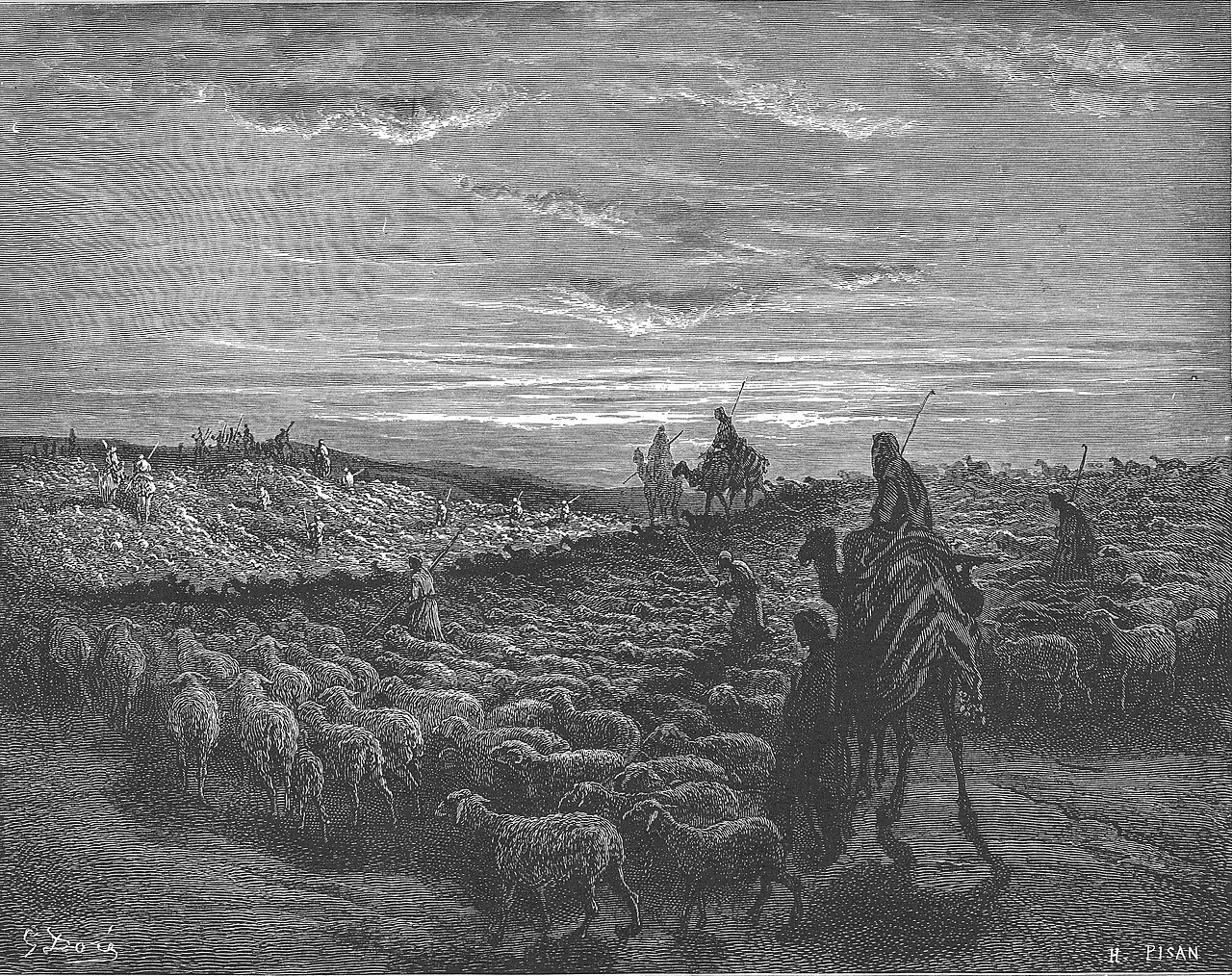
Abram Journeys into Canaan
Abram Lies to Pharaoh
Ramban on Genesis 12:10
Now Abraham went down to Egypt on account of the famine to dwell there in order to keep himself alive in the days of the drought, but the Egyptians oppressed him for no reason [and attempted] to take his wife.
Read it in full at Sefaria · Commentary on the Torah by Ramban (Nachmanides). Translated and annotated by Charles B. Chavel. New York, Shilo Pub. House, 1971-1976
Ramban on Genesis 12:11
BEHOLD NOW, I KNOW, ETC. SAY, I PRAY, THOU ART MY SISTER. I do not know why Abraham was more fearful for her now than before.
Read it in full at Sefaria · Commentary on the Torah by Ramban (Nachmanides). Translated and annotated by Charles B. Chavel. New York, Shilo Pub. House, 1971-1976
Ibn Ezra on Genesis 12:13
[THOU ART MY SISTER.] Achoti (my sister) is penultimately accented. Ordinarily the accent would be placed on the last syllable.
Read it in full at Sefaria · Ibn Ezra's commentary on the Pentateuch, tran. and annot. by H. Norman Strickman and Arthur M. Silver. Menorah Pub., 1988-2004
Hebrew words in this chapter
The 40 most used Hebrew words of the chapter, counted by lemma. The article, the object marker, the negatives and the common prepositions are left out.
| Word | Sense here | Uses | Strong’s |
|---|---|---|---|
| אַבְרָםʼAbrâm | Abram | 12 | H87 |
| אִשָּׁהʼishshâh | woman | 11 | H802 |
| אֶרֶץʼerets | land | 9 | H776 |
| אָמַרʼâmar | to say | 7 | H559 |
| יְהֹוָהYᵉhôvâh | yahweh | 7 | H3068 |
| הָלַךְhâlak | went | 6 | H1980 |
| רָאָהrâʼâh | to see | 6 | H7200 |
| פַּרְעֹהParʻôh | Pharaoh | 6 | H6547 |
| בָרַךְbârak | to bless | 4 | H1288 |
| לָקַחlâqach | to take | 4 | H3947 |
| שָׁםshâm | there | 4 | H8033 |
| בֵּית־אֵלBêyth-ʼÊl | of beth- | 4 | H1008 |
| בַּיִתbayith | and from household of | 3 | H1004 |
| עָשָׂהʻâsâh | to make | 3 | H6213 |
| שָׂרַיSâray | Sarai | 3 | H8297 |
| בּוֹאbôwʼ | and they came | 3 | H935 |
| מִצְרַיִםMitsrayim | Egypt | 3 | H4714 |
| גָּדוֹלgâdôwl | great | 2 | H1419 |
| שֵׁםshêm | name | 2 | H8034 |
| לוֹטLôwṭ | Lot | 2 | H3876 |
| Word | Sense here | Uses | Strong’s |
|---|---|---|---|
| בֵּןbên | son | 2 | H1121 |
| שָׁנֶהshâneh | year | 2 | H8141 |
| יָצָאyâtsâʼ | to come out | 2 | H3318 |
| חָרָןChârân | Haran | 2 | H2771 |
| נֶפֶשׁnephesh | the person | 2 | H5315 |
| כְּנַעַןKᵉnaʻan | Canaan | 2 | H3667 |
| בָּנָהbânâh | and he built | 2 | H1129 |
| מִזְבֵּחַmizbêach | altar | 2 | H4196 |
| קֶדֶםqedem | East | 2 | H6924 |
| קָרָאqârâʼ | to call | 2 | H7121 |
| נָסַעnâçaʻ | and he journeyed | 2 | H5265 |
| רָעָבrâʻâb | famine | 2 | H7458 |
| הִנֵּהhinnêh | here | 2 | H2009 |
| נָאnâʼ | please | 2 | H4994 |
| יָפֶהyâpheh | beautiful | 2 | H3303 |
| מִצְרִיMitsrîy | Egyptian | 2 | H4713 |
| חָיָהchâyâh | to live | 2 | H2421 |
| אָחוֹתʼâchôwth | sister | 2 | H269 |
| יָטַבyâṭab | be good | 2 | H3190 |
| עָבוּרʻâbûwr | for the sake of | 2 | H5668 |
Keep studying
Studies11
Sources for this chapter
The Hebrew text
STEP Bible, the tagged Hebrew text and its English glosses and James Strong, Strong's Exhaustive Concordance.
In Jewish life
Rashi, Rashi on Genesis 12, in Pentateuch with Rashi's commentary by M. Rosenbaum and A. M. Silbermann, 1929 to 1934, public domain; Radak, Radak on Genesis 12:4:1, 12:4:2 and 12:12:1, in HaChut Hameshulash, translated by Eliyahu Munk, CC-BY; Ibn Ezra, his three comments on Genesis 12, cited by reference; the licence Sefaria reports for the English version keeps the text out of the corpus; The Midrash and the Talmud, the forty locators on Genesis 12 in scripts/data/sources/sefaria/genesis/12.json and MannaFest, the annual cycle table at src/lib/hebraic/readings.ts.
The rabbinic texts
Ramban, Commentary on the Torah by Ramban (Nachmanides). Translated and annotated by Charles B. Chavel. New York, Shilo Pub. House, 1971-1976; Ibn Ezra, Ibn Ezra's commentary on the Pentateuch, tran. and annot. by H. Norman Strickman and Arthur M. Silver. Menorah Pub., 1988-2004 and Sefaria, texts and citation data.