
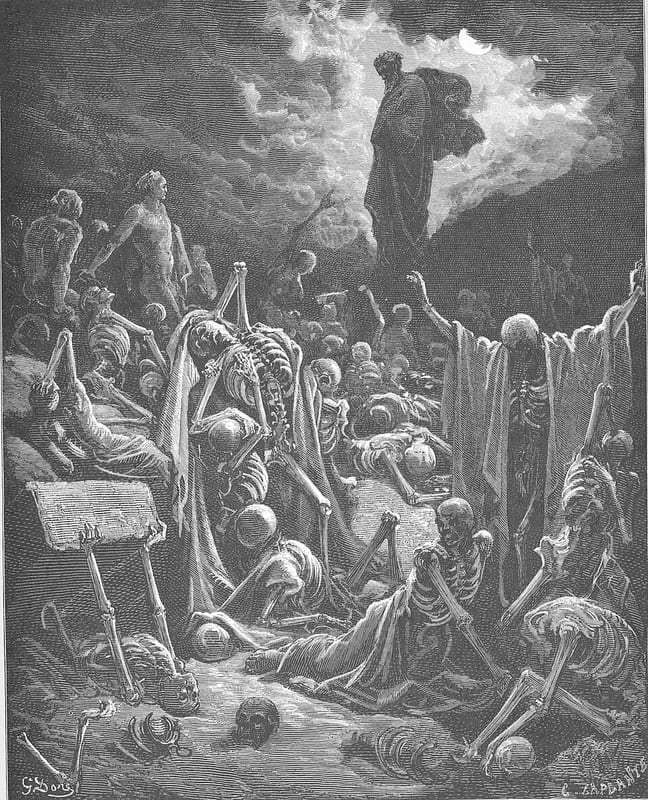
Ezekielchapter 39
29 verses · Ezekiel · 593 to 571 BC · The Prophets
Then I will strike the bow from your left hand and dash down the arrows from your right hand.
Introduction
Ezekiel, The Prophets, Ezekiel Overview.
Ezekiel continues the oracle against Gog for exiles who knew what an unburied battlefield meant. In their law a corpse in the open field made the land unclean, and a country covered in bodies could not live as it should. The chapter turns from the battle to its long aftermath and then to the reason for the whole exile. Listen for how many times God says that the nations and Israel will know Him. Listen also for the promise at the close, which answers the fear that God had left His people for good. The chapter closes the book's oracles of restoration.
Context
- Who
- Exiles who understood exactly what a field full of unburied bodies meant
- What
- The overthrow of Gog, the burning of his weapons and the burial of his army, and God's explanation of the exile and the return.
- Where
- Spoken among the exiles in Babylonia, about the mountains of Israel and the Valley of the Travelers east of the Sea, renamed Hamon-gog.
- When
- Spoken about 585 BC during the exile, as the close of the oracle begun in chapter 38.
- Why
- To show that Israel's captivity came from its own sin, with God's strength never in question, and to promise that He would hide His face from them no more.
Historical context
Burning the weapons for seven years sounds impossible until you remember what ancient weapons were made of. Bows, arrow shafts, spear shafts, clubs and the frames of wicker-and-hide shields were mostly wood. In a country where firewood was scarce and people cooked over dung and thorn scrub, an abandoned army's equipment really would be fuel, and the text says as much: they will not need to gather wood from the field or cut it from the forests.
Show the rest of the historical context, 3 more paragraphs
The seven months of burial is a purity problem, not a tidiness problem. Under the Law, a body in the open field defiled anyone who touched it for seven days, and a hanged man's body had to be buried the same day so the land would not be defiled. A country covered in corpses could not function. So everyone buries, then professional searchers go through the land marking any bone they find with a stake so the buriers can come and remove it. The valley gets a new name, Hamon-Gog, the horde of Gog.
The birds and beasts summoned to eat are the opposite side of the same coin. Being left for scavengers was the standard curse in ancient treaties and inscriptions, the fate reserved for the enemy nobody would honour. Ezekiel turns it into an invitation to a sacrificial feast, which is a deliberately shocking way to put it.
The closing section steps back from the battlefield and explains the whole exile to the watching world. The nations will know that Israel went into captivity for their iniquity, not because God was too weak to protect them. He hid His face from them and gave them into the hand of their enemies; now He brings them back and pours out His Spirit on the house of Israel.
Significance
The exiles' deepest wound was not the loss of the land; it was the suspicion that their God had failed. The last paragraph of this chapter is aimed straight at that, and it uses the word know four times over.
Show the rest of the significance, 1 more paragraph
The promise it lands on is total: I will not hide my face from them any more. For people who had watched the glory leave the temple in chapter ten, that single sentence is the turn the whole book had been moving toward, and the next chapter opens the doors of a house it can come back into.
This chapter in Jewish lifeWhat this chapter is in Jewish life and reading.
What is done
The site's own table in src/lib/hebraic/readings.ts, probed for this lane, printed no weekly portion and no Haftarah from this chapter, and no festival reading for the book. That table carries the Haftarah of each of the fifty-four weekly portions and the books read whole at the feasts, and it carries nothing for the special Sabbaths or the fast days. This card therefore names no public reading of the chapter and leaves that question to a source that holds those readings.
The corpus joins the chapter to the weeks of the Torah portions through the works arranged by portion. Under the eleventh verse it carries Midrash Tanchuma Buber, Noach 21:4 and Midrash Tanchuma, Noach 15:5. Under the seventeenth verse it carries Midrash Tanchuma Buber, Bo 6:1 and Midrash Tanchuma, Bo 4:6.
How it is read
Rashi is the one commentator on this chapter whose English the corpus carries, quoted here from The Judaica Press complete Tanach with Rashi, translated by A. J. Rosenberg, which Sefaria reports as CC-BY. Every quotation of it is held to fifty words or fewer because the translation is modern.
Rashi reads the end of Gog through the honour of God's name. Israel's humbling had profaned it, because the nations said the people of the Lord could not be saved: "Israel’s degradation is a profanation of His Name" (Rashi on Ezekiel 39:7:1). When the nations see the victory, "they will recognize that it was not because of inability that I did not save them" (Rashi on Ezekiel 39:23:1). Israel's iniquity was the cause.
The burial of Gog draws a reason from Genesis. "Since he is of the seed of Japtheth, who covered his father’s nakedness, he therefore merited burial" (Rashi on Ezekiel 39:11:1). The men set apart to search the land are "Men designed to continuously devote themselves to this", passing through it to gather the dead (Rashi on Ezekiel 39:14:1). The feast of the birds on rams, lambs, goats and bulls he reads as a figure: "kings and dukes, rulers, and princes" (Rashi on Ezekiel 39:18:1).
One note reaches for the language of the Mishnah. The word for kindling the weapons he explains from Orlah 3:5, "in the language of the Mishnah" (Rashi on Ezekiel 39:9:1). The judgment of the twenty-first verse is "My retribution" (Rashi on Ezekiel 39:21:1).
The corpus carries thirteen further notes on this chapter without an English text, each of them marked linked because Sefaria holds no English version of the ref. They stand cited and unquoted at Metzudat David on Ezekiel 39:1:1 and 39:24:1 and at Radak on Ezekiel 39:3:1, 39:4:1, 39:5:1, 39:6:1, 39:8:1, 39:10:1, 39:12:1, 39:17:1, 39:19:1, 39:20:1 and 39:22:1.
What the rabbis say
The corpus carries forty rabbinic locators on this chapter and the text of none, so each is cited and linked here rather than quoted. On the first verse it holds Chullin 139b:20 and Midrash Tehillim 150:1. On the second verse it holds Bamidbar Rabbah 13:2, Shir HaShirim Rabbah 4:16:1 and Vayikra Rabbah 9:6. On the sixth verse it holds Midrash Tehillim 11:6 and Otzar Midrashim, Hashkem, Midrash Hashkem ('Arise Early') 22. On the eighth verse it holds Mekhilta DeRabbi Yishmael, Tractate Pischa 12:17 and Yalkut Shimoni on Torah 207:1.
On the tenth verse it holds Shemot Rabbah 31:11. On the eleventh verse it holds Bereshit Rabbah 36:6, Midrash Tanchuma Buber, Noach 21:4 and Midrash Tanchuma, Noach 15:5. It also holds Midrash Yelamdenu, Selections from Yalkut Talmud Torah 47:2 and Yalkut Shimoni on Torah 61:10 there. On the twelfth verse it holds Otzar Midrashim, Midrashim of Rabbi Akiba, The Small Letters and their Purposes 28. On the thirteenth verse it holds Aggadat Bereshit 2:2.
On the fourteenth verse it holds Jerusalem Talmud Nazir 1:1:9. On the fifteenth verse it holds Ein Yaakov (Glick Edition), Eiruvin 5:14, Ein Yaakov (Glick Edition), Moed Katan 1:1 and Ein Yaakov, Eiruvin 5:15. It also holds Ein Yaakov, Moed Katan 1:1, Eruvin 54b:24 and Jerusalem Talmud Maaser Sheni 5:1:6 there. It also holds Jerusalem Talmud Moed Katan 1:2:8, Jerusalem Talmud Shekalim 1:1:14 and Jerusalem Talmud Sotah 9:1:6 there. It also holds Moed Katan 5a:13 there. On the seventeenth verse it holds Bereshit Rabbah 32:8, Midrash Lekach Tov, Deuteronomy 32:42:1 and Midrash Lekach Tov, Exodus 11:9:2. It also holds Midrash Sekhel Tov, Shemot 11:9:7, Midrash Tanchuma Buber, Bo 6:1 and Midrash Tanchuma, Bo 4:6 there. It also holds Midrash Tannaim on Deuteronomy 32:42:2, Pesikta DeRav Kahana 7:11 and Pesikta Rabbati 17:1 there. On the twenty-third verse it holds Midrash Aggadah, Deuteronomy 1:1:10.
On the twenty-ninth verse it holds Eikhah Rabbah 2:8 and Eikhah Rabbah 4:14. What each of them teaches is a saying of the rabbis, and is reported as theirs wherever this site quotes one. The quotations wait on a fetch that carries the text.
Sources: Rashi, Rashi on Ezekiel 39:2:1 to 39:23:1, The Judaica Press complete Tanach with Rashi, translated by A. J. Rosenberg, reported CC-BY; Metzudat David, Metzudat David on Ezekiel 39:1:1 and 39:24:1, cited by ref because the corpus carries no English text; Radak, Radak on Ezekiel 39:3:1, 39:4:1, 39:5:1, 39:6:1, 39:8:1, 39:10:1, 39:12:1, 39:17:1, 39:19:1, 39:20:1 and 39:22:1, cited by ref because the corpus carries no English text; The Sefaria corpus, scripts/data/sources/sefaria/ezekiel/39.json, the 40 Talmud and Midrash locators of this chapter; The site's own files, src/lib/hebraic/readings.ts, probed for this chapter and printing no weekly portion, no Haftarah and no festival reading.
The heads below are this chapter's scenes. The numbered points under each are its verses.
Gog's weapons struck from his hand on the mountains
Ezekiel 39:1-3
I am against you, O Gog: Chapter 39 opens with the summons that opened the oracle before it, prophesy against Gog, so the sentence stands before a single blow falls. Fairbairn notes the book's habit of stating a judgment and then restating it from another angle, as these two chapters do.
Ezekiel 39:1
“Therefore, thou son of man, prophesy against Gog,.... As he had been ordered to do before, and must still continue to do it: behold, I am against thee, O Gog; which is repeated for the confirmation of it, and to inject terror into him; for terrible it is to have God against any: the chief prince of Meshech and Tubal; See Gill on Eze 38:2, the Septuagint version adds "Ros" here as there.”
1 more voice on this verseWhat preachers and commentators have said about this verse, in their own words.
Ezekiel 39:1
“The present chapter describes the defeat of Evil and the triumph of God and His people. As the prophet predicted the advance of Evil under the figure of the invasion of an actual army; so he declares the overthrow of Evil by the figure of a host routed and slain, and the consequent purification of a land, partially overrun and disturbed.”
I will turn you around, drive you along: The Hebrew verb here is rare, and translators have rendered it in several ways. The King James reads leave but the sixth part of thee, and Clarke reports marginal readings of six plagues or a hook of six teeth. The Berean reading fits the hooks of 38:4.
Ezekiel 39:2
“And leave but the sixth part of thee - The margin has, strike thee with six plagues; or, draw thee back with a hook of six teeth.”
Adam Clarke · Commentary on the Bible (1810-1826)evangelical
1 more voice on this verse
Ezekiel 39:2
“And that is it which is here enlarged upon. His soldiers shall be disarmed and so disabled to carry on their enterprise. Though the men of might may find their hands, yet to what purpose, when they find it is put out of their power to do mischief, when God shall smite their bow out of their left hand and their arrow out of their right?”
Matthew Henry · Commentary on the Whole Bible (1707-1721)puritan
strike the bow from your left hand: Adam Clarke notes that the Persians, named in Gog's alliance at 38:5, were famous archers. Bows and arrows are among the weapons Israel burns for fuel in verse 9. Nothing is left for Gog to fight with.
Ezekiel 39:3
“I will smite thy bow out of thy left hand - The Persians whom Antiochus had in his army, Eze 38:5, were famous as archers, and they may be intended here. The bow is held by the left hand; the arrow is pulled and discharged by the right.”
Adam Clarke · Commentary on the Bible (1810-1826)evangelical
Ezekiel 39:4-5
every kind of ravenous bird: To lie as food for every kind of ravenous bird and wild beast is the curse Deuteronomy pronounces on covenant breakers. Here it falls on the invader instead of on Israel. Gill notes a tension: the birds are called, yet Israel buries the dead for seven months from verse 12.
You will fall in the open field: Gog dies in the land he came to plunder. His body lies exposed here, yet verses 11 to 16 describe a burial in a valley of Israel. The field shows the shame of his defeat, and the burial shows the land made clean.
Ezekiel 39:5
“Thou shalt fall upon the open field,.... Some part of his army should fall upon the mountains, and others upon the plain; wherever they will be found, they will be destroyed, either by the sword of the Jews and Christian princes, or by God's judgments from heaven: for I have spoken it, saith the Lord God; and therefore it should surely come to pass, since no word of his ever fails; this is added to assure of the truth of it, since it might be thought incredible that so large an army should be destroyed.”
Ezekiel 39:6-7
fire on Magog: The fire sent on Magog and on those who dwell securely in the coastlands carries the judgment to the wider world Gog stands for. “I will make My holy name known among My people Israel and will no longer allow it to be profaned” answers 36:20-23.
Ezekiel 39:6
“I will send a fire on Magog - On Syria. I will destroy the Syrian troops. And among them that dwell carelessly in the isles - The auxiliary troops that came to Antiochus from the borders of the Euxine Sea. - Martin.”
Adam Clarke · Commentary on the Bible (1810-1826)evangelical
1 more voice on this verse
Ezekiel 39:6
“And I will send a fire on Magog,.... On the land of Magog; see Eze 38:2, while Gog is in the land of Israel, and he and his army perish there, his country shall be destroyed by fire, or by some judgment or judgments of God, which shall consume like fire.”
My holy name: The title the Holy One in Israel stresses God's presence among His people, close to Isaiah's frequent title the Holy One of Israel. Adam Clarke refers the verse to Antiochus, who had profaned the temple and would profane it no more. Clarke reads the scourger as scourged in turn.
Ezekiel 39:7
“In the midst of my people Israel - This defeat of Gog is to be in Israel: and it was there according to this prophecy, that the immense army of Antiochus was so completely defeated. Ands I will not let them pollute my holy name any more - See on 1 Maccabees 1:11, etc., how Antiochus had profaned the temple, insulted Jehovah and his worship, etc. God permitted that as a scourge to his disobedient people; but now the scourger shall be scourged, and he shall pollute the sanctuary no more.”
Adam Clarke · Commentary on the Bible (1810-1826)evangelical
Ezekiel 39:8-10
Yes, it is coming: The Hebrew states the event as done, the prophetic perfect: “it is coming, and it will surely happen”. For seven years Israel burns the invader's weapons for fuel. “They will loot those who looted them and plunder those who plundered them” turns the coalition's purpose back on the takers.
Ezekiel 39:8
“Behold, it is come, and it is done, saith the Lord God,.... That is, the salvation of his people, and the destruction of their enemies; the prophecy concerning all this is come to pass, and the whole is accomplished; thus, because of the certainty thereof, it is represented as if the time was actually come, and the thing was really done; for the event is as sure as if it was now fulfilled: this is the day whereof I have spoken; by the Prophet Ezekiel and others; See Gill on Eze 38:17.”
Seven years of fuel and seven months of burying
For seven years they will use them for fuel: Albert Barnes links the seven years to the seven days of cleansing required after contact with the dead in Numbers 19:11. He calls the clearing of pagan spoils from the land a holy work. The seven months of verse 12 follow the same pattern.
Ezekiel 39:9
“Burn them with fire - Or, “kindle fire with them;” or, as in the margin. The weapons of the army left on the field of battle shall be so numerous as to supply fuel for the people of the land for seven years. Seven was a number connected with cleansing after contact with the dead (Num 19:11 ff), and this purification of the land by the clearance of paganish spoils was a holy work (compare Eze 39:12).”
They will loot those who looted them: The reversal answers Gog's plan in 38:12 to 13, where he came to seize spoil and plunder. The same Hebrew words for spoil and plunder return here with Israel as the subject. Isaiah 33:1 announces a like reversal on the destroyer.
Ezekiel 39:11-13
a burial place in Israel: Gog is given “a burial place in Israel, the Valley of the Travelers, east of the Sea,” renamed Hamon-gog for its buried multitude. Seven months of burying answers the corpse law of Numbers 19 and Deuteronomy 21, where a body left lying makes the land unclean.
Ezekiel 39:11
“The prophet pictures to himself some imaginary valley (compare Zec 14:5) at the “east of the sea,” the Dead Sea, a place frightful in its physical character, and admonitory of past judgments. He calls it “the valley of the passengers” (or, passers-by), because they who there lie buried were but as a passing cloud. In Eze 39:11-15 there is a play upon words - there were “passengers” to be buried, “passengers” to walk over their graves, “passengers” to bury them; (or, a play upon the treble meaning of passing in (invading), passing by, and passing through.)”
2 more voices on this verse
Ezekiel 39:11
“There therefore where the greatest number lay slain shall the burying-place be appointed. In the place where the tree falls there let it lie. And it shall be called, The valley of Hamon-gog, that is, of the multitude of Gog; for that was the thing which was in a particular manner to be had in remembrance.”
Matthew Henry · Commentary on the Whole Bible (1707-1721)puritan
Ezekiel 39:11
“The publicity of the road would cause many to observe God's judgments, as the stench (as English Version translates) or the multitude of graves (as HENDERSON translates, "it shall stop the passengers") would arrest the attention of passers-by.”
Jamieson, Fausset & Brown · Commentary Critical and Explanatory on the Whole Bible (1871)reformed
to cleanse the land: Seven months of burial show how many died and how seriously the land's defilement is taken. Adam Clarke calls the figure partly figurative but notes that Syrian soldiers who hid and died during the pursuit took months to find. Matthew Henry adds that deliverance should lead to reformation.
Ezekiel 39:12
“And seven months - It shall require a long time to bury the dead. This is another figurative expression; which, however, may admit of a good deal of literal meaning. Many of the Syrian soldiers had secreted themselves in different places during the pursuit after the battle, where they died of their wounds, of hunger, and of fatigue; so that they were not all found and buried till seven months after the defeat of the Syrian army.”
Adam Clarke · Commentary on the Bible (1810-1826)evangelical
1 more voice on this verse
Ezekiel 39:12
“This is an intimation that times of eminent deliverances should be times of reformation. The more God has done for the saving of a land from ruin the more the inhabitants should do for the cleansing of the land from sin.”
Matthew Henry · Commentary on the Whole Bible (1707-1721)puritan
it will bring them renown: The burial becomes Israel's renown on the day God displays His glory. Matthew Henry links this to Matthew 5:16, where good works lead others to glorify the Father, and he concludes God's glory is His people's honor. All the people share in the work.
Ezekiel 39:13
“Note, It is for the glory of God when his Israel do that which adorns their profession; others will see their good works and glorify their Father, Matt. v. 16 . And when God is honoured he will put honour upon his people. His glory is their renown.”
Matthew Henry · Commentary on the Whole Bible (1707-1721)puritan
Ezekiel 39:14-16
men will be employed: After the seven months, men employed to pass through the land search for any exposed bone and set a pillar beside it for the gravediggers. A city takes the multitude's name, Hamonah. The older commentators set this search beside the exact measuring of the sanctuary in the chapters ahead.
Ezekiel 39:14
“Men of continual employment - literally, as margin, i. e., men regularly appointed to this business. As the land of Israel represents figuratively the Church of Christ, the purification of that land is a proper part of the figure to indicate such a sanctification and cleansing of His Church, as Paul describes Eph 5:26-27.”
will set up a pillar next to it: The marker warns passersby so that no one touches the bone and becomes unclean, the concern of Numbers 19:16. Travelers and gravediggers work together. Later Jewish practice whitewashed tombs for the same reason, the custom behind Matthew 23:27.
the city will be named Hamonah.): Hamonah means multitude, the same word that names the Valley of Hamon-gog. Jamieson, Fausset and Brown report two views: Henderson takes it as a nearby town named to recall the defeat. Grotius takes it as a new name for Jerusalem.
Ezekiel 39:16
“A city in the neighborhood was to receive the name Hamonah, "multitude," to commemorate the overthrow of the multitudes of the foe [HENDERSON]. The multitude of the slain shall give a name to the city of Jerusalem after the land shall have been cleansed [GROTIUS].”
Jamieson, Fausset & Brown · Commentary Critical and Explanatory on the Whole Bible (1871)reformed
A sacrifice spread for the birds and the beasts
Ezekiel 39:17-20
every kind of bird: God calls “every kind of bird” and “every beast of the field” to a sacrificial feast on the mountains of Israel. Revelation 19:17-18 takes up the same summons to the birds. At God's table the “horses and riders” and the “mighty men and warriors of every kind” become the meal.
Ezekiel 39:17
“The city - That is, the multitude: the city which is next to this common tomb of Gog. I do sacrifice - The punishment of these God calls a sacrifice, which he offers to his own justice. Upon the mountains - Where more thousands are offered at once, than ever were at any time offered; 'tis a sacrifice so great, that none ever was, or will be like it.”
John Wesley · Explanatory Notes upon the Old Testament (1765)evangelical
1 more voice on this verse
Ezekiel 39:17
“The purposes of the past dispensation shall be made clear to God’s people themselves and to the pagan. His judgments were the consequence of their sins; and these sins once abandoned, the favor of their God will return in yet more abundance. Eze 39:29 Compare Act 2:17. Peter distinctly appropriates these prophecies (marginal references) to the outpouring of the Holy Spirit on the day of Pentecost, and the inauguration of the Church of Christ by that miraculous event. This was the beginning of the fulfillment. They shall find their consummation when time shall be no more.”
the flesh of the mighty: The animals are the choice sacrificial beasts, and Bashan east of the Jordan was known for fat cattle, as Amos 4:1 and Psalm 22:12 assume. Adam Clarke explains that the birds and beasts eat as guests at such a sacrificial feast. Matthew Henry notes the humbling of royal blood.
Ezekiel 39:18
“Ye shall - drink the blood of the princes of the earth - I need not mention the custom of the Scandinavians: they were accustomed to drink the blood of their enemies out of the skulls of the dead. But this is spoken of fowls and beasts here - rams, lambs, and goats. The feast shall be as grateful and as plenteous to the fowls and beasts, as one made of the above animals, the fattest and best of their kind, (because fed in the fertile fields of Bashan), would be to the guests of him who makes a sacrifice.”
Adam Clarke · Commentary on the Bible (1810-1826)evangelical
1 more voice on this verse
Ezekiel 39:18
“What a mortification is this to the princes of the blood, as they call themselves, that God can make that blood, that royal blood, which swells their veins, a feast for the birds and beasts of prey! (3.) It is the flesh and blood of wicked men, the enemies of God's church and people, that they are invited to.”
Matthew Henry · Commentary on the Whole Bible (1707-1721)puritan
At the sacrifice I am preparing: The law forbade Israel to eat fat or blood in Leviticus 3:17, so the invitation belongs to the birds and beasts alone. Adam Clarke answers Voltaire's charge that the Jews are invited to eat human flesh and calls it a plain falsehood. The guests are the scavengers of verse 17.
Ezekiel 39:19
“And ye shall eat fat - and drink blood - Who shall eat and drink, etc.? Not the Jews: though Voltaire says they ate human flesh, and are invited here by the prophet to eat the flesh and drink the blood of their enemies; which is a most unprincipled falsehood.”
Adam Clarke · Commentary on the Bible (1810-1826)evangelical
at My table: My table echoes the language of priestly service, since Ezekiel 44:16 calls the altar God's table. Here the table serves scavengers, and the offering is the fallen army. Horses and riders recall Pharaoh's army in Exodus 15:1.
Ezekiel 39:21-24
display My glory among the nations: “I will display My glory among the nations” states the purpose behind the whole episode. Israel went into exile “for their iniquity, because they were unfaithful to Me”. “I dealt with them according to their uncleanness and transgressions” keeps the responsibility where chapter 18 placed it, on the sinner.
From that day forward: The phrase marks a turning point, after which Israel's knowledge of God is settled. Matthew Henry notes the events silence Israel's doubts about whether the LORD was with them, and exclude boasting in themselves while securing boasting in God. The chapter then explains the exile.
Ezekiel 39:22
“They had sometimes been ready to question whether the Lord was with them or no; but the events of this day shall silence their doubts, and, the matter being thus settled and made clear, it shall not be doubted of for the future. As boasting in themselves is hereby for ever excluded, so boasting in God is hereby for ever secured. Mercy Promised to Israel.”
Matthew Henry · Commentary on the Whole Bible (1707-1721)puritan
because they were unfaithful to Me: The nations had misread the exile, as 36:20 reports. The Gog defeat shows them that the LORD sent Israel away Himself for its unfaithfulness. Matthew Henry observes that God punishes sin even in His own people, since justice is praised for its impartiality, and he cites Amos 3.
Ezekiel 39:23
“And it will appear much for the glory of God when the world is made to know, 1. That God punishes sin even in his own people, because he hates it most in those that are nearest and dearest to him, Amos iii. It is the praise of justice to be impartial.”
Matthew Henry · Commentary on the Whole Bible (1707-1721)puritan
I hid My face from them: Hiding the face is the threat of Deuteronomy 31:17 to 18, where God warns He will hide His face when Israel turns to other gods. Matthew Henry notes that God punishes sin most in those nearest to Him. Verse 29 promises He will hide it no longer.
Israel brought home and the Spirit poured out
Ezekiel 39:25-29
I will restore Jacob from captivity: “Now I will restore Jacob from captivity and will have compassion on the whole house of Israel,” the people chapter 37 promised to raise. “I will pour out My Spirit on the house of Israel” closes the restoration language on the note Joel sounds and Acts 2 cites.
Ezekiel 39:25
“Now God will have mercy upon the whole house of Israel, (1.) Because it is time for him to stand up for his own glory, which suffers in their sufferings: Now will I be jealous for my holy name, that that may no longer be reproached. (2.) Because now they repent of their sins: They have borne their shame, and all their trespasses.”
Matthew Henry · Commentary on the Whole Bible (1707-1721)puritan
1 more voice on this verse
Ezekiel 39:25
“Now will I bring again the captivity of Jacob - Both they and the heathen shall know that it was for their iniquity that I gave them into the hands of their enemies: and now I will redeem them from those hands in such a way as to prove that I am a merciful God, as well as a just God.”
Adam Clarke · Commentary on the Bible (1810-1826)evangelical
They will forget their disgrace: The Hebrew consonants can be read as they will bear or they will forget. The King James reads after that they have borne their shame, which Clarke explains as punishment for idolatry, while the Berean follows the reading forget. Either way, the shame belongs to the past.
Ezekiel 39:26
“After that they have borne their shame - After they shall have borne the punishment due to a line of conduct which is their shame and reproach, viz. idolatry.”
Adam Clarke · Commentary on the Bible (1810-1826)evangelical
I will show My holiness in them: The regathering reverses the exile's damage to God's name. Matthew Henry notes that as God was reproached in Israel's captivity, He is honored in their reformation and restoration as a holy and happy people. The verse repeats 36:23 and 38:16, where God shows Himself holy before the nations.
Ezekiel 39:27
“As God was reproached in the reproach they were under during their captivity, so he will be sanctified in their reformation and the making of them a holy people again, and will be glorified in their restoration and the making of them a happy glorious people again.”
Matthew Henry · Commentary on the Whole Bible (1707-1721)puritan
not leaving any of them behind: After the return from Babylon many Jews stayed in the east, as Adam Clarke observes, since all had liberty to return but many remained. He therefore refers this promise to a greater restoration in the gospel age. Verse 29 ties that gathering to the Spirit.
Ezekiel 39:28
“And have left none of then any more there - All that chose had liberty to return; but many remained behind. This promise may therefore refer to a greater restoration, when not a Jew shall be left behind. This, the next verse intimates, will be in the Gospel dispensation.”
Adam Clarke · Commentary on the Bible (1810-1826)evangelical
I will pour out My Spirit on the house of Israel: The promise joins Ezekiel 36:27 and 37:14 and is close to Joel 2:28, which Peter cites at Pentecost in Acts 2:17. Matthew Henry calls the indwelling Spirit a sure pledge that God's favor will continue. Adam Clarke says the Spirit will enlighten and cleanse their hearts.
Ezekiel 39:29
“And then, [2.] He will never hide his face any more from them, will never suspend his favour as he had done; he will never turn from doing them good, and, in order to that, he will effectually provide that they shall never turn from doing him service. Note, The indwelling of the Spirit is an infallible pledge of the continuance of God's favour.”
Matthew Henry · Commentary on the Whole Bible (1707-1721)puritan
1 more voice on this verse
Ezekiel 39:29
“For I have poured out my Spirit - That is, I will pour out my Spirit; see the notes on Eze 36:25-29 (note), where this subject is largely considered. This Spirit is to enlighten, quicken, purify, and cleanse their hearts; so that, being completely changed, they shall become God’s people, and be a praise in the earth. Now, they are a proverb of reproach; then, they shall be eminently distinguished.”
Adam Clarke · Commentary on the Bible (1810-1826)evangelical
Keep studying
Sources for this chapter
The summary
Jamieson, Fausset & Brown, Commentary Critical and Explanatory; John Wesley, Notes on the Old Testament and Matthew Henry, Complete Commentary.
The exposition
Adam Clarke, Commentary on the Bible; Albert Barnes, Notes, Explanatory and Practical, on the Old and New Testaments (1832-1869); Carl Friedrich Keil, Biblical Commentary on the Prophecies of Ezekiel; Jamieson, Fausset & Brown, Commentary Critical and Explanatory on the Whole Bible; John Gill, Exposition of the Old Testament; Matthew Henry, Commentary on the Whole Bible and Patrick Fairbairn, An Exposition of Ezekiel.