
Exoduschapter 7
25 verses · Moses, by tradition · 15th or 13th century BC · The Law
In Jewish life
The reading
Weekly portion 14 of 54
וָאֵרָא Va'era, Exodus 6:2 to 9:35
Read with it: Ezekiel 28:25 to 29:21.
The verse numbers here are the ones a Hebrew Bible carries, which differ from an English Bible by a verse or two in several places. The Sephardi reading is named only where this site records a difference; communities vary beyond what is listed. What these books are, and how a Christian reader meets them →
How it is read
Rashi meets the hardening of Pharaoh's heart at verse 3 and answers it directly. Pharaoh has resisted, he says, so it is better that his heart be hardened "in order that My signs may be multiplied against him". He then points to a distinction the text itself keeps. Through the first five plagues Scripture says that Pharaoh's heart was hardened, rather than that the LORD hardened it (Rashi on Exodus 7:3:1). That reading of the first five is worth setting beside this site's own entry on the question, which carries the positions with their holders. At verse 17 Rashi gives the reason the water was struck first. Egypt had no rain and lived by the river, so "God first smote their deity and afterwards smote them" (Rashi on Exodus 7:17:1). At verse 19 he holds that Aaron struck the river and Moses did not, because the river had sheltered Moses as a child (Rashi on Exodus 7:19:1). At verse 25 he reckons each plague at a quarter of a month, with warning given through the other three quarters (Rashi on Exodus 7:25:1). The text is the Rosenbaum and Silbermann Rashi of 1929 to 1934, in the public domain.
What the rabbis say
The rabbis take up the making of Moses as a god to Pharaoh at Bamidbar Rabbah 14:6 and 15:13. On the staff cast down before Pharaoh they taught at Menachot 85a:3 and Midrash Aggadah, Exodus 7:10:1. On the staff that swallowed the others they taught at Ein Yaakov (Glick Edition), Shabbat 11:2. On the hardening they taught in Midrash Lekach Tov, Exodus 7:3:1.
The text, verse by verse
Each word shows the Hebrew, the English under it, how it sounds and its Strong’s number. A rule between verses marks where the Hebrew manuscripts end a paragraph.
Made as God to Pharaoh
Ibn Ezra on Exodus 7:1
I. AND THE LORD SAID. This was in response to, how then shall Pharaoh hear me, who am of uncircumcised lips (Ex.:12).
Read it in full at Sefaria · Ibn Ezra's commentary on the Pentateuch, tran. and annot. by H. Norman Strickman and Arthur M. Silver. Menorah Pub., 1988-2004
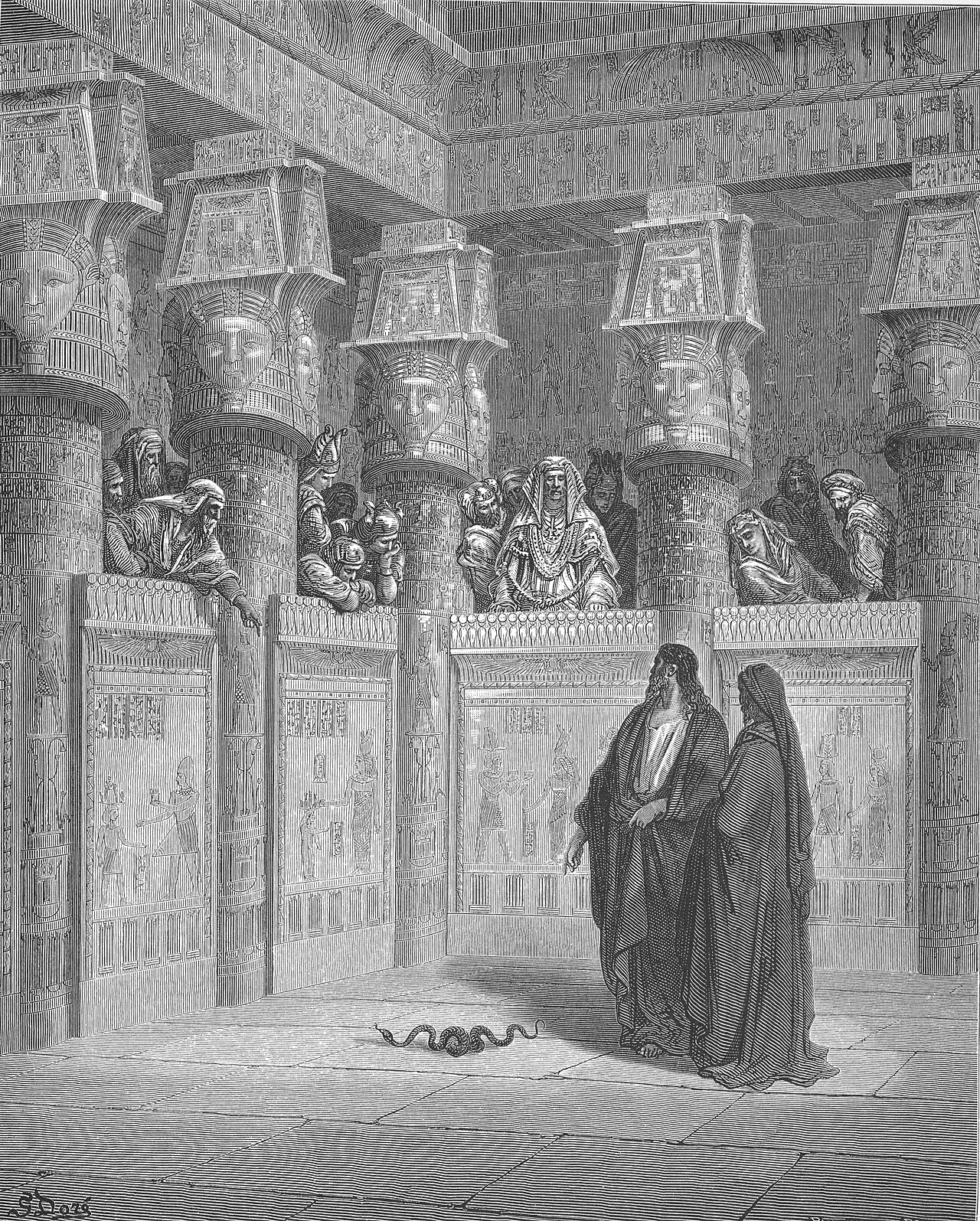
The Rod That Swallowed the Serpents
Ibn Ezra on Exodus 7:10
This too, namely, that the rod became a tannin (serpent), was a wonder.
Read it in full at Sefaria · Ibn Ezra's commentary on the Pentateuch, tran. and annot. by H. Norman Strickman and Arthur M. Silver. Menorah Pub., 1988-2004
Onkelos Exodus 7:10
Moshe and Aharon came to Pharaoh and they did exactly as Adonoy commanded [them].
Read it in full at Sefaria · Metsudah Chumash, Metsudah Publications, 2009 [with Onkelos translation]
Ramban on Exodus 7:11
AND THEY ALSO, THE MAGICIANS OF EGYPT, DID IN LIKE MANNER ‘B’LAHATEIHEM’ (WITH THEIR SECRET ARTS). Our Rabbis have said. Sanhedrin 67b.
Read it in full at Sefaria · Commentary on the Torah by Ramban (Nachmanides). Translated and annotated by Charles B. Chavel. New York, Shilo Pub. House, 1971-1976
Ibn Ezra on Exodus 7:12
This, the swallowing of the magicians’ rods by Aaron’s staff and their consequent disappearance, 58 The magicians’ rods disappeared permanently. was a second wonder.
Read it in full at Sefaria · Ibn Ezra's commentary on the Pentateuch, tran. and annot. by H. Norman Strickman and Arthur M. Silver. Menorah Pub., 1988-2004
Ibn Ezra on Exodus 7:13
By itself. 62 God did not harden Pharaoh’s heart. Pharaoh hardened it himself.
Read it in full at Sefaria · Ibn Ezra's commentary on the Pentateuch, tran. and annot. by H. Norman Strickman and Arthur M. Silver. Menorah Pub., 1988-2004
The Nile Turned to Blood
Ibn Ezra on Exodus 7:14
AND THE LORD SAID…PHARAOH’S HEART IS STUBBORN. Kaved (is stubborn) is a verb in the perfect.
Read it in full at Sefaria · Ibn Ezra's commentary on the Pentateuch, tran. and annot. by H. Norman Strickman and Arthur M. Silver. Menorah Pub., 1988-2004
Hebrew words in this chapter
The 40 most used Hebrew words of the chapter, counted by lemma. The article, the object marker, the negatives and the common prepositions are left out.
| Word | Sense here | Uses | Strong’s |
|---|---|---|---|
| פַּרְעֹהParʻôh | Pharaoh | 16 | H6547 |
| יְהֹוָהYᵉhôvâh | yahweh | 14 | H3068 |
| יְאֹרyᵉʼôr | the river | 14 | H2975 |
| אָמַרʼâmar | to say | 11 | H559 |
| אַהֲרוֹןʼAhărôwn | Aaron | 11 | H175 |
| מַיִםmayim | water | 10 | H4325 |
| מִצְרַיִםMitsrayim | Egypt | 9 | H4714 |
| מַטֶּהmaṭṭeh | staff your | 9 | H4294 |
| מֹשֶׁהMôsheh | Moses | 8 | H4872 |
| דָבַרdâbar | to speak | 6 | H1696 |
| עָשָׂהʻâsâh | and he did | 6 | H6213 |
| בֵּןbên | son | 5 | H1121 |
| אֶרֶץʼerets | land | 5 | H776 |
| לֵבlêb | heart | 5 | H3820 |
| יָדyâd | hand | 5 | H3027 |
| דָּםdâm | blood | 5 | H1818 |
| צָוָהtsâvâh | to command | 4 | H6680 |
| שָׁלַחshâlach | and he will let go | 4 | H7971 |
| שָׁמַעshâmaʻ | he will listen | 4 | H8085 |
| מִצְרִיMitsrîy | egypt | 4 | H4713 |
| Word | Sense here | Uses | Strong’s |
|---|---|---|---|
| שָׁתָהshâthâh | to drink | 4 | H8354 |
| נָתַןnâthan | to give | 3 | H5414 |
| יִשְׂרָאֵלYisrâʼêl | Israel | 3 | H3478 |
| יָצָאyâtsâʼ | to come out | 3 | H3318 |
| עַםʻam | people | 3 | H5971 |
| לָקַחlâqach | to take | 3 | H3947 |
| שָׁלַךְshâlak | to throw | 3 | H7993 |
| תַּנִּיןtannîyn | a serpent | 3 | H8577 |
| הִנֵּהhinnêh | there | 3 | H2009 |
| הָפַךְhâphak | it was changed | 3 | H2015 |
| נָכָהnâkâh | about to strike | 3 | H5221 |
| אֱלֹהִיםʼĕlôhîym | God | 2 | H430 |
| אָחʼâch | brother | 2 | H251 |
| מוֹפֵתmôwphêth | wonder | 2 | H4159 |
| יָדַעyâdaʻ | to know | 2 | H3045 |
| נָטָהnâṭâh | to stretch | 2 | H5186 |
| שְׁמֹנִיםshᵉmônîym | eighty | 2 | H8084 |
| שָׁנֶהshâneh | year | 2 | H8141 |
| בּוֹאbôwʼ | and he went | 2 | H935 |
| עֶבֶדʻebed | servants his | 2 | H5650 |
Keep studying
Sources for this chapter
The Hebrew text
STEP Bible, the tagged Hebrew text and its English glosses and James Strong, Strong's Exhaustive Concordance.
In Jewish life
Rashi, Rashi on Exodus 7:3:1, 7:17:1, 7:19:1 and 7:25:1, Pentateuch with Rashi's commentary by M. Rosenbaum and A. M. Silbermann, 1929 to 1934 (public domain); Ibn Ezra, Ibn Ezra on Exodus 7:13:1 and 7:20:1, cited by ref alone under the corpus licence rule; The Babylonian Talmud, Menachot 85a:3, cited by ref and The Midrash, Bamidbar Rabbah 14:6 and 15:13, Midrash Aggadah, Exodus 7:10:1, Ein Yaakov (Glick Edition), Shabbat 11:2, and Midrash Lekach Tov, Exodus 7:3:1, cited by ref.
The rabbinic texts
Ramban, Commentary on the Torah by Ramban (Nachmanides). Translated and annotated by Charles B. Chavel. New York, Shilo Pub. House, 1971-1976; Ibn Ezra, Ibn Ezra's commentary on the Pentateuch, tran. and annot. by H. Norman Strickman and Arthur M. Silver. Menorah Pub., 1988-2004; Targum, Metsudah Chumash, Metsudah Publications, 2009 [with Onkelos translation] and Sefaria, texts and citation data.